Faint source star planetary microlensing: the discovery of the cold
gas giant planet OGLE-2014-BLG-0676Lb
N. J. Rattenbury,
1,A?D. P. Bennett,
2,AT. Sumi,
3,AN. Koshimoto,
3,AI. A. Bond,
4,AA. Udalski,
5,BY. Shvartzvald,
6,CD. Maoz,
7,CU. G. Jørgensen,
8,DM. Dominik,
9,D,ER. A. Street,
10,EY. Tsapras,
10,11,EF. Abe,
12,AY. Asakura,
12,AR. Barry,
13,AA. Bhattacharya,
2,AM. Donachie,
1,AP. Evans,
1,AM. Freeman,
14,AA. Fukui,
15,AY. Hirao,
3,AY. Itow,
12,AM. C. A. Li,
1,AC. H. Ling,
4,AK. Masuda,
12,AY. Matsubara,
12,AY. Muraki,
12,AM. Nagakane,
3,AK. Ohnishi,
16,AH. Oyokawa,
12,ATo. Saito,
17,AA. Sharan,
1,AD. J. Sullivan,
18,AD. Suzuki,
2,AP. J. Tristram,
19,AA. Yonehara,
20,AR. Poleski,
5,21,BJ. Skowron,
5,BP. Mr´oz,
5,BM. K. Szyma´nski,
5,BI. Soszy´nski,
5,BP.
Pietrukowicz,
5,BS.
Kozłowski,
5,BK.
Ulaczyk,
5,22,BŁ.
Wyrzykowski,
5,BM. Friedmann,
7,CS. Kaspi,
7,CK. Alsubai,
23,DP. Browne,
9,DJ. M. Andersen,
24,DV. Bozza,
25,26,DS. Calchi Novati,
27,25,DY. Damerdji,
28,DC. Diehl,
11,DS. Dreizler,
29,DA. Elyiv,
28,DE. Giannini,
11,DS. Hardis,
8,DK. Harpsøe,
8,DT. C. Hinse,
30,DC. Liebig,
9,DM. Hundertmark,
11,D,ED. Juncher,
8,DN. Kains,
31,32,D,EE. Kerins,
33,DH. Korhonen,
8,DL. Mancini,
34,DR. Martin,
35,DM. Mathiasen,
8,DM. Rabus,
36,34,DS. Rahvar,
37G. Scarpetta,
25,26,38,DJ. Skottfelt,
8,DC. Snodgrass,
39,D,EJ. Surdej,
28,DJ. Taylor,
40,DJ. Tregloan-Reed,
40,DC. Vilela,
40,DJ. Wambsganss,
11,D,EA. Williams,
35,DG. D’Ago,
25,38,D,EE. Bachelet,
10,ED. M. Bramich,
23,ER. Figuera Jaimes,
31,EK. Horne,
9,EJ. Menzies,
41,ER. Schmidt
11,Eand I. A. Steele
42,EAffiliations appear at the end of the paper
Accepted ... Received ...; in original form ...
ABSTRACT
We report the discovery of a planet — OGLE-2014-BLG-0676Lb— via gravitational mi-crolensing. Observations for the lensing event were made by the MOA, OGLE, Wise, RoboNET/LCOGT, MiNDSTEp andµFUN groups. All analyses of the light curve data favour a lens system comprising a planetary mass orbiting a host star. The most favoured binary lens model has a mass ratio between the two lens masses of (4.78±0.13)×10−3. Subject to some important assumptions, a Bayesian probability density analysis suggests the lens system com-prises a 3.09+1.02
−1.12MJplanet orbiting a 0.62+ 0.20
−0.22Mhost star at a deprojected orbital separation of 4.40+2.16
−1.46AU. The distance to the lens system is 2.22+ 0.96
−0.83kpc. Planet OGLE-2014-BLG-0676Lb provides additional data to the growing number of cool planets discovered using gravitational microlensing against which planetary formation theories may be tested. Most of the light in the baseline of this event is expected to come from the lens and thus high-resolution imaging observations could confirm our planetary model interpretation.
Key words: gravitational lensing: micro – planets and satellites: detection – stars: individual
? E-mail:[email protected]
MNRAS Advance Access published December 9, 2016
at University of St Andrews on December 19, 2016
http://mnras.oxfordjournals.org/
1 INTRODUCTION
To date, 47 planets in 45 planetary systems have been discovered by microlensing1. Discovering planets via microlensing (Mao and Paczynski 1991) offers a number of advantages over either the tran-sit (Borucki et al. 2011) or radial velocity (Marcy et al. 2005) meth-ods. Principal among these is the fact that gravitational microlens-ing is most sensitive to planets orbitmicrolens-ing at a few AU away from typ-ical host stars, which is of particular interest to planetary formation theorists. This is because these orbital radii correspond to the lo-cation of the “snow-line”— the radius around a star beyond which both volatile and refractory material is present in a protoplanetary disk and according to the core-accretion theory of planetary for-mation, just beyond the snow line is where the most active planet formation occurs (Ida and Lin 2005). Understanding the distribu-tion of planets in this region is therefore of particular importance.
The probability that any given star is magnified by a fore-ground lens object is very small — around 10−6(Sumi et al. 2013). For this reason, microlensing survey observations are carried out towards the dense stellar fields of the Galactic bulge and the Mag-ellanic Clouds. The concomitant challenges of analysing crowded stellar field images, providing real-time analysis of light curve data and the timely notification of colleagues at instruments spaced in longitude regarding ongoing events have been tackled by the ground-based microlensing community over the last two decades. See Gaudi (2012) for a review.
Having demonstrated its worth as a planet-detection method, planet-hunters are now using space telescopes to obtain follow-up observations of gravitational microlensing events detected from ground-based surveys. This is a step towards the fully spaced-based observations proposed some time ago (Bennett and Rhie 2002; Rat-tenbury et al. 2002) and which now is being realised withSpitzer
observations of microlensing events (see e.g. Poleski et al. (2016); Bozza et al. (2016); Yee et al. (2015)). Furthermore, microlensing events are being monitored in Campaign 9 of theK2space tele-scope mission during the present 2016 microlensing season (Hen-derson et al. 2015; Penny et al. 2016), and there is great anticipation regarding the performance of microlensing as part of either or both of theEuclidandWFIRSTspace telescope missions (Beaulieu et al. 2013; Spergel et al. 2015; Yee et al. 2014).
For now, the work of the microlensing community remains — in part — to continue to report each planetary microlensing discov-ery, in order to power the statistical analyses that are informing us on the planet demographics of the Galaxy (Shvartzvald et al. 2016b; Sumi et al. 2011; Cassan et al. 2012; Gould et al. 2010), and which may challenge the present understanding of how planetary systems form.
Several ground-based observation programmes routinely monitor dense stellar fields to search for microlensing events. The Microlensing Observations in Astrophysics collaboration (MOA, Bond et al. (2001), Sumi et al. (2003)), the Optical Gravitational Lensing Experiment (OGLE, Udalski et al. (2015)) and the Korea Microlensing Network (KMTNet, Kim et al. (2016)) are continuing their microlensing survey operations. More details on these collab-orations are given in Rattenbury et al. (2015).
The Wise Observatory Group operates a 1 metre telescope at Wise Observatory in Israel. This instrument comprises the Large Area Imager for the Wise Observatory (LAIWO) camera which has a 1 square degree field of view. At the time of event
OGLE-2014-1 exoplanet.eu
BLG-0676/MOA-2014-BLG-175, the Wise Observatory was con-ducting a survey for microlensing events (Shvartzvald et al. 2016b). The survey collaborations issue alerts to the broader commu-nity when each new microlensing event is discovered. Particular attention is drawn to those events showing evidence for perturba-tions which could be owing to a planet, or which are predicted to have a high sensitivity to such perturbations. Confirmatory and sup-porting observations are sought and made by follow-up observa-tion groups such asµ-FUN (Gould et al. 2010), PLANET (Albrow et al. 1998), RoboNet (Tsapras et al. 2009) and MiNDSTEp (Do-minik et al. 2010). Preliminary models explaining the data in hand are computed by human and artificial experts alike (see e.g. Bozza (2010); Bozza et al. (2012)2) to inform any further commitment of follow-up resources.
This work reports the discovery of planet OGLE-2014-BLG-0676Lb via gravitational microlensing, using survey and follow-up data. In Sections 2 and 3 we describe the data and their treatment, respectively. We describe our modelling of the observed light curve data in Section 4. An analysis of the microlensed source star is given in Section 5 and the planet parameters estimated from a prob-ability density analysis are presented in Section 6. We discuss and conclude our work in Section 7.
2 OBSERVATIONS
Microlensing event OGLE-2014-BLG-0676 was discovered by the OGLE collaboration on 26 April 2014 at 21:19 UTC. The MOA collaboration discovered the same event 2.7519 days later, desig-nating the event MOA-2014-BLG-175. The OGLE coordinates of this event are (RA, Dec; J2000.0)=(17h52m24s.50,−30◦
32m54s.20); (l,b)=(359.376073◦,
−2.092892◦ ).
The OGLE light curve for this event comprises 4115 data points in the I band. The MOA light curve comprises 24659 data points, taken in the custom MOA-red filter, which has a passband corresponding to the sum of the standard R and I filters. 468 I band observations were obtained with the Wise telescope. In ad-dition to these survey data sets, further observations were made by the RoboNET collaboration using the Las Cumbres Observatory Global Telescope (LCGOT, Brown et al. (2013)), and the Danish 1.54 metre telescope at ESO La Silla, Chile as part of the MiND-STEp microlensing follow-up programme (Dominik et al. 2010). 7, 2 and 13 observations of the event in the SDSS-i passband were made using the 1 metre LCOGT telescopes at their SAAO, Sid-ing SprSid-ings and CTIO observatories, respectively. 16 observations were made with the Danish 1.54 metre telescope.
3 DATA REDUCTION
The OGLE data for this event were generated from image data via the OGLE difference imaging pipeline (Udalski 2003). The images obtained by the MOA telescope were reduced by the difference imagine pipeline of Bond et al. (2001). When performing difference imaging on a crowded stellar field, the photometry of a star can be affected by a neighbouring star of a different colour, owing to the differential refraction effect of Earth’s atmosphere. The MOA light curve data were corrected for differential refraction. The OGLE and Wise data did not require this correction. The Wise data were
2 www.fisica.unisa.it/GravitationAstrophysics/RTModel/. . .
. . . 2016/RTModel.htm
at University of St Andrews on December 19, 2016
http://mnras.oxfordjournals.org/
Table 1.Final data sets used for modelling planetary microlensing event OGLE-2014-BLG-0676/MOA-2014-BLG-175.
Group Band N
OGLE I 2530
MOA MOA-Red 9185
Wise I 444
LCOGT SDSS-i 22
MiNDSTEp R 16
reduced using the pySis DIA software (Albrow et al. 2009). The RoboNET data were reduced using DanDIA and the MiNDSTEp data were reduced using a modified version of DanDIA for use with EMCCDs (Bramich 2008; Bramich et al. 2013). The MiNDSTEp instrumental R-band light curve data were converted to I-band mag-nitudes using a photometric calibration between the MiNDSTEp and OGLE photometry scales (M. Hundertmark, private communi-cation). Theµ-FUN collaboration took a few observations in the I and H bands, however these data were not obtained with a view to constraining the parameters of a binary light curve model and are therefore not included here. The MOA collaboration did not obtain any V-band images of this event. While the OGLE collaboration did take some V-band images of the event field, the source star does not appear on their reference images, thus no measurement of the magnified source is possible.
The MOA and OGLE survey datasets were trimmed to include only data from the 2013 — 2015 microlensing seasons for the pur-pose of finding candidate models to explain the data. This trimming was done to avoid any problems arising from any long timescale systematic errors in the event’s baseline photometry, caused, for ex-ample, by flat-fielding inconsistencies over the timescales of years. The binary nature of the lens system is seen in the light curve data at times JD0 =
JD−2450000 ∈ [6775,6779] days. Any data points outside this time interval which provide a contribution to
χ2>16 with respect to a preliminary well-fitting binary lens model were discarded. Errors on the light curve data were rescaled to give
χ2/dof=1. The final data sets used for modelling are summarised in Table 1.
4 BINARY LENS MODELLING
The parameters for the simplest binary lens model assuming a finte-sized source star are the mass ratio,q=Mp/ML; the separation,s, of the two mass elements in the binary lens system; the angleα that the path of the source star subtends with respect to the line defined by the two mass elements in the binary lens; the impact parameteru0; the time intervaltEwhich the source takes to traverse the Einstein radius; the epocht0 which corresponds to when the source is at positionu0; and the source star radiusρ≡ θ?/θE.θ?
and θE are the angular sizes of the source star and Einstein ring radius respectively.u0is measured in units ofθEfrom the centre of mass of the lens system,sis measured in units of the Einstein ring radius andMpandMLare planet and host lens masses respectively. Initial binary lens models were found by performing a wide grid search over the parametersq,sandα, allowing the parameters
u0,t0,tEandρto vary. Starting from several good candidate binary lens solutions found in the grid search, we refined these models using an adaptation of the image-centred ray-shooting method of Bennett (2010). The limb-darkening of the source star is included
−100 −50 0 50 100 150 200 250 300 350
Amplification
6765 6770 6775 6780 6785 6790 −40
0 40
HJD − 2450000
Residual
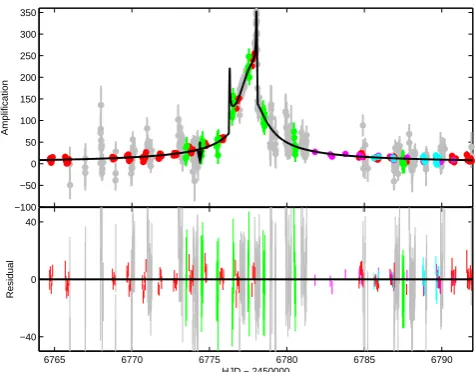
Figure 1.Observed data for event OGLE-2014-BLG-0676/ MOA-2014-BLG-175 from the MOA (gray), OGLE (red) and Wise (green) microlens-ing survey groups along with data from the RoboNET/LCOGT (cyan) and MiNDSTEp (magenta) groups. Also shown is the best-fitting binary lens model light-curve (black line). The parameters for this model are given in Table 2. The epoch when the OGLE collaboration issued an alert for this event is indicated with a black arrow. Data with extremely large errors are omitted.
in our modelling through a linear profile. The surface brightness of the source star is given bySλ(θ)=Sλ(0)[1−uλ(1−cos(θ))] where θis the angle between the line of sight and the normal to the stellar surface anduλis the limb-darkening coefficient for a particular filter
colour. The source star’s (V−I) colour determines our values of the limb-darkening coefficients. However, this colour estimate for the source is model dependent. We therefore iterated our analysis for producing a best-fitting binary lens model and the analysis leading to an estimate of the source colour — and thence to values ofuλ,
see Section 5 — until the iterative analysis converges on values of
uλ.
The parameters for our best-fitting binary lens models are shown in Table 2. The columns entitled “Wide” and “Close” list the parameter values for the best-fitting basic binary lens models. The model names — “Wide” and “Close” — reflect the different val-ues of the separation,s, between the binary lens masses. In terms ofχ2, the Wide model is preferred over the Close model by only
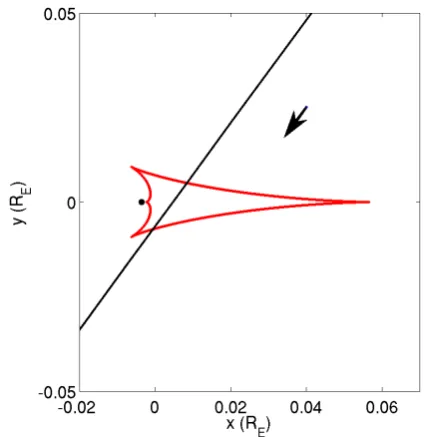
∆χ2'0.5. That degenerate models exist with valuessand 1/sfor source star tracks passing close to the central caustic is well-known in planetary microlensing (Dominik 1999). The light curve data and best-fitting model curve for event OGLE-2014-BLG-0676Lb is shown in Figures 1 and 2. The caustic curves and source star track is shown in Figure 3.
The effect of parallax arising from Earth’s orbital motion around the Sun (Gould 1992; Alcock et al. 1995) can allow an esti-mation of the distance to the lens system, and thereby a unique de-termination of the lens system properties — in particular the abso-lute values of the masses of the lens components and the separation between them. In terms of modelling microlensing light curves, we introduce two additional parametersπE,EandπE,Nthat are the east and north components of the parallax vectorπ~E. We can find the mass of the host star and its distance from Earth as follows:
ML=θE/(κπE) ; DL= AU
πEθE+πS
whereθE is the angular Einstein ring radius,πS = AU/DS and
at University of St Andrews on December 19, 2016
http://mnras.oxfordjournals.org/
Parameters Wide Close Wide+parallax Close+parallax
t0 6777.335 6777.306 6777.319 6777.309
(JD) 0.058 0.051 0.045 0.052
tE 116.3 107.3 130.5 126.4
(day) 12.2 11.4 12.4 10.5
u0×103 3.7 4.3 3.6 3.9
0.4 0.5 0.4 0.4
q×103 4.78 4.85 4.60 4.31
0.13 0.31 0.37 0.07
s 1.347 0.760 1.358 0.757
0.024 0.014 0.021 0.013
α 2.203 2.270 2.229 2.284
(rad) 0.044 0.045 0.030 0.046
ρ×104 2.78 2.69 2.61 2.43
0.33 0.31 0.27 0.27
πEN ... ... -1.81 -2.24
... ... 0.22 0.51
πEE ... ... 0.06 0.57
... ... 0.18 0.48
χ2 12150.2 12150.6 12127.4 12136.7
dof 12178 12178 12176 12176
χ2
[image:4.595.166.419.102.402.2]N 0.99771 0.99775 0.99601 0.99677
Table 2.Best-fitting binary lens model parameters for microlensing event OGLE-2014-BLG-0676/MOA-2014-BLG-175.
100 150 200 250 300 350
Amplification
6777.5 6777.6 6777.7 6777.8 6777.9 6778 6778.1 6778.2 6778.3 6778.4 6778.5 −40
0 40
HJD − 2450000
[image:4.595.43.278.437.621.2]Residual
Figure 2.This is a close-up view of the light curve for OGLE-2014-BLG-0676/MOA-2014-BLG-175 as shown in Figure 1, highlighting the second caustic crossing.
κ = 4G/(c2AU) = 8.144 mas/M
(Gould 2000). In addition to a measurement of parallax,πE, we also need an estimate of the dis-tance to the source star,DS, and an estimate of the absolute angu-lar source star size which, combined with a modelled value of the source star size, gives us an estimate ofθE. The value oftEfor the basic binary lens models is∼100 days, so hopes were high that parallax might be detectable in this event. Disappointingly how-ever, when we included parallax in our modelling for this event we could improve the model fit to the data by only∆χ2 ' 23.
Figure 3. The caustic curves (red) corresponding to the best-fitting model for planetary microlensing event OGLE-2014-BLG-0676/ MOA-2014-BLG-175. The source star track is also shown (black line), and the direction of the source motion is indicated with an arrow.
While this improvement seemsprima faciesignificant, there are two sources of concern shedding doubt on this measurement of parallax. Firstly, and perhaps most tellingly, the improvement inχ2 comes from the model fitting a set of incoherent and noisy MOA
at University of St Andrews on December 19, 2016
http://mnras.oxfordjournals.org/
[image:4.595.316.529.450.669.2]data in the baseline, giving rise to the improvement in overallχ2. Secondly, the modelled values ofπEare unusually higher than those seen in typical parallax events — casting further doubt on the valid-ity of the parallax models. The high degree of blending in this event, see below, possibly explains why parallax was not observed in this event, similar to event OGLE-2015-BLG-1319 (Shvartzvald et al. 2016a). For these reasons we do not consider that we have a reliable measurement of parallax for event OGLE-2014-BLG-0676/ MOA-2014-BLG-175. Despite the improvements inχ2 afforded by our best-fitting parallax models, we accept the binary lens models with-out parallax as our favoured explanation for this event.
Looking at Figures 1 and 2, we see that the Wide binary lens model fits the data well through the second caustic crossing and exit at times H JD0 ' 6778.0 – 6778.1 days. The second caustic crossing was only observed by the MOA collaboration, but the in-terval between the caustic crossings was well covered by MOA, OGLE and Wise observations. No data were recorded during the first caustic crossing.
5 SOURCE STAR
Combined with our modelled values ofρandtE, an estimate of the angular size of the source starθ?provides an estimate of the angular
Einstein ring radius θE via θE = θ?/ρ. This can provide tighter constraints on the binary lens mass and separation, see e.g. Suzuki et al. (2014). We can use published colour-radius relationships to obtain an estimate ofθ?, once we have an estimate of the source star colour.
We start by cross-matching the field stars in the MOA and OGLE-IV photometric catalogues in a 2 arcminute region cen-tred on the co-ordinates of event OGLE-2014-BLG-0676/ MOA-2014-BLG-175. This gives us the following relationship between instrumental MOA and OGLE-IV colours: (RMOA−IOGLE−IV) = 0.16709 (±0.0028)∗(V−I)OGLE−IV+−3.5593 (±0.0084). We then cross-match OGLE field stars for this event between the calibrated OGLE-III photometric database (Szyma´nski et al. 2011) and the OGLE-IV photometry:
IOGLE−III=(4.684±0.42)×10−2+IOGLE−IV+. . .
. . .+(−6.1±1.6)×10−3(V−I)OGLE−IV
(V−I)OGLE−III=(0.9165±0.0021) (V−I)OGLE−IV+. . .
. . .+(0.15747±0.0053)
From the best-fitting model, we obtain the instrumental source magnitude and colour (IOGLE−IV,(RMOA−IOGLE−IV)) and using the above two relationships we obtain the source colour in the cali-brated OGLE-III photometric scale:
IS=23.512±0.11 (V−I)S=4.27±0.11
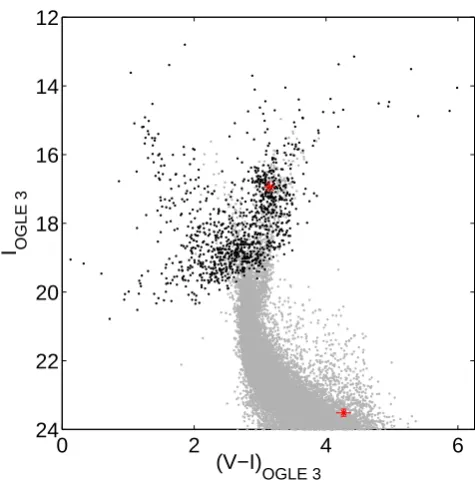
where the errors above include — in quadrature — model-dependent errors in estimating instrumental baseline magnitudes, and the uncertainties associated with the linear relationships above. A colour-magnitude diagram of the OGLE-III field stars within 60 arcsec of event OGLE-2014-BLG-0676/MOA-2014-BLG-175 is shown in Figure 4.
We need now an estimation of the extinction and reddening suffered by the source star. We make the usual assumption that the source star resides in the Galactic bulge and that it suffers the same degree of extinction and reddening as Red Clump Giant (RCG)
0
2
4
6
12
14
16
18
20
22
24
[image:5.595.305.543.96.338.2](V−I)
OGLE 3I
OGLE 3Figure 4.Colour magnitude diagram of the OGLE-III field stars within 60 arcsec of event OGLE-2014-BLG-0676/MOA-2014-BLG-175 (black). The Holtzman (1998) CMD data for Baade’s window is shown in grey. The centre of the red clump is indicated (red asterisk) as is the location of the source star.
stars residing in the bulge. Red clump giant stars are often used as standard candles for Galactic structure studies (e.g. Cao et al. (2013)). Using a colour magnitude diagram of the OGLE-III field stars for this event we isolate the RCG stars and find the centroid position in the CMD:
IRCG=16.94±0.03 (V−I)RCG=3.15±0.01.
We use the following values of the intrinsic luminosity values of Galactic bulge RCGs (Bensby et al. 2013; Nataf et al. 2013):
IRCG,0 = 14.44 ±0.04 with the colour of the red clump be-ing centred at (V −I)RCG,0 = 1.06 with dispersion 0.06. Us-ing these intrinsic RCG magnitudes and colours, we estimate the reddening and extinction towards event OGLE-2014-BLG-0676Lb to be (AI,E(V −I)) = (2.50,2.09)±(0.05,0.07). The intrinsic source colour and magnitude values are therefore (I,V−I)S,0 = (21.02,2.18)±(0.12,0.13).
In Figure 4 we also show stars observed with theHubble Space Telescopetowards a region of Baade’s window (Holtzman et al. 1998), where the central position of the red clump for each set of stars have been aligned. Shown on this diagram are the source colour and magnitude values which, with reference to the HST data, suggest that the source is marginally consistent with a star in the bulge. From the relationship given in Casagrande and VandenBerg (2014) we estimate the effective temperature of the source star to beTeff=3604+−8579K. Using thisTeffvalue, we use the ATLAS stel-lar atmosphere models of Cstel-laret (2000) to obtain the linear limb-darkening coefficients for both the I band data and the MOA-red filter: (cI,cRMOA) = (0.6014,0.6485) wherecRMOA is computed as
the average of the limb-darkening coefficients in theRandIbands. We apply the stellar radius-colour relationship of Kervella et al. (2004) to estimate the radius of the source star. Combined with our
at University of St Andrews on December 19, 2016
http://mnras.oxfordjournals.org/
Physical parameter Value
Planet mass 3.09+1.02 −1.12MJ
Orbital radius 4.40+2.16 −1.46AU
Host mass 0.62+0.20
−0.22M
Lens distance 2.22+−00..9683kpc
[image:6.595.94.231.104.216.2]Einstein ring radius 1.38±0.43 mas
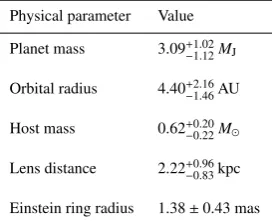
Table 3.Physical parameters for the favoured binary lens model for mi-crolensing event OGLE-2014-BLG-0676/MOA-2014-BLG-175.
modelled value ofρ=θ?/θE =(2.78±0.33)×10−4we estimate the angular Einstein ring radius to beθE=1.38±0.43 mas.
6 LENS SYSTEM PARAMETER ESTIMATION
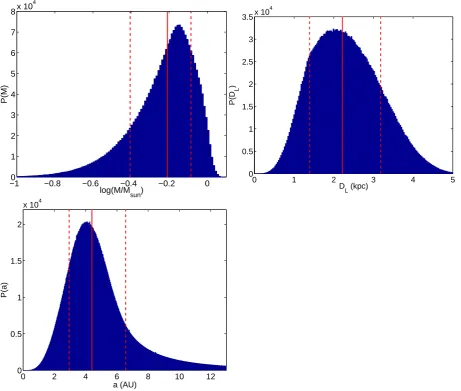
We are unable to set tight constraints on the absolute mass of the host star in the lens system, or its distance from Earth with-out a credible measurement of microlensing parallax. We resort therefore to a probabilistic analysis of the nature of the lens sys-tem (Beaulieu et al. 2006; Bennett et al. 2008), using a Galac-tic model (Han and Gould 2003) and assuming the distance to the Galactic centre is 8 kpc. Using our observed value ofθE,tE, and the de-extincted blend flux derived from the OGLE-I band data as the upper limit of the light contributed by the lens in this event,Ib,0 =17.202±0.005, we find the lens system comprises a 3.09+1.02
−1.12MJplanet orbiting a 0.62−+00..2022Mhost star at a deprojected orbital distance of 4.40+2.16
−1.46AU. The distance to the lens system is 2.22+0.96
−0.83kpc. The parameter distributions are shown in Figure 5. The lens-source proper motion is estimated asµrel =θE/tE = 4.33±1.43 mas/yr. Following the estimation of Bennett et al. (2007) of when the HST could have resolved the lens and source compo-nents for event OGLE-2005-BLG-169L, and considering the es-timated lens-source relative proper motion for OGLE-2014-BLG-0676/MOA-2014-BLG-175, HST could resolve the lens and source for this event in around 3.7 years following the event peak — cor-responding to the end of 2017. In our Bayesian analysis, most of the light in this event was contributed by the lens system and thus we needn’t wait for the separation of the lens and source to allow a measurement of the lens flux by HST. Adaptive optics measure-ments from the ground will be able to make measuremeasure-ments of the lens flux now for comparison to our Bayesian estimates.
There are a number of important assumptions made in the derivation of lens system parameters via such a Bayesean proba-bility density analysis and the reader is directed to Rattenbury et al. (2015) for these.
7 DISCUSSION AND CONCLUSION
We found the anomalous signal in gravitational microlensing event OGLE-2014-BLG-0676/MOA-2014-BLG-175 to be consis-tent with a planetary lens system. The source star passed through the central caustic, with the second caustic crossing being well recorded by the MOA microlensing survey collaboration. Ob-servations at epochs between the unrecorded first caustic cross-ing and the second caustic crosscross-ing were made by the OGLE,
Wise and MOA collaborations. Further observations were made by the RoboNET/LCOGT and MiNDSTEp groups, but these were made at times away from the planetary signal. The best-fitting bi-nary lens model for this event has a bibi-nary lens mass ratio of (4.78±0.13)×10−3 and the binary lens components are sepa-rated by s = 1.347±0.024, with a degenerate solution having
s = 0.760±0.014. This lens mass ratio is a few times greater than that found in the earlier work by Shvartzvald et al. (2016b), in which the mass ratio for this event was reported to beq∼1.4×10⁻³. This lower mass ratio was obtained from a coarse search of the bi-nary lens microlensing parameter space, as this event was only one of 29 anomalous events analysed in that work.
A believable measurement of parallax for this event was not possible. We did, however, estimate the angular radius of the source star and thereby estimate the angular size of the Einstein ring ra-dius,θE. The source star is rather faint, and very red. There is a possibility that the source may be blended with a nearby red star, causing an incorrect identification of the source star type.
A Bayesian probability analysis for the lens system pa-rameters for this event suggests that the binary lens system for OGLE-2014-BLG-0676/MOA-2014-BLG-175 is consistent with a 3.09+1.02
−1.12MJplanet orbiting a 0.62−+00..2022Mhost star at a deprojected orbital separation of 4.40+2.16
−1.46AU. The distance to the lens system is 2.22+0.96
−0.83kpc. This measurement of the lens mass is consistent with a K-dwarf star. In our Bayesian analysis we assumed that most of the light from this event is contributed by the lens star and thus lens flux measurements with an adaptive-optics system will provide a check on our Bayesian estimates of the lens system. In any event, planet OGLE-2014-BLG-0676Lb can be added to the growing list of planets discovered by microlensing against which planetary for-mation theories can be tested.
8 ACKNOWLEDGEMENTS
NJR is a Royal Society of New Zealand Rutherford Discovery Fellow. AS is a University of Auckland Doctoral Scholar. TS ac-knowledges financial support from the Japan Society for the Pro-motion of Science (JSPS) under grant numbers JSPS23103002, JSPS24253004 and JSPS26247023. NK is supported by Grant-in-Aid for JSPS Fellows. The MOA project is supported by JSPS grants JSPS25103508 and JSPS23340064 and by the Royal So-ciety of New Zealand Marsden Grant MAU1104. NJR acknowl-edges the contribution of NeSI high-performance computing fa-cilities to the results of this research. NZ’s national fafa-cilities are provided by the NZ eScience Infrastructure and funded jointly by NeSI’s collaborator institutions and through the Ministry of Business, Innovation & Employment’s Research Infrastructure pro-gramme (https://www.nesi.org.nz).
The OGLE team thanks Profs. M. Kubiak and G. Pietrzy´nski, former members of the OGLE team, for their contribution to the collection of the OGLE photometric data over the past years. The OGLE project has received funding from the National Science Cen-tre, Poland, grant MAESTRO 2014/14/A/ST9/00121 to AU.
YS is a NASA Postdoctoral Program Fellow.
The Danish 1.54 m telescope is operated based on a grant from the Danish Natural Science Foundation (FNU). The MiNDSTEp monitoring campaign is powered by ARTEMiS (Automated Terres-trial Exoplanet Microlensing Search) (Dominik et al. 2008). This publication was made possible by NPRP grants # X-019-1-006 and 09-467-1-078 from the Qatar National Research Fund (a member of Qatar Foundation). KH acknowledges support from STFC grant
at University of St Andrews on December 19, 2016
http://mnras.oxfordjournals.org/
−10 −0.8 −0.6 −0.4 −0.2 0 1
2 3 4 5 6 7 8x 10
4
log(M/Msun)
P(M)
0 2 4 6 8 10 12
0 0.5 1 1.5 2
x 104
a (AU)
P(a)
0 1 2 3 4 5
0 0.5 1 1.5 2 2.5 3 3.5x 10
4
D
L (kpc)
P(D
L
[image:7.595.65.527.101.492.2])
Figure 5.Lens system parameters from the probability density analysis. Parameter distributions are shown for, clockwise from top left, host star mass,M, host star distanceDLand deprojected planet orbital radius,a. Median parameter values and 68% confidence intervals are shown as vertical red solid and dashed lines, respectively.
ST/M001296/1. GD acknowledges Regione Campania for support from POR-FSE Campania 2014-2020. TCH acknowledges support from the Korea Research Council of Fundamental Science & Tech-nology (KRCF) via the KRCF Young Scientist Research Fellow-ship Programme and for financial support from KASI travel grant number 2014-1-400-06. J. Surdej acknowledges support from the Communaut´e franc¸aise de Belgique - Actions de recherche con-cert´ees - Acad´emie Wallonie-Europe. This work has made exten-sive use of the ADS service, for which we are thankful.
This work makes use of observations from the LCOGT net-work, which includes three SUPAscopes owned by the University of St Andrews. The RoboNet programme is an LCOGT Key Project using time allocations from the University of St Andrews, LCOGT and the University of Heidelberg together with time on the Liv-erpool Telescope through the Science and Technology Facilities Council (STFC), UK. This research has made use of the LCOGT Archive, which is operated by the California Institute of Technol-ogy, under contract with the Las Cumbres Observatory.
The authors thank Matthew Penny for his comments on this manuscript.
1Department of Physics, University of Auckland, Private Bag
92019, Auckland, New Zealand
2Department of Physics, University of Notre Dame, Notre Dame,
IN 46556, USA
3Department of Earth and Space Science, Graduate School of
Science, Osaka University, 1-1 Machikaneyama, Toyonaka, Osaka 560-0043, Japan
4Institute of Natural and Mathematical Sciences, Massey
Univer-sity, Private Bag 102-904, North Shore Mail Centre, Auckland, New Zealand
5Warsaw University Observatory, Al. Ujazdowskie 4,
00-478 Warszawa, Poland
6Jet Propulsion Laboratory, California Institute of Technology,
4800 Oak Grove Drive, Pasadena, CA 91109, USA
7School of Physics and Astronomy, Tel-Aviv University, Tel-Aviv
69978, Israel
8Institute and Centre for Star and Planet Formation, University of
Copenhagen, Øster Voldgade 5, 1350 Copenhagen K, Denmark 9SUPA, School of Physics and Astronomy, University of St.
Andrews, North Haugh, St Andrews, KY16 9SS, United Kingdom
at University of St Andrews on December 19, 2016
http://mnras.oxfordjournals.org/
10Las Cumbres Observatory Global Telescope Network, Inc., 6740
Cortona Drive, Suite 102, Goleta, CA 93117, USA
11Astronomisches Rechen-Institut, Zentrum f¨ur Astronomie der
Universit¨at, Heidelberg, M¨onchhofstr. 12-14, 69120 Heidelberg, Germany
12Solar-Terrestrial Environment Laboratory, Nagoya University,
Nagoya, 464-8601, Japan
13Astrophysics Science Division, NASA Goddard Space Flight
Center, Greenbelt, MD 20771, USA
14School of Physics, The University of New South Wales, Sydney
NSW 2052, Australia
15Okayama Astrophysical Observatory, National Astronomical
Observatory, 3037-5 Honjo, Kamogata, Asakuchi, Okayama 719-0232, Japan
16Nagano National College of Technology, Nagano 381-8550,
Japan
17Tokyo Metropolitan College of Industrial Technology, Tokyo
116-8523, Japan
18School of Chemical and Physical Sciences, Victoria University,
Wellington, New Zealand
19Mt. John Observatory, P.O. Box 56, Lake Tekapo 8770, New
Zealand
20Department of Physics, Faculty of Science, Kyoto Sangyo
University, 603-8555 Kyoto, Japan
21Department of Astronomy, Ohio State University, 140 W. 18th
Ave., Columbus, OH 43210, USA
22Department of Physics, University of Warwick, Gibbet Hill
Road, Coventry, CV4 7AL, United Kingdom
23Qatar Environment and Energy Research Institute (QEERI),
HBKU, Qatar Foundation, Doha, Qatar 24Boston University, Boston MA, USA
25Dipartimento di Fisica “E. R. Caianiello”, Universit`a di Salerno,
Via Giovanni Paolo II, 84084 Fisciano (SA), Italy
26Istituto Nazionale di Fisica Nucleare, Sezione di Napoli, Napoli,
Italy
27IPAC, Mail Code 100-22, Caltech, 1200 E. California Blvd.,
Pasadena, CA 91125
28Institut d’Astrophysique et de G´eophysique, Universit´e de Li`ege,
All´ee du 6 Aoˆut, Bˆat. B5c, 4000 Li`ege, Belgium
29Georg-August-Universi¨at, Altes Rathaus, Markt 9, 37073
G¨ottingen, Germany
30Korea Astronomy and Space Science Institute, Daejeon 305-348,
Republic of Korea
31European Southern Observatory, Karl-Schwarzschild-Str. 2,
85748 Garching bei M¨unchen, Germany
32Space Telescope Institute, 3700 San Martin Drive, Baltimore,
MD 21218, USA
33Jodrell Bank Centre for Astrophysics, The University of
Manch-ester, ManchManch-ester, M13 9PL, United Kingdom
34Max Planck Institute for Astronomy, K¨onigstuhl 17, 69117
Heidelberg, Germany
35Perth Observatory, 337 Walnut Rd, Bickley WA 6076, Australia
36Instituto de Astrof´ısica, Facultad de F´ısica, Pontificia
Univer-sidad Cat´olica de Chile, Av. Vicu˜na Mackenna 4860, 7820436 Macul, Santiago, Chile
37Department of Physics, Sharif University of Technology, P. O.
Box 11155-9161 Tehran, Iran
38Istituto Internazionale per gli Alti Studi Scientifici (IIASS),
84019 Vietri Sul Mare (SA), Italy
39Max-Planck-Institute for Solar System Research,
Justus-von-Liebig-Weg 3, 37077 G¨ottingen, Germany
40Astrophysics Group, Keele University, Staffordshire, ST5 5BG,
United Kingdom
41South African Astronomical Observatory, PO Box 9,
Observa-tory 7935, South Africa
42Astrophysics Research Institute, Liverpool John Moores
Univer-sity, IC2, Liverpool Science Park, 146 Brownlow Hill, Liverpool L3 5RF, United Kingdom
AMicrolensing Observations in Astrophysics (MOA)
BOptical Gravitational Lensing Experiment (OGLE)
CWise Observatory Group
DMicrolensing Network for the Detection of Small Terrestrial
Exoplanets (MiNDSTEp) ERoboNET
REFERENCES
Albrow, M., Beaulieu, J.P., Birch, P., Caldwell, J.A.R., Kane, S., Martin, R., Menzies, J., Naber, R.M., et al., 1998, ApJ, 509, 687 Albrow, M.D., Horne, K., Bramich, D.M., Fouqu´e, P., Miller, V.R., Beaulieu, J.P., Coutures, C., Menzies, J., et al., 2009, MN-RAS, 397, 2099
Alcock, C., Allsman, R.A., Alves, D., Axelrod, T.S., Bennett, D.P., Cook, K.H., Freeman, K.C., Griest, K., et al., 1995, ApJ, 454, L125
Beaulieu, J.P., Bennett, D.P., Fouque, P., Williams, A., Dominik, M., Jorgensen, U.G., Kubas, D., Cassan, A., et al., 2006, Nat, 439, 437
Beaulieu, J.P., Tisserand, P., Batista, V., 2013, European Planetary Science Congress 2013, held 8-13 September in London, UK., id.EPSC2013-837, 8, EPSC2013-837
Bennett, D.P., 2010, ApJ, 716, 1408
Bennett, D.P., Anderson, J., Gaudi, B.S., 2007, ApJ, 660, 781 Bennett, D.P., Bond, I.A., Udalski, A., Sumi, T., Abe, F., Fukui,
A., Furusawa, K., Hearnshaw, J.B., et al., 2008, ApJ, 684, 663-683
Bennett, D.P., Rhie, S.H., 2002, ApJ, 574, 985
Bensby, T., Yee, J.C., Feltzing, S., Johnson, J.A., Gould, A., Co-hen, J.G., Asplund, M., Mel´endez, J., et al., 2013, A&A, 549, A147
Bond, I.A., Abe, F., Dodd, R.J., Hearnshaw, J.B., Honda, M., Ju-gaku, J., Kilmartin, P.M., Marles, A., et al., 2001, MNRAS, 327, 868
Borucki, W.J., Koch, D.G., Basri, G., Batalha, N., Brown, T.M., Bryson, S.T., Caldwell, D., Christensen-Dalsgaard, J., et al., 2011, ApJ, 736, 19
Bozza, V., 2010, MNRAS, 408, 2188
Bozza, V., Dominik, M., Rattenbury, N.J., Jørgensen, U.G., Tsapras, Y., Bramich, D.M., Udalski, A., Bond, I.A., et al., 2012, MNRAS, 424, 902
Bozza, V., Shvartzvald, Y., Udalski, A., Calchi Novati, S., Bond, I.A., Han, C., Hundertmark, M., Poleski, R., et al., 2016, ApJ, 820, 79
Bramich, D.M., 2008, MNRAS, 386, L77
Bramich, D.M., Horne, K., Albrow, M.D., Tsapras, Y., Snodgrass, C., Street, R.A., Hundertmark, M., Kains, N., et al., 2013, MN-RAS, 428, 2275
Brown, T.M., Baliber, N., Bianco, F.B., Bowman, M., Burleson, B., Conway, P., Crellin, M., Depagne, ´E., et al., 2013, PASP, 125, 1031
Cao, L., Mao, S., Nataf, D., Rattenbury, N.J., Gould, A., 2013, MNRAS, 434, 595
at University of St Andrews on December 19, 2016
http://mnras.oxfordjournals.org/
Casagrande, L., VandenBerg, D.A., 2014, MNRAS, 444, 392 Cassan, A., Kubas, D., Beaulieu, J.P., Dominik, M., Horne, K.,
Greenhill, J., Wambsganss, J., Menzies, J., et al., 2012, Nat, 481, 167
Claret, A., 2000, A&A, 363, 1081 Dominik, M., 1999, A&A, 349, 108
Dominik, M., Horne, K., Allan, A., Rattenbury, N.J., Tsapras, Y., Snodgrass, C., Bode, M.F., Burgdorf, M.J., et al., 2008, As-tronomische Nachrichten, 329, 248
Dominik, M., Jørgensen, U.G., Rattenbury, N.J., Mathiasen, M., Hinse, T.C., Calchi Novati, S., Harpsøe, K., Bozza, V., et al., 2010, Astronomische Nachrichten, 331, 671
Gaudi, B.S., 2012, ARA&A, 50, 411 Gould, A., 1992, ApJ, 392, 442 Gould, A., 2000, ApJ, 542, 785
Gould, A., Dong, S., Gaudi, B.S., Udalski, A., Bond, I.A., Green-hill, J., Street, R.A., Dominik, M., et al., 2010, ApJ, 720, 1073 Han, C., Gould, A., 2003, ApJ, 592, 172
Henderson, C.B., Poleski, R., Penny, M., Street, R.A., Bennett, D.P., Hogg, D.W., Gaudi, B.S., Zhu, W., et al., 2015, ArXiv e-prints
Holtzman, J.A., Watson, A.M., Baum, W.A., Grillmair, C.J., Groth, E.J., Light, R.M., Lynds, R., O’Neil, Jr., E.J., 1998, AJ, 115, 1946
Ida, S., Lin, D.N.C., 2005, ApJ, 626, 1045
Kervella, P., Th´evenin, F., Di Folco, E., S´egransan, D., 2004, A&A, 426, 297
Kim, S.L., Lee, C.U., Park, B.G., Kim, D.J., Cha, S.M., Lee, Y., Han, C., Chun, M.Y., et al., 2016, Journal of Korean Astronomi-cal Society, 49, 37
Mao, S., Paczynski, B., 1991, ApJ, 374, L37
Marcy, G.W., Butler, R.P., Vogt, S.S., Fischer, D.A., Henry, G.W., Laughlin, G., Wright, J.T., Johnson, J.A., 2005, ApJ, 619, 570 Nataf, D.M., Gould, A., Fouqu´e, P., Gonzalez, O.A., Johnson,
J.A., Skowron, J., Udalski, A., Szyma´nski, M.K., et al., 2013, ApJ, 769, 88
Penny, M.T., Rattenbury, N.J., Gaudi, B.S., Kerins, E., 2016, ArXiv e-prints
Poleski, R., Zhu, W., Christie, G.W., Udalski, A., Gould, A., Bachelet, E., Skottfelt, J., Calchi Novati, S., et al., 2016, ApJ, 823, 63
Rattenbury, N.J., Bennett, D.P., Sumi, T., Koshimoto, N., Bond, I.A., Udalski, A., Abe, F., Bhattacharya, A., et al., 2015, MN-RAS, 454, 946
Rattenbury, N.J., Bond, I.A., Skuljan, J., Yock, P.C.M., 2002, in B. Battrick, F. Favata, I.W. Roxburgh, D. Galadi, editors, Stel-lar Structure and Habitable Planet Finding, volume 485 of ESA Special Publication, 195–199
Shvartzvald, Y., Li, Z., Udalski, A., Gould, A., Sumi, T., Street, R.A., Calchi Novati, S., Hundertmark, M., et al., 2016a, ArXiv e-prints
Shvartzvald, Y., Maoz, D., Udalski, A., Sumi, T., Friedmann, M., Kaspi, S., Poleski, R., Szyma´nski, M.K., et al., 2016b, MNRAS, 457, 4089
Spergel, D., Gehrels, N., Baltay, C., Bennett, D., Breckinridge, J., Donahue, M., Dressler, A., Gaudi, B.S., et al., 2015, ArXiv e-prints
Sumi, T., Abe, F., Bond, I.A., Dodd, R.J., Hearnshaw, J.B., Honda, M., Honma, M., Kan-ya, Y., et al., 2003, ApJ, 591, 204 Sumi, T., Bennett, D.P., Bond, I.A., Abe, F., Botzler, C.S., Fukui,
A., Furusawa, K., Itow, Y., et al., 2013, ApJ, 778, 150
Sumi, T., Kamiya, K., Bennett, D.P., Bond, I.A., Abe, F., Botzler,
C.S., Fukui, A., Furusawa, K., et al., 2011, Nat, 473, 349 Suzuki, D., Udalski, A., Sumi, T., Bennett, D.P., Bond, I.A., Abe,
F., Botzler, C.S., Freeman, M., et al., 2014, ApJ, 780, 123 Szyma´nski, M.K., Udalski, A., Soszy´nski, I., Kubiak, M.,
Pietrzy´nski, G., Poleski, R., Wyrzykowski, Ł., Ulaczyk, K., 2011, AcA, 61, 83
Tsapras, Y., Street, R., Horne, K., Snodgrass, C., Dominik, M., Allan, A., Steele, I., Bramich, D.M., et al., 2009, Astronomische Nachrichten, 330, 4
Udalski, A., 2003, Acta Astronomica, 53, 291
Udalski, A., Szyma´nski, M.K., Szyma´nski, G., 2015, AcA, 65, 1 Yee, J.C., Albrow, M., Barry, R.K., Bennett, D., Bryden, G.,
Chung, S.J., Gaudi, B.S., Gehrels, N., et al., 2014, ArXiv e-prints Yee, J.C., Udalski, A., Calchi Novati, S., Gould, A., Carey, S., Poleski, R., Gaudi, B.S., Pogge, R.W., et al., 2015, ApJ, 802, 76
at University of St Andrews on December 19, 2016
http://mnras.oxfordjournals.org/