Annals of Operations Research manuscript No.
(will be inserted by the editor)
A Stochastic Local Search Algorithm with Adaptive
Acceptance for High-school Timetabling
Ahmed Kheiri · Ender ¨Ozcan · Andrew J. Parkes
Received: date / Accepted: date
Abstract Automated high school timetabling is a challenging task. This prob-lem is a well known hard computational probprob-lem which has been of interest to practitioners as well as researchers. High schools need to timetable their regular activities once per year, or even more frequently. The exact solvers may fail to find a solution for a given instance of the problem. A selection hyper-heuristic can be defined as an easy-to-implement, easy-to-maintain and effective ‘heuristic to choose heuristics’ to solve such computationally hard problems. This paper de-scribes the approach of the team HySST (Hyper-heuristic Search Strategies and Timetabling) to high school timetabling which competed at the three rounds of the Third International Timetabling Competition. Despite this being the first at-tempt in high school timetabling, HySST generated the best new solutions for three given instances in Round 1 and gained the second place in Rounds 2 and 3 with a fairly standard stochastic search method but significantly enhanced by a selection hyper-heuristic with an adaptive acceptance mechanism.
Keywords Timetabling· Stochastic Local Search·Hyper-heuristic ·Restart · Scheduling
1 Introduction
Due to the inherit difficulties in educational timetabling, this area of study has been of interest to many researchers and practitioners across operational research, computer science and artificial intelligence since 1960s (Broder, 1964). There are different types of educational timetabling problems, such as examination timetabling and high school timetabling which are all known to be NP-hard real-world con-straint optimisation problems (Even et al, 1976; de Werra, 1997). The focus of this work is on high school timetabling (Pillay, 2010a).
Recently, a competition was organised on the topic as the last one in the series of timetabling challenges: the Third International Timetabling
tion (ITC2011). The goal was to provide a high school timetabling benchmark, determine the state-of-the-art solution method and promote researchers and prac-titioners to deal with the problems as they are without discarding the real world complexities. This study describes the approach of the team HySST (Hyper-heuristic Search Strategies and Timetabling) which competed at the three rounds of ITC2011.
Many different approaches have been proposed for high school timetabling problem specialised for a problem in hand. We describe a fairly standard stochas-tic search method but significantly enhanced by aselection hyper-heuristicfor high school timetabling. The proposed approach is more general in the sense that it is applicable to a variety of high school timetabling problems across the world and more effective than the existing approaches which frequently ignore the real-world complexities. Ahyper-heuristicis a high level search methodology that performs search over the space formed by a set of low level heuristics to solve computation-ally hard problems (Burke et al, to appear). A selection hyper-heuristicimproves an initially generated solution iteratively through heuristic selection and move acceptance processes ( ¨Ozcan et al, 2008). A candidate solution is perturbed af-ter applying a chosen heuristic using the heuristic selection method and a new solution is obtained. Then move acceptance method considers whether to accept or reject the new solution. This cycle continues until the termination criteria is satisfied. There has been a growing number of studies on hyper-heuristics since the initial ideas of combining the strength of existing heuristics (neighbourhood structures) was rooted in 1960s (Fisher and Thompson, 1963). More on differ-ent types of hyper-heuristics including selection hyper-heuristics can be found in (Chakhlevitch and Cowling, 2008; Ross, 2005; Burke et al, to appear). A selection hyper-heuristic should be “fast to implement, requiring far less expertise in either the problem domain or heuristic methods, and robust enough to effectively handle a range of problems” (Cowling et al, 2001). Despite this being the first attempt in high school timetabling, HySST generated the best new solutions for three given instances in Round 1 and gained the second place in Rounds 2 and 3 with the proposed selection hyper-heuristic which satisfies all previously suggested design criteria.
Section 2 discusses high school timetabling and selection hyper-heuristic frame-works. Section 3 provides an overview of the competition and high school timetabling problem dealt with during the competition. Section 4 describes the selection hyper-heuristic components that are used for solving the high school timetabling prob-lem. Section 5 presents the empirical and so competition results. Finally, Section 6 concludes the study.
2 Background
2.1 High School Timetabling Problem
consideredfeasibleand they are expected to satisfy as many of the soft constraints as possible, which represent preferences. In most of the previous formulations of the high school timetabling problem, infeasible solutions are allowed and eval-uated, differentiating their quality by considering the degree of hard constraint violations.
There is a variety of real world high school timetabling problems exhibit-ing various characteristics from different countries and many different approaches have been proposed for a particular problem in hand, including a tiling algorithm (Kingston, 2005), constraint programming approach (Valouxis and Housos, 2003; Marte, 2007), Hopfield neural networks (Smith et al, 2003) and integer program-ming (Birbas et al, 2009). The tabu search or simulated annealing metaheuris-tics are frequently preferred as the single-point-based solution methods for high school timetabling. Abramson (1991) employed simulated annealing for course timetabling and proposed a parallel algorithm for solving some randomly gen-erated problem instances and some Australian data. Hertz (1992) utilised tabu search for teacher-course assignment using hypothetical data from a Yugoslavian school. Schaerf (1996) tested a tabu search based approach which interleaves differ-ent types of moves on some instances from the Italian high-schools. The approach generated schedules that are of better quality than the manually created ones. Abramson et al (1999) compared different simulated annealing cooling schedules and the experimental results showed that geometric cooling with multiple rates performs the best. Jacobsen et al (2006) presented a tabu search algorithm for solving a timetabling problem at German secondary schools of Gymnasium type and compared its performance to a constraint programming approach. The results showed that they have a similar performance based on the feasible solutions ob-tained for the given instances. Bello et al (2008) tested a tabu search approach on some instances that are presentative of Brazilians high school timetabling prob-lems. Kannan et al (2012) applied graph theoretic approach to a problem from the New York City public school system, which decomposes a given instance and applies randomised heuristics.
the problem instances provided by Abramson and Dang (1993). The experimental results showed that genetic algorithm delivered either a better or similar perfor-mance to the previously proposed methods. Raghavjee and Pillay (2010) described a hybrid evolutionary algorithm with no crossover using a hill climber for solv-ing a South African high school course timetablsolv-ing problem along with a primary school timetabling problem. Moura and Scaraficci (2010) applied the greedy ran-domised adaptive search procedure (GRASP) heuristic to solve a Brazilian high school timetabling problem. Pillay (2010b) implemented an evolutionary algorithm based hyper-heuristic selection method. The study has revealed that the incorpora-tion of local search heuristics with mutaincorpora-tion and crossover operators improves the performance. The approach outperforms the other methods applied to the same problem. ¨Ozcan et al (2012) introduced a variant of a high school timetabling prob-lem from Turkey and proposed a genetic algorithm hybridised with hill climbing which interleaves the proposed algorithm with constructive methods while exploit-ing the underlyexploit-ing hierarchical structure of a given problem. More on high school timetabling can be found in (Pillay, 2010a, 2012). This study presents a selection hyper-heuristic method which is able to solve a variety of high school timetabling problems from different countries.
2.2 Selection Hyper-heuristic Frameworks
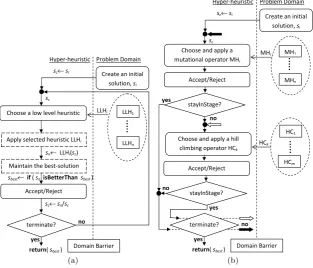
Figure 1(a) illustrates how a high level generic selection hyper-heuristic oper-ates. A selection hyper-heuristic manages a set ofperturbativeorconstructivelow level heuristics (move operators) (Burke et al, 2010b) and often improves an ini-tially generated solution (si) under an iterative framework until the termination
criterion is satisfied. We focus on the former type of selection hyper-heuristics. ( ¨Ozcan et al, 2008) identified two successive stages that are common to most of the single-point-based search hyper-heuristics influencing their performances: heuristic selection and move acceptance. A generic selection hyper-heuristic does not differentiate between the types of low level heuristics. Most of the simple se-lection hyper-heuristics are introduced by Cowling et al (2001). For example, A
simple randomheuristic selection method chooses a random low level heuristic at each step, whilerandom permutation produces a random permutation of all low level heuristics and applies the low level heuristic in the list one after another at each step. Greedy applies all low level heuristics to a given solution and selects the best heuristic which produces the best solution (which could be worse than the given solution, if all heuristic are performing random perturbation). Selec-tion hyper-heuristics have been successfully applied to many different real world problems, including channel assignment (Kendall and Mohamad, 2004), examina-tion timetabling ( ¨Ozcan et al, 2009), space allocation (Burke et al, 2005), vehicle routing problems (Pisinger and Ropke, 2007). More on hyper-heuristics including the descriptions of more elaborate selection hyper-heuristic components as well as other types of hyper-heuristics can be found in Burke et al (to appear).
version of iterated local search (Louren¸co et al, 2010) performed well on some benchmark functions which separates mutational and hill climbing operators, in-voking them successively and so enforcing diversification and intensification pro-cesses explicitly. Burke et al (2010a) also showed that a similar hyper-heuristic framework performs well on a hyper-heuristic benchmark1. In this study, we use a multistage approach as shown in Figure 1(b), which separates mutational and hill climbing heuristics as well. Mutational heuristics are employed until some criteria are satisfied which decides that it is time for intensification, and then a new stage starts employing only hill climbing low level heuristics. The proposed framework allows switching back and forth between diversification and intensification stages.
Choose a low level heuristic
Accept/Reject
LLH1
LLHn
Apply selected heuristic LLHi
LLHi
Create an initial solution, si
terminate?
sn← LLHi(sc)
sc←sn/sc
sc←si
sc
Maintain the best-solution
sbest← if ( sn isBetterThan sbest )
return( sbest )
Hyper-heuristic Problem Domain
Domain Barrier
yes
no
(a)
Accept/Reject
MHi sc←si
sc
return( sbest )
Hyper-heuristic Problem Domain
Domain Barrier Choose and apply a
mutational operator MHi
Choose and apply a hill climbing operator HCk
stayInStage?
yes
no
Create an initial solution, si
no yes
HC1
HCm
MH1
MHn
HCk
Accept/Reject
stayInStage?
no
yes
terminate?
(b)
Fig. 1 Illustration of a (a) generic and (b) multistage selection hyper-heuristic framework
The idea of reducing the number of low level heuristics within selection hyper-heuristics has been studied previously. Cowling and Chakhlevitch (2003) tested
peckish heuristic selection strategies within hyheuristics on a real-world per-sonnel scheduling problem. Although those strategies are found effective, selecting a low-level heuristic to apply at each decision point turned out to be slow since a large set of low level heuristics were used. Hence, Chakhlevitch and Cowling (2005) investigated learning strategies for choosing the subset of low-level heuris-tics withgoodperformance. At each step, the total improvement due to a heuristic
[image:5.595.88.402.230.498.2]is updated and used as a measure to choose that subset. The approach which lin-early reduces the number of the good performing low level heuristics in the subset shown to be promising. Mustafa (2012) introduced an adaptive strategy within a selection hyper-heuristic which identifies poorly performing low level heuristics and discards them during the search process. ¨Ozcan and Kheiri (2011) introduced a multistage hyper-heuristic in which the number of low level heuristics combined with their parametric choices are reduced based on the trade-off between improve-ment achieved by a low level heuristic with a given setting and the time it takes to achieve that performance. All selection hyper-heuristic methods described until here assumes that the nature of the low level heuristics is not known. Our approach to high school timetabling is based on a selection hyper-heuristic managing a re-duced set of low level heuristics, since the method employs either mutational or hill climbing low level heuristics at a given stage. Moreover, proposed framework enables the use of two separate heuristic selection mechanisms at each stage.
3 The Third International Timetabling Competition (ITC2011)
Due to the variety of existing high school timetabling problems and sometimes lack of algorithmic details, it is not trivial to implement and compare the performance of different approaches. More importantly, many previous studies frequently focus on simplified models of high school timetabling because of its inherit difficulty. The International Timetabling Competitions have been organised with the goal of encouraging researchers and practitioners to design solution methods for real world problems incorporating all real world complexities into their models and form real world benchmark for the timetabling community. The state-of-the-art methods for a given domain has always been of interest for researchers as well as practitioners, which has been the case for timetabling as well. The Third Interna-tional Timetabling Competition (ITC2011)2was recently organised after ITC2002 (http://www.idsia.ch/Files/ttcomp2002/) and ITC2007 (McCollum et al, 2010) which were on educational timetabling, mainly focusing on university course and examination timetabling.
The focus of ITC2011 was high school timetabling. The competition consisted of three rounds. In the first round, competitors were invited to submit solutions to all public instances with the goal of finding the best approach that improves upon the best known solution for each instance. In the second round, a time limit was imposed as 1000 nominal seconds based on the organisers’ computer. For each of the hidden instances, ten runs with different random seeds were conducted considering submission of stochastic algorithms. The solutions obtained from each run for each instance were ranked and then averaged to determine the winner. In the third round, the hidden instances were published and the competitors were invited to submit the best solutions that they can achieve by any algorithm. The same ranking strategy as the second round was used during this round to determine the winner. The high school timetabling instances were obtained across the world based on different education systems, where each problem came with its particular format. A unified format was required. Post et al (2012) proposed and used a
common XML data format to represent a given problem instance of ITC2011 as input.
3.1 Problem definition
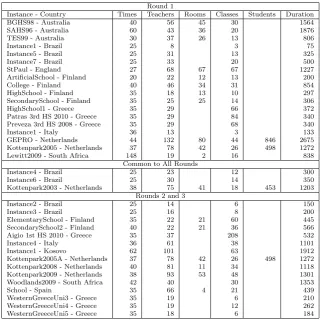
The ITC2011 problem instances (Post et al, 2012) contain four components in-cluding times, resources, events and constraints. A time component represents indivisible interval of time during which an event runs. A resource represents the entity which attends an event. For example, teacher, room, student or class are resources. An event is a meeting between resources. A constraint is the condition that a solution must/should satisfy, if possible. The ITC2011 problem instances contain 15 types of constraints in the overall: assign resource, assign time, split events, distribute split events, prefer resources, prefer times, avoid split assign-ments, spread events, link events, avoid clashes, avoid unavailable times, limit idle times, cluster busy times, limit busy times, limit workload (Post et al, 2012). In a standard fashion, constraints are separated intohardandsoft. Each constraint has a boolean variable calledRequiredto indicate whether the constraint is hard or soft. In the ITC2011 competition, such constraints are not strictly hard but are simply much more heavily penalised than the ’soft’ constraints.
A candidate solution is evaluated in terms of two components:feasibilityand
preferences. The evaluation function computes the weighted hard and soft con-straint violations for a given solution, where the weights are pre-defined in the input file representing a given instance, as infeasibility and objective values, re-spectively. The quality of a solution is denoted concatenating those two values as ininf easibility−value.objective−value using sufficient number of digits in the objective-value part and filling with 0s if necessary. For example, 10.000090 represents an infeasibility value of 10 and objective value of 90. For the compar-ison of algorithms, a solution is considered to be better than another if it has a smaller infeasibility value, or an equal infeasibility value and a smaller objective value. Post et al (2012) provides a more detailed description of the high school timetabling problem and ITC2011.
3.2 ITC2011 Dataset
Table 1 Characteristics of the problem instances used during three rounds of the competition
Round 1
Instance - Country Times Teachers Rooms Classes Students Duration
BGHS98 - Australia 40 56 45 30 1564
SAHS96 - Australia 60 43 36 20 1876
TES99 - Australia 30 37 26 13 806
Instance1 - Brazil 25 8 3 75
Instance5 - Brazil 25 31 13 325
Instance7 - Brazil 25 33 20 500
StPaul - England 27 68 67 67 1227
ArtificialSchool - Finland 20 22 12 13 200
College - Finland 40 46 34 31 854
HighSchool - Finland 35 18 13 10 297
SecondarySchool - Finland 35 25 25 14 306
HighSchool1 - Greece 35 29 66 372
Patras 3rd HS 2010 - Greece 35 29 84 340
Preveza 3rd HS 2008 - Greece 35 29 68 340
Instance1 - Italy 36 13 3 133
GEPRO - Netherlands 44 132 80 44 846 2675
Kottenpark2005 - Netherlands 37 78 42 26 498 1272
Lewitt2009 - South Africa 148 19 2 16 838
Common to All Rounds
Instance4 - Brazil 25 23 12 300
Instance6 - Brazil 25 30 14 350
Kottenpark2003 - Netherlands 38 75 41 18 453 1203
Rounds 2 and 3
Instance2 - Brazil 25 14 6 150
Instance3 - Brazil 25 16 8 200
ElementarySchool - Finland 35 22 21 60 445
SecondarySchool2 - Finland 40 22 21 36 566
Aigio 1st HS 2010 - Greece 35 37 208 532
Instance4 - Italy 36 61 38 1101
Instance1 - Kosovo 62 101 63 1912
Kottenpark2005A - Netherlands 37 78 42 26 498 1272
Kottenpark2008 - Netherlands 40 81 11 34 1118
Kottenpark2009 - Netherlands 38 93 53 48 1301
Woodlands2009 - South Africa 42 40 30 1353
School - Spain 35 66 4 21 439
WesternGreeceUni3 - Greece 35 19 6 210
WesternGreeceUni4 - Greece 35 19 12 262
WesternGreeceUni5 - Greece 35 18 6 184
4 A Multistage Hyper-heuristic Search for High School Timetabling
A stochastic local search algorithm is implemented for solving ITC2011 high school timetabling problems based on the selection hyper-heuristic framework as de-scribed in section 2.2 (Figure 1(b)) as a time contract algorithm which terminates after a given time, toverall for each instance. The approach consists of an initial
solution construction phase followed by an extensive improvement phase using a multistage selection hyper-heuristic. The pseudocode of the algorithm is provided in Figure 1. The initial construction of a complete solution is performed using the general solver implemented by Jeff Kingston as the KHE library3. The improve-ment phase uses the remaining time left (tremaining) after the construction of the
initial solution which takestinittime. Note that the construction phase often gives
a solution in which hard constraints are violated, and so the improvement phase also needs to improve the hard constraints. Until the given time limit is reached, the proposed approach switches between a diversification stage (stage A) which
3
employs a selection hyper-heuristic combining simple random heuristic selection with an adaptive move acceptance and an intensification stage (stage B) which employs a strict hill climbing process based on two heuristics (see section 2.2). Each stage takes a prefixed amount of time (tM U stageandtHCstage). Moreover,
stage A controls a threshold valueϵto relax the degree of consecutive worsening moves during the search process.
Algorithm 1Pseudocode of the proposed multistage hyper-heuristic. 1: procedureHySST Solver ITC2011(toverall,tM U stage,tHCstage)
2: S←create initial solution(); ◃takestinittime
3: tremaining←toverall−tinit;
4: Sbest←S;
5: thresholdList[] ={ϵ1, ϵ2, ..., ϵmaxLevel};
6: level←1;
7: whiletremainingnotExceededdo
8: Sstage best←S;
9: Sstage start←S;
10: ϵ←thresholdList[level]; ◃stage A entry usingϵ
11: whiletM U stage notExceeded&&tremainingnotExceededdo
12: LLH←SelectRandomlyF rom(M utationalHeuristics); 13: S′←ApplyHeuristic(LLH, S);
14: ifS′ isBetterT han Sbestthen
15: Sbest←S′;
16: end if
17: ifS′ isBetterT han Sstage bestthen
18: Sstage best←S′;
19: end if
20: S=M oveAcceptance(S, S′, Sstage best, ϵ); ◃threshold acceptance
21: end while
22: ifSstage bestisN otBetterT han Sstage startthen ◃stage B entry
23: whiletHCstagenotExceeded&&tremainingnotExceededdo
24: LLH←SelectRandomlyF rom(HillClimbers); 25: S′′←ApplyHeuristic(LLH, S);
26: ifS′′isBetterT han Sbestthen
27: Sbest←S′′;
28: end if
29: ifS′′isBetterT han Sstage bestthen
30: Sstage best←S′′;
31: end if
32: S←S′′; ◃accept all moves
33: end while
34: end if
35: ifSstage bestisN otBetterT han Sstage startthen
36: iflevel==maxLevelthen
37: S←Sstage start;
38: level←1;
39: else
40: level+ +;
41: end if
42: end if 43: end while 44: returnSbest;
45: end procedure
usefulness of restart in randomised search algorithms has already been known and different approaches have been proposed (Kautz et al, 2002; Luby et al, 1993). In this study, we use an adaptive threshold move acceptance method to enable ac-ceptance of worsening moves and partial restarts. The threshold move acac-ceptance method accepts all improved solutions or a worsening solution with a quality better than (1 +ϵ) of the quality of the best solution obtained during the search process at a stage. The acceptance of a worsening solution in this manner could be con-sidered as a partial restart on a given solution. The degree of a partial restart is indicated bylevelcontrolling the threshold value ofϵ. The larger the threshold is, the lower the quality of solutions that get accepted. The diversification stage is repeated within the time limits as long as the best solution obtained at the end of a stage (Sstage best) is of better quality than the best solution in hand at the
start of a stage (Sstage start). In a way, the diversification stage is parametrised
depending on ϵ. Each diversification stage using a differentϵ is considered as a different stage. If a diversification stage produces a worsening resultant solution, then the intensification stage which makes use of two hill climbing heuristics kicks in. If a solution cannot be improved even after an intensification stage, theϵvalue is increased to allow even larger changes in the solution causing larger worsening in its quality in the stage. We have used a discrete choice for the ϵ values and grabbed the next (previous) item from an ordered fixed-size threshold list in order to increase (decrease) its value. The minimum and maximum threshold values are limited with the first and last items in the list.
4.1 Low level heuristics
Two selection hyper-heuristics are employed operating cooperatively and mixing a set of 9 domain-specific low-level heuristics which are (mostly) fairly simple moves such as moving a task to a different resource, or swaps of events.
The diversification-stage selection hyper-heuristic manages seven mutational move operators:
– MH1:swap the time of two randomly selected events with a probability of %1
to split a randomly selected event into two events
– MH2:randomly select an event and reschedule to a random time slot
– MH3:swap the time of two events in case they have the same duration,
oth-erwise the event is moved to the following the last time slot occupied by the second event
– MH4:select one resource element within an event and change its assignment
to another
– MH5:swap two random resources
– MH6:reschedule resource element of an event to a random resource
– MH7: merge two randomly selected events adjacent in time and then assign
the same resources to both
first improvement hill climbing operator. Both hill climbing operators attempt to make moves which respect a particular constraint type while hoping to improve upon the other types of constraint violations but might have a net worsening of the objective, however, then such worsening moves are rejected. A hill climbing step is always non-worsening and so can be repeatedly applied in standard fashion until a local minimum is reached. A notable difference from standard methods (such as in memetic algorithms) is that we found that performance is better if the hill climbing is not applied if the mutational operators managed to improve the best solution. We suspect that excessive use of the hill climbing somehow gives over-optimised local solutions that afterwards lead to restricted movement within the search space.
5 Results
We joined ITC2011 as the team HySST (Hyper-heuristic Search Strategies and Timetabling) using the approach described in Section 4. At the end of the com-petition, there were four additional teams who were able to submit solutions for ITC2011: GOAL, HFT, Lectio and VAGOS. In this section, we present the results.
5.1 Multistage improvement using adaptive move acceptance
The multistage stochastic local search hyper-heuristic managing all low level heuris-tics and using the adaptive move acceptance for partial restarts turned out to be very effective in solving high school timetabling problems. If a small value of ϵ
does not provide any improvement in the solution quality in stage A, then its value is increased which causes acceptance of lower quality solutions and escape from a local optimum. Figure 2 provides a sample run on Instance4-Brazil using
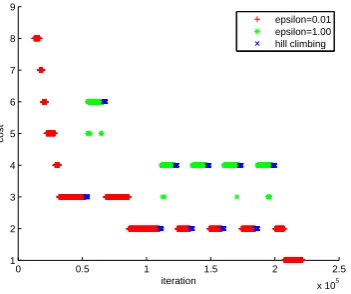
ϵ ={0.001, 0.33, 1.99} ignoring the strict hill climbing process in stage B. The plot shows that thereheatsdo lead to drastic drops in the cost of a solution, and without the reheats, the search is clearly stuck. For example, stage 0 (red points) performing almost strict hill climbing based onϵ= 0.001 is stuck and even stage 1 in whichϵis 0.33 (green points) is stuck. The blue points (stage 2) in Figure 2 are a strong relaxation whereϵ= 1.99, but do lead to later improvements.
0.0002 0.0004 0.0006 0.0008 0.001 0.0012 0.0014 0.0016 0.0018 0.002
2.2e+07 2.3e+07 2.4e+07 2.5e+07 2.6e+07 2.7e+07 2.8e+07
cost
iteration
level 1 level 2 level 3
Fig. 2 Cost versus iteration plot of a sample run towards the end of the search process which is obtained by applying the proposed approach to Instance4-Brazil using the threshold list of {0.001, 0.33, 1.99}.
0 0.5 1 1.5 2 2.5
x 105
1 2 3 4 5 6 7 8 9
iteration
cost
epsilon=0.01 epsilon=1.00 hill climbing
Fig. 3 Cost versus iteration plot of a sample run on WesternGreeceUni5.
5.2 Competition results
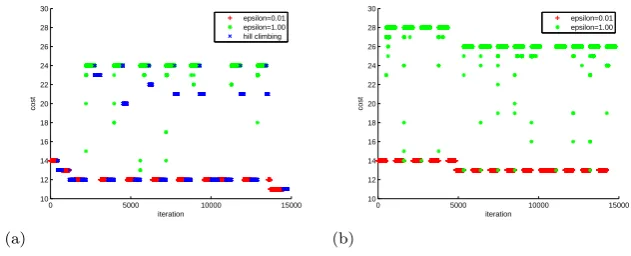
The proposed hyper-heuristic successfully improved upon the best previously known solutions (BKNs) for the Australian high school timetabling instances of BGHS98, SAHS96 and TES99 in the first round of the competition as shown in Table 2.
Table 2 The performance of the HySST approach in Round 1. The quality (cost) of a solution is indicated as feasibility-value.objective-value and BKN is the best previously known solution.
Dataset BKN HySST
[image:12.595.142.347.91.215.2] [image:12.595.159.335.283.430.2](a)
0 5000 10000 15000
10 12 14 16 18 20 22 24 26 28 30
iteration
cost
epsilon=0.01 epsilon=1.00 hill climbing
(b)
0 5000 10000 15000
10 12 14 16 18 20 22 24 26 28 30
iteration
cost
epsilon=0.01 epsilon=1.00
Fig. 4 Cost versus iteration plot for BGHS98 - Australia (a) with and (b) without hill climbing (stage B).
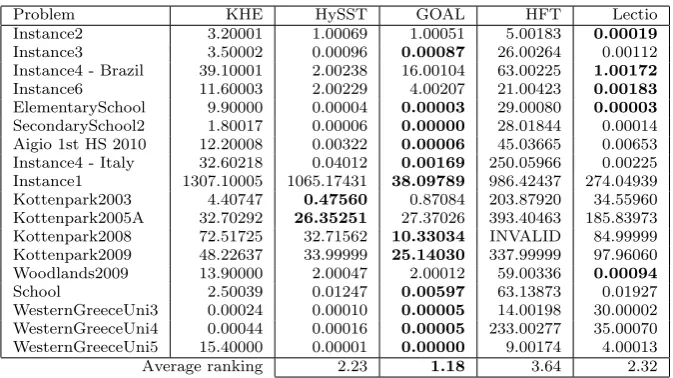
Table 3 summarises the results of Round 2 on the hidden instances. The column labelled as “KHE” shows the average quality of ten initial solutions produced by the constructive approach of the KHE library. The best feasibility/objective values over ten runs for each instance show that HySST performs the best on two instances of Kottenpark2003 and Kottenpark2005A from Netherland and worst on Instance1 - Kosovo. The results reveal that HFT and Lectio did not use the default constructive approach and they obtained solutions of quality which are even worse than the constructive approach achieves for 16 and 6 instances, respectively. Since the GOAL team submitted the Brazilian timetabling instances they are not considered for ranking for the first four instances. The table 3 provides, also, the average ranks of each approach based on their ranking for each instance per run. The proposed hyper-heuristic turns out to be the second best approach.
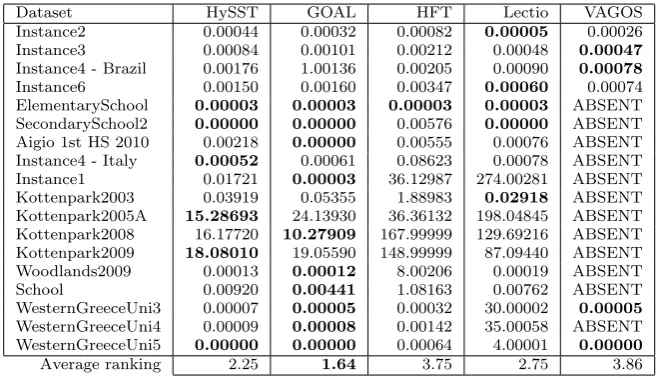
Table 4 summarises the feasibility/objective values obtained by the five com-petitors’ solvers including the developed hyper-heuristic (HySST) on the hidden instances on Round three. The proposed hyper-heuristic produced the best results in six including three ties out of eighteen instances. The GOAL team was not considered for the Brazilian instances for ranking in this round as well. The table 4 provides, also, the average ranks of each competing approach in round 3. Our selection hyper-heuristic became the second best approach.
6 Conclusion
[image:13.595.80.396.94.222.2]Table 3 The performance comparison of the HySST approach to the other competing ap-proaches over 10 trials showing the best quality (cost) of a solution indicated as feasibility-value.objective-value in Round 2. The best values are highlighted in bold.
Problem KHE HySST GOAL HFT Lectio
Instance2 3.20001 1.00069 1.00051 5.00183 0.00019 Instance3 3.50002 0.00096 0.00087 26.00264 0.00112 Instance4 - Brazil 39.10001 2.00238 16.00104 63.00225 1.00172 Instance6 11.60003 2.00229 4.00207 21.00423 0.00183 ElementarySchool 9.90000 0.00004 0.00003 29.00080 0.00003 SecondarySchool2 1.80017 0.00006 0.00000 28.01844 0.00014 Aigio 1st HS 2010 12.20008 0.00322 0.00006 45.03665 0.00653 Instance4 - Italy 32.60218 0.04012 0.00169 250.05966 0.00225 Instance1 1307.10005 1065.17431 38.09789 986.42437 274.04939 Kottenpark2003 4.40747 0.47560 0.87084 203.87920 34.55960 Kottenpark2005A 32.70292 26.35251 27.37026 393.40463 185.83973 Kottenpark2008 72.51725 32.71562 10.33034 INVALID 84.99999 Kottenpark2009 48.22637 33.99999 25.14030 337.99999 97.96060 Woodlands2009 13.90000 2.00047 2.00012 59.00336 0.00094 School 2.50039 0.01247 0.00597 63.13873 0.01927 WesternGreeceUni3 0.00024 0.00010 0.00005 14.00198 30.00002 WesternGreeceUni4 0.00044 0.00016 0.00005 233.00277 35.00070 WesternGreeceUni5 15.40000 0.00001 0.00000 9.00174 4.00013
Average ranking 2.23 1.18 3.64 2.32
between diversification and intensification processes automatically and allows par-tial restarts via a threshold move acceptance method whose parameter is also controlled by the proposed method. As the team HySST (Hyper-heuristic Search Strategies and Timetabling), we joined the ITC2011 with this multistage selection hyper-heuristic.
A selection hyper-heuristic should be “fast to implement, requiring far less expertise in either the problem domain or heuristic methods, and robust enough to effectively handle a range of problems” (Cowling et al, 2001). The teams HFT, Lectio and VAGOS attempted to develop tailored solutions in the given the limited time, while the HySST team preferred implementing a hyper-heuristic. At the end, our approach performed much better than the approaches proposed by those teams, but couldn’t beat the approach proposed by GOAL. However, the primary point of our work is that it shows the utility of the hyper-heuristic in that it makes better usage of the domain specific heuristics, and in particular demonstrates the advantages of multistage methods with adaptive relaxations.
References
Abramson D (1991) Constructing school timetables using simulated annealing: Sequential and parallel algorithms. Management Science 37(1):98–113
Table 4 The best-of-runs performance comparison of the HySST approach to the other com-peting approaches using the quality (cost) of a solution indicated as feasibility-value.objective-value in Round 3. The best feasibility-value.objective-values are highlighted in bold.
Dataset HySST GOAL HFT Lectio VAGOS
Instance2 0.00044 0.00032 0.00082 0.00005 0.00026 Instance3 0.00084 0.00101 0.00212 0.00048 0.00047 Instance4 - Brazil 0.00176 1.00136 0.00205 0.00090 0.00078 Instance6 0.00150 0.00160 0.00347 0.00060 0.00074 ElementarySchool 0.00003 0.00003 0.00003 0.00003 ABSENT SecondarySchool2 0.00000 0.00000 0.00576 0.00000 ABSENT Aigio 1st HS 2010 0.00218 0.00000 0.00555 0.00076 ABSENT Instance4 - Italy 0.00052 0.00061 0.08623 0.00078 ABSENT Instance1 0.01721 0.00003 36.12987 274.00281 ABSENT Kottenpark2003 0.03919 0.05355 1.88983 0.02918 ABSENT Kottenpark2005A 15.28693 24.13930 36.36132 198.04845 ABSENT Kottenpark2008 16.17720 10.27909 167.99999 129.69216 ABSENT Kottenpark2009 18.08010 19.05590 148.99999 87.09440 ABSENT Woodlands2009 0.00013 0.00012 8.00206 0.00019 ABSENT
School 0.00920 0.00441 1.08163 0.00762 ABSENT
WesternGreeceUni3 0.00007 0.00005 0.00032 30.00002 0.00005 WesternGreeceUni4 0.00009 0.00008 0.00142 35.00058 ABSENT WesternGreeceUni5 0.00000 0.00000 0.00064 4.00001 0.00000
Average ranking 2.25 1.64 3.75 2.75 3.86
Abramson D, Dang H, Krisnamoorthy M (1999) Simulated annealing cooling schedules for the school timetabling problem. Asia-Pacific Journal of Opera-tional Research 16:1–22
Beligiannis GN, Moschopoulos CN, Kaperonis GP, Likothanassis SD (2008) Ap-plying evolutionary computation to the school timetabling problem: The greek case. Computers & Operations Research 35(4):1265 – 1280
Bello GS, Rangel MC, Boeres MCS (2008) An Approach for the Class /Teacher Timetabling Problem. In: PATAT ’08 Proceedings of the 7th International Con-ference on the Practice and Theory of Automated Timetabling
Birbas T, Daskalaki S, Housos E (2009) School timetabling for quality student and teacher schedules. J of Scheduling 12(2):177–197
Broder S (1964) Final examination scheduling. Commun ACM 7(8):494–498 Burke EK, Landa-Silva JD, Soubeiga E (2005) Meta-heuristics: Progress as Real
Problem Solvers, Springer, chap Multi-objective Hyper-heuristic Approaches for Space Allocation and Timetabling, pp 129–158,
Burke EK, Curtois T, Hyde MR, Kendall G, Ochoa G, Petrovic S, Rodr´ıguez JAV, Gendreau M (2010a) Iterated local search vs. hyper-heuristics: Towards general-purpose search algorithms. In: IEEE Congress on Evolutionary Computation, pp 1–8
Burke EK, Hyde M, Kendall G, Ochoa G, ¨Ozcan E, Woodward JR (2010b) A classification of hyper-heuristics approaches. In: Gendreau M, Potvin JY (eds) Handbook of Metaheuristics, International Series in Operations Research & Management Science, vol 57, 2nd edn, Springer, chap 15, pp 449–468
Chakhlevitch K, Cowling P (2005) Choosing the fittest subset of low level heuristics in a hyperheuristic framework. In: Proceedings of 5th European Conference on Evolutionary Computation in Combinatorial Optimization (EvoCOP2005), Springer, Lecture Notes in Computer Science, vol 3448, pp 25–33
Chakhlevitch K, Cowling P (2008) Hyperheuristics: Recent developments. In: Cotta C, Sevaux M, Srensen K (eds) Adaptive and Multilevel Metaheuristics, Studies in Computational Intelligence, vol 136, Springer Berlin Heidelberg, pp 3–29
Colorni A, Dorigo M, Maniezzo V (1992) A genetic algorithm to solve the timetable problem. Tech. Rep. Technical Report No. 90-060, Politecnico di Milano, Italy Corne D, Ross P, Fang HL (1994) Fast practical evolutionary timetabling. In:
Selected Papers from AISB Workshop on Evolutionary Computing, Springer-Verlag, London, UK, UK, pp 250–263
Cowling P, Chakhlevitch K (2003) Hyperheuristics for managing a large collection of low level heuristics to schedule personnel. In: Proceedings of the 2003 Congress on Evolutionary Computation, pp 1214–1221
Cowling P, Kendall G, Soubeiga E (2001) A hyperheuristic approach to scheduling a sales summit. In: Selected papers from the Third International Conference on Practice and Theory of Automated Timetabling, Springer-Verlag, London, UK, pp 176–190
Erben W, Keppler J (1996) A genetic algorithm solving a weekly course-timetabling problem. In: Burke E, Ross P (eds) Practice and Theory of Au-tomated Timetabling, Lecture Notes in Computer Science, vol 1153, Springer Berlin Heidelberg, pp 198–211
Even S, Itai A, Shamir A (1976) On the Complexity of Timetable and Multicom-modity Flow Problems. SIAM Journal on Computing 5(4):691–703
Filho GR, Antonio L, Lorena LAN (2001) A constructive evolutionary approach to school timetabling. In: In Applications of Evolutionary Computing, Springer Lecture, pp 130–139
Fisher H, Thompson GL (1963) Probabilistic learning combinations of local job-shop scheduling rules. In: Muth JF, Thompson GL (eds) Industrial Scheduling, Prentice-Hall, Inc, New Jersey, pp 225–251
Hertz A (1992) Finding a feasible course schedule using a tabu search. Discrete Applied Mathematics 35:255–270
Jacobsen F, Bortfeldt A, Gehring H (2006) Timetabling at German Secondary Schools: Tabu Search versus Constraint Programming. In: in Proceedings 6th international conference on the practice and theory of automated timetabling, PATAT2006, pp 439–442
Kannan A, van den Berg G, Kuo A (2012) ischedule to personalize learning. In-terfaces 42(5):437–448
Kautz H, Horvitz E, Ruan Y, Gomes C, Selman B (2002) Dynamic restart policies. In: Eighteenth national conference on Artificial intelligence, American Associa-tion for Artificial Intelligence, Menlo Park, CA, USA, pp 674–681
Kendall G, Mohamad M (2004) Channel assignment optimisation using a hyper-heuristic. In: Proceedings of the 2004 IEEE Conference on Cybernetic and In-telligent Systems (CIS2004), Singapore, pp 790–795
Louren¸co HR, Martin OC, St¨utzle T (2010) Iterated local search: Framework and applications. In: Gendreau M, Potvin JY (eds) Handbook of Metaheuristics, International Series in Operations Research and Management Science, vol 146, Springer US, pp 363–397
Luby M, Sinclair A, Zuckerman D (1993) Optimal speedup of Las Vegas algo-rithms. Information Processing Letters 47(4):173–180
Marte M (2007) Towards constraint-based school timetabling. Annals of Opera-tions Research 155:207–225
McCollum B, Schaerf A, Paechter B, McMullan P, Lewis R, Parkes AJ, Gaspero LD, Qu R, Burke EK (2010) Setting the research agenda in automated timetabling: The second international timetabling competition. INFORMS J on Computing 22(1):120–130
Moura AV, Scaraficci RA (2010) A GRASP strategy for a more constrained School Timetabling Problem. International Journal of Operational Research 7
Mustafa M (2012) Intelligent hyperheuristics: A tool for solving generic optimi-sation problems. PhD thesis, Department of Computer Science, KU Leuven, Belgium
¨
Ozcan E, Kheiri A (2011) A hyper-heuristic based on random gradient, greedy and dominance. In: Gelenbe E, Lent R, Sakellari G (eds) ISCIS, Springer, pp 557–563
¨
Ozcan E, Bilgin B, Korkmaz EE (2008) A comprehensive analysis of hyper-heuristics. Intelligent Data Analysis 12(1):3–23
¨
Ozcan E, Bykov Y, Birben M, Burke E (2009) Examination timetabling using late acceptance hyper-heuristics. In: Evolutionary Computation, 2009. CEC ’09. IEEE Congress on, pp 997 –1004
¨
Ozcan E, Parkes AJ, Alkan A (2012) The interleaved constructive memetic algo-rithm and its application to timetabling. Comput Oper Res 39(10):2310–2322 Pillay N (2010a) An overview of school timetabling research. In: Proceedings of
the 8th International Conference on the Practice and Theory of Automated Timetabling (PATAT 2010), pp 321–335
Pillay N (2010b) A study into the use of hyper-heuristics to solve the school timetabling problem. In: Proceedings of the 2010 Annual Research Conference of the South African Institute of Computer Scientists and Information Technol-ogists, ACM, New York, NY, USA, SAICSIT ’10, pp 258–264
Pillay N (2012) Hyper-heuristics for educational timetabling. In: Proceedings of the Ninth International Conference on the Practice and Theory of Automated Timetabling (PATAT 2012)
Pisinger D, Ropke S (2007) A general heuristic for vehicle routing problems. Com-puters and Operations Research 34:2403– 2435
Post G, Ahmadi S, Daskalaki S, Kingston JH, Kyngas J, Nurmi C, Ranson D (2012) An xml format for benchmarks in high school timetabling. Annals of Operations Research 194(1):385–397
Post G, Gaspero LD, Kingston JH, McCollum B, Schaerf A (2012) The third in-ternational timetabling competition. In: Proceedings of the Ninth Inin-ternational Conference on the Practice and Theory of Automated Timetabling (PATAT 2012)
Technol-ogists on IT research in developing countries: riding the wave of technology, ACM, New York, NY, USA, SAICSIT ’08, pp 193–199
Raghavjee R, Pillay N (2010) Using genetic algorithms to solve the south african school timetabling problem. In: Second World Congress on Nature & Biologically Inspired Computing, NaBIC 2010, 15-17 December 2010, Kitakyushu, Japan, IEEE, pp 286–292
Ross P (2005) Hyper-heuristics. In: Burke EK, Kendall G (eds) Search Methodolo-gies: Introductory Tutorials in Optimization and Decision Support Techniques, Springer, chap 17, pp 529–556
Ross P, Corne D, Fang HL (1994) Improving evolutionary timetabling with delta evaluation and directed mutation. In: Davidor Y, Schwefel HP, M¨anner R (eds) Parallel Problem Solving from Nature, PPSN III, Lecture Notes in Computer Science, vol 866, Springer Berlin / Heidelberg, pp 556–565
Schaerf A (1996) Tabu search techniques for large high-school timetabling prob-lems. In: Proceedings of the thirteenth national conference on Artificial intelli-gence - Volume 1, AAAI Press, AAAI’96, pp 363–368
Smith KA, Abramson D, Duke D (2003) Hopfield neural networks for timetabling: formulations, methods, and comparative results. Comput Ind Eng 44(2):283–305 Valouxis C, Housos E (2003) Constraint programming approach for school
timetabling. Computers and Operations Research 30(10):1555–1572
de Werra D (1997) The combinatorics of timetabling. European Journal of Oper-ational Research 96(3):504–513