ISSN Online: 2151-4771 ISSN Print: 2151-4755
DOI: 10.4236/ce.2019.1012204 Nov. 28, 2019 2775 Creative Education
Sketching Engineering Design in STEM
Classroom: A Systematic Review
Siti Hajar Aisyah Zainuddin, Zanaton H. Iksan
Faculty of Education, Universiti Kebangsaan Malaysia, Bangi, Malaysia
Abstract
Numerous studies in the last two decades have attempted to explain the sig-nificant relationship between effects of freehand sketching especially in the initial phase of idea generation in engineering design process approach. However, freehand sketches are not favoured by novice designer while gene-rating design task. This paper aim to map how sketching skills benefit STEM- enriched learning environment and enabling visually communicated ideas to craft novelty solutions. This systematic review analysed nine papers that use sketch as design tool in STEM enriched engineering design activities. The li-terature is retrieved from established online database such as SCOPUS and EBSCOHOST. Sketch significantly proves as powerful tool in prompting vis-ual ideas, reflect prior knowledge, aid communication and collaborative prac-tise and engage active learning. The infancy of research using matured stu-dent sample, different ethnic and social economic background will create in-teresting research opportunities in multiracial nation.
Keywords
Sketch, Engineering Design, Integrated STEM, Design, Systematic Literature Review
1. Introduction
Integration of science, technology, engineering and mathematics (STEM) in education is believed by educators and researchers worldwide as catalyst in em-powering global economy. Hence, STEM-integrated approach has been in the limelight among practitioners in order to achieve the mission to produce quali-fied STEM professionals and inculcate STEM literacy to future global citizens
(MOE, 2013). Educational researchers claimed the effectiveness of implementing STEM-integrated activities soars by generating competitive workforce equipped
How to cite this paper: Zainuddin, S. H. A., & Iksan, Z. H. (2019). Sketching Engi-neering Design in STEM Classroom: A Sys-tematic Review. Creative Education, 10, 2775-2783.
https://doi.org/10.4236/ce.2019.1012204
Received: October 21, 2019 Accepted: November 25, 2019 Published: November 28, 2019
Copyright © 2019 by author(s) and Scientific Research Publishing Inc. This work is licensed under the Creative Commons Attribution International License (CC BY 4.0).
DOI: 10.4236/ce.2019.1012204 2776 Creative Education
with 21st century skills (Husin et al., 2016), elevating students’ interest (Mohd Shahali, Halim, Rasul, Osman, & Mohamad Arsad, 2018); and improve cogni-tive domain. Problem-based, project-based or design-based learning were the typical instructional approach to carry out integrated STEM lesson in the class-room.
Recently, design-based learning has gained special attention among educators and researchers (Kelley & Sung, 2017; King, English, King, & English, 2016; Eng-lish & King, 2018). For example, United States put emphasized in teaching engi-neering design in K-12 STEM classroom, focusing on younger grades (Kelley & Sung, 2017). In the recent education transformation, Malaysia introduced design and technology subject as new elective subject in national curriculum. Flexibility characteristics of design enable its application in various area of interest (Kelley & Sung, 2017; Wendell et al., 2010) including engineering design (Dym, Agoni-no, Eris, Frey, & Leifer, 2005). Growing body of literature supported the effec-tiveness of engineering design in elevating student interest in STEM subjects and sustain affection towards future STEM career (Mohd Shahali, Halim, Rasul, Osman, & Mohamad Arsad, 2018; Tseng, Chang, Lou, & Chen, 2013). Com-pared to conventional learning model, engineering design generates creativity by giving students chances to design novelty real-world solution (Bartholomew & Strimel, 2018). Furthermore, students are more likely to involve in engineering design activities when compared to other components of the integrated discip-line (Tseng, Chang, Lou, & Chen, 2013).
2. Engineering Design Learning in STEM
Systematic literature review by (Strimel & Grubbs, 2017) extensively map the P-16 United States curricula using different number of engineering design process models. Engineers design creative solutions to solve real-world problems
(Goktepe Yildiz & Ozdemir, 2018). Students are directed by the five-step process in engineering design in order to solve an open-ended design process. Students share positive outcome engaging actively engineering design challenges. Im-mersing students in engineering design processes and engineering practices creates meaningful and deepen core understanding (Guzey, Moore, Harwell, & Moreno, 2016; Shahali, Halim, Rasul, Osman, & Zulkifeli, 2017).
In engineering design activities, students, individual or collaboratively, pro-duced authentic artefacts or solutions to accomplish design. A strong relation-ship between sketching and design has been reported in the literature (Hilton, Li, Newton, Alemdar, Pucha, & Linsey, 2016). Thus, sketch and design are in-ter-related. Purpose of sketching rose from assisting the abstraction process, understand ill-defined problems and guide explorations of idea (Taborda, Chandrasegaran, Kisselburgh, Reid, & Ramani, 2012). Creativity, ability to think critically, communicate and collaborate are the skills of successful future work-force of the 21st century (Strimel & Grubbs, 2017). Creative citizens are coined as
fos-DOI: 10.4236/ce.2019.1012204 2777 Creative Education
ter economic growth of the nation. Hence, cultivating students design abilities can be highly beneficial for STEM learning concepts and develop higher order thinking. (Grubbs, Strimel, & Kim, 2018)pointed out the importance of method of teaching and scaffolding techniques by teachers by identifying student design strategies, cognitive effort and ability to apply STEM concepts to achieve mea-ningful learning.
In Malaysian context, Bitara STEM programmed implement engineering de-sign process in its activities to inculcate towards interest on STEM and STEM careers (Edy Hafizan, Lilia, Faszly, Kamisah, Zanaton, & Sattar, 2015). The in-formal learning provides opportunities to students by experiencing “real-life” engineer roles and creatively solve real-world problems. Additionally, students who involve in engineering project learn how to solve problems, initiate creative thinking, acquire communication skills and able to work collaboratively (Guzey, Moore, Harwell, & Moreno, 2016).
Freehand Sketching in Engineering-Design Learning
Freehand sketch is the simplest and fastest technique to visualize the idea by us-ing the simplest tool yet efficient—paper and pencil. Besides, sketch adds value by acting as communication tool in delivering designer’s big idea. Numerous studies in the last two decades have attempted to explain the relationship be-tween positive effects of freehand sketching and its impact in engineering educa-tion especially in the initial phase of idea generaeduca-tion process. However, freehand sketches are not favoured by current engineering student while generating de-sign task (Schmidt, Hernandez, & Ruocco, 2012). Development of digital source such as CAD software in the engineering curricular prompted the neglect of sketching among novice designer (Hilton, Paige, Williford, Li, Hammond, & Linsey, 2017; Uziak & Fang, 2018). The result agreed with the findings of other studies, in which prove to become a challenge in promoting the use of sketching as routine practise and design thinking among novice designers (Hilton, Paige, Williford, Li, Hammond, & Linsey, 2017; Hammond, Hilton, Linsey, Gamble, & Li, 2018; Sung, Kelley, & Han, 2019).
Several studies investigating freehand sketching have been carried out on its ability to improve spatial visualization skills. Quasi-experimental outcome from
DOI: 10.4236/ce.2019.1012204 2778 Creative Education
3. Methodology
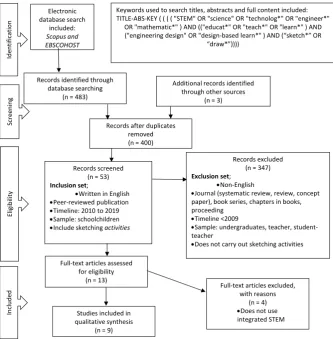
The construction of systematic literature review is based on Preferred Reporting Items for Systematic Reviews and Meta-Analyses (PRISMA) which involves four phases: 1) identification, 2) screening, 3) eligibility and 4) inclusion. Well-known online research databases which are related to education, engineering and tech-nology were selected to locate relevant literature sources using combination of keywords. The search key string used to retrieve literature are as in Figure 1. The last search is conducted on 18 June 2019. The search produces 31 articles. After inclusion and exclusion criteria, only 13 remains. After that, the abstract of each article was read to further eliminate articles that did not match the specific criteria of inclusion set. Nine articles remain as final.
[image:4.595.201.535.341.681.2]4. Result and Discussion
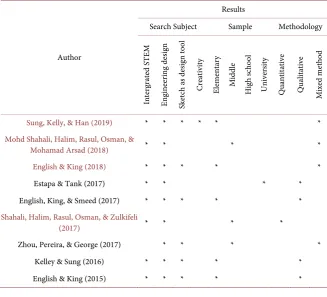
Table 1 visually indicates the void of research within past efforts, thus paving way for future research undertakings. The growing literature body of integrated STEM, engineering design and sketch as design tool produced significant dis-covery in implementation of engineering design in the classroom.
Figure 1. A flow diagram detailing the application of PRISMA to the qualitative synthesis of relevant literature of sketching in STEM research conducted between January 2010 and June 2019. Id en tif ica tio n Sc reen in g El igi bi lit y Inc lude d
Records after duplicates removed (n = 400)
Records screened (n = 53) Inclusion set;
•Written in English •Peer-reviewed publication •Timeline: 2010 to 2019 •Sample: schoolchildren •Include sketching activities
Records excluded (n = 347) Exclusion set;
•Non-English
•Journal (systematic review, review, concept paper), book series, chapters in books, proceeding
•Timeline <2009
•Sample: undergraduates, teacher, student-teacher
•Does not carry out sketching activities Additional records identified
through other sources (n = 3) Records identified through
database searching (n = 483) Electronic database search
included: Scopus and EBSCOHOST
Full-text articles assessed for eligibility
(n = 13)
Studies included in qualitative synthesis
(n = 9)
Full-text articles excluded, with reasons
(n = 4) •Does not use integrated STEM Keywords used to search titles, abstracts and full content included: TITLE-ABS-KEY ( ( ( ( "STEM" OR "science" OR "technolog*" OR "engineer*"
OR "mathematic*" ) AND (("educat*" OR "teach*" OR "learn*" ) AND ("engineering design" OR "design-based learn*" ) AND (“sketch*” OR
DOI: 10.4236/ce.2019.1012204 2779 Creative Education
Table 1 shows the high opportunities of studies which combine STEM, engi-neering design and sketch as design tool in stimulating creativity. From nine studies listed, only five incorporate sketches in their research design. This prove sketching in engineering design, in the context of integrating STEM teaching and learning is still in infancy. Sketching is perceived as “traditional technology” in the emergence of high-end digital gadgets pro to designing, nevertheless serve wide potential in engineering design education research. Previous research has indicated sketching possess positive impact on initial stage generation of idea in solving open-ended problems visually (King, English, King, & English, 2016), producing innovation by creating authentic products (Kelley & Sung, 2017) or simply act as communication support (Taborda, Chandrasegaran, Kisselburgh, Reid, & Ramani, 2012). Currently, the focus of research involving sketching is to gain understanding how student use sketching to learn and how the process in-tegrate and support science learning (Kelley & Sung, 2017). focusing on middle schoolchildren as the “gate barrier” in early STEM attainment (Shahali, Halim, Rasul, Osman, & Zulkifeli, 2017).
Three search results by (English, 2018)is actually part of longitudinal research in inculcating engineering design process thinking among elementary school-children. This due to (Booth, Bhasin, & Ramani, 2014) that sketching are skills that require time to develop. All five studies agreed that teacher’s instruction play major role in supporting younger children ability to produce design in en-gineering-based project. In terms of research framework, (Kelley & Sung, 2017)
Table 1. Overview of research paper based on search result, subject and methodology.
Author
Results
Search Subject Sample Methodology
In ter gr at ed S TE M En gi neer in g des ign Sk etch as des ign to ol Cr eat iv ity El em en tar y M id dle H ig h s cho ol U niv er sit y Q ua nti ta tiv e Q ua lit at iv e M ix ed m et ho d
Sung, Kelly, & Han (2019) * * * * * *
Mohd Shahali, Halim, Rasul, Osman, &
Mohamad Arsad (2018) * * * *
English & King (2018) * * * * *
Estapa & Tank (2017) * * * * English, King, & Smeed (2017) * * * * *
Shahali, Halim, Rasul, Osman, & Zulkifeli
(2017) * * * *
DOI: 10.4236/ce.2019.1012204 2780 Creative Education
applied the works from (Hope, 2008)which identify cognitive levels by classifi-cation of student drawing designs while, (King, English, King, & English, 2016)
use the approach by (Crismond & Adams, 2012).
The successful of integrating design sketch depend on instructional methods by practitioners. (Kelley & Sung, 2017) proposed that young children need to be rationalized on sketch uses in completing their design task; creating meaningful learning. Sketches should be valued by the content of its ideas instead of the end product. Integrating design activities means higher time consumption in teach-ing and learnteach-ing. Thus, becomes inhibitor for teachers as preferred choice of STEM instructional strategies in the classroom. As solution, the urge in using modular approach should be considered. Online resource prepared as guideline to assist teachers in implementing modular approach in schools. This create po-tential pool of research in investigating social interaction (i.e. student-student; teacher-student; teacher-teacher) and knowledge interaction (i.e. subject-subject) occurrence.
Teachers should consider the inhibitor of design process among students. In-corporating visual art in sketch designing helps to improve the student’s motiva-tion and lower the cognitive load to avoid frustramotiva-tion. This will test the skill of communication among teachers as middle school learners tend to give up. This also include on how teachers motivate the learners to improve their sketches while not focusing the details of the sketches but to the content of the sketches itself.
Sketching in engineering design is part of alternative assessment in measuring conceptual understanding in science learning. Alas, teachers need to be trained to understand the role of sketching in design, as well as how to assess the prod-uct of design sketch. Further work needs to be done to establish the understand-ing and self-efficacy of teacher to carry out design assessment as it will influence the result of design instruction.
5. Conclusion
This review analyses nine literatures which study include the use of sketch as process in engineering design in integrated STEM learning environment. Qua-litative and mixed method is chosen as research design in all the study to record student’s cognitive and affective response towards learning design. Sketch has been proven as powerful tool in prompting students to give ideas visually, inves-tigate prior knowledge and aid communication and collaborative practise, en-gaging active learning. The infancy of research uses matured student sample, different ethnic and social economic background creating interesting research opportunities in multiracial nation.
Acknowledgements
DOI: 10.4236/ce.2019.1012204 2781 Creative Education
Teacher Scholarship Programme at the Ministry of Education, Malaysia for pro-viding the funding for her studies in Universiti Kebangsaan Malaysia.
Conflicts of Interest
The authors declare no conflicts of interest regarding the publication of this pa-per.
References
Bartholomew, S. R., & Strimel, G. J. (2018). Factors Influencing Student Success on Open-Ended Design Problems. International Journal of Technology and Design Edu-cation, 28, 753-770. https://doi.org/10.1007/s10798-017-9415-2
Booth, J. W., Bhasin, A. K., & Ramani, K. (2014). Art Meets Engineering Design: An Ap-proach for Reducing Sketch Inhibition in Engineers during the Design Process. In
ASME 2014 International Design Engineering Technical Conferences & Computers and Information in Engineering Conference (pp. 1-12). Buffalo.
https://doi.org/10.1115/DETC2014-35278
Crismond, D., & Adams, R. S. (2012). A Scholarship of Integration: The Matrix of In-formed Design. Journal of Engineering Education, 101, 738-797.
https://doi.org/10.1002/j.2168-9830.2012.tb01127.x
Dym, C. L., Agonino, A. M., Eris, O., Frey, D. D., & Leifer, L. J. (2005). Engineering De-sign Thinking, Teaching, and Learning. Journal of Engineering Education, 94, 103-120. https://doi.org/10.1002/j.2168-9830.2005.tb00832.x
Edy Hafizan, M. S., Lilia, H., Faszly, R., Kamisah, O., Zanaton, I., & Sattar, R. (2015). Bi-tara-Stem Training of Trainers’ Programme: Impact on Trainers’ Knowledge, Beliefs, Attitudes and Efficacy towards Integrated Stem Teaching. Journal of Baltic Science Education, 14, 85-96.
English, L. D. (2018). Learning While Designing in a Fourth-Grade Integrated STEM Problem. International Journal of Technology and Design Education, 1-22.
https://doi.org/10.1007/s10798-018-9482-z
English, L. D., & King, D. (2018). STEM Integration in Sixth Grade: Desligning and Con-structing Paper Bridges. International Journal of Science and Mathematics Education, 17, 863-884. https://doi.org/10.1007/s10763-018-9912-0
Goktepe Yildiz, S., & Ozdemir, A. S. (2018). The Effects of Engineering Design Processes on Spatial Abilities of Middle School Students. International Journal of Technology and Design Education, 1-22. https://doi.org/10.1007/s10798-018-9491-y
Grubbs, M. E., Strimel, G. J., & Kim, E. (2018). Examining Design Cognition Coding Schemes for P-12 Engineering/Technology Education. International Journal of Tech-nology and Design Education, 28, 1-22. https://doi.org/10.1007/s10798-017-9427-y Guzey, S. S., Moore, T. J., Harwell, M., & Moreno, M. (2016). STEM Integration in
Mid-dle School Life Science: Student Learning and Attitudes. Journal of Science Education and Technology, 25, 550-560. https://doi.org/10.1007/s10956-016-9612-x
Hammond, T., Hilton, E. C., Linsey, J. S., Gamble, T., & Li, W. (2018). Back to Basics: Sketching, Not CAD, Is the Key to Improving Essential Engineering Design Skills. In
International Design Engineering Technical Conferences and Computers and Informa-tion in Engineering Conference (V007T06A051). Quebec.
https://doi.org/10.1115/DETC2018-86325
Confe-DOI: 10.4236/ce.2019.1012204 2782 Creative Education
rence on Engineering Design (pp. 217-224). Vancouver.
Hilton, E., Li, W., Newton, S. H., Alemdar, M., Pucha, R., & Linsey, J. (2016). The Devel-opment and Effects of Teaching Perspective Free-Hand Sketching in Engineering De-sign. In Proceedings of the ASME 2016 International Design Engineering Technical Conferences and Computers and Information in Engineering Conference IDETC/CIE 2016 (pp. 1-8). Charlotte.
Hope, G. (2008). Thinking and Learning through Drawing. Thousand Oaks, CA: SAGE Publication Ltd.
Husin, W. N. F. W. et al. (2016). Fostering Students’ 21st Century Skills through Project Oriented Problem Based Learning (POPBL) in Integrated STEM Education Program.
Asia-Pacific Forum on Science Learning and Teaching, 17, 1-19.
Kelley, T. R., & Sung, E. (2017). Sketching by Design: Teaching Sketching to Young Learners. International Journal of Technology and Design Education, 27, 363-386. https://doi.org/10.1007/s10798-016-9354-3
King, D., English, L. D., King, D., & English, L. D. (2016). Engineering Design in the Pri-mary School: Applying Stem Concepts to Build an Optical Instrument Concepts to Build an Optical Instrument. International Journal of Science Education, 38, 2762- 2794.
MOE (2013). Malaysia Education Blueprint 2013-2025.
Mohd Shahali, E. H., Halim, L., Rasul, M. S., Osman, K., & Mohamad Arsad, N. (2018). Students’ Interest towards STEM: A Longitudinal Study. Research in Science & Tech-nological Education, 37, 1-19. https://doi.org/10.1080/02635143.2018.1489789
Schmidt, L. C., Hernandez, N. V., & Ruocco, A. L. (2012). Research on Encouraging Sketching in Engineering Design. Artificial Intelligence for Engineering Design, Analy-sis and Manufacturing, 26, 303-315. https://doi.org/10.1017/S0890060412000169 Shahali, E. H. M., Halim, L., Rasul, M. S., Osman, K., & Zulkifeli, M. A. (2017). STEM
Learning through Engineering Design: Impact on Middle Secondary Students’ Interest towards STEM. Eurasia Journal of Mathematics, Science and Technology Education, 13, 1189-1211. https://doi.org/10.12973/eurasia.2017.00667a
Srinivasan, A., Smith, J. D., & Bairaktarova, D. (2016). Identifying Freehand Sectional View Technical Drawing Activities in Engineering Design Graphics Course to Enhance Spatial Skills of Engineering Students. In International Design Engineering Technical Conferences and Computers and Information in Engineering Conference (Vol. 3, pp. 1-7). Charlotte. https://doi.org/10.1115/DETC2016-60079
Strimel, G., & Grubbs, M. (2017). A Critical Examination of Engineering Design Processes and Procedures. In Proceedings of the 33rd Pupil’s Attitude toward Technology Con-ference. Philadelphia: Millersville University.
Sung, E., Kelley, T. R., & Han, J. (2019). Influence of Sketching Instruction on Elementary Students’ Design Cognition: A Study of Three Sketching Approaches. Journal of Engi-neering Design, 30, 199-226.
Taborda, E., Chandrasegaran, S., Kisselburgh, L., Reid, T., & Ramani, K. (2012). Enhanc-ing Visual ThinkEnhanc-ing in a Toy Design Course UsEnhanc-ing Freehand SketchEnhanc-ing. In Proceedings of ASME IDETC/CIE 2012 (p. 10). Chicago. https://doi.org/10.1115/DETC2012-71454 Tseng, K.-H., Chang, C.-C., Lou, S.-J., & Chen, W.-P. (2013). Attitudes towards Science,
Technology, Engineering and Mathematics (STEM) in a Project-Based Learning (PjBL) Environment. International Journal of Technology and Design Education, 23, 87-102. https://doi.org/10.1007/s10798-011-9160-x
Uttal, D. H., & Cohen, C. A. (2012). Spatial Thinking and STEM Education: When, Why,
DOI: 10.4236/ce.2019.1012204 2783 Creative Education https://doi.org/10.1016/B978-0-12-394293-7.00004-2
Uziak, J., & Fang, N. (2018). Improving Students’ Freehand Sketching Skills in Mechani-cal Engineering Curriculum. International Journal of Mechanical Engineering Educa-tion, 46, 274-286. https://doi.org/10.1177/0306419017744156
Wendell, K. et al. (2010). Incorporating Engineering Design into Elementary School Science Curricula. In ASEE Annual Conference and Exposition, Conference Proceed-ings. Louisville.