doi:10.4236/wsn.2009.14035 Published Online November 2009 (http://www.scirp.org/journal/wsn).
The Estimation of Radial Exponential Random
Vectors in Additive White Gaussian Noise
P. Kittisuwan1, S. Marukatat2, W. Asdornwised1 1
Department of Electrical Engineering, Faculty of Engineering, Chulalongkorn University, Bangkok, Thailand
2Image Laboratory, National Electronics and Computer Technology Center (NECTEC), Thailand Email: [email protected], [email protected], [email protected]
Received April 22, 2009; revised June 15, 2009; accepted June 22, 2009
Abstract
Image signals are always disturbed by noise during their transmission, such as in mobile or network commu-nication. The received image quality is significantly influenced by noise. Thus, image signal denoising is an indispensable step during image processing. As we all know, most commonly used methods of image de-noising is Bayesian wavelet transform estimators. The Performance of various estimators, such as maximum a posteriori (MAP), or minimum mean square error (MMSE) is strongly dependent on correctness of the proposed model for original data distribution. Therefore, the selection of a proper model for distribution of wavelet coefficients is important in wavelet-based image denoising. This paper presents a new image de-noising algorithm based on the modeling of wavelet coefficients in each subband with multivariate Radial Exponential probability density function (PDF) with local variances. Generally these multivariate extensions do not result in a closed form expression, and the solution requires numerical solutions. However, we drive a closed form MMSE shrinkage functions for a Radial Exponential random vectors in additive white Gaussian noise (AWGN). The estimator is motivated and tested on the problem of wavelet-based image denoising. In the last, proposed, the same idea is applied to the dual-tree complex wavelet transform (DT-CWT), This Transform is an over-complete wavelet transform.
Keywords:MMSE Estimator, Radial Exponential Random Vectors, Wavelet Transform, Image Denoising
1. Introduction
The denoising of a natural image corrupted by Gaussian noise is a classic problem in signal processing. The distor-tion of images by noise is common during its, acquisidistor-tion, processing, compression, mobile and network transmis-sion. Traditional algorithms perform image denoising based on threshold function methods, such as soft-thresh-old and hard-threshsoft-thresh-old [1]. If the wavelet transform and MMSE estimator are used for this problem, the solution requires a priori knowledge about wavelet coefficients. Therefore, two problems arise: 1) what kinds of distribu-tions represent the wavelet coefficients? 2) What is the corresponding estimator (shrinkage function)?
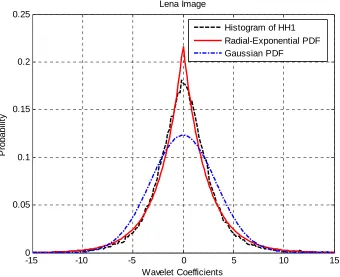
Figure 1 illustrates the histogram of photographic image and PDF plots. The PDF plots illustrate the mar-ginal Radial Exponential PDF and Gaussian PDF. The histogram in Figure 1 is very symmetric with zero mean and the histogram of wavelet coefficients are more like
marginal Radial Exponential PDF, it is more peaked and the tails are heavier, than the Gaussian distribution.
285
-15 -10 -5 0 5 10 15
0 0.05 0.1 0.15 0.2 0.25
Wavelet Coefficients
P
roba
bi
lit
y
Lena Image
[image:2.595.129.469.81.358.2]Histogram of HH1 Radial-Exponential PDF Gaussian PDF
Figure 1. Histogram of wavelet coefficients in HH1 subband of 512 512 pixel Lena image.
cients and its group of parent in detail. In Section 3, we derive a closed form of MMSE estimator using multi-variate Radial Exponential distribution with local vari-ance, Radial-Shrink. Section 4 describes the approxi-mated MAP (maximum a posteriori) estimation for lo-cal variances using Rayleigh density priori with Gaus-sian distribution (the local variances estimation of wavelet coefficients is the key to get better performance for image denoising). In Section 5, we use our model for wavelet based denoising of several images cor-rupted with additive Gaussian noise in various noise levels. The simulation results in comparison with MMSE_TriShrink _Laplace. In this paper, we not compare with BLS-GSM [4] because this method use a lot of time for denoising image. In the last simulation results, the performance of a subband dependent will be demonstrated on the dual-tree complex wavelet trans-form. The dual-tree complex wavelet transform (DT-CWT) [5,6] is an over-complete wavelet transform. The discrete wavelet transform (DWT) used in image denoising can be of many types, such as orthogo-nal/bi-orthogonal, real/ complex valued, separa-ble/non-separable, or decimated/non-decimated. Due to the shift- invariance property, the over-complete trans-form improves the image denoising performance in PSNR by 1 dB as compared to that of the decimated representation [7]. Finally the concluding remarks are given in Section 6.
2. Bayesian Denoising
In this paper, we are interested in the problem of esti-mating d-component Radial Exponential random vectors,
in additive white Gaussian noise (AWGN), The
x n
y x n (1) marginal models are weak models for wavelet coefficients of natural images because they ignore the dependencies between coefficients, although a coefficient and its parent are uncorrelated but are not independent. It is well known those wavelet coefficients are statistically dependent due to two properties of the wavelet transform 1) If a wavelet coefficient is large/small, the adjacent coefficients are likely to be large/small, and 2) large/small coefficients tend to propagate across the scales. Here, we can update the MMSE estimation problem as to take into account the statistical dependency between a coefficient and its group of parent. Let x x2, , ,3 xd represent the group of parent of x1 (x x2, , ,3 xd is the wavelet coefficient at the same spatial position as x1, but at the next coarser scale). If we observe a noisy wavelet coefficient, and is additive Gaussian noise zero mean with variance , MMSE estimator can be rewritten as:
y n
2 n
1 1
1 ˆ
( )Rd
x x f f d
f
x n y
y x y x x
y (2)
-20 -15 -10 -5 0 5 10 15 20 0
0.05 0.1 0.15 0.2 0.25 0.3 0.35 0.4
x
P
robabi
li
ty
Marginal of Radial Exponential Random Vector
[image:3.595.133.465.81.352.2]d = 1 d = 9
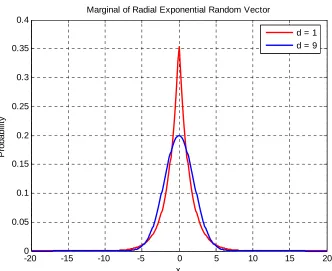
Figure 2. The marginal distribution of the d-component radial exponential PDF (3) for and
,
1
d
9
d 2
4
, where d1 the distribution is Laplacian PDF.
2.1. Wavelet Coefficients Distribution
In [3], and [8] a multivariate Laplacian distribution and bivariate Cauchy distribution are proposed to model wave-let coefficient and group of parent joint PDF. Figure 2 shows the marginal distribution of d-dimension Radial Exponential random vectors where d1 and d9. In case, (scalar) marginal distribution of Radial Expo-nential random vectors is Laplacian PDF. For
the marginal distribution of Radial Exponential is less kurtosis than the Laplacian distribution. As d-dimension increases, the marginal distribution be-comes more Gaussian. Indeed, the multivariate sphere-cally contoured of Radial Exponential distribution zero means with variance
1 d
1 d
2
has the density
1 exp 1 , dd
d
f C R
x x x x (3)
C is normalization constant parameter.
3. MMSE Estimators with Radial
Exponential Random Vectors
3.1. Generalized Incomplete Gamma Function
In 1994, Chaudhry and Zubair introduced the generalize
incomplete gamma function [3], defined as
, ;
1exp
/
x
x b t t b t d
t (4)For Ζ+1 2, Z are set of integer number, there is a
closed from expression for the generalized incomplete gamma function, for 1 2 and 1 2
la
, for ex-ample, there is the formu
1 2, ;x b
0.5 exp
x exp
b x
/
exp
/
erfcx x b x b x erfcx x b x
,
1 2, ;x b
0.5 / expb
x exp
b x
/
exp
/
erfcx x b x b x erfcx x b x
Here, numerical issues sometimes arise if some care is not taken. For example, computing the product of the first term in bracket of above equation can lead to nu-merical inaccuracies. However, note that exp
b x/
/
exp
2
/
erfcx x b x x b erfc x b x
.
If
It can be determined which of the two expressions is the more accurate using following rule. x 2 b, then the first term in bracket
287
exp b x erfcx/ x b x/
. Other cases, the first term in the bracket is exp
x2 b
erfc
x b x/
. Indeed, the generalized incomplete gamma function sat-isfies a recurrence relation for computing its values for other order, from [9,10]
1
( 1, ; )x b 1, ;x b , ;
b
x b
exp / .
x x b x
(5)
3.2. MMSE Estimator with Multivariate Radial Exponential Distribution
Multivariate spherically contoured of Radial Exponential density x can be generated by
z
x s,
where is d-component zero mean iid Gaussian ran-dom vectors with variance
s 2
2 2 2 2 1 exp 2 2 d f s s sand is a gamma PDF .
The two distribution are iid. Setting
z f zz( ) 4 exp( 2 ) z z ,z0 a z
, then. Changing the random variable of as
x z,s
a,x .Using Jacobian transform 2 1
dJ a a , then the PDF of random vectors x is given by
2 0z
f J f a f da
a
x s x x
2 01
2a d fz a f a a
s xda (6)
From MMSE estimator (2), we would like to find ( )
fy y and
d
R
A
fx x fn yx dx . If the noisesig-nal is independent additive white Gaussian noise (AWGN) with variance
n 2 n ,
2 2 2 2 1 exp 22 d n
n f n n n
First, the PDF of is given by the multivariate convolution. The multivariate convolution defines as:
y
( ) ( ) ( )
d
R
fy y
fx x fn yx dx (7)Using (6) gives
2
0 1 2 d z d R
f a f a f da f
a a
y s xy n y x dx
2
0 1 2 d z d R
af a f f d da
a a
s nx
y x x
Using Gaussian convolution formula [3]
1
d
d R
f f d
a a
s nx
y x x
2
2 2 2 2 2 2 2 2
1 1
exp 2
2 d d
n
n a
a
y Therefore,
22 2 2 2 2
0
1 1
2
2
z d d
n
f af a
a
y y
22 2 2
exp
2 n
da
a
y
3 2 2 2 2 2 02 2
2 2 2
8 2 exp 2 2 d d n n a a a d a
y aChanging the variable of integration, using 2 2 2
2 2 n , 4
t a dt ada,
gives
2 2 2 2 exp 2 nd
f
y y
2 2 2 2 2 2 2 2 2 exp n n d t t d t t
y t Using the generalized incomplete gamma function in (4), we get
2 2
2 22 2 2 2
exp 2 2
( ) 2 , ;
2
( )
n n
d
d
f
y y y 2 2 2 2 2 2 2
1 , ;
2
n d n
y 2
Second, from MMSE estimator (2), we would like to find ( ) ( ) d i R
A
x fx x fn yx dxUsing (6) gives
A
20 1
2 (
d
i d z
R
)
x a f a f da f d
a a
s nx
y x x
2 01
2 (
d
z i d
R
af a x f f d da
a a
s nx
y x) x
Using Gaussian convolution formula [3]
1
d
i d
R
x f f d
a a
s nx
y x x
2 2 2
2
2 2 2 2 2 2 2 2 2
1 exp 2 2 i d n n y a a a y n
a
Therefore,
2 2
2
2
2 2 2 2 2 2
0 1 2 2 i z d n n y a
A af a
a a
22 2 2
exp
2 n
da
a
y
5 2 2 1 2 2 2 2 0 8 2 i d d n a y a
2 22 2 2
exp 2
2 n
a d
a
y a
Changing the variable of integration at
2 2
2 2 4 exp 2 n i
d y A
2 2 24 2 2 2 2 2
2 1 2
2 4 exp n n n d t t t d t t
y t Using the generalized incomplete gamma function in (4), we get
2 2
2 22 2 2 2
exp 2 2
2 , ;
2
( )
n i n
d y d A y 2 2 2
2 2 2 2
2 2 2 2 2
4 2 2
1 , ; 4 , ;
2 2
n d n n d n
2 y y (9) Solving (2) using (8) and (9) gives the MMSE estima-tor,
2 2
2 2 2
ˆ 2 , ;
2 n
i i
d
x y
y 2 2 2
2 2 2 2
2 2 2 2 2
2 2
2 2 2
2 2 2 2 2
4 2 2
1 , ; 4 , ;
2 2
2 2 2
2 , ; 1 , ;
2 2
n n n n
n n n
d d d d 2 y y y y
Settingd3and using th ce relation of
gen-er comp
e recurren
alized in lete gamma function (5), we get
2 2 22
1 1 2 2 2
4 1 2
ˆ 1 ,
2
n n
x y
y y 2 ;
2 2 22 2
2 2 2 2
2
2 4 1 2
, ;
2
n n n
y y
3 2 2
2 2
1 2 2 2 2
2
2 2
2 2 2
2 2 2 2 2
2 2
exp
2
2 2 2
1, ; 1, ;
2 2
n n
n
n n n
y y y y (10) We called this method Radial-Shrink.
. Parameter Estimation
o apply our estimator, we need to know noise variance
4
T 2 n
and the variance of noise-free 2. To estimate e variance from noisy wavelet coef ients, a robust median estimator is used from the 1
nois fic
HH subband [11].
2 1
2 ( )
ˆ
0.6745 n
median HH
289
y k , an estimated 2
k can be found using local neighborhoodN k
. We use a square window N k
centered at y k
. To compute the variance of w coefficients, we use the fact that the wavelet coefficients and the additive noise are independent, thus we have the following relation between their variance:
2( ) 2 2
y n k k avelet (12)
where 2
is the variance of no y k d
isy wavelet coeffi-cient an g max 0,
g .Now, assume that a prior marginal distribution
2
2
y k y
f k
for each observed variance
2
AP e y k is we obtain an approximated M sti-y
available. Then mator for 2
k
as [13]2
y k
(13) In this paper, we assum
2
2
2 arg max ln | 2
y y
y j y k
j N k k
k f y k f
e
| 2
j yf y k , PDF of
noisy wavelet coefficient, is Gaussian PDF
| 2
j y
f y k
1/ 2y2
k
exp
y2j / 2
2y
k
and
2
yk
y
2
f k 12 y2
k
2 2exp k 2 , 0 , [14] 1 y 1
Rayleigh PDF. Using (13) and Cardanos’ method gives
2( ) 3 3
y k C k D k
(14)
where
2 2 2 3 ( ) ( ) 2 4 1 1 24 16 216
j j
j N k j N k
y y M C k
6 1
2 2 2 3 ( ) ( ) 2 4 1 1 24 16 216
j j
j N k j N k
y y
M
D k 6
1
giving that 1 is parameter of Rayleigh PDF and M is number of wavelet coefficient in
he
N k .
To select t parameter 1, we use the fact that un our Rayleigh PDF prior assumptio k
der
n computed
over all coefficients should distribute according to Rayleigh PD
2 y
,
F. First, the parameter 1 has calculated from the maximum likelihood estimation of 2
y k
that is
2 2
,
(
/
y ML j
j N k
k y M
)
(15)where [12]
1 2 co 2 , 1 2 N y M k
(16)where is number of wa t band. Using (12), we finall obtain ance, L N k vele y
N efficient in each
the noise-free
vari-
2( ) 3 3 2
n
k C k D k
(17)
5. Experimental Results
his section presents imag xamples in ie ur new model
ace limitation, however, we this section
T e denoising e
ncy of o
give in wavelet domain to show effic
and compare it with other method in literature. Due to sp
results concerning two 512 512 grayscale images and one 256 256 , namely, Lena, Boat, and Cam-eraman two types of wavelet representations, namely the decimated discrete wavelet transform (DWT) and dual-tree complex wavelet transform (DT-CWT). The images are obtained from USC-SIPI image database [7]. We also tested our algorithm using different ad-ditive Gaussian noise levels 2 5, 10, 20,30
n
and
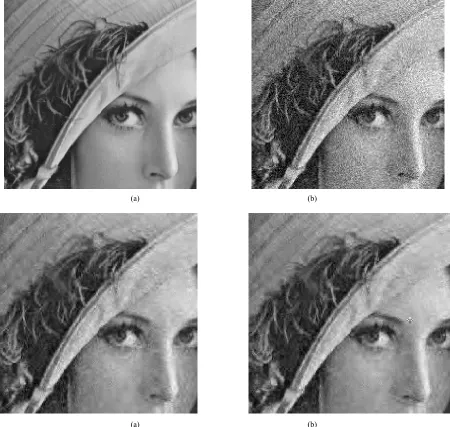
40 and compared with MMSE _TriShrink_Laplace [3], Figure 3 shows the original cropped image Lena, its noisy version 2 20
n
, and D ising
sions provide by two different methods, namely MMSE_ TriShrink_Laplace and Radial-Shrink The window size 7 7
WT-based deno ver
are used. We have also investi-gated different window sizes. A 9 9 window size can also be a good choice. However, using 3 3
window size resulted in a slight performance loss. In this paper, we have not considered different square shapes for N k
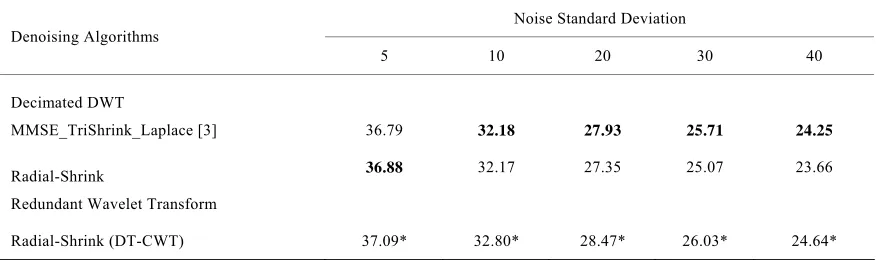
. Performance analysis is done usingthe PSNR measure. The results can be seen in Table 1-3. Each PSNR value in these tables is averaged over five runs. In t e e tables, the highest PSNR value is bolded.
For practical issue, an image, which is processed by our method, has some pixel values that are over the range of gray scale in MATLAB [1-256]. In this paper, we prese
h s
nt the solution figuring out an average from the neighboring pixels and use the average value in-stead.
(a) (b)
[image:7.595.74.524.82.509.2]
(a) (b)
Figure 3. Comparison of the denoising images obtained from Bayesian estimator DWT-based denoising
algo-rithms on Lena with TriShrink_Laplace [3] (PSNR
image over five runs for lena image.
2
20
n : (a) Noise-free image, (b) Noisy image, (c) MMSE_ = 30.15), and (d) Radial-Shrink (PSNR = 30.31).
Table 1. Average PSNR values of denoising
Noise Standard Deviation Denoising Algori
5 10 30 40
thms
20
Decimated DWT
MMSE_TriShrink_Laplace [3] 37.45 33.77 30.15 28.16 26.91
elet Transform
Radial-Shrink (DT-CWT) 38.17* 35.07* 31.51* 29.30* 28.04*
Radial-Shrink 37.60 33.95 30.31 28.32 26.98
[image:7.595.82.516.586.719.2]291
Table 2. Average PSNR values of denoising image over five runs for boat image.
tand ation
Noise S ard Devi
Denoisin
40 g Algorithms
5 10 20 30
Decimated DWT
MMSE_TriShrink_Laplace [3] 35 3 2 2 2
35.96 32.43 28.89 26.82 25.46
DT-CWT)
.94 2.32 8.75 6.73 5.31
Radial-Shrink
Redundant Wavelet Transform
Radial-Shrink ( 35.71* 33.08* 29.93* 27.95* 26.38*
e PSNR values of denoising image over five ru eram
Noise Standard Deviation
Table 3. Averag ns for cam an image.
Denoising Algo
40 rithms
5 10 20 30
Decimated DWT
MMSE_TriShrink_Laplace [3] 36 3 2 2 2
36.88 32.17 27.35 25.07 23.66
DT-CWT)
.79 2.18 7.93 5.71 4.25
Radial-Shrink
Redundant Wavelet Transform
Radial-Shrink ( 37.09* 32.80* 28.47* 26.03* 24.64*
6. Discussion and Conc
this paper, we present a new image denoising algo-ndom vectors with cal variance for modeling of wavelet coefficients in
Lai, L. Liu, and P. Lv, “An Improved Ap-shold Function De-noising of Mobile Im-ulti-wavelet Transform Domain,” IEEE
action Signal Processing, Vol.
3482-3496.
celli, “Image denoising using scale mixtures of Gaussian wavel n,” IE saction Processing, Vol. 12, No. 11, pp. 1338-1351, November 2003.
Transaction London A, September 1999.
wamy,
d and I. W. Selesnick.
ons with application,” Journal of Computer
lusion
Inrithm based on Radial Exponential ra lo
Aug
each subband, namely Radial-Shrink Instead of this den-sity model other denden-sity models can be used. For exam-ple, instead of using Radial Exponential random vectors we can use a mixture model of this distribution. The performance of proposed technique is fairly good in terms of PSNR.
7. References
] Y. Zhou, S. [1
proach to Thre age in CL2 M
“Im
Signal Processing, 2000.
[2] L. Sendur and I. W. Selesnick, “Bivariate shrinkage func-tions for wavelet-based denoising exploiting interscale dependency,” IEEE Trans
50, No. 11, pp. 2744-2756, November 2002.
[3] I. W. Selesnick “Estimation of Laplace Random Vectors in Adaptive White Gaussian Noise,” IEEE Transactions on Signal Processing, Vol. 56, No. 8, pp.
ust 2008.
[4] J. Portilla, V. Strela, M. Wainwright and E. P. Simon-
[5] N. G. Kingsbury, “Image processing with complex wavelet,” Phil.
in et domai EE Tran Image
[6] N. G. Kingsbury, “Complex wavelets for shift invariant analysis and filtering of signals,” Applied Computation, Harmon, pp. 243-253., May 2001.
[7] S. M. M. Rahman, M. O. Ahmad, and M. N. S. S “Bayesian wavelet-based image denoising using the Gauss-Hermite expansion,” IEEE Transaction Image Processing, Vol. 17, No. 10, pp. 1755-1771, October 2008.
[8] H. Rabbani, M. Vafadust, G. Saee
age denoising employing a bivariate Cauchy distribu-tion with local variance in complex wavelet domain,” IEEE Signal Processing, Vol. 9, pp. 203-208, 2006. [9] M. A. Chaudhry and S. M. Zubair, “Generalized incomplete
gamma functi
Applied Mathematic, Vol. 55, No. 1, pp. 99- 124, 1994. [10] M. A. Chaudhry and S. M. Zubair, “On a class of
incom-plete gamma functions with applications,” Chapman& Hall, New York, 2001.
[image:8.595.74.512.259.389.2]l. 11, No. 4, pp. 683-690, 1969.
wavelet coefficients.” IEEE Signal
-359, 1993. [12] S. C. Choi and R. Wette, “Maximum likelihood
estima-tion of the parameters of the gamma distribuestima-tion and their bias,” Technometric, Vo
[13] M. K. Mihcak, I. Kozintsev, K. Ramchandran and P. Moulin, “Low-complexity image denoising based on sta-tistical modeling of
Processing Letters, Vol. 6, No. 12, pp. 300-303, De-cem-ber 1999.