Abstract—The article considers the concept of additive manufacturing in engineering and enterprise development control. It describes modern methods of two-dimensional, three-dimensional integral-matrix analysis. It presents the capabilities of 4D modeling in the “Market-Technology-Product-Time” space using additive manufacturing as exemplified by the development of electric machines manufacturing technologies.
According to the developed algorithm, we made calculations to determine the priority of solving operational tasks and achieving strategic objectives in the implementation of additive manufacturing of 4D modeling in the “Market-Technology-Product-Time” space as exemplified by electric machines. An analysis has shown that the improvement of the electric machines manufacturing technology requires the greatest attention and support.
It is concluded that the use of models of four-dimensional modeling in the “Market-Technology-Product-Time” axes allows us to systematize expert estimates for determining the directions of development of research objects, both in the current period and at a long-term forecast.
Index Terms—Technological development, modeling, additive manufacturing, electric machines, integrated matrix analysis
I. INTRODUCTION
DDITIVE Manufacturing (AM) is a technology of layer-by-layer manufacturing of an object, when each successive layer of a substance is added to the previous one,
Manuscript received May 7, 2018; revised July 27, 2018. The work was done at the Department of Innovations Management in Business Federal State Autonomous Educational Institution of Higher Education “South Ural State University (National Research University)”. The work was supported by Act 211 Government of the Russian Federation, contract № 02.A03.21.0011.
Victor P. Tomashev, PhD in Technical Sciences, Associate Professor, Department of Innovations Management in Business South Ural State University (National Research University), Russia, Chelyabinsk (phone: +7-950-74-18-342, e-mail: [email protected]).
Andrey E. Shchelkonogov, Senior Lecturer, a postgraduate student, Department of Economic Security South Ural State University (National Research University), Russia, Chelyabinsk (phone: +7-906-860-37-47, e-mail: [email protected]).
Natalya S. Oreshkina, Senior Lecturer, a graduate student, Department of Economics of Industry and Project Management South Ural State University (National Research University), Russia, Chelyabinsk (phone: +7-952-519-27-47, e-mail: [email protected]).
Tatyana A. Zaitseva, a graduate student, Department of Russian Language and Literature South Ural State University (National Research University), Russia, Chelyabinsk (e-mail: [email protected]).
Elizaveta S. Zagrebina, a graduate student, Department of Motor Transport South Ural State University (National Research University), Russia, Chelyabinsk (phone: +7-950-732-09-78, e-mail: [email protected]).
forming an intended shape. Thus, additive manufacturing in engineering is associated with the build-up of a material in the process of manufacturing a product, in contrast to the usual “cut-off” [1].
The main element in the process of using additive manufacturing is 3D modeling and printing, which have been recently dynamically developing. 3D printing is used in imposition planning and modeling, prototyping. When creating models printed on a 3D printer, the number of cycles of their use is 1, but there are models used repeatedly, thereby reducing material costs [15].
We can outline a number of advantages that are available in the process of using additive manufacturing in the production environment [13]:
– ability of expanding the product range;
– acceleration of R&D and solving preproduction problems;
– saving time spent on product manufacture;
– improvement of performance indicators (economy and cost reduction).
Additivity is a type of relationship between any whole and its parts, in which the properties of the whole are completely determined by the properties of the parts [11]. It can also be said that additivity is a property of quantities lying in the fact that the value of a quantity corresponding to an entire object is equal to the sum of the values of the quantities corresponding to its parts. In any case, this is a summation in one or another form.
II. ADDITIVE MANUFACTURING IN THE ENTERPRISE DEVELOPMENT MANAGEMENT
The primary and generally accepted direction of using additive manufacturing is the production environment, additive manufacturing in engineering. However, such key property of this direction as a summation of the properties of parts to find integral characteristics of the whole object can be adapted for application in the management environment [4].
These technologies can be used in methods of assessing the potential of an organization, the effectiveness of systems, as well as development directions, for example, a new product.
To assess and choose a direction of the development of both the product and socio-economic objects, we used an integrated matrix analysis [9]. This analysis is based on defining the mutual relationship between the consumer requirements (CR) and the object characteristics (OC),
Management of the Industrial Enterprise’s
Technological Development of Based on the
Use of Additive Manufacturing
Victor P. Tomashev, Andrey E. Shchelkonogov, Natalya S. Oreshkina, Tatyana A. Zaitseva,
and Elizaveta S. Zagrebina
ensuring a compliance with these requirements. At the same time, the internal connection between the individual characteristics is taken into account. All the estimates are made in a numerical form by a group of experts, consisting of specialists in various fields of activity [3]. This modeling has features of additive manufacturing, since an expert estimate of these requirements and characteristics after a special mathematical processing allows us consider the market requirements “layer-by-layer” by their priority, and also “to build up” the characteristics ensuring the fulfillment of these requirements with their ranking according to special procedures. The characteristics can “be built up” both in “width”, increasing the number of chosen characteristics during the primary ranking, and in “depth” deciphering the main calculated characteristic at the second level: secondary ranking. Using the language of additive marketing, such “layer-by-layer production” of a socio-economic object allows us to choose its development direction based on collegiate estimates in more detail [6].
A two-dimensional integrated matrix analysis (IMA) is based on determining the mutual relationship between general consumer requirements and general supporting characteristics of the first level, taking into account the internal correlation between the characteristics. In this case it is possible to rank the characteristics of the second level for a detailed implementation of the chosen main characteristic of the first level [9], [10].
In a three-dimensional analysis, influencing factors or CRs to a product can be understood as strategic objectives that are applicable both to the market, to technologies and the product [8].
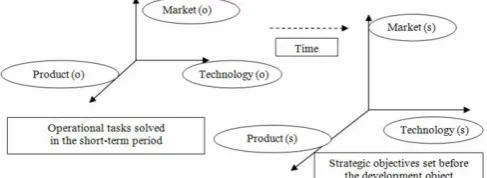
Operational tasks can be defined as market functions (technology, product) dependent on strategic objectives [8], [7]. Thus, we build two three-dimensional diagrams: of a strategic product development within the three axes (Market-Technology-Product) and of an operational solution of the tasks by the said development in the same coordinate axes (Fig. 1). The relationships between the spatial diagrams are realized through the IMA tool [2].
Fig. 1. Spatial axes of strategic objectives and operational tasks to be solved for achieving the set objectives.
In 3D IMA, we set the market, technology, product development strategy (as an argument in each plane) and through the coupling coefficients using the IMA method we determine the operational tasks to be solved in each plane (as functions) [14].
Each indicator (Market, Technology, and Product) acts in the same plane as an argument (strategic development objectives) and in another plane as a function (short-term tasks).
Thus, the following logical connection is ensured [12]: In the development strategy.
1. The market development preconditions a long-term change in the product parameters.
2. The change (requirement) of the product parameters is related to the capabilities (development) of the technology.
3. The market demand in the long-term period is associated with the development of technologies.
In the short-term period.
1. The current market needs are realized by the product parameters.
2. The product indicators relate to the current capabilities of technologies.
3. The market demand causes the development of technologies.
In each “Market”, “Technology”, “Product” group, there are several objectives (solvable tasks) that must be achieved as a result of certain operations. The list of these objectives (5 objectives are arbitrarily taken in each group) is quite universal, but their priority over time, when moving from operational tasks to the strategic development, changes.
Thus, a list of objectives is drawn up by the groups: Market (1...5); Technology (1...5); Product (1...5).
The expert scoring establishes the priority of long-term objectives (the object development strategy), as well as their connection with the objectives in the neighboring groups and between each other in one group.
An analysis of the objectives by each axis (group) is carried out using expert estimates and compilation of a vector diagram based thereon. The analysis reveals the main priorities that determine the product demand in the market.
The stage of product positioning in strategic development, we assess the level of satisfaction of each market (technology, product) requirement to the existing position before project changes of Рbi.
Then, a list of target values is formed in score points for each direction of development of Рpri, which, from an expert point of view, a new product must have in new market conditions and with new technologies.
The target values that do not need any changes are assumed to be equal to the base value:
Рpri Pbi. (1) Other target values are assumed higher than the base ones
Рpri Pbi. (2) The evaluation of the weight indicators of the strategic development directions takes into account both their base state and the necessary degree of improving each direction in the project. The improvement degree is calculated by the formula
P / P
Крi pri bi. (3)
Further, we determine the rating of each direction along each axis separately in the total score of all the project changes
Rcri Ppri/ Ppri. (4) Here, the weight Vтпi of each project objective is also set along the axes
[image:2.595.47.291.549.638.2]Then, we determine the sum of the weights of the project objectives ΣVтпi and the share of each weight of the objective Vтпi(ru) in the total sum
Vmni(ru) Vmni/ Vmni. (6) The weight indicators are used to determine the priority ranking of implementing the strategic development objectives and, according to the maximum weight, choose the priority ones to be implemented in each direction.
Let Ys represent the axis of strategic (long-term) market development objectives. Then, Ysi represents the i-th objective of this development. Analogously, for the technology Xs –> Xsi and the product Zs –> Zsi. Let us exemplify arbitrarily by i = 1…5.
Each strategic objective, as such (nominally), along each axis (Market, Technology and Product) is determined collectively. The priority ranking of implementing the strategic objectives is calculated using a special methodology based on expert scores and their increments from the base value of each objective score to the strategic (project) “ΔPi”. In this case, both the increment of score points and their initial and final values are taken into account.
Axes of states in the operational (short-term) period: – Yо represents the axis of operational (short-term) market development objectives. Then, Yоi represents the i-th objective of this operational development;
– Xо represents the axis of technological capabilities in the operational (short-term) period. Then, Xоi represents the i-th technology indicator in the short-term period;
– Zо represents the axis of product indicators in the operational (short-term) period. Then, Zоi represents the i-th product indicator in the short-term period.
Each strategic objective (technological capability or product indicator) along each axis is nominally reflected in the short-term (operational) period. I.e., Yo = Ys; Xo = Xs;
Zo = Zs according to the list of indicators. However, the priority ranking of the indicators along each axis in the strategic and operational periods will be different. This is ensured by the coupling coefficients both between different axes, and between different indicators within each axis.
The mutual relations between operational and strategic factors of different axes are taken into account by the coupling coefficients (Fig. 2):
– Kyixj represents the numerical coupling coefficient between the i-th market indicator (Y-axis) and the j-th technology indicator (X-axis).
– Kxizj represents the numerical coupling coefficient between the i-th technology indicator (X-axis) and the j-th product indicator (Z-axis).
– Kziyj represents the numerical coupling coefficient between the i-th product indicator (Z-axis) and the j-th market indicator (Y-axis).
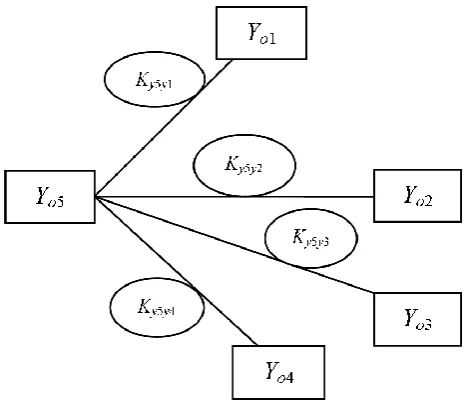
In addition to the mutual relations between the operational and strategic objectives of different axes, individual coefficients take into account mutual relations between the individual indicators of each operational axis, as shown in Fig. 3 and Fig. 4, for example, for the first and the fifth factors of the operational market axis (Yo).
Fig. 2. Three-dimensional diagram of strategic and operational objectives of the market, technology and product with coupling coefficients.
Fig. 3. Connection between the first and other 4 factors related to the operational market axis.
[image:3.595.308.546.48.289.2] [image:3.595.307.545.336.490.2] [image:3.595.310.543.530.732.2]The following designation is taken in Fig. 4:
Kyiyj represents the numerical coupling coefficient between the i-th and j-th market indicators in the operational period (Yo-axis).
Thus, the development strategy is determined by the relations both between the factors inside the three-dimensional space and between the axes indicators.
III. APPROBATION OF THE MODEL OF ADDITIVE PRODUCT DEVELOPMENT MODELING
Let us consider the capabilities of 4D modeling in the “Market-Technology-Product-Time” space using additive manufacturing as exemplified by the development of electrical machine manufacturing technologies [16].
As it is known, an electric machine is an electromechanical energy converter based on the phenomena of electromagnetic induction and the Ampere force acting on a conductor with a current in a magnetic field [5].
The operation of an electric machine as an electromechanical converter is based on the interaction of magnetic fields created by various elements of the machine. If the machine converts electrical energy into mechanical work and heat, the electric machine is an electric motor. If the machine converts mechanical work into electrical energy and heat, the electric machine is an electric generator. The reversibility principle is fulfilled for electric machines, when one and the same machine can act as an engine, a generator or an electromagnetic brake.
In general, the technology of designing and creating material objects or services includes advancing an idea of a product, for example, an electromechanical converter (electric machine) operating from any energy source and simple enough in production and repair. The demand for such product by potential consumers is preconditioned by a wide range of applications of electromechanical converters. The consumer qualities of the new electric machine can be ensured by the use in its production of modern, including additive, technologies and materials, the characteristics of which are closely related to the specific operation of the object.
The development of computer technologies has led to revolutionary changes in the design of electrical machines from analytical calculations to numerical and visual modeling of structures and characteristics. It significantly saves material resources of all levels in the development and manufacture of new types of electric machines. At the same time, the choice of manufacturing technologies is widening: the transition from electrotechnical steel sheets to new materials that meet the specific requirements of electromechanics and potential use of additive manufacturing.
The fields of application of each electric machine stipulate the requirements thereto, which cannot but influence their development. Let us imagine, as an example, possible directions of the development of electric machines in three axes, in the strategic and operational periods (an arbitrary time range). We arbitrarily limit their number along each axis by five factors. We also note that these studies
concern the general directions of the development of electric machines.
Market: 1. Operational flexibility of the device. 2. Product value. 3. Repairability. 4. Universality of the power supply by the voltage type and value. 5. Efficiency of energy conversion.
Design, manufacturing and repair technology: 1. Energy to output ratio. 2. Labor to output ratio. 3. Production automation. 4. Ability to quickly reconfigure the production. 5. Design automation.
Product: 1. Small scattering of passport data and real technical characteristics. 2. High controllability at optimum dimensions. 3. Adaptation to the place of use. 4. Environmentally friendly disposal. 5. Safety of operation.
According to the developed algorithm, we made calculations to determine the priority of solving operational tasks and achieving strategic objectives when implementing additive 4D modeling technologies in the “Market-Technology-Product-Time” space as exemplified by electric machines. The calculation results are presented in Table I and Table II.
TABLE I
SCORING OF THE STRATEGIC CHANGE IN THE KEY INDICATORS OF ELECTRIC MACHINES
# of item
MARKET development strategy (Ms)
Base Project According to the 10 point scale 1 Operational flexibility of
the device 6 9 1.86
2 Product value 7 9 1.60 3 Repairability 6 8 1.47 4 Universality of the
power supply by the
voltage type and value 5 10 2.76 5 Efficiency of energy
conversion 6 10 2.30
SUM TOTAL of the
points 46 10.00
# of item
TECHNOLOGIES
development strategy (Тs) Base Project
According to the 10 point scale 1 Energy to output ratio 6 9 1.78 2 Labor to output ratio 7 9 1.52 3 Production automation 7 10 1.88 4 Ability to quickly
reconfigure the
production 5 10 2.63
5 Design automation 6 10 2.19
SUM TOTAL of the
points 48 10.00
# of item
PRODUCT strategic
nature (Ps) Base Project
According to the 10 point scale 1 Small scattering of
passport data and real
technical characteristics 7 9 1.75 2 High controllability at
optimum dimensions 5 10 3.02 3 Adaptation to the place
of use 6 8 1.61
4 Environmentally friendly
disposal 7 9 1.75
5 Safety of operation 8 10 1.89
SUM TOTAL of the
TABLE II
SCORING OF THE DEVELOPMENT OF THE BASIC INDICATORS OF ELECTRIC MACHINES IN THE OPERATIONAL PERIOD
# of
item Operational technologies (То)
According to the 10 point scale 1 Energy to output ratio 1.81 2 Labor to output ratio 2.11 3 Production automation 2.24 4 Ability to quickly reconfigure the
production 1.92
5 Design automation 1.92
# of
item Product nature (Pо)
According to the 10 point scale 1 Small scattering of passport data and
real technical characteristics 1.53 2 High controllability at optimum
dimensions 2.10
3 Adaptation to the place of use 2.98 4 Environmentally friendly disposal 1.65 5 Safety of operation 1.74 # of
item Operational market characteristics (Mо)
According to the 10 point scale 1 Operational flexibility of the device 1.93
2 Product value 3.10
3 Repairability 1.39
4 Universality of the power supply by the
voltage type and value 1.94 5 Efficiency of energy conversion 1.64
Thus, we set a strategy of the electric machines market development as an argument in each plane of the coordinate axes (Fig. 2) and define operational tasks that need to be solved in each plane as functions.
Strategic objective –> operational support of the objective: 1. “Market–Technologies” in the axes “Ys–Xo”. The strategic market requirements in terms of market functionality of electric machines should be provided (supported) by the availability of technological solutions in the short-term (operational) period.
2. “Technologies–Product” in the axes “Xs–Zo”. The electric machine technology development strategy should be provided (supported) by the parameters of the products in the short term.
3. “Product–Market” in the axes “Zs–Yo”. The strategic requirements to the product should be provided (supported) in the short term by the market environment with respect to electric machines.
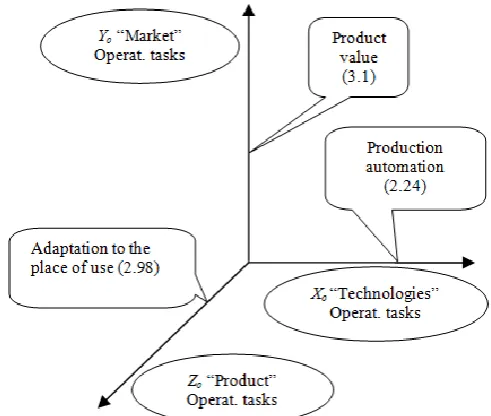
[image:5.595.302.548.52.260.2]Scaling of the axes in view of the score rating of the indicators of the objectives and tasks allows us to obtain a scaled display of the obtained results of calculating the operational tasks, as shown in Fig. 5, and strategic objectives (Fig. 6).
An analysis of the results of the first priority of the electric machine development allows us to make the following conclusions:
1. The strategic objective of product development: high controllability at optimal dimensions received the maximum score (3.02). At the same time, the main operational task of product development, which supports the strategic objectives, is the adaptation to the place of use at the development stage. This task received 2.98 score points and is slightly inferior to the strategic objectives of product development.
Fig. 5. Scaled three-dimensional analysis of priority operational tasks solved at the development of electric machines (the number of score points for this indicator is shown in the brackets).
Fig. 6. Scaled three-dimensional analysis of priority strategic objectives solved at the development of electric machines (the number of score points for this indicator is shown in the brackets).
2. The electric machine development strategy with respect to their application market lies in the universality of using the supply network (2.76 score points), which is supported on the market by the solution of operational tasks in terms of the cost of the applied converters in the product price (3.1 score points). A comparative analysis points to a slight discrepancy between the strategic objectives and the operational tasks that are solved when the electric machines are sold on the market.
3. The strategic objectives of the energy saving system development with respect to the technology lie in the ability to quickly reconfigure the production (2.63 score points). This is accompanied by the solution of the operational task in the part of production automation (2.24 score points).
[image:5.595.310.545.303.500.2]strategic tasks is determined on the basis of the discrepancy between the score points of the strategic objectives and operational tasks, as well as on the basis of the absolute value of their scoring.
The second most important implementation of the strategic objectives is to increase the electric machine efficiency factor, which should be accompanied by a reduction in the labor to output ratio and an increase in the safety of operation.
As for the market positions of the systems under consideration, it can be concluded that their market functionality is almost entirely consistent with the tasks of increasing the universality of the supply network. It points to a balance between the strategic objectives of the market and the tasks to be accomplished in the first priority.
An expert scoring has revealed that over time, the priority positions of certain characteristics may shift and be replaced with others. Thus, for example, the market factor “Product value”, having the first priority in the short-term period is shifted to the 4th place in the strategic period. The technological factor “Production automation” is shifted from the first position in the operational period to the third position in the long-term (strategic) period. The product indicator “Adaptation to the place of use” is shifted from the first place in the short-term period to the fifth place in the long-term period.
IV. CONCLUSION
An analysis of the results of the machine development forecast allows us to make the following conclusions:
1.Development of new materials that allow us to use new additive manufacturing using the materials applied in 3D printers.
Requirements to physical characteristics of the material: a)Cost of a material unit (powder).
b)Manufacturability of the formation of the product (stator, rotor) from the powder.
c)Mechanical strength of the product after its formation. d)Narrow hysteresis loop (low magnetic losses) in the finished product.
e)High electrical resistance to eddy currents (low magnetic losses) of the product.
2.The development of electronic power control systems for electric machines will improve the switching conditions of stator and rotor windings. Three-phase symmetrical sinusoidal power adapted to the rotor speed will ensure the creation of a reversible circular rotating magnetic field. For this purpose, it is necessary to develop compact electronic supply voltage converters of an acceptable cost and sufficient reliability. It will allow us to abandon such constructive element as a collector and to provide minimum sliding contacts.
Thus, using the models of four-dimensional modeling in the “Market-Technology-Product-Time” axes, it is possible to systematize expert estimates for determining the directions of development of research objects, both in the current period and at a long-term forecast.
REFERENCES
[1] Additive Production and Tool Industry [electronic resource] // Agency for Innovation and Development of Economic and Social Projects. Available: www.innoros.ru/publications/analytics/15/ additivnoe-proizvodstvo-i- instrumentalnaya- promyshlennost [2] A. Alabugin, S. Aliukov, and K. Osintsev, “Management models of
efficiency of development of resource and energy saving systems using methods of approximation of step functions,” in Lecture Notes in Engineering and Computer Science: World Congress on Engineering 2017, July 5–7, 2017, London, U.K., pp. 102–112. [3] L. I. Lukicheva and D.N. Egorychev, “Management decisions,” 4th
ed., Sr. Moscow: 2009. – 383 p.
[4] A. A. Alabugin and A. E. Shchelkonogov, “Management of technological development of an industrial enterprise in terms of indicators of combination of factors of production” // Science of South Ural State University [electronic resource]: materials of the 69th scientific conference. Section of Economics, Management and Law. Electronic text. (7.73 Mb). Chelyabinsk: Publishing Center SUSU, 2017. 1 electron. opt. disk (DVD); 12 cm, pp. 310–315. [5] A. V. Aristov, “The current state and prospects of development of
double-power machines in the electric drive of oscillatory motion,” Tomsk, Polytechnics, University, 2004. T. 307 – No. 6. P. 135–139. [6] Yu. V. Babanova and M. V. Goncharova, “Algorithm of the
high-tech enterprises’ financial and economic activity control system: algorithm” / Federal State Autonomous Educational Institution of Higher Education South Ural State University (NRU). – M., 2017. – State. reg. № AAAA-G17-617120840004-7.
[7] A. A. Dvornichenko and V. P. Tomashev, “Algorithm of an expert estimate of the indicators of the three-dimensional modeling of socio-economic systems: algorithm” / Federal State Autonomous Educational Institution of Higher Education South Ural State University (NRU). – M., 2016. – State. reg. № 50201650103. [8] V. P. Tomashev and B. V. Ivanenko, “Calculation of indicators for
the priority implementation of projects for the development of the organization in three-dimensional mapping: the program” / Federal State Autonomous Educational Institution of Higher Education South Ural State University (NRU). – M., 2016. – State. reg. № 50201650105. [9] N. K. Topuzov, A. A. Dvornichenko, and V. P. Tomashev, “Tools for launching innovative products” // Modern Problems of Science and Education, 2015, № 1. Available: www.science-education.ru/ 121-17203.
[10] N. K. Topuzov and V. P. Tomashev, “Algorithm of complex studying structural elements of the object: algorithm” / Federal State Autonomous Educational Institution of Higher Education South Ural State University (NRU). – M., 2016. – State. reg. № 50201650104. [11] Philosophical encyclopedia. Available: https://dic.academic.ru/
contents.nsf/enc_philosophy/
[12] N. K. Topuzov, A. E. Shchelkonogov and I. S. Amelin, “Multi-criteria approach to justification of production technology of hydrogen fuel,” in Lecture Notes in Engineering and Computer Science: World Congress on Engineering 2017 Vol I, WCE 2017, July 5–7, 2017, London, U.K., pp. 308–311. Available: http://www.iaeng.org/publication/WCE2017/WCE2017_pp308-311.pdf [13] A. E. Shchelkonogov, I. S. Amelin, T. A. Zaitseva, V. F. Gaisina, and A. A. Dvornichenko, “Prospects for the development of tool production on an innovative basis for increasing the competitiveness of a machine-building enterprise”// Scientific research and development of students: materials III Intern. student. scientific-practical. conf., March 31, 2017, Cheboksary / rare: O. N. Shirokov [and others]. - Cheboksary: CSS Interactive Plus, 2017, pp. 154–161. [14] V. V. Tomasheva, A. N. Topuzova, and A. E. Shchelkonogov, “Modeling of the economic objects in three-dimensional perspective” // Economics and Entrepreneurship. Moscow, vol. 11, nom. 5-2, 2017, pp. 830–834.
[15] T. A. Zaitseva, N. S. Oreshkina, and E. S. Zagrebina, “Actual problems and innovative ways of production based on the use of additive technologies” / scientific adviser V. P. Tomashev // Scientific research: theory, methodology and practice: materials III Intern. scientific-practical. conf., Nov. 19, 2017, Cheboksary. In 2 vol. T. 2 / rare: O. N. Shirokov [and others]. Cheboksary: CSS Interactive Plus, 2017, pp. 88–91. Available: https://interactive-plus.ru/ru/article/466018/discussion_platform.