ALPHA
MICRO
USERS
SOCIETY
Newsletter
From the President:
The NCC in New York drew lots of people.
Lines and
crowds everywhere.
Alpha Micro had Z booths, a large
one in the personal computer section and a smaller
one in the main convention hall. Alpha announced 9 new
products to the public at this time.
They are
described in detail elsewhere in the newsletter. Many
other vendors also announces new products at the show.
Another dealer meeting was held by Alpha as a
con-tinuation of a series of meetings between Alpha, the
dealers of AMDEAL.
I would like to give credit to Alpha
Micro for making such a committment to their customer
service organization as presented by Bob Kratz.
I
believe this committment of resources is second in
im-portance only to Alpha's committment to stay ahead.of
the competition with technological achievements.
The crux of the meetings however has been to reach
an agreement on a sales policy between Alpha Micro and
the dealers, including the requirements for becoming
a dealer.
Much of this goal was accomplished at the
New York meeting.
Since Alpha Micro does not deal directly with the
end user, there is a need to make sure that all dealers
can properly service the customer both on hardware and
software.
Alpha will be upgrading the dealers
capabili-ties.
If you are a dealer or OEM of Alpha Micro and have
not attended any of the meetings or have not received
and information concerning the sales policy, you should
contact Len Backus to become aware of what is happening.
Thanks to those of you who have responded to our
questionnaire in the newsletter and to Sharon's personal
phone calls .. We had hoped that a mail in ballot for
directors and officers would be a good way to handle the
voting, however the mail is very light.
Please send
in your ballot. Add some comments if you like.
We want to thank the people of DRAVAC for sending
their word processing software to help with the
news-letter. Their intention was to promote user articles.
See a paragraph labeled
~ewsletterArticles later on.
Also thanks to Chris Brandon of Colorado Springs
for making the
AD~3Adriver available to use.
See
later paragraph.
A:·ISOO
Board
iii!3!£!
-Persci
A number of people have responded that they too have
had trouble with the Persci drives. The best solution
we have right now for the problem is to let you know
of people who say they can fix them.
1. Fred Richardson was formerly the service
manager for Persci and now has his own business. He
claims to fix Perscis.
I believe his address is near
the manufacturing facility.
2.
Bill Nesbitt at the Byte Shop of Ventura,
ISS Norse Avenue, Ventura, CA
93003, claims 2 week
turnaround on Perscils.
3. Dale Horn at STAT Systems in Seattle Washington
is constantly fixing his own.
He may be willing to
try yours.
We will make other names available as we are
aware of them.
Newsletter Articles
We would like to publish articles submitted by
the members.
I will make communications available on
our machine on request until the network is set up.
You will log on to DSKl:lOO,l
You may copy files to your system and from your
system you should leave a message in the file called
MESAG.LST describing what you have left in the system.
We will try to make available anything that has been
sent to us including the ADM3A driver and Dravacls
word processing documentation.
Please leave articles
and advertisement for publication; change of addresses,
bugs and fixes; and subroutines to programs that you
would like to give to AMUS members.
That phone number
is 444-7248.
ADM3A Driver
Chris Brandon stopped by the office and left a
copy of the ADM3.DVR which he modified so that it
will work with VUE and the Alpha business package.
It
now will clear to end of line and clear to end of
screen if you have the switches set correctly. Mainly
you must turn off the AutoNL. since he had to use the
next 2 bytes not defined in the terminal definition
block, we hope Alpha Micro will recognize this use and
define them for this purpose.
Software by Golly
We are including elsewhere in this issue a reprint of a list of software complied and printed by AMDEAL. We will add to that list next month.
Large file Transfers
A couple of people have called to let me know that they have successfully transferred large files from Univac 1110 and IBM 370 systems through
communications.~ Others have accomplished it through tape.
Word Processing
Additional word processing systems are now available from:
Systems Services Specialists, 651 Palm Avenue,
Los Altos, CA 94022, 415-948-2326;
Dravac Ltd, 150 Fifth Ave. Auite 530, New York, New York 10011, 212-989-2100; and
DPCI, 1898 S. Flatiron Ct. Boulder, Colorado 80301
303-449-8847
Bugs (and patches) from down under
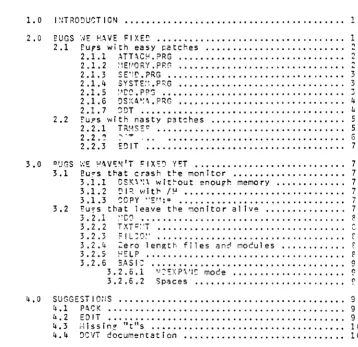
Dean Elsner from Alphasoft, University Computer Club in Western Australia has sent us 10 pages of
Bugs and fixes. We are including his table of contents
only for two reasons. 1. length and 2. most all of
the fixes are assembly fixes to 4.1 .PRG programs and many people might get in trouble if they tried to make these modifications and then didn't check them
out when they got 4.2. We will pass them along to
Alpha Micro and they are available to anyone who wants
to ask for them. We will try to get them onto the
communication system.
Sort Problems
Business Information Systems had a problem with BASORT and came to the following conclusion; If a key is floating point and Basort isn't sorting properly then try adding another byte in the MAP ahead of the
A/~ Brochures
Alpha Micro now has a nice looking set of ~rochures
for their products. We are including the ones about
the ~~-210, 310, 410 and 600 boards because these we~e
just announced at the NCC and many of you may not be aware of them.
AIM
Business SubroutinesWe are printing the Alpha Business Subroutines
list to let you know of their existance. They should
be very useful to you in your software development. To get them you must pay a licensing fee through your dealer to Alpha Micro.
DING (CR)
Typing DING (CR) will create 6S000 annoying dings
on the terminal. Lefford Lowden and the Byte Shop of
Reno have both modified the DING program so that it won't do that anymore.
SNOBOL
From Lefford Lowden's newsletter we learn that SNOBOL4 is now available from Francis Cox in England
for about $200.00. He calls it ~lACRO SPITBOL.
Software Agreement
Dale Horn has just had a software agreement written,
typed and reviewed by a lawyer that ~e wIll ~ake
available as an example for anyone needing such a document.
D.C.HAYES VS. AM-SOO
Chris Brandin from Business Operating Systems 1n Colorad0
Springs tells us that he had some trouble with t~e D.C.
Hayes board interfering with the Hawk contr011er board
when they were placed next to each other ~ithin the box.
He solved the problem by plugging in a card ~etween the
two which seemed to halt the signals ~roadca5t ~I the
AM-210
Floppy Disk Controller Circuit Board
FEATURES
SUPPORTS SINGLE AND DOUBLE SIDED DRIVES
SUPPORTS SINGLE AND DOUBLE DENSITY DRIVES
SUPPORTS FIVE AND EIGHT INCH DRIVES
1024 BYTE ON-BOARD BUFFER
ON-BOARD CLOCK AND DATA S EP A.RAl'OR
S-lOO BUS COMPATIBLE DEVICE
DESCRIPTION
Alpha ~cro's AM-Z10 Double Density Floppy Disk Controller circuit board provides an economical interface between standard or mini-size floppy disk drives and the Alpha Micro computer system or any standard 5-100 bus computer. The AM-Z10 can accommodate up to four single or double density floppy disk drives. :Bh 3740 and other standard soft sector formats are supported for single or double sided drives. An on-board data separator provides for FX and MFM encoding.
CONFIGURATION
The ~~-2l0 Floppy Disk Controller circuit board is contained on one 5 1/4" by 10" printed circuit board which plugs into the S-lOO bus chassis.
SPECIFICATIONS
~del number ••••••• AM-2l0
CPU Interface Standard 5-100 bus
Interrupt Multi-level
Capability ••••••••• interrupt driven
On-Board Buffer
Data Transfer
Mode •••••••••••••••
Drives Per Controller
1024 bytes
Programmed, multi-level interrupts
1-4
Drive Types •••••••• Single or double sided, single or doub Ie dens i ty , 5" and 8"
Input Power •••••••• +8 volts dc,
±
16 volts deInterconnections ••• One mounting slot of an 5-100 bus chassis. One 50-pin or 34-pin cable to dri-Je
Dimeosions ••••••••• 5 1/4" x 10" (13.3 cm x
25.4 cm)
Environment (operating)
Temperature •••••• 600 to 900F
(160 to 320C)
AM-310
Communications Controller Circuit Board
FEATURES
FOUR FULL COMMUNICATIONS PORTS
1024 BYTE ON-BOARD RAM BUFFER
MOLTI-LEVEL INTERRUPT CAPABILITY
SY~CHRONOUS/ASY~CHRONOUS
RS-232C INTERFACE
Z-80 BASED CONTROLLER
S-100 BUS COMPATIBLE DEVICE
DESCRIPTION
Alpha Micro's &~310 Communications Controller circuit board provides an economical communications inter-face between serial interinter-face devices and the Alpha Micro computer system or any standard S-lOO bus computer. The AM-310 contains four independent, fully programmable communications ports which provide the data conversion and processing necessary to "talk to" RS-232C, synchronous, and asynchronous type devices. The AM-310 can generate multi-level interrupts; all ports
~y ~e programmed to support any standard byte oriented communica-tions protocol. The four ports may be used in any order. The AM-310 circuit board is fully supported by &~OS (Alpha Micro Operating System) software.
CONFIGURATIO~
The &~310 Communications Controller circuit board is contained on one S 1/4" by 10" printed circuit board which pbgs i:lto the S-lOO bus c~assis.
7
5PEcrFICA:IONS
Model ~ber •••••••••• AM-310
CPC !nter:ace ••••••••• Standard S-100 bus
Interrupt Capability •• Multi-level interrupt driven
I/O Interface ••••••••• EIA RS-Z32C or other synchronous/ asynchronous protocol devices conforming to RS-232 levels
Number of Ports ••••••• 4
Transmit/Recieve Modes
Fully program-mable, 16 software selectable baud rates, synchronous/ synchronous
Baud Rates •••••••••••• Up to 19.2K baud
Data Transfer Mode •••• Block transfer, programmed I/O, interrupt driven
On-Board R&~ Buffer ••• 1024 bytes
Interconnections •••••• One mounting slot of an 5-100 bus chassis.
One 26-pin connector for each I/O port.
Dimensions ... S 1/4" x 10" (13.3 cm x
2S.4 cm)
Input Power ... +8 volts dc,
.=!: 16 volts dc
Environment (operating)
Temperature ••••••••• 600 to 900F
(160 to 320C)
Features
090 MILLION FORMATTED BYTE CAPACITY (15 MILLION BYTE REMOVABLE)
o
30 MILLISECOND AVERAGE ACCESS TIMEo
Z-80 BASED CONTROLLERo
S-100 BUS COMPATIBLE DEVICE DescriptionAlpha Micros AM-410 Dlsl< Sub-system features large capacity, random access disk· drives which record and read data on one removable and three fixed platters. The AM-410 Disk Sub-system IS a single spindle drive with a formatted disk storage capacity of 90 million bytes. The disk controller IS comprised of two printed CirCUit boards which have the ability to Inter-face with up to four disk drives. Data IS transferred at an average rate of 9 67 MHz between the controller and drives. Configuration
The AM-410 Disk Subsystem IS a completely self-contained unit, the drive Includes an Independent blower motor, Internal power supply, and an AC power cord The drive IS rack mount-able The controlier consists of two S-100 bus printed circuit boards.
~alpha
~~mlcra
17881 Sky Park North
Irvine Callfernla 92714
£7141 957-1404
Specifications Model Number Disk Drive: Disk DriveType. DlskType Used. Recording Mode Storage Capacity
Data Transfer Rate Rotation Access Time Latency Time
No. of Recording Surfaces Tracks Data Density Seclors Input Power. Dimensions Height Width Depth Weight Environment (operating) Temperature Humidity. Controller:
CPU Interface. Drives Per Controller Printed Circuit Boards Data Transfer Modes.
Data Transfer (Controller to Disk) Data Transfer (Controller
to Computer) Data Transfer Format
On-Board Buffer Error Checking Input Po_r Interconnections Dimensions Environment (operating) Temperature Humidity 8
AM-410
DISK SUBSYSTEM
AM-410CDC 9448 "PHOENIX" Cartridge module. model 1204 MFM recording techntque
90 million bytes (formatted) Including 15 million byte removable cartridge 967 MHz (controller to/from disk) 3600 rpm
30 milliseconds (average) 8 33 milliseconds 6 (5 fixed, 1 removable) BOB per surface 6038 bits per Inch i:nner) 36 per surface
-r120 volts ac @ 8 2 amps. 60 Hz
105"(26.4cm) 190" (48 3 em) front 1725" (43 B em) body 31 75" (BO 6 em) 170 Ibs. (n1 kg)
50° to 95°F l100 to 35°C) 20% to BO% (non-condenslng;
Standard S-100 bus 1-4
2
Programmed multi-level Interrupts. full sector block transfers
Serial
8-bIt bytes
512 bytes per sector, plus CRC and sentinel check bits
1024 bytes CRC error code +8 volts dc. -16 volts dc
Two mounting slots of an S-100 bus ChaSSIS. One 60-pm cable to first drive (100 fee! ma)(jmum). Four 26-ptn radial cables With one cable to each drive
5)'" x 10" (13.3 cm x 25 4 em)
60° to 90°F (16° to 32°C)
AM-600
Magnetic Tape Interface Circuit Board
FEATURES
SUPPORTS HALF-INCH MAGNETIC TAPE TRANSPORTS
FULL DMA TRANSFER CAPABILITY ALLOWS VERY LARGE BLOCK SIZES UP TO 65K BYTES
INTERRUPT CAPABILITY
S-lOO BUS COMPATIBLE DEVICE
DESCRIPTION
Alpha Micro's AM-600 Magnetic Tape Interface circuit board provides a general purpose single board i:ltarface between the "industry standard" half-inch magnet ic tape formatter and the Alpha Micro computer system or any standard 5-100 bus computer. The ~~-600 can support up to two formatters; interfacing with up to eight tape transports.
:1le ~'!-600 can control both seven a~d nine-track tape transports with bit densities up to 1600 bits per inch and tape speeds up to 45 inches per second. Full direct =enor/ access (D¥.A) and interrupt capability are provided.
CONFIGURATION
~e ~'!-600 ~gnetic Tape Interface circuit board is contained
o one 5 1/4" by 10" printed c rcuit board which plugs into t e S-~OO bus chassis.
9
SPECIFICA:'IONS
Model number •••••••••• ~~-600
CPU Interface Standard S-100 bus
Data Transfer Modes .•• Programmed, oulti-level interrup ts and DMA
Fonnatters Per •••••••• 2 Interface
Transports Per •••••••• 8 Interface
Transport Types .•••••• 1/2 inch, 7 or 9 track, up to 1600 bits per inch, up to 45 inches per second
Input Power ••••••••••• +8 volts dc
Interconnections ••.••• One mounting slot of an S-lOO bus chassis. Two 50-pin flat ribbon cables to the fonnatters
Dimensions .••••.•••••• 5 1/4" x 10" (13.3 cm x 25.4 em)
Environment (operating)
Temperature .•••.•••• 600 to 900F (160 to 320C)
ALPHA BUSINESS SUBROUTINES
1. ACCEPT This subroullne provides a mechanism for accepting arbitrary data from the user's ter· minai, Including control characters, and other characters normally trapped by the system.
2, ANYCN This subroutine IS used to ask the user If he wishes to change any of the data which he has lust entered, If he does, ANYCN will opllonally ask for the number of the line to be changed. All ANYCN transactions occur on line 24 of the terminal screen.
3. BASORT ThiS subroullne allows the sorting oi both random and sequential files from within AlphaBASIC. If sufficient memory IS avalJable In the user's partition, an Internal memory based heap sort Will take place. If there IS not enough space to fit all the file records Into memory, a disk based polyphase merge sort Will occur The combination of these two modes results In a respectably fast sort ulility.
4 COMMON The COMMON subrOuline provides a mechanism for plaCing data Into a common storage area, either to pass data between chained programs, or to pass messages be-tween Jobs, or for any other use that might be conceived By providing each packet of Information with a name, several different sets of data may be placed Into common storage to be retrieved at variOus times.
5 DSPL Y This subroutine provides a central mechanism for formatting and displaYing numeric data. It accepts numeric data In either string or floating pOint format and Will edit and display It on the user's terminal.
6. INPUT The INPUT subroutine provides a convenient method of accepting and editing data entered from the user's terminal. It provides a number of data formats to allow most any type of data to be entered and checked for validity.
7 MESAG ThiS subroutine provides a method of outputting standardized error messages.
8. MMENU ThiS subroullne displays the standard master file maintenance menu and accepts a selection. The name of the particular appllcallon IS displayed In the upper left hand corner of the screen. while In the middle of the screen the standard menu IS displayed. 9. PRINT The PRINT subroutine prOVides a fleXible, sophisticated method of formatting pllnter
output. It handles the lob of pagination, titling, and page numbering, as well as pro-Viding several options for headers and legends.
10. ROATE The ROATE subroutine allows the user to eaSily access the system date from AlphaBASIC.
11 SERCH ThiS subroullne handles binary and sequential searching of disk flies. It allows the user to qUickly access a file via symbolic keys, Without paYing the overhead costs of ISAM.
12 STENO The STENO subroutine prOVides a standard method of asking for starting and ending numbers, a task reqUired In many programs.
13 STRIP Whenever random length strings are handled, It often becomes necessary to remove the trailing blanks from a string The STRIP subroutine prOVides a convenient method for dOing Just that, at a speed of about 100 times faster than can be done In AlphaBASIC.
14. TMENU ThiS subroutine prOVides a way of displaYing the standardized transacllon menu and accepting the user's response.
15. WAIT The WAIT subroullne prOVides a convenient method of displaYing a variety of messages from an AlphaBASIC program.
\ 1 5" 3-79-UntCOrn-17186 Pnnteclln U $.A.
I
Z
·
c•
·
c"
•
ro r
..
; ~•
i·
•
%·
·
:
z ~ «•
•
·
%·
COMPUTER SYSTEMS INCORPORATED
500 SOUTH LAKE AVENUE, PASADENA, CAWFCR/'..'~ S1.~
Mr. Bob Currier & others
AD S.c_ JI.I.". S"CN ... SAC ... Ho • . • , l .. c,1I
7ELEF'HONE (213) 684-3311
1979 June 4
•
·
o
r
·
It·
·
:'·
2·
I ~ !·
~ C·
·
•
2 ir
·
•
Z i ~•
)0•
~•
Here is buglist 110. Same format as before. This time I am ~J:
•
•
~·
~ ~ c•
·
c·
·
~!
:
·
·
o!
•
•
c•
i·
C·
·
·
·
! J·
·
c·
·
>·
i:
·
•
·
i·
•
·
•
..
c·
·
c"
•
·
z·
·
•
:
"
·
ro
·
..
.... days late. I am a very bad ex~ple.
A copy of this goes to AMUS, as usual.
c::.o-. "a.-s. ... N ... K".'l:A ".~ ... Nt. a_o N,. v •• A~ .. "-ooaT ... w_ ....
Please forgive me againr !
)0
Yours truly,
Robert Fowler
i
~•
,.
·
:
CI ~..
·
:
~ ~ ~ )0•
•
·
·
·
~:
•
•
~·
%·
!•
•
·
•
~•
·
·
%•
: !•
·
·
!.•
·
o•
•
It·
·
•
·
·
zCOMAJTER SYSTEMS INCORPORATED
II_ 0 . . K • • SA'" H.M K ... u. ... N •• _""'. N_ V • • A ... Moo .... A.""., S., .MA • • allll ~".A •. J,. •. AD SACM "'ve . . . eM H . . . S"'C" 't.,. •• Mo • • • t Sac .. '
i ~
=
500 SOUTH LAKE AVENUe, PASAOENA, CAUFORNIA 91101 TELEPHONE (213) 694-3311 ~
·
.
:
~:
"
!
·
•
i z•
•
:
:
- 1
•
·
·
•
•
c:
•
•
..
•
·
"
:
·
•
•
•
•
i·
C·
•
•
•
:I·
·
·
c•
·
>·
i•
·
•
•
·
i=
l
:
•
·
II: a·
I:·
·
•
•
·
II::
o•
•
·
·
AMOS BUGS (Version 4. 1) 6/4/79
r
(1) EDIT --- old, old bug
z
•
•
~·
·
·
·
1·
Edit a file to contain 511 bytes & exit from EDIT. AMOS crashes. ~
(2) MACRO --- old, old bug
Type MACRO FRED, 'and see if everything is ok. If ok, then type
MACRO FRED.MAC, and MACRO will hang up in phase 4. Control C
will get you back to monitor level, but FRED.PRG is not there.
(3) MACRO --- Appendices B & C missing from new Monitor Calls manual
These have already been printed up and are available (1) from
your AM-lOa dealer, if not. from Alpha Micro. [AM-lOa dealers
yes you DO have them. Look inside your latest AM-lOa cpu boxes
among all the documentation. Xerox a few copies.]
(4) BASORT --- make sure that record sizes agree
z
i !
•
•
zi <
•
•
>•
~ J:•
•
:
> ~ !•
!•
l:
•
IWhen BASORTing a random, the file must be opened prior to calling
f
BASORT. Note that the OPEN statement will specify a record size. ;
In addition, note that the'XCALL BASORT statement will also
require a record size. If these two sizes agree, all goes well.
If they disagree
(a) BASORT does NOT choose to use one or the other, but (b) Gives no error message
(c) Fails to Sort the file
(d) destroys the original data in the file (e) system crashes
Note : This bug was simple, but took a long time to track down.
(5) IBMCPY &-IBMDIR don't work
I have not personally tested this bug. It was reported to me
during 4.0, but neither of these programs has changed as of 4.1. The.report goes "both IBMCPY and IBMDIR go to sector 9 (rather than sector 8>: to look for the Data Set Table Area.·
..
·
~ >•
•
..
I·
•
•
:
•
z·
!•
•
r
z•
•
•
•
z•
I !•
•
!
•
ao I 1I
•
•
•
=
z·
!.COMPUTER SYSTEMS INCORPORATED
EIIl 0 • • K • • SAT HAM K .. _TA .. \I . . . . HI. aM ... HI_ v • • A ... MooaT A""".I . . . G .. ". ,. ... G . .lAP Aa Sac: .. J"' . . . . S .. c: .. ,.. •• , S .. e .. H ... Ho • • • , s.c:.~
-
•
.
•
Z·
c•
•
•
"
:
o
•
..
'i·
•
II Ii o % ~•
·
z·
·
·
..
:
%•
·
·
..
•
·
·
·
~ 3 c..
·
c·
:
·
..
·
·
"
!
z•
•
..
i•
C..
·
•
o :Ii·
:
c·
·
>·
i:
z..
·
i =·
,
..
c·
·
·
"
•
·
z·
·
..
:
lC·
·
o·
..
500 SOUTH LAKE AVENUE. PASADENA, CAUFORNIA 91101 TEL.EPHONE (21:3) 684-3:31"1
AMOS BUGS (Version 4.1) 6/4/79
(6) *.TDV --- they all have this bug (improper TAB range check)
o
•
•
1I·
·
..
:
z·
•
~:
Consider SOROC.TDV. Looking at SOROC.MAC[lO,2], one sees that
i
TAB(-1,n) is defined for n from 0 to 14. Anything else p~oduces ~ no output at all. Except: TAB(-1,15) is slipping by, and causes: arbitrary output. Unfortunately, at this time, all the TDV:S ~ have been copied from the same source, and they all have th~s : problem. Whatever the last defined n is, n+l will slip by. : To fix this, a "_1" must be inserted at the same place in each MAC file. Look for the following lines :
CRTS: MOVB Rl,Rl
CMP Rl, iCRCB-CRCA
£lJ
where the boxed area is to be inserted (it is now missing) .
(7) block 0 in a file --- what causes this ?
<
•
•
> ~ I:•
•
·
« ->•
!•
Here's your chance, readers, to repay me for any of my info that ; _ has been of help. Explain why a file somehow gets block O. : This happens every once in a blue moon on a floppy system (and : finally happened on our Hawk 5+5 MByte system after almost a year
!
of carefree usage). It is more likely to occur during some bad : situation (like pulling the power plu~ out, etc). The file : .. containing the block may be ERASEd, but the very next block ~aJ,location will grab i t up again (it now being the "first avail- ~ able block to the file management system"). The file containing ~ block 0 is likely to be lost, for all practical purposes. The : safest procedure to deal with this problem, is to ERASE the bad I
file (try to save it if you possibly can), then COPY (dont DSKCPY)
i
the other files onto a clean disk (ette) , then re-FORMAT the bad :disk(ette), and consider i t clean. :
•
Note: I have tried to artificially create this problem by ; using DSKDDT on block 2 (the bitmap block) to mark block 0 (the ; first bitmap bit) as unused (a "0" bit). It didn't work. After : every COpy command, &~OS resets this bit to 1, and all is ok. ~(8) VUE --- MENU.VUE found in DSKn: rather than DSKO:
If the user is logged onto a DSK other than DSKO, VUE will not find DSKO:MENU.VUE[7,0], but will find DSKn:MENU.VUE[7 0) where DSKn: is the user's drive number. This disagrees with'th~ VUE manual.
·
•
·
·
zEll ON" K .... SAT HAM K"."'A 11'''l1li11(1101 HI . . . 0 tilt. V • • AKAI. MOO.T A"I.IN' SA' ."UI.III. G"". P ... a .. o. J.,u •• AD S"C: .. J"" • • o S"~H H • • , SAC" N ... " Ho •.•• I.c.d
-
,
.
~~ 500 SOUTl-t LAKE AVENUE. PASADENA. CALIFORNIA 91101 TELEPt-tONE (213) 684-3311 ~
·
.
:
~:
.
~ AMOS BUGS (version 4.1) 6/4/79 ~
·
o·
"
~
..
i ;; o % ~·
,
z ~·
..
·
·
% ~ , WI o ~,
·
' U·
..
·
<-
:
:
L·
,
"
·
·
·
,
III < WI ~<
·
·
o,
~ «
·
< ~,.
·
is
·
..
·
i:
,
Li
x ~ z·
·
•
·
·
,.
·
·
o(9) VUE --- large files leave about 100 free bytes in memory
~
•
:
·
·
On extra large files, EDIT has always loaded as much of the file as ~
possible, and left about 1700 free bytes for editting room. VUE,
!
however, loads as much as i t can, and leaves only about 100 bytesf
free. The user must detect this and YANK or UNYANK to modify his •VUE "window" as needed. If he runs out of room, the entire VUE :
session may be lost. ~
~
(10) VUE --- No room left on disk predicament •
~ ~
If you FINISH a VUE session, and VUE £inds insufficient room to I
save the file on disk, then i t leaves the text in the user's memo~ and displays a message that. (e.g.) "MEM:FRED.DAT" is in memory. ~
The VUE manual says to SAVE it onto another disk, and then VUE i t
a
again to restore all the carriage returns. Actually, this fails. ; The user may save his file by instead SAVEing i t onto another disk,; using EDIT to delete the very first character, then using VUE to ;restore the carriage returns. f
Q
<
·
(11) VUE Global replace beyond column 80 fails
i
Use VUE to create a new file, and put into i t 2 or more identical : lines, (e.g.) "AAAAAAA •.•. AAAAABC", where there exactly 80 ~ letter A's, thus 82 charters per line. Then try to use GLOBAL to : replace each "c" with a "0". The first line will come out ok. but :' all the others will end up with 0 inserted after C, rather than ~ replacing C. This epitomizes the problem. The first is a replace,i
the others are inserts. :
·
:
(12) VUE --- replace gets fouled-up by sub-strings of the search string ~Use VUE to create a file, insert the single line try to replace "AB" with "C". It will fail. In search, replace, or global replace will fail for the search-string which is immediately preceeded subset of the search string.
·
!"AAB", and then :' general, a string ~ each occurance of ~
·
by a proper :
%
·
! [I lifted both these VUE bugs, (11) & (12), from the AMDEAL letter]!(13) BASIC --- only one -littl-e -semi-bug
ALPHABASIC is getting more adamant about requiring subscripted variables to be previously D1M'ed or MAP'ped. Those old
_"WReNG_~UMBER OF SUBSCRIPTS" messages seem to be on the rise. Or maybe I'm just getting paranoid.
•
·
·
!...
•
o·
•
"
~..
~ z·
••
-COMPUTER SYSTEMS INCORPORATED
E_ 0 ... K .... SAT H", ... .c .... T .. ,.u .... HI" a .... o H,. V • • A ... "" MOO.T A~1J"1 SA' aM ... c;",,, "" •• "'0. J.~ Ao S .. c: .. .1",.. .. 11 !"COOI M • • , S .. oe. .. "" ... Ho •. e. S .. CM'
-
.
·
·
·
·
·
~·
·
o·
..
~
..
Ii·
•
·
·
~ z·
·
·
·
•
~·
..
~·
~ ~..
·
c~
·
~·
>"
·
500 SOUTH LAKE AVENUE, PASADENA, CALIFORNIA 91101 TEt-.::""-C,,"= :2':31 684-3311 o
,
·
"
·
·
AMOS SUGGESTIONS (Version 4.1) 6/4/79
!
~
(1) MACRO --- allow someway to input lower-case filen~es
The macro FSPEC doesn't function correctly except '.oIi '::h "-'pper case file names. Some assembly program users express cis~y chat there is neither a lower case capability in FSPEC, nor is ~~ere a general macro that converts lower to upper case. Yet ~CS ~onitor can process lower'case file names, so this routL~e exists s~TIewhere in that huge monitor.
(2) TXTFMT --- Table Of Contents improvement
•
"
·
·
·
·
..
~·
•
zi ~
·
,
z i <·
·
~c-,
The Table of Contents file is created using the CHAP'I'ER and HEADER LEVEL formatting information. The CHAPTERS can have t~tles, and these titles will carry over to the Table of Contents. But the HEADER LEVELs don't have any text, and all of the corresponding ,lines in the Table of Contents have to be filled in by hand. If
HEADER LEVEL formats allowed an (optional) text,
the ~
HEADER LEVEL
<n>
<text>then this could be done automatically.
(3) MEM.DVR --- allow access to other memory partitions ?
•
;·
·
-"
c·
..
·
·
·
·
~ ~·
-~ Let MEM: or MEMO: represent the current user's memory partition, and~
~ let MEMn: represent the memory partition of job in. ~
= .
< •
~ (4) Spooler --- some notes & suggestions ;
g :
~ (a) --- In case the manual didn't make i t perfectly clear, each ;
: spooler printer requires another 4K of memory. ~
: (b) --- The current banners require 120 columr.s for a full 6-letter !
~ file name. If the 3x3 "matrix" block were replaced by a 2x2 !
i block, this banner would be 80 columns at most, and fit on a ~
; normal-sized 8~xll page. ~
: (c) --- For those of you with TIBIa printers, who also like banners,;
z
and further like 8~xl1 paper, you can have all 3. Put the 2 :~ charters escape, "6" in the beginning of your spooling files, ; ~ and set the printer to compressed print before printing starts. !
; This causes a compressed print banner, followed by a regular ~
~ sized print (10 characters per inch) file listing. ~
: (d) --- Da~anding users wish to see the title, page number, and date:
~
(e)~~_e;~~s~~;~e:P~~1~~~ge~h;~r~~~;di~:e~it~~~lt~n8~:c~y~;:~in~he!
1
_~ _~_______
banner 'is what is taking up a SUbstantial portion of that 4000 ~ :: -Dytes-fi) each -spooler-job~--- -- --
-r-~
(f) --- Upgrade SPOOL. SBR to include the (optional) spooler name. ;EM 0 • • K .... Sa,. "" .... K4W'1'A"""'_ Hi" IlMAO H •• VJUt A"'-AL Moo..-r ... "' . . SAJ ."'-4"" GioiA Plt"",tII..40. J.a.P. Al.) SAc" JV4"-O" SAc .. H • • J S"".poo H ... i:lA. Helll Jlh SAc. .. i
COMPUTER SYSTEMS INCORPORATED
c_ 0 . . K .... S .. ,. M .... K ... TA poy . . . . Nul . . . N_ V • • A .... M.OA'I' A"u.. S .. t . . . Ou. P, .... " •• J ... SACM ... u ... S .. _ M ••• SAC .. N ... Ho •• 8. S.cwl
-
~1
500 SOU11-! L.AKE AVENUe, PASAOENA, CAUFORNIA 91101 TEL.EPHONE (:213) 694-3311~
:
.
•
•
= :
II AMOS NOTES (Version 4.1) 6/4/79
r
&
;
•
•
•
•
•
I•
.;
•
iI
..
J:•
·
•
•
z;
!
i
:
i
•
•
•
r
c I
c
•
i•
c
(1) Spooler --- another hint to bring i t up
If you are bringing up the spooler on a memory-managed system, and are moving -the spooler out of the "sharable" memory into the banked memory, then remember to JOBMEM it and KILL it (like all the other banked jobs) before forcing any commands to it.
(2) BASIC --- no DEF, but •••••
There is no DEF statement (yet 1), but there is a vestiqule left
over from days of better intentions-. Type the statement n 1 DEF=l n
and you will see the message "SYNTAX ERRORn •
(3) ~he ADDS terminal & VUE --- revisited
=
I
·
•
Zi
r
:
z
i
c
~
•
·
r&
•
!
~
c
Remember, gentle reader, in our last bug1ist the ADDS had a problem
!
with VUE. Well, apologies are in order to Alpha Micro, because the;
problem is actually with the ADDS firmware ROM. In some of the :
ADDS-IOO terminals (whose serial numbers preceed 167100), the shi£t
=
key affects not only outgoing characters, but also incoming escape
!
characters. In a highly interactive situation (e.g. VUE), the user:
will often keep the shift key depressed while the computer is :
responding, and this causes all incoming escapes to be changed. ~
Since the ADDS absolute cursQr positioning command begins with an ;
escape, this is catastrophic. If you have this problem, call Dick
Kimball at 714-752-2458 (the ADDS company in Newport Beach, CAl. ~
•
•
i
:
gi
•I : The ~cro !rogramming ~anquage was used by Alpha Micro in generatingt •
c the source code for the Alpha Accounting system, which was first
!
: released with an AMOS release called ·pre-4.0ft • If you look close, :
• you will find MPL.PRG[1,4] on that release. 13 blocks. It has :
: disappeared on-.al1 further releases, has no public documentation, :
i
and is [Mike Roach :] "unsupported". No further plans in sight. ~i
But it lives on! Type the ersatz device (e.g.) "DIR MPL:R. :• Also, create, edit, and "GO" from VUE any file with an MPL extensionJ
• - I
i
: (5) Hawk Users Beware --- CDC9427 ~ CDC9427! ! :1
t
: The disk packs for the CDC9427H (the Hawk we use) have 12 sector R
: notches (take off the cover and look). The packs for the CDC9427
i
= (not a Hawk) have only 1 sector notch. They are strictly incompat- •
: ible with each other. Bad naming system on DEC' s part. ~
•
•
·
~&
~=
!
ffiJ(H)~cg~~o
COMPUTER SYSTEMS INCCJRPCRATED
" . 0 • • K ... SAT H ... KA.TA ~ .... " .. Nt ... 0 H .. V • • A .... M.CHlT "'"'U_. SA • • ".N. G",. 11 . . . 0 J ... AD SAC" ;" • • D IACM H ••• SAC" H ... iofO&1 a, ... C~
-
.
~
500 SOUTH LAKE AVENUE, PASADENA, CALIFORNIA 91101 TELEPHCNE(2~3)
684-3311r
c "
·
I.
C
"
:
o
·
"
-;
·
c% ~
·
·
•
·
l
~·
•
•
c·
~;
•
I l-I•
o f·
I•
c•
i·
<
~·
•
•
2
·
c·
C·
·
>·
i•
·
I•
·
i I·
·
•
I-:
•
c"
•
·
z =•
·
c"
•
•
o·
•
AMOS NOTES (Version 4.1)
6/4/79~
(6) Persci" Drives --- alignment problems
•
~:
..
c·
·
•
z ir
In the AMDEAL newsletter of last MAY, Jim Taylor asked to hear from dealers who can relate their overall experience with PERSCI DRIVES used with Alpha Micros. He indicated that up to 25% of all Perscis will require some kind of (re-)alignment after _
purchase. That indeed~our experience also, at Khalsa Computer ~ Systems. Re-alignment is covered during the warranty pe=i,od. ~ I am told that the double sided/density drives will not have this :
problem. "~
(7) Spooler --- default on 2 spoolers
If you have 2 spoolers, one really slow (DIABLO) and one really fast (DEC-WRITER), and you want to make it easy for your users to direct a printout to a specific printer (rather than the default printer with the shortest queue), dont require them to type the printer's name, e.g.
PRINT DECWRT=FRED.DAT
because if they ever forget, i t ' s annoying. Use 2 DO files, called PRIN~l.DO and PRINT2.DO, containing the single lL,es
PRINT DECWRT=$O and
PRINT DIABLO=$O respectively.
(8) SYSTEM. INI --- minimum
What is minimum in some
the minimum SYSTEM.INI file? The following is ~~e bare needed to bring up a system that is actually "complete" sense of the word.
JOBS JOBl
TRMDEF CRT,AM300=l,HAZEL,90,90,10 BITMAP DSK,32,0
SYSTEM
Let's lower our standard:- Say that we would be happy just to get the system to a point where i t is accessible to the crt keyboard. Then only the first 2 lines of the above are necessary. The other 2 lines could be typed in immediately after the system is available to the crt.
I
•
·
:
~i
!
•
:
:
Q i..
·
:
•
~•
•
·
·
z~ c
:
·
~ z :·
! ":
" z Z·
:
·
%•
! !•
•
n !. to·
o Note" For an AMS format diskette system, replace the (IBM-format) : number 32 in the BITMAP by 39. For a Hawk disk system, use 606. :·
•
·
·
z•
• I
-COMPUTER SYSTEMS INCORPORATED
IE_ 0 • • K ... S .... NA. K .... T. "" .... Nut .... 0 N .. V • • A ... t. Moo_", A.lUN ... _ .... ,. ... J ••• A. S.c_ .h, ••• S.CM H • • , S.c .. H ... Ho •• 8, W"CM'
-
•
.
•
a
500 SOUTH LAKE AVENUE, PASADENA. CAUFDRNIA 91101 TELEPt-tDNE (21:3) 684-:3:311 ~•
:II:
o·
..
i u c•
Ii ;•
I ~ ~ Z I U·
•
i·
2:•
u:
•
j
I·
C•
•
c
·
::
·
:
cl
·
·
"
:
c
I
•
·
•
i·
C·
•
o o lE·
c·
C·
·
>·
i o c•
•
•
i ~l
•
AMOS NOTES (Version 4 .1)
(9) ALPHA SNOBOL --- see enclosed advertisement
:
•
·
«6/4/79 :
"
·
·
:
..
~•
•
z(10) ALPHA COMMON PILOr --- see enclosed advertisement i
f
(11) FINDIR.MAC --- to re-construct a crunched MFD
·
o
z
i
c
·
•
Its a normal day, and then all of a sudden your Hawk disk has its ~
MFD wiped out, Just 1 block, and yet what would you do ? What could ~
you do? Use FINDIR. It scans the entire disk(ette) for user
f
directories, and only displays those disk blocks that have a 99%+ !
probability of being real directories. The source code listing
itself has a summary of how to proceed after that. So, look at it.
•
=
·
•
..
~..
·
:
·
~..
•
~ >•
•
•
~..
i·
•
•
·
·
•
%·
!•
•
·
•
zCOMPUTER SYSTEMS INCORPORATED
Ell! 0 ... K". S ... N ... KA'U'" PU."" N . . . N .. V •• A .... Mo,",'" AI\,"" SA' aM A". Qw. Pe"'."'D. J"P "D ... c ... S"CM H ••• S.c." N •• u .• Mo., . ' Sac. .. 1
-
•
..
•
Z 500 SOUTH LAKE AVENUE, PASAOENA, CALIFORNIA 91101 TELEPHONE (2131 694-3311 ~
·
.
:
·
.
~C
~ AHO,S NOTSS (Version 4.1) 6/4/79
r
o ~
·
.
·
~ (12) Reversing Rub/Underline key --- answer to AMDEAL query ; ~..
~~ Some terminal drivers (e.g. Hazeltine) are desirable to alter so :
i
that the rub key is lower (not upper) case. To do this, look at ~~
~~p~~M~~~Ct~~u~~:l~~~f'r~~!~~ed~~~l:~a~i~~u~~ee~~~l;W!;C~t
isi
~ to the terminal driver program that you wish to change, and tten ~
: change the very second line of actual assembler code from a "R~l" i
: to a "BR INPUT", as in the ADM3.MAC driver source. :
% ~ c
..
:
·
,
•
~..
•
c·
·
·
·
·
..
·
,
"
!
·
•
c..
i,
.(
·
·
g:l J
·
·
c•
·
>·
i ~·
•
·
i·
~ i:
·
c"
•
·
z
·
c•
·
c"
(13) HAZEL.TDV --- what is the matter with 4.1 ?
wiffl ~
If you used version 4.1 F~ZEL.TDV, especiallYAVUE, you probably
!
noticed that something was different. Several things are actually? going on all at once, but first lets just summarize i t all.
!
•
~VUE Function
cursor up cursor down cursor right cursor home toggle insert back page
VUE
Codes
---ctrl K
ctrl J ctrl L
ctrl 1\
ctrl
\.
ctrl R---HAZEL
V 4.0
---ctr1 K
ctrl J ctrl L
[none] [none] ctrl R
---HAZEL
V 4.1
ctrl L or up key(*) . ctrl K or down key(*) ctrl F or forespace(*) ctrl N
clear key
ctrl R or home key
•
~-·
·
I)c
·
~·
·
·
·
•
-·
·
~•
•
·
·
·
-First, note that the Hazelti~e cannot generate control A or \ . : This was unfortunate, since VUE needs these. In 4.0, the user ;simply did without these f~,ctions in VUE, although there were ~ other functions that could subst~tute reasonably well for awhile. • Second, note that use was made of the 4 special keys available on ; the Hazeltine 1510 and 1520 (but not on the 1500 !). These being • the cursor up/down/back/forespace keys, marked with (*) above. ~ Third, note that because of the implementation of these cute little: special keys, that i t was necessary to re-assign the VUE controls ;
just for the Hazeltine. ;
!
•
·
•
!.•
•
o•
•
"
•
·
•
=·
&
~•
•
: . 0 ... 11( .. _ 15 .. ,. N .. _ K .. aTA ~u.1IOt "I_ ... 0 N,. v •• A ... ~ Moofn' A..II.,. ... SA.I . . . . -"\ a ... ,..A ... J.P. AD IAC.M J,... .... SAc ... H • • I SACfI 1'C • • • c "'0 .. 81 SAc .. i
FINDIR - rTND ALl US.ER DIRECTORIES ON AN AMOS IlIS:nF"TTE)
THIS f"ROGRAM HELPS RECONSTRUCT A DESTROYH' AMOS M. r. D.
Al.L DI':iK OLOCK:3 THAT LOI1K Uf'{:: Dlm::CTORtr-.:S ARE DI~·PLAYf.D.
AIONC; WITH THEIR l INKS (LOCATION ('If" FtRST DIREC'TOf'(V BLOCI'::).
TO RECONS.TRUCT AN M.F.D •• IJSE SYSAC'T TO ClEAR THF: 1'1.F.r •• ~,
RESTORE THr:: PPN"S (WITHOUT LINK'::). THEN u~;:t=: OSlmDT ON BUKK
1 <THE M.F".D.) TO F~ESTORE THE LIN"'~, AS FOUND BY '-INrIIR.
AS ('IF" 5/11 179. FINDIR W(·EDS OUT 100:'1. f')F ALL E:u"l ... I<~: THAT
ARt=: NOT OIRECTOIUE'3 ON THE HAWK S,(::.TEI1 AT Id~AI.'::A COMPUTER
SYSTEMS (PASADENA. CALlF'ORNIA). NO GUARANTEE'S • • ,0WEVCR •••
; , ; , ; ; ; , , ; ; ; ; ; ; ; ; ; ; ; ; , ; ; ; ; ; ; ; , ;;;; , ; ; ; ; ; I " ; ; ; ; ; ; ; ; I;; I; ; , ; ; ; ; " ; ; ; ; ; ; =
Robert Fowler. ~hals~ Computer Systems. P~saden~. CA Ql1nt (t~7? Apr ~7)
r'evised 1979 May 11
COpy S·YS
: INITIAL ENTRY POINT·· D-:·~~FJ X: PU::.H #MEt1L TH
PIJ'='H
GETMEM (!Sr
POP FlS
POP CI.R CLR BVP 1.11'1 BNE DDBIN<HS) 00130I.lT(R5)
DS~Tr 1
OOTAIN SV-::.TEM MACRO'!.
:=:ET UP (,[TMEM I~AI.L
TYPECR :lISAOE : F LNDIR devN::>
EXIT
J):"KF [1 = rSPEG
INIT
WIT
BIS
(,M[lGO= TYPESP
I<B[l CTRl C BYP MOV LIN BEl:) (,TaCT
READ: CTRLC
M .... V REI-lD T~,TB OEQ TyrE
1"10 V OCVT TYF'E DCVT r'fPECR
,IMP
Sr::TREGI MOV
11.12
f"ILE1: TST
BI'IE ,.IMP
F'ILE1N= CMr
I3LO ADD TST E:rl;! eMP BlO FILE1S: ADD
TST BEI~ CMf'" DDBfNCRS) DDBIN(R5) D[lBOUT(R5)
#4no, DDBIN+l (f':5)
--". FIRST DLOC-I(
EOF"GO #O.Rl f'~EAD EOFr; .... Rl.DDBIN+10(RS) DODIN(nS) D[l[:IN<HS) SET REG
-( READ ERROR AT
OD8II'I+-1 0 <R'5) • Rl
5,2
~ ( DECIMAL : ::>
':',2 :: » CMDGO DDBINI·2(RS).R3 R3 @R3 FII.EIN RECGO @R3.#31no nECGO #4. ,R3 .eR8 rllElS @R3.1DI00 nrC-GO
.,..~. ,R3 @R:: RECGO (!R"3, #969L
20
.
.
f:LOCK ; ;r,ET BUFF"ERS
ERROR::: ARf OJ~
Bl.OCK #0 DEFAUI T
BLOCK NUMBeR
AN'.' ERR .... R .... NOP~
# ~.
RETRIEVE 01.00'.
AND DISPLAV IN
AND W DE( I MAL
1*
(ICTAl.
; LAST BLOCk READ
POINTER
ARE 1ST ?I l.ETTERS OF' FllEt~AMr:: PoLAN/( 7'
NO . .•.. I)IREC fOR,{ riOT F.rIPTV
IS THERE A NON· BLAN"·. ArTE'R A E:lAtW -,
yr::S ..•. - TH r S I '; NO TAr- I LE fiAt'£::
Gel ON TO E"XTENSION FIEI.D IS TliIS '3 13tAtlI<S ';'
YES - . THAT''?: 01(
OR IS TIIERE A Non ·DtAN~ ArTER A [:L~NI<
YES . . . - THAT'S NnT (lJ:
(,I) ON TO T(ITAl 1* OF 81.000:· r LEl.D t -;. 1 T 7E"F~fl 7'
'1E'3 - .. Il"If'n-:,':,IDL£ I
Cf~EO·: IF rna BIG rem A HAI.J.·; [11'-:;"
BHt ADD
':Mr'
DEI) CMf' milFIU=:tt: ADD E,T DEO CMF'
[<: ~ I
FIt E2: ADD T-:,r BEn CMF' DlO rrLE'::8: ADD (Mr'
DE);l
CMF' BHI r I l e : : ADD
eM?
E:EQ CMr'
BlH
REPORT: '=,UB T,(P~ MOV OCVT TYF'E MOV O('.,.'T
NAME1 : T't"f'E"
CMP
DNE TYPE ,.IMP PRINTl : PRI'IAM
NAME:::: TYPE ADD T':,T P,r:0 CMP BNE T't"PF.
,-'MF-F'F! I rJT:::: PRNAM
a~r.L UI: TYPE(R
RECGO: MOl,)
ItJ(
,-'MP
(oOF(;O: r::XIT DDBIN=()
DrmOUT=DDB I ~II 5.)
MEMl TH=DDBrll.lT~ 5()
RAD50 END
#12. ,r~ .. -::
@R3, 1*-1
F,[POra ~F,;:, #5t::.
j.'ECf)f)
#::;". ,R";:
: BLI)CI~ •.
DDBIN~ 10<R':"), R1 .~., 3
. • NEXT:
>
I!'DDBINI~(F:'5).Rl ~,3• rIRST FILE
@r,'3,",* ,t
F'RINT 1
: -- r-.:RASED --:. NAME2
@R"3
[jDBJN~ 10 (R'5) • R1 Rl
r,EACl
)
',['3 . - FlU:: CA~!T r:E rtll':; [:1(. '
GO 10 ~ nF DYTES IN lAS' BLOCf rE:~r FOR ;"ANnGM Frl,::':
YES ,- niAl '0.
(:I-n::';
Tron
'~,D~!/ ,r:tH 1,..;1 r" ~ I_I. Nf. 111 !ER DOl n D I '~.f 'l ;4 ','(,0 Of\! TO 1 '". T [".OC'· r.'!:r OPD # i 1 r:! f:
1-:, IT ZEEfi '.
','E:; - .. 'r:~t,:, CF.~lN(IT DE
1 ':, IT (.nr:ATE', 1 ~!AN At-!, ".!\:..Jf· Fll OC: Yr:'; --. It1F'IY-,':· I 3lL: '
(in ON TO :::f'JD f' r L E ';, r f;:':'1E
ARE 1 '3 r :: 1,1'2 r r
cr":, or r
I I.ENAt1C ::::1_"';~·11· YES THAT '=:, fl~I'; THERE A tlmJ ·13l.~rll( i'>iTrT' A r-l.,o,rlf YES' . THF; ]'0, 'JOT A F1LE fJAI'IE
GO TO it OF B {T~':, trl ::NIJ FILi:
TEST rOR RAN~)M ~ILE
TE';:, T
ron
':-EGJI.lttJ1 t':'l F I L F.NE I THEr:: - , [1I'ltH
,I [,:
r'f.,,", 'fGO TO # OF DYTES J~ JRD FILE TEST FOR RANDOM ~ILE
TEe,,. ~nF, '=,EOUnnJ~l FILE'"
NEl TI·IER - - . nOtH D T ':;PI_A f
("iO [:ACk TI) ~ JF~", T F Jl E ~ IAI1E
[:lOn.: tJI.IMBER
BUFFER A[I[lRE'o,'::
GO ON TO f;'f (CC, F I l.E MAMF:
r-tu:
THF;.oC ...NO DO~H D T ,oPL"", ':'t~, TI : t ~.IC.
CHEI:-f: rn:-~' DCLf r[D F J Lr::
F'R 1 NT rJAM[ (I, ,'J L E
I tJPUT rr LE LlD8 OUTPUT i ru:: DDf' l O( At. r1F"MliR \' U'=.F D
, <: OP', RIGHT 1 '.:;78 I' HAl. '~,A I' OMPIJTER ';, Y':, rEM': . .'
(:tCJ6I671- filM
403 31St Streel Bellingham WA.9822S
Press leI ease
11 May 1979
COMMON PILOT
Alpha-Soft announces COMMON PILOT for the Alpha Micro AM-100. COMMON PILOT is the proposed standard CAl language that is available for a wide range of other microcomputers. Alpha-Soft COMMON PILOT is upwards compatible with these other versions, and has many enhancements to provide greater computational flexibility. Some of the many features of COMMON PILOT are:
1.
2.
3.
Computational featues - COMMON PILOT includes floating point numbers, scientific functions, varying· length cnaracter strings, strin, manipulationl extensive pattern matching1 and
dynamic execut10n of iDstruc~ions in character strings. ~OMHON
PILOT includes all the features normally found in extended EASIC.
Virtual program s~ace - COMMON PILOT interprets the pro$ram from disk, allow1n, virtually unlimited program size - lim1ted only by available d1sk SDace. Instructional courses may then be richly branched ana conversational without sQueezing them into available main memory. A typical 45 minute Cl1 course may be 30 to lOOK bytes on disk.
Extensive pattern matching and string manipulation provides powerful capabilities for examining student answers. AutDmatic features for matching spelling errors and character editing are included.
Graphics - COMMON PILOT supports graphics - either from a built in graphics interface or an external user supplied interface. Easy to use vector graphics are supported, and graphics input from the terminal is provided. The AMOS CRT control functions are accessible from COMMON PILOT, allowing terminal independence.
5. COMMON PILOT is a reusable, reentrant program so COMMON PILOT can be loaded into ~ystem memory allowing simultaneous use by many jobs without each job having it's own copy of COMMON PILOT. COMMON PILOT supports anf standard AM-100 devices and any version of AMOS later than V3.~
6 •. A catalog of COMMON PILOT cours~are is available from
Alpha-Soft
7. A single CPU license for COMMON PILOT, including .two sample COMMON PILOT programs is $300.
AM-100 and AMOS are trademarks of Alpha Micro.
:'ay 1379 !'ugs - ~J'0S - 1\ I phaSoft
Table of Sontents
1.0 I~~TRODU~TION ••••••••••••••••••••••••••••••••••••••••• :!. 2 • 0 [; U G S ." E r'~ V E F I XED . . . 1
2.1 Eurs with easy ~atches •••••••••••••••.•.•••••••• 2
2.1.1 ,~TT.\C~.PRG ••••••••••••••••••••••••••••••• 2 2.1.2 ~~E~,AOR'(.PP.r: ••••••••••••••••••••••••••••••• :.
2.1.3 SE·!D.PRG . . . 3 2.1.~ SYSTE:~.P::;.G . . . 3 2.1.5 :·'CC'.PP'J •••••••••••••••••••••••••••••••••• :; 2.1.6 !JS:(/\':'\.P~G . . . ~ 2 • 1 • 7 ~ DT •••••••••••••••••••••••••••••••••••••• 4 2.2 PUYS with nasty patches ••••••••••••••••••••••••• 5 2.2.1 T;U.·IS::!:' •••••••••••••••••••••••••••••.•••.• 5
2.2.:! ... . . . . , . . . 6
2.2.3 EDIT . . . 7
3.0 DUGS WE ~~V~~'T CIX::!J Y~T •.•••••.•••.•.•.•••.•.•.•.•. 7
3.1 Eu.s that crash t~e monitor ••••••••••••••••••••• 7
3.i.l DSK\':\ wlt~out enough memory . . . 7 3.1.2 !)I~. vt!th ,." . . . 7
3.1.3 r:Opy "E":= . . . 7 3.2 Pu~s that leave the r:1onltor alive . . . 7 3.2.1 ~~C'J . . . 8
3.2.2 TXT:::'T .... t • • • • • • • • • I • • • t • • • • • • • • • • t • • • • • C
3.2.3 ::IL:C"~'.""" . . . f 3.2.4 Zero lengtr. files an~ moc'ules . . . t
3.2.5 !-'ELP . . . P 3 .2 .6 5./\ S I·:; •••••••.•••.•.•••••••.•••.•.•••.•••• 9
3 • 2 • 6 • 1 ',I:' ':: X P \ '1 C mo de.. .. .. .. .. .. .. .. .. ... 9
3.2.6.2 Spaces . . . ~
~. 0 SUGGEST I O~jS •••••••••••••••••••••••••••••••••••••••••• 9
~.l P/\~K . . . 9 u.2 EDIT . . . 9 ~ • 3 i·i Iss in!: "t" s ••••••••••••••••••••••••••••••.•.••• 1 0 4.~ D~VT documentation . . . 10
[image:23.505.118.476.167.514.2]1111111
Champaign Computer CD.
May 3T, 1979
Mr. Jim Taylor
Alpha Micro Users Society c/o Community Free School Box 1724
Boulder ,Colorado 80306
Dear Mr. Taylor',
406 Elm Mahomet, I L 61853
Enclosed is a AMOS system program which we beleive will be helpful to AlphaMicro users everywhere. I would appreciate it very much if you would print this program listing in the next copy of AMUS. The program, MTEST3. finds common memory problems that the DIAG programs will never find. Our experience with static memory boards suggests that most memory problems with the AlphaMicro are 'slow chips or bad single bit errors. The DIAG programs do not exercise memory as fast as some WD-1600 instructions and will test as good chips that are in fact too slow. MTEST3 uses one of the fastest
read-modify-write instructions in the machin~. and it has spotted memory error's
that would have been impossible to find otherwise.
Sincerely • .
1111111
Champaign Computer CD.
406 Elm Mahomet, IL 61853... MTEST3 ...
A SIMPLE FAST COMPLEMENT MEMORY TEST
1979 CHAMPAIGN COMPUTER COMPANY AUTHOR:BOB RUBENDUNST
04/08/79last updated 5-10-79
COpy
SYS
MTEST3: NOP
LEA
USREND
SUB
TYPECR
TYPECR
MOV
OCV!
TYPE
USREND
OCV!
CRLF
!O ALLOW NON-LOGGED
EXECUTI~NRO,!S!BAS
ref rO to test base (end of prg)
R5
R5 gets usrend
RO, R5
iR5 gets
IIof bytes to test
<MTEST3 tests all memory in your bank after MTEST3>
<You may stop at any time by using AC. Memory test base= >
RO,Rl
6,2
< Memory end = >
Rl
Rl gets user memory end
6,2
inow we must zero out the test area
CLEAR:
MOV
R5,R2
LEA
RO,TSTBAS
CLRMEM: CLRB
eRO)+
SOB
R2,CLRMEM
CLR
R3
CLR
R4
get byte count from r5
start test at end of mtest3
clear all memory to zero
R2 contains byte count
clear pass
& error regs
inow the first of two fast complement tests
AGAIN:
MOV
R5,R2
LEA
RO,TSTBAS
LOOP1:
COMB
@RO
CMPB
(RO)+,#377
BNE
ERRORl
CONT1:
SOB
R2,LOOPl
isecond complement test
MOV
R5, R2
LEA
RO,TSTBAS
LOOP2:
COMB
@RO
CMPB
(RO)+,IO
SNE
ERROR2
CONT2:
SOB
R2,LOOP2
INC
R3
MOV
R3,Rl
TYPESP
<Pass>
DCV!
0,2
TYPESP
< complete-error count is>
RO is mem index,R2 is count reg
complement memory byte
see if comb performed properly
subtract one and ranch till r2=O
get user memory end
get test base address
complement again
should be zero now
show error if non-zero
subtract 1
& branch till
bump pass count
show
IIof passes
r2=O
MOV
R~,Rl inow show error count
DC V!
0,2
1111111
Champaign Computer CD.
406 Elm Mahomet.IL61853
1.1
MTESn
'*.
(continued)
MOVI
15,R1
JUST DO A CARRAIGE RETURN
TTY
CTRLC
DONE
check for exit
BR
AGAIN
do it again
ERROR1 : MOVI
7,R1
get a bel
TTY
DING THE USER
TYPESP
<[Error at address>
DEC
RO
adjust mem pointer to error location
MOV
RO,R1
OCVT
6,2
type mem location on tty
TYPESP
< should be>
MOV
fJ377,R1
OCVT
3,2
TYPESP
<,was>
MOVB
@RO,R1
read bad memory location
BIC
fJ177~OO,R1mask out top bits
OCVT
3,2
show what was there
TYPECR
< ] >
MOVS
fJ377,(RO)+
jpost increment to restore
INC
R~jbump error count
CTRLC
DONE
jlet user control c out
BR
CONT1
jreturn for more testing.
ERROR2: MOVI
7,R1
TTY
ding the user.
TYPESP
«Error at address>
DEC
RO
adjust pointer to bad byte
MOV
RO,R1
OCVT
6,2
show
i ton tty
TYPESP
< should be>
CLR
R1
OCVT
3,2
TYPESP
<,was>
Mova
@RO,R1
get contents of bad byte
BIC
#177400,R1
mask out top byte
OCVT
3,2
show it
TYPECR
< ]>
CLRS
(RO)+
try to restore to 0
INC
R~bump error count
CTRLC
DONE
let user
~cout
BR
CONT2
continue 'zero test
DONE:
CRLF
EXIT
WORD
0
TSTSAS: WORD
0
END
;
::~~I~;,~***¥***),::***)j.~***J.;.**;q:)j(**********~*************lI;t****:r~***~:;:*:r;Atr.-3A
:ERMINAL uNIT ROUTINE
;:=A~~ZS
ro
SUPPORT EOS
&
EOL 5/26/79 BY:
CHRIS
BRA~~IN:c
",,=1~:E?=:e
?J::=Z~
?cu==s
ILS ="':..;
CO?!
SIS
;; ; ;; ; ;; ; ;; ;
...
" ,
;; ; ;; ; ;; ;
;~**¥****¥****¥******
;'" A:'M';!
*
;************~*******
; :O:::P. ':
IML
::;:!'In
CO"'''1tJ~ICATIONS
5I~3A: ro~r
e
3R I ~?UT
3:1. GU':'?UT
::!l.
E::E:OER ~~':'
;***~***¥************
;*
i~?J~*
A2.EA "
BUSINESS
C?EaA:!~~SYS7EMS,
IN~.COLORADO
SP~IN~S, CC:J~JjTrRMI~Al A:'TRIB~TES
; I:-l?UT ?OUT 1
"n
jOur?lJl' :tourINE
; 3:Cl!O ROUT! ~LiC!{T
CO:v:'ROL
;A~!,--3A : .. ?J':::
l~?UT
RcrTIN3
REV~RSES!EE CASE OF TRS
RUBOJ~ I~Y C~?3n
::t-'P 3~':; "DE
Rl,=137
iREVEaSE
IF 127 OR 177
I ~~? V : I \?X :
IN:!V
Rl,:177
I'-.i?X ::43,F.1
;*****¥***