Design and Fabrication of a Programmable Selective
Sorting System
Manas Choudhary, Rishabh Narang, Pradeep Khanna
Abstract- Modern manufacturing techniques require high degree of automation. It is of importance to enable our manufacturing systems to deliver the required products in right quantity, quality and at low cost. Modern machines in the manufacturing industry perform highly specialized and complex tasks for which they need to be fed with inputs in a right manner.in fact, certain machines require input parts in a particular orientation, feature and speed. Present work was inspired from the survey carried out in the field of manufacturing automation with specific emphasis on discrete part feeding. Vibratory bowl feeders are used since long for discrete part feeding on assembly lines. They are capable of feeding a large variety of parts and make a useful contribution in such feeding applications in industry. The feeder however is primarily designed to feed only one type of part at a time. A vast technical literature is available dealing with the optimization of feed rate of various components under different sets of input conditions. However, very less work is available pertaining to the selective feeding of components, which might be useful for feeding the flexible or mixed assembly lines catering to batch production runs. Hence the present work aims at designing and developing a smart identification and sorting system capable of color sensing and spatial orientation of parts to ensure that parts with preselected color and orientation only are allowed to react the delivery point of the feeder. Moreover, the developed system is programmable and has the flexibility of pre-selecting desired features of the parts to be fed out of a lot having an assortment of parts with different features. The designed system makes use an Arduino based microcontroller along with several electronic sensors and actuators to accomplish the task in a mistake-proof manner.
Index Terms- Feeder, Microcontroller, Programmable, Smart Sorting
1) Manas Choudhary is pursuing B.Tech in Mechanical Engineering with specialization in Automotive Engineering from Department of Mechanical Engineering, Delhi Technological University, New Delhi, India
E-mail: [email protected]
2) Rishabh Narang is pursuing B.E. in Manufacturing Processing and Automation, Department of MPAE, Netaji Subhas Institute of Technology, New Delhi, India
E-mail: [email protected]
3) Mr. Pradeep Khanna is teaching as a lecturer in Manufacturing Processes and Automation at Netaji Subhas Institute of Technology, Delhi, India
E-mail: [email protected]
I. INTRODUCTION
A vibratory bowl feeder is an industrial device that is used to feed components to assembly lines in desired orientation and at a desired feed rate. It consists of a vibratory bowl that has circular track along the wall of the bowl to facilitate the upward movement of components aided by vibrations, towards the delivery chute. Present work is aimed at the designing and development of a smart identification and sorting system capable of color sensing and spatial orientation of parts to ensure that parts with preselected color and orientation only are allowed to react the delivery point of the feeder even when the bowl contains a mixture of a variety of components having variation in color size and orientation. The developed setup consists of a sensing unit, an Arduino Uno microcontroller board, a solenoid actuator, a relay and an external DC power supply unit for the actuator. All the components have been mounted on a custom designed galvanized iron stand.
Automation in assembly is thus essential to maximize productivity.
The developed system holds an edge over existing techniques as, the identification, selection and sorting processes take place within the feeder itself, unlike existing techniques which carry out this process externally, thus saving the space occupied by an external sorting system. It also results in a significant saving in cost of fabricating an elaborated external sorting system. Not only that, the developed system gives the operator the flexibility to choose the desired component, by virtue of its programmability.
II. SELECTIVE FEEEDING
Selective feeding can be defined as the feeding where only one particular type of component with predetermined features is allowed to be selected from a set that has a variety of components with different features. A selective sorting system thus achieves the purpose of offering reliability and flexibility to obtain effectiveness in batch production systems. The system evolved out of present endeavors can thus be designated as a smart vibratory bowl feeding system
III. NEED FOR FLEXIBLE SYSTEMS
This will help industrial set-ups reduce their dependence on costly inventory. Systems must get smarter so that less technically skilled personnel can operate them successfully [1]. "Smarter" means that system is capable of self-diagnosing any change in product configuration so that it can self-regulate itself to accommodate the same without affecting the productivity significantly. The need for smarter systems will drive the conversion from the conventional assembly systems controlled by programmable logic controllers (PLCs) to microcontroller based programmable systems resulting in, fast, less bulky, and cost-effective solutions.
IV. THE DEVELOPED SYSTEM AND WORKING
PRINCIPLE
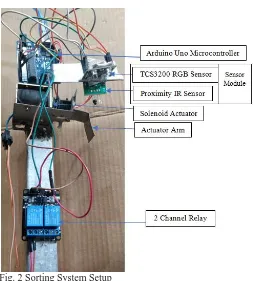
The developed system is shown in figure 1. It consists of a sensing module mounted on an extension of the main setup. The extension suspends over the portion of the track, right before the sorting station.
The sensor module consists of a proximity IR sensor and an RGB sensor TCS3200 connected directly to the microcontroller board.
The IR sensor detects the orientation of the component whereas the RGB sensor detects the color of the component. Both the sensors give their respective outputs to the microcontroller. The microcontroller then processes and compares the received data against the conditions programmed into it. Based on the result of this comparison, the microcontroller sends a binary signal to the relay which works as a switch that controls the solenoid actuator. The desired components are allowed to pass, while the remaining components are thrown back into the feeder bowl by the actuator, at the sorting station.
[image:2.612.314.567.54.335.2]The present system offers a peculiar advantage over the conventional sorting systems in a way that in case of the latter, frequency of feeding becomes less meaningful as it uses escapements to keep two consecutive parts at a fixed interval apart to match the sensing response time. Whereas in present system no such restrictions are there. And the final feed rate can be varied using frequency regulator.
Fig. 1 Developed System Setup with Vibratory Bowl Feeder
Fig. 2 Sorting System Setup
V. THE CONTROL PROGRAM
A. Processing RGB Sensor Response
Fig.3 is the working portion of the function reading the RGB sensor. All types of components and the base of the track have a distinct characteristic response value for Red, Blue and Green. The microcontroller accepts response for red blue and green color and stores in variables ‘rfrequency’, ‘bfrequency’, and ‘gfrequency’ respectively.
The code then compares the predetermined values of frequencies for the preselected component with the input frequencies stored in the variables.
Return value = 1 implies that the component is desired. Return value = 2 implies that there is no object under the RGB sensor
Return value = 0 implies that component under RGB sensor is undesired.
Range for values of RGB for all types of components is given as follows:
Black: R140-150; G160-170; B125-135 White: R70-90; G85-100; B80-90 Track Base: R115-125; G125-145; B105-115
B. Processing IR Sensor Response
[image:2.612.47.298.520.713.2]of the sensor and gives a value >700, in which case the function returns a value 1.
C. Actuator Control
Fig. 5 shows the actuator control.
The solenoid actuator is an electro-mechanically powered actuator. When electricity is passed through the actuator, the arm is pulled back due to the magnetic force inside the solenoid, and the spring gets compressed. when the supply is cut-off by the relay, the mechanical energy stored in the spring pushes the arm outwards causing the pushing motion
In the figure, it is apparent that when the RGB sensor detects base, actuator takes no action, when the RGB sensor detect the desired color and the IR sensor detects the desired orientation, actuator takes no action and lets the component pass. However, if either or both the conditions are left unsatisfied, i.e., in all other cases, the actuator pushes the component back into the feeder.
VI. THE PROCESS FLOWCHART
The stepwise flow control and processes taking place in the system can be exhibited by the process flowchart in Fig.6.
Fig.3 RGB Sensor Response snippet
Fig. 4 IR Sensor Response Snippet
VII. ELECTRONIC CIRCUITRY
Following are the electronic components used in the circuit:
A. Arduino Uno microcontroller [2]: Arduino Uno is a
[image:5.612.52.291.172.328.2]microcontroller board on the atmega328p. It has 14 digital input/output pins 9of which 6 can be used as PWM outputs), 6 analog inputs, a 16mHz quartz crystal, a USB connection, a power jack, an ICSP header and a Reset button. [3]
Fig 7. Arduino Uno Microcontroller Board
B. Channel 5V 10A relay [4]: A relay is defined as an electrically operated switch; their main use is controlling circuits by a low-power signal or when several circuits must be controlled by one signal. This module incorporates 2 relays. The following forms the relay system:
Input: VCC, connected to the 5V current on the
Arduino Board, GND, connected to the ground and 2 digital inputs. (In1 & In2)
Output: The 2-channel relay module could be
[image:5.612.354.550.179.299.2]considered like a series switches: 2 normally Open (NO), 2 normally closed (NC) and 2 common Pins (COM).
Fig 8. 2 Channel 5V Relay
*NC- Normally Closed, in which case NC is connected with COM when INT1 is set low and disconnected when INT 1 is high.
*NO- Normally Open, in which case NO is disconnected with COM when INT1 is set low and connected when INT 1 is high [5].
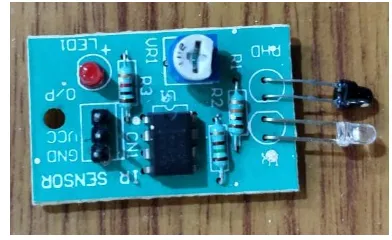
[image:5.612.83.291.498.649.2]C. Proximity IR Sensor [6]: This is a multipurpose infrared sensor which can be used for obstacle sensing, line sensing, etc. and also as an encoder sensor. The sensor provides a digital output (1 or 0). The sensor outputs a logic one (+3.5V) at the digital output when an object is placed in front of the sensor and logic zero (0V), when there is no object in front of the sensor. An onboard LED is used to indicate the presence of an object.[7]
Fig 9. Proximity IR Sensor
D. RGB Color Sensor (TCS3200) [8]: This Arduino
compatible TCS3200 color sensor module consist of a
TAOS TCS3200 RGB sensor chip and 4 white LEDs. The main part of the module is the TCS3200 chip which is a Color Light-to-Frequency Converter. The white LEDs are used for providing proper lighting for the sensor to detect the object color correctly. This chip can sense a wide variety of colors and it gives the output in the form of corresponding frequency. This module can be used for making color sorting robots, test strip reading, color matching tests etc.
The TCS3200 chip consist of an 8 x 8 array of
photodiodes.
[image:5.612.352.557.536.674.2]Each photodiode has either a red, green, or blue filter, or no filter. The filters of each color are distributed evenly throughout the array to eliminate location bias among the colors. Internal circuit includes an oscillator which produces a square-wave output whose frequency is proportional to the intensity of the chosen color. [9]
VIII. FUTURE SCOPE
Though the developed system is working satisfactorily, there is still scope for further feature and performance enhancement, in the following two ways.
a) Machine Learning can be used in order to train the sorting systems to recalibrate itself according to the change in feeding frequency. The current system is capable of working at higher as well lower frequencies and has been underclocked by adding time delays. Machine learning could enable the system to increase or decrease the delay time according to the feeding frequency changes.
b) Computer Vision can be used to replace the sensor module, thus, making the system universal in its applications enabling it to process different types of components on multiple parameters.
IX. RESULTS
Extensive number of trial runs were conducted on the system to test its ability to perform the intended task. An average of 2% error was recorded.
X. CONCLUSION
The developed system has proven its utility to elaborated scheme of experimentation under different sets of variables. The results obtained were found to be stable and uniform. The system can successfully be used in industry for various sorting applications and it lends itself to be a low-cost alternative to the available practices.
REFERENCES
[1] Gupta, A., Singhi, G., Agarwal, G., Sankar, N., Khanna, P., “Design and Fabrication of an Agile Sorting and Feeding System”, Proceedings of the World Congress on Engineering and Computer Science 2007, WCECS 2007, October 24-26, 2007, San Francisco, USA
[2] https://www.farnell.com/datasheets/1682209.pdf accessed on 27th July 2018. Description:- Data sheets of Microcontroller Arduino board explaining it’s components and working.
[3] https://store.arduino.cc/usa/arduino-uno-rev3 accessed on 27th July 2018.Description:- Functioning of Microcontroller Arduino board and uses.
[4] http://www.fecegypt.com/uploads/dataSheet/14808480 03_2_channel_5v_10a_relay_module.pdf accessed on 27th July 2018. Description:- Data sheets of Relay
functioning module explaining it’s components and working.
[5] https://sites.google.com/site/summerfuelrobots/arduino-sensor-tutorials/2-channel-relay-module accessed on 27th July 2018. .Description:- Functioning of Relay module and uses.
[6] http://silicontechnolabs.in/upload/IR%20Proximity%20 Sensor%20datasheet.pdf accessed on 27th July 2018. Description:- Data sheets of Proximity IR sensor explaining it’s components and working.
[7] http://silicontechnolabs.in/ir-proximity-sensor accessed on 27th July 2018. Description:- Functioning of Proximity IR sensor and uses.
[8] https://media.digikey.com/pdf/Data%20Sheets/DFRobo t%20PDFs/SEN0101_Web.pdf accessed on 27th July 2018. Data sheets of color sensor(TCS3200) explaining it’s components and working.