Random Fuzzy Multiobjective Linear
Programming Through Probability Maximization
and Its Application to Farm Planning
Hitoshi Yano and Kota Matsui
Abstract—In this paper, we propose an interactive decision
making method for random fuzzy multiobjective linear pro-gramming problems (RFMOLP) through a probability maxi-mization model. In the proposed method, it is assumed that the decision maker has fuzzy goals for not only permissible objective levels of a probability maximization model but also the corresponding distribution function values. Using the fuzzy de-cision, such two kinds of membership functions are integrated. In the integrated membership space, a satisfactory solution is obtained from among a Pareto optimal solution set through the interaction with the decision maker.
Index Terms—random fuzzy variable, a probability
maxi-mization model, satisfactory solution, interactive decision mak-ing.
I. INTRODUCTION
In the real world decision making situations, we often have to make a decision under uncertainty. In order to deal with decision problems involving uncertainty, stochastic program-ming approaches [1], [2], [3], [10] and fuzzy programprogram-ming approaches [16], [20], [25] have been developed. Recently, in order to deal with mathematical programming problems involving the randomness and the fuzziness, random fuzzy programming has been developed [11], in which the coef-ficients of the objective functions and/or the constraints are represented with random fuzzy variables [17], [18]. As a natural extension, a random fuzzy multiobjective program-ming problem (RFMOLP) was formulated and the interac-tive decision making methods were proposed to obtain the satisfactory solution of the decision maker from among the Pareto optimal solution set [12], [13], [14], [15]. Moreover, in order to show the efficiency of random fuzzy programming techniques, real-world decision making problems under ran-dom fuzzy environments were formulated as ranran-dom fuzzy programming problems, and the corresponding algorithms to obtain the optimal solutions were proposed [6], [8], [19].
Under these circumstances, we focus on the interactive decision making method [11], [12], [13] for RFMOLP to obtain a satisfactory solution, in which a probability maxi-mization model or a fractile optimaxi-mization model is adopted in order to deal with RFMOLP. In their proposed methods, it seems to be very difficult for the decision maker to specify permissible objective levels or permissible probability levels appropriately. From such a point of view, in this paper, under the assumption that the decision maker has fuzzy goals for
H. Yano is with Graduate School of Humanities and Social Sci-ences, Nagoya City University, Nagoya, 467-8501, Japan, e-mail: [email protected]
K. Matsui is with Department of Computer Science and Mathematical Informatics, Graduate School of Information Science, Nagoya University, Nagoya, 464-8601, Japan, e-mail: [email protected]
permissible objective levels of a probability maximization model, we propose an interactive decision making method for RFMOLP to obtain a satisfactory solution of the decision maker [22]. The proposed method can be regarded as a ran-dom fuzzy version of the interactive decision making meth-ods for fuzzy random multiobjective programming problems [23], [24]. In section II, RFMOLP is formulated by using a concept of a possibility measure and a probability maxi-mization model, and theD-Pareto optimal solution concept for RFMOLP is introduced. For the reference membership values specified by the decision maker, the correspondingD -Pareto optimal solution is obtained by solving the minmax problem. It is shown that the optimal solution of the minimax problem can be easily obtained by the convex programming technique. In section III, the interactive algorithm to obtain the satisfactory solution from among a D-Pareto optimal solution set is proposed, which is based on the convex programming technique. In section IV, In order to illustrate the proposed method, a crop planning problem at farm level [5], [7], [9], [21] is formulated as a numerical example, and the interactive processes under the hypothetical decision maker are demonstrated. Finally, in section V, we conclude this paper.
II. PROBLEMFORMULATION
In this section, we focus on RFMOLP in which random variable coefficients are involved in objective functions. [RFMOLP]
min
x∈X
¯ ˜
Cx= (¯˜c1x,· · ·,¯˜ckx)
wherex= (x1, x2,· · ·, xn) T
is ann dimensional decision variable column vector, ¯˜ci = (¯˜ci1,· · ·,¯˜cin), i = 1,· · ·, k,
are coefficient vectors of objective function ¯˜cix, whose elements are random fuzzy variables [17], and the symbols
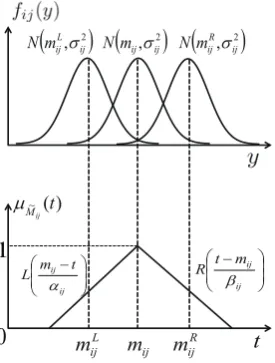
"-"and"˜"mean randomness and fuzziness respectively. In this paper, according to Katagiri et al. [11], [12], [13], we assume that a random fuzzy variable ¯˜cij is normally
distributed with the fuzzy number M˜ij as mean andσ2ij as
variance. As a result, we assume that a probability density functionfij(y)for a random fuzzy variable ¯˜cij is formally
represented with the following form.
fij(y) =
1 √
2πσij e−
(y−Mij˜ )2 2σ2
ij ,1≤i≤k,1≤j≤n (1)
where M˜ij is an L-R fuzzy number characterized by the
following membership function.
µM˜
ij(t) =
L
( mij−t
αij
)
if mij ≥t
R (
t−mij
βij
)
if mij ≤t
(2)
IAENG International Journal of Applied Mathematics, 43:2, IJAM_43_2_07
!
2
, ij L ij
m N
) (
~ t
ij M
L ij
m
t
! " # # $ % &
ij ij t m
L !!
" # $ $ % & '
ij ij
m t R
1
0
ij
m R
ij
m
!
2
, ij ij
m
N
!
2"
, ij R ij
[image:2.595.102.240.54.236.2]m N
Fig. 1. An Image of a random fuzzy variable¯˜cij
L and R are called reference functions, mij is the mean
value, andαij, βij are spread parameters [4].
Then, a random fuzzy variablec¯˜ij can be characterized by
the following membership function [11], [12], [13].
µ¯˜cij(¯γij) = sup
sij
{µM˜ij(sij)|γ¯ij ∼N(sij, σ
2
ij)} (3)
where N(sij, σ2ij) means a normal distribution with mean sij and standard deviation σij. Moreover, using Zadeh’s
extension principle [20], [25], the objective function¯˜cix
be-come a random fuzzy variable characterized by the following membership function [11], [12], [13].
µ¯˜c
ix(¯ui) = sup
(si1,···,sin)∈Rn
{
min
1≤j≤nµM˜ij(sij)
¯
ui∼N ∑n
j=1
sijxj, n ∑
j=1
σij2x2j
(4)
Unfortunately, we can not treat RFMOLP directly because it is ill-defined. Katagiri et al. [11], [13] formulated RFMOLP using permissible objective levels of a probability maxi-mization model and the possibility measure. For permissible objective levels fi, i = 1,· · ·, k specified by the decision
maker, a probability maximization model for RFMOLP can be formulated as follows.
[MOP1(f)]
max
x∈X(Pr(ω|
¯ ˜
c1(ω)x≤f1),· · · ,Pr(ω|¯˜ck(ω)x≤fk))
It should be noted here that the each objective function :
˜
Pi(x, fi)
def
= Pr(ω|¯˜ci(ω)x≤fi), (5)
becomes a fuzzy set and the corresponding membership function is defined as follows[11], [12], [13].
µP˜i(x,fi)(pi)
def
= sup
¯
ui
{
µ¯˜cix(¯ui)
pi= Pr(ω|u¯i(ω)≤fi),
¯
ui ∼N ∑n
j=1
sijxj, n ∑
j=1
σij2x2j
(6)
Katagiri et al. [11], [12], [13] showed that, from (4), the membership function (6) can be transformed as follows.
µP˜i(x,fi)(pi) = sup
(si1,···,sin)∈Rn
min
1≤j≤n {
µM˜ij(sij) pi= Pr(ω|u¯i(ω)≤fi),
¯
ui∼N ∑n
j=1
sijxj, n ∑
j=1
σij2x2j
(7)
Using (5), MOP1(f) can be transformed as follows. [MOP2(f)]
max
x∈X( ˜P1(x, f1),· · ·,
˜
Pk(x, fk))
MOP2(f) is ill-defined yet, because objective functions of MOP2(f) are fuzzy sets depending on permissible objective levelfi, i= 1,· · ·, k. In order to deal with MOP2(f), let us
assume that the decision maker has a fuzzy goalG˜ifor each
objective function P˜i(x, fi), which is expressed in words
such as ”P˜i(x, fi)should be substantially less thanpi”. For
the corresponding membership function µG˜i(pi), we make
the following assumption. Assumption 1.
µG˜
i(pi), i= 1,· · · , k are strictly increasing and continuous
with respect to pi ∈ [pimin, pimax], and µpi(pimin) = 0,
µpi(pimax) = 1, where0.5< pimin is a maximum value of
an unacceptable levels and pimax <1 is a minimum value
of a sufficiently satisfactory levels. Using possibility measure [4],
ΠP˜i(x,fi)( ˜Gi)
def
= sup
pi
min{µP˜i(x,fi)(pi), µG˜i(pi)}, (8)
Katagiri et al. [11], [12], [13] transformed MOP2(f) into the following well-defined multiobjective programming problem. [MOP3(f)]
max
x∈X(ΠP˜1(x,f1)( ˜G1),· · ·,ΠP˜k((x,fk))( ˜Gk))
Unfortunately, in MOP3(f), the decision maker must spec-ify permissible objective levels in advance. However, it seems very difficult to specify such values becauseΠP˜i(x,fi)( ˜Gi)
depends on a permissible objective levels fi. From such a
point of view, in this paper, instead of MOP3(f), we consider the following extended problem wherefi, i= 1,· · ·, k are
not constants but decision variables. [MOP4]
max
x∈X,fi∈R1,i=1,···,k
(ΠP˜1(x,f1)( ˜G1),· · ·,
ΠP˜k((x,fk))( ˜Gk),−f1,· · ·,−fk)
Considering the imprecise nature of the decision maker’s judgment, we assume that the decision maker has a fuzzy goal for each permissible objective level. Such a fuzzy goal can be quantified by eliciting the corresponding membership function. Let us denote a membership function of a per-missible objective level fi as µF˜i(fi). For the membership
functionµF˜i(fi), we make the following assumption.
Assumption 2.
µF˜i(fi), i= 1,· · · , k are strictly decreasing and continuous
with respect to fi ∈ [fimin, fimax], and µfi(fimin) = 1,
µfi(fimax) = 0, where fimin is a maximum value of a
sufficiently satisfactory levels. andfimaxis a minimum value
of an unacceptable levels.
IAENG International Journal of Applied Mathematics, 43:2, IJAM_43_2_07
Then, MOP4 can be transformed as the following multi-objective programming problem.
[MOP5]
max
x∈X,fi∈R1,i=1,···,k
(ΠP˜
1(x,f1)( ˜G1),· · · ,ΠP˜k((x,fk))( ˜Gk),
µF˜1(f1),· · · , µF˜k(fk))
It should be noted here that,ΠP˜i(x,fi)( ˜Gi)is strictly
increas-ing with respect tofi. If the decision maker adopts the fuzzy
decision [20], [25] to integrate ΠP˜
i(x,fi)( ˜Gi) and µF˜i(fi),
MOP5 can be transformed into the following form. [MOP6]
max
x∈X,fi∈R1,i=1,···,k
(µD1(x, f1),· · ·, µDk(x, fk))
where
µDi(x, fi)
def
= min{ΠP˜i(x,fi)( ˜Gi), µF˜i(fi)}
In order to deal with MOP6, we introduce aD-Pareto optimal solution concept.
Definition 1.
x∗ ∈ X, fi∗ ∈ R1, i = 1,· · · , k is said to be a D-Pareto
optimal solution to MOP6, if and only if there does not exist another x ∈ X, fi ∈ R1, i = 1,· · · , k such that µDi(x, fi)≥µDi(x∗, fi∗)i= 1,· · ·, kwith strict inequality
holding for at least onei.
For generating a candidate of a satisfactory solution which is also D-Pareto optimal, the decision maker is asked to specify the reference membership values [20]. Once the ref-erence membership values µˆ = (ˆµ1,· · ·,µˆk) are specified,
the corresponding D-Pareto optimal solution is obtained by solving the following minmax problem.
[MINMAX1(µˆ)]
min
x∈X,fi∈R1,i=1,···,k,λ∈[0,1]
λ (9)
subject to
ˆ
µi−ΠP˜
i(x,fi)( ˜Gi) ≤ λ, i= 1,· · · , k (10)
ˆ
µi−µF˜i(fi) ≤ λ, i= 1,· · · , k (11)
From [11], [12], [13], each constraint of (10) can be equiv-alently transformed into the following form.
ˆ
µi−ΠP˜i(x,fi)( ˜Gi)≤λ
⇔
n ∑
j=1
{mij−L−1(ˆµi−λ)αij}xj
+Φ−1(µ−˜1
Gi(ˆµi−λ))
v u u t∑n
j=1
σ2
ijx2j≤fi (12)
where Φ(·) is a distribution function of the standard Gaus-sian random variable, Φ−1(·) is a corresponding inverse
function, and L−1(·), µ−1 ˜
Gl
(·) are pseudo-inverse functions of L(·), µG˜i(·) respectively. Moreover, since the
inequal-ities (11) can be transformed into fi ≤ µ−F˜1
i
(ˆµi − λ),
MINMAX1(µˆ) can be reduced to the following problem. [MINMAX2(µˆ)]
min
x∈X,λ∈Λλ (13)
subject to
n ∑
j=1
{mij−L−1(ˆµi−λ)αij}xj
+Φ−1(µ−˜1 Gi
(ˆµi−λ)) v u u t∑n
j=1
σ2
ijx
2
j ≤µ−
1 ˜
Fi
(ˆµi−λ),
i= 1,· · ·, k (14)
where
Λ def= [λmin, λmax]
= [ max
i=1,···,kµˆi−1,i=1min,···,kµˆi]. (15)
The relationships between the optimal solution (x∗, λ∗) of MINMAX2(ˆµ) and D-Pareto optimal solutions can be characterized by the following theorem.
Theorem 1.
(1) If x∗ ∈ X, λ∗ ∈ Λ is a unique optimal solution of MINMAX2(µˆ), then x∗ ∈ X, µ−˜1
Fi(ˆµi −λ
∗) ∈ R1, i =
1,· · ·, k is aD-Pareto optimal solution.
(2) If x∗ ∈ X, fi∗ ∈ R1, i = 1,· · ·, k is a D-Pareto
optimal solution, thenx∗∈X, λ∗= ˆµi−ΠP˜
i(x∗,fi∗)( ˜Gi) =
ˆ
µi − µF˜
i(f
∗
i), i = 1,· · ·, k is an optimal solution of
MINMAX2(µˆ) for some reference membership values µˆ= (ˆµ1,· · ·,µˆk).
(Proof)
(1) Assume thatx∗∈X, fi∗def= µ−˜1 Fi
(ˆµi−λ∗), i= 1,· · ·, k
is not a D-Pareto optimal solution. Then, from (10), there existx∈X, fi∈R1, i= 1,· · ·, k such that
µDi(x, fi) = min{ΠP˜i(x,fi)( ˜Gi), µF˜i(fi)}
≥ µDi(x
∗, f∗
i)
= min{ΠP˜i(x∗,fi∗)( ˜Gi), µF˜i(f
∗
i)}
= µˆi−λ∗, i= 1,· · ·, k,
with strict inequality holding for at least onei. Then it holds that
ΠP˜
i(x,fi)( ˜Gi) ≥ µˆi−λ
∗, i= 1,· · · , k, (16)
µF˜
i(fi) ≥ µˆi−λ
∗, i= 1,· · · , k. (17)
From (12), (16) can be transformed as follows.
n ∑
j=1
{mij−L−1(ˆµi−λ∗)αij}xj
+Φ−1(µ−˜1 Gi
(ˆµi−λ∗)) v u u t∑n
j=1
σ2
ijx
2
j ≤fi (18)
From (17), it holds thatfi≤µ−F˜i1
(ˆµi−λ∗). As a result, there
existsx∈X such that
n ∑
j=1
{mij−L−1(ˆµi−λ∗)αij}xj
+Φ−1(µ−˜1 Gi
(ˆµi−λ∗)) v u u t∑n
j=1
σ2
ijx2j ≤µ−
1 ˜
Fi
(ˆµi−λ∗)
i= 1,· · · , k (19)
which contradicts the fact that x∗ ∈X, λ∗∈Λ is a unique optimal solution to MINMAX2(ˆµ).
IAENG International Journal of Applied Mathematics, 43:2, IJAM_43_2_07
(2) Assume thatx∗∈X, λ∗∈Λis not an optimal solution to MINMAX2(ˆµ) for any reference membership valuesµˆ= (ˆµ1,· · · ,µˆk), which satisfy the equalities :
ˆ
µi−λ∗= ΠP˜i(x∗,fi∗)( ˜Gi) =µF˜i(f
∗
i), i= 1,· · ·, k. (20)
Then, there exists some x∈X, λ < λ∗ such that
n ∑
j=1
{mij−L−1(ˆµi−λ)αij}xj
+Φ−1(µ−˜1
Gi(ˆµi−λ))
v u u t∑n
j=1
σ2
ijx2j ≤µ−
1 ˜
Fi(ˆµi−λ),
i= 1,· · · , k. (21)
This means that
ΠP˜
i(x,fi)( ˜Gi) ≥ µˆi−λ >µˆi−λ
∗, i= 1,· · · , k
µF˜i(fi) = µˆi−λ >µˆi−λ∗, i= 1,· · · , k,
wherefi
def
= µ−˜1 Fi
(ˆµi−λ). From (20), there existsx∈X, fi∈
R1, i= 1,· · ·, k such that
µDi(x, fi)> µDi(x
∗, f∗
i), i= 1,· · ·, k.
This contradicts the fact thatx∗∈X, fi∗∈R1, i= 1,· · ·, k
is aD-Pareto optimal solution. 2 Since the constraints (14) are nonlinear, it is not easy to solve MINMAX2(ˆµ) directly. Before considering the algo-rithm to solve MINMAX2(µˆ), we first define the following functions corresponding to (14).
gi(x, λ)
def
= µ−˜1
Fi(ˆµi−λ)−
n ∑
j=1
{mij−L−1(ˆµi−λ)αij}xj
−Φ−1(µ−˜1 Gi
(ˆµi−λ)) v u u t∑n
j=1
σ2
ijx2j,
i= 1,· · ·, k (22)
Because of µ−˜1 Gi
(ˆµi−λ) > 0.5 for any λ∈ Λ, it holds
that Φ−1(µ−pi1(ˆµi−λ))>0. This means thatgi(x, λ), i=
1,· · · , k are concave with respect to x ∈X for any fixed value λ∈Λ. Let us define the following feasible setX(λ) of MINMAX2(µˆ) for some fixed valueλ∈Λ.
X(λ)def= {x∈X |gi(x, λ)≥0, i= 1,· · · , k} (23)
Then, it is clear that X(λ) is a convex set. X(λ) satisfies the following property.
Property 1.
If λmin ≤ λ1 ≤ λ2 ≤ λmax, then it holds that X(λ1) ⊂
X(λ2).
In the following, it is assumed that X(λmin) =
ϕ, X(λmax)̸=ϕ. From Property 1, we can obtain the optimal
solution (x∗, λ∗) of MINMAX2(ˆµ) using the following simple algorithm which is based on the bisection method and the convex programming technique.
[Algorithm 1.]
Step 1: Setλ0=λmin, λ1=λmax,λ←(λ0+λ1)/2.
Step 2: Solve the following convex programming problem for the fixed value λ, and denote the optimal solution as
x(λ).
max
x∈Xgj(x, λ) (24)
subject to
gi(x, λ)≥0, i= 1,· · ·, k, i̸=j (25)
Step 3: If gℓ(x(λ), λ) ≥ 0, ℓ = 1,· · · , k then set λ1 ←
λ, λ ← (λ0+λ1)/2. Otherwise, set λ0 ← λ, λ ← (λ0+
λ1)/2. If | λ1−λ0 |< ϵ then go to Step 4, where ϵ is a
sufficiently small positive constant. Otherwise, go to Step 2. Step 4: Setλ∗←λandx∗←x(λ). The optimal solution (x∗, λ∗)of MINMAX2(ˆµ) is obtained.
III. ANINTERACTIVEALGORITHM
In this section, we propose an interactive algorithm to obtain a satisfactory solution from among aD-Pareto optimal solution set. From Theorem 1, it is not guaranteed that the optimal solution(x∗, λ∗)of MINMAX2(µˆ) isD-Pareto optimal, if it is not unique. In order to guarantee the D -Pareto optimality, we first assume thatkconstraints (14) are active at the optimal solution(x∗, λ∗),i.e.,
n ∑
j=1
{mij−L−1(ˆµi−λ∗)αij}x∗j
+Φ−1(µ−˜1 Gi
(ˆµi−λ∗)) v u u t∑n
j=1
σ2
ijx∗j
2=µ−1 ˜
Fi
(ˆµi−λ∗),
i= 1,· · · , k. (26)
If theℓ-th constraint of (14) is inactive,i.e.,
n ∑
j=1
{mℓj−L−1(ˆµℓ−λ∗)αℓj}x∗j
+Φ−1(µ−˜1 Gℓ
(ˆµℓ−λ∗)) v u u t∑n
j=1
σ2
ℓjx∗j
2< µ−1 ˜
Fℓ
(ˆµℓ−λ∗),
(27)
we can convert the inactive constraint (27) into the active one by applying the bisection method for the reference membership valueµˆℓ∈[λ∗, λ∗+ 1].
For the optimal solution(x∗, λ∗)of MINMAX2(ˆµ), where the active conditions (26) are satisfied, we solve theD-Pareto optimality test problem defined as follows.
[D-Pareto optimality test problem]
max
x∈X,ϵi≥0,i=1,···,k
wdef=
k ∑
i=1
ϵi (28)
subject to
n ∑
j=1
{mij−L−1(ˆµi−λ∗)αij}xj
+Φ−1(µ−˜1 Gi(ˆµi−λ
∗))
v u u t∑n
j=1
σ2
ijx2j+ϵi
≤
n ∑
j=1
{mij−L−1(ˆµi−λ∗)αij}x∗j
+Φ−1(µ−˜1 Gi
(ˆµi−λ∗)) v u u t∑n
j=1
σ2
ijx∗j
2,
i= 1,· · · , k (29)
IAENG International Journal of Applied Mathematics, 43:2, IJAM_43_2_07
For the optimal solution of the above test problem, the following theorem holds.
Theorem 2.
For the optimal solutionxˇ,ˇϵi, i= 1,· · · , k of the test
prob-lem (28)-(29), ifw= 0 (equivalently,ˇϵi = 0, i= 1,· · ·, k), x∗ ∈ X, fi∗ def= µ−˜1
Fi
(ˆµi−λ∗)∈ R1, i = 1,· · · , k is a D
-Pareto optimal solution. (Proof)
From the active condition (26) at the optimal solution (x∗, λ∗)of MINMAX2(µˆ), it holds that
ˆ
µi−λ∗ = ΠP˜i(x∗,fi∗)( ˜Gi), i= 1,· · ·, k,
ˆ
µi−λ∗ = µF˜i(f
∗
i), i= 1,· · ·, k.
Assume that x∗ ∈ X, µ−˜1 Fi(ˆµi−λ
∗), i = 1,· · · , k is not a
D-Pareto optimal solution. Then, there exist x ∈ X, fi ∈
R1, i= 1,· · ·, k such that
µDi(x, fi) = min{ΠP˜i(x,fi)( ˜Gi), µF˜i(fi)}
≥ µDi(x
∗, f∗
i)
= µˆi−λ∗, i= 1,· · ·, k,
with strict inequality holding for at least onei. This means that
ΠP˜i(x,fi)( ˜Gi) ≥ µˆi−λ∗, i= 1,· · ·, k, (30) µF˜i(fi) ≥ µˆi−λ∗, i= 1,· · ·, k. (31)
From (12), (30) and (31), the following inequalities hold,
n ∑
j=1
{mij−L−1(ˆµi−λ∗)αij}xj
+Φ−1(µ−˜1 Gi(ˆµi−λ
∗))
v u u t∑n
j=1
σ2
ijx2j ≤µ−
1 ˜
Fi(ˆµi−λ
∗)
i= 1,· · ·, k (32)
with strict inequality holding for at least onei. This contra-dicts the fact thatˇϵi= 0, i= 1,· · ·, k. 2
Now, following the above discussions, we can present the interactive algorithm in order to derive a satisfactory solution from among aD-Pareto optimal solution set.
[Algorithm 2]
Step 1: The decision maker sets each of the membership functions µF˜i(fi), i = 1,· · ·, k of the fuzzy goal F˜i for
permissible objective levelfi according to Assumption 2.
Step 2: Corresponding to the fuzzy goal G˜i for the
probability that the objective function ¯˜cix is less than fi,
the decision maker sets each of the membership functions
µG˜i(pi), i= 1,· · ·, k according to Assumption 1.
Step 3: Set the initial reference membership values asµˆi=
1, i= 1,· · · , k.
Step 4: Solve MINMAX2(ˆµ) by applying Algorithm 1, and obtain the optimal solution (x∗, λ∗). For the optimal solution (x∗, λ∗), The corresponding D-Pareto optimality test problem (28)-(29) is formulated and solved.
Step 5: If the decision maker is satisfied with the current values of the D-Pareto optimal solution µDi(x∗, fi∗), i =
1,· · · , kwherefi∗=µ−˜1 Fi
(ˆµi−λ∗), then stop. Otherwise, the
decision maker updates his/her reference membership values ˆ
µi, i= 1,· · ·, k, and return to Step 4.
IV. A NUMERICALEXAMPLE
In order to demonstrate our proposed decision making method, we consider the following crop planning problem [5], [7], [9], [21], in which a farmer or an agricultural manager wants to maximize his/her total profit (unit: 1000 yen) and minimize his/her working time (unit: 1 hour) by using his/her farmland effectively. In order to decide the planting ratio for four kinds of cropsxj, j= 1,· · · ,5 (unit:
1000 m2 ) in his/her farmland, we formulate the following
multiobjective fuzzy random programming problem. [RFMOLP]
min ¯˜c1x= 5
∑
j=1
¯ ˜
c1jxj (profit maximization)
min ¯˜c2x= 5
∑
j=1
¯ ˜
c2jxj (labor minimization)
subject to
x∈X = {x∈R5|x1+x2+x3+x4+x5≤200
x1≥15, x2≥35, x3≥20, x4≥25,
x5≥45}(Land Constraint)
where x = (x1, x2, x3, x4, x5)
T
is a five dimensional de-cision variable column vector, each element xj means the
cultivation area for cropj. ¯
˜
c1j, j= 1,· · · ,5are profit coefficients at the unit area for
cropj, and ¯˜c2j, j = 1,· · ·,5 are working time coefficients
for growing cropj at the unit area, each of which is defined as a random fuzzy variable. Random fuzzy variables¯˜cij, i=
1,2, j = 1,· · · ,5 are normally distributed with the fuzzy numberM˜ij as mean andσij2 as variance, and a probability
density function fij(y) for a random fuzzy variable ¯˜cij is
formally represented with the following form.
fij(y) =
1 √
2πσij e−
(y−Mij˜ )2 2σ2
ij ,1≤i≤2,1≤j ≤5 (33)
˜
Mij is an L-R fuzzy number characterized by the following
membership function.
µM˜ij(t) =
L
( mij−t
αij ,
)
mij≥t
R (
t−mij
βij ,
)
mij ≤t
(34)
whereL(t) =R(t) = max{0,1−t}, and mij,αij(= βij), σ2
ij are given in Table I.
In RFMOLP, let us assume that the hypothetical decision maker sets the membership functionsµF˜i(·),µG˜i(·),i= 1,2
as follows (Step 1, 2).
µF˜1(f1) =
f1−(−1000)
(−1650)−(−1000)
µF˜2(f2) =
f2−1500
1200−1500
µG˜
1(p1) =
p1−0.7
0.85−0.7
µG˜2(p2) =
p2−0.8
0.9−0.8
Set the initial reference membership values as (ˆµ1,µˆ2) =
(1,1) (Step 3), and solve MINMAX2(ˆµ) to obtain the correspondingD-Pareto optimal solution (x∗, λ∗) (Step 4).
(µD1(x∗, f1∗), µD2(x∗, f2∗)) = (0.7965,0.7965)
IAENG International Journal of Applied Mathematics, 43:2, IJAM_43_2_07
TABLE I
THE PARAMETERS OF THE FUZZY NUMBERM˜ijAND THE VARIANCEσ2 ij
OF THE RANDOM FUZZY VARIABLEc¯˜ij
¯ ˜
Mij mij αij(=βij) σ2ij(the variance of¯˜cij)
¯ ˜
M11 -4.2 0.5 1
¯ ˜
M12 -8 0.4 2
¯ ˜
M13 -5.6 0.3 2
¯ ˜
M14 -10.6 0.2 3
¯ ˜
M15 -9.5 0.3 1
¯ ˜
M21 10 0.3 2
¯ ˜
M22 5 0.4 3
¯ ˜
M23 5 0.4 1
¯ ˜
M24 9 0.2 2
¯ ˜
M25 5 0.1 1
TABLE II INTERACTIVE PROCESSES
Iteration 1 2 3
ˆ
µ1 1 1 0.93
ˆ
µ2 1 0.8 0.8
f1∗ -1517.78 -1597.23 -1559.20 f2∗ 1261.02 1305.01 1280.90 p∗1 0.8194 0.8378 0.8290
p∗2 0.8796 0.8649 0.8730
µD1(x∗, f1∗) 0.7965 0.9188 0.8603
µD2(x∗, f2∗) 0.7965 0.6499 0.7303
where fi∗ = µ−˜1 Fi
(ˆµi −λ∗), i = 1,2. The hypothetical
decision maker is not satisfied with the current value of the D-Pareto optimal solution (x∗, fi∗), and, in order to improve µD1(·) at the expense of µD2(·), he/she updates his/her reference membership values as (ˆµ1,µˆ2) = (1,0.8)
(Step 5). Then, the correspondingD-Pareto optimal solution is obtained by solving MINMAX2(µˆ) (Step 4). The inter-active processes under the hypothetical decision maker are summarized in Table II.
In order to compare our proposed approach with the previous ones, let us consider the following multiobjective programming problem based on a probability maximization model for RFMOLP.
[MOP2’(f)] max
x∈X(ΠP˜1(x,f1)( ˜G1),ΠP˜2((x,f2))( ˜G2))
where f1 and f2 are permissible objective levels specified
by the decision maker in his/her subjective manner. Once the reference membership valuesµˆ= (ˆµ1,µˆ2)are specified
by the decision maker, the corresponding Pareto optimal solution is obtained by the following minmax problem. [MINMAX3(µˆ,f)]
min
x∈X,λ∈Λλ (35)
subject to ˆ
µi−ΠP˜
i(x,fi)( ˜Gi)≤λ, i= 1,2
¿From (12), MINMAX3(µˆ,f) can be equivalently trans-formed to the following form.
[MINMAX4(µˆ,f)]
min
x∈X,λ∈Λλ
subject to
TABLE III
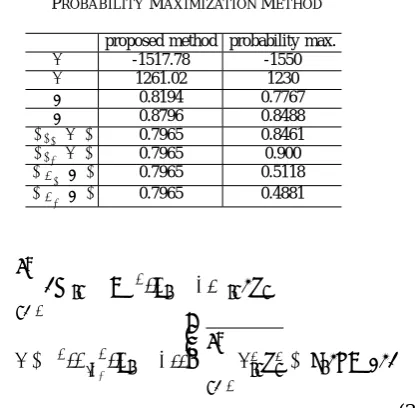
COMPARISON BETWEEN THEPROPOSEDMETHOD AND THE PROBABILITYMAXIMIZATIONMETHOD
proposed method probability max.
f1∗ -1517.78 -1550
f2∗ 1261.02 1230
p∗1 0.8194 0.7767
p∗2 0.8796 0.8488
µf1(f1∗) 0.7965 0.8461
µf2(f2∗) 0.7965 0.900
µG˜1(p
∗
1) 0.7965 0.5118
µG˜2(p
∗
2) 0.7965 0.4881
n ∑
j=1
{mij−L−1(ˆµi−λ)αij}xj
+Φ−1(µ−˜1 Gi
(ˆµi−λ)) v u u t∑n
j=1
σ2
ijx
2
j ≤fi, i= 1,2
(36)
We can easily solve MINMAX4(ˆµ,f) by applying Algo-rithm 1, because the constraint set (36) are convex for any fixed λ ∈ Λ. Let us assume that the decision maker sets his/her reference membership values as(ˆµ1,µˆ2) = (1,1)and
permissible objective levels as (f1, f2) = (−1550,1230).
Then, the corresponding Pareto optimal solution can be obtained as shown in Table III, where the left side shows theD-Pareto optimal solution of the proposed method with reference membership values (ˆµ1,µˆ2) = (1,1) (see the
first iteration in Table II). In Table III, it is clear that, in the proposed method, a proper balance between permissible probability levels and the corresponding objective functions in a probability maximization model is attained in member-ship space. On the other hand, In a probability maximization model based method, although permissible objective levels are improved in comparison with the proposed method, the corresponding probability function values was changed for the worse.
V. CONCLUSION
In this paper, we have proposed an interactive decision making method for RFMOLP based on a probability maxi-mization model to obtain a satisfactory solution from among a Pareto optimal solution set. In the proposed method, the decision maker is required to specify the membership functions for the fuzzy goals of not only the permissible objective levels in a probability maximization model but also the corresponding distribution function. Such two kinds of membership functions are integrated and, in the integrated membership space, a D-Pareto optimal solution concept is introduced. The satisfactory solution can be obtained by updating the reference membership values and solving the corresponding minmax problem by applying the convex programming technique. At anyD-Pareto optimal solution, it is guaranteed that a proper balance between permissible objective levels and the corresponding distribution function values in a probability maximization model is attained.
REFERENCES
[1] J.R.Birge and F.Louveaux, Introduction to Stochastic Programming, Springer, 1997.
IAENG International Journal of Applied Mathematics, 43:2, IJAM_43_2_07
[2] A.Charnes and W.W.Cooper, “Chance Constrained Programming,” Management Science, vol.6, pp.73-79, 1959.
[3] G.B.Danzig, “Linear Programming under Uncertainty,” Management Science, vol.1, pp.197-206, 1955.
[4] D.Dubois and H.Prade, Fuzzy Sets and Systems: Theory and Applica-tions, Academic Press, 1980.
[5] J. J. Glen, “Mathematical Models in Farm Planning : A Survey,” Operations Research, 35, pp. 641-666, 1987.
[6] T.Hasuike, K.Katagiri and H.Ishii, “ Portfolio Selection Problems with Random Fuzzy Variable Returns,” Fuzzy Sets and Systems, vol.160, pp.2579-2596, 2009.
[7] K. Hayashi, “ Multicriteria Analysis for Agricultural Resource Manage-ment : A Critical Survey and Future Perspectives,” European Journal of Operational Research, 122, pp. 486-500, 2000.
[8] X.Huang, “ Optimal Project Selection with Random Fuzzy Parameters,” International Journal of Production Economics, vol.106, pp.513-522, 2007.
[9] T. Itoh, H. Ishii and T. Nanseki, “ A model of crop planning under uncertainty in agricultural management,” International Journal of Pro-duction Economics, pp. 81-82, 555-558, 2003.
[10] P.Kall and J.Mayer, Stochastic Linear Programming Models, Theory, and Computation, Springer, 2005.
[11] H.Katagiri, T.Hasuike and H.Ishii, “A random fuzzy programming models based on possibilistic programming, ” in Proceedings of 2008 IEEE International Conference on Systems, Man and Cybernetics (SMC2008), pp.1788-1793.
[12] H.Katagiri, M.Sakawa and T.Matsui, “Interactive Multiobjective Ran-dom Fuzzy Programming Problems Through the Possibility-Based Fractile Model, ” in Proceedings of 2011 IEEE International Conference on Systems, Man and Cybernetics (SMC2011), pp.3144-3148. [13] H.Katagiri, M.Sakawa and T.Matsui, “An Interactive Satisficing
Method for Multiobjective Random Fuzzy Programming Problems Through the Possibility-Based Probability Model, ” in Proceedings of 2011 IEEE International Conference on Fuzzy Systems , pp.1778-1782. [14] H.Katagiri, T.Uno, K.Kato,H.Tsuda and H.Tsubaki, “Interactive Multi-objective Random Fuzzy Programming: Necessity-Based Value at Risk Model, ” in Proceedings of 2012 IEEE International Conference on Systems, Man and Cybernetics (SMC2012), pp.727-732.
[15] H.Katagiri, T.Uno,K.Kato, H.Tsuda and H.Tsubaki, “Random Fuzzy Multi-objective Linear Programming: Optimization of Possibilistic Value at Risk (PVaR),” Expert Systems with Applications, vol.40, pp.563-574, 2013.
[16] V.J.Lai and C.L.Hwang, Fuzzy Mathematical Programming, Springer, 1992.
[17] B.Liu, “Random Fuzzy Dependent-chance Programming and Its Hy-brid Intelligent Algorithm,” Information Sciences, vol.141, pp.259-271, 2002.
[18] B.Liu, Uncertainty Theory, Springer-Verlag, 2004.
[19] U.S.Sakalli and O.F.Baykoc, “ An Application of Investment Decision with Random Fuzzy Outcomes,” Expert Systems with Applications, vol.37, pp.3405-3414, 2010.
[20] M.Sakawa, Fuzzy Sets and Interactive Multiobjective Optimization, Plenum Press, 1993.
[21] T. Toyonaga, T. Itoh, H. Ishii, “A Crop Planning with Fuzzy Random Profit Coefficients,” Fuzzy Optimization and Decision Making, vol.4 pp.51-69, 2005.
[22] H.Yano and M.Matsui, “Random Fuzzy Multiobjective Linear Pro-gramming Through Probability Maximization,” Lecture Notes in En-gineering and Computer Science: Proceedings of The International MultiConference of Engineers and Computer Scientists 2013, IMECS 2013, 13-15 March, Hong Kong, pp.1135-1140, (2013).
[23] H. Yano and M. Sakawa, “Interactive Multiobjective Fuzzy Random Linear Programming through Fractile Criteria,” Advances in Fuzzy Systems, Hindawi Publishing Corp., vol.2012, Article ID:521080, 2012. [24] H. Yano and M. Sakawa, “Interactive Fuzzy Programming for Mul-tiobjective Fuzzy Random Linear Programming Problems through Possibility-based Probability Maximization,” Operational Research : An International Journal, (to appear).
[25] H.-J.Zimmermann, Fuzzy Sets, Decision-Making and Expert Systems, Kluwer Academic Publishers, 1987.