Background
Commanders employ forces within the three states (peacetime, conflict, and war) of the theater strategic environment. Army commanders, particularly at the operational level, operate with other services, government agencies, United Nations (UN) agencies, nongovernmental organizations (NGOs), private voluntary organizations (PVOs), and multinational partners. These unified operations—joint, multinational, and interagency efforts— require a thorough understanding of Army capabilities as they contribute to the unified structure. Combatant commands and theaters form the unified structure for this organizational environment. A combatant command is one of the unified or specified commands established by the President. A theater is the geographical area outside the continental United States (CONUS) for which a commander of a unified command has been assigned military responsibility. Combatant commanders conduct unified operations.
To discuss the US Army in theater operations at the operational level of war, commanders must understand the theater strategic and operational environment. To do that, they must understand the fundamentals that define that strategic environment and how the application of those fundamentals affects Army operations. Chapter 1 discusses planning and execution of major operations, operational art, operations in war, and military operations other than war (MOOTW). Chapter 2 describes the national and theater strategic environments and provides a means to assess Army operations at the operational level. Chapter 3 examines how the commander in chief (CINC) and the Army service component commander (ASCC) apply operational art and design. Operational art and design are the linkage between execution of tactical operations and campaign plans to obtain strategic objectives in theater. These chapters provide the basis necessary for understanding Army operations at the operational level.
Chapter 1
Decisive Victory
In peacetime, conflict, and war, the Army is the nation’s predominant decisive land force. Whenever the Army is called upon, it fights to win and operates to achieve decisive results at minimum cost to life and treasure. Army forces (ARFOR) in combat seek to impose their will on the enemy. In MOOTW, they seek to create, set, or control conditions to achieve their purpose. The standard is to achieve the military commander’s end state within the strategic end state articulated by the National Command Authorities (NCA).
PLANNING AND EXECUTION
Chapter 1
the key. Commanders at all levels must organize, resource, train, and employ their forces to be the decisive force when and where required. The Army operational-level commander’s challenge is to shape the military environment and set the conditions for decisive results or victory—unqualified success in all major operations, whether in peacetime, conflict, or war. This chapter is synchronized with Joint Pubs 1, 0-2, 3-0, 4-0, and 5-0; multiservice publications (FMFM 1, NDP 1, AFM 1); and Army FMs 100-1 and 100-5.
THEATER CAMPAIGN
The theater campaign is the focus of army operations in war, conflict, or peacetime. It is linked to a theater strategy. The campaign is a series of related and integrated major operations with strategic, operational, and tactical complementary actions simultaneously and sequentially arranged to accomplish national strategic, theater strategic, and operational objectives within a given time and space. The campaign plan describes the conduct of air, land, sea, space, and special operations. If appropriate, it also includes interagency operations, NGOs and PVOs, and multinational operations, often in relation to UN actions. To win rapidly and decisively, both combat and noncombat operations occur simultaneously throughout the combatant commander’s campaign space and the operational-level commander’s battle space and against the enemy’s theater depths.
In wartime, a broadly conceived theater campaign plan normally involves the employment of large unified and joint forces. A single, unifying strategic concept of operations synchronizes the actions taken at each level of war against the enemy’s depth. The intent is to concentrate strategically the decisive force, simultaneously destroying and disrupting key enemy capabilities and functions, and exploiting the resultant strategic advantage and initiative before the enemy can react. Achieving the theater strategic objectives, while striving to incur minimum casualties, is the measure of success.
Other campaigns may also be broad in scope but usually call for smaller forces and may include UN forces as well as other
international agencies, NGOs, PVOs, Government agencies. Also based on
and US theater strategies, these campaigns involve a series of integrated operations with strategic aims at international, national, and theater levels. The intent is to establish and maintain the desired military conditions while employing a wide range of military and nonmilitary capabilities to achieve theater strategic and operational objectives.
Campaigns covering the full range of military operations demand plans with sound linkages between theater strategy, the campaign plan, and major operations plans. The theater campaign must include forward-deployed forces and force-projection forces involved in peacetime engagement— for example, the Partnership for Peace Program, multilateral training, meetings—all part of the CINC’s strategy.
THEATER STRATEGY, CAMPAIGN,
AND MAJOR
OPERATIONS LINKAGES
The vital linkage between national and theater strategic direction and the tactical employment of forces on the battlefield takes place in major operational-level planning. The theater strategy and campaign relate the ends, ways, and means of national strategy to the outcomes, methods, and resources for operational activities. Translating national, alliance, or coalition guidance, the theater commander devises theater strategic objectives, concepts, and resource implications for a broad range of activities in the theater, including provisions for both war and MOOTW. The theater strategy is the foundation for the campaign plan and forms the framework for the employment of forces.
With the outbreak of crisis or, more optimally, in anticipation of an outbreak, the CINC modifies portions of his strategy and campaign and, when necessary, develops a new campaign plan. His critical tasks are to identify the military operations that will achieve the desired military end state, thereby contributing to conditions for achieving the strategic end state. The military end state normally represents the conditions the CINC wants the campaign to achieve and is reflected
in his mission statement, concept, and intent. The NCA normally directs the military to support other elements of national power to achieve a strategic end state that may be broader in scope than the necessary military end state. The intent of the CINC to meet the necessary military end state must be nested inside the broader intent of the NCA. Within the theater of war and theaters of operations, the CINC’s campaign plan supports the strategic intent, concepts, and objectives.
Operational-level commanders set the conditions for tactical plans and support the campaign with operational intents, concepts, and objectives. Commanders at the tactical level ensure their intents, concepts, and objectives are nested within those of the operational-level commander. Regardless of level, Army commanders consider the objective factors of mission, enemy, terrain, troops-time available (METT-T) in their battle space to achieve dominance over the enemy and to protect the force.
MAJOR OPERATIONS
Commanders of major operations require a fundamental understanding of the principles of planning. Operational and tactical planning share the same basic, self-evident requirements—a complete definition of the mission, clarity of the commander’s intent, thoroughness of estimates, and sound concepts of operations. At the operational level, the imperative is to remain capable of responding to continually changing conditions. These principles assist operational-level planners significantly.
Mission
To the Army operational-level commander, a mission is more than expressing what the unit must accomplish and for what purpose. In analyzing the mission, he considers his superiors’ intent and the battle space and anticipates the missions that could logically follow from the mission in the campaign plan. Anticipating and staying ahead of change requires the operational-level commander to continuously reassess the stated mission in light of changing strategic and operational conditions. Subordinates still require clear,
understandable statements of mission and intent before and during battle. In assigning missions, commanders consider that nested concepts contribute to the unified effort and dominance of the enemy.
Estimates
Just as at the tactical level, the operational-level commander’s continuous estimate assists commanders in choosing the best course of action (COA) and in making adjustments to changing situations during execution. Commanders first consider the enemy’s capabilities, his likely intent and COA, and wargame friendly alternatives to get from the current friendly state to the desired military end state. Once a commander selects a COA, he articulates the operational concept—a description of his vision for the operation. He also begins to formulate ways to support the CINC’s plan to keep the public informed of the campaign, thereby gaining its understanding and support. The result of the estimate is an accurate assessment of the current enemy and friendly situation, a refined understanding of the mission, and a clear expression of alternatives, which is the basis for the rest of the plan.
Estimates never stop. Operational-level commanders continually review the situation by—
•Visiting subordinates and getting their estimates
•Observing operations.
•Meeting with higher and adjacent commanders.
•Receiving updated intelligence and information about support efforts.
Commanders revise their concepts accordingly. During the execution of the plan, they may adjust the operation. Estimates include changes in military and strategic conditions as a basis for future missions. Further consideration of estimates is important for resource allocation changes, particularly in support operations.
Commander’s Intent
Chapter 1
operation’s purpose, the desired end state, the degree of acceptable risk, and the method of unifying focus for all subordinate elements. The operational-level commander’s intent contains the intent statement of the next senior commander in the chain of command. The commander’s intent is meant to be a constant reference point for subordinates to discipline their efforts. It helps them focus on what they have to do to achieve success, even under changed conditions when plans and concepts no longer apply. For major operations, a clear statement of intent is essential to successful integration and synchronization of effort, including support operations throughout the depth of the battle space.
Concept of Operations
The concept of operations describes how a commander visualizes the major operation unfolding. The concept is based on the selected COA to accomplish the mission, expressing
what, where, and how the various subordinate
operations will affect the enemy. The concept addresses the sequence and timing of events most likely to produce the desired end state. Support, in particular, can be a dominant factor in the determination of the nature and tempo of operations. Operational-level commanders answer these questions—what, where, and how—in sufficient detail for the staff and subordinate commanders to understand what they are to do, how they are to fight, and how they are to provide support for the fight. In the concept of operations, subordinate commanders describe how they
see the actions of each unit fitting together to accomplish the mission. They describe their view of probable enemy actions and how they plan to defeat the enemy. The operational-level commander ensures that his concept is consistent with his intent, the intent of the CINC, and
campaign.
OPERATIONAL ART
The subordinate commanders’ application of operational art begins with understanding the theater strategic concept and guidance about the military end state. As strategic realities tend to constrain the strategic possibilities, the guidance also limits operational-level possibilities. Directly stated, strategic guidance allows the operational-level commander to proceed along clear lines in planning an operational concept to support a desired military end state.
the strategic purpose of the
Every subordinate campaign or operation plan (O-PLAN) requires an overarching operational concept. The subordinate joint force commander (JFC) is normally responsible for the concept—an idea that is initially a product of the higher commander’s intent, mission analysis, personal estimate of the situation, and creative imagination and intuitive judgment. Initially, it exists only in his mind. Yet, the operational concept must be clearly articulated relative to the conditions in which it will apply. No finite set of principles
exists to help in formulating an operational concept, but history has validated the application of several key military notions or concepts.
Three commonly used concepts are center of gravity, lines of operations, and decisive points. Center of gravity usually relates to the main enemy force or capability. The concept of center of gravity is useful as a tool to analyze enemy strengths and vulnerabilities. By identifying and controlling decisive points, commanders gain a marked advantage over the enemy and can influence the outcome of an action. A line of operation connecting a force with its base of operations is useful for focusing the effects of combat power toward a desired outcome. A commander who uses more than one line of operation produces flexibility and creates opportunities for success. By applying all three concepts, either separately or in concert, the commander forms a concept to set conditions for operations and battles with conclusive, and sometimes, decisive results. Other useful theoretical concepts include culminating point, synergy, simultaneity and depth, anticipation, leverage, tempo, direct versus indirect approach, and termination.
In developing the concept, operational-level commanders should consider alternatives that lead to decisive operations and battles.
These operations are key to determining the outcome of engagements, battles, and major operations. Many other operations support decisive operations. For example, two supporting ground battles, an interdiction operation, and a deception operation all could support a separate, decisive ground battle during a single phase of a campaign.
Commanders at all levels provide focus by designating the main effort and supporting efforts, which help set priorities, determine risks, and unify the effort. The operational-level commander focuses by applying structure to the theater of war and his area of responsibility (AOR). Structure is a product of the strategic objectives, forces allocated for the theater, a concept for their employment, the factors of METT-T, and the presence of alliance or coalition structures.
Thinking more broadly and outside the structure, the commander synchronizes major actions within his battle space. The operational-level operating systems—
movement and maneuver, fires, protection, battle command, intelligence, and combat service support (CSS)— are logical ways for
commanders to describe systematically the integration of functions that occurs in each phase of the campaign plan within a given battle space.
OPERATIONS IN WAR
The Army operational-level commander dominates land combat to provide decisive results for the CINC. He recommends force projection into theaters; links strategy and campaigns to major operations and tactics through battle dynamics (described later in this chapter); integrates assigned and supporting joint capabilities effectively; and transitions smoothly from crisis back to peacetime. The Army operational-level commander also understands all aspects of the CINC’s intent. More than merely comprehending the Army or land force role in the joint operation, he understands the planning considerations of the other service operational-level commanders and ensures a mutual understanding and contribution to the accomplishment of all subordinate missions.
He also realizes that the joint team shares limited resources. The CINC’s vision for the campaign provides direction for the allocation of these limited resources. Most significantly, the Army operational-level commander recognizes that theater success requires more than the success of a single service component; it requires unified success of the joint team, as directed by the CINC.
FORCE PROJECTION AND
EARLY ENTRY
Power projection is the ability of the US to
Chapter 1
conduct joint, multinational, and interagency operations anywhere in the world from CONUS or forward-deployed locations.
Ensuring the projection of lethal force worldwide represents the operational-level commander’s most critical and difficult task. This task is essential because power projection forms a central element of the US National
Security Strategy. This task is challenging
because it requires the operational-level commander to deploy limited forces thousands of miles and conduct a high-stakes, come-as-you-are operation. The importance of the anticipation, balance, and timing of offensive operations represents three critical force-projection considerations.
Anticipation
The operational-level commander improves his ability to project decisive force through anticipation. Predeployment and deployment decisions are crucial. Made under conditions of great uncertainty and friction, these decisions influence the success of entry, combat, and postconflict operations. Once made, the decisions are most often irretrievable. The operational-level commander improves these early decisions by anticipating alert and deployment. Anticipation also plays a key role throughout the deployment. Time remains a critical resource, while ambiguity and uncertainty continue to cloud the environment. Continuous force tracking, total asset visibility, and continuous intelligence-preparation-of-the-theater enable the operational-level commander to anticipate changes and maximize his freedom of action.
Balance
The most difficult predeployment decisions in support of the campaign plan concern force mix and balance. The operational-level commander must resolve requirements for quick, decisive victory with strategic constraints and uncertainty. Initially, he must seek a balance in joint capabilities instead of a balanced ARFOR. He will want to deploy credible, lethal forces early, but limited strategic lift, undeveloped theater infrastructure, and time constraints may prevent him from doing so. Conversely, he may require the maximum amount of combat power
at the cost CINC can
of logistical support. Either way, the seldom afford duplicate capabilities among elements of the joint team. Maritime air and amphibious capabilities, naval gunfire, and fleet ballistic missiles represent lethal force often available to support early entry operations. These or other forward-presence forces may protect the lodgment, deter enemy attack, or initiate limited offensive operations if conditions limit the early entry of fully balanced Army combat power. The operational-level commander must exploit forward-presence forces; split-based operations; and host nation, coalition, and joint assets to balance early entry capabilities.
Timing
The operational-level commander also faces a critical decision as he plans the transition to offensive operations. Early entry units may initially secure the lodgment as additional forces arrive. However, American operations doctrine and the situation will prevent long-term defensive operations. The operational-level commander must decide when he has sufficient combat capability to transition to offensive operations. He must also consider other joint capabilities that complement Army force projection characteristics. He must apply the CINC’s intent and guidance to evaluate trade-offs between the time required to assemble overwhelming combat force and the benefits of early offensive action against an enemy that is consolidating gains or preparing for offensive action. The preferred model remains Operation Just Cause, which emphasized overwhelming and paralyzing the enemy through decisive, simultaneous strikes throughout the depth of the battle space. This action resulted in minimal losses and rapid strategic conclusion.
BATTLE DYNAMICS
WITHIN THE THEATER
Operational art links success in tactical engagements and battles with strategic aims. The aspects of battle dynamics establish this relationship: battle command; battle space;
depth and simultaneous attack; early entry, lethality, and survivability; and CSS. Although
FM 100-5 describes each of these dynamics,
TRADOC Pamphlet 525-5 is the first document that codifies the elements of battle dynamics.
Battle Command
Battle command describes one dimension of the linkage among strategy, operations, and tactics. Battle command is a commander’s mental decision-making frame work. The attributes of battle command—assigning missions, prioritizing and allocating resources, assessing and taking risks, guiding and motivating the organization—contribute to positive impact on commanders at critical points in the battle or on the battlefield. Commanders visualize current and future states of friendly and enemy forces and then formulate concepts of operation to accomplish the mission. The Army operational-level commander faces unique responsibilities in this area. Time constraints and requirements during force projection strain the process of translating theater strategy and design into operational design and tactical objectives. The Army operational-level commander may proceed through the first iteration of the estimate process concurrently with the CINC and subordinate Army commanders. Consequently, the CINC may not fully develop and communicate his strategy in military terms early enough to support parallel planning. The Army operational-level commander must translate nonmilitary theater end states into clear military objectives to support the planning of his staff and subordinate commands.
Battle Space
Battle space characterizes another facet of the linkage among the levels of war. It represents the domain in which commanders conduct their operations at the tactical, operational, and theater strategic levels. The Army operational-level commander’s battle
Chapter 1
capabilities of the units and systems that support his command. The Army operational-level commander’s battle space may extend beyond his operations area, and it may not be contiguous. It also extends back to CONUS, to include the deployment and logistical systems that support Army operations in theater.
Depth and Simultaneous Attack
Depth and simultaneous attack reinforce the linkage among strategy, operations, and tactics. The operational-level commander supports the CINC’s aims by dominating the opponent in his battle space through depth and simultaneous attack. The operational-level commander cannot maximize depth through unilateral action. To achieve it, he must link the levels of war by augmenting his intelligence and deep operations systems with joint capabilities. The operational-level commander also joins the levels of war through simultaneous attack. His efforts to achieve simultaneity concentrate the effects of engagements, battles, and major operations in the dimension of time. Resulting concurrent operations at all levels of war increase the requirement for tightly integrated activities. Application of depth and simultaneous attack blurs the boundaries among tactics, operations, and strategy.
Early Entry, Lethality, and Survivability
Early entry forces are those operational deploying forces required to support the CINC or other JFC concepts of operations in a precrisis or crisis situation. Early entry forces must be able to deploy rapidly, enter the operational area, and secure the lodgment. They must either immediately have a decisive effect or create conditions for the arrival of substantial follow-on forces that can then conduct decisive operations. Early entry forces must consist of lethal and survivable units tailored to support or carry out the operational intent of the JFC.
Combat Service Support
The functions of CSS have not changed in many centuries. Logisticians have and will continue to have similar requirements to arm, fuel, fix, move, and sustain soldiers and their systems. The primary differences are in the
execution of the support provided. These differences are a result of diplomatic, economic, social, and technological changes. Successful armies recognize and adapt to this change, harness it to their benefit, and are ultimately victorious.
Rapid force projection from CONUS, extended lines of communication (LOCs), and potential forcible entry into logistically bare-based areas of operations (AOs) require Army development of a CSS system that is versatile, deployable, and expansible. The CSS system must be as capable as the joint and multinational forces, to include the SOF, it supports. The CSS system must include both the deployed force and the sustainment base. Its purpose must be to maintain readiness and sustain ARFOR in all operations across the range of military operations and at all levels of war—strategic, operational and tactical. The focus of the CSS system must continue to be soldiers and their weapons systems.
INTEGRATION OF JOINT CAPABILITIES
The operational-level commander plays a critical role in integrating joint capabilities. He understands all aspects of the CINC’s intent and recognizes the importance of unity of effort. These two abilities underpin the concept of integrated joint capabilities. The operational-level commander integrates joint capabilities during the land phase of joint operations and as a service component commander reinforcing other members of the joint team.
The operational-level commander is the primary coordinator and integrator of joint capabilities during decisive land operations. The CINC seeks combinations of forces and actions to achieve concentration in various dimensions throughout all phases of the campaign. During the decisive phase of joint operations, the operational-level commander becomes the integrator of joint capabilities within his battle space. During this phase, the CINC coordinates the availability of resources and integrates supporting joint force operations elsewhere in the theater. The operational-level commander synchronizes the actions of theater intelligence assets, naval
gunfire and fleet ballistic missiles, air interdiction, close air support (CAS), joint electronic warfare assets, SOF, and other joint and national assets. He and his staff must exploit the capabilities of these resources.
The operational-level commander also integrates joint operations indirectly through the support of other services. He contributes to the integration of operations in which the CINC assigns him support missions. The attack of enemy air defenses to support air operations and the attack of small enemy naval vessels in support of maritime operations during the Gulf War are two examples of this. The operational-level commander also seeks opportunities to integrate his capabilities into the operations of the other members of the joint force. He understands the planning considerations of air, maritime, and SOF and seeks opportunities to contribute to unity of effort and the accomplishment of other service missions.
TRANSITION TO PEACETIME OR WAR
The operational-level commander considers postconflict operations early in the planning process. They fall in two broad categories:
•Actions to restore order and normal social activities following armed conflict.
•Operations to readiness levels.
Early decisions
reestablish precrisis concerning mobilization and deployment establish conditions for critical postconflict operations. Long-term solutions to regional crises usually require more than the defeat of the enemy’s military. The operational-level commander develops plans for conflict termination and postconflict operations early. He reviews them as branches and sequels to deployment and combat operations and plans for simultaneous combat. ARFOR assist the JFC in supporting the host nation with operations to handle refugees, clear minefield for immediate tactical purposes, control prisoners of war, provide humanitarian assistance, and provide other forms of support. Nonmilitary considerations often require the initiation of these MOOTW before the completion of combat operations.
Once the conflict ends, forces may deploy to their home stations or to another theater. The operational-level commander must plan for this possibility. He must expect the NCA to alert his forces, as in precrisis operations. His forces must be versatile enough to transition rapidly from one regional conflict to another. Once forces return to their home stations, they rapidly reestablish premobilization levels of readiness in anticipation of future operations.
MILITARY OPERATIONS OTHER THAN WAR
The Army operational-level commander’s role in MOOTW is critical to achieving strategic success. Like the decisive phase of combat, most of these operations are land-based. Consequently, the Army operational-level commander functions as the central integrator of a joint and multinational team. He faces ambiguous threats, unpredictable conflicts, ad hoc staffs, and force packages, as well as a multitude of nonmilitary participants. The operational-level commander prepares for a mission of unknown duration and anticipates changes in its nature and scope. To ensure success, he applies operational art executed within the framework of battle dynamics. He achieves his desired end state by carefully planning, integrating complementary
capabilities, and using versatile forces. Transitions may have no clear division between combat and peacetime activities, may lack definable timetables for transferring responsibilities, and may be conducted in a fluid, increasingly diplomatic environment.
Chapter 1
significant focusing effect on the efforts of DOD and non-DOD participants and answered the question, “How do I know when I am done?”
This disaster-relief effort demonstrated the versatility of the US armed forces. The training for war that developed initiative, ingenuity, and flexibility in the conduct of operations served the nation well in a noncombat situation. The alert of the 10th Mountain Division for Somalia less than six weeks after sending more than 6,000 soldiers and their equipment to south Florida further highlights their versatility.
PLANNING CONSIDERATIONS
Military decision making and planning processes also apply to MOOTW. The operational-level commander faces unique
planning considerations because of the nature of MOOTW. Areas that require special planning considerations include interagency cooperation, parallel and continuous planning, intelligence, and constraints and restraints placed on the operation.
Gaining cooperation among the multitude of participants is a formidable task. The operational-level commander unifies the efforts of all participants operating within his battle space by attempting to reach agreement on common goals and objectives. Consensus on goals and objectives requires an understanding of the roles, missions, and capabilities of each participating member. Additionally, both national and international representatives of the media will likely cover the operation. Facilitating their mission keeps the service member, the local populace, and the
international community apprised of the situation and may contribute to the achievement of national aims and objectives.
Parallel planning is essential. Ideally, this begins with the NCA decision to commit military forces. The uncertainty surrounding the mission requires commanders to simultaneously begin planning at all levels. Parallel planning provides planners with the ability to influence task organizations, mission statements, and force caps and obtain access to critical strategic intelligence early in the planning process. The operational-level commander must participate in the development of end states, conditions, and measures of effectiveness (MOEs). He must understand the diplomatic, economic, and social objectives of the operation before determining the military end state and sequencing operations to achieve it. Clarity of mission and desired end state is critical.
Intelligence is the key to force protection. The Army operational-level commander acquires and disseminates information on the country, the people, and the diplomatic, economic, and military situations. Key items of information are shared with members of participating civilian organizations, who in turn can be vital sources of intelligence. Continuous access to strategic intelligence and reliable low-level sources is paramount to situational awareness. The viability of the rules of engagement (ROE) are assessed continuously with the current mission, friendly force capability, threat conditions, and environment within which operations are conducted. ROE protect the force and also provide a framework within which hostile acts are controlled.
The Army operational-level commander must conduct a continuous estimate process. He operates in a dynamic environment. Changes in strategic objectives, operational constraints, or the nature of the threat are three examples that may invalidate the initial mission analysis. Operations, intelligence, deployment, engineer, and logistics estimates are constantly updated as new information becomes available. The commander’s continuous estimate process serves to integrate
the parallel planning and estimate processes ongoing in each functional area.
The operational-level commander obtains clear, strategic guidance on constraints and restraints early in the planning phase. He determines his authority and capability to enforce local laws and assesses restraints on weaponry, tactics, and levels of violence. Excessive force could impede the attainment of operational goals and hamper the efforts to maintain legitimacy and obtain international acceptance. Disciplined forces, measured responses, and patience are essential to successful outcomes.
INTEGRATION OF COMPLEMENTARY
CAPABILITIES
The operational-level commander integrates and synchronizes complementary capabilities within his battle space. Establishing cooperation among many participants is demanding; integrating their capabilities is even more so. The simultaneous application of complementary strengths, concurrently conducted at all levels, provides the necessary leverage to achieve the desired end state. The key to developing this leverage is the ability to establish unity of military and civilian efforts. Without a formal interagency command structure, commanders ensure unity of effort through leadership. They must demonstrate the logic and soundness of their solutions and the competence of their execution. Robust liaison is critical in this role. Providing assistance to other participants promotes integration of their unique capabilities. Operational-level commanders enhance their integration efforts by—
•Collocating their headquarters with local and regional governments.
•Establishing a civil-military operations centers.
•Aligning military and diplomatic boundaries.
Chapter 1
TRANSITION TO WAR
OR OTHER OPERATIONS
The operational-level commander plans MOOTW anticipating the requirement to transition to another, similar operation or even war. The experiences of the 10th Mountain Division (Light Infantry) during 1992 and 1993 set the precedent. MOOTW require flexible leaders with versatile forces. The operational-level commander must be able to address a wide array of missions against a multitude of diverse threats. His versatile force must be capable of fighting and winning our nation’s wars, yet it must be fully capable of
transitioning from warfighting to other operations. Rapid changes in the strategic situation may force sequential commitment from one theater to another; while changes within the same theater may require a transition from one type of operation to another. Activities such as nation assistance, humanitarian support, and disaster-relief operations may continue when higher levels of violence arise. Commitments to MOOTW may precede combat, follow combat, or flow readily back and forth between the two.
MULTINATIONAL OPERATIONS
Throughout history, military operations have been conducted with armed forces of several nations in pursuit of common objectives. The changing world environment dictates that future operations will most likely require multinational involvement.
An operation conducted by forces of two or more nations is termed a multinational
operation. An operation conducted by forces of
two or more nations in a formal arrangement is called and alliance operation. An operation where the military action is temporary or informal is called a coalition operation. Campaigns and major operations may be conducted within the context of an alliance, coalition, or other international arrangement. Such operations, whether or not they involve combat, are planned through both international and US channels. In practice, each coalition operation is unique. Planning and conduct of the operations vary with the international situation and the composition of the forces. Alliance or coalition members may not have identical strategic perspectives, but there should be sufficient harmony of interests to ensure a common purpose for the campaign. The need to maintain consensus within the unified effort.
Multinational operations require close cooperation among all forces. Capabilities will often differ substantially among national forces, but higher considerations of national prestige will often be as important to the final success as the contributions to the overall effort. Seemingly small decisions, such as national composition of the main effort, may have significant consequences for the outcome of the operation. Members should be consulted on their recommendations for COA development, ROE, and assignment of missions.
To assure unity of effort, all plans require detailed coordination with essential supporting plans for liaison and the provision of mutual support. Host nation support and the capabilities of coalition partners in particular may dictate the tempo of the attack and its form. The commander must focus on lateral coordination across national and interagency boundaries, in particular the effective sharing of information. Though unity of command promotes unified effort, American commanders should be prepared to operate within the alliance or coalition under command of other than a senior US commander.
alliance or coalition is paramounted to preserve a
The Theater
The Unified Command Plan (UCP) establishes criteria for a unified theater based on National Security Strategy, National
Military Strategy, geography, and history. The President approves
the UCP, which sets forth basic guidance to all unified combatant commanders; establishes their missions, responsibilities, and force structure; delineates the general geographical AOR for geographic combatant commanders; and specifies functional responsibilities for functional combatant commanders. A key consideration is strategic objectives. National strategic direction and evolution of geopolitical circumstances shape the theater’s geographic boundaries.
Theater commanders provide strategic direction and operational focus to subordinate commanders. They develop a theater strategy and campaign plan, organize their theaters, and establish command relationships for effective unified (joint and multinational) operations. Through this process, theater commanders plan and conduct unified operations that ensure a united effort within the command.
The military instrument of national security policy requires synchronization with the diplomatic, informational, and economic efforts. Circumstances determine the extent of the synchronization required. The national synchronization effort is referred to as unified
action; the theater level is referred to as unified operations.
Interagency operations are another consideration for Army commanders in the theater.
The US Constitution requires civilian control (the NCA) of US military forces. Consequently, subsequent legislation has molded today’s defense establishment and produced the concept of the unified theater. Unity of command requires that one responsible commander focus resources toward obtaining defined objectives and strategic end states. Across the range of military operations, unity of command gives a single, unified commander responsibility for all military operations within a designated theater strategic environment (see Figure 2-1). Command lines within the unified theater are established to designate one responsible commander.
Section I
The Strategic Hierarchy
The first round of the first battle is a strategic-level decision. GEN William W. Hartzog Commander, US Army Training and Doctrine Command
Chapter 2
the potential threat posed by the presence and capabilities of that force to secure national security objectives through the application of force. The CINC derives his military strategy for a geographic region from a hierarchy of guidance and manifests it in the unified theater campaign plan and theater contingency plans.
The theater strategic environment is shaped by the special conditions, circumstances, and influences in the theater that affect the employment of military forces and the decisions of the chain of command. The theater strategic direction is expressed through hierarchical levels of strategy.
National Security Strategy, National Military Strategy, and theater strategy
all provide the basis for each theater’s strategic direction. These strategies integrate national security and military objectives (ends), national security policies and military concepts (ways), and national resources and military forces (means) to achieve national security objectives. The Army’s planning and conduct of major operations or MOOTW is the operational-level link between the tactical level force’s actions and the strategic hierarchy discussed above. This operational-level link is discussed later in this chapter and in the Chapter 3 discussion of operational art and design.
The National Security Act (NSA) of 1947, as amended, created the Department of Defense and the positions of Secretary of Defense (SECDEF) and Joint Chiefs of Staff (JCS). The National Security Act of 1947, and subsequent implementing memorandums, authorized the formation of unified and specified combatant commands. Commanders of these combatant commands are called CINCs.
NATIONAL SECURITY STRATEGY
The NCA establish the National Security
Strategy and appropriate strategic end states.
The National Security Strategy announces US interests and objectives. This strategy is the art and science of developing, applying, and coordinating the instruments of national power—diplomatic, economic, military, and informational—to achieve objectives that contribute to national security. National values and principles form the foundation of US interests and objectives. The Army’s keystone doctrine (FM 100 5) reflects these values as the
American view of war. US interests and
objectives outlined in the 1994 version of
National Security Strategy include—
•Enhancing our security. The survival of the
US as a free and independent nation, with its basic values intact and its institutions and people secure.
•Promoting prosperity at home. A healthy
and growing US economy to ensure opportunity for individual prosperity and resources for national endeavors at home and abroad.
• Promoting democracy. Healthy, cooperative,
and diplomatically vigorous relations with allies and friendly nations. A stable and secure world where political and economic
freedom, human rights, and democratic institutions flourish.
The 1995 National Military Strategy describes two fundamental strategic military objectives derived from the National Security
Strategy.
•Promote stability through regional cooperation and constructive interaction. •Thwart aggression through credible
deterrence and robust warfighting capabilities.
To achieve these strategic objectives, US military forces must perform three tasks:
•One, remain constructively engaged in peacetime.
•Two, attempt to prevent the eruption of conflict.
•Three, should conflict prevention fail, fight and win our nation’s wars.
The overlapping and interrelated strategic concepts that allow the military to execute these three tasks are overseas presence and
power projection. Figure 2-2 depicts the
Chapter 2
NATIONAL MILITARY STRATEGY
The Goldwater Nichols DOD The National Military Strategy and
Reorganization Act of 1986 requires the defense policy provide strategic guidance for Chairman of the Joint Chiefs of Staff (CJCS) to the employment of military forces. The Joint help the NCA in providing strategic direction Strategic Capabilities Plan (JSCP) provides for the armed services. The National Military planning guidance to the CINCs and chiefs of
Strategy and the Joint Strategic Planning the services to accomplish their missions based System (JSPS) are the methods the CJCS uses on current military capabilities.
for providing that assistance.
THEATER STRATEGY
The CINC translates the national level strategic directives into a theater strategy. This strategy is the basis for developing a campaign plan and leads to operations plans for execution. Joint or multinational forces implement these plans in theater to achieve theater strategic objectives that, in turn, achieve national objectives.
The CINC’s strategy has several components. First, it expresses his vision and intent (military objectives). –the theater ends to which operations are conducted. Next, it provides integrated strategic concepts, COAs, and guidance —the theater ways designed to secure national objectives, using the theater’s wide-ranging military capabilities. Finally, it gives the service and functional component commanders guidance for planning and employing nuclear, conventional, and SOF theater means.
The plan’s process allocates the theater means. Forces are allocated based on theater missions as they compete with requirements in other theaters. Means are expected to fall short of what would ideally be available. The theater campaign plan sequences unified activities over time and space to compensate for these shortcomings.
METT-T analysis is a traditional assessment method for tactical-level leaders. Under deliberate planning circumstances, tactical-level commanders and staffs should use the Army’s deliberate decision making procedures in FM 101-5. As part of the Joint Operations Planning and Execution System (JOPES) procedures, strategic and operational-level leaders use more formal methods, such as strategic estimates or commander’s estimates, as they analyze military and diplomatic situations (see Joint Pubs 5-03.1 and 5-00.2).
includes the mission analysis and the assessment of the operational-level environment discussed in Section VI of this chapter. At the theater strategic level, the CINC develops his theater strategy by first identifying specified and implied missions and tasks for his theater. He derives these from many sources, including the national security and military strategies, policies, directives, the JSCP, the UCP, Joint Pub 0-2, and other directives and agreements.
While identifying theater missions, the CINC analyzes his theater strategic environment. Using the strategic estimate, which includes the factors of METT-T, he considers the potential instabilities or threats, the limitations, and the nature of anticipated operations. Assessment factors include the integration of capabilities by diplomatic, informational, and economic instruments of national power provided to the military. In addition, the CINC must consider international security agreements. This analysis leads to formulation of a strategic estimate that defines the strategic situation in the theater. Thus, the estimate produces broad, strategic concepts of what must be done in theater. Then, the CINC integrates these concepts into the theater strategy.
The CINC’s staff and subordinates, to include his service and functional component
commanders, contribute to the development of
the theater strategy. The functional component commander is the commander in charge of a service or functional component command, which consists of all individuals, units, detachments, organizations, and installations under the command assigned to the unified CINC. The development of the multiple theater strategic concepts leads to a specific strategic COA for implementation in the theater At the strategic level, METT-T analysis campaign. Once the CINC selects the desired focuses on conditions, circumstances, and course, his staff and subordinate joint influences of the theater strategic commands use the theater strategy to develop environment. At the operational level, it and integrate OPLANs, including campaigns.
Section II
The Chain of Command
The Goldwater Nichols DOD Reorganization Act of 1986 prescribes the chain of command. The NCA exercises authority and control of the armed forces through the chain of command with two distinct branches. The first branch runs from the President to the SECDEF to the combatant commanders for missions and forces assigned to their commands. The second branch runs from the NCA to the secretaries of the military departments to the chiefs of the service forces for execution of service functions.
Commanders of combatant commands are responsible to the NCA for the preparedness of their commands and execution and accomplishment of assigned missions. The secretaries of the military departments are responsible for organizing, training, equipping, and providing forces. The authority exercised by the military departments is subject by law to the authority provided to the combatant commanders.
The DOD Reorganization Act placed the CJCS within the chain of command to communicate the directions of the NCA. Though he does not exercise military command over any combatant forces, all communications between the NCA and combatant commanders pass through the CJCS. Figure 2-3 displays the chain of command.
NATIONAL COMMAND AUTHORITIES
This portion of the chain of command action is passed to combatant commanders. begins with the President and SECDEF, who The President, with the advice of the SECDEF make up the NCA. They alone have the and CJCS, establishes combatant commands constitutional authority to direct US armed and appoints combatant commanders under forces into military action. Once the NCA the authority of the National Security Act of1947. The JSCP apportions forces for each makes the decision, authorization for military combatant command for planning.
CHAIRMAN, JOINT CHIEFS OF STAFF
While the CJCS does not exercise command over military forces, the SECDEF may assign oversight responsibilities to the CJCS to assist in controlling and coordinating the combatant commanders. The CJCS functions within the chain of command by conveying to the CINCs the orders of the President and SECDEF.
The CJCS coordinates all communications on matters of joint interest addressed to the CINCs by other authority. The CJCS acts as the spokesperson for the CINCs, especially on the operational requirements of their commands. The CJCS monitors the geographic regions of the world not assigned to a combatant command.
COMBATANT COMMANDER
A combatant commander is a commander statutory authority (combatant command) to of a unified or specified command. A combatant organize and task all services under his control commander is called the CINC. A combatant to accomplish military missions. Combatant commander is the only military leader with commanders are key links in the chain of
Chapter 2
SERVICE BRANCH (MILITARY DEPARTMENTS)
The chain of command for the military departments runs from the NCA to the secretaries of the military departments. The secretaries exercise authority, direction, and control through the service chiefs of their forces not assigned to combatant commands. This chain of command includes all military forces within the respective service. This branch of the chain of command is separate and distinct from the branch that exists within a combatant command.
The secretaries of the military departments are responsible for the administration and support of their forces, to include those assigned or attached to
combatant commands. The secretaries fulfill their responsibilities for forces apportioned to combatant commands by exercising administrative control (ADCON) through the service component commanders assigned to the combatant commands. ADCON is subject to the command authority of the combatant commander.
The ASCC, using ADCON authority, is responsible for preparing, maintaining, training, equipping, administering, and supporting ARFOR assigned to the unified and specified commands. The emphasis of the service branch of the chain of command is administrative (legal, personnel, finance) and
logistical support to respective service forces. Training during peacetime, in preparation for war, and before commitment of forces is also a key element and task for the ASCC.
The CINC provides the channel for strategic and operational guidance in theater and ensures the US unity of command. The service administrative and support channel provides administrative, training, and logistics support, ensuring that the CINC receives organized, equipped, and trained US military
forces. Figure 2-3 illustrates this branch of the chain of command.
Within the parameters set by the CINC’s organization of the theater and the command relationships he establishes, the ASCC organizes the ARFOR to best accomplish the assigned missions. The CINC has the authority to direct certain Army organizational options but normally leaves internal Army organization and command relationships to the ASCC.
COMMAND AUTHORITIES
Command is central to all military actions. Unity of command is central to unity of effort. The authority vested in a commander must be commensurate with the responsibility assigned. Commanders in the chain of command exercise authority as prescribed by law or a superior commander. Commanders of US military forces use various levels of authority, which are described as command relationships and other authorities. Within the seven levels of authority, four are command relationships—combatant command (COCOM), operational control (OPCON), tactical control (TACON), and support. The other three are coordinating authority, ADCON, and direct liaison authorized (DIRLAUTH).
COMBATANT COMMAND
COCOM is the command authority authorized by Title 10, US Code, Section 164, or as directed by the President in the UCP to combatant command commanders (unified or specified). COCOM provides full authority to organize and employ commands and forces as the combatant commander considers necessary to accomplish assigned missions. This authority enables the CINC to organize and employ his commands and forces, assign tasks, designate objectives, and give authoritative direction over all aspects of military operations, joint training, and logistics necessary to accomplish the assigned missions. The CINC normally exercises COCOM through his service component commanders. COCOM is not transferable.
OPERATIONAL CONTROL
Commanders at or below the combatant commander exercise OPCON as their command authority. OPCON is inherent in
COCOM and is the authority to perform the functions of command over subordinate forces.
The CINC may delegate OPCON to his subordinates. OPCON is the most authority with which subordinates can direct all aspects of military operations and joint training needed to accomplish any assigned mission. A commander with OPCON may control forces from one or more services. OPCON does not normally include the authority to direct logistics, administration, discipline, internal organization, or unit training. The service component commander retains his service responsibility and authority for forces under OPCON of another command. Commanders must be aware of the US and North Atlantic Treaty Organization (NATO) terms of OPCON and not interchange the two. The NATO term
OPCON more closely resembles the US
definition of TACON.
TACTICAL CONTROL
The CINC uses TACON to limit the authority to direct the tactical use of combat forces. TACON is authority normally limited to the detailed and specified local direction of movement and maneuver of the tactical force to accomplish an assigned task. TACON does not provide organizational authority or administrative and support responsibilities. The service component continues to exercise these authorities.
SUPPORT
The CINC identifies support relationships for one force to aid, assist, protect, or logistically support another force. The
supporting force gives the needed support to
Chapter 2
components is a useful option to accomplish supporting action, and other instructions needed tasks. This concept applies equally to necessary for coordination and efficiency. The all dimensions of the joint force organized by
the CINC.
Each subordinate element of the joint force can support or be supported by other elements. Normally an establishing directive is issued to specify the purpose of the support relationship, the effect desired, and the scope of the action to be taken. Joint Pub 0-2 states, “Unless limited by the establishing directive, the commander of the supported force will have the authority to exercise general direction of the supporting effort.” The execution of general direction includes the designation and prioritization of targets or objectives, timing and duration of the
supporting commander is responsible for ascertaining the needs of the supported commander. The supporting commander must fulfill those needs from within the existing capabilities, priorities, and requirements of other assigned tasks. The categories of support are general, mutual, direct, and close.
General Support
General support provides designated
support to an entire supported force and not to any particular subdivision. General support is the most centralized support relationship. For
combat units, this relationship provides the most flexibility for influencing the battle during conduct of operations and is used when the enemy situation is unclear. It is more commonly used in the defense than the offense.
Mutual Support
Mutual support describes actions that units provide one another against an enemy because of their assigned tasks, their positions relative to one another and to the enemy, and their inherent capabilities.
Direct Support
Direct support provides designated
support to a specific force and authorizes the supported force to seek this support directly. The supporting force provides support on a priority basis to the supported force. Also, the supporting force may provide support to other forces when it does not jeopardize the mission or put the supported force at risk. The authority to accomplish support of other than directly supported forces rests with the higher tactical or operational commander but also may be delegated. An example of this support is when the elements of a general support artillery brigade assigned a direct support mission are diverted temporarily to support a force other than the designated force.
Close Support
The fourth alternative, close support, is that action of the supporting force against targets or objectives that are sufficiently near the supported force as to require detailed integration or coordination of the supporting action with the fire, movement, or other actions of the supported force.
OTHER AUTHORITIES
Other authorities granted outside the command relations delineeated above are coordinating authority, ADCON, and DIRLAUTH.
Coordinating Authority
Coordinating authority is a consultation
relationship between commanders, but not an authority to exercise control. The CINC and other subordinate commanders designate coordinating authority to assist during planning and preparation for actual operations. The CINC specifies coordinating authority to foster effective coordination; however, coordinating authority does not compel any agreements.
Administrative Control
ADCON is the direction or exercise of
authority necessary to fulfill military department statutory responsibilities for administration and support. ADCON may be delegated to and exercised by service commanders at any echelon at or below the service component command. The secretaries of military departments are responsible for the administration and support of their forces assigned or attached to unified commands. The secretaries fulfill this responsibility by exercising ADCON through the service component commander of the unified command. ADCON is subject to the command authority of the combatant commander.
Direct Liaison Authorized
DIRLAUTH is the authority granted by a
commander at any level to a subordinate commander to coordinate an action directly with a command or agency within or outside the command. DIRLAUTH is a coordination relationship, not a command relationship.
Section III
Joint Force Commands
Chapter 2
COMBATANT
With the advice and assistance of the CJCS, the NCA establishes combatant commands (unified and specified) to perform military missions and prescribes the force structure of such commands. Commanders of combatant commands are responsible to the NCA for the preparedness of their commands to execute assigned missions and for the accomplishment of the military missions assigned to them.
SPECIFIED COMMANDS
A specified command is a command that has broad, continuing missions. The NCA, with advice and assistance of the CJCS, establishes a specified command. A specified command is composed normally of forces from a single military department. Still, it may include units and staffs from other services. Currently, no specified commands exist.
UNIFIED COMMANDS
Unified commands are those combatant commands with significant forces from two or more services. Unified commands may be functionally or regionally oriented.
Functionally Oriented (Global) Unified Commands
Functionally oriented unified commands are the US Space Command (SPACECOM), the US Transportation Command (TRANSCOM), the US Special Operations Command (SOCOM), and the US Strategic Command (STRATCOM). Functionally oriented unified
COMMANDS
commands operate globally across all geographic regions. The UCP provides missions, geographical areas, and forces assigned to unified commands. The UCP is normally reviewed biennially during an odd year. Suggested changes are submitted for consideration. Those that receive support are subsequently implemented.
Regionally Oriented (Theater) Unified Commands
Unified commands with regional responsibilities are the US Atlantic Command (ACOM), the US Southern Command (SOUTHCOM), the US European Command (EUCOM), the US Central Command (CENTCOM), and the US Pacific Command (PACOM). Each regional combatant command has a specific geographic AOR or theater that includes the land, sea, and airspace in the strategic region. UCP-designated AORs provide military focus and a basis for coordination worldwide.
A theater combatant commander has the flexibility to organize and employ forces wherever required to accomplish his assigned responsibilities in coordination with other supporting combatant commanders. Effective use of the nation’s military power requires close integration of the separate services. Unity of effort is required for effectiveness and efficiency. Centralized direction provides for unified action by forces. Decentralized execution is essential because of the enormity of the command and control (C2
) span.
THEATER COMBATANT COMMANDS
The theater combatant commander, referred to as the CINC, is a strategic-level commander of a unified command, who provides strategic direction and operational focus to his subordinate commands. CINCs serve as the vital link between national military strategy and theater strategy. They provide the strategic and operational direction required for major unified and joint land, air, and maritime operations. The CINC is not simply a planner and allocator of resources; he has a broad range of responsibilities established by public law and described in joint publications.
The CINC organizes his forces, assigns tasks, designates objectives, provides authoritative direction, and employs his forces. He designs and executes theater campaigns and unified operations, supports the operations of other theater CINCs, and continually assesses the environment, anticipating the need for theater operations where his forces may play a supporting or supported role.
A CINC is assigned a myriad of responsibilities to fulfill his unique command role. Joint Pub 0-2 discusses the CINC’s responsibilities at length. It specifies that the CINC is responsible for maintaining the security of his command and protecting the
interests of the US, its possessions, and its bases against direct and indirect hostile threats. The CINC ensures that his command is prepared to carry out missions assigned by the NCA. The CINC assigns responsibilities and missions to his component forces and maintains unity of command.
The CINC executes his strategic planning responsibilities for developing a theater strategy and theater campaigns (war plans to achieve national strategic objectives). He uses operational art and theater design while performing the following critical tasks:
•Prepares the estimates (strategic and commander’s) of the situation.
•Establishes a theater strategic end state. •Determines strategic center of gravity. •States his strategic vision and intent in his
strategic concept of operations. •Organizes the theater.
•Identifies subordinate commands and determining specific forces required to execute campaign plans.
•Establishes command relationships and delegating authority.
•States readiness shortfalls and developing programs to correct those shortfalls.
•Concentrates his forces and supplies strategically.
•Conducts strategic maneuver to destroy, dislocate, or neutralize the strategic center of gravity.
•Seeks strategic advantage and the initiative.
•Directs the development of theater contingency plans and concept plans leading to the conduct of operations in war or MOOTW.
•Achieves a theater strategic end state. The CINC’s campaign plan provides a common frame of reference within which operations of land, air, maritime, special operations, and space forces, as well as interagency, multinational, or UN forces, are unified, integrated, and harmonized. Joint campaign doctrine is found in Joint Pubs 3-0, 5-0, 5-00.1.
The services provide forces to operate within a subordinate JFC in the operational
areas that the theater commander organizes. They further subdivide these areas among their forces. The SECDEF directs the Secretary of the Army to assign ARFOR to the CINCs. Operating within national budget constraints, the NCA cannot satisfy all of the CINC’s requirements. Therefore, during deliberate planning, CINCs identify their force shortfalls. The CJCS, through the military department chiefs, identifies forces to fill these shortfalls. The JSCP apportions forces to each CINC for planning purposes. This apportionment may not equal the current forces assigned. The NCA assigns additional forces when a CINC is required to implement a specific plan requiring more forces than assigned or apportioned for planning.
The CINC, by exercising COCOM authority, performs the following legal functions of command over assigned forces:
•Determines forces required to achieve the military end state, organizes available forces, allocates resources, and commands forces.
•Employs commands and forces. •Assigns tasks.
•Designates objectives.
•Exercises authoritative direction over all aspects of military operations, signal support, logistics, and joint training to accomplish missions assigned to his command.
Combatant commanders alone exercise COCOM authority by establishing command relationships with subordinates, delegating appropriate authorities, and assigning responsibilities to their subordinates (see Figure 2-4). The CINC strives for centralized direction and decentralized planning and execution. The CINC has the following six options, including combining options, through which he may exercise COCOM authority (Joint Pub 0-2):
•Service component command. •Functional component command. •Subordinate unified command. •Joint task force.
Chapter 2
SERVICE COMPONENT
COMMAND
A service component command consists of those individuals, units, detachments, organizations, and installations of a single military service assigned to the unified command. Except for the CINC and members of his joint staff, the senior officer of the service component assigned to a unified command and qualified for command by the regulations of that service is designated the service
component commander. His assignment is
subject to the concurrence of the CINC. The service component commander is responsible for all command aspects of his force, to include logistics within the unified command.
The ASCC serves as the principal advisor to the CINC for supporting and employing ARFOR in theater and ARFOR outside the theater tasked to support theater operations. The ASCC may delegate part of this
responsibility
complex, and as the theater becomes moreit may become necessary to establish an intermediate headquarters, based on the complexity of the operational environment. This alternative is discussed further in Section VI of this chapter.
FUNCTIONAL COMPONENT
COMMMAND
Based on his mission analysis, the CINC may form a functional component composed of like functional forces from more than one service. Functional component commands may be established for MOOTW or war to perform particular operational missions that may be of short duration or may extend over time and involve forces from two or more services. The
functional component commanders are as follows:
•Joint force land component commander (JFLCC).
• Joint force air component commander (JFACC).
•Joint force maritime component commander (JFMCC).
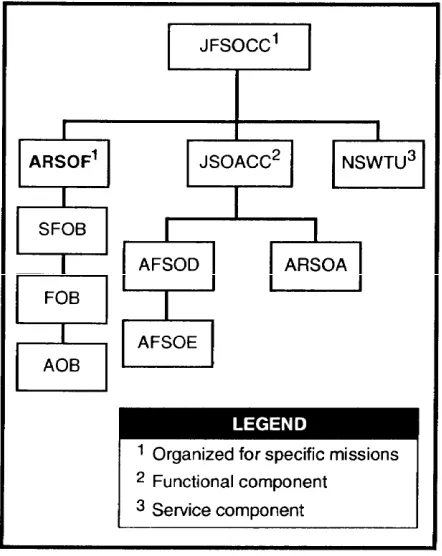
•Joint force special operations component commander (JFSOCC).
Each focuses on operational responsibilities, leaving logistical support to the respective service component commander. See Figure 2-5. Functional component commanders may serve simultaneously as service component commanders. For example, an Army JFLCC could direct Marine forces and serve as the ASCC commander.
SUBORDINATE UNIFIED
COMMAND
Unified commanders, with approval from the NCA, may establish subordinate unified commands (also called subunified commands). CINCs establish subunified commands to conduct operations on a continuing basis according to the criteria that established the unified command.
The CINC may exercise COCOM through a subunified commander for operations on a continuing basis. The subunified commander exercises functions, authority, and responsibilities similar to those of a unified command CINC, except for COCOM. He exercises OPCON of assigned commands and forces within the assigned AOR or functional area. The CINC PACOM, for example, has three subordinate unified commands: Alaskan
Command (ALCOM), US Forces Japan (USFJ), and US Forces Korea (USFK).
The ASCC of subunified commands operates in the chain of command within the subordinate unified command. The ASCC of the subunified command normally communicates directly with the unified command ASCC on matters that relate specifically to that service and informs the subunified commander as that commander directs.
JOINT TASK FORCE
The SECDEF, a combatant commander, a subunified commander, a functional component commander, or an existing commander of a joint task force (CJTF) may establish a JTF. A JTF is established normally on a geographical area or functional basis to execute missions with specific limited objectives that do not require centralized control of joint logistics. A JTF is composed of elements of two or more services and exists until mission completion.
The CJTF exercises OPCON over forces assigned to the JTF. The unified command’s ASCC places an ARFOR under OPCON of the CJTF for the conduct of operations and retains responsibility to provide service-specific support to the ARFOR. The JTF established in the Persian Gulf in 1988 to protect