Automatic Reasoner Composition and
Selection
A thesis submitted to the
University of Dublin, Trinity College,
for the degree of
Doctor of Philosophy
Wei Tai
Knowledge and Data Engineering Group,
Department of Computer Science,
Trinity College, University of Dublin.
I
Declaration
I, the undersigned, declare that this work has not previously been submitted as an exercise for a degree at this or any other University, and that, unless otherwise stated, it is entirely my own work.
___________________________________ Wei Tai
II
Permission to Lend or Copy
I, the undersigned, agree that Trinity College Library may lend or copy this thesis upon request.
___________________________________ Wei Tai
III
ACKNOWLEDGEMENTS
I would like to thank my supervisors Dr. Declan O’Sullivan and Dr. John Keeney for their unflagging support, insightful contributions and the many revisions of this thesis. I would also like to thank Dr. Rob Brennan for sharing his innovative ideas. My thanks to all in the KDEG research group for their lively discussions, their participation in my experiments, and also the proof reading/feedback.
I would like to especially thank my parents for their constant encouragement, support and the many sacrifices. A special word of thanks to my grandparents for their affection and encouragement.
IV
ABSTRACTS
The development of OWL and OWL reasoning technologies has enabled them to be used for knowledge base (KB) modelling and/or intelligent data processing in applications of various areas. However the computation and memory intensive nature of OWL reasoners impedes the deployment of OWL ontology reasoning on resource-constrained devices. In order to address this issue, a possible approach is to compose the reasoners according to their application characteristics such that unnecessary reasoning capabilities are not loaded. This thesis introduces two novel automatic reasoner composition approaches, a selective rule loading algorithm and a two-phase RETE algorithm, that compose rule-entailment reasoners both at the rule level and inside the reasoning algorithm based on the ontology expressivity, in order to reduce resource consumption for reasoning on resource-constrained devices. With the growth of usage of ontology reasoners and the introduction of new reasoner characteristics, it is envisaged that reasoner selection in the future will become too complicated for the current consultation based process between application developers and reasoner experts. In addition the thesis proposes a semi-automatic reasoner selection process (RESP) that allows users to independently select a most appropriate reasoner for their applications according to application characteristics. The solutions to the problems of how to achieve resource constrained reasoning and more automatic reasoning selection, have been respectively implemented, in a resource-constrained composable reasoner (COROR) and a semi-automatic reasoner selection tool (TARS).
V
TABLE OF CONTENTS
Automatic Reasoner Composition and Selection ... I
Declaration ... I Permission to Lend or Copy ... II ACKNOWLEDGEMENTS ... III ABSTRACTS ... IV TABLE OF CONTENTS ... V TABLE OF FIGURES ... VIII TABLE of TABLES ... X ABBREVIATIONS ... XII
Chapter 1 Introduction ... 1
1.1 Motivation ... 1
1.2 Research Question and Objectives ... 4
1.3 Research Process and Approach ... 5
1.4 Contributions ... 8
1.5 Thesis Overview ... 11
Chapter 2 Background and Related Work ... 13
2.1 Introduction ... 13
2.2 Background ... 15
2.2.1 OWL and OWL Sublanguages ... 15
2.2.2 RETE and RETE Optimizations ... 18
2.3 Related Work ... 27
2.3.1 Survey of OWL Reasoners ... 27
2.3.2 Survey of Semantic Applications ... 38
2.3.3 Reasoner Composability ... 42
2.3.4 Resource-Constrained OWL Reasoners ... 49
2.4 Summary ... 52
Chapter 3 COROR: A COmposable Rule-entailment Owl Reasoner for Resource-Constrained Environments ... 54
3.1 Introduction ... 54
3.2 An Overview ... 57
VI
3.4 Composition Algorithms ... 59
3.4.1 Selective Rule Loading Algorithm ... 59
3.4.2 Two-Phase RETE Algorithm ... 65
3.4.3 Hybrid Algorithm ... 76
3.5 Extending COROR to Support OWL 2 (Design Perspective) ... 76
3.6 Summary ... 83
Chapter 4 RESP: An Automatic Reasoner Selection Process ... 86
4.1 Introduction ... 86
4.2 Overview of RESP ... 89
4.3 Discussion of Interplay between Semantic Applications and RCs ... 92
4.3.1 RCs used ... 93
4.3.2 Aspect 1 - Frequently Changing Knowledge Bases ... 95
4.3.3 Aspect 2 - Required Semantics ... 97
4.3.4 Aspect 3 – Reasoning Tasks ... 97
4.3.5 Aspect 4 - Query ... 98
4.3.6 Aspect 5 - Rules ... 99
4.3.7 Aspect 6 - Concrete Domains ... 100
4.3.8 Aspect 7 - Closed-World Features ... 101
4.3.9 Aspect 8 - Large Knowledge Base or Persistent Storage ... 102
4.3.10 Aspect 9 – User/Application Manipulation of Ontology ... 103
4.3.11 Aspect 10 - Explanation of Reasoning and Ontology Debugging ... 104
4.3.12 Aspect 11 - Miscellaneous ... 105
4.3.13 A Summary of Example Candidate ACs and Connections ... 106
4.4 Matchmaking ... 106
4.5 Summary ... 109
Chapter 5 Implementation ... 111
5.1 Introduction ... 111
5.2 COROR ... 112
5.2.1 Choosing a Platform ... 112
5.2.2 Constructing a Resource-Constrained Rule-Entailment Reasoner ... 113
5.2.3 Implementing the pD* Semantics ... 124
5.2.4 Implementing the Composition Algorithms ... 128
5.2.5 Extending COROR to Support OWL 2 (Implementation Perspective) ... 136
5.3 TARS: Tool for Automatic Reasoner Selection ... 137
5.4 Summary ... 146
Chapter 6 Evaluation ... 148
6.1 Introduction ... 148
6.2 Performance Comparison and Investigation of COROR ... 150
6.2.1 Criteria of Selecting Performance Metrics ... 150
6.2.2 Design and Execution ... 152
6.2.3 Intra-Reasoner Comparison: Results and Discussions ... 155
VII
6.2.5 Accuracy of the Selective Rule Loading Algorithm and the Two-Phase RETE
Algorithm ... 196
6.3 Usability Test of TARS ... 197
6.3.1 Design of evaluation ... 198
6.3.2 Results and discussions ... 202
6.3.3 Questionnaires analysis ... 204
6.4 Summary and Key Findings ... 209
6.4.1 Reasoner Composition Algorithms ... 209
6.4.2 RESP ... 211
Chapter 7 Conclusions and Future Work ... 214
7.1 Progress vs. Objectives ... 214
7.2 Contributions ... 218
7.3 Limitation and Future Work ... 221
7.4 Final Remarks ... 222
References ... 223
Appendix A A Survey on OWL Reasoners ... 1
Appendix B Scenario descriptions used in the usability experiment of RESP ... 1
Appendix C pD* Entailment and Its Implementation in Jena Rule Format ... 1
Appendix D Rule-Construct Mappings ... 1
VIII
TABLE OF FIGURES
Figure 2-1: An example RETE network ... 20
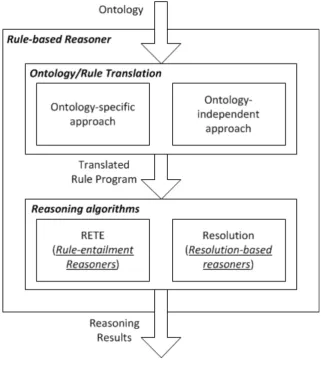
Figure 2-2: Reasoner categorization used in this thesis ... 28
Figure 2-3: A general structure of rule-based reasoner ... 33
Figure 3-1: An Overview of COROR ... 58
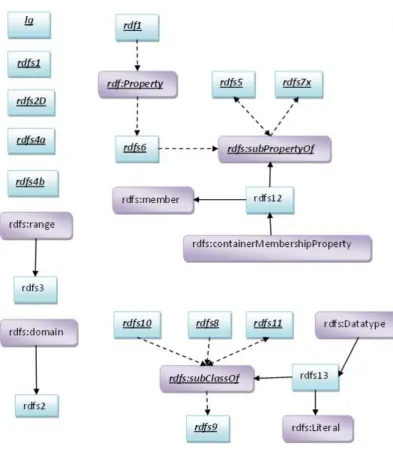
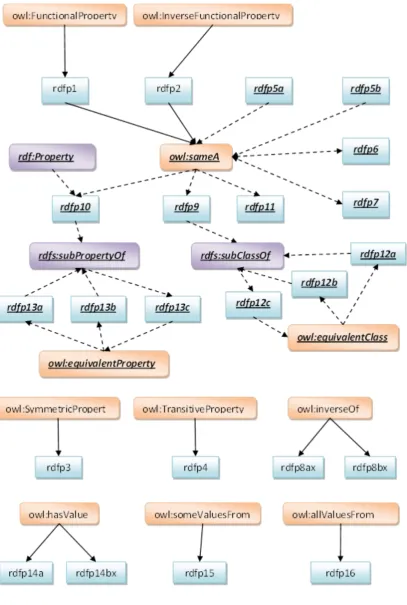
Figure 3-2: Rule-construct dependency graphs (D* entailment rules) ... 61
Figure 3-3: Rule-construct dependency graphs (P entailment rules) ... 62
Figure 3-4: Flow of the Two-Phase RETE Algorithm ... 66
Figure 3-5: A shared alpha network v.s. a non-shared alpha network. ... 69
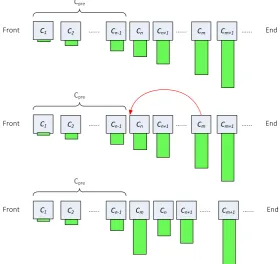
Figure 3-6: Join sequences after been reordered by the most specific condition first heuristic. ... 71
Figure 3-7: pre-evaluation of the join connectivity heuristic ... 72
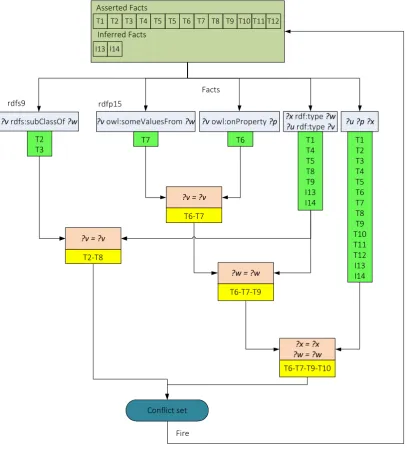
Figure 3-8: RETE Network with facts after all RETE cycles. ... 74
Figure 3-9: Rule-Construct dependency graph for OWL 2 RL entailments (semantics of equality). ... 77
Figure 3-10: Rule-Construct dependency graph for OWL 2 RL entailments (Semantics of Axioms about Properties). ... 78
Figure 3-11: Rule-Construct dependency graph for OWL 2 RL entailments (Semantics of Classes). ... 79
Figure 3-12: Rule-Construct dependency graph for OWL 2 RL entailments (Semantics of Class Axioms) ... 80
Figure 3-13: Rule-Construct dependency graph for OWL 2 RL entailments (Semantics of Datatypes) ... 80
Figure 3-14: Rule-Construct dependency graph for OWL 2 RL entailments (Semantics of Schema Vocabulary) ... 81
Figure 4-1: An overview of RESP ... 89
Figure 5-1: Sun SPOT wireless sensor network development kit. ... 113
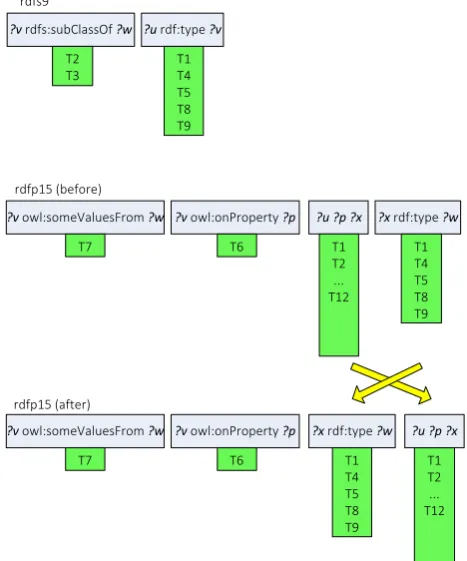
Figure 5-2: An example intermediate result for rule rdfp15 ... 116
Figure 5-3: An example Jena RETE network and an illustration of join operations ... 118
Figure 5-4: Class diagrams of the µJena enhanced with the Jena forward reasoner. ... 121
Figure 5-5: Implementation of the selective rule loading algorithm. ... 129
Figure 5-6: Code snippet for the constructing a selective rule set. ... 131
Figure 5-7: Classes related to the two-phase RETE algorithm implementation ... 132
Figure 5-8: Code snippet for two-phase RETE algorithm ... 133
Figure 5-9: Intermediate results for the condition (?v ?p ?w) and (?u ?p ?x) in the rule rdfp15 and the rule rdfs4b. ... 134
IX
Figure 5-11: Implementation for the most specific condition first heuristic. ... 136
Figure 5-12: Packages and classes of TARS. ... 138
Figure 5-13: A snippet of the XML-coded profile for FaCT++. ... 139
Figure 5-14: Application characteristics selection interface. ... 141
Figure 5-15: Connections for AC integrity constraints. ... 143
Figure 5-16: Reasoner selection results interface ... 143
Figure 5-17: The user interface for registering candidate reasoners. ... 144
Figure 5-18: User interface for specifying reasoner expressivity using OWL constructs. .. 145
Figure 5-19: User interface for specify reasoner expressivity in DL. ... 146
Figure 6-1: Comparisons of memory and reasoning time between COROR composition modes (Intra-reasoner comparison). ... 157
Figure 6-2: #IR generated by each rule when COROR-noncomposable/COROR-selective reasons over selected ontology ... 162
Figure 6-3: Percentage of #IR occupied by each rule for COROR noncomposable. ... 165
Figure 6-4: Comparison between #M/#J of COROR-noncomposable and COROR-selective ... 167
Figure 6-5: #M for the foaf ontology ... 168
Figure 6-6: #J for the foaf ontology. ... 169
Figure 6-7: Comparison of #IRM/#IRJ between COROR noncompoable and COROR two-phase RETE ... 171
Figure 6-8: Comparison of #J between COROR-two-phase and COROR-noncomposable. ... 174
Figure 6-9: Comparison of #M between COROR two-phase and COROR noncomposable. ... 175
Figure 6-10: Modified rule rdfp1, rdfp2 and rdfp4. ... 177
Figure 6-11: Comparison of the memory usages of noncomposable and COROR-two-phase to reason over selected ontology for different rule sets. ... 178
Figure 6-12: Comparison of the reasoning time of noncomposable and COROR-two-phase to reason over selected ontology when different rule sets are used. ... 179
Figure 6-13: #M generated by COROR-noncomposable and COROR-two-phase when different rule sets are used. ... 181
Figure 6-14: #J generated by COROR-noncomposable and COROR-two-phase when different rule sets are used. ... 182
Figure 6-15: #IRM required by COROR-noncomposable and COROR-two-phase when different rule sets are used. ... 184
Figure 6-16: #IRJ required by COROR-noncomposable and COROR-two-phase when different rule sets are used. ... 185
Figure 6-17: #IRM/#IRJ required by COROR-hybrid and COROR-two-phase. ... 188
Figure 6-18: #M required by COROR-hybrid and COROR-two-phase ... 189
Figure 6-19: #J required by COROR-hybrid and COROR-two-phase. ... 190
Figure 6-20: Comparison of reasoning time/memory usage between COROR hybrid and state of the art reasoners. ... 195
X
TABLE of TABLES
Table 2-1: OWL constructs supported by the pD* semantics ... 16
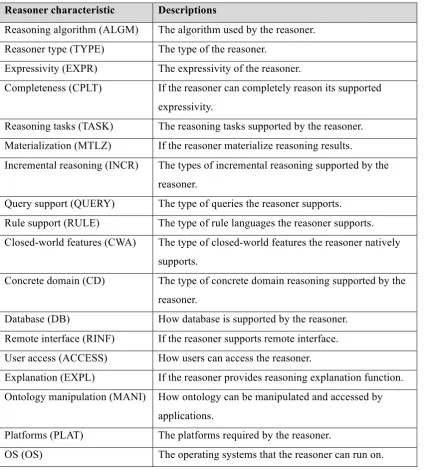
Table 2-2: Reasoner characteristics used in the survey of OWL reasoners ... 37
Table 3-1: Number of matched facts for each condition ... 70
Table 4-1: A summary of values of the corresponding reasoner characteristics in the survey ... 94
Table 4-2: Candidate ACs and Connections Derived from Frequently Changing Knowledge Bases ... 96
Table 4-3: Candidate AC and Connection Derived from Required Semantics ... 97
Table 4-4: Candidate AC and Connection Derived from Terminology-Centric Reasoning .. 98
Table 4-5: Candidate ACs and Connections Derived from Query-Related ... 99
Table 4-6: Candidate AC and Connection Derived from Rules ... 100
Table 4-7: Candidate ACs and Connections Derived from Concrete Domains ... 101
Table 4-8: Candidate ACs and Connections Derived from Closed-World Features ... 102
Table 4-9: Candidate ACs and Connections Derived from Large Knowledge Base or Persistent Storage ... 103
Table 4-10: Candidate ACs and Connections Derived from Ontology Manipulation ... 104
Table 4-11: Candidate ACs and Connections Derived from Explanation of Reasoning and Ontology Debugging ... 105
Table 4-12: Candidate ACs and Connections Derived from Miscellaneous ... 105
Table 4-13: A Summary of Example ACs and Connections ... 106
Table 4-14: An example reasoner profile for COROR ... 107
Table 5-1: pD* entailment rule rdfp2. ... 124
Table 5-2: Descriptions of built-in functors ... 125
Table 5-3: Definitions of lg, rdfs1 and rdf2-D in pD* entailments ... 126
Table 5-4: pD* entailment rule gl ... 127
Table 5-5: The new application characteristic resource sensitive and its connections . 139 Table 5-6: The new reasoner characteristic composition level and its possible values ... 140
Table 6-1: Ontologies used in intra-/inter-reasoner comparison experiments ... 154
Table 6-2: Raw data for memory tests and time tests (memory in byte and time in millisecond). ... 158
Table 6-3: Memory reduction achieved by the COROR-selective. ... 163
Table 6-4: The size of result ontologies generated by each reasoner mode. ... 197
Table 6-5: Not selected ACs ... 202
Table 6-6: Incorrectly selected ACs. ... 202
Table 6-7: Not selected RCs. ... 204
Table 6-8: Incorrectly selected RCs. ... 204
Table 6-9: Mean values (overall and application-aware) for evaluation questions ... 206
XI
Table A-2: Results of the survey of OWL reasoners (cont’d) ... 4
Table A-3: Results of the survey of OWL reasoners (cont’d) ... 5
Table A-4: Results of the survey of OWL reasoners (cont’d) ... 6
Table A-5: Results of the survey of OWL reasoners (cont’d) ... 7
Table A-6: Results of the survey of OWL reasoners (cont’d) ... 8
Table A-7: Results of the survey of OWL reasoners (cont’d) ... 9
Table A-8: Results of the survey of OWL reasoners (cont’d) ... 10
Table A-9: Results of the survey of OWL reasoners (cont’d) ... 11
Table E-1: Classes added to µJena to forming the enhanced µJena. ... 1
XII
ABBREVIATIONS
ABox Assertion Box
AC Application Characteristic
CDC Connected Device Configuration
CLDC Connected Limited Device Configuration
COROR COmposable Rule-entailment Owl Reasoner
CPU Central Processing Unit
CWA Closed World Assumption
DB Database
DL Description Logic
FOL First Order Logic
IR Intermediate Results
KB Knowledge Base
L.H.S. Left Hand Side
MIDP Mobile Information Device Profile
NaF Negation as Failure
OS Operating System
OWA Open World Assumption
OWL Web Ontology Language
RAM Random Access Memory
RC Reasoner Characteristic
RDF Resource Description Framework
RDFS RDF Schema
RESP REasoner Selection Process
R.H.S. Right Hand Side
SPARQL Simple Protocol and RDF Query Language
SUS System Usability Scale
SWRL Semantic Web Rule Language
TARS Tool for Automatic Reasoner Selection
TBox Terminology Box
XML eXtensible Markup Language
1
Chapter 1
Introduction
1.1
Motivation
The Web Ontology Language (OWL) [McGuinness and Van Harmelen 2004] is an ontology language aiming to enable the content of information to be processed by machine rather than merely being displayed to humans. To enable this, OWL includes a set of formally defined constructs with logic-based semantics [Patel-Schneider et al 2004], which facilitates machine reasoning on an OWL ontology revealing implicit knowledge from knowledge that is explicitly stated. An example would be the inference from a subclass/superclass relationship that any individual of a subclass is also an individual of the superclass.
The formal definition and machine reasoning feature then enables OWL and its reasoning techniques to be used for knowledge base (KB) modelling and/or intelligent data processing in applications of various areas, such as clinical informatics [héja et al 2008, openGALEN, Golbeck et al 2003], bioinformatics [Harris et al 2004], battle field systems [Gomez et al 2008, Sensoy et al 2011], sensor network systems [Calder et al 2010, Kim et al 2008, Eid et al 2007], web services composition [Hatzi et al 2009] and so on, forming semantic applications. Such semantic applications usually have diverse (reasoning related) application characteristics (ACs) that impose different requirements on reasoning, leading to the need for different OWL reasoners with distinct reasoner characteristics (RCs) to be used. For example some sensor network systems require OWL reasoning to be performed on historical sensor readings stored in a database and therefore a database-enabled OWL reasoner is preferable, while for some semantic publish/subscribe systems the ability to quickly answer a query over a changing KB would be an important RC.
2
growth of development of semantic applications, for example for pervasive computing, there is an increasing demand for device OWL reasoning to facilitate intelligent on-device data processing, which in turn motivates the need for resource-constrained OWL reasoners [Kleemann and Sinner 2006, Brennan et al 2009, Koziuk et al, 2008]. Compared to the large amount of research performed to construct desktop OWL reasoners with different reasoner characteristics, very little research work has been conducted into how to minimize OWL reasoners so that they could operate on resource-constrained devices, in order to promote on-device intelligent data process and management [Ali and Kiefer 2009, Jang and Sohn 2004, Kim et al 2010].
Desktop OWL reasoners are often computationally and resource intensive therefore it is difficult to have them run on resource-constrained devices where resource limitations are imposed (e.g. the Sun SPOT sensor board has 180MHz 32-bit ARM920T core processor with 512K RAM and 4M Flash [SUN SPOT 2010]). A natural and reasonable thought would be to adjust the reasoning algorithms according to the application characteristics of a particular application such that only required reasoning capabilities are preserved and unneeded reasoning capabilities are not loaded, thereby hypothetically the amount of required processing and memory could be reduced. The term coined for such an approach in this thesis is reasoner composition whereby a customized reasoner is composed for a given application, ontology or platform.
3
keep changing with time, e.g. users’ interests, available services, the surrounding community and so on, which may need to alter ontologies and rules [Luther et al 2008, Ejigu et al 2007]. Hence it would be better that these systems are able to dynamically configure themselves to handle the diverse information from fast changing surroundings. Furthermore, as aforementioned, nowadays systems tend to push data processing toward the leaf nodes/edge of a network such as mobile phones or sensors, either to relieve servers from the heavy workloads and reduce throughputs of the networks from the system performance perspective or to protect users’ privacy from being uploaded to servers from the human perspective [Kleemann and Sinner 2006, Brennan et al 2009, Koziuk et al, 2008]. Considering the large amount of resource-constrained devices involved as well as the often lack of expertise of the end users, this thesis argues that static reasoner composition mechanisms appear to be inappropriate for semantic applications in dynamic areas and automatic composition mechanisms show better suitability for such dynamic areas.
There are already many different reasoner characteristics out there for existing reasoners such as the support of rules, the support of database, and the support of conjunctive queries and so on, and the advance in OWL reasoning technologies will add more reasoner characteristics to the ever growing set of reasoner characteristics. For example the proposed reasoner composition mechanisms may enable reasoners to run on even smaller resource-constrained devices, adding a new reasoner characteristic. On the other hand, as mentioned earlier the different semantic applications emphasize different reasoner characteristics. Therefore this raises a problem that the selection of an appropriate reasoner is becoming ever more complicated and there is an increasing need to help people to be able to choose an appropriate reasoner for their applications.
4
specific languages. The result could be a considerable amount of effort being required during consultations between an application developer and reasoner expert before an agreement is reached, or could even result in a wrong reasoner being selected. Secondly the existing approach requires that a reasoner expert is accessible to application developers, which will not always be the case. These inadequacies motivate the need for an automated approach to help application developers to limit consultation requirements or even to independently select a suitable reasoner for their semantic applications.
In summary, this thesis focuses on overcoming the problem of how to undertake reasoning in a dynamic and complex resource-constrained environment. Given the highly dynamic nature of pervasive computing, it is taken as an example of such an environment. Two solutions in particular are identified and focused upon: (1) the provision of an automatically composed reasoner based on application characteristics (e.g. the ontology to be reasoned), focusing on a resource-constrained environment, and (2) tool support for the semi-automatic selection of the most appropriate reasoner for a given semantic application.
1.2
Research Question and Objectives
This thesis addresses the question of:
“How an appropriate resource-constrained OWL reasoner can be automatically composed and be selected based on application characteristics.”
Five objectives are derived:
§ Objective 1: survey the state of the art OWL reasoners, identifying Reasoner Characteristics (RCs) and categorizing them. Identify an appropriate type of reasoner upon which the reasoner composition research should be based. Survey semantic applications, identifying reasoning-related Application Characteristics (ACs).
§ Objective 2: design automatic reasoner composition mechanisms and implement them in a resource-constrained reasoner.
§ Objective 3: study the performance impact on the resource-constrained reasoner brought by the application of composition algorithm(s).
5
§ Objective 5: evaluate the usability of the reasoner selection process designed in objective 4.
Objective 1 establishes a foundation for the other research carried out in this thesis. The categorization of OWL reasoners enables the reasoner composition research (objective 2) to be carried out for a type of reasoner rather than a particular reasoner implementation, providing this research with a general grounding. Furthermore during the survey reasoner characteristics are identified, and they are examined for each survey reasoner. Similarly the survey on semantic applications can facilitate the identification of application characteristics, and furthermore it helps the study of how existing semantic applications select reasoners to fulfil their application characteristics. Both surveys provide a basis for objective 4 and 5 where the research on the automatic reasoner selection process is carried out.
Objective 2 and 3 together address the first half of the research question that examines how an appropriate resource-constrained OWL reasoner can be automatically composed based on application characteristics. Objective 2 designs the automatic reasoner composition mechanisms for the selected type of reasoners. The designed reasoner composition mechanisms need also to be integrated into a resource-constrained reasoner, implementing a composable resource-constrained reasoner. Objective 3 examines the performance impacts of the reasoner composition algorithms on the selected type of OWL reasoner. A natural approach is followed in the evaluation where the performance of the composable resource-constrained reasoner implementation with the use of composition mechanisms is compared with the reasoner without the composition mechanisms being used.
Objective 4 and 5 together address the second half of the research question, which is how an appropriate OWL reasoner can be automatically selected based on application characteristics. Design and implementation of an automatic reasoner selection process is performed in objective 4, and evaluation of such process is included in objective 5. The automatic reasoner selection process constructed in objective 4 will still require application developers to be involved at some stages of the automatic reasoner selection process, for example to perform some tasks such as identifying application characteristics for their applications. Thus the evaluation focuses on the usability of this reasoner selection process, achieved through user trials.
1.3
Research Process and Approach
6
algorithm, reasoner type, reasoner expressivity, completeness (in terms of the supported expressivity), reasoning tasks, materialization, incremental reasoning, query support, rule support, closed-world features, concrete domain, database support, remote interface, user access, explanation, ontology manipulation, platforms, and os. Reasoners were then categorized into five types according to the algorithm used, including DL-Tableaux reasoners (DL stands for Description Logic), rule-entailment reasoners, resolution-based reasoners, hybrid reasoners and miscellaneous reasoners (as discussed in detail in section 2.3.1.1). For each type of reasoners, it’s suitability for composition was discussed and the rule-entailment reasoner was found to have a good balance between expressivity and composability and thus was chosen as the target type of reasoner as the basis for the reasoner composition research. As reported in objective 1 another aim of this survey is the identification of reasoner characteristics. In fact as discussed in section 4.3 an example set of reasoner characteristics was identified based on this survey.
Then a second survey was performed over five diverse sample types of semantic applications, namely semantic publish/subscribe systems, semantic context-aware systems, medical and bioinformatics systems, semantic sensor network management systems, and software engineering systems, chosen due to their wide adoption of semantic reasoning technologies to solve previously encountered problems or to perform intelligent data processing/accessing. This survey mainly concentrated on the examination of the application characteristics of these applications and how these application characteristics could affect the selection of an appropriate reasoner. As a matter of fact the examination of them facilitated the identification of an example set of application characteristics and correspondingly the mapping between application characteristics and reasoner characteristics which is termed connections in this thesis.
The RETE algorithm [Forgy 1982] is the most common reasoning algorithm for rule-entailment reasoners and hence two reasoner composition algorithms were designed by the author to compose at different levels, i.e. the rule set level and inside the RETE algorithm. The implementation of both composition algorithms was performed on a modified version of µJena [Micro Jena 2010] extended with a J2ME-ported Jena RETE engine [Carroll et al 2004]. The choice of Jena RETE engine was motivated by the fact that it is a typical rule-entailment reasoner and it is open source. The resulting implementation is named a COmposable Rule-entailment Owl Reasoner (COROR).
7
composition algorithms, two experiments were performed. A first experiment was performed to measure and compare the time/memory performance of different COROR composition configurations (with one, two, or no composition algorithms) to fully reason over ontologies. This can directly reflect the performance change caused by the application of composition algorithms. A second experiment was then carried out to compare the performance of COROR with four counterpart rule-entailment reasoners namely Bossam [Jang and Sohn 2004], BaseVISor [Matheus et al 2006], SwiftOWLIM [Kiryakov et al 2005] and Jena RETE engine. This experiment could show how COROR performs compared to the other rule-entailment reasoner implementations. In addition it could reveal the performance merits and pitfalls of COROR compared to other state of the art rule-entailment reasoners
A REasoner Selection Process (RESP) was then designed which aims to assist application developers with little background on ontology reasoning to perform semi-automatic reasoner selection based only on application characteristics. A simple matchmaking approach is used in the process to check if the characteristics of an application are all satisfied by reasoner characteristics of a candidate reasoner. This process was designed to be a methodology without specifying any detailed technical solutions in order that it can be reused for different application domains. To make this process less abstract for demonstration and evaluation, a set of example application characteristics were identified based on the examination of 11 selected reasoning-related aspects of the surveyed semantic applications, ranging from frequently changing knowledge base to explanations of reasoning. Connections between the example application characteristics and the example reasoner characteristics were drawn based on the discussion in the survey. RESP was implemented as a prototype desktop application using Java, termed Tool for Automatic Reasoner Selection (TARS). The example application characteristics, example reasoner characteristics, and connections were implemented in TARS.
8
1.4
Contributions
Two contributions are identified.
Major contribution: the design of two novel automatic reasoner composition algorithms for rule-entailment reasoners, termed the selective rule loading algorithm
and the two-phase RETE algorithm, and the implementation of them as a resource-constrained rule-entailment OWL reasoner named COROR (COmposable Rule-entailment Owl Reasoner)
Minor contribution: the design and implementation of an automatic REasoner Selection Process (RESP) and a prototypical implementation, termed the Tool for Automatic Reasoner Selection (TARS).
The major contribution that distinguishes this research from the state of the art is the design of the two novel automatic reasoner composition algorithms for rule-based reasoners, i.e. the selective rule loading algorithm and the two-phase RETE algorithm, and the implementation of them into a resource-constrained rule-based OWL reasoner named COROR (COmposable Rule-entailment Owl Reasoner). As will be introduced in section 2.3.1.1.2 this research focuses on rule-based reasoners, more specifically on rule-entailment reasoners, because they provide good balance between semantic expressivity and composability. The reasoner composition algorithms respectively perform the reasoner composition at the rule set level (selective rule loading algorithm) and inside the RETE algorithm (two-phase RETE algorithm). Briefly the selective rule loading algorithm estimates the usage of OWL reasoning rules for reasoning a particular ontology, and then selectively loads into the engine the rules estimated as useful. Unneeded rules are omitted, avoiding the allocation of resources originally required. The two-phase RETE algorithm interrupts the RETE network construction [Forgy 1982] (which is the internal reasoning algorithm for rule-entailment reasoners) midway by matching ontology against already constructed network, such that some heuristic indicators about the ontology that was only known at runtime can be collected and used to optimize1 the remaining RETE network construction. This enables the reasoning to be optimized taking into account information of the particular ontology.
Experiments were performed to investigate the performance impact by applying the algorithms. Results show that for the tested ontologies the application of the selective rule
9
loading algorithm on average can reduce the time consumption by 33% and memory consumption by 35% for fully computing entailments. The application of two-phase RETE algorithm on average can reduce the time consumption by 78% and memory consumption by 74%. This contribution enables rule-entailment reasoners to be automatically composed in accordance with the ontology to be reasoned.
Hence reasoners can always remain tightly “fit” to the changing ontology, enabling customized OWL reasoning for applications with high dynamism. Good examples of such applications are context-aware computing on resource-constrained devices or semantic publish/subscribe systems as described above. As shown by the experiment results, such customization of reasoning algorithms can save a large amount of resources for reasoning the same ontology, which, in other words, means that more complex/bigger ontology than before can be reasoned on the same resource-constrained devices, increasing the amount of intelligent processing that can be pushed to the edge of a network. In addition, although targeted at resource-constrained environment, it is envisaged by the author that the capability to reduce the memory consumption of OWL rule-entailment reasoning also enables the two introduced composition algorithms to benefit (desktop-based) applications, for example, to reduce the memory consumption of applications requiring web-scale reasoning, e.g. social network applications, so as to increase reasoning scalability.
10
Usability experiments show RESP helps application developers in determining the reasoner to be used with little or even no help from reasoner experts (in contrast to the existing consultation-based reasoner selection process in which application developers totally rely on reasoner experts to select an appropriate reasoner).
This contribution enables the reasoner selection process to be moved from a human-to-human consultation-based approach to a human-to-human-to-computer semi-automatic approach. Application developers can easily select an appropriate reasoner for their applications without putting a lot of efforts in looking for reasoner experts or in the uptake of the intricacies of OWL reasoning technologies, facilitating the widespread of OWL and OWL reasoning technologies. Furthermore as a by-product when researching the semi-automatic reasoner selection approach, the identified application characteristics and reasoner characteristics will be useful as a starting point for other research in this area.
Four papers were published in relation to research carried out in this thesis:
“An Automatically Composable OWL Reasoner for Resource Constrained Devices”, in Proceeding of the International Conference on Semantic Computing (ICSC’09), 2009. This paper describes the selective rule loading algorithm and a prototype implementation of it on a desktop reasoner.
“Open Framework Middleware for intelligent WSN topology adaption in smart buildings”, Proceedings of the International Conference on Ultra Modern Telecommunications (ICUMT’09), 2009.
This paper investigates a potential use of composable reasoner to perform localized fault correlation in clustered wireless sensor networks.
“A COmposable Rule-Entailment Owl Reasoner for Resource-Constrained Devices”, Proceedings of the International Symposium on Rule-Based Reasoning, Programming, and Applications (RuleML’11), 2011.
11
“RESP: A Computer Aided OWL REasoner Selection Process”, Proceedings of the International Conference on Semantic Computing (ICSC’11), 2011.
This paper describes in detail the RESP process. Application characteristics are discussed from 11 reasoning-related aspects. A prototype implementation (TARS) and a usability evaluation are also presented and discussed.
It is planned to submit a more detailed description of COROR and RESP based on this thesis to the Journal of Web Semantics or IEEE transaction on knowledge and data engineering.
1.5
Thesis Overview
This thesis is comprised of seven chapters.
Chapter Two provides background knowledge and related work of this thesis. Background knowledge includes the OWL ontology language and its sublanguages, and the RETE algorithm and its optimizations. Related work includes a survey of OWL reasoners, a survey of semantic applications, a discussion of state of the art composition approaches for rule-based reasoners, and finally a discussion of resource-constrained reasoners.
Chapter Three presents the design of COROR, a composable rule-entailment reasoner. Two novel composition algorithms are described in detail.
Chapter Four describes the design of RESP, a process for selecting an appropriate reasoner for a given set of ACs. Some examples are also discussed.
Chapter Five describes a prototype implementation of COROR and also a prototype implementation of RESP (named TARS) with some code snippets and screen shots attached. Chapter Six presents the design, settings and results of experiments performed for this thesis. Two experiments, i.e. an intra-reasoner comparison and an inter-reasoner comparison, were performed to evaluate how reasoning performance changes with the application of reasoner composition algorithms. This chapter also presents a usability experiment for RESP and TARS, and provides results and analysis.
Chapter Seven concludes this thesis. Contributions and future work of this work are discussed.
12
OWL reasoners, the scenario descriptions used in the usability experiment for TARS, the questionnaires used in the usability experiment for TARS, the pD* entailment rules and their implementations as Jena rules, the construct mappings as a text implementation of rule-construct dependency graphs, the profiles of candidate reasoners registered with TARS, and finally a full list of the Java classes added to µJena in order to make it support OWL reasoning.
13
Chapter 2
Background and Related Work
2.1
Introduction
This chapter presents the background as well as related work for the investigation of the research question of this thesis as to
“How an appropriate resource-constrained OWL reasoner can be automatically composed and be selected based on application characteristics.”
14
The survey of semantic applications was to help the author to learn the interplays between the application characteristics and OWL reasoner characteristics, and also help the identification of (reasoner-related) application characteristics, that would facilitate the design of an automatic reasoner selection process. This survey and the survey of reasoners mentioned earlier influenced each other to some extent: the distillation of some specific reasoner characteristics, e.g. closed-world features, was inspired by the observation that the satisfaction of some application characteristics, e.g. integrity constraints, greatly depends on the possession of such reasoner characteristics and vice versa. The survey of semantic applications is presented in section 2.3.2.
Then in order to identify a type of reasoner upon which to carry out the automatic reasoner composition research, the composability for different OWL reasoner categories is discussed in section 2.3.3. Rule-based reasoners were found to have better potential in composition and hence show better suitability for the automatic reasoner composition research. Existing reasoner composition approaches for rule-entailment reasoners were then studied (although none of these approaches are called “reasoner composition approach”). These reasoner composition approaches can fall into three types according to different composition levels they work on: to manually set the reasoning capability using pre-defined OWL sublanguages, to manually add/remove inference rules loaded into the reasoner, and automatic reasoning capability composition. Further investigation of these approaches revealed a gap where the automatic reasoner composition research could fit in: the existing reasoner composition approaches are either static relying on human tuning or designed to work on a specific semantics, therefore emphasizing the need for the design of an automatic reasoner composition approaches at the reasoning algorithm level and independent of specific semantics.
15
As will be seen in Chapter 3, rule-entailment reasoners are selected as the basis to carry out the reasoner composition research. Since RETE [Forgy 1982] is the major reasoning algorithm for this type of reasoner, a detailed description of RETE is given in the background section.
2.2
Background
In this section background knowledge of this thesis is presented. It includes two major parts: the OWL and its sublanguages and the RETE algorithm and its optimizations.
2.2.1
OWL and OWL Sublanguages
OWL is an ontology modelling language standardized and recommended by W3C. It consists of a set of formally defined OWL constructs each of which is given a logic-based semantic [Patel-Schneider et al 2004]. OWL has three standard sublanguages, i.e. OWL-Full, OWL-DL and OWL-Lite, varying in the set of constructs supported and the semantic expressivity. Non-standard OWL sublanguages are also designed for different usages according to the OWL features supported, such as the pD* family [ter Horst 2005a, ter Horst 2005b] and so on. Standard and non-standard OWL sublanguages are respectively discussed in section 2.2.1.1 and 2.2.1.2. OWL 2 [OWL 2 Overview] is the latest update of OWL. It extends OWL with more semantic expressivities and three application-oriented sublanguages, i.e. sublanguages that have been carefully crafted to suit for different usages. OWL 2 is introduced in section 2.2.1.3.
2.2.1.1
OWL-Full, -DL and -Lite
OWL original has three standard sublanguages: OWL-Full, OWL-DL and OWL-Lite. OWL-Full provides complete support for all OWL constructs and it is fully compatible with RDF. It is very expressive for modelling domain knowledge however its reasoning tasks are not decidable, and fully automated reasoning is not possible. OWL-DL (OWL Description Logic) supports the same set of OWL constructs as OWL-Full but restricts support for some of the semantics possible in RDF in order to have decidable reasoning tasks. OWL-DL is currently the most widely used of the OWL sublanguages. OWL-Lite has a reduced construct set in order to provide the minimal useful language features for tool builders to support. In the rest of this thesis when OWL is mentioned without specifying the sublanguage it should be taken to mean OWL-DL.
2.2.1.2
Nonstandard OWL Sublanguages
16
sublanguages are discussed including the pD* semantics [ter Horst 2005a, ter Horst 2005b], EL++ [Baader et al 2005, Baader et al 2008], DL-Lite [Calvanese et al 2007], and DLP [Grosof et al 2003].
The pD* semantics (including pD* and pD*sv) defines a weakened but tractable2 subset of the OWL semantics. It adds to the D* semantics (the complete RDFS semantics extended with various datatypes, refer to [ter Horst 2005a]) with P entailment rules (a set of entailment rules implementing the partial semantics for some OWL constructs, refer to [ter Horst 2005a]). Some OWL constructs are missing, such as cardinality constructs (cardinality, minCardinality and maxCardinality), some (in)equality constructs (allDifferent and distinctMembers), Boolean combination constructs (unionOf, complementOf and intersectionOf), and oneOf. Still a substantial subset of OWL-DL constructs is kept (as indicated in Table 2-1). Semantics are encoded using a set of RDFS-like if semantic conditions and therefore the pD* semantics have PTIME3 entailment complexity when variables are not used in the target ontology, i.e. checking if a variable-free target ontology G’ is the logical consequence of an ontology G for the given semantics, and NPTIME4 entailment complexity when variables are used in the target ontology. A later work in [ter Horst 2005b] extends the pD* semantics with the support of the iff semantics for the owl:someValuesFrom forming the pD*sv entailment. However it does not have PTIME complexity. The pD* semantics inspired the standardization of OWL 2 RL [OWL 2 Profiles], an OWL 2 sublanguage with RDFS-like if semantics. A full set of pD* entailment rules can be found in Appendix C.
Table 2-1: OWL constructs supported by the pD* semantics owl:FunctionalProperty owl:Restriction owl:InverseFunctionalProperty owl:onProperty
owl:SymmetricProperty owl:hasValue
owl:TransitiveProperty owl:someValuesFrom
owl:sameAs owl:allValuesFrom
owl:inverseOf owl:differentFrom
owl:equivalentClass owl:disjointWith
owl:equivalentProperty
2 Tractable is a concept in computational complexity theory. A problem is tractable if it can be solved in
polynomial time.
3 PTIME (Polynomial TIME): A PTIME problem can be solved by a deterministic Turing machine using a
polynomial amount of computation time.
4 NPTIME (Nonuniform Polynomial TIME): A NPTIME problem can be solved in polynomial time on a
17
The EL++ is a specially dimensioned description logic to have tractable subsumption problems for ontology with a very large number of properties and classes. A very large subset of it (without property chain) can correspond to a subset of OWL. Some expressivity of OWL needs to be removed for EL++ to ensure its tractability, such as atomic negation, disjunction, at least restriction, inverse property, cardinality, and functional/inverse functional property. However EL++ is still expressive enough for modelling bioinformatics or medical ontologies such as Gene [Harris et al 2004] and SNOMED [héja et al 2008]. Part of the Galen ontology [openGALEN] can be expressed in EL++ as well. The EL family description logic has been standardized as an OWL 2 sublanguage, i.e. OWL 2 EL [OWL 2 Profiles].
The DL-Lite is a family of description logics carefully tailored to provide efficient conjunctive query answering capabilities over knowledge bases with large datasets. DL-Litecore is the basic logic of the DL-Lite family. It can express someValuesFrom (unqualified), concept conjunction, concept disjointness, domains and ranges of properties, inverse properties. There are several variants for DL-Litecore extending it with different features without complicating the reasoning problems. For example DL-LiteR extends DL-Litecore with inclusion assertions between object properties and DL-LiteF extends with functional and inverse functional property. DL-LiteR is standardized in OWL 2 as the logic underpinning of OWL 2 QL [OWL 2 Profiles].
DLP (Description Logic Programmes) is a significant subset of OWL DL and Horn logic. It aims to provide bi-directional translation between semantic web ontologies and horn rules, coined DLP-fusion (for both ontology and reasoning problems), which allows an ontology built on top of rules and conversely rules built on top of an ontology. DLP supports the following features of OWL DL, namely concept disjointness, domains and range of properties, inverse and symmetric properties, functional and inverse-functional properties, inclusion and equivalence of object properties, transitive properties and a limited form of General Concept Inclusion (GCIs, i.e. C ⊑ D where both C and D are complex concept description rather than concept names). The translation between OWL and rules adopted by DLP is directly based on the semantic connections between horn logic and DL. Therefore rather than translating the ontology into a set of facts and using a set of OWL entailment rules to perform OWL reasoning, DLP translates the ontology into a horn rule program.
2.2.1.3
OWL 2 and OWL 2 Sublanguages
18
different from those in OWL, it is backward compatible with OWL 1. All OWL DL and OWL Lite ontologies are also considered as OWL 2 ontologies [OWL 2 Overview]. OWL 2 adds some new features into OWL, including some new syntactical features, such as disjoint union of classes, and some new expressivity enhancements, such as: keys; property chains; richer datatypes/data ranges; qualified cardinality restriction; asymmetric, reflective and disjoint properties; and some enhanced annotation properties. These new expressivities together with OWL DL amount to an equivalent expressivity as the description logic SROIQ(D) (refer to [Baader et al 2007] for the naming scheme for a description logic). As in OWL 1, there are two types of semantics for OWL 2, a direct model-theoretic semantics [OWL 2 Direct Semantics] and a RDF-based semantics [OWL 2 RDF-Based Semantics]. A correspondence theorem is defined between them.
OWL 2 defines five sublanguages. OWL 2 Full and OWL 2 DL are used to (informally) represent the entire OWL 2 capabilities when respectively interpreted using RDF-based semantics and direct semantics. OWL 2 DL can be viewed as OWL 2 Full with restrictions on some RDF features, such as the separation of properties, individuals and classes. In addition OWL 2 also defines three other more frequently used sublanguages, i.e. OWL 2 EL, OWL 2 QL and OWL 2 RL, in order to obtain tractable reasoning problems for some specific applications while retaining sufficient expressivities. OWL 2 EL extends EL++ and is designed to provide tractable reasoning services for very large ontologies with classes. OWL 2 QL enables efficient conjunctive query answering. OWL 2 RL defines a set of entailment rules (based on the pD* semantics), enabling OWL ontologies to be reasoned using rule systems.
Note that in the rest of this thesis that if not specifically mentioned, the term OWL is used only for OWL DL. The terms OWL 2 will be specifically mentioned when OWL 2 is to be discussed.
2.2.2
RETE and RETE Optimizations
19
2.2.2.1
An Overview of RETE
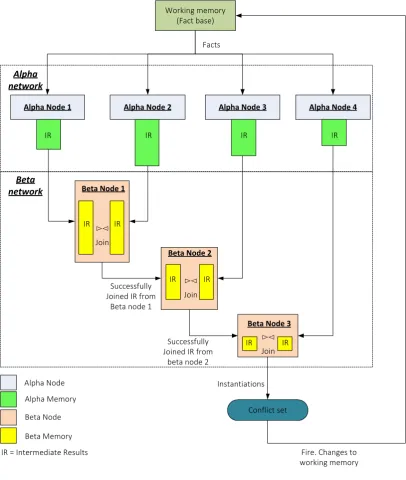
The RETE algorithm is an efficient forward chaining pattern matching algorithm that matches facts in working memory against rules using a discrimination network termed RETE network (Figure 2-1). RETE forms the basis for most modern production rule engines and is also the internal reasoning algorithm for rule-entailment reasoners. RETE incorporates two of the three types of knowledge that are considered may be included in a production system algorithm [McDermott et al 1978], which are
memory support, i.e. a scheme indicating the subset of working memory elements matching each condition element, and
condition relationship, i.e. interaction between condition elements within a rule.
The above two types of knowledge correspond to the alpha network and beta network of a typical RETE network (as shown Figure 2-1). The alpha network is comprised of one-input nodes named alpha nodes (maybe chained for some implementations), each of which performs intra-element test for each individual condition element in the left hand side (l.h.s.) of each rule. This intra-element test operation is termed match. Successfully matched facts are stored in the alpha memory of the corresponding alpha node as an intermediate result (IR), forming the memory support.
As given in Figure 2-1, the beta network is comprised of networked two-input beta nodes that check for the consistency of variable bindings for pairs of intermediate results. The consistency checking operation is termed a join. Each input has associated memory where inputs from alpha memory or previous beta memory joins are stored, called beta memory. A typical beta node receives an intermediate result from one input each time (and stores it in the connected beta memory) and joins it against intermediate results stored in the opposite input. A joined intermediate result is generated for the paired tokens with consistent variable bindings and it is propagated to its successors which could be another beta node performing similar inter-condition checks or the conflict set (where intermediate results successfully matched to the entire rule reside) waiting for firing. The intermediate results joined by the last beta node are termed as an instantiation of the rule. The beta network realizes the condition relationship.
20
[image:33.595.116.523.105.586.2]intermediate results stored in the memory, and then propagates to the next node.
Figure 2-1: An example RETE network
The RETE algorithm operates iteratively with each iteration (termed a RETE cycle in this thesis) containing facts matching, joining and firing. The firing of rules may change the working memory by adding/removing any inferred facts, and changes are reflected in the RETE network by inserting the newly inferred facts into the network, matching and joining as normal facts. RETE blocks when no more changes are made to the working memory, and the result in working memory then contains all asserted and inferred facts.
Alpha Node 1 Alpha Node 2 Alpha Node 3 Alpha Node 4
Conflict set Working memory
(Fact base)
Fire. Changes to working memory
Alpha network
Beta network
Facts
Alpha Node Alpha Memory
Beta Node
Beta Memory
IR IR IR IR
IR IR
IR IR
IR IR
Beta Node 1
⊳⊲
JoinSuccessfully Joined IR from
Beta node 1
Successfully Joined IR from
beta node 2 Beta Node 2
⊳⊲
Join⊳⊲
Join Beta Node 3Instantiations
21
RETE does not solve two problems that are commonly encountered in practical implementations. They are conflict resolution, i.e. how multiple instantiations can be ordered in the conflict set for firing, and rule firing, i.e. how firing a rule can change the working memory (e.g. adding/removing facts) and then affect the execution of the RETE algorithm (e.g. removing a fact can cause the retraction of an instantiation in conflict set). Many solutions have been proposed but since they are out the scope of this thesis they are not discussed in detail here.
2.2.2.2
Other Pattern Matching Algorithms
There are some other pattern-matching algorithms besides RETE. The two most famous ones are TREAT [Miranker 1987] and LEAPS [Miranker et al 1990].
TREAT is designed following the conjecture made in [McDermott et al 1978] that sometimes maintaining intermediate results may require more efforts than re-testing and hence it becomes not worthwhile. It incorporates three types of knowledge: condition membership, memory support and conflict set support, where the former two are already defined in [McDermott et al 1978] as two of the three knowledge types should be included in a production system algorithm, and the conflict set support is proposed by TREAT as a forth type of the knowledge. It decides whether to generate or to invalidate instantiations for addition and retraction of facts. TREAT uses alpha memory only and excludes beta memory, realizing memory support but excluding the condition relationship knowledge of a RETE– based production system.
An initial empirical test by counting joins required in reasoning show TREAT outperforms RETE in all cases [Miranker 1987]. However a later work in [Nayak et al 1988] points out that although TREAT performs faster deletion operation for positive nodes, RETE outperforms it in most cases as TREAT is more likely to suffer from a long-chain effect, i.e. where the absence of successful matching is only detected after a large amount of expensive matching operations have been performed, leading to a waste of computational resources. Another performance comparison conducted in [Wang and Hanson 1992] shows TREAT always outperforms RETE in terms of the number of joins and storage required for evaluating database rule conditions. However later work in [Ding et al 2009] replaces the RETE engine in CLIPS with a TREAT engine and the experiment shows TREAT scales better than RETE. As recently pointed out by Miranker on his personal website5, RETE and TREAT share the same algorithmic complexity and the algorithmic superior of TREAT can
22
easily be overcome by implementation. Furthermore since a single pass method is outlined for producing code for RETE, a RETE implementation is easier than a TREAT implementation.
LEAPS (Lazy Evaluation Algorithm for Production Systems) is a variant of TREAT with best-first search for instantiations [Miranker et al 1990]. It is developed to avoid time and space wastage in the eager evaluation of rules [Miranker et al 1990]. Rather than enumerating the conflict set searching for the first to fire, LEAPS executes a best-first search for instantiations on a total ordered working memory (by recentness). Search states are stored in a stack. For each addition (deletion) that is matched to a non-negative fact (negative fact), an initial search state is generated and pushed into a stack. Once an instantiation is found the best-first search pauses immediately. The current search state is pushed into stack and the instantiation is fired. A next search state is popped as the root of the following search if the current search is exhausted. The algorithm halts if no more search states can be popped. A preliminary evaluation in [Miranker et al 1990] shows it substantially improves execution time as well as the space requirement for some application programs. Descriptions of the LEAPS implementation in OPS5 can be found in [Miranker et al 1990, Batory 1994]. LEAPS was supported in the Drools 3.x rule engine as well but not in later versions due to poor maintenance [Drools Documentation V4.x].
Although TREAT and LEAPS outperform RETE in some cases, RETE is widely implemented in general rule engines and a lot of optimizations have been developed (as will be discussed in the next section), improving its performance. In addition TREAT and LEAPS have not yet been implemented in any surveyed rule-entailment reasoners. As a matter of fact RETE is the major algorithm used by the surveyed rule-entailment OWL reasoners.
2.2.2.3
RETE Optimizations
23
how they are applied automatically by RETE optimizers is also discussed. Finally some other heuristics are also discussed briefly.
2.2.2.3.1
RETE Join Sequence Optimization Heuristics
By default conditions are joined in the sequence in which they appear in the rule, which in many cases is authored by domain experts, and therefore join sequences of these rules are not already optimized (in most cases they might not). However as indicated by previous research [Ullman 1982, Brownston et al 1985, Wang and Hanson 1992, Ishida 1994] the join sequences of condition elements can greatly impact the performance of join operations and an inappropriate join sequence (e.g. cross production join) could cause drastically more join operations to be performed, hence leading to a lot more memory (more intermediate results generated) and time required (more joins performed) by the beta network. Therefore some join sequence optimization heuristics have been proposed to cope with the excessive overhead caused by inappropriate join sequences. Two most widely applied are the most specific condition first [Ishida 1988, Wang and Hanson 1992, Ishida 1994, Özacar et al 2007] and the pre-evaluation of join connectivity [Scales 1986, Nayak et al 1988, Ishida 1988, Ishida 1994, Özacar et al 2007].
24
according to their specificity, which is (1) static, that is the same order is used regardless of the particular ontology to be reasoned, and (2) somewhat inaccurate, e.g. it is not always correct to say that owl:subPropertyOf is more specific than owl:subClassOf.
Pre-evaluation of join connectivity between condition elements is another widely adopted join sequence optimization heuristic [Scales 1986, Nayak et al 1988, Ishida 1988, Ishida 1994, Özacar et al 2007]. It ensures two joining condition elements should at least have one common variable or otherwise it changes the join sequence. This heuristic is designed to avoid Cartesian product joins.
There are some other less commonly applied RETE join sequence optimization heuristics. The pushing volatile conditions last heuristic [Ishida 1988, Ishida 1994] pushes the condition elements that match the frequently changing facts towards the end of the join sequence such that less joins are needed for changes. The join cluster sharing heuristic [Ishida 1988, Scales 1986, Ishida 1994] re-orders the join sequence to enable common join structures to be shared among rules, reducing the required efforts and resource to 1/n (if the sharable join structure is shared by n rules). However they are either not suitable for OWL reasoning (e.g. OWL ontology does not usually change) or highly constrained limiting their wide adaptation in general cases (e.g. the left-associative join tree of RETE network limits that only common join structures in the front of rules can be shared). Therefore they are not discussed in detail in this thesis.
2.2.2.3.2
Application of RETE Join Sequence Optimization Heuristics
Direct application of different RETE join sequence optimization heuristics may cause conflict with one another, e.g. pushing the most specific condition to the start of a join sequence may break the sharable join structure [Scales 1986, Ishida 1988, Wang and Hanson 1992, Ishida 1994, Özacar et al 2007]. Therefore some approaches are proposed to carefully plan the application of these heuristics.25
A condition with a lower rank is then regarded as one that adds more constraints than a condition with a higher rank. For example a condition with rank 1, i.e. condition with bound value in identifier, and constants in attributes and values, is regarded as to add more constraint than a condition with rank 8, i.e. condition with unbound variable in identifier. This approach is shown to be effective for SOAR. However it is specifically designed for SOAR rules and lacks generality. In addition, it uses only static information on the conditions to approximate optimal join sequence, which will generate the same join sequence even for two totally different fact bases.
In the work in [Ishida 1994] the author proposes to use a priori execution to collect join costs for all conditions and then to enumerate all possible join structures and use a predefined cost model to estimate the cost for them. The join structure with the minimal cost is considered as the optimal join structure. Three heuristics are used to constrain the number of enumerated join structures: connectivity, i.e. all generated join structures should have common variable, minimal-cost, i.e. newly generated join structure should have lower cost than previously generated ones, and priority, i.e. avoid joining lower priority condition if a higher priority condition is available. This approach can find an optimal RETE structure however there are two obvious drawbacks: (1) enumerating all possible candidate join structures and computing costs for them may require a large amount of resources, and (2) a priori execution might not always be practical, particularly for the context of this research where limited resources are available.
2.2.2.3.3
Miscellaneous RETE Optimizations
Some other optimizations are designed to speed up or improve RETE algorithm in other aspects, such as: using indices to speed up searching for intermediate results; using non-linear join structures to improve join performance or to enhance join structure sharing; enhancing RETE with the ability to process time sensitive events, and so on. They are described in this section.
26
Some research considers replacing the linear join network of RETE with other join structures such as a binary network or a bilinear network to gain more performance benefit. The work in [Scales 1986] discusses in detail three possible effects of using a non-linear join network, including the change of the number of generated intermediate results, the improvement on the likelihood of join cluster sharing, and the elimination of long-chain effects. However a potential negative effect is that Cartesian production joins could occur more frequently, which may easily cancel out the benefits. Uni-RETE [Tambe et al 1992] adopts a bilinear join structure as an alternative of the linear join structure to increase sharing of common join structure. Experiment results show that the bilinear version of uni-RETE requires less time than the linear version of uni-uni-RETE and much less time than RETE. [Lee and Schor 1992] proposes a matching algorithm for generalized RETE network. Research in [Wright and Marshall 2003] proposes to prune the beta network at runtime so the amount of beta memory can be adjusted dynamically according to the availability of memory. Joins for the pruned part of the beta network is calculated on demand (as in TREAT). Therefore TREAT is a special case with all the beta networks pruned.
Optimizations are proposed to improve the poor deletion performance of RETE. For example the work in [Wright and Marshall 2003] proposes to use a search-based asymmetric deletion approach to speed up the deletion operation in RETE network. It keeps the original facts in intermediate results and therefore deletion turns out to be searching for all the intermediate results containing the deleted fact.
Some other optimizations that are not specially designed for RETE are also applicable or potentially applicable to it. For example, the work in [Schmolze and Snyder 1997] presents an approach for detecting redundant production rules for general production systems. The Gator network [Hanson and Hasan 1993] has been proposed as a generalized RETE/TREAT by allowing generalized join network. Similarly optimizations used in the Gator network [Hanson et al 2002] can also be studied and used by RETE optimizers. In addition given the close connection between RETE and query processing in database systems some optimizations strategies, such as query transformation heuristics, selectivity and cost estimation and so on, can be modified and applied for RETE optimization [Ullman 1982, Jarke and Koch 1984, Smitha and Geneseretha 1985, Elmasri and Navathe 2003].
27
2.3
Related Work
Related work of this this research is four-fold. Two surveys are presented in the first instance: a survey of OWL reasoners and a survey of semantic applications. There were two goals for the survey of OWL reasoners: a categorization of OWL reasoners that enables the reasoner composition research to be conducted on a general grounding and the distillation of a set of reasoner characteristics. The survey of semantic applications helps the understanding of the complicated interplay between semantic applications and OWL reasoners, which may facilitate the design of an automatic reasoner selection process. Results of these two surveys form the foundation of research carried out in this thesis. Then existing reasoner composition approaches are presented. By discussing the existing reasoner composition approaches,