A Joint Framework for Coreference Resolution and Mention Head Detection
Haoruo Peng Kai-Wei Chang Dan Roth
University of Illinois, Urbana-Champaign Urbana, IL, 61801
{hpeng7,kchang10,danr}@illinois.edu
Abstract
In coreference resolution, a fair amount of research treats mention detection as a pre-processed step and focuses on developing algorithms for clustering coreferred men-tions. However, there are significant gaps between the performance on gold mentions and the performance on the real problem, when mentions arepredictedfrom raw text via an imperfect Mention Detection (MD) module. Motivated by the goal of reduc-ing such gaps, we develop an ILP-based joint coreference resolution and mention head formulation that is shown to yield sig-nificant improvements on coreference from raw text, outperforming existing state-of-art systems on both the ACE-2004 and the CoNLL-2012 datasets. At the same time, our joint approach is shown to improve men-tion detecmen-tion by close to 15% F1. One key insight underlying our approach is that identifying and co-referring mentionheads
is not only sufficient but is more robust than working with complete mentions.
1 Introduction
Mention detection is rarely studied as a stand-alone research problem (Recasens et al. (2013) is one key exception). Most coreference resolution work simply mentions it in passing as a module in the pipelined system (Chang et al., 2013; Durrett and Klein, 2013; Lee et al., 2011; Bj¨orkelund and Kuhn, 2014). However, the lack of emphasis is not due to this being a minor issue, but rather, we think, its dif-ficulty. Indeed, many papers report results in terms of gold mentions versus system generated mentions, as shown in Table 1. Current state-of-the-art sys-tems show a very significant drop in performance when running on system generated mentions. These performance gaps are worrisome, since the real goal of NLP systems is to process raw data.
System Dataset Gold Predict Gap Illinois CoNLL-12 77.05 60.00 17.05 Illinois CoNLL-11 77.22 60.18 17.04 Illinois ACE-04 79.42 68.27 11.15 Berkeley CoNLL-11 76.68 60.42 16.26 Stanford ACE-04 81.05 70.33 10.72 Table 1: Performance gaps between using gold mentions and predicted mentions for three state-of-the-art corefer-ence resolution systems. Performance gaps are always larger than 10%. Illinois’s system (Chang et al., 2013) is evaluated on CoNLL (2012, 2011) Shared Task and ACE-2004 datasets. It reports an average F1 score of MUC, B3 and CEAFe met-rics using CoNLL v7.0 scorer. Berkeley’s system (Durrett and Klein, 2013) reports the same average score on the CoNLL-2011 Shared Task dataset. Results of Stanford’s system (Lee et al., 2011) are for B3metric on ACE-2004 dataset.
This paper focuses on improving end-to-end coreference performance. We do this by: 1) De-veloping a new ILP-based joint learning and infer-ence formulation for coreferinfer-ence and mention head detection. 2) Developing a better mention head can-didate generation algorithm. Importantly, we focus on heads rather than mention boundaries since those can be identified more robustly and used effectively in an end-to-end system. As we show, this results in a dramatic improvement in the quality of the MD component and, consequently, a significant reduc-tion in the performance gap between coreference on gold mentions and coreference on raw data.
Existing coreference systems usually consider a pipelined system, where the mention detection step is followed by that of clustering mentions into coref-erence chains. Higher quality mention identification naturally leads to better coreference performance. Standard methods define mentions asboundariesof text, and expect exact boundaries as input in the coreference step. However, mentions have an intrin-sic structure, in which mention heads carry the cru-cial information. Here, we define a mention head as the last token of a syntactic head, or the whole syn-tactic head for proper names.1 For example, in “the 1Here, we follow the ACE annotation guideline. Note that
incumbent [Barack Obama]” and “[officials] at the Pentagon”, “Barack Obama” and “officials” serve as mention heads, respectively. Mention heads can be used as auxiliary structures for coreference. In this paper, we first identify mention heads, and then detect mention boundaries based on heads. We rely heavily on the first, head identification, step, which we show to be sufficient to support coreference deci-sions. Moreover, this step also provides enough in-formation for “understanding” the coreference out-put, and can be evaluated more robustly (since mi-nor disagreements on mention boundaries are often a reason for evaluation issues when dealing with predicted mentions). We only identify the mention boundaries at the end, after we make the coreference decisions, to be consistent with current evaluation standards in the corefernce resolution community. Consider the following example2:
[Multinational companies investing in [China]] had become so angry that [they] recently set up an anti-piracy league to pressure [the [Chinese] government] to take action. [Do-mestic manufacturers, [who] are also suffering], launched a similar body this month. [They] hope [the government] can introduce a new law in-creasing fines against [producers of fake goods] from the amount of profit made to the value of the goods produced.
Here, phrases in the brackets are mentions and the underlined simple phrases are mention heads. Moreover, mention boundaries can be nested (the boundary of a mention is inside the boundary of another mention), but mention heads never overlap. This property also simplifies the problem of mention head candidate generation. In the example above, the first “they” refers to “Multinational companies investing in China” and the second “They” refers to “Domestic manufacturers, who are also suffer-ing”. In both cases, the mention heads are sufficient to support the decisions: ”they” refers to ”compa-nies”, and ”They” refers to ”manufacturers”. In fact, most of the features3 implemented in existing
coreference resolution systems rely solely on men-tion heads (Bengtson and Roth, 2008).
Furthermore, consider the possible mention can-didate “league” (italic in the text). It is not cho-sen as a mention because the surrounding context is not focused on “anti-piracy league”. So, mention the CoNLL-2012 dataset is built from OntoNotes-5.0 corpus.
[image:2.595.334.518.60.196.2]2This example is chosen from the ACE-2004 corpus. 3All features except for those that rely on modifiers.
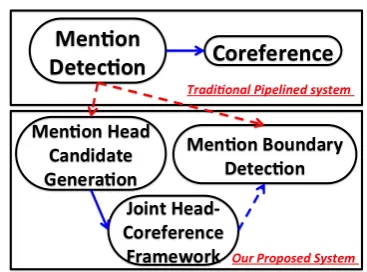
Figure 1:Comparison between a traditional pipelined sys-tem and our proposed syssys-tem.We split up mention detection into two steps: mention head candidate generation and (an op-tional) mention boundary detection. We feed mention heads rather than complete mentions into the coreference model. Dur-ing the joint head-coreference process, we reject some mention head candidates and then recover complete mention boundaries after coreference decisions are made.
detection can be viewed as a global decision prob-lem, which involves considering the relevance of a mention to its context. The fact that the coreference decision provides a way to represent this relevance, further motivates considering mention detection and coreference jointly. The insight here is that a men-tion candidate will be more likely to be valid when it has more high confidence coreference links.
This paper develops a joint coreference resolution and mention head detection framework as an Inte-ger Linear Program (ILP) following Roth and Yih (2004). Figure 1 compares a traditional pipelined system with our proposed system. Our joint for-mulation includes decision variables both for coref-erence links between pairs of mention heads, and for all mention head candidates, and we simultane-ously learn the ILP coefficients for all these vari-ables. During joint inference, some of the mention head candidates will be rejected (that is, the corre-sponding variables will be assigned ’0’), contribut-ing to improvement both in MD and in coreference performance. The aforementioned joint approach builds on an algorithm that generates mention head candidates. Our candidate generation process con-sists of a statistical component and a component that makes use of existing resources, and is designed to ensure high recall on head candidates.
Ideally, after making coreference decisions, we extend the remaining mention heads to complete mentions; we employ a binary classifier, which shares all features with the mention head detection model in the joint step.
differ-ences to be addressed. First, OntoNotes removes singleton mentions, even if they are valid mentions. This causes additional difficulty in learning a good mention detector in a pipelined framework. How-ever, our joint framework can adapt to it by rejecting those singleton mentions. More details will be dis-cussed in Sec. 2. Second, ACE uses shortest deno-tative phrases to identify mentions while OntoNotes tends to use long text spans. This makes identifying mention boundaries unnecessarily hard. Our system focuses on mention heads in the coreference stage to ensure robustness. As OntoNotes does not contain head annotations, we preprocess the data to extract mention heads which conform with the ACE style.
Results on ACE-2004 and CoNLL-2012 datasets show that our system4reduces the performance gap
for coreference by around 25% (measured as the ra-tio of performance improvement over performance gap) and improves the overall mention detection by over 10 F1 points. With such significant improve-ments, we achieve the best end-to-end coreference resolution results reported so far.
The main contributions of our work can be sum-marized as follows:
1. We develop a new, end-to-end, coreference ap-proach that is based on a joint learning and in-ference model for mention heads and corefer-ence decisions.
2. We develop an improved mention head candi-date generation module and a mention bound-ary detection module.
3. We achieve the best coreference results on pre-dicted mentions and reduce the performance gap compared to using gold mentions.
The rest of the paper is organized as follows. We explain the joint head-coreference learning and in-ference framework in Sec. 2. Our mention head candidate generation module and mention boundary detection module are described in Sec. 3. We report our experimental results in Sec. 4, review related work in Sec. 5 and conclude in Sec. 6.
2 A Joint Head-Coreference Framework This section describes our joint coreference resolu-tion and menresolu-tion head detecresolu-tion framework. Our work is inspired by the latent left-linking model in Chang et al. (2013) and the ILP formulation from Chang et al. (2011). The joint learning and infer-ence model takes as input mention head candidates
4Available at http://cogcomp.cs.illinois.
edu/page/software_view/Coref
(Sec. 3) and jointly (1) determines if they are indeed mention heads and (2) learns a similarity metric be-tween mentions. This is done by simultaneously learning a binary mention head detection classifier and a mention-pair coreference classifier. The men-tion head detecmen-tion model here is mainly trained to differentiate valid mention heads from invalid ones. By learning and making decisions jointly, it also serves as a singleton mention head classifier, build-ing on insights from Recasens et al. (2013). This joint framework aims to improve performance on both mention head detection and on coreference.
We first describe the formualtion of the men-tion head detecmen-tion and the ILP-based menmen-tion-pair coreference separately, and then propose the joint head-coreference framework.
2.1 Mention Head Detection
The mention head detection model is a binary classi-fiergm=w>1ϕ(m), in whichϕ(m)is a feature vector
for mention head candidatemandw1 is the
corre-sponding weight vector. We identify a candidatem
as a mention head ifgm>0. The features utilized in
the vectorϕ(m)consist of: 1) Gazetteer features 2) Part-Of-Speech features 3) Wordnet features 4) Fea-tures from the previous and next tokens 5) Length of mention head. 6) Normalized Pointwise Mutual In-formation (NPMI) on the tokens across a mention head boundary 7) Feature conjunctions. Altogether there are hundreds of thousands of sparse features.
2.2 ILP-based Mention-Pair Coreference
LetMbe the set of all mentions. We train a corefer-ence model by learning a pairwise mention scoring function. Specifically, given a mention-pair (u,v)
(u,v∈M,uis the antecedent ofv), we learn a left-linking scoring function fu,v =w>2φ(u,v), where
φ(u,v) is a pairwise feature vector and w2 is the
weight vector. The inference algorithm is inspired by the best-left-link approach (Chang et al., 2011), where they solve the following ILP problem:
argmax
y u<v
∑
,u,v∈Mfu,vyu,v,s.t.
∑
u<vyu,v≤1, ∀v∈M, yu,v∈ {0,1} ∀u,v∈M.
(1)
Here,yu,v=1 iff mentionsu,vare directly linked.
2.3 Joint Inference Framework
We extend expression (1) to facilitate joint inference on mention heads and coreference as follows:
argmax
y u<v
∑
,u,v∈Mfu,vyu,v+m∑
∈Mgmym,s.t.
∑
u<vyu,v≤1, ∀v∈M 0,
∑
u<vyu,v≤yv, ∀v∈M 0,
yu,v∈ {0,1}, ym∈ {0,1} ∀u,v,m∈M0.
Here,M0is the set of all mention head candidates. ym is the decision variable for mention head
candi-date m. ym=1 if and only if the mention head m
is chosen. To consider coreference decisions and mention head decisions together, we add the con-straint∑u<vyu,v≤yv, which ensures that if a
candi-date mention headv is not chosen, then it will not have coreference links with other mention heads.
2.4 Joint Learning Framework
To support joint learning of the parameters w1 and w2described above, we define a joint training
objec-tive functionC(w1,w2) for mention head detection
and coreference, which uses a max-margin approach to learn both weight vectors. Suppose we have a col-lection of documents D, and we generatend
men-tion head candidates for each documentd (d∈D). We use an indicator function δ(u,m) to represent whether mention headsu,mare in the same corefer-ence cluster based on gold annotations (δ(u,m) =1 iff they are in the same cluster). Similarly,Ω(m)is an indicator funtion representing whether mention headmis valid in the gold annotations.
For simplicity, we first define
u0=argmax
u<m(w >
2φ(u,m)−δ(u,m)), u00=arg max
u<m,δ(u,m)=1w >
2φ(u,m)Ω(m).
We then minimize the following joint training ob-jective functionC(w1,w2).
C(w1,w2) =|D1|
∑
d∈D1
nd
∑
m(Ccore f,m(w2)+Clocal,m(w1) +Ctrans,m(w1)) +R(w1,w2).
C(w1,w2) is composed of four parts. The first part
is the loss function for coreference, where we have
Ccore f,m(w2) =−w2>φ(u00,m)Ω(m)
+ (w>2φ(u0,m)−δ(u0,m))(Ω(m)∨Ω(u0)).
It is similar to the loss function for a latent left-linking coreference model5. As the second
com-ponent, we have the quadratic loss for the mention head detection model,
Clocal,m(w1) =12(w>1ϕ(m)−Ω(m))2.
Using the third component, we further maximize the margin between valid and invalid mention head can-didates when they are selected as the best-left-link mention heads for any valid mention head. It can be represented as
Ctrans,m(w1) =12(w>1ϕ(u0)−Ω(u0))2Ω(m).
The last part is the regularization term
R(w1,w2) =λ21||w1||2+λ22||w2||2. 2.5 Stochastic Subgradient Descent for Joint
Learning
For joint learning, we choose stochastic subgradi-ent descsubgradi-ent (SGD) approach to facilitate performing SGD on a per mention head basis. Next, we de-scribe the weight update algorithm by defining the subgradients.
The partial subgradient w.r.t. mention headmfor the head weight vectorw1is given by
∇w1,mC(w1,w2) =
1
|D|nd(∇Clocal,m(w1) +∇Ctrans,m(w1)) +λ1w1, (2)
where
∇Clocal,m(w1) = (w>1ϕ(m)−Ω(m))ϕ(m), ∇Ctrans,m(w1) = (w>1ϕ(u0)−Ω(u0))ϕ(u0)Ω(m).
The partial subgradient w.r.t. mention headmfor the coreference weight vectorw2is given by
∇w2,mC(w1,w2) =λ2w2+
φ(u0,m)−φ(u00,m) ifΩ(m) =1,
φ(u0,m) ifΩ(m) =0 andΩ(u0) =1,
0 ifΩ(m) =0 andΩ(u0) =0.
(3)
Here λ1 and λ2 are regularization coefficients
which are tuned on the development set. To learn the mention head detection model, we consider two different parts of the gradient in expression (2).
∇Clocal,m(w1) is exactly the local gradient of
the gradient for mention headu0, the mention head
chosen by the current best-left-linking model form. This serves to maximize the margin between valid mention heads and invalid ones. As invalid mention heads will not be linked to any other mention head,
∇trans is zero whenmis invalid. When training the
mention-pair coreference model, we only consider gradients when at least one of the two mention heads
m,u0 is valid, as shown in expression (3). When
mention head mis valid (Ω(m) =1), the gradient is the same as local training for best-left-link ofm
(first condition in expression (3)). When m is not valid while u0 is valid, we only demote the
coref-erence link between them (second condition in ex-pression (3)). We consider only the gradient from the regularization term when bothm,u0are invalid.
As mentioned before, our framework can han-dle annotations with or without singletion mentions. When the gold data contains no singleton mentions, we haveΩ(m) =0 for all singleton mention heads among mention head candidates. Then, our men-tion head detecmen-tion model partly serves as a single-ton head detector, and tries to reject singlesingle-tons in the joint decisions with coreference. When the gold data contains singleton mentions, we haveΩ(m) =1 for all valid singleton mention heads. Our mention head detection model then only learns to differenti-ate invalid mention heads from valid ones, and thus has the ability to preserve valid singleton heads.
Most of the head mentions proposed by the al-gorithms described in Sec. 3 are positive exam-ples. We ensure a balanced training of the men-tion head detecmen-tion model by adding sub-sampled invalid mention head candidates as negative exam-ples. Specifically, after mention head candidate gen-eration (described in Sec. 3), we train on a set of candidates with precision larger than 50%. We then use Illinois Chunker (Punyakanok and Roth, 2001)6
to extract more noun phrases from the text and em-ploy Collins head rules (Collins, 1999) to identify their heads. When these extracted heads do not overlap with gold mention heads, we treat them as negative examples.
We note that the aforementioned joint framework can take as input either complete mention candi-dates or mention head candicandi-dates. However, in this paper we only feed mention heads into it. Our ex-perimental results support our intuition that this pro-vides better results.
6http://cogcomp.cs.illinois.edu/page/
software_view/Chunker
3 Mention Detection Modules
This section describes the module that generates our mention head candidates, and then how the mention heads are expanded to complete mentions.
3.1 Mention Head Candidate Generation
The goal of the mention head candidate genera-tion process is to acquire candidates from multiple sources to ensure high recall, given that our joint framework acts as a filter and increases precision. We view the sources as independent components and merge all mention heads generated. A sequence labelling component and a named entity recogni-tion component employ statistical learning methods. These are augmented by additional heads that we acquire from Wikipedia and a “known heads” re-source, which we incorporate utilizing string match-ing algorithms.
3.1.1 Statistical Components
Sequence Labelling Component We use the
fol-lowing notations. LetO=<o1,o2,···,on>
repre-sent an input token sequence over an alphabetΩ. A mention is a substring of consecutive input tokens
mi,j =<oi,oi+1,···,oj > for 1≤i≤ j≤n. We
consider the positions of mentions in the text: two mentions with an identical sequence of tokens that differ in position are considered different mentions. The sequence labeling component builds on the following assumption:
Assumption Different mentions have different
heads, and heads do not overlap with each other. That is, for each mi,j, we have a corresponding head ha,b where i≤a≤b≤ j. Moreover, for an-other head ha0,b0, we have the satisfying condition
a−b0>0 or b−a0<0 ∀ha,b,ha0,b0.
Based on this assumption, the problem of identifying mention heads is a sequential phrase identification problem, and we choose to em-ploy the BILOU-representation as it has advan-tages over traditionalBIO-representation, as shown, e.g. in Ratinov and Roth (2009). The BILOU -representation suggests learning classifiers that identify the Beginning, Inside and Last tokens of multi-token chunks as well asUnit-length chunks. The problem is then transformed into a simple, but constrained, 5-class classification problem.
vector is sparse and we use sparse perceptron (Jack-son and Craven, 1996) for supervised training. We also apply a two layer prediction aggregation. First, we apply a baselineBILOU-classifier, and then use the resulting predictions as additional features in a second level of inference to take interactions into account in an efficient manner. A similar technique has been applied in Ratinov and Roth (2009), and has shown favorable results over other ”standard” sequential prediction models.
Named Entity Recognition Component We use
existing tools to extract named entities as additional mention head candidates. We choose the state-of-the-art “Illinois Named Entity Tagger” package7.
It uses distributional word representations that im-prove its generalization. This package gives the standard Person/Location/Organization/Misc labels and we take all output named entities as candidates.
3.1.2 Resource-Driven Matching Components
Wikipedia Many mention heads can be directly
matched to a Wikipedia title. We get 4,045,764 Wikipedia titles from Wikipedia dumps and use all of them as potential mention heads. The Wikipedia matching component includes an efficient hashing algorithm implemented via a DJB2 hash function8.
One important advantage of using Wikipedia is that it keeps updating. This component can con-tribute steadily to ensure a good coverage of men-tion heads. We first run this matching component on training documents and compute the precision of entries that appear in the text (the probability of ap-pearing as mention heads). We then get the set of en-tries with precision higher than a thresholdα, which is tuned on the development set using F1-score. We use them as candidates for mention head matching.
Known HeadSome mention heads appear
repeat-edly in the text. To fully utilize the training data, we construct a known mention head candidate set and identify them in the test documents. To balance be-tween recall and precision, we set a parameterβ>0 as a precision threshold and only allow those men-tion heads with precision larger thanβ on the train-ing set. Please note that thresholdβ is also tuned on the development set using F1-score.
We also employ a simple word variation tolerance algorithm in our matching components, to general-ize over small variations (plural/singular, etc.).
7http://cogcomp.cs.illinois.edu/page/
software_view/NETagger
8http://www.cse.yorku.ca/˜oz/hash.html
3.2 Mention Boundary Detection
Once the joint learning and inference process deter-mines the set of mention heads (and their corefer-ence chains), we extend the heads to complete men-tions. Note that this process may not be necessary, since in many applications, the head clusters often provide enough information. However, for consis-tency with existing coreference resolution systems, we describe below how we expand the heads to complete mentions.
We learn a binary classifier to expand mentions, which determines if the mention head should in-clude the token to its left and to its right. We fol-low the notations in Sec. 2.1. We construct pos-itive examples as (op,ha,b,dir), ∀mi,j(ha,b). Here p∈ {i,i+1,···,a−1} ∪ {b+1,b+2,···,j} and when p= i,i+1,···,a−1, dir =L; when p=
b+1,b+2,···,j, dir=R. We construct negative examples as(oi−1,ha,b,L)and(oj+1,ha,b,R). Once
trained, the binary classifier takes in the head, a to-ken and the direction of the toto-ken relative to the head, and decides whether the token is inside or out-side the mention corresponding to the head. At test time, this classifier is used around each confirmed head to determine the mention boundaries. The fea-tures used here are similar to the mention head de-tection model described in Sec. 2.1.
4 Experiments
We present experiments on the two standard coref-erence resolution datasets, ACE-2004 (NIST, 2004) and OntoNotes-5.0 (Hovy et al., 2006). Our ap-proach results in a substantial reduction in the coref-erence performance gap between gold and pre-dicted mentions, and significantly outperforms ex-isting stat-of-the-art results on coreference resolu-tion; in addition, it achieves significant performance improvement on MD for both datasets.
4.1 Experimental Setup
DatasetsThe ACE-2004 dataset contains 443
MUC B3 CEAFe AVG
GoldM/H 78.17 81.64 78.45 79.42 StanfordM 63.89 70.33 70.21 68.14
PredictedM 64.28 70.37 70.16 68.27
H-M-CorefM 65.81 71.97 71.14 69.64
H-Joint-MM 67.28 73.06 73.25 71.20
StanfordH 70.28 73.93 73.04 72.42
PredictedH 71.35 75.33 74.02 73.57
H-M-CorefH 71.81 75.69 74.45 73.98
[image:7.595.73.296.61.207.2]H-Joint-MH 72.74 76.69 75.18 74.87
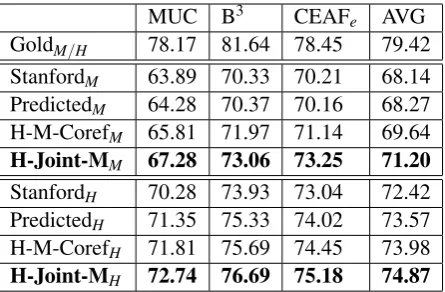
Table 2:Performance of coreference resolution for all sys-tems on the ACE-2004 dataset. Subscripts (M, H) indicate evaluations on (mentions, mention heads) respectively. For gold mentions and mention heads, they yield the same per-formance for coreference. Our proposed H-Joint-M system achieves the highest performance. Parameters of our proposed system are tuned asα=0.9,β=0.8,λ1=0.2 andλ2=0.3.
The ACE-2004 dataset is annotated with both mention and mention heads, while the OntoNotes-5.0 dataset only has mention annotations. There-fore, we preprocess Ontonote-5.0 to derive men-tion heads using Collins head rules (Collins, 1999) with gold constituency parsing information and gold named entity information. The parsing information9
is only needed to generate training data for the men-tion head candidate generator and named entities are directly set as heads. We set these extracted heads as gold, which enables us to train the two layer
BILOU-classifier described in Sec. 3.1.1. The non-overlapping mention head assumption in Sec. 3.1.1 can be verified empirically on both ACE-2004 and OntoNotes-5.0 datasets.
Baseline Systems We choose three publicly
avail-able state-of-the-art end-to-end coreference systems as our baselines:Stanfordsystem (Lee et al., 2011),
Berkeley system (Durrett and Klein, 2014) and
HOTCoref system (Bj¨orkelund and Kuhn, 2014).
Developed SystemsOur developed system is built
on the work by Chang et al. (2013), using Con-strained Latent Left-Linking Model (CL3M) as our
mention-pair coreference model in the joint frame-work10. When the CL3M coreference system uses
gold mentions or heads, we call the system Gold; when it uses predicted mentions or heads, we call the system Predicted. The mention head candidate generation module along with mention boundary detection module can be grouped together to form a complete mention detection system, and we call it H-M-MD. We can feed the predicted mentions fromH-M-MDdirectly into the mention-pair
coref-9No parsing information is needed at evaluation time. 10We use Gurobi v5.0.1 as our ILP solver.
MUC B3 CEAFe AVG
GoldM/H 82.03 70.59 66.76 73.12 StanfordM 64.62 51.89 48.23 54.91
HotCorefM 70.74 58.37 55.47 61.53
BerkeleyM 71.24 58.71 55.18 61.71
PredictedM 69.63 57.46 53.16 60.08
H-M-CorefM 70.95 59.11 54.98 61.68
H-Joint-MM 72.22 60.50 56.37 63.03
StanfordH 68.53 56.68 52.36 59.19
HotCorefH 72.94 60.27 57.53 63.58
BerkeleyH 73.05 60.39 57.43 63.62
PredictedH 72.11 60.12 55.68 62.64
H-M-CorefH 73.22 61.42 56.21 63.62
H-Joint-MH 74.83 62.77 57.93 65.18
Table 3:Performance of coreference resolution for all sys-tems on the CoNLL-2012 dataset. Subscripts (M, H) indi-cate evaluations on (mentions, mention heads) respectively. For gold mentions and mention heads, they yield the same per-formance for coreference. Our proposed H-Joint-M system achieves the highest performance. Parameters of our proposed system are tuned asα=0.9,β=0.9,λ1=0.25 andλ2=0.2.
erence model that we implemented, resulting in a traditional pipelined end-to-end coreference system, namely H-M-Coref. We name our new proposed end-to-end coreference resolution system incorpo-rating both the mention head candidate generation module and the joint framework asH-Joint-M.
Evaluation Metrics We compare all systems
us-ing three popular metrics for coreference resolution: MUC (Vilain et al., 1995), B3 (Bagga and
Bald-win, 1998), and Entity-based CEAF (CEAFe) (Luo,
2005). We use the average F1 scores (AVG) of these three metrics as the main metric for comparison. We use the v7.0 scorer provided by CoNLL-2012 Shared Task11. We also evaluate the mention
de-tection performance based on precision, recall and F1 score. As mention heads are important for both mention detection and coreference resolution, we also report results evaluated on mention heads.
4.2 Performance for Coreference Resolution
Performance of coreference resolution for all sys-tems on the ACE-2004 and CoNLL-2012 datasets is shown in Table 2 and Table 3 respectively.12 These
results show that our developed systemH-Joint-M 11The latest scorer is version v8.01, but MUC, B3, CEAFe and CoNLL average scores are not changed. For evaluation on ACE-2004, we convert the system output and gold annotations into CoNLL format.
[image:7.595.312.539.63.258.2]shows significant improvement on all metrics for both datasets. Existing systems only report results on mentions. Here, we also show their performance evaluated on mention heads. When evaluated on mention heads rather than mentions13, we can
al-ways expect a performance increase for all systems on both datasets. Even though evaluating on men-tions is more common in the literature, it is often enough to identify just mention heads in corefer-ence chains (as shown in the example from Sec. 1).H-M-Coref can already bring substantial perfor-mance improvement, which indicates that it is help-ful for coreference to just identify high quality men-tion heads. Our proposed H-Joint-M system out-performs all baselines and achieves the best results reported so far.
4.3 Performance for Mention Detection
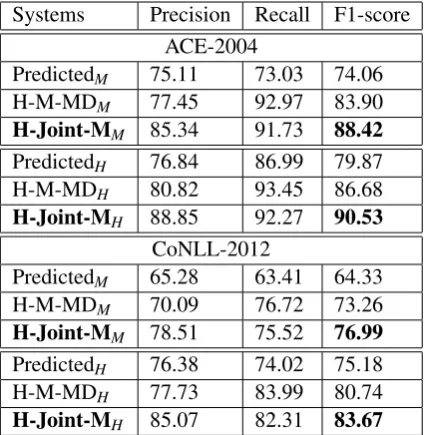
The performance of mention detection for all sys-tems on the ACE-2004 and CoNLL-2012 datasets is shown in Table 4. These results show that our developed system exhibits significant improvement on precision and recall for both datasets. H-M-MD
mainly improves on recall, indicating, as expected, that the mention head candidate generation mod-ule ensures high recall on mention heads. H-Joint-Mmainly improves on precision, indicating, as ex-pected, that the joint framework correctly rejects many of the invalid mention head candidates during joint inference. Our joint model can adapt to anno-tations with or without singleton mentions. Based on training data, our system has the ability to pre-serve true singleton mentions in ACE while reject-ing many sreject-ingleton mentions in OntoNotes14. Note
that we have better mention detection results on ACE-2004 dataset than on OntoNotes-5.0 dataset. We believe that this is due to the fact that extract-ing mention heads in the OntoNotes dataset is some-what noisy.
4.4 Analysis of Performance Improvement
The improvement of ourH-Joint-Msystem is due to two distinct but related modules: the mention head candidate generation module (“Head”) and the joint learning and inference framework (“Joint”).15 We 13Here, we treat mention heads as mentions. Thus, in the evaluation script, we set the boundary of a mention to be the boundary of its correponding mention head.
14Please note that when evaluating on OntoNotes, we even-tually remove all singleton mentions from the output.
15“Joint” rows are computed as “H-Joint-M” rows minus “Head” rows. They reflect the contribution of the joint frame-work to mention detection (by rejecting some mention heads).
Systems Precision Recall F1-score ACE-2004
PredictedM 75.11 73.03 74.06
H-M-MDM 77.45 92.97 83.90
H-Joint-MM 85.34 91.73 88.42
PredictedH 76.84 86.99 79.87
H-M-MDH 80.82 93.45 86.68
H-Joint-MH 88.85 92.27 90.53
CoNLL-2012
PredictedM 65.28 63.41 64.33
H-M-MDM 70.09 76.72 73.26
H-Joint-MM 78.51 75.52 76.99
PredictedH 76.38 74.02 75.18
H-M-MDH 77.73 83.99 80.74
[image:8.595.320.533.62.280.2]H-Joint-MH 85.07 82.31 83.67
Table 4:Performance of mention detection for all systems on the ACE-2004 and CoNLL-2012 datasets.Subscripts (M, H) indicate evaluations on (mentions, mention heads) respec-tively. Our proposedH-Joint-Msystem dramatically improves the MD performance.
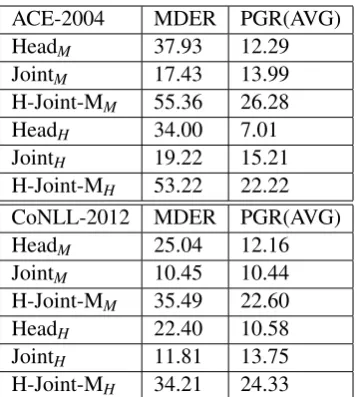
evaluate the effect of these two modules in terms ofMention Detection Error Reduction(MDER) and
Performance Gap Reduction(PGR) for coreference. MDER is computed as the ratio of performance im-provement for mention detection over the original mention detection error rate, while PGR is com-puted as the ratio of performance improvement for coreference over the performance gap for corefer-ence. Results on the ACE-2004 and CoNLL-2012 datasets are shown in Table 5.16
The mention head candidate generation module has a bigger impact on MDER compared to the joint framework. However, they both have the same level of positive effects on PGR for coreference resolu-tion. On both datasets, we achieve more than 20% performance gap reduction for coreference.
5 Related Work
Coreference resolution has been extensively stud-ied, with several state-of-the-art approaches ad-dressing this task (Lee et al., 2011; Durrett and Klein, 2013; Bj¨orkelund and Kuhn, 2014; Song et al., 2012). Many of the early rule-based systems like Hobbs (1978) and Lappin and Leass (1994) gained considerable popularity. The early designs were easy to understand and the rules were designed manually. Machine learning approaches were intro-duced in many works (Connolly et al., 1997; Ng and
ACE-2004 MDER PGR(AVG)
HeadM 37.93 12.29
JointM 17.43 13.99
H-Joint-MM 55.36 26.28
HeadH 34.00 7.01
JointH 19.22 15.21
H-Joint-MH 53.22 22.22
CoNLL-2012 MDER PGR(AVG)
HeadM 25.04 12.16
JointM 10.45 10.44
H-Joint-MM 35.49 22.60
HeadH 22.40 10.58
JointH 11.81 13.75
[image:9.595.95.274.60.259.2]H-Joint-MH 34.21 24.33
Table 5: Analysis of performance improvement in terms ofMention Detection Error Reduction(MDER) and Perfor-mance Gap Reduction(PGR) for coreference resolution on the ACE-2004 and CoNLL-2012 datasets.“Head” represents the mention head candidate generation module, “Joint” repre-sents the joint learning and inference framework, and “H-Joint-M” indicates the end-to-end system.
Cardie, 2002; Bengtson and Roth, 2008; Soon et al., 2001). The introduction of ILP methods has influ-enced the coreference area too (Chang et al., 2011; Denis and Baldridge, 2007). In this paper, we use the Constrained Latent Left-Linking Model (CL3M)
described in Chang et al. (2013) in our experiments. The task of mention detection is closely related to Named Entity Recognition (NER). Punyakanok and Roth (2001) thoroughly study phrase identifica-tion in sentences and propose three different general approaches. They aim to learn several different lo-cal classifiers and combine them to optimally satisfy some global constraints. Cardie and Pierce (1998) propose to select certain rules based on a given corpus, to identify base noun phrases. However, the phrases detected are not necessarily mentions that we need to discover. Ratinov and Roth (2009) present detailed studies on the task of named entity recognition, which discusses and compares different methods on multiple aspects including chunk repre-sentation, inference method, utility of non-local fea-tures, and integration of external knowledge. NER can be regarded as a sequential labeling problem, which can be modeled by several proposed mod-els, e.g. Hidden Markov Model (Rabiner, 1989) or Conditional Random Fields (Sarawagi and Cohen, 2004). The typical BIO representation was intro-duced in Ramshaw and Marcus (1995); OC repre-sentations were introduced in Church (1988), while Finkel and Manning (2009) further study nested named entity recognition, which employs a tree
structure as a representation of identifying named entities within other named entities.
The most relevant study on mentions in the con-text of coreference was done in Recasens et al. (2013); this work studies distinguishing single men-tions from coreferent menmen-tions. Our joint frame-work provides similar insights, where the added mention decision variable partly reflects if the men-tion is singleton or not.
Several recent works suggest studying corefer-ence jointly with other tasks. Lee et al. (2012) model entity coreference and event coreference jointly; Durrett and Klein (2014) consider joint coreference and entity-linking. The work closest to ours is that of Lassalle and Denis (2015), which studies a joint anaphoricity detection and corefer-ence resolution framework. While their infercorefer-ence objective is similar, their work assumes gold men-tions are given and thus their modeling is very dif-ferent.
6 Conclusion
This paper proposes a joint inference approach to the end-to-end coreference resolution problem. By moving to identify mention heads rather than men-tions, and by developing an ILP-based, joint, online learning and inference approach, we close a signif-icant fraction of the existing gap between corefer-ence systems’ performance on gold mentions and their performance on raw data. At the same time, we show substantial improvements in mention de-tection. We believe that our approach will gener-alize well to many other NLP problems, where the performance on raw data (the result that really mat-ters) is still significantly lower than the performance on gold data.
Acknowledgments
References
A. Bagga and B. Baldwin. 1998. Algorithms for scoring coreference chains. InIn The First International Con-ference on Language Resources and Evaluation Work-shop on Linguistics Coreference.
E. Bengtson and D. Roth. 2008. Understanding the value of features for coreference resolution. InEMNLP. A. Bj¨orkelund and J Kuhn. 2014. Learning structured
Perceptrons for coreference resolution with latent an-tecedents and non-local features. InACL.
C. Cardie and D. Pierce. 1998. Error-driven pruning of Treebanks grammars for base noun phrase identifica-tion. InProceedings of ACL-98.
K. Chang, R. Samdani, A. Rozovskaya, N. Rizzolo, M. Sammons, and D. Roth. 2011. Inference proto-cols for coreference resolution. InCoNLL.
K.-W. Chang, R. Samdani, and D. Roth. 2013. A con-strained latent variable model for coreference resolu-tion. InEMNLP.
K. Church. 1988. A stochastic parts program and noun phrase parser for unrestricted text. InANLP.
M. Collins. 1999. Head-driven Statistical Models for Natural Language Parsing. Ph.D. thesis, Computer Science Department, University of Pennsylvenia. D. Connolly, J. Burger, and D. Day. 1997. A machine
learning approach to anaphoric reference. In New Methods in Language Processing.
A. Culotta, M. Wick, and A. McCallum. 2007. First-order probabilistic models for coreference resolution. InNAACL.
P. Denis and J. Baldridge. 2007. Joint determination of anaphoricity and coreference resolution using integer programming. InNAACL.
G. Durrett and D. Klein. 2013. Easy victories and uphill battles in coreference resolution. InEMNLP.
G. Durrett and D. Klein. 2014. A joint model for entity analysis: Coreference, typing, and linking.
J. Finkel and C. Manning. 2009. Nested named entity recognition. InEMNLP.
J. R. Hobbs. 1978. Resolving pronoun references. Lin-gua.
E. Hovy, M. Marcus, M. Palmer, L. Ramshaw, and R. Weischedel. 2006. Ontonotes: The 90% solution. InProceedings of HLT/NAACL.
J. Jackson and M. Craven. 1996. Learning sparse per-ceptrons. Proceedings of the 1996 Advances in Neural Information Processing Systems.
S. Lappin and H. Leass. 1994. An algorithm for pronom-inal anaphora resolution. Computational linguistics.
E. Lassalle and P. Denis. 2015. Joint anaphoricity detec-tion and coreference resoludetec-tion with constrained latent structures.
H. Lee, Y. Peirsman, A. Chang, N. Chambers, M. Sur-deanu, and D. Jurafsky. 2011. Stanford’s multi-pass sieve coreference resolution system at the conll-2011 shared task. InProceedings of the CoNLL-2011 Shared Task.
H. Lee, M. Recasens, A. Chang, M. Surdeanu, and D. Ju-rafsky. 2012. Joint entity and event coreference reso-lution across documents. InEMNLP.
X. Luo. 2005. On coreference resolution performance metrics. InEMNLP.
V. Ng and C. Cardie. 2002. Improving machine learning approaches to coreference resolution. InACL. NIST. 2004. The ACE evaluation plan.
S. Pradhan, A. Moschitti, N. Xue, O. Uryupina, and Y. Zhang. 2012. CoNLL-2012 shared task: Modeling multilingual unrestricted coreference in OntoNotes. InCoNLL.
V. Punyakanok and D. Roth. 2001. The use of classifiers in sequential inference. InNIPS.
L. R. Rabiner. 1989. A tutorial on hidden Markov mod-els and selected applications in speech recognition. Proceedings of the IEEE.
L. A. Ramshaw and M. P. Marcus. 1995. Text chunking using transformation-based learning. InProceedings of the Third Annual Workshop on Very Large Corpora. L. Ratinov and D. Roth. 2009. Design challenges and misconceptions in named entity recognition. InProc. of the Annual Conference on Computational Natural Language Learning (CoNLL).
M. Recasens, M.-C. de Marneffe, and C. Potts. 2013. The life and death of discourse entities: Identifying singleton mentions. InNAACL.
D. Roth and W. Yih. 2004. A linear programming formulation for global inference in natural language tasks. In Hwee Tou Ng and Ellen Riloff, editors, CoNLL.
S. Sarawagi and W. Cohen. 2004. Semi-Markov con-ditional random fields for information extraction. In NIPS.
Y. Song, J. Jiang, W.-X. Zhao, S. Li, and H. Wang. 2012. Joint learning for coreference resolution with markov logic. InProceedings of the 2012 Joint Conference of EMNLP-CoNLL.
W. M. Soon, H. T. Ng, and D. C. Y. Lim. 2001. A ma-chine learning approach to coreference resolution of noun phrases. Comput. Linguist.