Reliability Measures in Circulant Network
*Indra Rajasingh, Bharati Rajan, and R. Sundara Rajan
Abstract—Reliability and efficiency are important criteria in the design of interconnection networks. Connectivity is a widely used measurement for network fault-tolerance capacities, while diameter determines routing efficiency along individual paths. In practice, we are interested in high-connectivity, small-diameter networks. Recently, the w-wide diameter dw(G), (w −1)-fault diameter Dw(G) and the w-Rabin number rw(G), for w ≤ k(G) have been used to measure network reliability and efficiency. In this paper, in addition to these pa-rameters we introduce(w−1)-fault wide diameterρw(G)and study these parameters for the undirected circulant network.
Index Terms—wide diameter, fault diameter, fault wide dia-meter, Rabin number, circulant network.
I. INTRODUCTION
R
ELIABILITY is an important concept in the design of networks. Connectivity and edge connectivity are widely used as reliability measures. In practice, we are often interested in the collection of multipaths between a pair of nodes [6]. The distancedG(x, y)from a vertexxto anothervertex y in a network G is the minimum number of edges of a path from x toy. The diameter d(G) of a networkG is the maximum distance from one vertex to another. The connectivityk(G) of a networkG is the minimum number of vertices whose removal results in a disconnected or trivial network. According to Menger’s theorem, there are atleastk (internally) vertex-disjoint paths from a vertex xto another vertexy in a network of connectivity k[17].
The classical approach to study routing in interconnection networks is to try to find the shortest path between the sending station and the receiving station. Whenever some stations are faulty on the path between the sending station and the receiving station, the management protocol has to find a way to bypass those faulty stations and set up a new path between them. Similarly, if this new path is disconnected again, a third path needs to be set up, if it is possible [4]. In this context, diameter is the measurement for maximum transmission delay and connectivity is a good parameter to study the tolerance of the network on occasions when nodes fail. Fault tolerant interconnection networks can be found in Hsu [17].
For a graph (network) G with connectivity k(G), the parametersw-wide diameter dw(G), (w−1)-fault diameter
Dw(G) and the Rabin number rw(G) for any w ≤ k(G)
arise from the study of parallel routing, fault-tolerant systems and randomized routing respectively [6], [9], [10], [14]. Due to the widespread use of reliable, efficient and fault-tolerant networks, these three parameters have been the subject of extensive study over the past decade [6]. In the sequal,
(x1, x2, ..., xn)denotes a path fromx1 toxn.
Manuscript received December 03, 2010; revised December 21, 2010. *This work is supported by DST Project No.SR/S4/MS: 494/07.
Indra Rajasingh, Bharati Rajan, and R. Sundara Rajan are with the Department of Mathematics, Loyola College, Chennai 600 034, Tamilnadu, India (e-mail: [email protected]).
II. PRELIMINARIES
Definition 1.[4] A containerC(x, y)between two distinct nodesxandyin a networkGis a set of node-disjoint paths betweenxandy. The number of paths inC(x, y)is called the width of C(x, y). A C(x, y) container with widthw is denoted by Cw(x, y). The length of Cw(x, y), written as
l(Cw(x, y)), is the length of a longest path inCw(x, y).
Definition 2.[5] Forw≤k(G), thew-wide distance from xtoy in a networkGis defined as
dw(x, y) =min{l(Cw(x, y))/Cw(x, y) is a container with widthw betweenxand y} Thew-wide diameter of Gis defined as
dw(G) =maxx,y∈V(G){dw(x, y)}.
In other words, forw≤k(G), thew-wide diameterdw(G)
of a network G is the minimum l such that for any two distinct vertices xandy there existw vertex-disjoint paths of length at mostl from xtoy.
The notion of w-wide diameter was introduced by Hsu [6] to unify the concepts of diameter and connectivity. It is desirous that an ideal interconnection networkG should be one with connectivity k(G) as large as possible and diam-eter d(G) as small as possible. The wide-diameter dw(G)
combines connectivityk(G)and diameterd(G), where 1≤
w≤k(G). Hencedw(G)is a more suitable parameter than
d(G) to measure fault-tolerance and efficiency of parallel processing computer networks. Thus, determining the value of dw(G) is of significance for a given graph G and an
integerw. Hsu [6] proved that this problem isN P-complete [18].
Remark 1.If there exists a container Cw∗(x, y)such that
each of the wpaths in Cw∗(x, y)is a shortest path between
xandy inG, then
dw(x, y) =l(Cw∗(x, y))
Definition 3.[11] Forw≤k(G), the(w−1)-fault distance fromxtoy in a networkGis
Dw(x, y) =max{dG−S(x, y) :S ⊆V with
|S|=w−1 andx, y are not inS}
wheredG−S(x, y) denotes the shortest distance between x
andy inG−S.
The(w−1)-fault diameter ofGis
Dw(G) =max{Dw(x, y) :xandy are inG}
The notion ofDw(G)was defined by Hsu [6] and the
spe-cial case in whichw=k(G)was studied by Krishnamoorthy et al. [9].
0
1
2
3
4 5
[image:2.595.102.231.55.196.2]6 7
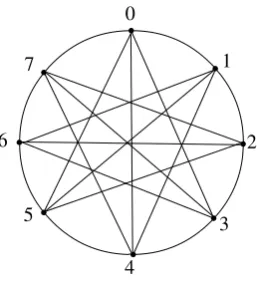
Fig. 1. Circulant graphG(8;±{1,3,4})
Definition 4. For w ≤ k(G), the (w−1)-fault wide distance from xtoy in a networkGis
ρw(x, y) =max{dk(G)−|S|(x, y) :S⊆V with
|S|=w−1 andx, yare not in S} The (w−1)-fault wide diameter ofGis
ρw(G) =max{ρw(x, y) :xandy are inG}
Definition 5.[11] Thew-Rabin numberrw(G)of a network
Gis the minimumlsuch that, for anyw+ 1distinct vertices x, y1, ..., yw there existwvertex-disjoint (except at x) paths
of length at most l fromxtoyi,1≤i≤w.
This concept was first defined by Hsu [6]. It is clear that when w= 1, d1(G) =D1(G) = ρk(G) = r1(G) = d(G)
for any network G. The following are basic properties and relationships among dw(G),Dw(G), ρw(G)andrw(G).
Lemma 1. [11] The following statements hold for any networkGof connectivity k:
1. D1(G)≤D2(G)≤ · · · ≤Dk(G)
2. d1(G)≤d2(G)≤ · · · ≤dk(G)
3. r1(G)≤r2(G)≤ · · · ≤rk(G)
4.Dw(G)≤dw(G)andDw(G)≤rw(G)for1≤w≤k
It is easy to check that the new parameterρw(G)exhibits
the following properties.
Lemma 2.LetGbe a network of connectivity k. Then 1. ρ1(G)≥ρ2(G)≥ · · · ≥ρk(G)
2. Dw(G)≤dw(G)≤ρw(G)≤rw(G)for 1≤w≤k
In 1994, Chen et al. determined the wide diameter of the cycle prefix network [5]. In 1998, Liaw et al. found fault-tolerant routing in circulant directed graphs and cycle prefix networks [12]. The line connectivity and the fault diameters in pyramid networks were studied by Cao et al. in 1999 [4]. In the same year Liaw et al. determined the Rabin number and wide diameter of butterfly networks [10], [11]. In 2005, Liaw et al. found the wide diameters and Rabin numbers of generalized folded hypercube networks [13]. In 2009, Jia and Zhang found the wide diameter of Cayley graphs ofZm, the
cyclic group of residue classes modulo m and they proved that the k-wide diameter of the Cayley graph Cay(Zm, A)
generated by a k-element set A is d+ 1 for k = 2 and is bounded above byd+ 1for k= 3, wheredis the diameter of Cay(Zm,A) [7].
In this paper we compute the w-wide diameter dw(G), (w−1)-fault diameterDw(G),(w−1)-fault wide diameter
ρw(G), and thew-Rabin numberrw(G)forw≤k(G)when
Gis an undirected circulant graph with connectivityk.
1
2
r
0
n-1
n-r
n-2r
n-2r+1
r+1
2r+1 2r n-2
Fig. 2. 2r-wide diameter ofG
III. MAINRESULTS
The circulant is a natural generalization of the double loop network and was first considered by Wong and Coppersmith [16]. Circulant graphs have been used for decades in the design of computer and telecommunication networks due to their optimal fault-tolerance and routing capabilities [3]. It is also used in VLSI design and distributed computation [1], [2], [15]. The term circulant comes from the nature of its adjacency matrix. A matrix is circulant if all its rows are periodic rotations of the first one. Circulant matrices have been employed for designing binary codes [8]. Theoretical properties of circulant graphs have been studied extensively and surveyed by Bermond et al. [1]. Every circulant graph is a vertex transitive graph and a Cayley graph [17]. Most of the earlier research concentrated on using the circulant graphs to build interconnection networks for distributed and parallel systems [1], [3].
Definition 6. A circulant undirected graph, denoted by G(n;±{1,2, ..., j}), 1 ≤ j ≤ ⌊n/2⌋, n ≥ 3 is defined as an undirected graph consisting of the ver-tex set V = {0,1, ..., n − 1} and the edge set E =
{(i, j) :|j−i| ≡s(mod n), s∈ {1,2, ..., j}}.
The circulant graph shown in Fig. 1 is G(8;±{1,3,4}). It is clear that G(n;±1) is the undirected cycle Cn
and G(n;±{1,2, ...,⌊n/2⌋}) is the complete graph Kn. Theorem 1. If G is an undirected circulant graph
G(n;±{1,2, ..., r}), then
d2r(G) = {
⌊n−2r
r ⌋+ 2, if n≡1(mod r)
⌈n−2r
r ⌉+ 2, otherwise
for allr= 1,2, ...,⌊n/2⌋.
Proof.SinceGis2r-regular, by Menger’s theorem there are exactly2rvertex disjoint paths between any two vertices u andvinG. We begin with the case whenuandvare adjacent inCn. SinceGis vertex-transitive, without loss of generality
we assume thatu= 0andv= 1. Since the neighbourhood of
0namelyN(0)is the setN(0) ={1,2, ..., r, n−1, ..., n−r}, each path in any container C2r(0,1) contains exactly one
member fromN(0).
Consider a path P in C2r(0,1) passing through n−r.
Since V(P)∩(N(0)\(n−r)) = ϕ, in order to compute d2r(G)we chooseP to be a shortest path between0 and1.
Thus
[image:2.595.358.496.65.188.2]0 1 2 3 4 5 6 7 8 9 10 12 13 14 15 16 17 18 19 20 21 11
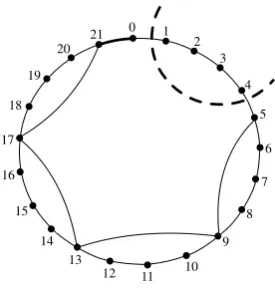
Fig. 3. 3-fault diameter ofG(22;±{1,2,3})is6
of length⌊n−r2r⌋+ 2, when n≡1 (mod r) and
P = (0, n−r, n−2r, . . . , j+r,1 +r,1),2≤j ≤1 +r of length ⌈n−r2r⌉+ 2 in all other possibilities. Thus every containerC2r(0,1) contains a path of length
⌊n−2r r
⌋
+ 2 if n≡1 (mod r) and⌈n−r2r⌉+ 2 ifn̸≡1(mod r).
We observe that the edge(0,1) is a path of length1 and the paths(0, r−j,1)and(0, n−r+1+j,1),0≤j≤r−2are paths of length 2 between0 and1 passing through vertices inN(0)\{n−r}. Thus there exist a container C2r(0,1) in
which the longest path isP and all other paths are of length
1 or 2. See Fig. 2.
The case when uandv are not adjacent onCn naturally
yields paths betweenuandv of length atmost⌊n−r2r⌋+ 2, when n≡1(mod r) and atmost⌈n−2r
r ⌉
+ 2, when n̸≡1
(mod r).
In the following theorem we obtain the(r+ 1)-fault diam-eter for the undirected circulant graphG(n;±{1,2, ..., r}).
Theorem 2. Let G be the circulant graph
G(n;±{1,2, ..., r}). Then
Dr+1(G) =
⌊
n−r r
⌋
for allr= 2, ...,⌊n/2⌋.
Proof.We begin with rfaulty nodes which are consecutive vertices inCn. Without loss of generality let1,2, ..., rbe the
faulty nodes. LetG′ =G\{1,2, ..., r}. It is easy to see that dG′(0, r+ 1)≥dG′(i, j)for all vertices i, j taken modulo
n. NowdG′(0, r+ 1) = ⌊n−r
r ⌋
. On the otherhand, suppose the faulty nodes are not consecutive vertices of Cn, then
dG′(i, j)is bounded above by ⌊n−r
r ⌋
. See Fig. 3.
Theorem 3.IfGis an undirected circulant graph, then
D2(G(n;±{1,2, ..., r})) =
⌈n
2r
⌉
for allr= 1,2, ...,⌊n/2⌋.
Proof. Since G is vertex-transitive, let us assume that the vertex labeled r be the faulty node. Let G′ = G\{r}. We assume that u = 0 and v = ⌊n/2⌋. In order to compute D2(G) we choose P to be shortest path between 0 and
⌊n/2⌋. Then
P= (0, n−r, n−2r, . . . ,⌊n/2⌋)
of length 2nr if n−r ≡0 (mod r). Otherwise, we choose the shortest pathP between0 and⌊n/2⌋as
P = (0, r−1,2r−1, . . . ,⌊n/2⌋)
[image:3.595.357.495.55.200.2]0 1 2 3 4 5 6 7 8 9 10 11 12 13 14 15 16 17 18 19 20 21
Fig. 4. 5-fault wide diameter ofG(22;±{1,2,3})is5
of length⌈2nr⌉. It is easy to see thatdG′(0,⌊n/2⌋) = ⌈n
2r ⌉
≥ dG′(i, j)for all vertices i,j taken modulon.
In the next result we obtain the(w−1)-fault wide diameter for an undirected circulant graph.
Theorem 4. Let G be the circulant graph
G(n;±{1,2, ..., r}). Then
ρ2(G) =
⌈
n−(2r+ 1)
r
⌉
+ 2
for allr= 1,2, ...,⌊n/2⌋.
Proof.SinceGis vertex-transitive, let us assume that1be the faulty node. LetG′ =G\{1}. ThenG′is(2r−1)-connected. We chooseu= 0 andv= 2. Since the neighbourhood of 0
is the setN(0) ={2,3, ..., r, n−1, ..., n−r}, each path in the containerC2r−1(0,2)contains exactly one member from
N(0).
Consider a pathPinC2r−1(0,2)passing throughn−r+1.
SinceV(P)∩(N(0)\(n−r+ 1)) =ϕ,in order to compute ρ2(G)we choose P to be a shortest path between0 and2.
Thus
P = (0, n−r+ 1, n−2r+ 1, . . . ,2)
of length
⌈
n−(2r+1)
r ⌉
+2. Again by Theorem 1, the length of
other paths are less than or equal to
⌈
n−(2r+1)
r ⌉
+2. It is also
easy to see thatd2r−1(0,2) =
⌈
n−(2r+1)
r ⌉
+ 2≥d2r−1(i, j)
for all verticesi,j taken modulo ninG′.
Theorem 5. Let G be the circulant graph
G(n;±{1,2, ..., r}). Then
ρ3(G) =
⌈
n−(2r−2)
r ⌉
+ 2,ifn−(2r−2)≡x(mod r) wherex∈ {3,4, . . . , r−1}
⌊
n−(2r−2)
r ⌋
+ 2,otherwise
for allr= 4,5, ...,⌊n/2⌋.
Proof.SinceGis vertex-transitive, let us assume that1,2be the faulty nodes. Let G′ =G\{1,2}. Then G′ is (2r−2) -connected. We assume that u = 0 and v = 3. Since the neighbourhood of0is the setN(0) ={3, ..., r, n−1, ..., n− r}, each path in the container C2r−2(0,2) contains exactly
one member fromN(0).
Consider a pathPinC2r−2(0,2)passing throughn−r+2.
0 1 2
3 4
5
6
7
8 9 10 11 12 13 14 15 16 17 18
19 20
[image:4.595.45.289.52.418.2]21
Fig. 5. 6-Rabin number ofG
Thus
P = (0, n−r+ 2, n−2r+ 2, . . . ,3)
of length
⌈
n−(2r−2)
r ⌉
+ 2ifn−(2r−2)≡x(mod r), where x∈ {3,4, ..., r−1}. By Theorem 1, the length of other paths are less than or equal to
⌈
n−(2r−2)
r ⌉
+ 2. Also it is easy to
see thatd2r−2(0,3) =
⌈
n−(2r−2)
r ⌉
+ 2≥d2r−2(i, j)for all
vertices i,j taken modulon inG′.
Remark 2.If r= 3, then
ρ3(G) =
⌈
n−4 3
⌉
+ 1
whereGbe the circulant graph G(n;±{1,2, ..., r}).
Theorem 6.IfGis an undirected circulant graph, then
ρr+1(G(n;±{1,2, ..., r})) =
⌈
n−(r+ 2)
r
⌉
+ 1
for allr= 1,2, ...,⌊n/2⌋.
Proof. Since G is vertex-transitive, let us assume that
1,2, ..., r be the faulty nodes. Let G′ = G\{1,2, ..., r}. Then G′ is r-connected. We assume that u = 0 and v = r + 1. Since the neighbourhood of 0 is the set N(0) = {n −1, ..., n −r}, each path in the container Cr(0, r+ 1)contains exactly one member from N(0).
Consider a pathP inCr(0, r+ 1)passing throughn−1.
In order to computeρr+1(G) we chooseP to be a shortest
path between0 andr+ 1. Thus
P = (0, n−1, n−1 +r, . . . , r+ 1)
of length
⌈ n−(r+2)
r ⌉
+ 1. By Theorem 1, the length of other
paths are less than or equal to
⌈ n−(r+2)
r ⌉
+ 1. It is also easy
to see that dr(0, r+ 1) = ⌈
n−(r+2)
r ⌉
+ 1≥dr(i, j) for all
vertices i,j taken modulon inG′. See Fig. 4.
We now proceed to determine thew-Rabin number for an undirected circulant graph.
Theorem 7.IfGis an undirected circulant graph, then
r2m−1(G(n;±{1,2, ..., m})) =
⌊
n−3
m
⌋
+ 1
for allm= 1,2, ...,⌊n2⌋.
Proof.By definition of Rabin number, we choose2mpoints (sayu, u1, u2, . . . , u2m−1) inG. It is enough to consider the
case when these points are consecutive points inCn labeled
i, i1, . . . , i2m−1 modulon. We claim that, there are2m−1
vertex-disjoint paths fromitoik,1≤k≤2m−1of length
atmost⌊nm−3⌋+1. We in fact, construct2m−1vertex-disjoint paths fromitoik,1≤k≤2m−1 as follows.
The edge(i, i1)is a path of length 1 fromitoi1. Further
(i, in−m+l1, i1),1≤l1≤m−1 and(i, in+l2, i1),2≤l2≤ mare2m−2number of paths inGof length 2 fromitoi1.
The edge (i, i2) is a path of length 1 from ito i2. Further
(i, i1, i2), (i, in+l1, i2), 3 ≤ l1 ≤ m and (i, in−m+l2, i2),
2≤l2≤m−1are2m−3 number of paths inGof length
2 fromitoi2. Also(i, i+n−r, i+n−2r, . . . , i2+r, i2)
is a path of length⌊nm−3⌋+ 1.
Similarly, the2m−1 vertex-disjoint paths from i to ik, 3≤k≤2m−1are of length less than or equal to⌊nm−3⌋+1.
Theorem 8. If G is an undirected circulant graph G(n;±{1,2, ..., m}), then
r2m(G) = {
⌊n−2m
m ⌋+ 2, ifn≡1(mod m)
⌈n−2m
r ⌉+ 2, otherwise
for allm= 1,2, ...,⌊n2⌋.
Proof.This theorem is an easy consequence of Theorem 7. See Fig. 5.
IV. CONCLUSION
In this paper we have found thew-wide diameter,w-fault diameter, w-fault wide diameter and w-Rabin number for a circulant undirected graph G. It would be interesting to study reliability measures in interconnection network such as hypercube network, butterfly network, mesh network and so on.
ACKNOWLEDGMENT
We thank Prof. Paul Manuel, Department of Information Science, Kuwait University, Kuwait for his fruitful discus-sions. We also thank the unknown referee for his useful suggestions on revising the paper.
REFERENCES
[1] J.C. Bermond, F. Comellas and D.F. Hsu, Distributed loop computer networks,A survey Journal of Parallel and Distributed Computing, vol. 24, no. 1, pp. 2-10, 1995.
[2] R. Beivide, E. Herrada, J.L. Balc azar and A. Arruabarrena, Optimal Distance Networks of Low Degree for Parallel Computers, IEEE Transactions on Computers, vol. 40, no. 10, pp. 1109-1124, 1991. [3] F.T. Boesch and J. Wang, Reliable circulant networks with minimum
transmission delay,IEEE Transactions on Circuit and Systems, vol. 32, no. 12, pp. 1286-1291, 1985.
[4] F. Cao, D. Du, D.F. Hsu and S. Teng, Fault Tolerance Properties of Pyramid Networks,IEEE Transactions on Computers, vol. 48, no. 1, pp. 88-93, 1999.
[5] W.Y.C. Chen, V. Faber and E. Knill, Restricted Routing and Wide Diameter of the Cycle Prefix Network,DIMACS Series in Discrete Mathematics and Theoretial Computer Science, vol. 21, pp. 31-46, 1995.
[6] D.F. Hsu, On Container Width and Length in Graphs, Groups and Networks,IEICE Trans. Fundamentals of Electronics, Comm., and Computer Sciences, vol. E-77A, pp. 668-680, 1994.
[7] K.E. Jia and A.Q. Zhang, On Wide diameter of Cayley graphs,
Journal of Interconnection Networks, vol. 10, no. 3, pp. 219-231, 2009.
[8] M. Karlin, New binary coding results by circulants,IEEE Transac-tions on Information Theory, vol. 15, no. 1, pp. 81-92, 1969. [9] M.S. Krishnamoorthy and B. Krishnamurthy, Fault diameter of
in-terconnection networks,Comput. Math. Appl., vol. 13, no. 5-6, pp. 577-582, 1987.
[10] S.C. Liaw and G.J. Chang, Wide Diameters of Butterfly Networks,
Taiwanese Journal of Mathematics, vol. 3, no. 1, pp. 83-88, 1999. [11] S.C. Liaw and G.J. Chang, Rabin number of Butterfly Networks,
[12] S.C. Liaw, G.J. Chang, F. Cao and D.F. Hsu, Fault-tolerant Routing in Circulant Networks and Cycle Prefix Networks,Annals of Com-binatorics, vol. 2, no. 2, pp. 165-172, 1998.
[13] S.C. Liaw and P.S. Lan, Wide Diameters and Rabin Numbers of Generalized Folded Hypercube Networks, PhD Thesis, Taiwan, Republic of China, June 2005.
[14] I. Rajasingh, B. Rajan, R.S. Rajan and P. Manuel, Topological properties of Fat trees,Journal of combinatorial mathematics and combinatorial computing, to be published.
[15] R.S. Wilkov, Analysis and Design of Reliable Computer Networks,
IEEE Trans. Communications, vol. 20, no. 3, pp. 660-678, 1972. [16] G.K. Wong and D.A. Coppersmith, A combinatorial problem related
to multimodule memory organization,J. Assoc. Comput. Machin., vol. 21, no. 3, pp. 392-401, 1974.
[17] J. Xu, Topological Structure and Analysis of Interconnection Net-works, Kluwer Academic Publishers, 2001.