Improved under Water Image Enhancement
Method
Adi Lakshmi D1, Anuradha T2, Eswaramma M3, Meenakshi M4, Munwar Ali Shaik5
1, 2, 3, 4
B.Tech Students, 5Assistant Professor, Department of ECE, ESWAR college of Engineering, Narasaraopet , A.P, India.
Abstract: Under water images are generally need the process of image enhancement because of light refraction and absorption, floating objects. But most of the underwater images are suffered from poor illumination due to ocean depth and color degradation. This paper mainly focus on brief study on HSV ‘V’ element transform algorithm and different Histogram based equalization techniques for improving the color and contrast of underwater images. In this paper we have studied Histogram equalization (HE), Adaptive Histogram equalization (AHE) Techniques. Firstly an under water image enhancement is separated into its R(Red),G(green),B(blue) components from RGB color space to HSV color space. Then secondly, extension of V element it is coordinated under the control of the start and end of the interval. Then convert HSV to RGB color space and Histogram Equalization and Adaptive Histogram Equalization is applied to each RGB components. After that combine the components RGB to form color image. Finally, the proposed method was compared with the result of the other study to evaluate its performance using mean value, entropy. The obtained results shows that the proposed method makes remarkable improvement for under water images.
Keywords: Underwater images, Image enhancement, HSV V transform algorithm, histogram, adaptive histogram equalization of color images, RGB color space.
I. INTRODUCTION
Underwater image processing is one of the major area in Digital image processing which is applied in various fields in Underwater images are captured to explore the world, for application such as under water whether forecasting, in Under water like Robotics, Seismic monitoring for oil extraction by under water sensor networks, remote sensing, deep sea diving and under water aquatic life. Under images are usually not clear its because of light refraction in under water, the absorption of the light ,floating objects ,and being little hazzy under water. Sometimes a color becomes a dominant color. Therefore the under water images require the processing of the image enhancement for segmentation an under water image and recognition objects of an image. The main purpose of image enhancement technique is to process a given image so that the outcome is more appropriate than the original image for a definite use, such as segmentation and identification of objects. To increase the visibility of under water images, there are various suggested methods or approaches in the literature such as contrast stretching, histogr am equalization, adaptive histogram equalization.
Segmentation of under water image without lossing details become difficult since clarity of under water image is poor. So, image segmentation approach has been developed in which adaptive histogram equalization method to enhance the image quality.
A. HSV
The Hue, Saturation, Value (HSV) color space is more commonly used color system which has
the ability separating between color and intensity. HSV can rebuild images better than the RGB color space does., HSV color system has a conical form. Hue is the color type such as red, blue, or yellow. The corresponding colors vary from red through yellow, green, cyan, blue, magenta as hue ranges from 0 to 1.0. For example, 0 is red or 55 is a shade of yellow. Saturation is the intensity of the color. As saturation ranges from 0 to 1.0, the corresponding colors vary from unsaturated (0) that is a shade of grey between black and white, to fully saturated (1) that means intense color. Value is the brightness of the color. As value, or brightness ranges from 0 to 1.0, the corresponding colors become increasingly brighter. For example, depending on the saturation, 0 is always black, or 1 may be white or somewhat saturated color
B. Histogram Based Techniques
Underwater image enhancement by using histogram based techniques are classified in to two types as shown below:-
Fig(1) Histogram Equalization Based Techniques
1) Histogram Equalization(HE): Histograms are the basis for numerous spatial domain processing techniques . Histogram manipulation can be used for image enhancement. It is also quite useful in other image processing application ,such as image compression and segmentation Histograms are simple to calculate in software and also lend themselves to economic hardware implementations, thus make than a popular tool for real time image processing. Let an image ‘I’ in which the intensity of pixel with coordinates (x,y) is I(x,y) we would write the histogram hx as h(i) indicating that intensity I, appears h(i) times in the image. If we left the expression (a=b) have the value 1 when a=b and 0 other wise, we can write for histogram h(i):
Histogram equalization is an image enhancement technique which enhances the contrast of an image by spreading the intensity values over the entire available dynamic range. This is achieved through a transformation function T(r), which can be defined by the Cumulative Distribution Function (CDF) of a given Probability Density Function (PDF) of gray levels in an image.
The histogram is a graph which shows the frequency of occuring of data in the whole data set. It plots the number of pixels for each tonal value. Consider an image with M total possible intensity levels.
Then, the histogram of the image in [0, M-1] is defined as a discrete function:
P(rk )=nk/n Where, rk is the kth intensity level in the interval. nk is the number of pixels in the image whose intensity level is rk. n is the total number of pixels in the image intensity levels that are continuous quantities normalized to the range [0, 1].
Let, Pr(r) is the PDF of the intensity levels Ps(S)=Pr(r)|dr/dt|
Then, the required transformation on the input levels to obtain the output level S is:
…………eq(1)
where w is a dummy variable of integration. Then, it can be shown that the PDF of the output levels is uniform, i.e.,
………..eq(2)
The above transformation generates an image whose intensity levels are equally likely and also, it covers the entire range [0, 1]. This intensity level equalization process results in an image with increased dynamic range with a tendency to have higher contrast. 2) Adaptive Histogram Equalization(AHE): AHE is a method of contrast enhancement which is sensitive local spatial information in an image has been proposed as a solution to the problem of the inability of ordinary display device to depict the full dynamic intensity range. Ordinary histogram equalization uses the same transformation derived from the image histogram to transform all pixels this works well when the distribution of pixel value is similar through out the image. And it is not commonly used in consumer electronics like TV, Digital camera so Adaptive techniques are used. It is different from ordinary histogram equalization in the sense that it is not global and it computes many histograms corresponding to different sections of an image . So, it is possible to enhance the local contrast of an image through AHE. With AHE, the information of all intensity ranges of an image can be viewed simultaneously and thereby solving the problem Of many ordinary devices which are unable to depict the full dynamic intensity range. Here, first, a contextual region is defined for every pixel in the image. The contextual region is the region centered about that particular pixel. Then, the intensity values for this region are used to find the histogram equalization mapping function. The mapping function thereby obtained is applied to the pixel being processed in the region and
HISTOGRAM BASED
TECHINIQUES
hence, the resultant image produced after each pixel in the image is mapping differently. This results in the local distribution of intensities and final enhancing are based on local area rather than the entire global area of the image. This is the main advantage of AHE. But, sometimes, AHE tends to over enhance the noise content that may exist in some homogeneous local block of the image by mapping a short range of pixels to a wide range.
II. IMAGE ENHANCEMENT PROPOSED METHOD:
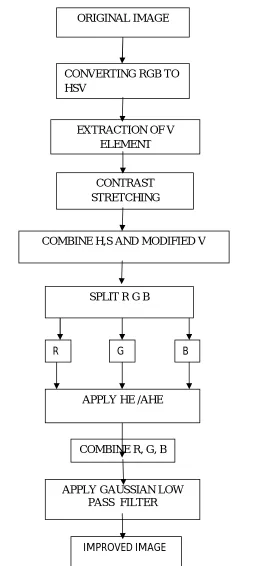
Firstly an under water image is separated into R(Red),G(Green), and B(Blue) components and is convereted into HSV color space. Secondly extension of V element is coordinated under the control of the start and end of the interval and apply contrast stretching . Then ,it is converted from HSV color space to RGB color space and the histogram, adaptive histogram equalization techniques are applied to each R,G,B components.
After that R,G,B components are combined to form a color image. Finally ,Gaussian low pass filter is applied to the under water image.
III. IMAGE ENHANCEMENT PROPOSED METHODS:
A. HSV Color System
When humans view a color object, we describe it by its hue , saturation , brightness .The hue is a color attribute that describes a pure color. Saturation gives a measure of the degree to which a pure color is diluated by white light. Value is the colorfulness is at maximum for the color defined by the Hue. HSV was created in 1978. The Hue saturation value (HSV) color space is more commonly used color system which has the ability seperating between color and intensity. HSV can rebuild images better than the RGB color space does HSV color system has a conical form. Hue is the color type such as red, green, blue components to be in the range [0:1] the value V is computed by taking the maximum value of RGB.
V=max[R,G,B]
Saturation S=V-min(R,G,B)/v
Red is at 0(zero) degree ,green is at 120 degree and blue is at 240 degree. The maximum RGB color controls. The starting point
Rl=V-R/v-min(R,G,B) ………..eq(3)
Gl=V-G/v-min(R,G,B) …………eq(4)
B1=V-B/v-min(R,G,B) …………eq(5)
r= , g= , b= ……….eq(6)
………eq(7)
………eq(8)
…………eq(9)
V ………eq(10)
.
Fig (3) The block Diagram of proposed method Value layer(V) is almost synonymous with brightness.
The close link between the original image and the layer valve means that the valves match the original birth image with the counter
parts on the 5th layer.
The method uses only the HSV color space that the 5th element expands, preserving chromatic details such as Hue and saturations.
ORIGINAL IMAGE
CONVERTING RGB TO HSV
EXTRACTION OF V ELEMENT
CONTRAST STRETCHING
COMBINE H,S AND MODIFIED V
SPLIT R G B
R G B
APPLY HE /AHE
COMBINE R, G, B
APPLY GAUSSIAN LOW PASS FILTER
[image:4.612.122.392.74.640.2]B. Contrast Stretching
Contrast of an image defines the ability distinguish the objects present in the image scattering phenomenon of light causes light rays to disperse in water which leads to decrease in the amount of light striking on the objects under the sea. This results in attenuation of light which does not allow the viewer to accurately identify and differentiate between the objects underwater. Hence the contrast of the image which marks the existence of various objects in an image it’s decreased to a great level. Therefore we have Used contrast stretching method to improve the contrast to better level. In this method the range of intensity values of the pixels is stretched (or) expanded to a desired range. Pout=(pin-c) (b-a÷d-c) +a A, b =lower and upper limits of a pixel C, d=corresponds to the min and max pixel value present in the image.
C. Histogram
The histogram of a digital image is a distribution of its intensity levels in the range [0,L-1]. The distribution is a discrete function h associating to each intensity level rk the number of pixel with this intensity : nk
Transformation of histogram
1) Normalization: It is a technique consisting into transforming the discrete distribution of intensifies number of pixel. Because of digital image is a SRT of discrete values that could be seen as a matrix and its equivalent to divide each nk by the dimension of the array which is the product of the width by the length of the image.
nkn=nk/length×width
………..equ(11)
2) Equalization: Histogram equalization is a method to process images in order to adjust the contrast of an image by modifying the intensity distribution of the histogram. The objective of this technique is to give a linear trend to the cumulative probability function associated to the image. Histogram equalization relies on the use of CDF .
D. Adapative Histogram Equaluization
AHE improve on this by transforming each pixel with a transformation function derived from a neighbourhood region. It was first developed for use in aircraft ,cock pit display.
This technique used to improve contrast in images. It differ from ordinary histogram equalization in respect to that the adaptive method computes several histograms. each corresponding to a distinct section of the image and uses them to redistribute the lightness value of the image. Because the image contains regions that are significantly lighter (or) darker then most of the images. It is therefore suitable for improving the local contrast and enhancing the definition of the each region of an image. It improves the local contrast and enhancing the definition on edges in each region of an image. It has a tendency to over amplify noise in relatively homogeneous regions of an image. The derivation of the transformation of AHE is same as the ordinary histogram equalization. i,e transformation function is proportional to the cumulative distribution function of pixel value in neighbourhood Pixel near the image boundary have to be treat specially because their neighbourhood couldn't lie completely within the image. The size of the neighbourhood region is a parameter of the Method.It constitutes a characteristics length scale. At smaller scale is enhanced, while contrast at larger scales as reduced.
Here again AHE is classified into two types
1) Contrast limited AHE.
2) Sliding window AHE.
E. Gaussian Low Pass Filter
This method is used to reduce image noise and reduce in details. A low pass filter are usually used for smoothing. The filter transfer function for Gaussian low pass filter is given by.
………..eq(12) Do=cut off frequency a specific non negative number
D(u, v) =distance from point (u, v) to the center of the filter H(u, v) =transfer function General formula for filtering G(u, v) =F(u, v). H(u, v)
IV. EXPERIMENTAL RESULTS
The work is executed on MATLAB Software with various images. Taken from the internet source. First the different Histogram based techniques mentioned in the previous section are applied to the images and then the performance of Histogram based techniques are Analyzed . There is no doubt that the image processing is a source of thr most important sources of scientific impact in many sciences team. Our proposal scheme aims to achieve a good balance among the missing elements of the under water image. In this paper, we have used algorithm both on RGB and HSV color. The novel algorithm had been implemented in MATLAB. Tested our algorithm for many different foggy and hazy from underwater images to a great extent. This work is executed on MATLAB Software and various images. First the different Histogram/AHE based techniques mentioned in the previous section are applied to the imaged and then various proposed methods are applied and got the perfect result.
INPUT IMAGE (1) AFTER HE AFTER FILTERING
INPUT IMAGE (2) AFTER HE AFTER FILTERING
INPUT IMAGE(3) AFTER HE AFTER FILTERING
INPUT IMAGE(1) AFTER AHE AFTER FILTERING
INPUT IMAGE(2) AFTER AHE AFTER FILTERING
INPUT IMAGE(3) AFTER AHE AFTER FILTERING
V. CONCLUSION
Underwater image haze removal techniques have a very significant role in improving the quality and contrast of underwater images. Most of the existing techniques remove haze to a good extent but low contrast, darkness after haze removal and uneven illumination etc. problems still exist.
The proposed method focuses to develop to improve underwater image without spending a lot a time and effort. The main aim of this paper is to offer an easy approach which contains the HSV color space with extension of V component and Histogram and Adaptive Histogram equalization.
The comparative analysis has shown that the proposed technique has better results than existing technique on the basis of results of visual analysis and performance metrics.
REFERENCES
[1] SK.Y MuneerAhamed, Bharat Kumar.M, NarasihaRao.J, ShowriBabu.N, Munwar Ali Shaik. “An Improved Underwater Image Enhancement Technique”,2018.
[2] R. C. Gonzalez and R. E. Woods. “Digital Image Processing”. 3rd ed. Prentice Hall, 2002.
[3] Abdul Ghani, A.S., Mat Isa, N.A., 2015. Enhancement of low quality underwater image through integrated global and local contrast correction. Appl. Soft Comput. 37, 332–344.
[4] 4.A.A. Yassin, R.M. Ghadban, S.F. Saleh, and H.Z Neima, “Using Discrete Wavelet Transformation to Enhance Underwater Image”, International Journal of Computer Science Issues, 10, (5), 2, pp. 220-228, 2013.
[5] 5.Pooja Sahu,Neelesh Gupta and neetu Sharma, “ A Survey on Underwater Image Enhancement Techniques”, Volume 87 – No.13, February 2014.
[6] Shamsudin, N., Ahmad, W.F.W., Baharudin, B., Rajuddin, M.K.M., Mohd, F., 2012. Significance level of image enhancement techniques for underwater images. In: International Conference on Computer & Information Sciences (ICCIS), 12–14 June 2012, Kuala Lumpur, vol. 1, pp. 490–494.
[7] A..A. Yassin, R.M. Ghadban, S.F. Saleh, and H.Z Neima, “Using Discrete Wavelet Transformation to Enhance Underwater Image”,International Journal of Computer Science Issues, 10, (5), 2, pp. 220-228, 2013.
[8] T. Kaur, R.K. Sidhu, “Performance Evaluation of Fuzzy and Histogram Based Color Image Enhancement”, VisionNet’15, Procedia Computer Science, 58, pp. 470 – 477, 2015.
[9] J.-Y. Chiang, Y-C. Chen, and Y-F. Chen, “Underwater Image Enhancement: Using Wavelength Compensation and Image Dehazing”, J. Blanc-Talon et al. (Eds.): ACIVS 2011, LNCS 6915, pp. 372–383, 2011.
AUTHORS
ADILAKSHMI DASARI is presently studying final year B.tech in Electronics and Communication engineering ESWAR college of engineering Narasaraopet, Andhra Pradesh ,India. ADILAKSHMI DASARI research interests include Digital Signal Processing and Digital image processing.
Image Processing. ANURADHA THUMU is presently studying final year B.tech in Electronics and Communication engineering
in ESWAR college of engineering Narasaraopet, Andhra Pradesh ,India. ANURADHA THUMU research interests in Digital Signal Processing and Digital Image Processing.
ESWARAMMA MAILA is presently studying final year B.tech in Electronics and Communication engineering in ESWAR college of engineering Narasaraopet, Andhra Pradesh ,India. ESWARAMMA MAILA research interests include Digital Signal Processing and Digital image processing.
MEENAKSHI MEGHAVATHU is presently studying final year B.tech in Electronics and Communication engineering in ESWAR college of engineering Narasaraopet, Andhra Pradesh ,India. MEENAKSHI MEGHAVATHU research interests include Digital Signal Processing and Digital image processing.