A Two-surface Discrete Sliding Mode Control based
on Approach Angle Reaching Law
Rinu Alice Koshy, Susy Thomas
Abstract-- Sliding mode controllers are known to be robust to parameter changes, disturbances and uncertainties. In this paper a novel discrete time sliding mode controller with two surfaces is proposed to improve the speed of response. Here, approach angle reaching law is used to take the trajectory to the surfaces. The advantage is that the system trajectory is bought to the first surface with maximum velocity thereby shortening the reaching phase. The scheme assures robustness, asymptotic stability and fast transients with minimum chattering.
Index Terms-- Discrete Sliding mode control, two surface sliding mode control, Approach angle, Chattering, Asymptotic Stability
I.
I
NTRODUCTIONHE core of variable structure control system is its sliding mode. Variable structure control, which provides the robust stability, is an area that has attracted much research interest. With the computer technology being widely applied in control field, the discrete variable structure control has attained wide popularity.
It is well known that Discrete-time VSC has properties that are quite different from the continuous-time VSC, because of the finite sampling time. In discrete-time systems, the control input is updated at a sampling instant, and is unchanged until the next sampling instant
.
Therefore, the control input cannot be changed at the very instant when the system motion crosses the sliding surface. For this reason, it is not easy to maintain ideal sliding mode motion. Since the invariance and robustness properties of VSC are satisfied only in sliding mode, these desirable properties may not be maintained in DVSC. Furuta proposed a variable structure algorithm which drives the system state to an appropriately determined sector in state space [3].Manuscript received on December 08, 2011
1.Rinu Alice Koshy, Research scholar, Electrical Engineering Department, National Institute of Technology Calicut, India/Assistant Professor ,Rajagiri School of Engineering ,Cochin, India(phone no.09895055233,e.mail: [email protected])
2. Dr. Susy Thomas, Professor, Electrical Engineering Department, National Institute of Technology Calicut, Kerala, India(e.mail: [email protected])
In 1990 GAO had presented the reaching law method to design the controller, and extended the same to discrete time counter part [1], [2].
In the reaching law approach, switching function dynamics satisfying the reaching condition is chosen, and then the control input is derived from the inverse dynamics. Therefore, in this approach, the determination of the control law is simple. Also, the control input derived has a property to make the switching function stable by choosing the design parameters to satisfy the reaching condition. But there exist deficiencies like, the reaching law cannot finally keep the system stable at the origin, and the chattering character of the system is one of the major drawbacks due to the discontinuous switching control which excites the unmodelled high frequency dynamics of the system [2],[4].
In this paper, an improved two surface discrete sliding mode control using approach angle reaching law is presented. In Approach angle methodology the trajectory is forced on to the chosen switching surface by the reaching control law for which the reaching angle is generally small. The direct implication of this constraint is that reaching phase is increased. This in turn affects the robustness of the control system. In the proposed method we define two surfaces where, the first surface is a virtual surface that aids the fast motion of the trajectory on to its final destination. The motion from this to the second one is then effected by the approach angle reaching law with small approach angle to avoid chattering. This sliding mode motion then guarantees that the system state is bounded under the existence of time varying disturbance and uncertainty. The paper is organized as follows. In section II, the some concepts of reaching law is revealed. In section III, the approach angle reaching law is explained in detail. In section IV a simulation example is given to compare the performance of approach angle based two surface sliding mode controllers with that of single surface sliding mode controllers. In section V, conclusion is given.
II .
C
ONCEPTSComparing with continuous-time control system, the properties, the existence conditions and the reaching conditions of the sliding mode in discrete-time variable structure control will be changed because of the existence of sampling process [1]. Theoretically, DSMC systems cannot be obtained from their continuous counterpart by means of simple equivalence [11].
The desired state trajectory of DVSC system should have following attributes [8].
A1) Starting from any initial state, the trajectory will move monotonically towards the switching plane and cross it in finite time.
A2) Once the trajectory has crossed the switching plane the first time, it will cross the plane again in every successive sampling period, resulting in a zigzag motion about the switching plane.
A3) The size of each successive zigzagging step should be non increasing and the trajectory stays within a specified band. GAO gave the complete definition for the quasi-sliding mode in discrete-time system and presented a reaching condition in form of equation given below, that is the exponential reaching law [5],[8].
( 1) (1 ) ( ) sgn ( )
s k qT s k T s k ... (1)
where T is the sampling period, ε is the reaching rate, and q is the approximation rate.
q>0, ε>0 ,(1-qT) >0.
The inequality for T must hold to guarantee attribute Al, which implies that the choice of T is restricted.
The signum term guarantees attributes A2 and A3. Reaching law approach has the following merits
:
i) A desirable reaching mode response can be achieved by the proper choice of parameters ε and q.
ii) The width of the quasi-sliding mode band (QSMB) can conveniently be calculated.
iii) The effect of T on the VSC system can be evaluated since it contains T as one of the parameters.
iv
) The determination of the control law based on reaching law is simple. The equality form of the reaching law leads to a control law, which is also in equality form.There were some shortages for the exponential reaching law namely the system states do not guarantee convergence to the origin and sometimes the limit loop could be formed in vicinity of origin. In order to avoid the above drawbacks, a new reaching law
(
1)
( )
( ) sgn ( )
s k
s k
T x k
s k
………..(2) was tried near the vicinity of the origin, which would allow the trajectory to converge to the origin [1],[9].This method also had some shortages regarding the determination of switching time and the input will be blown up when the two reaching laws are switched.Thus new reaching laws were introduced [1],[9] some of which are
2
| ( )| 2
(
1) (1
) ( )
|| ||
(
1) (1
) ( )
( )sgn ( )
(
1) (1
) ( )
s k( )sgn ( )
s k
qT s k
Tarctg x
s k
qT s k
Ts k
s k
s k
qT s k
Te
s k
s k
Each one of the reaching laws had its own merits and demerits. In all the reaching law methods, either the distance to the surface or to the origin is considered. The approach angle reaching law was introduced, to make the design of control input more comprehensive [1]. This method had reduced the switching problem between the reaching laws.
Moreover stability and convergence to origin was guaranteed, but with chattering.
In this paper a two surface sliding mode approach is adopted. From the initial condition, the trajectory can be brought to the first virtual surface with maximum velocity and from where the trajectory is forced onto its destined sliding mode region by approach angle reaching law. This method guarantees asymptotic convergence to the origin, less chattering and improved speed of response.
III.
APPROACH ANGLE REACHING LAW
Consider a single input linear discrete-time system
x(k +1) = Ax(k) + Bu(k)
where the state vector x(k) є Rn , scalar u(k) is control input,
rank(B) = 1.The index k indicates the kth sample We assume (A,B) is a controllable pair.
Choosing the switching function
s(k) = Cx(k)
Approach angle θ is the angle between sliding surface and the trajectory Fig.1
Considering the approach angle [1] the reaching law is ( 1) (1 ) | cos | ( ) || || sgn ( )
s k qT s k Tarctg x s k …………(3)
and 1
( ) ( ) [ ( ) (1 ) | cos | ( ) || || sgn ( )]
u k CB CAx k qT s k
Tarctg x s k
Lemma 1: The reaching law (3) can guarantee the system trajectories to converge to the origin
Proof:
(
1) (1
) | cos | ( )
|| || sgn ( )
s k
qT
s k
Tarctg x
s k
|| || ( 1) (1 ) | cos | ( )
|| ( ) || ( 1) ( )
Tarctg x
s k qT s k
s k
s k s k
only when β is less than 1 the system trajectory is convergent to the origin.
If || ( ) || (2 ) | cos ||| ||
( 1) | cos | ( )
Tarctg x s k
qT
s k s k
If θ is small cos θ≈ 1 s(k+1)=-s(k), which implies s(k+1) < s(k) and the trajectory enter into the equiamplitude
vibration movement, with comparatively less control effort.
Lemma 2: By the controller designed by approach angle based
reaching law
( 1) (1 ) | cos | ( ) || || sgn ( )
s k qT s k Tarctg x s k , the state
trajectories can be driven to the switching surface s(k)=0 in finite time and can be maintained there all the time.
Proof:
( 1) (1 ) | cos | ( ) || || sgn ( ) ( 1) ( ) | cos | ( ) || || sgn ( ) ( 1) ( ) ( )
0
( ) ( ) || || sgn ( )
s k qT s k Tarctg x s k
s k s k qT s k Tarctg x s k
s k s k s k
if
s k qTs k Tarctg x s k
( ) 0
( ) 0
lim
( ) 0
lim
( ) 0
s k s k
s k
s k
if θ = 90º
( ) 0
( ) 0
( ) || || sgn ( ) lim ( ) 0
lim ( ) 0 s k
s k
s k Tarctg x s k
s k s k
Therefore for any angle between 0º and 90º the trajectory can be driven to the switching surface s(k)=0 in finite time. But from Theorem 1, it is evident that only if θ is small the trajectories enter into equiamplitude vibration. Also excessive chattering is caused by state approach angle, θ, being very large in magnitude as it nears the sliding surface [4].
IV. SIMULATION Consider a second order system x(k+1) =Ax(k)+Bu(k). T=0.001s, q =30 ε = 0.05
In order to compare the simulation results the example in [1] is taken. All the simulation is carried out with the same initial state. A sliding mode controller was designed with i) GAO’s reaching law ii) approach angle based reaching law,
iii) a two surface sliding mode controller was designed with approach angle based reaching law. A comparison is done between approach angle based reaching law and proposed method when disturbance and uncertainty is considered. A disturbance d =[0.004;cos(k/(0.009*pi)]
and uncertainty
is considered for simulation.
The simulation results are as follows
:
i) GAO’s reaching law
Fig.3. x1 vs x2 0.05 0.003
0.001 0.06
A
Fig.4. s vs time
Fig.5. u vs time
Fig.6. x1,x2 vs time
ii) Approach angle reaching law
Fig.8. x1 vs x2
Fig.9.s vs time
Fig.10.. u vs time
Fig.12.x1 vs x2 (with disturbance) Chattering is observed near the origin
Fig.13.x1 vs x2(with uncertainty)
[image:5.595.321.538.66.659.2]iii) Two surface method
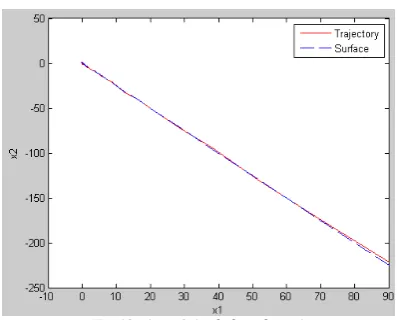
Fig.14.x1 vs x2
Fig 15.u vs time
Fig.16. x1,x2 vs time
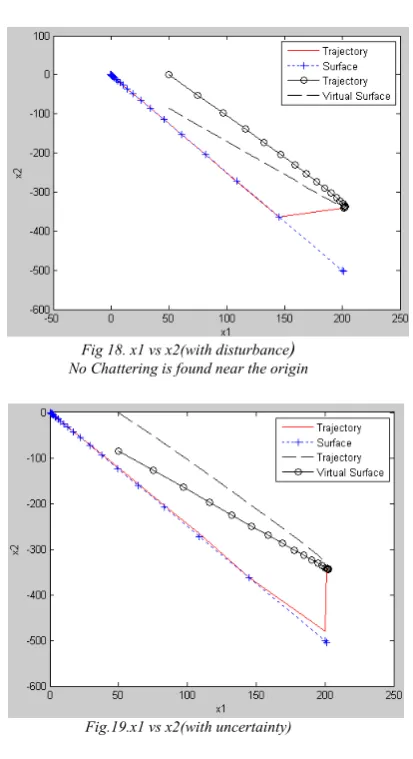
[image:5.595.69.268.80.240.2] [image:5.595.69.266.478.644.2]Fig 18. x1 vs x2(with disturbance)
No Chattering is found near the origin
[image:6.595.74.281.71.451.2]Fig.19.x1 vs x2(with uncertainty)
V. CONCLUSION
In this paper, a reaching law based two-surface sliding mode controller was designed to reduce the reaching phase and chattering. Figures 3-7 shows the simulation results using GAO’S reaching law and figures 9-13 shows the simulation using Approach angle reaching law with one surface. Figures 14-19 shows simulation results conducted assuming a virtual surface on which the trajectory is initially brought and then taken to the sliding surface by approach angle reaching law. On comparing the three simulations the method proposed in this paper is capable of reducing chattering and allowing more time on the sliding manifold. The strategy guarantees faster transient response .The method assures invariance to disturbance and uncertainty. On comparing Fig 7(GAO’s reaching law) and Fig.12,13(Approach angle based reaching law) with Fig.18,19 (two surface DSMC) reveals the improved invariance property of the proposed method.
REFERENCES
[1] Yang Ling Ling ,Zhang Yun “Approach angle based reaching law for discrete time variable structure control system” Proceedings of the 7th Asian control Conference,
Hongkong August27-29 2009.
[2] C.Vivekanandan, R.Prabhakar “Redefined Quasi Sliding Mode Control Strategy” World Academy of Science , Engineering and Technology 2008.
[3] Andrezej Bartoszewicz, “ A new reaching law for discrete-time variable structure sytems” Proceedings of the 36th Conference on Decision and control December ,1997.
[4] Kenneth R Buckholtz, “Approach angle based switching function for sliding mode control Design”Proceedings of the American Control conference , May ,2002..
[5] Charles J. Fallaha, Maarouf Saad “Sliding-Mode Robot Control With Exponential Reaching Law” IEEE Industrial Electronics, Vol. 58, No. 2, February 2011.
[6] Shibin Su, Heng Wang, Hua Zhang “Reducing Chattering Using Adaptive Exponential Reaching Law” 2010 Sixth International Conference on Natural Computation (ICNC 2010)
[7] Asif Sabanovic, “Variable Structure Systems With Sliding Modes in Motion Control—A Survey” IEEE Transactions on Industrial Informatics.
[8] W.Gao, Yufu Wang “Discrete –Time variable structure control systems” IEEE Transactions on Industrial Electronics Vol.42, April 1995.
[9] Y.Zheng,Y.W.Jing,G.H.Yang, “Design of approximation law for Discrete time variable structure control systems”
Proc.45th IEEE. Conf. Decision Control San Diego ,2006
[10] S. Z. Sarpturk, Y. Istefanopulos, and 0. Kaynak, “On the stability of discrete-time sliding mode control systems,”
IEEE Trans. Automat.Contr., vol. 32, no. 10, pp. 930-932, 1987.