License Plate Detection Using Raspberry Pi
Naveen A M
1, N Darshan
2, Manoj B
3, Praveen Kumar N
4, Shruthi P
51, 2, 3, 4
Global Academy of Technology, Bangalore.
Abstract: License plate Detection (LPD) is the technology for identification of license plate numbers from an image without human interaction using Raspberry pi. Image processing field has been improved in recent years using various technologies, one of them is OpenCV technology and it in an open source computer vision image processing library and can work on multiple free platforms. The aim of the study is to develop a system using Raspberry pi and OCR to detect the license plate of the vehicle parked in the no parking area and to send a warning message along with fine details to the owner of the vehicle.
Keywords: Raspberry pi, Open CV, OCR (optical character recognition), Image processing.
I. INTRODUCTION
Automobiles are one of the essential parts of our life and are increasing day by day. Managing vehicles in parking and non-parking area becomes difficult. So, to reduce the problems of vehicle in no parking area, necessitates for developing a system to automatically detect, extract and recognize the characters of the license plate of vehicles found in no parking zone. License plate detection makes a small contribution by developing a smart application to detect the vehicles parked in non- parking zone. The whole license plate detection system is implemented on a Raspberry Pi. License plate detection is a technology based on image processing and optical character recognition. License Plate Detection system involves three main steps. First step is to capture the image and localize plate in the image. Second, Extraction of the region containing the license plate and lastly recognizing the character within the plates and convert them to text which is called as optical character recognition (OCR). Most of the traditional license plate detection systems proposed have problems such as, handling different fonts, size of the plate, plate location in the image, indistinct picture, a lot of storage space is needed to store surveillance data and cost remains relatively high. Implementation of license plate detection on Raspberry Pi and cloud platform has given a new direction of research in the field of IOT.
II. LITERATURE REVIEW
Image processing field has been improved thanks to various technology in recent years. One of them is a very significant program OpenCV technology. OpenCV is an open source coded independent image processing library and can work on multiple free platforms. On the other hand, expect for image processing technology through Internet of Things (IOT) along with Industry 4.0 had very huge development in this field. There are hundreds of different devices which were developed for this area. One of these devices is the Raspberry PI tool. In this study, a platform for vehicle license plate tracking system which uses embedded system was developed. It has been aimed at making push notification for relevant units by comparing an image with image processing algorithm by means of camera, screen and GPRS module which were added on this developed system, Raspberry PI, with the current notifications [1].
A camera captures images of vehicles passing through toll booth thus a vehicle is detected through camera. Depending on the area occupied by the vehicle, classification of vehicles as light and heavy is done. Further this information is passed to the Raspberry pi which is having web server set up on it. When Raspberry Pi comes to know the vehicle, then it accesses the web server information and according to the type of the vehicle, appropriate toll is charged [2].
processing and neural networks techniques. In the proposed algorithm, the license plates are located by analyzing the regions with highest vertical edge density. Hough transformation and the affine transformation techniques are used to handle the skewed license plates. After extracting the license plate characters, a neural network is used to recognize those characters. The experimental results show that the proposed system can successfully detect and recognize all types of license plates in Sri Lanka and is suitable for real time implementation because of the lower execution time [4].
Electronic Toll Collection system developed in India to save the time by collecting the toll electronically instead of manually. In order to provide zero delay toll collection system, so many modern toll collection systems are used like RF Tags based toll collection system, Barcode Scanner based toll collection system, and number plate recognition-based toll collection system. As all the aforesaid systems are reliable, but still it’s not defined as system without human interaction. The smart toll collection system using embedded Linux environment. The whole system is balanced and focused to design and develop an entirely automated license plate recognition system which will be an excellent low-cost alternative to all other systems. The entire system is design using embedded Linux development board such as Raspberry Pi. The board is most suitable for Implementing Image processing algorithm. In the suggested system one webcam is interfaced with Raspberry Pi Board which is used to capture the image of vehicle’s license plate which will pass through the toll booth. These images of license plates are processed through Optical Character Recognition (OCR) engine such that image of license plate will be converted into equivalent ASCII characters. This extracted information will further send to the RTO server to identify the type of vehicle and owner of the vehicle. The retrieval information will once again send to the system through GSM module interfaced with Raspberry Pi. According to the type of the vehicle the nominal toll will be deducted from owner’s account. After receiving the notification message on registered mobile number of the owner about the deducted amount from owner’s registered account, the barrier will open and vehicle is allowed to leave the toll booth [5].
III. DESIGN OF THE SYSYTEM
[image:2.612.199.418.398.605.2]To design and develop cost effective smart application to extract and recognize license plate of car using raspberry pi, OpenCV and ABBYY OCR cloud.
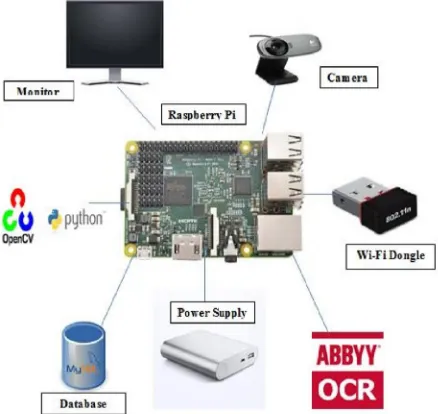
Figure 1: System Architecture of Proposed System.
The system architecture is as shown in above Figure 1. Raspberry pi 3 model B which is the third generation of raspberry pi is used. It has a micro SD card for booting and data storage, 4 USB ports, 1 HDMI port for display connection, 110/100 Mbit/s Ethernet port for LAN connection.
Other peripherals include Passive Infrared Sensor (PIR) for motion detection, USB webcam to capture images, Power bank for power supply and Wi-Fi adapter to provide internet connection and remote access. Use of power bank and Wi-Fi adapter makes the system portable.
Raspberry Pi is configured with OpenCV and python for processing the captured image. Virtual environment for python is created to separate it from the system python and other applications and MYSQL database is configured to store the processed and extracted plate images. A warning message along with fine details is sent to owner of the vehicle.
[image:3.612.196.434.168.558.2]
IV. IMPLEMENTATION OF THE SYSTEM
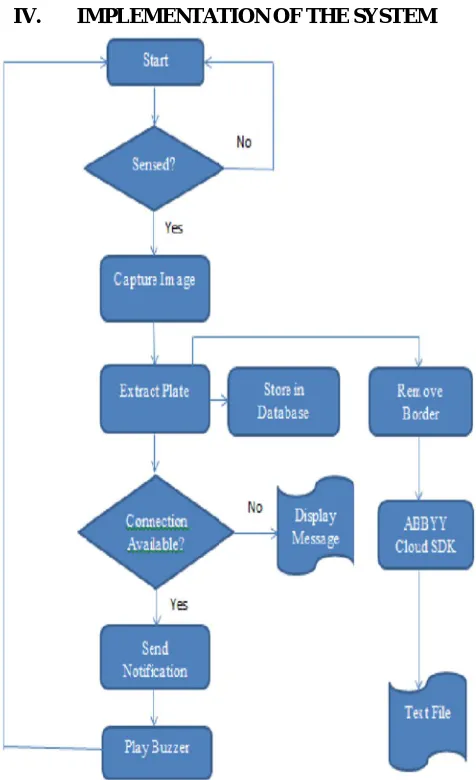
Figure 2: Flowchart of proposed system
System consists of 5 modules as follows:
1) Capture Image(): captures image through webcam and stores in specific directory
2) Extract Plate(): Extracts the license plate area from the captured image by applying OpenCV functions
3) Rmborder():Extracted plate obtained from ExtractPlate() function is processed to remove the unwanted border of the license plate. This function involves filtering using homomorphic filter followed by border removal through the use of contours. This function returns the license plate with white characters on the black background.
4) DBcompare(): Database compare in this function it compare the character obtained from the Rmborder() function with the database to get the details of the vehicle’s owner.
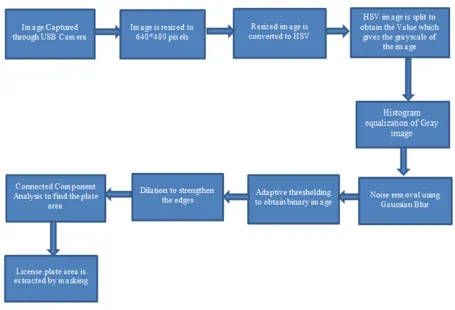
V. LICENSE PLATE DETECTION AND EXTRACTION Following steps are performed to extract the license plate from the captured image.
Figure 3: Steps of License Plate area Extraction.
The Figure 2 shows how the license plate area is extracted from the captured image. First the captured image in resigned to some required pixels and in converted to HSV (Hue, Saturation, Value). The HSV image is split into values to obtain grayscale image. Histogram equalization and noise removal are performed on the image. Adaptive thresholding is performed to obtain binary image. Dilation is performed to strengthen then edges and the license plate area is extracted using masking.
VI. RESULT
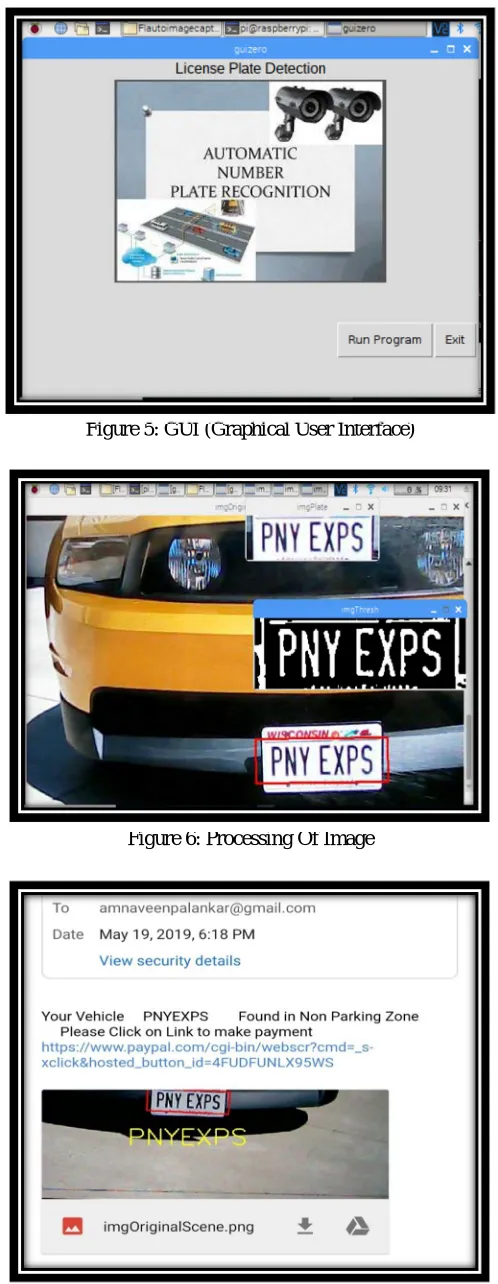
[image:4.612.183.426.517.703.2]Figure 5: GUI (Graphical User Interface)
[image:5.612.183.429.77.284.2]Figure 6: Processing Of Image
A. Along With Payment Link
In this paper Licence plate Detection is done by Raspberry pi as shown in figure 4, Image of the vehicle that is parked in non-parking zone is captured by the camera as shown in figure 5. Then image is sent for processing to extract the character from Licence Plate that is captured by image as shown in figure 6. Next character that is extracted is searched in database to obtain the details of the vehicle’s owner and send warning email along with the payment link as shown in figure 7.
VII. CONCLUSION
The License Plate Detection is a low-cost smart application is adopted for automatic license plate recognition system using IOT and cloud technology. The use of IOT and cloud technologies to recognize the characters of the license plate using Raspberry Pi system. OCR cloud is used for optical character recognition. The license plate detection technique uses the camera in the no parking area that captures the images of the vehicle and identifies the license plate of the vehicle and sends email and message regarding the fine details to the owner of the vehicle.
REFERENCES
[1] Suryatali, V. Dharmadhikari, “Computer Vision Based Vehicle Detection for Toll Collection System Using Embedded Linux”, ICCPCT, 2015 [2] A.Wijetunge and D. Ratnaweera, “Real-Time Recognition of License Plates of MovingVehicles in Sri Lanka”, ICIIS,2011, pp. 82-87 [3] S. Ramiah, T. Liong, M. Jayabalan,” Detecting Text Based Image with Optical Character Recognition for
English Translation and Speech using Android”, SCOReD, 2015, pp. 272-277
[4] Radhika S.Dangare, Prof. G.D.Dalvi “Automatic Number plate Recognition for in different countries using Raspberry pi” Volume 5 Issue 11,November 2016 [5] Emrah’s, Bornan, “Vehicle Plate Tracking System”, IEEE 2018, P-80404648.
[6] http://www.pyimagesearch.com/2015/07/20/install-op encv-3-0-and-python-3-4-on-ubuntu.