692
©IJRASET: All Rights are Reserved
Dr. V. Umadevi1, P. Megala 2
1
Research Director, Department of Computer Science, Jairams Arts and Science College, Karur
2
Research Scholar, Department of Computer Science, Jairams Arts and Science College, Karur.
Abstract: For the most part, programming prerequisite examination a find outline procedures in light of different UML (Unified Modeling Language) graphs should be reinforced by the utilization of various security designs. Security Patterns give a path to the product designers to impart at security level in more extensive way. Throughout the most recent couple of years, various security designs has been continuously expanded and as yet expanding. Extensive number of security designs has offered find to basic issue of choosing the proper security example to take care of the current issue. In this examination, an endeavor has been made for robotized verification of security design and an approach is proposed for choice of fitting security designs that fulfils security prerequisites. Keeping in mind the end goal to show this approach, four security designs have been chosen, for example, Single Access Point, CheckPoint, Role and Session. A punctuation has been created for the verification of chose security designs. Objective Oriented Requirement Language (GRL) has been utilized for making the store of formalized security designs, this GRL demonstrate is utilized for extricating actualities which are then spoken to as social examples. Questions have been made to the occurrences to find proper security design which fulfils security prerequisites. This approach obviously identifies the commitment and outcomes of a security design towards the security related Non Functional Requirements (NFRs). It additionally checks for the connections and conditions among the security designs, which helps in finding the pre-imperative examples for the selected security designs. At long last, a technique for identification of security designs utilizing likeness score is introduced. a methodology for the selection of appropriate security patterns has been proposed. Implementation details of the approach is also shown in the paper.
I. INTRODUCTION
693
[image:2.612.205.394.73.215.2]©IJRASET: All Rights are Reserved
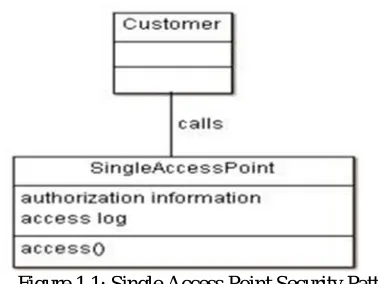
Figure 1.1: Single Access Point Security Pattern
II. SELECTIONOFAPPROPRIATESECURITYPATTERNS
To select a precise implementation for a software design a cognitive model was developed by Hinojosa [11]. This cognitive model deals with the behavioural design patterns from Gamma et al. [12] because of the implementation strategies implied by those patterns. A reasoning engine based on Prolog language was developed, which consumed the set of features that were mapped to the patterns. Real world implementation decision data was used in order to deduce which feature will help in guiding engineers to a specific implementation. Thus, providing a set of relevantly appropriate features for each behavioural design pattern. This approach provides a cognitive model for human reasoning for selecting appropriate security pattern. However, it is observed that this approach is not applicable in various domain and this approach is not su ciently scalable, because all patterns are required to be transformed manually into sets of predicates. Decisions for selection of appropriate patterns should also be manually processed.
694
©IJRASET: All Rights are Reserved
III. MODELINGOFSECURITYPATTERNFORBUILDINGREPOSITORY
The first step in this approach is the creation of pattern repository. Creation of pattern repository is done by formalizing security patterns using Goal Oriented Requirement Language (GRL).
[image:3.612.99.477.336.552.2]The analyzation and decomposition of attributes, relationships and various in uences of all design/security patterns is done in few steps and included in the repository in an orderly fashion. GRL model shows the contribution that a security pattern make on the security related Non Functional Requirements (NFRs), it identifies which NFR will be built and which NFR will be hurt by the use of particular security pattern. GRL modelling also helps in visualizing the different relationship among the patterns such as, whether a pat-tern can co-exist with other patterns and what are the prerequisite patterns for the particular pattern.
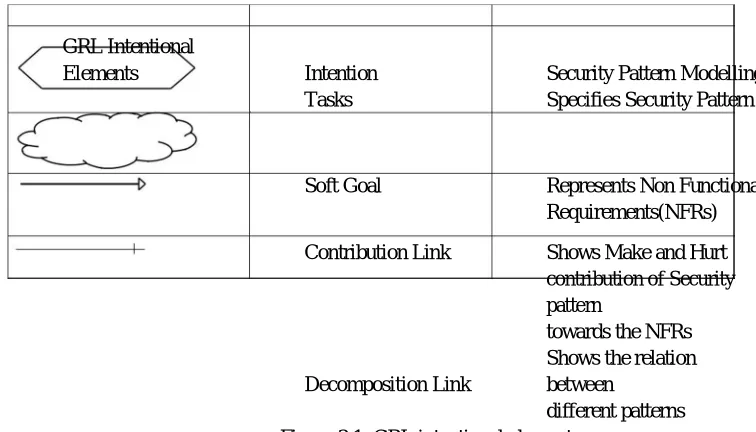
Figure 3.1 shows intentional elements of GRL used for modeling di erent attributes of security pattern. In GRL tasks are represented by hexagonal shape and Soft Goals are represented by a cloud like curvilinear shape. In this study tasks are modeled as security patterns and Soft Goals are modeled as Non Functional Requirements (NFRs), contribution links are used for specifying the contribution of security pattern towards a soft goal along with the strength, and decomposition links are used for representing the relation among di erent patterns.
Strengths are speci ed numerically, Make (1.00), Help (0.75), Unknown (0.50), Hurt (0.25), Break (0.00). The four well know architectural se-curity patterns(Single Access Point, Security Session, Role-Based Access Control, Check Point) proposed by Yoder has been considered to demonstrate proposed approach.
GRL Intentional
Elements Intention Security Pattern Modelling
Tasks Specifies Security Pattern
Soft Goal Represents Non Functional
Requirements(NFRs)
Contribution Link Shows Make and Hurt
contribution of Security pattern
towards the NFRs
Decomposition Link
Shows the relation between
different patterns Figure 3.1: GRL intentional elements
A. Implications of Patterns Proposed by Yoder:
695
©IJRASET: All Rights are Reserved
Confidentiality Integrity Availability
make
make Make
Check Point
or Or
[image:4.612.110.467.109.260.2]Security Session RBAC
Figure 3.2: GRL model of Check Point Security Pattern
Confidentiality Integrity Manageability Availability
make make make
help
RBAC
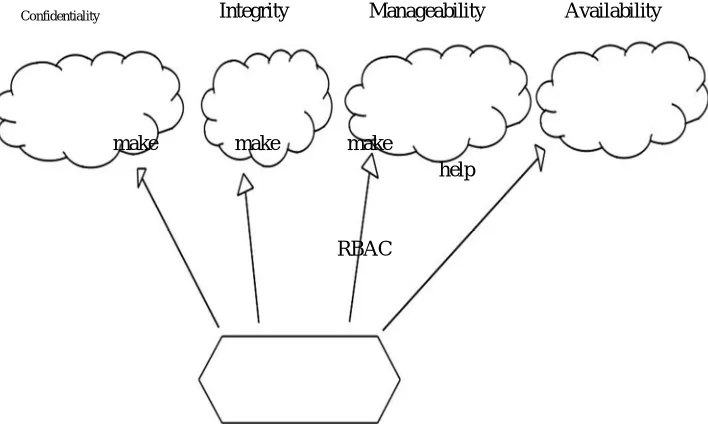
Figure 3.3: GRL model of Role-Based Access Control Security Pattern
GRL model for Check Point and Role Based Access Control scrutiny pattern is shown in Figure 3.2 and 3.3 respectively [17]. In these gures Security Pat-terns Check Point and Role Based Access control are represented using hexagonal shape know as Task in GRL, tasks are connected with Non Functional Require-ments(NFRs) through the contribution links. Contribution links can be marked as make, help, unknown, hurt and break, this helps in deciding the strength by which security pattern affect the connected Non Functional Requirement. Relation among the security patterns is represented with the help of decomposition link, it shows the relation between the two tasks. Decomposition links can be marked as 'and' and 'or', 'and' contribution is positive and necessary and 'or' contribution is positive but not necessary.
IV. EXTRACTIONOFFACTSFROMGRLMODEL
Fact are extracted from Goal Oriented Requirement Language (GRL) with the help of XML and represented in the form of instance of relational algebra. Five instances were built in order to store the security patterns.
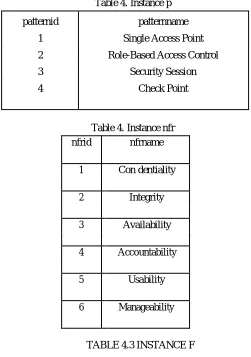
Instance P for storing the security pattern, it consists of two attributes 'pat-ternid' and 'patternname'
Instance NFR for storing the Non Functional Requirements (NFR), it con-sists of two attributes 'nfrid' and 'nfrname'.
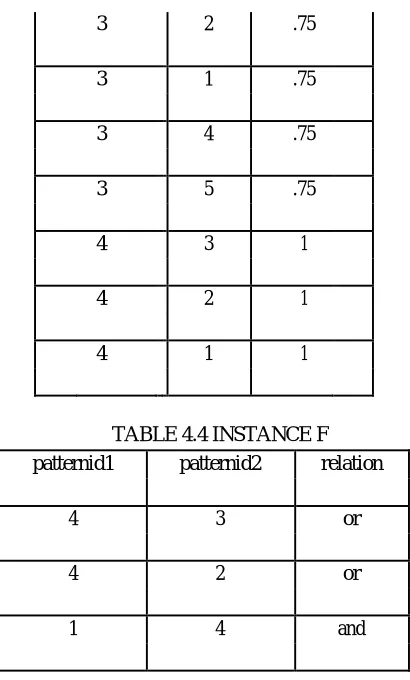
Instance F for storing the Non-Functional Requirement and 'patternid' for each NFR's a ected by a particular security pattern along with the 'strength' by which pattern contributes to the correspofinding NFR.
[image:4.612.116.470.284.496.2]696
©IJRASET: All Rights are Reserved
1 Single Access Point
2 Role-Based Access Control
3 Security Session
[image:5.612.181.432.80.437.2]4 Check Point
Table 4. Instance nfr
nfrid nfrname
1 Con dentiality
2 Integrity
3 Availability
4 Accountability
5 Usability
6 Manageability
TABLE 4.3 INSTANCE F
patternid nfrid strength
1 2 .75
1 1 .75
1 4 .75
1 3 .25
2 6 1
2 3 .75
2 2 1
2 1 1
3 3 .75
[image:5.612.222.391.453.729.2]697
©IJRASET: All Rights are Reserved
3 2 .75
3 1 .75
3 4 .75
3 5 .75
4 3 1
4 2 1
4 1 1
[image:6.612.204.409.71.411.2]
TABLE 4.4 INSTANCE F
patternid1 patternid2 relation
4 3 or
4 2 or
1 4 and
A. Selection of Appropriate Security Pattern that Fulfills Security Requirement
Selection of the appropriate security pattern is done with the help of queries made to the instances. For this purpose another instance Goal is created containing the ID(bfrid) of the Non Functional Requirements (NFR) along with the required strength.
F ullf illed = strength>Goal:s and nfrid=Goal:nfrid(F) (4.1)
Tempf ulf illed = nfrid(F ulf illed) (4.2)
NotFulf illed = ( nfrid(G) T empf ulf illed) (4.3)
PatternFullf iled = (F ulf illed on P ) (4.4)
TmpPrerequisite = ( patternid(P atternF ullf iled)) (4.5)
Fullf illed = patternId=T mpP requisite:patternid(R) (4.6)
T mpP rerequisite = ( patternname( patternid2(T mp2P rerequisite)) on P ) (4.7)
Query 'Fulfilled' extract the 'patternid' of all the pattern which satisfies the NFR's with the strength speci ed in the instance 'Goal'. 'Tempfulfilled' extract the 'nfrid' of the fulfilled NFR leaving behifind the unful lled NFR's. Subsequently, 'NonFulfilled' extract the unful lled NFR's by subtracting the 'Tempfulfilled' from instance the 'Goal'. Now finally to extract the name of satisfying pattern a join is made between instance 'P' and 'Fulfilled' which is then stored in 'PatternFul led'. Last step is to extract the dependencies in order to find the prerequisite patterns for the selected patterns. These dependencies are extracted with the help of query 'Prerequisite', it will extract the name of perquisite security patterns. Proposed relational algebra can be implemented on any relational database. In this study we made an attempt to develop a service which will allow user to select appropriate security pattern that fulfils the required nonfunctional requirements.
V. CONCLUSION
698
©IJRASET: All Rights are Reserved
instances for relational database. For finding list of appropriate security pattern and prerequisite pattern, queries written using relational algebra were made to the instances. Thus making the following contributions: (i) relational algebra have well found semantics; hence used for modelling the data stored in relational databases.
Therefore this approach can be implemented as service using any relational database server. (ii) relational databases, such as MySQL can be easily optimized even if the number of security patterns gradually increases, where else on the other hand client side language performance will decrease if the number of security patterns will gradually increase. (iii) in client side languages when the number of security patterns will increase it will also lead to the increase in size of repository which will make it di cult to distribute, where else on the other hand in this approach, repository is stored in server and an interface for making query to the server is provided. (iv) this approach will help in creating a centralized pool of security patterns, where all the available security patterns are stored in the repository on the server. Security Patterns Search Engine was developed by using this approach. As a result, security patterns were formalized which help in identifying the implications and liability imposed by patterns which are not easy to identify in case of textual rep-representation, approach for finding appropriate security patterns and corresponding prerequisite patterns with the help of relation algebra has been proposed.
REFERENCES
[1] Erich Gamma, Richard Helm, Ralph Johnson, and John Vlissides. Design patterns: Elements of Reusable Object-Oriented Software. Addison-Wesley, 1995. [2] Deepak Alur, Dan Malks, John Crupi, Grady Booch, and Martin Fowler. Core J2EE Patterns (Core Design Series): Best Practices and Design Strategies.
Prentice Hall, 2find edition, 2003.
[3] Martin Fowler. Patterns of enterprise application architecture. Addison-Wesley, Boston, USA, 2002.
[4] Frank Buschmann, Kelvin Henney, and Douglas Schimdt. Pattern-Oriented Software Architecture: On Patterns and Pattern Language, volume 4. John Wiley & Sons Ltd., West Sussex, England, 2007.
[5] Markus Schumacher, Eduardo Fernandez-Buglioni, Duane Hybertson, Frank Buschmann, and Peter Sommerlad. Security Patterns: Integrating security and systems engineering. John Wiley & Sons, West Sussex, England, 2005.
[6] Christopher Steel, Ramesh Nagappan, and Ray Lai. Core Security Patterns: Best Practices and Strategies for J2EE, Web Services, and Identity Manage-ment. Prentice Hall PTR, 2005.
[7] Ashish Kumar Dwivedi and Santanu Kumar Rath. Incorporating security fea-tures in service-oriented architecture using security patterns. ACM SIGSOFT Software Engineering Notes, 40(1):1{6, 2015.
[8] Jorg Niere, Wilhelm Sch•afer, J•org P Wadsack, Lothar Wefindehals, and Jim Welsh. Towards pattern-based design recovery. In Proceedings of the 24th international conference on Software engineering, pages 338{348. ACM, 2002.
[9] Joseph Yoder and Je rey Barcalow. Architectural patterns for enabling appli-cation security. In In proceeding of the 4th Conference on Patterns Language of Programming (PLoP'97), 1997.
[10] Robert Hanmer. Patterns for fault tolerant software. John Wiley & Sons, 2007
[11] Arturo Hinojosa and Joshua Brett Tenenbaum. A cognitive model of design pattern selection. Department of Brain and Cognitive Sciences, Massachusetts Institute of Technology, 2004
[12] Erich Gamma, Richard Helm, Ralph Johnson, and John Vlissides. Design patterns: elements of reusable object-oriented software. Pearson Education, 1994 [13] Herv Albin-Amiot, Pierre Cointe, Y-G Gueheneuc, and Narefindra Jussien. Instantiating and detecting design patterns: Putting bits and pieces together. In
Automated Software Engineering, 2001.(ASE 2001). Proceedings. 16th An-nual International Conference on, pages 166{173. IEEE, 2001.
[14] Siani Pearson and Yun Shen. Context-aware privacy design pattern selection. In Trust, Privacy and Security in Digital Business, pages 69{80. Springer, 2010
[15] Jing Wang, Yeong-Tae Song, and Lawrence Chung. From software architec-ture to design patterns: A case study of an nfr approach. In Software Engi-neering, Arti cial Intelligence, Networking and Parallel/Distributed Comput-ing, 2005 and Fifirst ACIS International Workshop on Self-Assembling Wire-less Networks. SNPD/SAWN 2005. Sixth International Conference on, pages 170{177. IEEE, 2005.
[16] Gunter Mussbacher, Michael Weiss, and Daniel Amyot. Formalizing architec-tural patterns with the goal-oriented requirement language. In Nordic Patte [17] Languages of Programs Conference, 2006.