Master Degree Thesis
Alignment of an IT-based organisation
An implementation methodology based on RUP to create
multi-disciplinary and cross-medial project teams.
Wegener Dagbladen / TC Tubantia
Student
Michael Angelo Meyer (s0040509)
University of Twente Supervisors Dr. A.B.J.M. (Fons) Wijnhoven (MBI) Dr. E.M.A.G. (Betsy) van Dijk (EWI)
Wegener Dagbladen Supervisors G. Bastet (Director)
Table of Contents
Abstract...2
Executive summary... 2
1
Introduction ... 4
1.1
Problem description... 41.2
Implementation methodology ... 62
Research model ... 10
2.1
Theoretical model ...102.2
Practice ...123
Literature research ... 14
3.1
Method ...143.2
Business/marketing strategy ...153.3
Organisational infrastructure and processes...193.4
IT strategy...223.5
Information Technology infrastructure and processes...254
Action Research Method ... 30
4.1
What is action research? ...304.2
Research design ...325
Results ... 37
5.1
Pilot team 1 (sport)...375.1.1
Business/marketing strategy ...375.1.2
Organisational infrastructure and processes...385.1.3
IT strategy...385.1.4
IT infrastructure and processes...395.1.5
Conclusion ...415.1.6
Information validation ...415.2
Implementation methodology after the first iteration ...425.2.1
Guidelines...425.2.2
Techniques ...435.2.3
Tools...435.2.4
Templates...445.3
Pilot team 2 (culture and recreation) ...455.3.1
Business/marketing strategy ...465.3.2
Organisational infrastructure and processes...475.3.3
IT strategy...485.3.4
IT infrastructure and processes...495.3.5
Conclusion ...505.3.6
Information validation ...515.4
Implementation methodology after the second iteration ...515.4.1
Guidelines...515.4.2
Techniques ...525.4.3
Tools...535.4.4
Templates...545.5
Differences between pilot team 1 and pilot team 2 ...565.6
Alignment model representing both pilot teams...565.6.1
Alignment model for the whole organisation ...565.6.2
Alignment model for pilot team 1 ...575.6.3
Alignment model for pilot team 2 ...587
Conclusions ... 61
7.1
Usage recommendations ...617.2
General recommendations...617.3
General remarks ...627.4
Conclusion & Discussion...637.5
Further research ...648
References ... 65
Appendix A ... 69
Appendix B ... 70
Abstract
This result of this research will be an implementation methodology to be used in a practical environment for a regional newspaper publisher in The Netherlands. This methodology helps create new project teams with people with different backgrounds (multidisciplinary) working on cross-medial products. The new framework is based on a well-known framework used when implementing Information Systems (IS): RUP.
An IT alignment model has helped to structure the implementation methodology created based on RUP. This alignment model makes sure that all four main areas of any organisation are covered, namely organisation infrastructure and processes, IT infrastructure and processes, business strategy and IT strategy. The implementation methodology also ensures that these four areas stay in balance.
RUP has helped to create an implementation methodology, which is based on theoretical models and principles but also includes practical information that has been validated according to various principles. This implementation methodology can be used for (regional) news publishers forming new and improving existing multi-disciplinary and cross-medial teams.
Executive summary
During the research several problems have been encountered regarding the organisation and the IT aspect of both pilot teams. Both pilot teams were organized in an unprofessional manner, tasks were not assigned to people and these tasks were never monitored to make sure they were completed. The outdated IT infrastructure was regularly a source of frustration for team members resulting in final product with enough room for improvement.
Not enough attention was being paid to the website making it difficult to create new revenue streams and improve the website’s number of visitors. The idea of working cross-medially is innovative, however when brought into practice this cross-medial way of working is not being done optimally.
These problems can be solved by upgrading the IT infrastructure and considering a different technological partner or by agreeing on having more flexibility. More IT tools need to be used to codify the information. This information can be used for evaluation purposes and also to share knowledge throughout the organisation.
Possibly someone (new) has to be in charge of stimulating communication between the different team members and between their departments. This way important decisions can be made quickly and objectives can be met.
These changes are necessary if Tubantia is to succeed in creating cross-medial products and generate more revenue. The Internet is the future for any business, and especially for businesses like Tubantia that generate content. The Internet offers so many possibilities to generate revenue with relatively low investments.
1
Introduction
Wegener publishes and distributes eight daily regional newspapers. The core business is their newspaper; the company also exploits other communication media (but to a lesser extent) such as websites, promotional books, leaflets and from time to time audio and video messaging.
Wegener Dagbladen has come to a point where it’s forced to expand its core businesses and seek opportunities in other media such as the Internet. A new plan has been designed titled ‘Newsroom Of The Future’. The management and head of Editorial Staff working at Twentse Courant (TC) Tubantia in Enschede have introduced this plan. This thesis is meant to help the organisation implement this plan.
This plan prescribes that employees working at the marketing, advertising, editorial and website/IT departments must collaborate to ensure that the overall quality of the newspaper is improved and that revenues increase (with for example advertisements and subscriptions).
Wegener has already executed this plan by starting two pilot teams that are currently working in a cross-medial and multidisciplinary manner. One team is responsible for the content related to sports. The other team is responsible for the publication of a cultural weekly edition. Both teams will be used as sources of information for this paper.
Another aspect of this plan is that employees need to work cross-medially, ensuring that the content is distributed using different communication methods (website, print, audio and video).
The problem with the ‘Newsroom of the Future’ plan is that it doesn’t explain how this idea should be implemented. To ensure that this plan is executed correctly, an implementation methodology must be designed. This methodology guides the people involved to create a new project team.
The organisation’s current practice of implementing these changes is based on trial & error, making the chances of success relatively low in comparison to a more structured method.
The ideal situation would be to base this research on an existing implementation methodology with some modifications so that it adapts to the needs of Wegener. A thorough research has lead to many different methodologies and frameworks, but none meets all requirements. Therefore some adaptations will have to be made.
1.1
Problem description
Wegener defines the Newsroom of the Future as being cross medial, multidisciplinary and content-driven. It has four important characteristics, namely:
News is 24/7 and therefore should be cross medial to take advantage of immediate publications on the Internet.
The content is their core business.
The editorial process is standardized with possibly some exceptions on regional offices.
In the past, breaking news was delayed till the next day to maintain its exclusivity. This will change with the newsroom of the future plan, ensuring that the latest news is published on the Internet as soon as possible. It is no longer the responsibility of the journalist to determine the moment of publication.
Within the Newsroom of the Future all departments are required to collaborate with each other. With the use of the Internet, it is possible to create user-generated content to create some interactivity and community feeling, which hopefully will lead to more revenue streams.
Based on the information obtained from the head of editorial staff, changes that the Newsroom of the Future bring about can be summarised into the following points:
New projects that are planned to take a long period of time (whatever the media type) will start with a cross-medial concept, so that background information, research or (print) specials are delivered in a cross-medial package.
Different media types will be used for the distribution of the news. These can be print, Internet, moving pictures (video), sound, mobile and narrow casting.
News managers solve problems centrally. On the work floor, the edition chief is responsible for the cross-medial approach.
News managers decide on long-term planning. They delegate the daily tasks to chiefs and heads of departments.
The quick delivery of news causes a change in the content of the printed newspaper. It is therefore important to change the content in the newspaper to more in-depth stories. The content on the website must contain more background information so that the difference between the online content and the printed content is visible.
With the increasing opportunities of user-generated video clips and videos made by reporters/photographers it may be wise to stimulate the use of these videos for the final product.
Research has been done by TC Tubantia to identify the wishes of the employees that will be affected by this new Newsroom of the Future plan. It has to be noted that this research was in no way theoretical nor done using accurate information retrieval methods, but has only been included in this research to give some background information regarding the attitude of the employees with respect to the Newsroom of the Future plan.
This research shows that there is a lack of motivation and willingness from personnel to cooperate with the change. The conclusion was that people are unfamiliar with the possible changes and a lot of frustration regarding the cross-medial future is present. This frustration is due to the lack of guidance and information regarding the project is not being shared. Employees are also frustrated because of the aged technology they have to work with. Because of this, employees demand that the technology is updated before starting with the Newsroom of the Future.
In summary: 70-80% of employees have a neutral attitude towards the Newsroom of the Future, 10-15% are totally against it and 10-15% are totally in favour of the new plan (again, these numbers should not be taken too seriously but can be used as a guideline).
In this plan, the head of editorial staff gave some conclusions, in terms of how the Newsroom of the Future should be set up:
Give openness regarding the transformation of the organisation. Give a deadline of when the plan should be finalized.
Ensure that the technology is updated so that the plan can be executed.
Train the employees so that they can work with the new technology.
A transparent cross-medial organisation prevents uncertainty within the workforce.
Make sure that management has gained the trust of their employees, ensuring that enough information is shared between all levels of the organisation.
Create a group of people that are excited to start with this project to develop new ideas and investigate whether they can be realized.
For a successful introduction of the Newsroom of the Future, according to the head of editorial staff it is a prerequisite that the technological process is as simple as possible. It should facilitate journalists to create the content (pictures, films and text) via e-mail or SMS with the help of smart phones. The conclusions of this technological investigation lead by the head of editorial staff are as follows:
It is important that a central application is implemented for the whole organisation.
All journalists should be able to have a connection to the network using WIFI hotspots and UMTS.
Make sure that employees that have to work with the technology are properly trained. The technology should also be easy to use.
Besides using Nokia mobile phones, make sure that digital cameras are also being used to capture images, sounds and videos.
Carefully identify the bottlenecks that may affect processes in a negative way.
Employees are not motivated to make the step to the Newsroom of the Future. According to the employees and the IT department, technology is also a problem. The current technology is not stable enough to cope with the changes.
1.2
Implementation methodology
The result of this research is an implementation methodology that can be used to solve the issues that have been mentioned in the plan regarding the newsroom of the future. This framework or implementation methodology is necessary to structure this research.
The implementation methodology is meant to facilitate stakeholders (management, IT department and journalists) to communicate with each other. The purpose of the methodology is by no means to solve any existing attitude problems related to motivation and resistance to change that may interfere with the communication but rather focuses on facilitating the communication.
To prevent spending too much time on designing a new implementation method, some research has to be done to find out what implementation methods currently exist. It may be the case that no perfect framework exists and therefore a combination of the elements from several frameworks has to be used.
PRINCE2
PRINCE2 is a well-known project framework being used by several companies such as British Rail, Nat West, Hitachi, etc. Some of the many features of this methodology are (CCTA, 1989):
• A defined project management structure. • Flexible decision-making points.
• A system of plans for resources and technical issues. • A set of control procedures.
• A focus on product deliverables to the client.
• A focus on project deliverables throughout the project.
The advantage of PRINCE2 is that the method is independent of the application domain such as IT software development, marketing, building and construction, and change management. Because of this PRINCE2 is generically applicable to any project. PRINCE2 provides a layer over the disciplines that are needed in the project because it defines a flexible “project language” that suits multidisciplinary project teams. Therefore, the method bridges the gap between IT and Business for instance (Charvat, 2003). Furthermore this method is applicable to small and large mega-projects.
However, people who want to apply PRINCE2 should be aware that the method is not a solution for any project. People who use PRINCE2 might apply and interpret the methodology in a rigid way and do not customize it to the project (Charvat, 2003). See for a real-life example of PRINCE2 in an organisation Appendix A.
System Development Life Cycle (SDLC) Methodology
Many projects follow the classic waterfall approach, which is straightforward to conceptualize. People using this methodology need to focus on the logical progression of what has to be done. The SDLC is in essence a waterfall methodology. This methodology consists of the following phases (Fitzgerald, 2000):
• Needs analysis: used to determine the specific requirements for the
proposed solution. This analysis helps identifying the exact business and functional requirements.
• Project concept: establishes the business objectives and assumptions,
risks and deliverables into a project concept.
• Project design: create and/or formulate the design for the solution. • Project training: the people involved are trained to use the new solution. • Project delivery: this is done after training and ensures that the project is
delivered at the relevant location(s) within schedule.
• Project support: ensures that the necessary support for the solution has
been coordinated and managed.
The Rational Unified Process (RUP)
This implementation framework is based on a Web-enabled software engineering process that enhances team productivity and delivers software best practices to all team members. The Rational Unified Process is unique in that it allows development teams to recognize the full benefits of the Unified Modelling Language (UML), software automation, and other industry best practices (Kuncher, 2000).
The Rational Unified Process is the software engineering method of the Rational Software Corporation. It is an iterative, object-oriented, controlled and tool-supported method applicable to all sorts of software development projects. The RUP enjoys a considerable popularity in the software industry, especially amongst users of Rational’s modelling and implementation support tools (Kuncher, 2000).
The RUP is a good framework, structured along a number of workflows, which group different kinds of activities such as business modelling, requirements, analysis and design, implementation, test and deployment, but also project management and configuration and change management (Kuncher, 2000).
The RUP however is more focused on the development of software rather than organisational changes. Nevertheless, this framework does include four main components (tools, techniques, templates and guidelines) that can be used in a setting much like the one this research is about (Kuncher, 2000).
This methodology includes the following four components (Kuncher, 2000):
• Guidelines that specify the steps necessary for a successful project team. • Techniques that describe how an activity should be undertaken.
• Tools that are linked to a technique and is used to ensure that an activity
is undertaken in the most effective way. These tools don’t necessarily have to be software tools, but can also be designing tools such as UML that help manage and design projects. The five tools that have to be incorporated are:
o Data gathering tools: tools that help gather relevant information that is required to make appropriate decisions.
o Decision-making tools: tools that help the people involved to make the right decisions.
o Design tools: tools that help design the solution that has to be implemented.
o Change tools: tools that monitor the changes within the organisation after the introduction of the solution.
o Evaluation tools: tools that help evaluate the whole process from information gathering to making the changes.
• Templates (reusable documents and checklists) that provide advice and
assistance in completing tasks.
Comparison
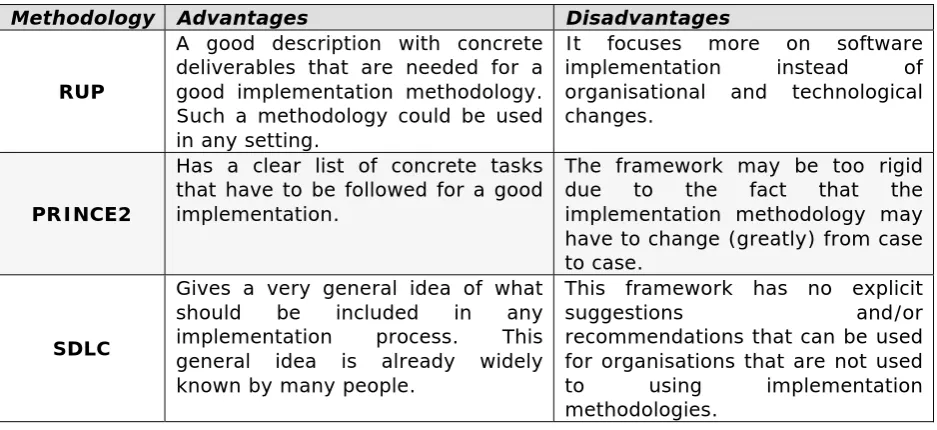
[image:11.595.55.524.123.338.2]From this selection of frameworks, the most relevant one will have to be chosen so that it can be used for this research. Table 1 summarizes the results.
Table 1 Comparison of the different implementation methodologies
Methodology Advantages Disadvantages
RUP
A good description with concrete deliverables that are needed for a good implementation methodology. Such a methodology could be used in any setting.
It focuses more on software implementation instead of organisational and technological changes.
PRINCE2
Has a clear list of concrete tasks that have to be followed for a good implementation.
The framework may be too rigid due to the fact that the implementation methodology may have to change (greatly) from case to case.
SDLC
Gives a very general idea of what should be included in any implementation process. This general idea is already widely known by many people.
This framework has no explicit
suggestions and/or recommendations that can be used
for organisations that are not used to using implementation methodologies.
PRINCE2 can be optimally used when the requirements and processes involved of the project are known beforehand. At Tubantia however the requirements are not known at the beginning and the implementation methodology is supposed to help management and employees to form these requirements along the way. PRINCE2 is also a very rigid framework, which contradicts the idea of creating an implementation methodology for Tubantia that would help for any kind of multi-disciplinary and cross-medial team.
The SDLC methodology helps breakdown the processes involved in a project by using for example Gantt charts. The breaking down of the processes can be useful to manage the progress of the team and ensure that objectives are met. However, in this case even the team processes involved are unknown beforehand and therefore no breaking down can be done. Because of this SDLC is not a good basis for an implementation methodology at Tubantia.
2
Research model
There are two main elements that have to be analyzed in order to create an implementation methodology that is useful for TC Tubantia. These two main elements are technology and organisation. (Information) Technology (computers, internet, cameras, software, etc) helps employees with their tasks. Organisation processes are necessary to determine the long-term strategy and the short-term planning.
Every business has to think about their long-term and short-term goals. The long-term involvement of technology is supported by the IT infrastructure. The IT processes support the day-to-day tasks and are therefore responsible for the short-term goals. With regard to the organisation, long-term strategies and short-term planning are present. These 4 areas make the business complete and ensure that everything runs smoothly.
2.1
Theoretical model
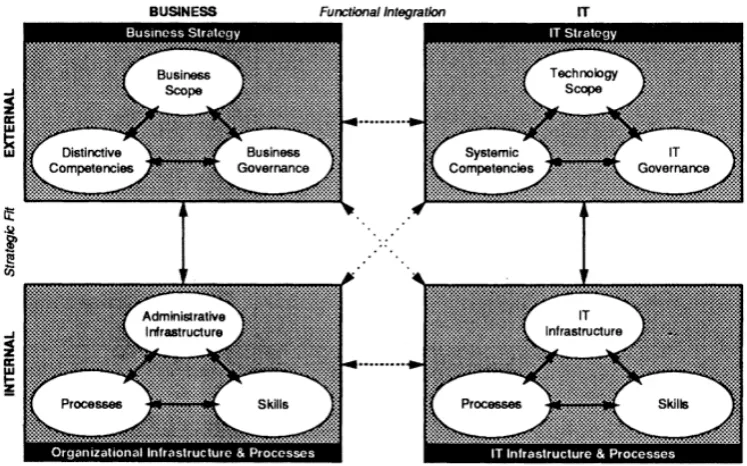
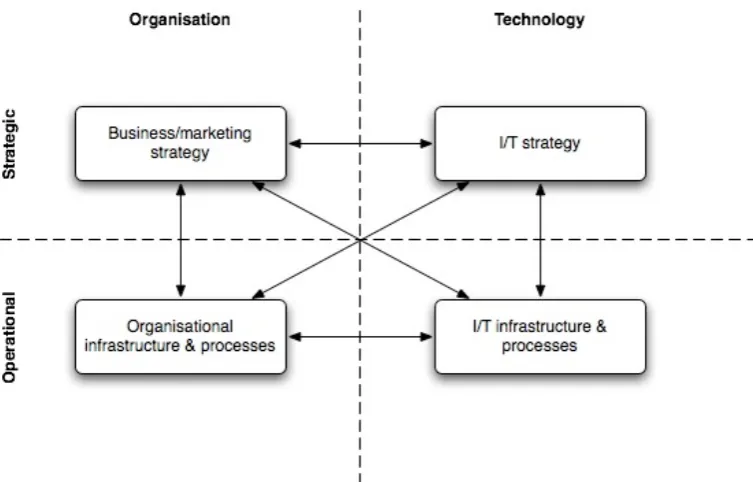
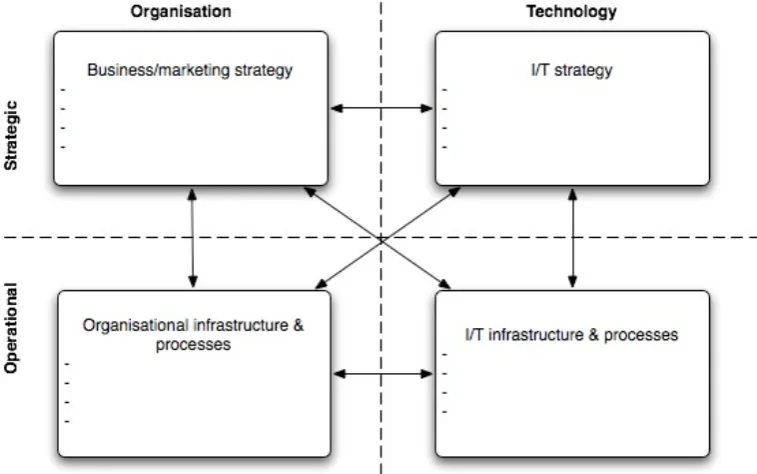
[image:12.595.93.467.328.561.2]To give some body to the implementation method, the alignment model introduced by Wijnhoven et al. (2006) will be used. This model is based on another alignment model designed by Henderson and Venkatraman (1992) shown in Figure 1.
Figure 1 Original alignment model (Henderson & Venkatraman, 1992)
Figure 2 Alignment model used for this research
The model is divided into four quadrants; the horizontal quadrants represent the strategic elements (business and IT strategy) and operational elements (organisational and IT infrastructure and processes). Vertically the organisational elements (business strategy and organisational infrastructure and processes) and the technological side of the organisation (IT strategy and IT infrastructure & processes) are shown.
These four quadrants introduce the idea of approaching the organisation from different directions (organisation and technology) and at different levels (strategic and operational). Because of this, it is now possible to design an implementation methodology that covers all the essential areas of an organisation. It also gives some structure to the methodology so that possible/potential problem areas are tackled in a structured manner.
All four blocks have to be present in order for the alignment to succeed. An organisation cannot be run without a clear business strategy as it consists of (long-term) goals and planning. An organisation must have an infrastructure, which supports the processes responsible for the creation of the final product and/or service. If IT is present in the business (which usually is nowadays), then there should be an IT strategy present to support the changes that are planned for the future.
The bi-directional arrows between all of these blocks indicate that they are interdependent. This relation is mandatory for the whole organisation to operate correctly and efficiently. The links between the business strategy and the IT strategy support the long-term plans of the organisation in terms of IT and the IT strategy should be aligned with the business strategy to ensure that the long-term goals are achieved. If the organisation relies heavily on IT and there is no IT strategy, then long-term goals/objectives will not be achieved efficiently.
An IT strategy of a company cannot be formed/planned if there is no infrastructure to support it. An IT infrastructure without a strategy can operate on its own but the objectives that have to be accomplished are unknown making it difficult for the company to profit from the infrastructure.
The organisational infrastructure and IT infrastructure continuously interact with each other, employees require IT to do their jobs, IT requires an organisational infrastructure and processes to ensure that it is clear what has to be made/produced.
The business strategy relies heavily on the IT infrastructure as it offers the framework for all the processes within the organisation that are responsible for the production. Without an IT infrastructure there is no way of creating the product/service and therefore it is impossible to achieve the (long-term) goals. An IT infrastructure cannot operate on its own without an organisational strategy. The organisational strategy dictates in many ways how the infrastructure should look like in order to cope with the demands.
The same can be said about the relation between the organisational infrastructure and the IT strategy. If it is unclear what the organisational processes are, and how IT can support these processes, then it’s impossible to create an IT strategy. An IT strategy is also required in order to know what processes have to be present to achieve the IT strategy.
It is possible to place performance measures on each quadrant separately. These performance measures can be used to identify whether or not the organisation is evenly balanced. Spending more time on IT strategy for example can unbalance the whole organisation if little to no time is spent on the organisational strategy. It is therefore important that:
a) All areas of the organisation are covered sufficiently to make the organisation operate correctly
b) There is a good balance between all the four areas to ensure that each element can rely on each other for an efficient and successful workflow.
2.2
Practice
The modified model now indicates four areas and twelve relations that possibly reflect the problems within Wegener Dagbladen, namely:
Business / marketing strategy: this includes long-term planning, generating revenue, and reaching the readers adequately in order to sell the product.
Organisational infrastructure & processes: these can be internal and external processes that are required to create the final product (in this case the news, website and newspaper).
IT strategy: this includes the long-term planning in terms of the IT infrastructure and processes.
IT infrastructure & processes: this encapsulates all the technological requirements the organisation may require to create the final product.
This research will be structured according to these four areas. The information collected would be:
Organisational infrastructure and processes: find out what tasks are required to create the final product. Some research would have to be done to identify the capabilities of the employees and determine whether they have the correct tools and information to do their jobs (correctly).
IT strategy: people responsible for the IT strategy have to be interviewed to find out whether or not there is an IT strategy in place. If there is one, research has to be done to identify whether or not the goals are realistic based on the IT infrastructure.
IT infrastructure and processes: The people that need to use IT to do their jobs will have to be interviewed so that problem areas are identified and possible improvements are discussed.
3
Literature research
To properly diagnose the issues at Wegener, some background information is required. The literature used in this thesis will be the foundation for the case study and will cover the four different areas. The information gathered can be used and applied into practice to create the implementation method in the end.
3.1
Method
There is a lot of literature regarding organisational changes, management and IT implementations. In order to find adequate literature for this research careful thought has to be made on how to retrieve relevant information effectively.
As the topic of this research is the cross-medial way of working, it would be interesting to also apply this way of working to this research. Therefore, some literature will be obtained by using the Internet (particularly search engines like University Library, EBSCO, Google Scholar, etc). This in most of the cases is both efficient and effective as the tools that are currently available ease the search process. On the other hand papers and books from the library will also be consulted for more in depth information.
It is useful to have these tools at hand, but it is also important to know what keywords should be used. Some general keywords like ‘change management’, ‘IT infrastructure’ and ‘IT alignment’ can be used. This kind of information can be very useful for background information. However, if more relevant information is to be collected, more concrete keywords will have to be used.
The alignment model is a good basis for coming up with concrete keywords. Some of these concrete keywords can be ‘management of cross-medial teams’, ‘effects of IT infrastructure in an organisation’, ‘change of organisational processes and infrastructure’, ‘defining business strategies using IT’, ‘possibilities of IT in news(papers)’, etc.
Searching these keywords may definitely result in many papers, documents, newspaper articles, comments, etc. The next step would be to filter the good literature from the bad. This can be done by looking at how many times the particular documents have been cited (the more the better), where the article has been published (well-known journals are better than the less-known), when the paper was written (the more recent the better) and whether it is relevant.
Preferably the papers found should discuss similar topics (IT and organisation) in similar settings (cross-medial and multi-disciplinary), so that the literature can give some additional value to this research. The focus will be on searching journals that discuss the four areas rather than looking for journals about (online) newspapers. This ensures that enough depth is given to the literature research.
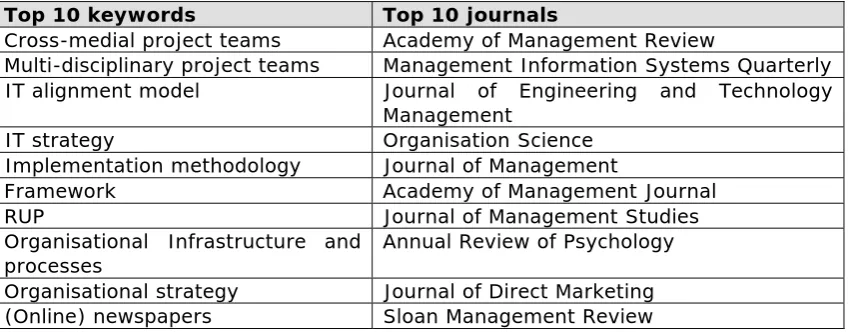
Table 2 Top 10 keywords and journals
Top 10 keywords Top 10 journals
Cross-medial project teams Academy of Management Review
Multi-disciplinary project teams Management Information Systems Quarterly
IT alignment model Journal of Engineering and Technology
Management
IT strategy Organisation Science
Implementation methodology Journal of Management
Framework Academy of Management Journal
RUP Journal of Management Studies
Organisational Infrastructure and processes
Annual Review of Psychology
Organisational strategy Journal of Direct Marketing
(Online) newspapers Sloan Management Review
[image:17.595.88.513.88.254.2]These keywords have been chosen based on the alignment model introduced earlier. More keywords will certainly be used but this top 10 reflects the majority of the information that is going to be used for this research. The top 10 journals have different backgrounds: technology, psychology, management and marketing.
Table 3 shows a categorization of a selection of the references that will be used for this research according to their topic. The topics reflect the four areas shown in the alignment model, background information and theoretical information regarding the framework and the research methodology.
Table 3 Relation between topics and references
Topic Reference(s)
IT strategy Cegielski, Reithel & Rebman (2005), Charitou & Markides (2003), Kanter (2002), Prahalad & Krishnan (2002), Ross & Beath (2002), Ross & Weill (2002), Weill & Aral (2006), Weill, Subramani & Broadbent (2002)
IT infrastructure and
organisation Alchian & Demsetz (1972), Anand, Manz & Glick (1998), Andolsen (1999), Dewett & Jones (2001) Organisational/marketing
strategy Charvat (2003), Draft & Lewin (1993), McCarthy (1960), Picard (2000) Organisational
infrastructure and processes
Adair (1988), Bateman & Organ (1983), Jackson (1996)
Action research Baskerville (1997), Baskerville (1999), Baskerville (1996), Blum (1955), Hult & Lennung (1980)
Research validation Klein & Myers (1999), Yin (1994), Yin (2004) Frameworks /
Implementation methodologies
CCTA (1989), Kuncher (2000)
(Online) newspapers Boczkowski (2004)
3.2
Business/marketing strategy
Some news publishers have made the choice to make the online newspaper look similar to their traditional newspaper (for example nytimes.com), others have taken this a step further by offering interactive multimedia content customized to the individual reader in a manner radically different from that of traditional newspapers (for example nu.nl).
The newspaper has been a source of information and entertainment for centuries and is driven by three key elements: advertising, content and delivery. The content basically consists of the written product including articles, comments, and other information. The delivery of a newspaper is traditionally being done by the use of trucks and carriers (Boczkowski, 2004).
The online newspaper on the other hand includes the same elements of content, advertising and delivery, but rather than using paper and mechanical distribution as its medium, it uses the Internet. It is even possible to distribute the content using eBooks and similar mobile devices. Because of the Internet it is possible to present content using text, graphics, photos, audio and video. Usually the digital newspaper is published on a website and provides some or all of the paper version’s content and in some cases expands the coverage with extended editorial content (Boczkowski, 2004).
With respect to advertising, news publishers tend to use two types of methods: retail and classified (Shaw, 1997). Retail advertising consists of publishing a banner advertisement with a link to the advertiser’s website. Classified ads are usually submitted by readers and contain short messages like a vacancy and exchange of goods (Shaw, 1997).
To be able to analyze the traditional newspaper and the online newspaper in terms of its marketing potential it is necessary to use a well-known model in the marketing world, namely the four P’s (McCarthy, 1960). The marketing theory of product, price, promotion and place provides an outline of related issues.
Product includes both the display and description of the product, its quality, information about the product, its characteristics and how it is used. Price is consists of product cost, tax, shipping and handling. Pricing is often a key marketing decision, attempting to meet market demands while maintaining reasonable profit. Promotion includes the activities of advertising and merchandising the products. Place refers to the availability of the product, and the ability to deliver the product via distribution channels (McCarthy, 1960).
[image:18.595.83.512.599.762.2]Palmer & Eriksen (1999) have attempted to analyze both types of newspapers, based on this model. Their (summarized) findings are shown in Table 4.
Table 4 Newspapers and marketing activities (Palmer & Eriksen, 1999)
Marketing
element Traditional Newspaper Digital Newspaper
Product
News service, heavily text-driven information through classified advertising
News service, classified and retail advertising multimedia content, archive service, customized product, market maker
Price Subscription, advertising Subscription, advertising, pay-per-use
Promotion Promotional discounts, in-paper self-advertising, other media
Pricing
The main way of pricing the online newspaper is by offering subscriptions to all or part of the content available through the website (Palmer & Eriksen, 1999). This could be for a given time (subscription) or on a per view basis (usage fee). It appeared from research that especially those papers with a specialized content (topic or geographic area) tend to charge a subscription or usage fee (Picard, 2000).
Product
Within this marketing element, there are three different types of products, namely archiving, multimedia and customized products. The customized content consists of providing specific kinds of content based on the reader’s needs (either on a general basis or even on an individual scale). These can include customized / advanced search possibilities, advertisements or even delivery mechanisms such as e-mail notifications (Palmer & Eriksen, 1999). Some newspapers included in the research done by Palmer & Eriksen (1999) have generated additional revenue through the development of customized products, ranging from research services and archiving to specialty items such as comics.
Archives can be an extra service that can be used by the readers. In some cases it may even be possible to charge for the usage of the archive. This depends on the size of the research departments, and their commitment to maintaining paper-based archives. Payment schemes can include a charge per article, time session or periodic (Picard, 2000).
Multimedia implementations can typically involve the use of audio and video clips. It may even be possible to support this multimedia by sponsoring organisations involved in the broadcast media, providing a ready source of supply and expertise. The combination of audio with video has the potential to generate substantially different products from the text and photographs of the paper version and to stimulate increased reader interest (Picard, 2000).
An emerging marketing role for digital newspapers is that of market intermediary. An example is Den Blå Avis (www.dba.dk) bringing buyers and sellers together. Such a newspaper becomes a market-maker providing support for transactions by serving as an intermediary of information for all parties.
Promotion / Advertising
Online two types of products can be advertised: tangible products and other online services. By clicking on the advertisement the user either visits a website containing information about the tangible product or is direct to the website of the advertiser. Another distinction can be made, namely cross-advertising (advertising other products or services of the newspaper’s publisher) and paid advertisements (banner and classified) from other companies. The first method would probably be used to promote or create exposure for complementary goods/services; the second one would be a direct source of income for the news publisher (Mehta & Sivadas, 1995).
Place / Distribution
Online distribution is immediate, breaking the traditional delivery barriers of time and space. Because of this in most cases it would suffice to just publish the newspaper articles on a website where everyone with Internet access can visit the page without paying. The website may have additional services where the reader may have to pay for to gain access. It is also possible to send a customized version of the paper, or articles based on a user’s profile via e-mail or using an information service such as PointCast (pointcast.com).
Applied to Tubantia
Marketing/business has many dimensions. Thanks to the categorization given by the four P’s it is possible to tackle each area separately. The goal is to have a plan that incorporates all these four areas, which can later be used to measure whether or not the project team was capable to successfully introduce a new product into the market (McCarthy, 1960).
TC Tubantia has already incorporated the idea of working with different media in their marketing and business strategy. Because of this they have started with both pilot teams that consist of people with different disciplines who each work on the printed version and the website.
Furthermore, not a lot of revenue generation is being done. The organisation’s primary focus is to exploit their current advertisers in order to generate more revenue. There have been initiatives to increase their customer base and therefore hopefully increase their revenue, however, concrete long-term plans have yet to be made.
Table 5 Business strategy - current state and recommendations
Area Current state of Tubantia Recommendations for Tubantia
Product
Printed product is good, but has few pages making it difficult to attract advertisers. Website is acceptable but needs
improvement when it comes to publishing newsflashes.
Change the printed product so that it has several pages, making it very attractive for customers to
advertise. The website should incorporate more interaction with the visitor. It should have a good technological foundation that enables journalists to publish content easily and quickly. Both website and printed product should be seen as complementary goods so references have to be made to each other to emphasize this.
Price
The price mechanism of the printed product is common in the newspaper industry so it doesn’t have to be changed. There is currently no pricing mechanism on the website.
Improve the website to offer something extra that can only be used by paying. Motivate visitors to purchase these services. This would create a new revenue stream.
Promotion
Promotion of the printed
product is present. More can be done to promote the website. Currently the only promotion being done is a link on the newspaper’s websites and a banner on the printed product.
Promote the website by improving the content and structure of the website so that people searching through the internet on topics such as sport and recreation end up on the website.
Place
The printed product is currently being distributed via postal mail, which is the only possible distribution method. The website is part of the newspaper’s main website.
Maybe deliver the content published on the website in different manners, such as via mobile devices, eReaders, e-mail, etc.
3.3
Organisational infrastructure and processes
Organisations pursue new business strategies to compete in the global marketplace. They often conclude that multi-disciplinary teams are needed to develop innovative products and services to respond to customer’s interests in a wide range of products and services. Multi-disciplinary teams are a foundation for bringing together employees with different technical backgrounds that are required to complete the tasks. The increasing popularity of team-based organisational topologies reflects the widely shared belief that teamwork offers the possibility to achieve outcomes that would never have been achieved by individuals working in isolation (Jackson, 1996).
When forming multi-disciplinary teams, many organisations do experience that teams do not always produce the desired results. Even when teams fulfil their potential, team members and their organisations may experience unanticipated negative side effects, such as unproductive conflict and high turnover. There are a number of challenges team members must overcome to achieve their common goal (Jackson, 1996):
• Efficient decision-making and problem solving: team members have
• Leadership: some members of the team should have the qualities to lead
the group to achieve the goals.
• Implementing decisions: generating ideas is not the only task members
have, these ideas need to be implemented in the near future for the team to be a success.
• Feeling of cohesiveness: this may be a struggle for team members and
can therefore lead to a negative atmosphere within the group.
These challenges are explained in further detail:
Efficient decision-making and problem solving
Decision-making processes are important if teams are to function properly. It is often because diverse perspectives are presumed to improve decision-making processes that organisations employ multidisciplinary team structures.
A typical decision-making process would look as follows (Jackson, 1996):
1. An environmental scanning would occur in the earliest phase of decision-making.
2. Based on this environmental scanning, it should be possible for the team members to provide a more comprehensive view of the possible issues that might be placed on the team’s agenda (including threats and opportunities).
3. Once potential threats and opportunities have been identified, discussion amongst members with diverse perspectives should improve the team’s ability to consider a variety of alternative interpretations of the information gathered by the team
4. Based on the information gathered, creative solutions can be generated that can be integrated into the diverse perspectives.
5. As the team discusses alternative courses of action and solutions, diverse perspectives presumably will increase the team’s ability to foresee all possible costs, benefits and side effects. All team members should have a fairly equal say.
Some examples of the decision-making process can be read in Porac & Howard (1990).
The problem with team members having different disciplinary backgrounds can be that each member has no interest in what other people within the team are working on. It is therefore important that the project leader stimulates conversation between the team members in order to come up with a good decision-making process (Jackson, 1996).
Leadership
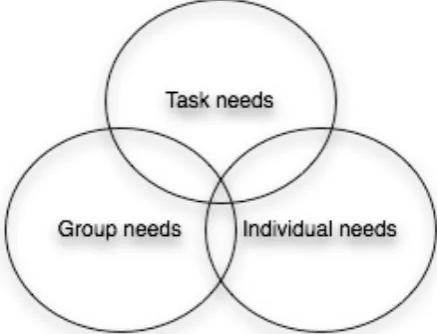
According to Adair (1988), there are three areas of need present in working groups with regard to proper leadership, namely:
1. The need to achieve the common task
2. The need to be held together as cohesive unities 3. The needs that individuals bring into the group
function effectively. This will achieve the common task by working as a team, while respecting and developing individual members.
Figure 3 Three circles model (Adair, 1988)
Implementing decisions
Having too much diversity within a team that is not relevant to the task at hand may interfere with the implementation of the ideas. This is because all members of the team may be less strongly committed to whatever solution is eventually agreed upon. If diversity of perspectives makes reaching consensus difficult, teams may choose to resolve conflicts through compromise and majority rule instead of persisting to a creative resolution that is acceptable to everyone. Dependence on compromises or majority rule may decrease team members’ acceptance of and enthusiasm for the team’s resolution (Jackson, 1996).
Diversity may slow down the process of decision-making and implementation, but it can also increase the team’s alertness in attending to feedback about the quality of their decisions. The trade-off between speed and vigilance suggests that diversity may be a very positive feature for teams engaged in high-risk decisions (Jackson, 1996).
Cohesiveness
In order to solve complex decision-making problems, the expression and discussion of conflicting opinions and perspectives ensures through discussion of a wide range of interpretations, possible solutions and alternative consequences that might follow the acceptance of a solution (Schweigner, Sandberg & Rechner, 1989). Exposure to alternative views may improve the quality of thinking about the issue at hand. It may also stimulate learning, which should benefit the team as it works on new tasks in the future (Nemeth, 1986). Unfortunately, however, opposition and disagreement often stimulate negative emotional reactions (Nemeth & Staw, 1989), which may be directed toward other individuals in the team.
Applied to Tubantia
Good coordination from higher levels in the organisation should allow for proper decision-making, efficient use of time and ensure that every person within the group has an equal say regarding the product/service being created and also solve problems (if any) regarding cultural differences.
The organisational structure of TC Tubantia is traditional with many levels in the hierarchy and wide spans of control. The head of editorial staff is responsible for nearly 125 journalists spread over different offices in the Twente region (including the designers, internet journalists, and photographers), making it difficult to stay up to date. This wide structure makes it very difficult to quickly react to changes in the market.
Within TC Tubantia setting up a project group to produce a website and newspaper is a revolution. Nothing similar has occurred ever before. Because of this the organisation of the pilot team is not as good as it should and could be.
Even though these project teams have been made, the responsibilities of each team member are still unclear. Interaction between the members is present. However specific tasks are never assigned explicitly to each team member resulting in tasks never being completed. The team members are good in generating ideas, however when it comes to dividing the tasks (if this is ever done), then there’s little motivation among the team members to elaborate on these ideas. The findings regarding this topic are summarized in Table 6.
Table 6 Org. infrastructure & processes – current state & recommendations
Challenge Current state of Tubantia Recommendations for Tubantia
Decision-making and
problem-solving
On a higher level in the organisation decisions are being taken and problem-solving tasks are being delegated to employees on the work floor. Decisions and problems being discussed within the group are however usually not followed through.
Assign problem-solving tasks explicitly to the responsible members within the team. A superior should also monitor the progress on these tasks and ensure that these tasks are being completed.
Leadership
The head of editorial staff is in charge of the team and leads the weekly meetings.
Give somebody (new) the task to monitor the progress of the team and ensure team members complete their tasks.
Implementing decisions
Team members usually don’t have the authority to make the decisions that are required to improve the daily processes.
Give the team members more authority to make necessary decisions or ensure that the communication channels between the team members and the people who do have the authority to make the decisions are short and fast.
Cohesiveness
Both pilot teams arrange weekly meetings to ensure that everyone is up to date. Everyone understands each other and there is sufficient communication between the members either via e-mail, verbally or telephone.
Codify the information being exchanged often for future reference. This information can consist of conversations that take place between team members or decisions that have been made and the reasons for making them.
3.4
IT strategy
and strategic level and by all parties involved. These parties are in general a combination of the management of an organisation, the management of the business functions and IT management. The purpose of this control is to achieve an application of IT facilities complying with the demanded functional and performance requirements’.
An IT strategy consists of managing all IT resources for the short-, medium- and long-term period. All employees that are/may be involved with this IT infrastructure should therefore be involved in the making of IT strategies. There are five critical success factors for the development of an IT strategy. These five factors have to be in place for strategic development to be effective.
1. Revisit the business model
A business model explains how the different pieces of a business fit together. It ensures that everyone in an organisation is focused on the kind of value a company wants to create. Only when the business model is clear, strategies can be developed to articulate how a company will deliver that value in a unique way that others cannot easily imitate (Ross & Beath, 2002). Thus, it is essential that all managers, including IT and business managers, completely understand how their business as a whole works.
2. Adopt strategic themes
IT strategy used to be about individual projects. Now it is about carefully crafted programs that focus on developing specific business capabilities. Each program consists of many smaller, inter-related business and IT initiatives that cut across several functional areas. These programs are designed so that they can be adapted, reconfigured, accelerated or cancelled as the strategic program evolves. Themes give both business and IT managers a broad yet focused topic of interest that challenges them to move beyond current operations (Kanter, 2002).
3. Get the right people involved
One of the most important distinguishing factors between companies that get high IT business value and those that do not is that senior managers in high performing companies take a leadership role in IT decision-making. Abdication of this responsibility is a recipe for disaster (Ross & Weill, 2002).
Getting the right people involved also means getting business managers and other key stakeholders involved in IT strategy as well. To do this, several focus group organisations have established “account manager” positions in IT to work and learn about the business and suggest opportunities for using IT. Research shows that the best strategies often stem from grass-roots innovations and it is therefore critical that organisations take steps to ensure that good ideas are nurtured and not filtered out by different layers of management (Kanter, 2002).
4. Work in partnership with the business
Successful strategy demands a true partnership between IT and business. Strategy decisions are best made with input from both business and IT executives (Ross & Weill, 2002). Partnership is not just a matter of “involving” business leaders in IT strategy or vice versa or “aligning” business and IT strategy. Today effective strategizing is about “continuous and dynamic synchronization of capabilities” (Prahaland & Krishman, 2002).
5. Balancing IT investment opportunities
issue is complicated by the fact that most businesses today require significant IT services just to operate (Weill & Aral, 2006).
IT strategy must consider two important components (Weill & Aral, 2006): 1) How to do more with less (driving down fixed costs)
2) How to allocate the remaining budget towards those IT investment opportunities that will support the organisation’s business strategy.
There are five investment opportunities: business improvement, business enabling, business opportunities, opportunity leverage and infrastructure (Appendix B). Determining the balance between the opportunities is a significant component of how IT strategy delivers business value. In a way, organisations have to adopt a portfolio approach to IT investments. Too much or too little focus on one type of investment can mean a failure to derive maximum value from a particular strategic business theme (Weill & Aral, 2006).
Applied to Tubantia
The IT strategy focuses on the future of the organisation in terms of its IT infrastructure, opportunities and way of thinking. Technology can play an important role in determining the course of the organisation and in most cases also helps the organisation to operate efficiently and effectively.
Every organisation has to think about the five Critical Success Factors or CSFs (the business model, adopting strategic themes, involving the right people working in partnership with the business and balancing the IT investment opportunities). All of these CSFs are interrelated and it is therefore essential that all of these factors are balanced out between them and enough attention is being paid to all of them.
An IT strategy within Tubantia is basically non-existent. The main problem is that there is a lack of knowledge regarding technology, which in practice results in a lack of IT strategies and goals. The company has outsourced their IT activities to external parties, but contracts with these parties are so meagre that it gives Wegener little room to innovate and being able to use the latest technologies.
Table 7 IT strategy - current state and recommendations
Area Current state of Tubantia Recommendations for Tubantia
The business model
The business model does include IT elements, however these are vague, not measurable and not enough attention is being paid to the opportunities IT has to offer.
Spend more time in finding out what the current IT problems are. Spend more time determining if the IT infrastructure is good enough for the business model and decide where to invest on.
Adopt strategic themes
The current applications being used by the employees are generally outdated making it difficult to profit from new technologies.
Do some research in determining what areas need
investment/upgrades. Try to implement new technologies wherever possible.
Involving the right people
Currently not a lot of people within the organisation have sufficient IT knowledge to help improve the IT strategy. Because of this, IT is usually placed on second place.
Motivate people to investigate new technologies and employ new people with IT knowledge.
Work in partnership
with the business
IT has a lower priority in comparison the organisational strategies. Because of this representatives of the IT
departments are rarely involved with the decision-making
process.
Bring IT to a higher level by finding out how IT can help achieve
strategic goals and other operational processes.
Balancing IT investment opportunities
Little to no investment is being done on IT, resulting in an IT infrastructure, which is outdated. Long-term IT plans are being cancelled.
Spend more time in identifying how the IT of the organisation can be improved, which investments are worth its money.
3.5
Information Technology infrastructure and processes
IT infrastructure inter-links business processes, with the organisation and the firm’s customers and suppliers. The IT infrastructure spans and supports all these business processes and provides an enabling base of information systems. A typical IT infrastructure consists of hardware such as servers and workstations and communication channels such as the network and data centres (Keen, 1991).Figure 4 The role of IT in the organisation (Dewett & Jones, 2001)
The organisational characteristics and organisational outcomes mentioned in the figure are naturally a selection of all the possible characteristics and outcomes present in an organisation. The goal of the model is to show that by applying IT on certain characteristics of the organisation, certain outcomes can be achieved that can have an overall positive effect on the efficiency and innovation of the company. These improvements are named information efficiencies and information synergies in this model.
Information efficiencies (INE) are the cost and time-savings achieved when IT allows employees to perform their current tasks at an improved level, assume additional tasks, and have a greater influence on the organisation due to the increased ability to gather and analyze data. For example, after applying IT in an organisation, individuals / teams may share or reorganize their tasks as technologies increases their ability to process information.
IT links and enables employees
Compared to face-to-face contact, the use of electronic communication has been shown in the literature to increase the overall amount of communication in the organisation. This conclusion implies that the use of IT in organisations contributes to a fundamental benefit when linking and enabling employees, within and between functions and departments, Therefore INE and INS are also achieved. However, relying largely on IT for communication purposes can lead to increased alienation among employees (DeSanctis & Monge, 1999).
The disadvantage of linking employees is that the amount of good advice received will increase, but bad advice may increase as well. It is not possible to assess the source’s expertise, motives and so on (Constant, Sproull & Kiesler, 1996). Sarbaugh-Thompson and Feldman (1998) suggest that two possible negative effects of the use of electronic communication are the reduction in casual conversation and that it may lead to less opportunities to signal “communication trustworthiness” in social situations.
IT codifies the knowledge base
Information that is not being codified and only kept in the minds of the employees is subject to erosion and error (Huber, 1990). Organisations therefore have trouble maintaining this information as it basically consists of a collective of individuals. Advances in IT have greatly facilitated organisational memory and the ability to capture and integrate explicit knowledge by codifying, assimilating, communicating, storing and retrieving information (Anand, Manz & Glick, 1998).
It may be possible that too much information is codified and stored resulting in an information overload. This may impede managers to make timely decisions if the information is not properly filtered and/or there are no means to easily/quickly search through the information (Desanctis & Monge, 1999).
IT increases boundary spanning
Codifying information using IT then enables organisations to easily exchange and share information within its departments but also to the outside world. Information can be exchanged between (on a lower level) employees and departments and (on a higher level) organisations. This can facilitate the decision making process by making sure the decision-makers have enough information at their disposal. This can however again lead to information overload. Research (Eisenhardt, 1989) however, shows that fast decision makers actually use more information compared to slower decision makers.
IT promotes efficiency
Summarizing all three characteristics mentioned in the previous sections, it could be concluded that IT improves efficiency within an organisation. IT makes it possible to:
• Communicate more easily and less expensively across time and
geographic locations,
• Communicate more rapidly with greater precision to targeted groups, • Record and index more reliably and inexpensively the context and nature
of communication events,
• More selectively control access and participation in a communication
event or network,
• Make decisions based on a lot of information,
• Ensure that information can be rapidly and accurately combined and
reconfigured,
• More reliably and inexpensively record and retrieve information about the
IT promotes innovation
According to Myers and Marquis (1996), innovation can be defined as “a complex activity, which proceeds from the conceptualization of a new idea to a solution of the problem and then to the actual utilization of economic or social value”. Dewett & Jones (2001) among other definitions uses the definition of innovation as being “a process bringing any new problem-solving ideas into use”. Because IT determines the way information is stored, transmitted, communicated, processed and acted upon, it falls under this last definition.
Take project based work as an example: some project members will be part of a team from beginning till end, others will only be member of the team when their expertise is required and will leave the group once their job is completed. The exchange of information, rotation of tasks, and recording of decisions can be done by using IT (Myers & Marquis, 1996).
IT provides management with real-time capability to monitor project progress and tools to allocate knowledge resources accordingly to optimize the overall value added of each team member, ad, in turn, optimizing knowledge use and the potential for INS. This movement has resulted in employees working in a more parallel manner, working on different tasks at the same time, instead of sequentially or in batches. This development can promote innovation (Myers & Marquis, 1996).
Daft & Lewin (1993), among others, have shown that new IT-enabled forms are viewed as more innovatively responsive to varied environmental pressures, such as heightened market volatility, the globalization of business, increased uncertainty, and demographic changes in labour and consumer sectors in comparison with more rigid bureaucratic organisational forms.
Applied to Tubantia
IT has shown to be a very useful tool when creating, saving and organizing information. It is technology that can certainly improve the efficiency, effectiveness and innovation of processes. IT can help keep knowledge within the company, improves and/or facilitates communication between employees ensuring that they are up to date. Little knowledge is lost if one (important) employee were to leave the company if all available knowledge were codified. In summary: IT is a must for any organisation operating in a continuously changing environment.
When asking Tubantia’s journalists about the IT within the organisation, unanimously they all say that the infrastructure is out of date, knowledge regarding IT is present but only in a few people, hardware being unreliable for the job, etc. Many complaints have been collected regarding the out-dated infrastructure and the outdated hardware and software. Even though the IT may be out-dated, people can still do their jobs. Maybe not in an efficient and effective way, but they can do their jobs. It maybe the case that employees blame IT to less productivity as an excuse to do less, which in some cases may be true, but one thing is a fact that IT does create a lot of frustration among employees.
Many innovative projects have been postponed or even cancelled, because management was unconvinced that the current IT infrastructure was able to support these new ideas. This is a very bad sign, and does affect the innovativeness of the organisation. These new projects can lead to a more dynamic and efficient organisation and new revenue streams.
and in a wider range of products and services, which on their part creates new revenue streams.
Before investing, research should be done to identify what the benefits would be with the new infrastructure, what the estimated increases would be in revenue, the organisational improvements, the return on investment, etc. Based on this information, management can safely make the decision whether or not improving the infrastructure is a wise decision.
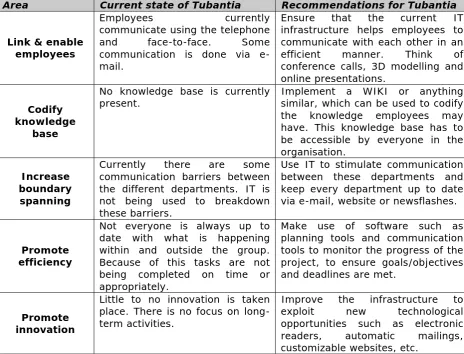
[image:31.595.88.553.224.578.2]Table 8 summarizes all the points and adds some recommendations regarding this topic.
Table 8 IT infrastructure and processes - current state and recommendations
Area Current state of Tubantia Recommendations for Tubantia
Link & enable employees
Employees currently communicate using the telephone
and face-to-face. Some communication is done via e-mail.
Ensure that the current IT infrastructure helps employees to communicate with each other in an efficient manner. Think of conference calls, 3D modelling and online presentations.
Codify knowledge
base
No knowledge base is currently
present. Implement a WIKI or anything similar, which can be used to codify the knowledge employees may have. This knowledge base has to be accessible by everyone in the organisation.
Increase boundary
spanning
Currently there are some communication barriers between the different departments. IT is not being used to breakdown these barriers.
Use IT to stimulate communication between these departments and keep every department up to date via e-mail, website or newsflashes.
Promote efficiency
Not everyone is always up to date with what is happening within and outside the group. Because of this tasks are not being completed on time or appropriately.
Make use of software such as planning tools and communication tools to monitor the progress of the project, to ensure goals/objectives and deadlines are met.
Promote innovation
Little to no innovation is taken place. There is no focus on long-term activities.
4
Action Research Method
This section will describe how the practical research will be done. A method has to be chosen which ensures that enough information is retrieved from the practical environment. This can be done using action research, which turns out to be a very useful way of researching practical case studies.
4.1
What is action research?
Action research is an established research method in use in the social and medical sciences since the mid-twentieth century, and has increased in importance for information systems toward the end of the 1990s (Baskerville, 1999). The method produces highly relevant research results because it is grounded in practical action, aimed at solving an immediate problem situation based on theory where possible.
Action research is typically done in a social setting, analyzing for example the link between an organisation and its information technology. It is difficult to develop an understanding of the interaction of complex social organisations and their information systems. Because of this, the best way to analyze such social processes is to introduce changes into these processes and observe the effects of these changes.
The interpretive viewpoint allows social intervention into the research setting. When the researcher intervenes, the researcher becomes part of the study, i.e. one of the study subjects. Because of this the researcher perceives the ‘meaning’ of the observation. As the researcher attempts to understand what is observed, this personal understanding will invade the recording of the observation and the deductions that follow.
The idiographic viewpoint follows from the acceptance that each social setting involves a unique set of interacting human subjects. Any meaningful investigation must consider the frame of reference and underlying social values of the subjects. Action research consists of an idiographic method of enquiry partly by incorporating the subjects into their research as powerful collaborators.
Having covered these two viewpoints, it is also necessary to coll