1
A study on
identity orientation and citizenship performance behaviour
Master thesis Human Resource Development
Marlous Maarleveld
University of Twente
Enschede, March 2009
supervisors
Dr. J.C.A. Ardts
2
A study on identity orientation and citizenship performance behaviour
In this study the relationships between different identity orientations and different types of citizenship performance behaviour (Coleman and Borman, 2001) are investigated using an extended model of self representation (Brewer and Gardner, 1996). A total of 101 employees from three knowledge intensive companies participated in this study. Results suggest that differences in identity orientation can be seen as predictors of citizenship performance behaviours. Partial support was found for the moderating effect of organizational identity orientation. Theoretical and practical implications of this study are discussed, as well as suggestions for further research.
In research on organizational effectiveness and organizational behaviour, the focus was usually on the performance of formal tasks by employees (Borman, 2004). Now increasingly more attention is paid to exploring performance related behaviours that go beyond the assigned tasks and responsibilities for which employees are typically held responsible, also referred to as discretionary work performance (Hoffman, Blair, Meriac and Woehr, 2007), organizational citizenship behaviour (OCB) (Smith, Organ, and Near, 1983; Organ, 1988), or citizenship performance behaviour (Borman and Motowidlo 1993, 1997; Coleman and Borman, 2000; Borman, 2002). Citizenship performance behaviour is important because it shapes the organization‟s social system. By creating a situation that supports and improves
3
more on professionalism of their employees. Providing high quality services requires employees who will do just a bit extra and show citizenship performance behaviours (Borman and Motowidlo, 1997).
In research on citizenship performance, the antecedents of an employee‟s decision to show such behaviour are of particular interest: What makes employees decide to voluntarily show citizenship performance behaviour? In empirical research four major categories of antecedents can be distinguished; task characteristics, organizational characteristics, leadership behaviours and individual or employee characteristics (Podsakoff, MacKenzie, Paine and Bachrach, 2000). According to Organ and Ryan (1995) this last category contains both attitudinal antecedents like employee satisfaction, organizational commitment, perceptions of fairness and perceptions of leader supportiveness, and predispositional or personality differences like conscientiousness, agreeableness, positive and negative affectivity. These constructs have received extensive empirical attention in relation to organizational citizenship behaviours - see Borman, Penner, Allen and Motowidlo (2001) for an overview of personality predictors of OCB. A construct not mentioned by Organ and Ryan (1995) is identity orientation.
Literature on identity orientation deals with the way the self is defined in relation to others (Gardner and Brewer, 1996). Three different identity orientations (personal, relational and collective) can be distinguished (Brewer and Gardner, 1996). Each stands for different types of social motivation (what is important to him/her), types of relevant self-knowledge (with what terms does he/she like to describe him/herself?) and the frame of reference, which is used to evaluate the self. Basically a certain identity orientation answers the question 'who am I?' and by implication also 'how should I act?' Although extensive literature on identity orientation exists in relation to a wide variety of topics, research on the relation between a person‟s identity orientation and citizenship performance is a relative 'undiscovered' area of
research.
In this study it is argued that a person‟s identity orientation is a predictor of citizenship
4
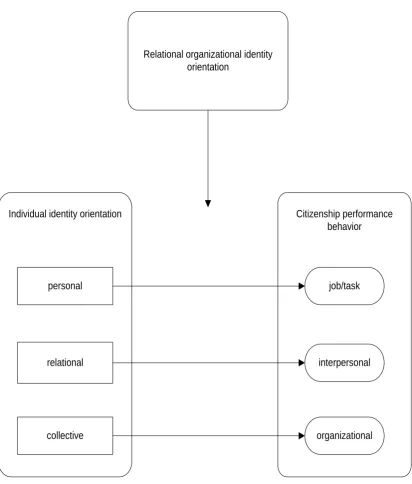
A model is presented to show the relation between different identity orientations on individual level using an extended model of self representations (Brewer and Gardner, 1996) and different foci of citizenship performance behaviour (Coleman and Borman, 2001). Following Brickson (2005, 2007), identity orientation at an organizational level is investigated in relation to citizenship performance behaviour in the organizational context.
Defining citizenship performance behaviour
Since most empirical studies investigating citizenship performance constructs have their origins to a large extent in the work of Organ and his colleagues (Bateman & Organ, 1983; Smith et al., 1983), it makes sense to start with their concept of organizational citizenship behaviour. About 20 years ago, they first introduced the term organizational citizenship behaviour (OCB). Based on the concept of the “willingness to cooperate” (Barnard, 1938) and the distinction between ‟‟dependable role performance‟‟ and “innovative and spontaneous behaviours‟‟ (Katz, 1964; Katz & Kahn, 1966, 1978 in: Podsakoff et al., 2000), Organ (1988: 4), defined organizational citizenship behaviours as “individual behaviour that is
discretionary, not directly or explicitly recognized by the formal reward system, and that in the aggregate promotes the effective functioning of the organization‟‟. Since then, research on
5
organization, like 'helping others who have been absent', and 'taking a personal interest in other employees'.
Coleman and Borman (2000) also investigated the underlying structure of the performance citizenship performance domain. They derived a three dimension model of citizenship performance from a list of twenty-seven organizational performance behaviours (OPBs) representing the full range of concepts and models of citizenship related behaviours. Their model of citizenship performance behaviour is used in this research, because it provides a comprehensive model, integrating relevant previous research on organizational citizenship performance related behaviours. The domains of the Coleman and Borman (2000) model are interpersonal, organizational and job/task citizenship behaviours. Similar to the Williams and Anderson (1991) model, the different domains of citizenship performance are directed at different entities. Comparable to Williams and Andersons (1991) OCB-O, organizational citizenship performance refers to behaviours benefiting the organization. It consists of endorsing, supporting and defending organizational objectives, following organizational rules and procedures and organizational citizenship dimensions. Interpersonal citizenship performance refers to behaviours benefiting organization members. It consists of helping and cooperating with others and interpersonal citizenship dimensions and is comparable to Williams and Andersons OCB-I. The job/task citizenship performance refers to behaviours benefiting an employee's job or task. This domain of citizenship performance behaviour is not directed to others, but only to the self: one‟s own career and one‟s own tasks. It consists of
job/task conscientiousness dimensions and persisting with enthusiasm and extra effort as to complete one‟s own tasks activities successfully.
Adding the job/task dimension to the citizenship performance model is what differentiates the model from most other models/systems. It can be found in the job dedication construct of Van Scotter and Motowidlo (1996). Van Dyne, Graham and Dienesh (1994) included self development and accomplishment of work behaviour and Borman and Motowidlo (1993) included volunteering and extra effort concepts in their model.
6
improve the organization. The second reason lies in the possible difficulties in empirically distinguishing the job/task dimension from task performance (Motowidlo, 2000) but it should not be a problem for this study, since the distinction between task and non task (citizenship performance) behaviours is not the issue. The additional job/task dimension, and the distinction of the entity towards the citizenship behaviours are directed (to either the organizational as a whole, to another member of the organization or to one‟s own job/task) is
what makes this model excellent to use in relation to identity orientation.
Perspectives on identity orientations
Literature on identity comes mainly from two lines of research; cross-cultural identity research (e.g. Triandis, 1989; Markus & Kitayama, 1991) and the social identity theory (Tajfel, 1978; Tajfel & Turner, 1979). Both of them contain valuable information on defining identity orientation in this study and will therefore be discussed. In both lines of research a distinction is made between a personal or individuated self (aspects of the self that are distinct and differentiate the self from others) and a collective self (aspects of the self that reflect assimilation to others or significant social groups). In both lines of research identity resides within the individual. Different identity orientations coexist within each individual and they can be activated, but the difference lies in how a certain identity is activated.
According to the social identity theory, people tend to organize social information by categorizing individuals into groups. By comparison, social categorizations are given meaning and the relative worth of groups as well as individuals is assessed. By relating information about social groups to the self, people identify with a certain group (Tajfel,1978; Tajfel and Turner, 1979). They perceive themselves to be a representative of a group and by doing so, they adopt a social identity, instead of a personal identity (Hogg and Terry, 2000). According to the social identity approach, membership in social groups affects the self concept (van Knippenberg, 2000) by internalizing the group membership as „a part of who you are‟
7
evaluate your identity positively. In the social identity approach the term „salience‟ is used to indicate the activation of a certain identity. Identity salience is highly context dependant, making the social context a central feature in the social identity approach (Hogg & Terry, 2000). A social identity salience analysis specifies the processes that dictate whether people define themselves in terms of personal or social identity, and when a social identity is salient, which particular group membership serves to guide behaviour (Haslam, Powell and Turner, 2000). In this perspective identity salience changes across situations, it is context dependant. In cross-cultural psychology people have a certain identity orientation which is more or less stable across situations. In this perspective culture determines the dominant identity orientation. The way the self is construed depends on cultural values, belief systems and socialization (Markus and Kitayama, 1991; Trafimow, Triandis and Goto, 1991; Triandis, 1989). An often used example in characterizing cultural differences in relation to how individuals define themselves and their relationships with others, is that people in western cultures generally define themselves as individuals and in eastern cultures people primarily define themselves in terms of a collective.
8
with the other players of the game. Although identity orientation as a stable individualistic characteristic has not been empirically studied to great extent, it has proven its usefulness in relation to pro-social behaviour. Therefore it seems worthwhile to pursue this view, in relation to citizenship performance behaviour.
An extended model of identity orientation
Both the social identity approach and the cross-cultural perspective in identity state that there are two levels of self representation. They distinguish a personal and a social self. More recent work on identity orientation adds a third level of identity. Brewer and Gardner (1996) present a classification of identification in which the link between three levels of individuals' identity and their relations with others is described. They state that there are two levels of social self: a relational and a collective self. The relational self is derived from interpersonal relationships; connections and role relationships with significant others. A relational identity can also be derived from membership in small face-to-face groups functioning as networks for these dyadic relationships. The collective self is derived from membership of a larger, more impersonal collective. It is comparable to the social self in the social identity approach in which the individual comes to perceive himself as interchangeable with other group members. So both identity orientations are social extensions of the self but differ on the level of inclusiveness (Brewer & Gardner, 1996). By adding the relational identity orientation, Brewer and Gardner‟s extended model includes three levels of self representation, a personal,
9
The extended identity orientation framework with the relational identity orientation has been used several times in recent literature. For example Kashima and Hardie (2000) designed a scale to measure individual, relational and collective self aspects and used it to explain gender differences in identity orientation. Brickson (2000) investigated the relationships between organizational context, identity and positive and negative consequences of diversity in organizations. The identity orientation framework has been used on an organizational level, to determine if organizations differ in identity orientation (Brickson, 2005) and its relation to different types of social value creation (Brickson, 2007). Flynn (2005) related differences in identity orientation to different preferred forms of social exchange. Finally, it has been used to explain pro-social behaviour in diverse workgroups (Vos & Van der Zee, 2009) but to the best of my knowledge, the extended identity framework has not been used in relation to citizenship performance behaviour.
Identity orientation and citizenship performance behaviour
In 1995, Moorman and Blakely explored individual differences as a cause for organizational citizenship behaviour. They linked individualism/collectivism to OCB and results suggest that if an individual holds collectivistic values or norms, he or she would be more likely to perform citizenship behaviours. Van Dyne, Vanderwalle, Kostova, Latham and Cummings (2000) found that collectivism was related to helping behaviour measured six months later. In research on pro-social personality orientation Penner, Midili and Kegelmeyer (1997) found that a pro-social personality orientation- an enduring predisposition to feel concern for the welfare of other people- is related to organizational citizenship behaviour. Ellemers, de Gilder and Haslam (2004) relate personal and collective identity orientation to motivation. They state that when the collective identity is adopted in the definition of the self, the needs, goals and expected outcomes are on behalf of the collective instead of the individual self. Brewer and Gardner (1996) also state that each identity orientation has its own social motivations. An individual‟s primary motivation is either to enhance his own, his partner‟s or a group‟s
wellbeing, depending on his/her identity orientation. In terms of citizenship performance behaviour, it is argued that differences in how the self is defined in relation to others and related differences in social motivation, are related to different types of citizenship performance behaviour. This leads to the following set of hypotheses:
10
organizational setting, it is expected that a personal oriented person will focus on his own job or career and show behaviours that are beneficial to the self. The more an individual identifies with his career, the more he will think and act on behalf of his career (van Dick, Wagner, Stellmacher & Christ, 2004). One can argue that a focus on your own needs might be contradictory to the needs of the organization but behaviours such as excelling at your job, putting extra effort in and engaging in self-development to improve your own effectiveness are citizenship performance behaviours that are beneficial to the organization (Coleman & Borman, 2000).
Hypothesis 1a: Individuals with a strong personal identity orientation will show more job task citizenship performance behaviour than individuals with a strong relational or collective identity orientation.
A person with a strong relational identity orientation defines himself in terms of a role in relation to a significant other (Brewer & Gardner, 1996; Brickson, 2000). In focusing on the relationship with the other, the primary motivation is to enhance his partner‟s wellbeing and maintain a good relationship (Brewer & Gardner, 1996). In research on the role of identity orientation on pro-social behaviour, Vos and Van der Zee (2009) found that an individual‟s focus on relationships promotes two forms of pro-social behaviour towards workgroup members from a different social group; cooperating and helping behaviour. In Coleman and Borman's (2000) model of citizenship performance, both cooperating and helping behaviour are sub dimensions of interpersonal citizenship performance. Within the organizational setting, it is expected that individuals with a strong relational identity orientation will show behaviour that is beneficial to other organizational members. In terms of citizenship performance behaviour, a relational oriented person will demonstrate more interpersonal citizenship performance: behaviours that assist, support and develop organizational members trough cooperative and facilitative efforts that go beyond expectation (Coleman & Borman, 2000).
11
A person with a strong collective identity orientation is motivated to ensure the group's wellbeing (Brewer & Gardner, 1996; Brickson 2000). The more people identify with a group or organization, the more the group‟s or organization‟s interests are incorporated in the self-
concept, and the more likely the individual is to act with the organization‟s best interest in mind (Ashforth & Mael, 1989; Dutton, Dukerich & Harquail, 1994; Van Knippenberg & Ellemers, 2003), and taking the organization‟s perspective and goals as his or her own (Van
Knippenberg, 2000). In research on organizational identification and organizational citizenship behaviour, Van Dick, Grojean, Christ and Wieseke (2006) showed that employees who strongly identify with their organization are more likely to „go the extra mile‟ on behalf of the organization and put in extra effort to help their colleagues. Other than Coleman and Borman's (2000) model of citizenship performance, Van Dick et al. (2006) did not make a distinction in citizenship behaviour towards specific others and citizenship towards the organization as a whole, but they explained helping a colleague to be an act of citizenship that helps the organization. It is expected that a collective oriented person will show more behaviour that is beneficial to the organization as a whole, defined as organizational citizenship performance (Coleman & Borman, 2000).
Hypothesis 1c: Individuals with a strong collective identity orientation will show more organizational citizenship performance than individuals with a strong personal or relational identity orientation.
Relational organizational identity orientation
12
Defining organizational identity orientation
To define organizational identity, Brickson (2005) is followed. She applied Brewer and Gardner‟s (1996) model of identity orientation at the organizational level to provide insight
into the link between organizational identity and an organization‟s relations. According to Brickson (2005, 2007) organizations can be identified by their orientation towards stakeholders. Organizational identity is not the sum of individual's own identity orientations nor is it the same as the perceived central, distinctive and enduring characteristics of an organization that usually defines the organizations‟ identity and answers the question: ‟Who are we as an organization?‟(Albert & Whetten, 1985; Dutton & Dukerich, 1991; Pratt &
Foreman, 2000). It is more: identity orientation refers to the nature of relations between an organization and its stakeholders as perceived by its members. Similar to Brewer and Gardner‟s (1996) model of identity orientation, an organization can have an individualistic, a
relational or a collective identity orientation (Brickson, 2005, 2007). Each identity orientation is „derived from deeply rooted and commonly held underlying perceptions about the nature of relationships with other entities‟ (Brickson, 2007 p.869). According to this framework of
13
external and internal community. By assessing how much the organization contributes to the community and by intergroup comparison, the organization is evaluated by its members.
To predict an organization‟s identity orientation, Brickson (2005) states that the variables that characterize relations between the organization and its environment need to be considered. For example, in research on identity orientation in both professional service firms and classic production based firms, Brickson (2005) found that knowledge intensive companies or professional service firms are distinct from classic production firms in their input, output and production processes. This leads to a different structure in the relationships an organizations has and as a result, professional service firms are more relational oriented and classic production firms are more personal oriented. Collectivistic organizations can be found in the non-profit and governmental sector, but also in for profits when they are more structured as a cooperation, which is created to benefit a particular collective, for example the suppliers, customers, or workers. Although the organizational identity orientation is a shared construct made up of many members‟ perceptions, Brickson (2005) found that many
organizations do not have just one pure identity orientation; most of the organizations in her research showed multiple identity orientations.
Identity and citizenship performance in consultancy companies
14
this study. Autonomy, creativity and innovation are very much valued in consultancies, and they all engender distinctiveness from others. A very strong focus on targets may put more emphasis on the competitive and individualistic side of the organization as well. Most importantly, consultancies are commercial organizations where financial results get the highest priority. Therefore it is to be expected that consultancies, like any other for-profit organization, will have a strong personal orientation. Due to practical reasons, this study focuses on the relational organizational identity only. When looking for organizations that could have strong relational identity orientation, it is expected that a consultancy is a type of organization that scores high on relational orientation, because of the importance of relationships with clients.
When looking at the possible effect of an organization's identity orientation, it would be very interesting to see if an organizational orientation on relations will influence the relationship between identity orientation of individual employees and their citizenship performance behaviours. In consultancies, an orientation on relationships is mainly external; it is focused on building and maintaining relations with clients. It is argued that an external focus on relationships externally influences the importance of relationships internally. According to Brickson (2005) an organizational identity is socially constructed and negotiated with internal and external stakeholders, therefore external and internal identity orientations of an organizations tend to be parallel. More importantly, the organizational identity is embedded in organizational rituals, symbols and structures (Brickson, 2007). Organizational identity is reflected in differences in HRM policies, different forms of socialization in the organization, types of psychological contracts and other practices and policies (Brickson, 2005). In any organization, the guideline for behaviour is to behave in ways according to the rules and regulations, and certainly according to the norms of the organization. In that way, an organizational identity orientation may function as a guideline for organizational behaviour. A relational oriented organization will provide a guideline for behaviour that is of a relational nature. In terms of citizenship performance behaviour, it is expected that individuals will show more interpersonal citizenship performance behaviour when they work in a relational oriented organization. Based on this reasoning, the following hypothesis is proposed:
15
Individual identity orientation Citizenship performance
behavior
personal
relational
collective
job/task
interpersonal
organizational Relational organizational identity
[image:15.595.74.487.92.577.2]orientation
16 Method
Participants
Three knowledge intensive companies participated in this study, all three were involved with training and/or consultancy. The total amount of questionnaires sent to the organizations is estimated at 250 of which 106 questionnaires were responded to. A total of 101 people finished the entire questionnaire, of which 53.1% male and 46.9% female. Age was measured in three categories; 35.1 % of the participants were younger than 30 years, 43.3 % was between the age of 31 and 50 and 21.1 % was older than 50 years.
Procedure
The organizations were reached by means of private networking. A link to an online questionnaire was sent per email to a contact person in each organization, who made sure to send it to all possible participants. This email was accompanied by a letter from the researcher requesting to participate, informing participants about the study, why they were asked to participate and what would happen with the results. A request to participate from the manager of the company was included to increase the response rate. Also, the potential participants received a reminder after 10 days to increase response rate.
Measures
Identity orientation. To measure personal, relational and collective identity orientation, the identity orientation scale developed by Vos, Van der Zee and Buunk (2009) was used. They reported a good internal consistency, with a Cronbach alpha coefficient of .73 (personal), .78 (relational) and .85 (collective) on a 7 point Likert scale. In the current study the items were measured on a 5 point Likert scale ( 1= strongly disagree, 5= strongly agree). This resulted in a lower but still good internal consistency with a Cronbach alpha coefficient of respectively .67, .74 and .83. The identity orientation scale consisted of seven items for each variable, with a total of 21 items. A factor analysis with varimax rotation was conducted to examine the internal structure of the 21 items of the identity orientation scale. A three-factor solution explained 45.6 percent of the variance. Appendix B shows the three-factor solution, with most loadings exceeding .50. Sample items for the personal identity orientation are: „I enjoy being
17
the collective identity orientation are 'In my thoughts I mostly focus on groups to which I belong‟ and 'I like to be absorbed in the group‟.
Citizenship performance behaviour. Based on the dimensions of the integrative model of citizenship performance behaviour (Coleman & Borman, 2001) a scale was developed by the author. All twenty items are measured on a five point Likert scale (1= strongly disagree, 5= strongly agree). Although a factor analyses with twenty items requires a lager sample size, a factor analysis was conducted to examine the internal structure of the citizenship performance behaviour scales. A first factor analysis with varimax rotation resulted in a six-factor solution, explaining 60.9 percent of the variance. Items that scored low on all the factors (<.50) and items that scored high on more than one factor were excluded. Finally a three factor solution was found, explaining 57.8 percent of the variance. (see appendix C) The three-factor solution is in line with the job/task, interpersonal and organizational dimensions of citizenship performance behaviour as described in the theoretical framework. sample items of citizenship performance behaviour are: 'In my work I always go for the best results' ( job/task CPB), 'I like to help my colleagues, even when I'm busy' (interpersonal CPB) and 'I always act in the best interest of my organization' (organizational CPB). The job/task CPB scale consisted of three items an had a Cronbach alpha coefficient of .60. The interpersonal CPB scale was measured with four items and had a Cronbach alpha coefficient of .68. The organizational CPB scale consisted of three items and had a slightly lower Cronbach alpha coefficient of .54.
Relational organizational identity orientation. To measure relational organizational identity orientation a scale was developed, based on items from the identity orientation measure (Brickson, 2005). Respondents were asked to think of their organization as a whole and also about their organization as it is instead of how he/she might like it to be while answering these questions. Item samples of the relational organizational identity orientation are „My organization can be best described as a collaborative partner‟ and „the main interest
of my organization is to maintain its relationships with its stakeholders‟. The four items were measured on a five point Likert scale (1= strongly disagree, 5= strongly agree) with a Cronbach alpha coefficient of .64.
17 Table 1
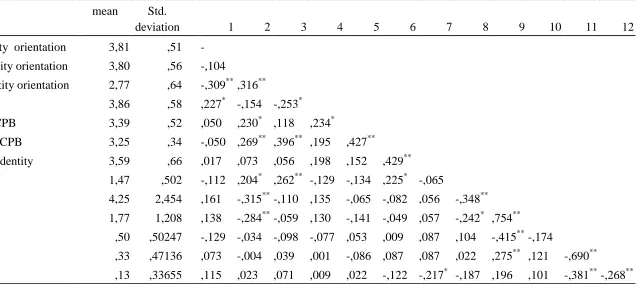
Means, Standard deviations and Correlations Between the Variables
* correlation is significant at the .05 level **correlation is significant at the .01level
mean Std.
deviation 1 2 3 4 5 6 7 8 9 10 11 12
1. personal identity orientation 3,81 ,51 - 2. relational identity orientation 3,80 ,56 -,104 3. collective identity orientation 2,77 ,64 -,309** ,316**
4. job/task CPB 3,86 ,58 ,227* -,154 -,253* 5. interpersonal CPB 3,39 ,52 ,050 ,230* ,118 ,234*
6. organizational CPB 3,25 ,34 -,050 ,269** ,396** ,195 ,427**
7. organizational identity 3,59 ,66 ,017 ,073 ,056 ,198 ,152 ,429**
8. sex 1,47 ,502 -,112 ,204* ,262** -,129 -,134 ,225* -,065 9. age 4,25 2,454 ,161 -,315** -,110 ,135 -,065 -,082 ,056 -,348** 10. tenure 1,77 1,208 ,138 -,284** -,059 ,130 -,141 -,049 ,057 -,242* ,754**
11. organization 1 ,50 ,50247 -,129 -,034 -,098 -,077 ,053 ,009 ,087 ,104 -,415** -,174 12. organization 2 ,33 ,47136 ,073 -,004 ,039 ,001 -,086 ,087 ,087 ,022 ,275** ,121 -,690**
18 Results
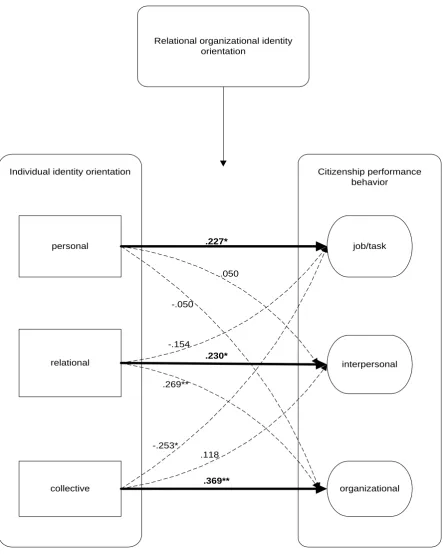
Means, standard deviations and correlations between the different variables are shown in Table 1. Figure 2 shows the correlations between identity orientations and citizenship performance behaviours.
Correlations between identity orientations
Personal identity orientation is not related to relational identity orientation r=.104 and is negatively related to collective identity orientation ( r=-.309, p < .01). Although the identity orientation scale is used to distinguish three independent identity orientations (Vos et al., 2009), a significant positive relation was found between the relational and collective identity orientation (r = .316 p < .01). Vos et al. (2009) explained the moderately high correlation between the relational and collective identity orientation they found by the possible overlap between the constructs: a group may not just be attractive to those who are collective oriented, but also for those who are relational orientated since a group may provide opportunities for close relationships. For those people a collective identity is about the relationships rather than depersonalized collectives (Vos et al., 2009). However the factor analyses in both the current study as the study by Vos et al. (2009) showed that the three identity orientations can clearly be distinguished as three separate constructs.
Correlations between citizenship performance behaviours
The correlation between job/task CPB and interpersonal CPB is small; r=.234 (p < .01). No correlation was found between job/task CPB and organizational CPB but a moderately high correlation was found between interpersonal CPB and organizational CPB; r=.427 (p < .01). The correlation between interpersonal and organizational CPB can also be explained by a possible overlap in both constructs. Helping a colleague is indirectly also beneficial to the organization and people may not make a very clear distinction in helping a specific other or the organization in general when it comes to acts of citizenship that are not directed at one's own job or task. This should not be a problem, because the factor analysis shows that the three citizenship performance behaviours can be distinguished from each other.
Correlations between identity orientations and citizenship performance behaviours
19
identity orientations and citizenship performance behaviours are mainly pointing in the expected direction as described in the theoretical part.
Individual identity orientation Citizenship performance
behavior
personal
relational
collective
job/task
interpersonal
organizational Relational organizational identity
orientation
.227*
.230*
.369**
.050
-.050
-.154
.269**
-.253*
.118
[image:20.595.74.518.118.673.2]
20
A positive relationship was found between personal identity orientation and job/task CPB (r=.227 p < .05) whereas no relationship was found between relational identity orientation and job/task CPB. Between collective identity orientation and job/task CPB a negative relationship was found (r=-.253 p <.05). A positive relationship was found between relational identity orientation and interpersonal CPB (r=.230 p < .05). No relationship was found between personal or collective identity orientation and interpersonal CPB. A positive relationship between collective identity orientation and organizational CPB was found (r = .369, p < .01). A positive relationship was also found between relational identity and organizational CPB (r=.269, p <.01). No relationship was found between personal identity orientation and organizational CPB.
These results show that relationships between identity orientations and citizenship performance behaviours exist. They indicate that identity orientation may explain differences in citizenship performance behaviour, and it seemed worthwhile to further investigate the relationship between identity orientation and citizenship performance behaviour. Therefore a regression analysis was conducted.
Regression analysis: testing hypotheses 1 a, b and c
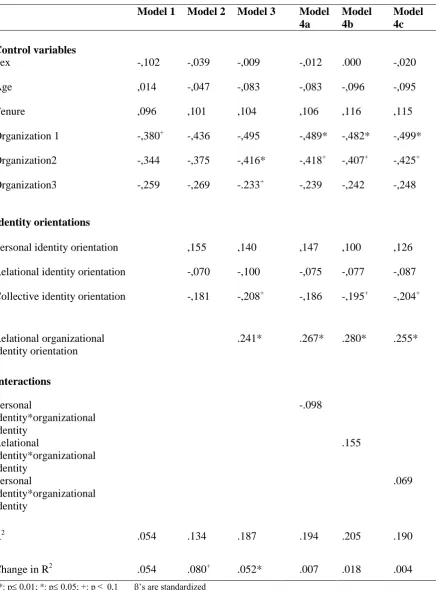
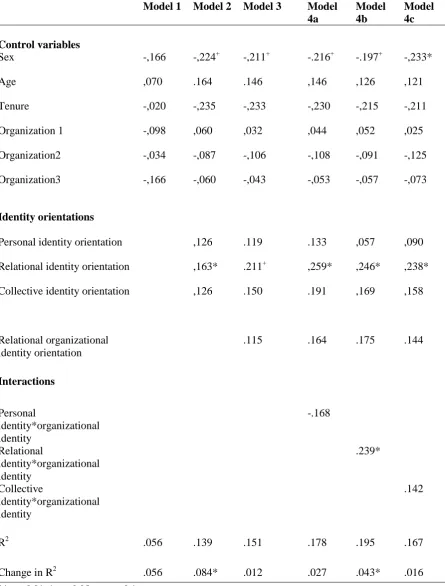
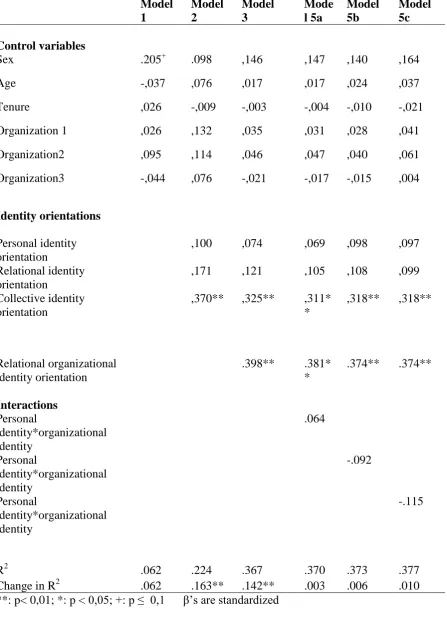
Table 2, 3 and 4 show the results of the regression analysis with respectively job/task CPB interpersonal CPB and organizational CPB as dependant variable. Because table 1 showed relationships with some of the control variables, they were controlled for in the regression analysis. Model 1 contains the control variables and in model 2, personal, relational and collective identity orientations were added to see if the identity orientations make a significant contribution in explaining the dependant variable.
21 Table 2
Regression Analysis with Job/task CPB as Dependent Variable.
Model 1 Model 2 Model 3 Model 4a
Model 4b
Model 4c
Control variables
Sex -,102 -,039 -,009 -,012 .000 -,020 Age ,014 -,047 -,083 -,083 -,096 -,095 Tenure ,096 ,101 ,104 ,106 ,116 ,115 Organization 1 -,380+ -,436 -,495 -,489* -,482* -,499* Organization2 -,344 -,375 -,416* -,418+ -,407+ -,425+ Organization3 -,259 -,269 -.233+ -,239 -,242 -,248
Identity orientations
Personal identity orientation ,155 ,140 ,147 ,100 ,126 Relational identity orientation -,070 -,100 -,075 -,077 -,087 Collective identity orientation -,181 -,208+ -,186 -,195+ -,204+
Relational organizational
identity orientation
.241* .267* .280* .255*
Interactions
Personal
identity*organizational identity
-.098 Relational
identity*organizational identity
.155 Personal
identity*organizational identity
.069
R2 .054 .134 .187 .194 .205 .190 Change in R2 .054 .080+ .052* .007 .018 .004
**: p 0,01; *: p 0,05; +: p ≤ 0,1 β‟s are standardized
22 Table 3
Regression Analysis with Interpersonal CPB as Dependent Variable.
Model 1 Model 2 Model 3 Model
4a
Model 4b
Model 4c
Control variables
Sex -,166 -,224+ -,211+ -.216+ -.197+ -,233* Age ,070 .164 .146 ,146 ,126 ,121 Tenure -,020 -,235 -,233 -,230 -,215 -,211 Organization 1 -,098 ,060 ,032 ,044 ,052 ,025 Organization2 -,034 -,087 -,106 -,108 -,091 -,125 Organization3 -,166 -,060 -,043 -,053 -,057 -,073
Identity orientations
Personal identity orientation ,126 .119 .133 ,057 ,090 Relational identity orientation ,163* .211+ ,259* ,246* ,238* Collective identity orientation ,126 .150 .191 ,169 ,158
Relational organizational identity orientation
.115 .164 .175 .144
Interactions
Personal
identity*organizational identity
-.168 Relational
identity*organizational identity
.239* Collective
identity*organizational identity
.142
R2 .056 .139 .151 .178 .195 .167 Change in R2 .056 .084* .012 .027 .043* .016
23 Table 4
Regression Analysis with Organizational CPB as Dependent Variable.
Model 1 Model 2 Model 3 Mode l 5a Model 5b Model 5c Control variables
Sex .205+ .098 ,146 ,147 ,140 ,164
Age -,037 ,076 ,017 ,017 ,024 ,037
Tenure ,026 -,009 -,003 -,004 -,010 -,021
Organization 1 ,026 ,132 ,035 ,031 ,028 ,041
Organization2 ,095 ,114 ,046 ,047 ,040 ,061
Organization3 -,044 ,076 -,021 -,017 -,015 ,004
Identity orientations
Personal identity orientation
,100 ,074 ,069 ,098 ,097
Relational identity orientation
,171 ,121 ,105 ,108 ,099
Collective identity orientation
,370** ,325** ,311* *
,318** ,318**
Relational organizational identity orientation
.398** .381* *
.374** .374**
Interactions Personal identity*organizational identity .064 Personal identity*organizational identity -.092 Personal identity*organizational identity -.115
R2 .062 .224 .367 .370 .373 .377
Change in R2 .062 .163** .142** .003 .006 .010 **: p< 0,01; *: p < 0,05; +: p ≤ 0,1 β‟s are standardized
24
Regression analysis: testing hypothesis 2
Hypothesis 2 predicted that an organization's relational identity orientation positively moderates the relationship between an individual's identity orientation and interpersonal citizenship performance. To test the possible moderating effects, regression analyses were conducted.
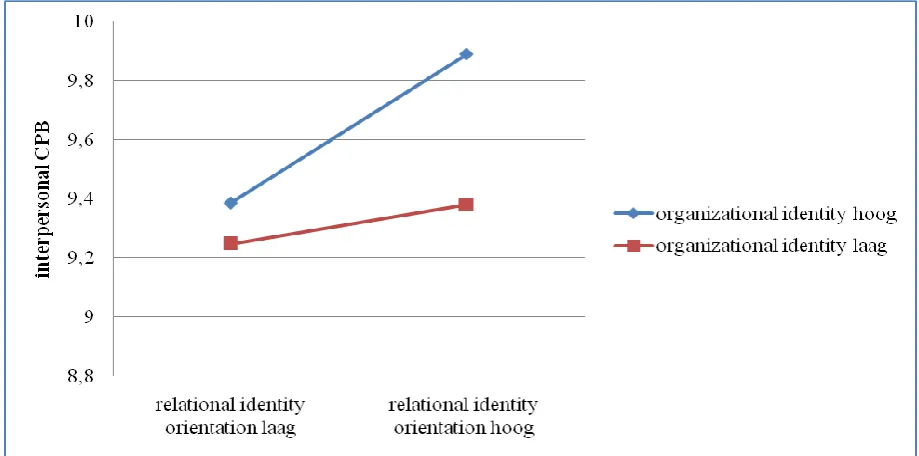
[image:25.595.71.531.464.692.2]In model 3, relational organizational identity orientation was added as an independent variable, after the control variables and the three identity orientations were added. It shows that adding relational organizational identity orientation as an independent variable significantly contributes in explaining job/task CPB and organizational CPB, but it does not contribute in explaining interpersonal citizenship performance behaviour. To investigate moderating effects, the interaction terms were computed. Model 4a, 4b and 4c show the effect of the interaction terms of respectively personal, relational and organizational identity orientation with relational organizational identity orientation on interpersonal CPB. The only significant moderating effect of relational organizational identity orientation was found in table 3. It shows that organizational relational identity orientation has a moderating effect on the relationship between identity orientation and interpersonal CPB. However, this effect was only found for the relational identity orientation and not for the personal or collective identity orientation. This partially confirms hypothesis 2.
25
Discussion and conclusion
The aim of this study was to examine the relation between different identity orientations and different foci of citizenship performance behaviour. Based on the extended model of self representations (Brewer & Gardner, 1996) and the integrative model of citizenship performance behaviour (Coleman & Borman, 2001) a research model was created, focusing on the relationships between both constructs. Hypothesis 1a, b and c predicted a relationship between identity orientation (personal, relational and collective) and citizenship performance behaviour (respectively job/task, interpersonal and organizational).
Hypothesis 1a predicted that a person with strong a personal identity orientation has a primary motivation to enhance his own wellbeing (Brewer & Gardner, 1996; Brickson, 2000) and would therefore focus on his own job or career and show behaviours that are beneficial to the self. Although personal identity orientation did make a positive contribution to job/task CPB, while both relational and collective identity orientation showed a negative effect on job/task CPB, none of the three identity orientations made a significant contribution in explaining job/task CPB. Therefore, hypothesis 1a cannot be confirmed.
Hypothesis 1b predicted that individuals with a strong relational identity orientation would show more interpersonal citizenship performance behaviour than individuals with a strong personal or collective identity orientation. A positive relation was found between relational identity orientation and interpersonal citizenship performance behaviour. No support was found for the relation between personal identity orientation and interpersonal CPB, nor for the relationship between collective identity orientation and interpersonal CPB. Furthermore the regression analyses show that the relational identity orientation is the only significant predictor in explaining interpersonal citizenship performance behaviour. This means that individuals who primarily focus on the relationships with others and identify themselves accordingly show more behaviour that is beneficial to other organizational members than personal or collective oriented individuals.
26
orientation. As pointed out before, this could indicate an overlap in these two constructs. It also suggests that both the relational and the collective identity orientations are predictors of organizational CPB. However, the results of the regression analyses show that only the collective identity orientation makes a significant contribution in explaining organizational citizenship performance behaviour. This means that individuals who focus on the group's wellbeing and identify themselves accordingly show more behaviour that is beneficial to the organization as a whole than personal or relational oriented individuals.
The second part of this study focused on the moderating effect of organizational identity on the relationship between identity orientation and citizenship performance behaviour, suggesting that interpersonal citizenship performance can be enhanced when the organization is perceived to be relational oriented. First the relational organizational identity orientation was added as an independent variable. Surprisingly it significantly contributed in explaining job/task CPB and organizational CPB, but it did not contribute in explaining interpersonal citizenship performance behaviour. A possible explanation is that interpersonal CPB is less bounded to a specific organization than job/task CPB and organizational CPB. You can keep helping your colleagues when you change jobs whereas it pursuing the best possible results in your tasks and acting in the best interest of your organization is directly related to the organization you work for.
The expected moderating effects were found only for relational oriented individuals. Both personal and collective oriented individuals did not show an increased interpersonal CPB when the effect of organizational identity was added in the regression analysis. Therefore hypothesis 2 can only partially be confirmed. A possible explanation why no moderating effect was found for personal and collective identity orientation can be found in PO-fit literature. Kristoff (1996, p.1) defined PO-fit as the “compatibility between people and the organizations in which they work.” Characteristics of individuals can be congruent with organizational characteristics and the degree of congruence or “fit” between individuals and organization can influence individuals‟ attitudes and behaviours (Argyris, 1957). Under the
27
28
Contributions, limitations and suggestions for future research
The main constructs -identity orientation and citizenship performance behaviour- stem from a rich line of research, but the conceptualizations used in this study are relatively new. In most research on identity orientation so far, a distinction is made between a personal and a collective self. This study is one of the first to use the extended model of self representation (Brewer & Gardner, 1996) which also includes a relational identity orientation. The construct of citizenship performance behaviour is not new in itself, but the conceptualization used in this study differs from the conceptualization of the more traditional organizational citizenship behaviour (OCB). The concept of CPB in this study makes a distinction of the entity towards the citizenship behaviours are directed (to either one‟s own job or task, to another member of
the organization or to the organizational as a whole). Also the job/task dimension is new in the construct of citizenship performance, since in previous research, citizenship towards another individual was not considered to be part of the citizenship behaviour construct. Coleman & Borman (2000) included the job/task dimension into their model, because excelling at your job, putting extra effort in and engaging in self development to improve your own effectiveness is beneficial to the organization. Return on investment is the basic reasons why organizations invest in their employees' development and their careers. However, one can argue that a focus on your own needs might be contradictory to the organizations' needs. For example, an employee might choose to work a few extra hours on his own project instead of going to a knowledge sharing meeting. Even more serious would be when an employee chooses to leave the organization for a career opportunity elsewhere. In this study no relation -negative or positive- was found between job/task CPB and organizational CPB. The results do not support a contradiction between these constructs. To be able to indicate such a contradiction, further research on the effects of different types of citizenship performance is needed.
29
correlations were reported for both scales, further research is needed to investigate if the scales can be used in different contexts. To measure identity orientation, an existing scale was used. This study was able to show that the identity orientation scale (Vos, van der Zee & Buunk, 2009) can be used outside an experimental setting.
It needs to be pointed out here that the results may have been distorted by common method variance because the constructs in this study were all measured using self-reports. Common method variance occurs when respondents have a tendency to answer consistently, even if those answers do not exactly reflect that respondents' opinion, feeling or behaviour. It causes systematic measurement error and can bias the estimates of the true relationship between the constructs (Podsakoff, Mackenzie, Lee & Podsakoff, 2003). Further research should focus on using different measurement methods, to minimize the chance of method variance.
The relationship between identity orientation and citizenship performance behaviour has not received much attention in research. This study shows that different types of CPB are in fact predicted by different identity orientations. It confirms that although the relational identity and the collective identity are not fully independent, they can be distinguished as separate constructs and they are related to different types of citizenship performance behaviour.
This study introduces the use of identity orientation on an organizational level in relation to identity and citizenship performance behaviour. It shows that a relational organizational identity strengthens the relationship between relational identity orientation and interpersonal citizenship performance behaviour. Identity on organizational level definitely deserves more attention in organizational research. Using a multilevel research model could lead to a better understanding of the effect of organizational identity orientation on a number of organizational behaviours. In this study, multilevel research was not an option, since the organizations did not significantly differentiate from each other. A suggestion for further research on identity orientation on organizational level would be to focus on the „fit‟ and 'misfit' between organizational identity and individual identity. For example, will a person with a strong individual identity orientation show more helping behaviour toward others when he/she works for a relational or collective organization?
30
within consultancies also indicate a strong personal orientation. A suggestion for further research would be to investigate multiple organizations, and determine the purity of identity orientation in consultancies and the effect of different identify orientations on citizenship performance behaviour.
Practical implications
This study has shown that individuals can have different identity orientation, but they have one identity orientation that is dominant. This means that people can interpret the same social situation differently, because they differ in their dominant identity orientation. This study has also shown that these different identity orientations are related to different types of citizenship performance behaviour. Although a person‟s identity orientation seems to be stable across time and situations, this study has shown that citizenship performance behaviour can be enhanced by the organizations identity orientation. These results have two important implications for organizations who wish to benefit from citizenship performance behaviour. First of all, it is interesting for organizations to know that a person‟s identity orientation is not the only predictor of citizenship performance behaviour. The organizational identity orientation also contributes to employee‟s behaviour. Unfortunately the organizational identity is embedded in organizational rituals, symbols and structures, which are not that easily changed. A more promising implication of this study is that organizations may want to consider using information about different identity orientations and related behaviour in personnel selection. For example, to avoid hiring a collectivistic oriented person for a job in a highly competitive setting, or explicitly look for someone with a strong relational orientation for a job that requires to have frequent contact with different people.
31 References
Albert, S., and D, Whetten (1985). Organizational identity. In B, M, Staw and L, L,
Cummings (Eds,), Research in Organizational Behavior, 7, 263-295, Greenwich, CT: JAI press.
Argyris C. (1957). Some problems in conceptualizing organizational climate: A case study of a bank. Administrative Science Quarterly, 2, 501-520.
Ashforth, B.E. & Mael, F. (1989) Social identity theory and the organization. Academy of Management Review, 14, (1) 20-39.
Barnard, C.T. (1938). The functions of the executive. Cambridge, MA: Harvard University Press.
Bateman T.S, & Organ DW. (1983). Job satisfaction and the good soldier: The relationship between affect and employee "citizenship." Academy of Management Journal, 26,
587-595.
Brewer M.B. & Gardner, W. (1996). Who is this „We‟?: Levels of collective identity and self representations. Journal of Personality and Social Psychology, 71, 83-93.
Borman, W.C. (2004). The concept of organizational citizenship. Current Directions in Psychological Science, 13 (6), 238-241.
Borman, W.C., & Motowidlo, S. J. (1993). Expanding the criterion domain to included
elements of contextual performance. In N. Schmitt, & W. C. Borman (Eds.), Personnel selection. Jossey-Bass Frontiers Series, San Francisco, CA.
Borman, W.C., & Motowidlo, S. J. (1997). Task performance and contextual performance: The meaning for personnel selection research. Human Performance, 10, 99 - 109. Borman, W. C., Penner, L. A., Allen, T. D., & Motowidlo, S. J. (2001). Personality predictors
of citizenship performance. International Journal of Selection and Assessment, 9, 52-69.
Brickson, S.L. (2000). The impact of identity orientation on individual and organizational outcomes in demographically diverse settings. Academy of Management Review, 25
(1), 82-101.
Brickson, S.L. (2005). Organizational identity orientation: Forging a link between
organizational identity and organizations‟ relations with stakeholders. Administrative Science Quarterly, 50, 576-609.
Brickson, S.L. (2007). Organizational identity orientation: The genesis of the role of the firm and distinct forms of social value. Academy of Management Review, 32 (3) 864-888. Cable, D.M. & DeRue, D.S. (2002). The convergent and discriminant validity of subjective fit
perceptions. Journal of applied psychology, 87 (5), 875-884.
Coleman, V.I., & Borman, W.C. (2000). Investigating the underlying structure of the
citizenship performance domain. Human resource management Review, 10 (1), 25-44. Cross, S.E., Bacon, P.L. & Morris, M.L. (2000). The relational-interdependent self-construal
and relationships. Journal of Personality and Social Psychology, 78, 791-808. Dutton, J.E. & Dukerich, J.M. (1991). Keeping an eye on the mirror: The role of image and
32
Dutton, J.E., Dukerich, J.M.& Harquail, C.V. (1994). Organizational Images and member identification. Administrative Science Quarterly, 39 (2), 239-263
Ellemers, N., De Gilder, D. & Haslam, S. H. (2004). Motivating individuals and groups at work: A Social Identity perspective on leadership and group performance. Academy of Management Review, 29 (3), p. 459-478.
Flynn, F.J. (2005). Identity orientations and forms of social exchange in organizations.
Academy of management review, 30 (4), 737-750.
Haslam, S.A., Powel, C. & Turner, J.C. (2000). Social Identity, Self- categorization, and Work motivation: rethinking the contribution of the group to positive and sustainable organizational outcomes. Journal of Applied Psychology: an international review, 4
(3), 319-339.
Haslam, S.A. (2001). Psychology in organizations. The Social Identity approach. London: SAGE publications Ltd.
Haslam, S.A., van Knippenberg, D., Platow, M. J. & Ellemers, N., (2003). Social identity at work: developments, debates, directions. In Haslam, S. A., van Knippenberg, D., Platow, M. J. & Ellemers, N., (Eds). Social identity at work: Developing theory for organizational practice (pp. 3-26). UK: Psychology Press.
Hoffman, B.J., Blair, C.A., Meriac, J.P & Woehr, D.J. (2007). Expanding the criterion
domain? A qualitative review of the OCB literature. Journal of Applied psychology, 92
(2), 555-566.
Hoffman, B.J. & Woehr, D.J. (2006). A quantitative review of the relationship between person–organization fit and behavioural outcomes. Journal of Vocational Behaviour, 68, 389–399.
Hogg, M.A. & Terry, D.J. (2000). Social identity and self-categorization processes in organizational contexts. Academy of Management Review, 25,(1), 121-140.
Van Knippenberg, D. & Van Schie, E. C. M. (2000). Foci and correlates of organizational identification. Journal of Occupational and Organizational Psychology, 73, 137-147. Kashima, E.S., & Hardie, E.A. (2000). The development and validation of the relational,
individual and collective self aspects (RIC) scale. Asian Journal of social psychology, 3, 19-48.
Kristoff, A.L. (1996). Person-Organization fit: An integrative review of its
conceptualizations, measurement, and implications. Personnel Psychology 49, 1-49. LePine, J.A. & Johnson, D.E. (2002). The nature and dimensionality of organizational
citizenship performance behaviour: a critical review and meta-analysis. Journal of applied psychology, 87 (1), 52-65.
Markus, H. & Kitayama, S. (1991). Culture and the self: implications for cognition, emotion and motivation. Psychological Review, 98, 224-253.
Moorman, R.H., Blakely, G.L. (1995). Individualism-collectivism as an individual difference predictor of organizational citizenship behaviour. Journal of organizational behaviour, 16, 127-142.
33
Organ, D.W., & Ryan, K. 1995. A meta-analytic review of attitudinal and dispositional predictors of organizational citizenship behaviour. Personnel Psychology, 48, 775– 802.
Penner, L. A., Midili, A. R., & Kegelmeyer, J. (1997). Beyond job attitudes: A personality and social psychology perspective on the causes of organizational citizenship behavior. Human Performance, 10 (2), 111-130.
Podsakoff, P.M., MacKenzie, S.B., Lee, J. & Podsakoff, N.P. (2003). Common method biases in behavioral research: a critical review of the literature and recommended remedies.
Journal of applied psychology, 88, (55), 879-903.
Podsakoff, P.M., MacKenzie, S.B., Paine, J.B., & Bachrach, D.G. (2000). Organizational citizenship behaviours: A critical review of the theoretical and empirical literature and suggestions for future research. Journal of Management, 26, 513–563.
Van Scotter, J. R., & Motowidlo, S. J. (1996). Interpersonal facilitation and job dedication as separate facets of contextual performance. Journal of Applied Psychology, 81, 525-531.
Smith, C. A., Organ, D. W., & Near, J. P. (1983). Organizational citizenship behaviour: Its nature and antecedents. Journal of Applied Psychology, 68, 453-463.
Tajfel, H., & Turner, J.C. (1979). An integrative theory of intergroup conflict. In Austin, W.G.& Worshel, S. (Eds.). Social Psychology of intergroup relations (p.33-47). Monterey: Brooks-Cole.
Trafimow, D., Triandis, H.C. & Goto, S.G. (1991). Some tests of the distinction between the private self and the collective self. Journal of Personality and Social Psychology,60,
649-655.
Triandis, H.C. (1989). The self and social behaviour in differing cultural contexts,
Psychological Review, 96, 506-520.
Turner, J.C. (1982). Towards a cognitive redefinition of the social group. In Tajfel, H. (Ed.). Social Identity and Intergroup relations (p. 15-40). Cambridge: Cambridge University Press.
Turner, J.C. & Giles, H. (1981). Introduction: The social psychology of intergroup behaviour. In Turner, J. C. & Giles, H. (Eds). Intergroup behaviour (p. 1-32). Oxford: Basil Blackwell.
Van Dick, R., Wagner, U., Stellmacher, J. and Christ, O. (2004). The utility of a broader conceptualization of organizational identification: Which aspects really matter?
Journal of occupational and organizational psychology, 77, 171-191
Van Dick, R., Grojean, M.W., Christ, O., & Wieseke, J. Identity and the extra-mile: Relationships between organizational identification and organizational citizenship behaviour. British Journal of Management, 17, 283-301.
Van Dyne, L.V., Cummings, L. L., & Parks, J. M. (1995). Extra-role behaviours: In pursuit of construct and definitional clarity (a bridge over muddied waters). Research in
Organizational Behaviour, 17, 215 - 285.
34
Van Dyne, L.V., Vanderwalle, D., Kostova, T., Latham, M.E., and Cummings, L.L. (2000). Collectivism, propensity to trust and self esteem as predictors of organizational citizenship in a non-work setting. Journal of organizational behaviour, 21, 3-23. Van Knippenberg, D. & Sleebos, E. (2006). Organizational identification versus
organizational commitment: Self-definition, social exchange, and job attitudes.
Journal of Organizational Behaviour, 27, 571–584.
Van Knippenberg, D. & Ellemers, N. (2003). Social identity and group performance:
identification as the key to group-oriented efforts. In Haslam, S. A., van Knippenberg, D., Platow, M. J. & Ellemers, N. (Eds.), Social identity at work: Developing theory for organizational practice (pp. 29–42). UK: Psychology Press.
Van Scotter, J. R., & Motowidlo, S. J. (1996). Interpersonal facilitation and job dedication as separate facets of contextual performance. Journal of Applied Psychology, 81, 525 - 531.
Vos, M.W., Van der Zee, K.I. & Buunk, A.P. (2009). Individual differences in self
representation: The development of a measure of personal, relational and collective identity orientation. Manuscript under revision
Vos, M.W. & Van der Zee, K.I. (2009). With a little help from my friends: Enhancing prosocial behavior in diverse work groups by focusing on relational identities. Manuscript submitted for publication.
Williams, L.J. & Anderson, S.E. (1991). Job satisfaction and organizational commitment as predictors of organizational citizenship and in-role behaviours. Journal of
1 Appendix A
Appendix B
Factor analysis: identity orientation
1 2 3
Collective identity orientation
Ik beschrijf mezelf graag als lid van de groepen waartoe ik behoor
,707 ,182 ,236 Bij belangrijke beslissingen ben ik sterk geneigd om af te gaan op
het oordeel van de groep waartoe ik behoor ,644 -,361
Voor mijn identiteit is het heel belangrijk om bij een groep te
horen ,801 ,169
Wanneer ik andere mensen ontmoet dan wil ik graag laten weten
bij welke groepen ik hoor ,708 -,235
Ik spiegel me vooral aan de groepen waar ik deel van uitmaak ,648 ,193 -,263
Ik ga graag op in de groep ,511 ,213 -,104
Het is belangrijk voor mijn zelfbeeld om tot een groep te behoren
Relational identity orientation
,722 ,321
Ik ben iemand die gemakkelijk z'n eigen gang gaat -,241 ,596 Het is voor mij heel belangrijk om mijn eigen ding te doen -,108 ,548 Ik denk dat ik een uniek individu ben met unieke eigenschappen
-,291 ,190 ,640
Ik geniet er van anders te zijn dan anderen ,692
Ik beschrijf mezelf graag in termen van unieke eigenschappen ,626 Ik denk dat ik zelf veel invloed op mijn identiteit heb -,396 ,193 ,209 Ik wil graag zichtbaar zijn als individu
Personal identity orientation
-,172 ,451 ,528
Ik geniet ervan relaties te onderhouden met anderen ,442 ,133 Ik denk dat de mensen die dicht bij me staan veel invloed op mijn
identiteit hebben ,250 ,508 -,242
Het is belangrijk voor mij om geaccepteerd te worden door de
mensen die dicht bij me staan ,180 ,688
Ik ga graag op in relaties ,445
Het is belangrijk voor mijn zelfbeeld om persoonlijke relaties te
hebben met anderen ,193 ,702 -,178
Ik wil graag gewaardeerd worden door de mensen die belangrijk
voor me zijn ,138 ,622
Het is belangrijk voor mij om sociale relaties met anderen te
onderhouden ,722 -,151
Appendix C
Factor analysis: citizenship performance behaviour
1 2 3
Interpersonal CPB
Ik help graag mijn collega's ook als ik het druk heb ,741 ,403
Ik heb veel over voor mijn collega's ,725 ,309
Ik doe altijd mijn uiterste best om nieuwe collega's te verwelkomen ,704 -,291 ,215
Ik stel mijn kennis en kunde altijd beschikbaar voor mijn collega's
Job/task CPB
,581 ,381
Ook onder hoge werkdruk wil boven verwachting presteren ,808
In mijn werk ga ik altijd voor het beste resultaat ,725
Ook onder lastige omstandigheden werk ik met enthousiasme
Organizational CPB
,595
Wanneer anderen mijn organisatie bekritiseren stel ik me altijd positief op ten
opzichte van mijn organisatie ,853
Ik handel altijd vanuit het belang van mijn organisatie ,322 ,746
Ik werk altijd volgens de regels en richtlijnen van mijn organisatie ,293 -,220 ,435