Extending CACI:
Implementing Support Functions for the
Context Producer and Designing a Security
Framework
Thesis for a Masters Degree in Telematics from the University of Twente, The Netherlands
By:
Tania Tariq
Graduation Committee
Abstract
Ubiquitous computing has gained considerable popularity in recent years due to the proliferation of mobile devices like laptops, mobiles phones and pocket computers. An emerging field in this regard is providing users with context-aware applications that are able to adapt themselves to their situations. The benefit of context-aware applications like smart homes is that they are able to sense information about the user’s environment and react automatically based on the input that they receive. This allows the application designer to provide users with newer and better services.
Unfortunately the distributed nature of participating entities when combined with the requirements for gathering/sensing, storing, advertising and accessing contextual information had lead many developers to believe that a broad deployment of context-aware applications requires a supporting infrastructure. A novel proposal of such a supportive platform is the Context Aware Component Infrastructure (CACI) which aims to assist application developers by abstracting from the details of where and how the context aware information is acquired. The developer only needs to indicate what type of information he/she requires and CACI will do the rest. In CACI terminology sources that provide the context information are called ‘context producers’ whereas applications that use this context information are called ‘context consumers’. Since CACI is still a work-in-progress, in this thesis we present our work on two outstanding issues related to CACI.
Table of Contents
CHAPTER 1
Introduction
1.1 Context-Aware Applications . . . 2
1.1.1 Middleware and CACI. . . 2
1.2 Motivation and Objectives. . . 3
1.2.1 Approach . . . 4
1.3 Structure. . . 5
CHAPTER 2
Context and Context Awareness
2.1 Understanding Context and Context-Awareness. . . 62.2 Evolution of Context-Aware Applications . . . 7
2.3 Context Aware Applications . . . 8
2.3.1 The Active Badge System . . . 8
2.3.2 The PARCTAB System . . . 8
2.3.3 Cyberguide. . . 8
2.3.4 CoolTown . . . 9
2.4 Context Aware Middleware. . . 9
2.4.1 The Context Toolkit. . . 9
2.4.2 Gaia . . . 10
2.4.3 A Service Oriented Context Aware Middleware (SOCAM) . . . 11
2.4.4 The PACE Middleware . . . 12
2.4.5 The Java Context Awareness Framework (JCAF). . . 13
2.5 Assessing Context-Aware Applications and Middleware . . . 13
CHAPTER 3
The CACI Middleware
3.1 Component Based Middleware . . . 153.2 Open Service Gateway initiative (OSGi). . . 16
3.2.1 OSGi Framework . . . 16
3.3 Context Aware Component Interface (CACI) . . . 18
CHAPTER 4
Support Functions for the CACI Context Producer
4.1 The CACI Binding Mechanism for Context Producers. . . 21
4.2 Design Decisions . . . 22
4.3 CACI Producer Advertisement Architecture. . . 22
4.3.1 CBDL Description . . . 23
4.3.2 Deployer and Parser. . . 24
4.3.3 Publisher . . . 25
4.3.4 CACI Database and GUI . . . 26
CHAPTER 5
Securing CACI
5.1 Wired vs. Wireless Networks . . . 285.2 Attacks: Passive and Active. . . 29
5.3 Security Building Blocks . . . 29
5.4 Cryptography . . . 31
CHAPTER 6
A Security Framework for CACI
6.1 Use Case: Epilepsy Safety System . . . 356.2 Security Requirements for CACI. . . 38
6.3 Non-Security Requirements for CACI . . . 39
6.4 Generic Security Frameworks . . . 40
6.4.1 Fully User Assisted Approach . . . 41
6.4.2 The Partially User Assisted Approach. . . 42
6.4.3 The Minimally User Assisted Approach . . . 44
6.5 A Standards Based Approach . . . 45
6.5.1 Context Discovery Phase . . . 47
6.5.2 Context Access Phase . . . 47
6.5.3 Revocation . . . 48
CHAPTER 7
Related Work
7.1 CACI . . . 49
7.1.1 Context Sensitive Bindings . . . 50
7.1.2 Service Oriented Network Sockets (SoNS) . . . 51
7.1.3 The OSGi Extended Service Binder . . . 51
7.1.4 Distinguishing Features of CACI vs Related Technologies . . . 52
7.2 Security . . . 52
7.2.1 Authentication, Authorization and Accounting . . . 52
7.2.2 X.509 Standard . . . 54
7.2.3 Kerberos and the KDC. . . 54
7.2.4 Security Assertion Markup Language (SAML). . . 55
7.2.5 WS-Trust . . . 56
7.2.6 Open-Id . . . 56
CHAPTER 8
Conclusions and Future Work
8.1 Conclusions . . . 588.1.1 CACI . . . 58
8.1.2 Security Framework for CACI. . . 59
8.2 Future work . . . 59
8.2.1 CACI . . . 59
8.2.2 Security Framework for CACI. . . 60
Terminology
. . . .
62
CHAPTER 1
Introduction
The arrival of mobile communication has brought with it a wave of change in the computing industry. This includes development of new types of applications which leverage on certain key features of mobile communication. Mobile and ubiquitous computing have heightened users’ expectations with respect to the accessibility of information [1, 2], with users feeling that they should be able to access information at any time and at any place.
The current trend in this direction has been to take the provision of information to the users one step further by providing them with contextual information. The intent is to move from the traditional explicit information request model to a new model where information is supplied based on the context. Although context-aware computing came to the limelight in the 1990s, ‘context’ is a well known concept. Well known because since time immemorial humans have used the context of situations and circumstance to enrich their comprehension and experiences. Humans are 'context-aware' without even realizing it [1, 4], and unconsciously acquire large amounts of additional information, or context, from the situation and the environment around them.
A great deal of research is being carried out to replicate this kind of ‘awareness’ in mobile applications. However a pre-requisite for such application development is that context and context-awareness have to be formally defined. Researchers have put forth various definitions of context-awareness, for example as “a term that describes the ability of the computer to sense and act upon information about its environment, such as location, time, temperature or user identity” [19]. It is noteworthy that existing context-aware applications can be described as monolithic entities which take in input from users, context from various sources and processes it to produce an output. These can generally be classified into either [1, 3]:
Office and meeting tools
Tourist guides
Context-Aware Applications
Memory aids.
1.1 Context-Aware Applications
A central challenge in the development of context-aware applications is (a) the collection and (b) the manipulation of contextual information. As an evolving research area there are as yet no standards for data interpretation and manipulation. Context-aware applications have traditionally been built using ad hoc processes that limit the development to specific application domains and, as such, restrict the expansion and reuse across disciplines [1]. The need for reuse and increased flexibility has resulted in research focusing on providing a solution to this problem. Reusability and flexibility are quite important because the field of computer science evolves very rapidly and applications must be reusable and flexible for them to remain relevant [21].
Context-aware applications have traditionally been developed using one of a number of available techniques, for example, tight coupling and sensor abstractions [1]. In tightly coupled applications the sensors which were used to generate context were hardwired into the application. As such it was extremely difficult and highly labour intensive to reuse the application with a new set of sensors. The next generation of context-aware applications were ‘sensor abstracted’ applications. These applications, unlike the tightly coupled applications before them, allowed freedom from the limitations of hardwired sensors by using daemons or servers to abstract from the sensors. Abstraction produced a new overhead, i.e. the application needs to deal with a different interface for every sensor (server) that it had to communicate with. Despite the advantage of abstracting from the sensors, these applications were not proactive with regards to the collection of context.
1.1.1 Middleware and CACI
The use of abstractions led application developers to consider the benefits of middleware for context-aware application development. The use of middleware allows the application developer to abstract from the underlying complexities of a computing environment and can generally be classified into:
Object-oriented middleware
Event-based middleware
Reflective middleware
Message-oriented middleware, or
Component middleware.
Motivation and Objectives
which has conducted research to assess the viability of component based middleware for context-aware applications.
“Component middleware is defined as a class of middleware that enables reusable services to be composed, configured, and installed to create applications rapidly and robustly” [16].
Such middleware allow the applications freedom from platform dependency, delineate the boundaries of components and provide well defined interfaces for the interaction of various components.
CACI has defined two types of basic entities. The first known as context consumers retrieve and use context information, and the second known as context producers create and offer context information. A context consumer is usually a context-aware application while a context producer is usually a sensor. To summarize, CACI utilizes component middleware to provide context-aware applications with key support functions such as the binding between context-producers and context-consumers. Binding [37] refers to the association of a context consumer to a producer. It is through this association that the consumer receives context information.
1.2 Motivation and Objectives
The CACI model utilizes component middleware for the collection and manipulation of context-information. Its goal is to simplify application development by providing applications with access to supporting infrastructure. This infrastructure provides binding between context consumers and context producers based on the consumers’ requirements, as specified in a CACI specific descriptive language called CBDL (CACI Binding Descriptive Language).
At the start of this project the binding facility offered by CACI was incomplete as it did not provide services for context producers. The existing prototype lacked the capability to dynamically add context producers. Furthermore, it did not have any features which allowed context producers to advertise their services. The prototype needed to be extended so that it could support binding of such context producers based on their requirements and offerings respectively.
Motivation and Objectives
Since CACI has been designed as a light weight middleware for mobile battery operated devices the main challenge in securing CACI lies not in the development of new security algorithms or protocols (a rich plethora of which already exist) but in the development of a framework suitable for mobile resource constrained devices. The main obstacle to securing mobile wireless environments is that the security mechanisms need to be robust while being lightweight and energy efficient [24]. This is because mobile devices are generally very constrained in terms of available resources such as battery life and processing power.
1.2.1 Approach
Summarizing, we have two main objectives in this work. The first is to design and implement an extension to CACI for providing services for context producers and the second objective is to design a security framework for CACI that is both robust and lightweight. At the conclusion of this project we should have:
Researched context, context-awareness and CACI.
Extended the CACI model to include support for context producers.
Incorporated the extensions for the context producer into the CACI prototype.
Identified CACI’s security requirements and any related system constraints.
Designed a suitable security framework for CACI that meets the above constraints.
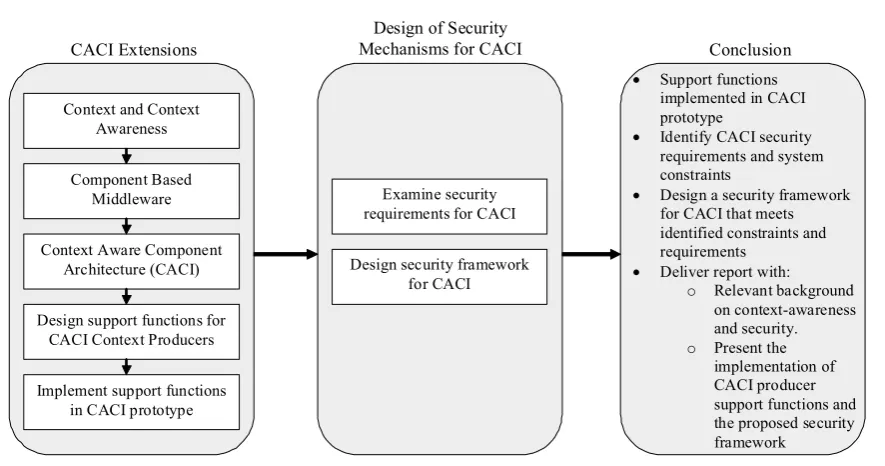
[image:9.595.76.519.493.726.2]A more diagrammatic representation of the structure of this project is illustrated in Figure 1.1.
FIGURE 1.1. Project Structure
• Support functions implemented in CACI prototype
• Identify CACI security requirements and system constraints
• Design a security framework for CACI that meets identified constraints and requirements
• Deliver report with:
o Relevant background on context-awareness and security.
o Present the implementation of CACI producer support functions and the proposed security framework Design of Security
Mechanisms for CACI
CACI Extensions Conclusion
Context and Context Awareness
Component Based Middleware
Context Aware Component Architecture (CACI)
Design support functions for CACI Context Producers
Implement support functions in CACI prototype
Examine security requirements for CACI
Structure
1.3 Structure
We have structured our work in two sections.
Section 1: CACI Context Producer
Chapter 2 provides the background information for context-awareness and context-aware applications. This chapter includes a comparison of context-aware applications to date and highlights the advantages of component based context-aware applications.
Chapter 3 gives an overview of middleware and more specifically component based middleware. Specifically, it also gives an overview of CACI where we highlight the need for a producer component.
Chapter 4 highlights the design for the support functions for the context producer component and its integration with CACI.
Section 2:Design of security architecture for CACI
Chapter 5 gives a brief overview of security topics that are of relevance when designing a security framework for a distributed system like CACI.
Chapter 6 discusses the security requirements for CACI with the help of a use case. We also highlight the system constraints imposed on our design and discuss various approaches for securing CACI.
Chapter 7 gives a brief discussion of various related technologies.
CHAPTER 2
Context and Context
Awareness
Although speech is the central feature of our interpersonal interaction, it is not the only tool that we use for communicating with our fellow human beings. We, as humans, have evolved a complex set of tools which we use to gather information in any given situation. When interacting with others we retrieve situational information from our environment, tone, inflection, body language etc. All of this additional information serves to better inform us about our situation. Application developers are working to emulate this awareness in computing.
Traditionally, computer applications have worked on an ‘explicit information request’ model i.e. where the applications have been provided with specific inputs in response to specific user requests. However, a move is being made gradually towards a more implicit model where applications will provide contextual information to users without them having to ask explicitly for it. This field of research is called context-awareness. The main premise of research in this domain is to create context-aware applications that provide the user with information based on the application's awareness of the user's environment.
2.1 Understanding Context and Context-Awareness
Since researchers have typically defined context based on the contextual requirements of the application being developed they have overlooked the need to explain the concept of context in a more general sense. The following are some of the definitions of context and context awareness that have been put forth by various researchers.
Evolution of Context-Aware Applications
The authors identify three important aspects of context, which are (a) where you are (b) who you are with and (c) what resources are nearby. They also explained that context can extend to include factors such as lighting, noise level, network connectivity etc.
Ryan, Pascoe and Morse, from the University of Kent at Canterbury, define context-awareness as “a term that describes the ability of the computer to sense and act upon information about its environment, such as location, time, temperature or user identity” [19].
Dey and Abowd, researchers at Georgia Tech, defined context aware computing as “an area of research where the human computer interface leverages knowledge of the user's context. Context includes, but is not limited to, information the user is attending to, emotional state, focus of attention, location and orientation, date and time of day, objects and people in the user's environment” [20].
It is clear that the afore mentioned definitions of context loose clarity outside of the scope of the applications for which they were intended. This was realized by Dey and Abowd [4] who proposed the following definition:
“Context is any information that can be used to characterize the situation of an entity. An entity is a person, place or object that is considered relevant to the interaction between a user and an application, including the user and application themselves.”
Furthermore, Dey and Abowd defined context-awareness as:
“A system is context-aware if it uses context to provide relevant information and/or services to the user, where relevancy depends on the user's task.”
This is our definition of choice when referring to context and context-awareness for the remainder of this report.
2.2 Evolution of Context-Aware Applications
Context-aware applications have undergone an evolutionary process with advancements in the complimentary fields of mobile and wireless communications and the decrease in cost of sensors. The first generation of context-aware applications were developed with tight coupling between the application and the sensors [1]. As such the sensors which these applications relied on for contextual information were typically hardwired into the application. Consequently these applications were both quite complex to create and highly inflexible.
Context Aware Applications
sensor. This generation of applications therefore, had more flexibility than the first. However inspite of an increase in flexibility, the task of creating an separate interface on a server for each sensor was still quite cumbersome.
The use of middleware is a well known means of addressing the issue of heterogeneity in a distributed computing environment. Middleware too has undergone an evolutionary process which has resulted in a number of middleware, each better suited to a specific situation. Middleware provide different levels of abstractions which provide network, platform and machine independence. Middleware such as CORBA, and JAVA provided application developers with a number of interfaces. The use of such interfaces frees the application developers from network or platform details, allowing them to focus on features such as the storage of context and notifications in the changes of context etc. This has also decreased the complexity of context-aware applications. Since providing flexibility and scalability are central to the design of middleware; their use in the development of context-aware applications has also increased their flexibility and scalability. Researchers are also looking towards creating middleware which are specifically tailored to handle the needs of context-aware applications.
2.3 Context Aware Applications
The following are brief introductions to some first and second generation context aware applications:
2.3.1 The Active Badge System
The Olivetti Research Lab created the Active Badge System in 1992. This system provides a mechanism for locating people within a building with the help of special badges. These badges emit unique infra-red signals periodically which are picked up by sensors placed at various locations within the building. The location of personal can be pinpointed based on the readings of these sensors. The active badge system is one of the earliest context-aware applications [1, 3, 6, 10].
2.3.2 The PARCTAB System
This system was created by the Xerox Palo Alto Research center in 1993. The central goal behind this system is to evaluate the viability of mobile computers in an office environment. To this end, the PARCTAB system provides its users with a handheld mobile computer that interacts with workstation-based applications wirelessly via infrared transceivers [3, 7, 10].
2.3.3 Cyberguide
Context Aware Middleware
Georgia Tech. Each of the visitors are provided with a handheld device which displays a map of the laboratory. Various areas of interest and information related to these areas are indicated on the maps. As the visitors moved about the lab, the mobile device provides them with information relevant to their current position. Incidentally, 'tour-guide' applications have since become the most commonly available form of context-aware applications [1, 3, 8, 10].
2.3.4 CoolTown
In 2001 Hewlett Packard Laboratories presented the idea of a ‘web-enabled world’ in which every device is connected to the Internet. In the CoolTown project, every person or device is represented as a web page that is consistently updated to reflect changes in the user's environment. Users are provided with updated information about their environment with the help of sensors and infra-red badges [9, 10].
2.4 Context Aware Middleware
The following are explanation of some of the context-aware middleware available to application developers. These middleware have been used to build various context-aware applications with limited success.
2.4.1 The Context Toolkit
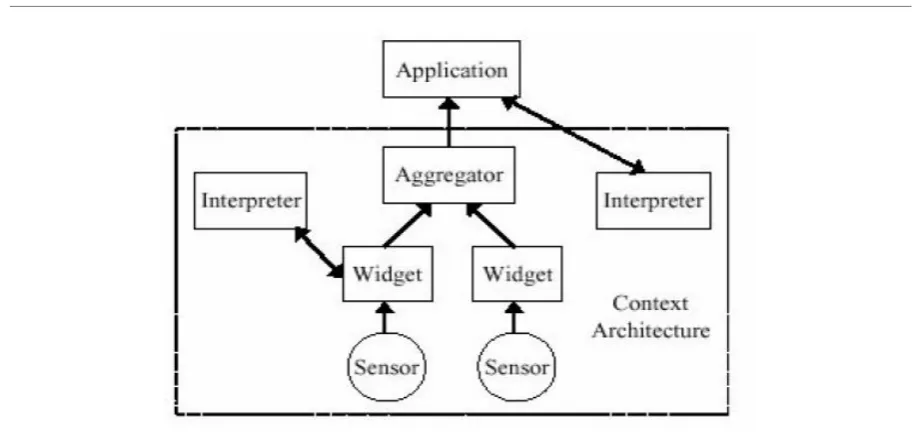
The Context Toolkit was proposed by Dey and Abowd in 1999. This toolkit aims to provide developers with an architecture that will support the development of context aware applications. The central focus of the toolkit is to separate the context acquisition process from the use of context within an application. To this end, the toolkit provides three abstractions, called widgets, servers and interpreters, which deal with the acquisition and delivery of context. [1,3]
Context widgets are software components that provide applications with access to context sensed from their operating environment. They free applications from the context acquisition process by hiding the complexity of the sensors from applications. Each widget encapsulates state and a set of event callbacks. The state is comprised of contextual information that applications can exploit via polling or subscribing. Callbacks represent the types of events that the widget can use to notify subscribing applications. The widget also maintains contextual state allowing other components to retrieve historical context information. [10]
Context Aware Middleware
Context interpreters are responsible for implementing the interpretation of context information. They transform between different representation formats or merge different context information to provide new representations. [10].
[image:15.595.67.526.218.436.2]The above mentioned abstractions are implemented as a set of Java objects. Please refer to Figure 2.1 for a diagrammatic representation of the Context Toolkit architecture.
FIGURE 2.1. Context Toolkit Architecture
2.4.2 Gaia
Context Aware Middleware
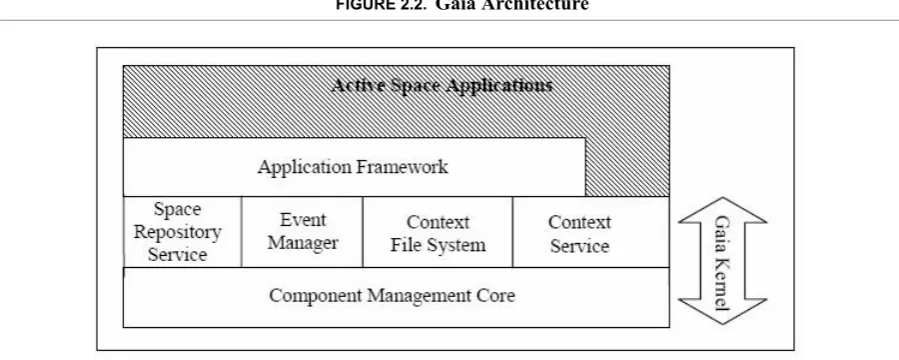
FIGURE 2.2.Gaia Architecture
The Gaia architecture is comprised of the Gaia kernel, the Gaia Application framework, and the applications (see Figure 2.2). The tools required for the development of active space environment applications are provided by the Gaia Application Framework. All other applications and non-kernel services which are running in the active space are housed in the active space application layer.
The Gaia kernel represents the minimum functionality that is required to activate a physical space. A physical space is defined as “a geographic region with limited and well defined physical boundaries, containing physical objects, heterogeneous networked devices, and users
performing a range of activities” [12]. The Component Management Core and four basic
services, namely the Event Manager Service, the Context Service, the Space Repository Service and the Context File System, make up the kernel. The component core and its supporting services are implemented with the help of middleware platforms. Currently, Gaia has been implemented in CORBA.
2.4.3 A Service Oriented Context Aware Middleware (SOCAM)
This middleware was proposed by researchers at the National University of Singapore in 2004. The central aim of this middleware is to provide an architecture for the rapid prototyping of context-aware applications. SOCAM converts different physical spaces where context is acquired into a semantic space where context-aware applications can share and access the context easily.
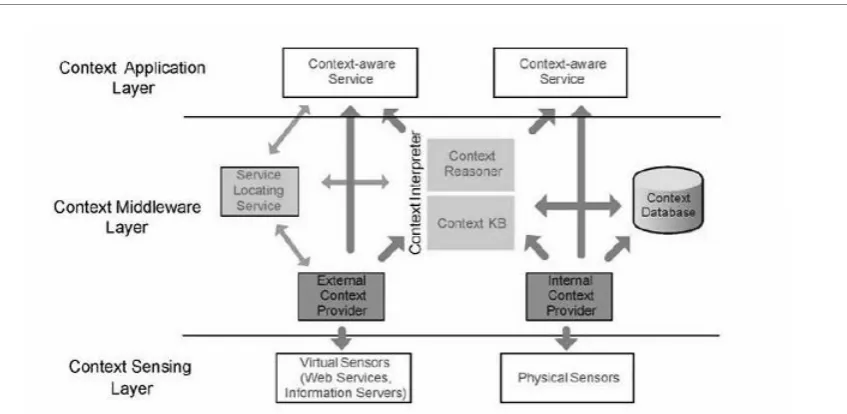
The SOCAM architecture is comprised of the following key components [13]:
Context Aware Middleware
Context Interpreters are responsible for providing the logic that is necessary to process the context information.
Context Databases are databases of context ontologies and past contexts
The Service Locating Service is responsible for providing a mechanism which allows users and context-aware applications to locate the various services which are advertising context.
[image:17.595.95.519.280.487.2]The SOCAM components have been implemented in JAVA. Please refer to Figure 2.3 [13] for a diagrammatic representation of the SOCAM architecture.
FIGURE 2.3. SOCAM Architecture
2.4.4 The PACE Middleware
The PACE middleware was presented by Henrickson et. al. in 2005 as a result of research conducted under the PACE project. The main components of this middleware are: the context management system, the preference management system, the programming toolkit and the messaging framework.
The context management system, as the name suggests, is responsible for the management of context-information. In addition to performing query evaluation, this system is responsible for the aggregation and storage of context. The context management system consists of a number of repositories, each of which is maintains a catalog containing the fact type and situation definitions of context models.
Assessing Context-Aware Applications and Middleware
actions are preferred by the user in the current context. The preference information of various applications is stored in one or more preference repositories.
The programming toolkit is responsible for providing the tools necessary to facilitate the interaction between the application components and the context and preference management systems. Finally, the messaging framework facilitates the remote communication between the components of context-aware systems.
2.4.5 The Java Context Awareness Framework (JCAF)
The Java Context Awareness Framework was proposed in 2005 by Jacob Bardram from the Center of Pervasive Computing at the University of Aarhus, Denmark. The central aim behind this proposal is to provide programmers with a simple framework that can be used in the development and deployment of context-aware applications. The framework provides a Java API that can be used to develop specialized context-aware applications. It is designed to support different implementations.
JCAF is comprised of two key components: a Context-awareness Runtime Infrastructure and a
Context-awareness Programming Framework. The central design features of the runtime
environment include providing the programmer with services that can be used in a distributed and cooperative manner. It also aims to provide the user with an infrastructure that is geared to react to the changes that are inherent to context applications. The provision of security has also been taken into account be the runtime infrastructure. The central aim of the programming framework is to provide the application developer with tools that make is easy to design and develop context-aware applications.
2.5 Assessing Context-Aware Applications and Middleware
In order to fully appreciate the motivation behind this research project, it is beneficial to look at the key features of the above mentioned context aware applications. Karren Henricksen [11] has provided the following as guideline for the requirements for middleware for context-aware applications:
Support for hertrogeneity: This is a key feature of middleware. Middleware must be able to provide support for legacy systems and a number of different underlying technologies and languages
Scalability: This a very important feature for all development projects including middleware. The middleware must scale well if the number of variables increase. For example the middleware is expected to perform well if the number of sensors increase from 10 to 100.
Assessing Context-Aware Applications and Middleware
application should not be compromised.
Ease of deployment: Finally, the middleware should be easy to deploy by both experts and non experts.
Please refer to [11] for a detailed explanation of the above mentioned features.
Binding: We have also added binding as one more requirement for the comparison of middleware. Binding [37] refers to the association of a context consumer to a producer. It is through this association that the consumer receives context information. Binding is a very crucial part of the context consumer and producer interaction. The application developer should be unaware of how the actual binding is created and maintained.
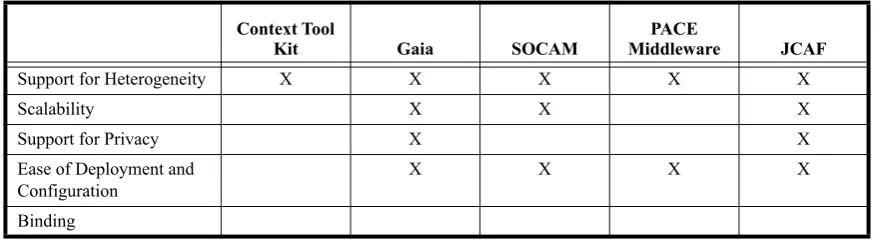
X - indicates features that are present in a specific middleware.
[image:19.595.77.518.282.403.2]Table 2.1 looks at the features supported by the middleware from section 2.4. We can see that application developers have so far not focused on features that facilitates the creation of bindings between context consumers and context producers. This failure has been addressed by the Awareness team [22] with the development of the Context-Awareness Component Infrastructure (CACI). Please refer to Chapter 3 for a more detailed explanation of CACI.
TABLE 2.1. Comparison of the various Context-Aware Applications and Middleware
Context Tool
Kit Gaia SOCAM MiddlewarePACE JCAF
Support for Heterogeneity X X X X X
Scalability X X X
Support for Privacy X X
Ease of Deployment and Configuration
X X X X
CHAPTER 3
The CACI Middleware
Distributed computing, leveraging on the pervasiveness of networked environments such as LANs and WANs, aims to enable interaction with services in a location independent manner and without concern for the underlying environment. This goal, however, is hard to realize in practice because of the heterogeneous nature of the underlying environments. The only scalable way to solve this problem is to provide developers with sufficient degrees of independence from the platforms, languages, machines and networks [14]. This independence is provide by a type of software known as middleware.
Middleware can be defined as “a distributed software layer or platform that abstracts over the complexity and heterogeneity of the underlying distributed environment with its multitude of network technologies, machine architectures, operating systems, and programming languages” [15].
As distributed applications have become more widespread, so too has middleware. Different types of middleware have been developed to provide support to different distributed environments. Middleware can typically be classified into object-oriented middleware, event-based middleware, reflective middleware, message-oriented middleware, and component middleware.
3.1 Component Based Middleware
“Component middleware is a class of middleware that enables reusable services to be
composed, configured, and installed to create applications rapidly and robustly” [16].
It has the following key features:
Open Service Gateway initiative (OSGi)
It defines standard container mechanisms that are needed to execute components in generic component servers.
It specifies the infrastructure to assemble, package, and deploy components throughout a distributed environment.
When using component middleware the actual business logic of an application is implemented in the application’s components. These components are housed within ‘containers’ and interact with the help of ports, interfaces, and connection points. The containers provide an execution environment for similar components. Finally, these containers and components can communicate via a middleware bus, and reuse common middleware services.
Next we present an overview of the OSGi component framework which forms the basis of the design and implementation of CACI.
3.2 Open Service Gateway initiative (OSGi)
The OSGi alliance is an open standards organization that has provided developers with a service oriented component based environment. It provides the specifications for a component framework and offers a standardized approach to manage software life cycles. The main aim of this specification was to provide software developers with a tool that would assist them not only in application development but, more importantly, also provide them with a standardized way to integrate existing components. The OSGi specification has been in use for a number of years now. Several implementation of the specification are available, for instance, Oscar, Knopplerfish, Equinox and Osxa.
3.2.1 OSGi Framework
Open Service Gateway initiative (OSGi)
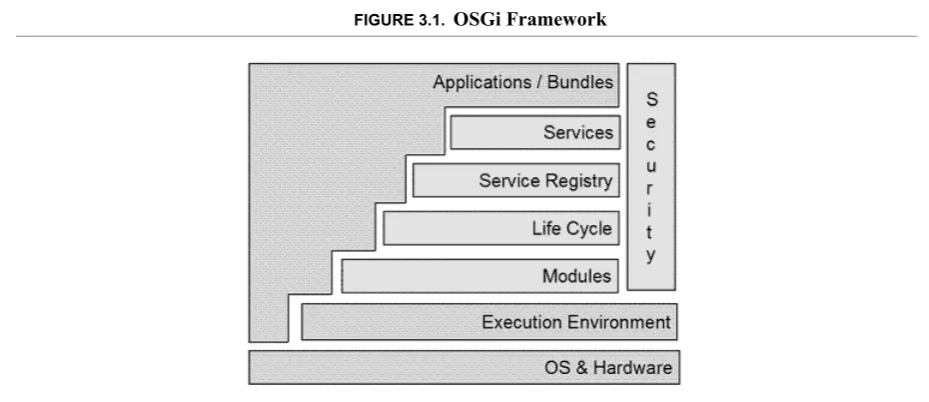
FIGURE 3.1.OSGi Framework
As can be seen in Figure 3.1, the framework is divided into a number of layers.
The execution environment is the specification of the Java environment.
The modules layer contains the definitions of the class loading policies. The class loading model in OSGi based on Java but with some additions.
The life cycle layer handles the life cycle management of bundles. The framework provides for the installation, the starting and stopping, updates and un-installations of bundles via this layer.
The service registry is responsible for providing the model for the sharing of objects between bundles. It also defines a number of events which organize the arrival and departure of services.
Security in the OSGi specifications is based on the Java and the Java 2 security model. This layer is responsible for enforcing the security requirements on the bundle at every other layer.
The OSGi alliance has designed a services layer on top of the framework. This layer provides many services which are specified via a Java interface. These services are implemented via applications and registered with the service registry. Once a service has been registered with the registry, clients of the service can find it. The following are examples of services being offered in release 4 of OSGi.
Framework Services: These services are related to the functioning of the framework.
Context Aware Component Interface (CACI)
Protocol Services: In OSGi provisions have been made for the mapping of external protocols onto OSGi service. All such services are being offered under the protocol services grouping.
In addition to the above mentioned services a number of miscellaneous services have also been specified [23]. At this point, CACI has been tested on the Oscar and Knopflerfish OSGi implementations both on PCs and windows mobile devices.
3.3 Context Aware Component Interface (CACI)
A typical context aware system has two types of entities. The first known as context
consumers retrieve and use context information, and the second known as context producers
create and offer context information. A context consumer is usually a context aware application while a context producer is usually a sensor. In order to exchange information, the context consumer must be bound to the context producer at run time.
Context-aware application have benefited from the creation of middleware which provide infrastructural support for the discovery and exchange of context information [11]. There is however no standardized way to support the creation of bindings between context producers and context consumers. These bindings are being created in existing applications by an explicit programming effort on the part of the application developer. The Context Aware Component Infrastructure (CACI) [22] aims to provide an infrastructure that will alleviate this problem. To this end, CACI shifts the responsibility of the establishment and creation of these bindings to the support infrastructure thereby freeing the application developer. It also provides application programmers a descriptive binding language that can be used to define context requirements on a high level of abstraction.
3.3.1 CACI Design and Implementation
CACI has therefore been defined as a client-side support infrastructure. It has been designed with a component oriented approach whereby both consumers and producers have been represented by components. These components have in-turn been defined inside a container with two ports namely, application ports and context ports. The application port is responsible for handling the functionalities being required or offered by the component whereas a context port is responsible for the context requirements or offerings of a component.
Context Aware Component Interface (CACI)
[image:24.595.95.506.215.585.2]CACI has been based on the OSGi component framework and is bundled as a standard OSGi component. It has been implemented such that a virtual container is created within the OSGi container. This virtual container interacts with the deployed components to establish the binding. As a result it is lightweight and can be deployed on different implementation of OSGi. The binding mechanism lies at the heart of CACI. Refer to Figure 3.2 for a diagrammatic representation of the functional blocks of the CACI binding mechanism.
FIGURE 3.2.CACI Functional Blocks
The following is a step by step explanation of the consumer binding mechanism, as implemented in CACI.
The deployer intercepts the component that is being deployed.
Once the component has been deployed, the parser can extract the CBDL description from it. When the CBDL context request has been extracted and parsed, it is stored in the CACI database.
Context Aware Component Interface (CACI)
The deployer then dispatches this request to the binder. The binder plays a key role in the consumer binding operation in CACI. Upon receipt of the request, the binder forwards it to the monitor. The monitor deploys a probe in the underlying discovery network. This is done so that the monitor can be informed of any changes. It is notified in the event of a producer’s disappearance or the arrival of new context producers. In the former case a new discovery process is initiated.
If the request is being sent to the monitor for the first time, it forwards the request to the discovery manager. The discovery manager conducts a search on the underlying discovery network for a context producer. Possible results of this search are sent to the decider which is responsible for selecting an appropriate context producer.
Once the appropriate producer has been selected the binder creates a proxy. The context requesting component is “bound” to the proxy via a proxy manager. The proxy is in turn bound to the real context producer.
The proxy manager is responsible for handling the binding between the requesting component and the proxy.
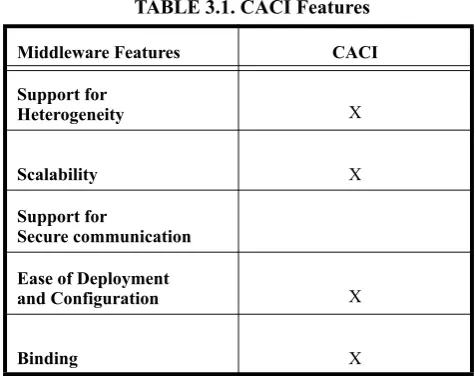
[image:25.595.182.420.469.657.2]CACI does not support context producers. A simulation function is currently being used to simulate the presence of context producers. One of the central goals of this research project is to provide support for context-producers in CACI. Once the support for context-producers has been added, CACI will be able to react to context advertisements by context producers. The following table rates CACI against the guidelines discussed in the previous chapter.
TABLE 3.1. CACI Features
Middleware Features CACI
Support for
Heterogeneity X
Scalability X
Support for
Secure communication
Ease of Deployment
and Configuration X
CHAPTER 4
Support Functions for the
CACI Context Producer
This chapter will discuss the design of the CACI context producer which has been successfully implemented in the CACI prototype. The actual code is a significant part of the project but can not be shown here.
4.1 The CACI Binding Mechanism for Context Producers
Since CACI is based on the OSGi component framework, the OSGi container has been extended to include a virtual container which represents CACI. This container interacts with the various components via the IContextProducerManager interface. The interface is responsible for the operations pertaining to the retrieval of and establishment with context producers. All underlying services which are required by CACI are deployed within the OSGi container as standard components. Please refer to Figure 4.1 for a diagrammatic representation of the high level implementation architecture of CACI.
FIGURE 4.1.Implementation Architecture of CACI
Container CACI binding
mechanism
Design Decisions
The CACI binding mechanism assumes the presence of a generic discovery mechanism. The current implementation of CACI uses the SimuContext repository [26] as the context producer discovery mechanism. SimuContext offers a library to simulate context producers. Developers can specify the characteristics of a producer that they wish to emulate via the SimuContext interfaces. Once a context producer has been created and registered via SimuContext it can be discovered by an application.
As explained in the previous chapter, CACI currently only provides support for binding requests initiated by context consumers. This limits the support that CACI can provide to applications developers who create both context consumers and developers.
4.2 Design Decisions
One of the main functional requirement of CACI was that CACI should establish a binding between a contest consumer and a producer based on the requirements specified by the context consumer developer and the offerings specified by the context producer developer. Furthermore, the end user should remain unaware of the creation of such a binding.
As the CACI consumer binding component has already been developed, any design decisions taken to develop the producer advertisement component have to be compatible with CACI’s existing architecture. Therefore, the CACI producer advertisement architecture closely follows the CACI consumer binding architecture.
Furthermore, a central design strategy of the CACI developers has been to ensure scalability and flexibility. To this end, adapters have been used where possible. The use of adapters makes it possible to plug-in new functions simply by ensuring that the new functions have compatible adapters. Adapters were, therefore, used in our design where possible.
4.3 CACI Producer Advertisement Architecture
CACI Producer Advertisement Architecture
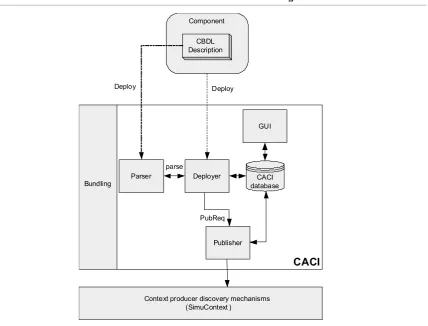
FIGURE 4.2. CACI Producer Functional Diagram
4.3.1 CBDL Description
The CACI component includes a CBDL description which specifies the context requirements of the component. In this way the CACI component is different from a standard OSGi component. This CBDL description is used by both context consumers and context developers to indicate to CACI their respective requirements.
A CBDL Document represents the context requirements of a component. This document can
be used to specify any number of binding and/or publishing requests. The binding requests indicate that the component is a context consumer whereas the publishing requests indicate that the component is a context producer. These requests can both be simultaneously present in a CBDL description. In such a case the component is both a context consumer and a context producer.
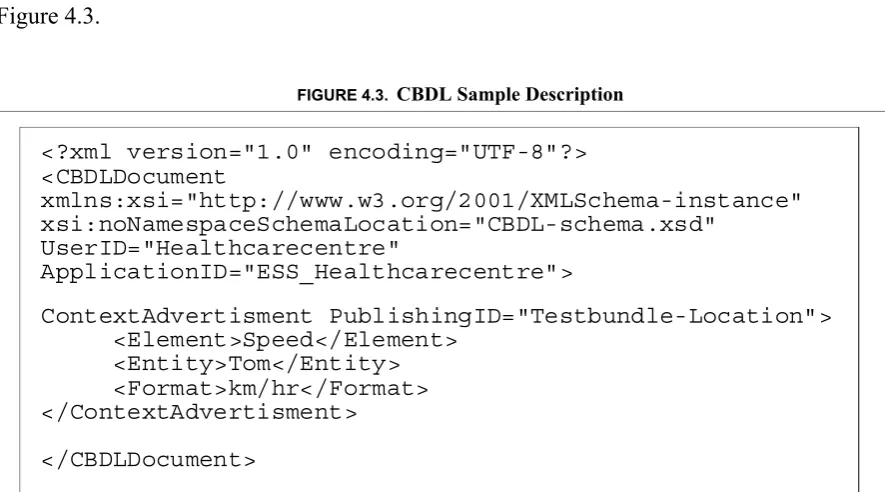
The particulars of the binding/publishing requests are specified with the help of various CBDL tags. A typical publishing request is comprised of an id, a producer entity, a context element
and a context format. The producer entity specifies who is producing the context information in the id field. The context element field is used to indicate a singular type of context information that is being offered. Finally, the format field comprises the kinds of formats that the advertised context information can be presented in. This field is flexible as the publisher may choose to use this field to specify formats. A sample publishing request is shown in
Context producer discovery mechanisms (SimuContext )
CACI
Deployer
Publisher Component
CBDL Description
Deploy
CACI database
GUI
Bundling Parser parse Deploy
CACI Producer Advertisement Architecture
Figure 4.3.
FIGURE 4.3. CBDL Sample Description
4.3.2 Deployer and Parser
When a component is deployed in the CACI container, it will be intercepted by the deployer component. This is made possible by using the bundle event mechanisms implemented by the OSGi framework. More specifically a bundle listener event is deployed which monitors bundle events such as bundle installations, if a bundle is started, stopped etc. When a bundle is deployed a CACI binding event is instantiated.
The deployer then checks to see if a CBDL description has been included in this specific bundle. If a CBDL description is found; then it is forwarded to the parser. The parser is responsible for checking the validity of the document. It is also responsible for extracting any publishing requests that may be present in the CBDL document. The deployer also checks the ID of this publishing request to ensure that it is new in the system. The publishing requests are handed over to the publisher.
<?xml version="1.0" encoding="UTF-8"?> <CBDLDocument
xmlns:xsi="http://www.w3.org/2001/XMLSchema-instance" xsi:noNamespaceSchemaLocation="CBDL-schema.xsd"
UserID="Healthcarecentre"
ApplicationID="ESS_Healthcarecentre">
ContextAdvertisment PublishingID="Testbundle-Location"> <Element>Speed</Element>
<Entity>Tom</Entity> <Format>km/hr</Format> </ContextAdvertisment>
CACI Producer Advertisement Architecture
FIGURE 4.4. The Deployer and Parser Adapter
The deployer and parser functions have been implemented with adapters called the
IDeployerAdapter and the IParserAdapter respectively (see Figure 4.4). A
OSGiDeployerAdapter and a CBDLParserAdapter are also shown in Figure 4.4. The
OSGiDeployerAdapter is responsible for notifying the deployer of any OSGi bundle events by using the notify method which is specified in IDeployerAdapterCallback. As the name suggests, the CCDLParserAdapter is responsible for using the notify function from
IParserAdapterCallback to notify the deployer of the CBDL descriptions that it has parsed.
4.3.3 Publisher
The publisher lies at the heart of the support functions for context consumers. The publisher receives the publishing requests from the deployer and advertises these requests to the underlying discovery mechanism (See Figure 4.5). The new publishing request is also stored in a database. Adapter classes were also used to implement the publishing functions in CACI. The AdvertAdapter and its interface, the IAdvertAdapter were created to assist the transference of the publishing request to the discovery mechanism. The presence of the adapter allows the flexibility of changing discovery mechanisms. Please refer to the appendix for a detailed look at the classes associated with the publisher and relevant adapters.
Deployer +setDeployer(in IDeployerAdapterCallback) +initDeployerAdapter() «interface» IDeployerAdapter 1 1 +setBundleContext(in BundleContext) OSGiDeployerAdapter
+parse(in CCDLInputStream, in Deployer) +setDeployer(in IParserAdapterCallback) +initParserAdapter() «interface» IParserAdapter 1 1 CCDLParserAdapter +notifyBindingRequest(in BindingRequest) «interface» IParserAdapterCallback
+notifyComponentInstall(in componentname, in CCDLpointer, in CCDLStream) +notifyComponentUninstall()
«interface»
IDeployerAdapterCallback
Parser 1 1
CACI Producer Advertisement Architecture
FIGURE 4.5. Deployer and Publisher Adapters
4.3.4 CACI Database and GUI
The CACI database is a repository of information that is used for administrative purposes. Information relating to the deployed components, various binding and publishing request are stored in it. Currently, the database is implemented in memory but future extensions envision a move towards more sophisticated implementations such as relational databases. Additionally, the current CACI GUI also relies on this database as it is a visual representation of the information stored in it. Figure 4.6 shows a view of the CACI GUI. Future work on CACI may include a more complex GUI.
Deployer
+setBundleContext(in BundleContext) OSGiDeployerAdapter +setDeployer(in IDeployerAdapterCallback) +initDeployerAdapter()
«interface» IDeployerAdapter +PublishAdvert(in AdvertRequest)
+TransformAdvertRequest(in AdvertRequest) AdvertAdapter
Publisher
+notifyComponentInstall(in componentname, in CCDLpointer, in CCDLStream) +notifyComponentUninstall()
«interface» IDeployerAdapterCallback +PublishAdvert(in AdvertRequest)
«interface»IAdvertAdapter
1
1
1 1
1
1
1
CACI Producer Advertisement Architecture
FIGURE 4.6. CACI GUI
CHAPTER 5
Securing CACI
The problem of security in the context of CACI can be summarized as the need to ensure the secure exchange of contextual information between distributed context producers and context consumers. Such a problem falls within the domain of network security. In this chapter we will focus on the different security concepts within this domain as well as how these concepts are implemented using cryptographic techniques.
5.1 Wired vs. Wireless Networks
Before we look at the problem of security in more detail, we would like to address one important question: Will CACI be deployed on a wired or wireless network? The reason this question is important is because securing a wired network is typically simpler than securing a wireless network. Wired networks offer security based on physical access which is enough in most cases. For example, a home where CACI enabled sensors and corresponding consumer applications are deployed in a wired setting. The inherent access control based on physical protection of the network means that since only authorized users have access to the network (someone with a key to enter the house) network security does not need to be specifically addressed. Even if this network is connected to an insecure network like the Internet, security can still be maintained using suitably configured firewalls at network entry points.
Attacks: Passive and Active
5.2 Attacks: Passive and Active
The main aim of security is to prevent attacks. Attacks are deliberate attempts to compromise the security of a system, usually exploiting weaknesses in the design or operation. Attacks against wireless communication are usually classified into two types: passive and active. Passive attacks attempt to learn information that does not affect the operation of the system e.g. eavesdropping on message content and traffic analysis. They are thus a threat against the confidentiality and anonymity of the communication. In section 5.3.3 we will introduce the concept of encrypting traffic to ensure confidentiality and in section 5.3.8 we will talk about anonymity.
On the other hand active attacks attempt to alter system resources or affect their operation by modifying and injecting packets into the network. Examples of active attacks are masquerading, replay, modification and denial of service. Section 5.3 will discuss the various mechanisms which are used to defend a framework against passive attacks. Passive attacks are typically more difficult to detect than active ones.
To summarize, it is much easier for unauthorized users to gain access to a wireless network in order to launch both active and passive attacks because:
Eavesdropping is easier.
Injecting fake messages into the network is easier.
Replaying previously transmitted messages is easier.
Launching Denial of Service (DoS) attacks is easier.
Next we look at some of the building blocks typically used to secure wireless communication. We will also give example of the commonly used security mechanisms to create these building blocks.
5.3 Security Building Blocks
The next step in our design process is identifying the types of security that a typical system requires. Under Information Assurance (IA) security functions can be classified as: confidentiality, integrity, authentication, availability, and non-repudiation [42]. However it is important to note that a secure system does not necessarily need all of these features in place. The eventual implementation of some or all of these security functions is dependant on the needs of the system.
Security Building Blocks
should not be possible for an adversary to disable a node or a service given by a node in the network. Denial of service attacks on wireless ad-hoc networks can be of many different types. On the physical and media access control layers an attacker can use jamming techniques to interfere with communication [27]. On network layer, a malicious node participating in the network can easily pollute the routing infrastructure by injecting fake messages [28]. On higher layers, the attacker could interfere with service discovery etc.
In general, it is hard to completely protect distributed devices against denial of service attacks. Physical layer attacks based on jamming can be resisted using mechanisms such as spread spectrum [27]. Other DoS attacks target finite resources e.g. fake authentication attempts in order to cause battery exhaustion. Such attacks can be resisted by lowering the cost of authentication. Furthermore introducing priority rules on the tasks performed can give some level of protection against battery exhaustion.
5.3.2 Authentication: Authentication allows the communicating parties to be assured of the each others identity. In computer security, authentication is performed by proving knowledge of a cryotpgraphic secret. Without authenticity it is difficult to provide availability, integrity and confidentiality because an attacker would be able to impersonate a legitimate node. The challenge in providing authentication in a distributed environment such as that envisioned for CACI is in key management. We would like previously unassociated CACI producers and consumers to authenticate each other seamlessly. Creating such credentials in a transparent and automatic manner is a challenging task.
Authentication protocols based on challenge-response are the simplest and most widely used authentication protocols today. In such a protocol, Alice issues a challenge to Bob whose response proves that he knows a valid cyptographic secret. When authentication is mutual (i.e. mutual-authentication), Bob will also challenge Alice who must in turn prove her knowledge of a valid cyptographic secret. Other well-known authentication mechanisms are based on biometrics.
5.3.3 Confidentiality: Confidentiality ensures that the information transmitted between two parties can only be accessed by the intended receiver. Wireless transmission is easy to eavesdrop so messages traveling over the wireless medium must be protected.
In wireless communication confidentiality is typically enforced using encryption ciphers such as The Data Encryption Standard (DES), the Triple DES (3DES) and the Advanced Encryption Standard (AES) [27]. Note however that the confidentiality of stored information is a different matter altogether and is related to the problem of tamper resistance. The use of tamper resistant modules to store sensitive information is well known, but their widespread use is discouraged due to increased cost of devices.
keyed-Cryptography
Hash Message Authentication Codes (HMAC) such as MD5 and SHA-1 (section ).
5.3.5 Authorization: Given the insecure nature of wireless communication it is important that access to network resources should only be provided to legitimate entities. Authorization typically follows authentication and is this closely linked with it.
Authorization is generally provided using access control based on policies. Although the Policy Enforcement Point (PEP) [29] is almost always the service equipment, functionality related to the Policy Decision Point (PDP) [29] can be out sourced to a trusted third party. This is usually done in large centralized environments such as corporations where all policies reside and are evaluated at a central entity. Having a single point of control reduces the overhead of management and means that any changes made at the central entity are immediately reflected in the network.
5.3.6 Replay detection: Replay detection ensures the freshness of the messages received over the wireless link. It is usually carried out by adding sequence numbers or time stamps to transmitted messages. Duplicate messages are detected based on the repeated sequence number or expired time stamps and are then discarded.
5.3.7 Non-repudiation: Non-repudiation is the concept of ensuring that the sender or receiver of a message can not deny having sent it or received it. It is the opposite of plausible deniability. Non-reputation can only be done using cryotpgraphic techniques that are asymmetrical. Consequently the most popular way to guarantee non-repudiation in computer communication is to use digital signatures (section 5.4.5 ).
5.3.8 Anonymity: Often a basic expectation from the user is that sensitive information related to him should not be revealed without his consent. Sensitive information does not only includes the identity of the user but also things linked to his identity such as his geographical position.
In the next section we provide an introduction to cryptographic algorithms and protocols used to provide the main security services described above.
5.4 Cryptography
The above security functions are usually implemented using cryptographic techniques. In computer communication cryptography is the process of modifying data using a secret known as a key such that it ensures some security properties. In this section we will introduce some relevant security mechanims based on cryptography. We will look at mechanisms for encryption, Hash function, Hash Message Authentication Codes and Digital signatures.
Cryptography
[image:37.595.79.515.194.294.2]mathematical algorithm (E) that uses the key (K) to transform the data (m) into an alternate form called the cipher text (EK(m)). The ciphertext can be decrypted (D) back in the plain text using a correct key. An encryption algorithm is secure if it is extremely difficult, if not impossible, to revert back to the original information from just the cipher text i.e. without knowing the key. This is illustrated in Figure 5.1 .
FIGURE 5.1. Encryption and Decryption
A key is a piece of information, such as a password, that allows the holder to encode or decode information. As such a recipient of an encoded message must have the key or some related information to decode the message. Key based algorithms are usually categorized as asymmetric (section 5.4.3 ) or symmetric (section 5.4.2 ).
5.4.2 Symmetric Encryption: In symmetric encryption the same key is used for both the encryption and decryption of a message. Therefore in the figure above K = K’. Before an individual can send encoded information to someone, they must communicate the key to this person. This is because the recipient will be unable to decode the message unless he/she has access to this key. This form of encryption is very efficient and requiring minimal processing power. Key management is a major drawback of this type of cryptographic technique. If either the sender’s or the recipient’s key should get compromised, an intermediate person can decrypt and read the messages.
All encryption schemes can be classified into two basic categories. Those based on symmetric cryptography and those on asymmetric cryptography. When encrypting bulk data, symmetric encryption is preferred due to its lower overhead. The most popular asymmetric key encryption methods are several orders of magnitude slower than the best known symmetric key schemes.
The two main types of ciphers based on symmetric cryptography are those that process the plaintext in large blocks of characters and those that operate on individual characters of plaintext. The former are called block ciphers, and the latter stream ciphers. The exact cipher to use is beyond the scope of this document and depends on the type of information being protected. Reference [30] presents a detailed benchmark for a selection of block ciphers. The authors take into account the security properties, storage and energy efficiency of a set of candidates and arrive at a selection of block ciphers and operation modes.
5.4.3 Asymmetric Cryptography: Encryption in asymmetric cryptography takes place with
E D
m plaintext
K
encryption key decryption keyK’ EK(m)
ciphertext
DK’(EK(m)) = m
Cryptography
use of a pair of keys: the private key and the public key. Therefore in the figure above K!= K’. Furthermore it is computationaly infeasible to compute K’ from K.
The public key is used to encrypt the message whereas the private key is used to decrypt it. In this scheme a sender can freely distribute his/her public key, however there must be a secure means of linking the public key with the identity of the person. One approach to preventing such attacks is by using a certificate authority. The certificate authority is a trusted third party which issues a digital certificate that has been signed stating that this key belongs to a particular person.
People wishing to send encrypted messages to the receiver can do so by using the public key of the receiver. The main advantage of asymmetric key cryptography is that as the key used for encryption is public, so there is no danger of the key being compromised. RSA, Diffie-Helman and El Gamal are examples of some popular public key algorithms.
[image:38.595.78.517.403.516.2]5.4.4 Hash Functions. Hash Functions: Hash functions are a mathematical operation (usually ease to compute) that map a bit string of finite length in to a bit string of fixed length. This is illustrated in the figure below.
FIGURE 5.2. Hash Function
Although hash collisions due to the many-to-one mapping are unavoidable, finding such collisions of a given message is difficult. The hash of a message serves as a compact representative image of the message (like a fingerprint).
5.4.4.1 Hash Message Autentication Codes (HMACs): HMACs are hash functions that also accept key along with the message. Similar to hash functions, they also produce an output known as a Message Authentication Code (MAC) that is a bit string of fixed length. This MAC is appended to each message transmitted over the insecure channel. When the message is received by the destination it generates a new MAC using the shared key and compares it with the MAC included with the message. If the two MACs are identical it means that the message was sent by the correct sender and not modified in transit. This message is illustrated in Figure 5.3 .
message of arbitrary length
fix length
hash value / message digest / fingerprint hash
Cryptography
FIGURE 5.3.HMACs
Given the mathematical properties of a hash function it is not computationally feasible to produce a correct MAC for a message without knowing the correct key. Therefore without knowing the secret key, attackers cannot modify the MAC of transmitted packets without detection, or generate new packets with a correct MAC. Consequently HMAC functions are used to implement data integrity and authentication.
CHAPTER 6
A Security Framework
for CACI
CACI is a middleware that offers services to context consumers and producers in a distributed environment. Loosely coupled and physically distributed systems such as CACI rely on the transmission of messages and events that need to be secured before such systems can be widely deployed. The identity of entities involved, the authorization to access available services and the privacy and integrity of transmitted messages must all be established. Consider the typical example of a health monitoring application based on CACI. This context-aware application takes as inputs the medical data about a user and outputs an alarm to a health service if the heart rate goes above a certain threshold. We want to ensure that the information being provided by the application is only visible to the necessary individuals i.e. the doctors. Similarly, the doctors should have the assurance that the information has indeed come from the right person. Furthermore, we would also like to ensure that the information that is being transferred has not been tampered with in any way.
In this chapter we follow a systematic approach to designing a security framework for CACI. We begin by describing a typical use case for CACI that highlights its security requirements. Once we have matched these security requirements to the security functions of section 5.3, we describe the system constrains that must be kept into account when designing security for CACI. Next we analyze three generic security frameworks for distributed environments and select the one that best suits the requirements and constrains we identified earlier. Finally, we recommend a standardized security framework that corresponds to the generic model that we selected.
6.1 Use Case: Epilepsy Safety System
Use Case: Epilepsy Safety System
some cases by surgery. Sufferers of epilepsy find that their quality of life suffers greatly due to the unpredictability of their seizures.
Research has shown that these seizures can be predicted by monitoring the various vital signs such as blood pressure, heart rate, brain activity etc. of a patient in question. The Epilepsy Safety System (ESS) leverages this knowledge to provide epilepsy patients with a system that can help improve their quality of life. The ESS utilizes context information such as the patient's current location and the location of the patient's care-giver to provide customized care. If a seizure is detected, the ESS takes appropriate actions such as directing the primary care givers to the patient's current position. The ESS also utilizes context information to conclude what to do should the primary caregiver be unreachable, whether to trigger first-aid assistance if the vital signs indicate only a mild seizure etc.
6.1.2 Scenario: Emily, who is an epilepsy patient, lives in Enschede. Upon discovering that the weather will be especially warm this weekend, she has decided to visit the beach in The Hague. Emily always travels with her PDA which is the local component of the ESS. That is, Emily's vital signs are monitored via a special bracelet that she wears. This bracelet communicated her vitals to the PDA which is responsible transmitting this information to her health monitoring service.
She takes the bus to the beach where she spends a few nice hours enjoying the sun. However, after a few hours the ESS realizes that her vitals are symptomatic of the onset an epileptic seizure. When the ESS detects the onset of a seizure it notifies the health monitoring service of Emily’s condition and her current location. This service in turn notifies a doctor in Emily's vicinity, Emily's primary physician and her family.
The doctor is provided with Emily's exact location so that he may provide her with the essential medical attention that she requires. Emily's primary physician in Enschede is also apprised of the situation (but not her location) because when Emily returns to Enschede he may want to alter her medicine or dosage. Finally, Emily's family may be informed (if so decided by Emily) so that they may be able to assist her if they wish.
6.1.3 Analysis and Requirements: This story illustrates how the ESS can be used to help a person such as Emily avoid a potentially life-threatening situation. Because her vital signs were constantly being monitored, Emily was not house bound and could go out and enjoy the weather. Furthermore, upon receiving indications that Emily might get a seizure, the health care providers were able to ensure that she had the required medical assistance that she needed on time. In essence the ESS being sensitive to Emily’s context is able to provide her with a better quality of life.
Use Case: Epilepsy Safety System
Privacy: It is important to realize that Emily's privacy needs to be protected. She needs to be sure that her vital signs are not sent to the wrong parties and unauthorized people should not be able to eavesdrop on such communication. Furthermore, even though Emily's doctor in Enschede is allowed to query her vital signs at any time he may not be allowed to query her location. For example in the ESS use case, the PDA communicated Emily’s location to the health monitoring service but there was no need for other parties to be informed of Emily's location. Also it may be necessary to ensure that eavesdroppers are unable to see whose vitals are being monitored let alone what those vitals are. Thus the identity of the party may need to stay anonymous.
With respect to “Security Building Blocks” (see section 5.3), we can identify authentication, confidentiality, authorization and anonymity as the underlying security functions required to support privacy. In this work our focus will be on designing a security framework for CACI that supports our requirements for authentication and authorization. Once authentication is performed, other security functions such as confidentiality, integrity, replay detection etc. can be provided easily by leveraging on the resultant cryptographic keys and using any of the well researched encryption algorithms, for instance those mentioned in sections 5.3.3 and 5.3.4. In the above use case, anonymity can be provided by using virtual identities that can only be mapped to real world identities when presented with proper authorization. Since the exact mechanism to provide anonymity will vary from situation to situation, a in-depth framework for anonymity will not be a part of our generic security framework.
Trust: Trust is another key feature of any context-aware system. When prod