KNOWLEDGE REPRESENTATION FOR COMMONSENSE REASONING
WITH TEXT
Kathleen Dahlgren
Joyce McDowell
IBM Los Angeles Scientific Center E d w a r d P. Stabler, J r . l University of Western Ontario
1 INTRODUCTION 1.1 NAIVE SEMANTICS
The reader of a text actively constructs a rich picture of the objects, events, and situation described. The text is a vague, insufficient, and ambiguous indicator of the world that the writer intends to depict. The reader draws upon world knowledge to disambiguate and clar- ify the text, selecting the most plausible interpretation from among the (infinitely) many possible ones. In principle, any world knowledge whatsoever in the read- er's mind can affect the choice of an interpretation. Is there a level of knowledge that is general and common to many speakers of a natural language? Can this level be the basis of an explanation of text interpretation? Can it be identified in a principled, projectable way? Can this level be represented for use in computational text understanding? We claim that there is such a level, called naive semantics (NS), which is commonsense knowledge associated with words. Naive semantics identifies words with concepts, which vary in type. Nominal concepts are categorizations of objects based upon naive theories concerning the nature and typical description of conceptualized objects. Verbal concepts are naive theories of the implications of conceptualized events and states. 2 Concepts are considered naive be- cause they are not always objectively true, and bear only a distant relation to scientific theories. An informal example of a naive nominal concept is the following description of the typical lawyer.
1. If someone is a lawyer, typically they are male or female, well-dressed, use paper, books, and brief- cases in their job, have a high income and high status. They are well-educated, clever, articulate, and knowledgeable, as well as contentious, ag-
gressive, and ambitious. Inherently lawyers are adults, have gone to law school, and have passed the bar. They practice law, argue cases, advise clients, and represent them in court. Conversely, if someone has these features, he/she probably is a lawyer.
In the classical approach to word meaning, the aim is to find a set of primitives that is much smaller than the set of words in a language and whose elements can be conjoined in representations that are truth-conditionally adequate. In such theories "bachelor" is represented as a conjunction of primitive predicates.
2. bachelor(X) ¢~ adult(X) & human(X) & male(X) & unmarried(X)
In such theories, a sentence such as (3) can be given truth conditions based upon the meaning representation of "bachelor," plus rules of compositional semantics that map the sentence into a logical formula that asserts that the individual denoted by " J o h n " is in the set of objects denoted by "bachelor."
3. John is a bachelor.
The sentence is true just in case all of the properties in the meaning representation of "bachelor" (2) are true of " J o h n . " This is essentially the approach in many com- putational knowledge representation schemes such as KRYPTON (Brachman et al. 1985), approaches follow- ing Schank (Schank and Abelson 1977), and linguistic semantic theories such as Katz (1972) and Jackendoff (1985).
Smith and Medin (1981), Dahlgren (1988a), Johnson- Laird (1983), and Lakoff (1987) argue in detail that all of these approaches are essentially similar in this way and all suffer from the same defects, which we summarize
Copyright 1989 by the Association for Computational Linguistics. Permission to copy without fee all or part of this material is granted provided that the copies are not made for direct commercial advantage and the CL reference and this copyright notice are included on the first page. To copy otherwise, or to republish, requires a fee and/or specific permission.
0362-613X/89/010149-170503.00
Kathleen Dahlgren, Joyce McDowell, and Edward P. Stabler, Jr. Knowledge Representation for Commonsense Reasoning with Text
briefly here. Word meanings are not scientific theories and do not provide criteria for membership in the categories they name (Putnam 1975). Concepts are vague, and the categories they name are sometimes vaguely defined (Labov 1973; Rosch et al. 1976). Mem- bership of objects in categories is gradient, while the classical approach would predict that all members share full and equal status (Rosch and Mervis 1975). Not all categories can be decomposed into primitives (e.g., color terms). Exceptions to features in word meanings are common (most birds fly, but not all) (Fahlman 1979). Some terms are not intended to be used truth-condition- ally (Dahlgren 1988a). Word meanings shift in unpre- dictable ways based upon changes in the social and physical environment (Dahlgren 1985b). The classical theory also predicts that fundamentally new concepts are impossible.
NS sees lexical meanings as naive theories and denies that meaning representations provide truth con- ditions for sentences in which they are used. NS ac- counts for the success of natural language communica- tion, given the vagueness and inaccuracy of word meanings, by the fact that natural language is anchored in the real world. There are some real, stable classes of objects that nouns are used to refer to, and mental representations of their characteristics are close enough to true, enough of the time, to make reference using nouns possible (Boyd 1986). Similarly, there are real classes of events which verbs report, and mental repre- sentations of their implications are approximately true. The vagueness and inaccuracy of mental representa- tions requires non-monotonic reasoning in drawing in- ferences based upon them. Anchoring is the main explanation of referential success, and the use of words for imaginary objects is derivative and secondary.
NS differs from approaches that employ exhaustive decompositions into primitive concepts which are sup- posed to be true of all and only the members of the set denoted by
lawyer.
NS descriptions are seen as heuris- tics. Features associated with a concept can be overrid- den or corrected by new information in specific cases (Reiter 1980). NS accounts for the fact that while English speakers believe that an inherent function of a lawyer is to practice law, they are also willing to be told that some lawyer does not practice law. A non-prac- ticing lawyer is still a lawyer. The goal in NS is not to find the minimum set of primitives required to distin- guish concepts from each other, but rather, to represent a portion of the naive theory that constitutes the cogni- tive concept associated with a word. NS descriptions include features found in alternative approaches, but more as well. The content of features is seen as essen- tially limitless and is drawn from psycholinguistic stud- ies of concepts. Thus, in NS, featural descriptions associated with words have as values not primitives, but other words, as in Schubert et al. (1979).In NS, the architecture of cognition that is assumed is one in which syntax, compositional semantics, and
Parser
Compositkmal
SemontTca
X
wCompositional
[
Augmentation of the
Discourse
[image:2.612.304.551.57.203.2]Naive Inference
Figure 1. Components of Grammar in NS.
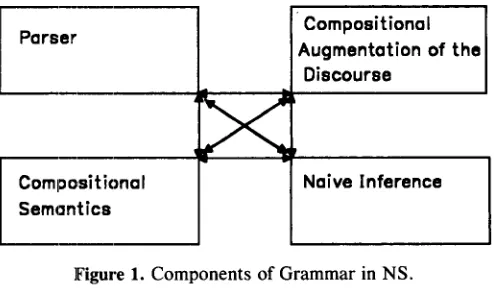
naive semantics are separate components with unique representational forms and processing mechanisms. Figure l illustrates the components. The autonomous syntactic component draws upon naive semantic infor- mation for problems such as prepositional phrase at- tachment and word sense disambiguation. Another au- tonomous component interprets the compositional semantics and builds d i s c o u r s e r e p r e s e n t a t i o n s t r u c t u r e s (DRSs) as in Kamp (1981) and Asher (1987). Another component models naive semantics and completes the discourse representation that includes the implications of the text. All of these components operate in parallel and have access to each other's representations when- ever necessary.
1.2 THE KT SYSTEM
Naive semantics is the theoretical motivation for the KT system under development at the IBM Los Angeles Scientiific Center by Dahlgren, McDowell, and others. 3 The heart of the system is a commonsense knowledge base with two components, a commonsense ontology and databases of generic knowledge associated with lexical items. The first phase of the project, which is nearly complete, is a text understanding and query system. In this phase, text is read into the system and parsed by the MODL parser (McCord 1987), which has very wide coverage. The parse is submitted to a module (DISAMBIG) that outputs a logical structure which reflects the scope properties of operators and quantifi- ers, correct attachment of post-verbal adjuncts, and selects, word senses. This is passed to a semantic translator whose output (a DRS) is then converted to first-order logic (FOL). We then have the text in two different semantic forms (DRS and FOL), each of which has its advantages and each of which is utilized in the system in different ways. Queries are handled in the same way as text. Answers to the queries are obtained either by matching to the FOL textual database or to the commonsense databases. However, the commonsense knowledge is accessed at many other stages in the processing of text and queries, namely in parse disam- biguafion, in lexical retrieval, anaphora resolution, and in the construction of the discourse structure of the entire text.
Kathleen Dahlgren, Joyce McDowell, and Edward P . S t a b l e r , J r . Knowledge Representation for Commonsense Reasoning with Text
The second phase of the project, which is at present in the research stage, will be to use the commonsense knowledge representations and the textual database to guide text selection. We anticipate a system, NewSe- lector, which, given a set of user profiles, will distribute textual material in accordance with user interests, thus, in effect, acting as an automatic clipping service. Our target text is the Wall Street Journal. The inferencing capabilities provided by the commonsense knowledge will allow us to go well beyond simple keyword search. The theoretical underpinnings and practical work on the KT system have been reported extensively else- where, in conference papers (Dahlgren and McDowell 1986a, 1986b; McDowell and Dahlgren 1987) and in a book (Dahlgren 1988a). Since the publication of those works, a number of significant additions and modifica- tions have been made to the system. The intended focus of this paper is this new work. However, in order to make this accessible to readers unfamiliar with our previous reports, we present in Section 2 an overview of the components of the present system. (Readers famil- iar with our system can skip Section 2). In the remaining sections on new work we have emphasized implemen- tation, because this paper is addressed to the computa- tional linguistics community: in Section 3, the details of disambiguation procedures that use the NS representa- tions and in Section 4 the details of the query system. Finally, Section 5 discusses work in progress regarding discourse and naive semantics.
2 OVERVIEW o r THE K T SYSTEM
2 . 1 KNOWLEDGE REPRESENTATION 2.1.1 THE ONTOLOGY
Naive theories associated with words include beliefs concerning the structure of the actual world and the significant "joints" in that structure. People have the environment classified, and the classification scheme of a culture is reflected in its language. Since naive seman- tics is intended as a cognitive model, we constructed the naive semantic ontology empirically, rather than intu- itix;ely. We studied the behavior of hundreds of verbs and determined selectional restrictions, which are con- straints reflecting the naive ontology embodied in En- glish. We also took into account psychological studies of classification (Keil 1979), and philosophical studies of epistemology (Strawson 1953).
2.1.1.1 MATHEMATICAL PROPERTIES OF THE ONTOLOGY The ontology has several properties which distinguish it from classical taxonomies. It is a directed acyclic graph, rather than a binary tree, because many concepts have more than two subordinate concepts (Rosch et al. 1976). FISH, BIRD, MAMMAL, and so on, are subordinates of VERTEBRATE. It is a directed graph rather than a tree, because it handles cross-classification. Cross-clas- sification is justified by contrasts between individual and collective nouns such as " c o w " and " h e r d . " This
E N T I T Y
A B S T R A C T
N U M E R I C A L R E A L
P H Y S I C A L --*
N O N - S T A T I O N A R Y --* C O L L E C T I V E --* T E M P O R A L ---> R E L A T I O N A L --~
E V E N T --*
Table 1.
( A B S T R A C T v R E A L ) & ( I N D I V I D U A L v C O L L E C T I V E )
I D E A L v P R O P O S I T I O N A L v N U M E R I C A L v I R R E A L N U M B E R v M E A S U R E
( P H Y S I C A L v T E M P O R A L v S E N T I E N T ) & ( N A T U R A L v S O C I A L )
( S T A T I O N A R Y v N O N S T A T I O N A R Y ) & ( L I V I N G v N O N L I V I N G )
( S E L F M O V I N G v N O N S E L F M O V I N G ) M A S S v S E T v S T R U C T U R E
R E L A T I O N A L v N O N R E L A T I O N A L ( E V E N T v S T A T I V E ) & ( M E N T A L v E M O T I O N A L v N O N M E N T A L ) ( G O A L v N O N G O A L ) & ( A C T I V I T Y v A C C O M P L I S H M E N T v A C H I E V E M E N T )
The Ontological Schema
implies that cognitively there are essentially parallel ontological schemas for individuals and collectives. Thus we have the parallel ontology fragments in Figure 2. Table 2 illustrates cross-classification at the root of the ontology, where ENTITY cross-classifies as either REAL or ABSTRACT, and as either INDIVIDUAL or COLLECTIVE. Cross-classification is handled as in McCord (1985, 1987).
INDIVIDUAL
COLLECTIVE
ENTITY
ENTITY
ABSTRACT REAL ABSTRACT REAL
/
/
P~SICAL, N ~ U RAI_, SE ~ M ~ I N G PH~IC~,~TURAL,SE~VING
/
/
ANIMAL F A U N A
/
/
[image:3.612.328.575.55.203.2]COW HERD
Figure 2. Parallel Portions of the Ontology.
INDIVIDUAL COLLECTIVE
REAL c o w herd
ABSTRACT idea b o o k
Table 2. Entity Node Cross Classification
Multiple attachments of instantiations to leaves is possible. For example, an entity, John, is both a HU- MAN with the physical properties of a MAMMAL, and is also a PERSON, a SENTIENT. As a SENTIENT, John can be the subject of mental verbs such as think
and say. Institutions are also SENTIENTs, so that the SENTIENT node reflects English usage in pairs like (4). 4. John sued Levine. The government sued Levine.
[image:3.612.325.571.364.637.2]Kathleen Dahlgren, Joyce McDowell, and Edward P. Stabler, Jr. Knowledge Representation for Commonsense Reasoning with Text
On the other hand, John, as a HUMAN, is like animals, and has physical properties. Both John and a cow can figure as subjects of verbs like " e a t " and "weigh." Multiple attachment was justified by an examination of the texts. It was found that references to human beings in text, for example, deal with them either as persons (SENTIENTs) or as ANIMALs (physiological beings), but rarely as both at the same time.
2.1.1.2 ONTOLOGICAL CATEGORIES
The INDIVIDUAL/COLLECTIVE cut was made at the level of ENTITY (the highest level) because all types of entities are conceived individually or in collec- tions. C O L L E C T I V E breaks into sets of identical mem- bers (herd, mob, crowd, fleet), masses that are con- ceived as stuff (sand, water), and structures where the members have specified relations, such as in institutions (school, company, village). Leaf node names, such as ANIMAL and FAUNA, are shorthand for collections of categories inherited from dominating nodes and by cross-classification. Thus " c o w " and " h e r d " share all categories except that " c o w " is an INDIVIDUAL term and " h e r d " is a C O L L E C T I V E term.
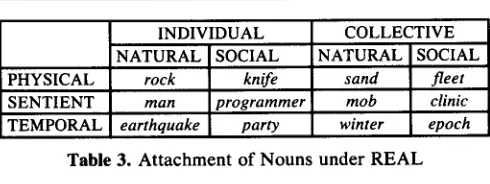
The R E A L node breaks into the categories PHYSI- CAL, TEMPORAL, and SENTIENT, and also NAT- URAL and SOCIAL. Entities (or events) that come into being (or take place) naturally must be distinguished from those that arise through some sort of social inter- vention. Table 3 illustrates the assignment of example words under the R E A L cross-classification.
INDIVIDUAL COLLECTIVE
NATURAL SOCIAL NATURAL SOCIAL
PHYSICAL rock knife sand fleet
SENTIENT man programmer mob clinic
TEMPORAL earthquake party winter epoch
Table 3. Attachment of Nouns under REAL
The SENTIENT/PHYSICAL distinction is placed high because in commonsense reasoning, the properties of people and things are very different. Verbs select for SENTIENT arguments or PHYSICAL arguments, as illustrated in (5). Notice also, that as a physical object, an individual entity like John can be the subject both of verbs that require physical subjects and those that require SENTIENT subjects, as in (6).
5. The lawyer/the grand jury indicted Levine. *The cow indicted Levine.
6. John fell.
John sued Levine. The cow fell.
We make the SENTIENT/NON-SENTIENT distinc- tion high up in the hierarchy for several reasons. Philosophically, the most fundamental distinction in
epistemology (human knowledge) is arguably that be- tween thinking and non-thinking beings (Strawson 1953). Psychology has shown that infants are able to distinguish humans from all other objects and they develop a deeper and more complex understanding of humans than of other objects (Gelman and Spelke 1981). In the realm of linguistics, a class of verbs selects for persons, roles, and institutions as subjects or objects. Thus the SENTIENT distinction captures the similarity between persons and institutions or roles. There is a widespread lexical ambiguity between a locational and institutional reading of nouns, which can be accounted for by the SENTIENT distinction, as in (7).
7. The court is in the center of town. The court issued an injunction.
The NATURAL/SOCIAL distinction also was placed high in the hierarchy. Entities (including events) that are products of society, and thereby have a social function, are viewed as fundamentally different from natural entities in the commonsense conceptual scheme. The distinction is a basic one psychologically (Miller 1978; Gelman and Spelke 1981). SOCIAL entities are those that come into being only in a social or institutional setting, with "institution" being understood in the broadest sense, for instance family, government, edu- cation,, warfare, organized religion, etc.
2.1.1.3 CONSTRUCTION OF THE ONTOLOGY
The ontological schema was constructed to handle the selectional restrictions of verbs in 4,000 words of geog- raphy text and 6,000 words of newspaper text. These were arranged in a hierarchical schema. The hierarchy was examined and modified to reflect cognitive, philo- sophical, and linguistic facts, as described above. It was pruned to make it as compact as possible. We mini- mized empty terminal nodes. A node could not be part of the ontology unless it systematically pervaded some subhierarchy. Distinctions found in various places were relegated to feature status. The full ontology with examples may be found in Dahlgren (1988).
2.1.1.4 VERBS
In KT, verbs are attached to the main ontology at the node TEMPORAL because information concerning the temporality of situations described in a sentence is encoded on the verb as tense and because the relations indicated by verbs must be interpreted with respect to their location in time in order to properly understand the discourse structure of a text. Thus the ontology implies that events are real entities, and that linguistic, not conceptual, structure distinguishes verbalized from nominalized versions of events and states.
We view the cognitive structure of the concepts associated with nouns and verbs as essentially different. Non-derived nouns in utterances refer to objects. Lex- ical nouns name classes of entities that share certain features. Verbs name classes of events and states, but
[image:4.612.42.287.431.523.2]Kath|een Dahlgren, Joyce McDoweli, and Edward P. Stabler, J r . Knowledge Representation for Commonsense Reasoning with Text
these do not share featural descriptions. Psychologi- cally, verbs are organized around goal orientation and argument types (Huttenlocher and Lui 1979; Graesser and Hopkinson 1987).
The primary category cut at the node TEMPORAL is between nouns, which name classes of entities, in this case temporal entities like " p a r t y , " "hurricane," and " w i n t e r , " and verbs, which indicate relations between members of these nominal classes, like " h i t , " " l o v e , " " r e m e m b e r . " We attach temporal nouns to the TEM- PORAL/NON-RELATIONAL node and verbs to the TEMPORAL/RELATIONAL node. Many nouns are, of course, relational, in the sense that " f a t h e r " and "indictment" are relational. Our node RELATIONAL does not carry this intuitive sense of relational, but instead simply indicates that words attached here re- quire arguments for complete interpretation. So, while " f a t h e r " is relational, it is possible to use " f a t h e r " in a text without mentioning the related entity. But verbs require arguments (usually overtly, but sometimes un- derstood, as in the case of commands) for full interpre- tation. Nominalizations like "indictment" are a special case. In our system, all deverbal nominalizations are so marked with a pointer to the verb from which they are derived. Subsequent processing is then directed to the verb, which, of course, is attached under TEMPORAL, RELATIONAL.
2.1.1.5 THE VENDLER CLASSIFICATION
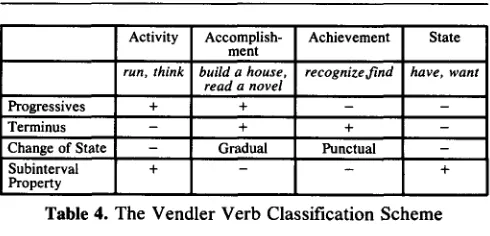
One basis of the relational ontology is the Vendler (1967) classification scheme, which categorizes verbs into aspectual classes (see Dowty 1979). According to this classification, R E L A T I O N A L divides into EVENT or STATIVE, and EVENT divides into ACTIVITY, ACHIEVEMENT, or ACCOMPLISHMENT. Vendler and others (particularly Dowty 1979) have found the following properties, which distinguish these classes.
8. STATIVE and ACHIEVEMENT verbs may not appear in the progressive, but may appear in the simple present.
ACTIVITY and ACCOMPLISHMENT verbs may appear in the progressive and if they appear in the simple present, they are interpreted as describ- ing habitual or characteristic states.
ACCOMPLISHMENTs and ACHIEVEMENTs entail a change of state associated with a terminus (a clear endpoint). STATIVEs ( " k n o w " ) and AC- TIVITYs ( " r u n " ) have no well-defined terminus. ACHIEVEMENTs are punctual (John killed
Mary) while ACCOMPLISHMENTs are gradual
(John built a house).
STATEs and ACTIVITYs have the subinterval property (cf. Bennett and Partee 1978).
Table 4 summarizes these distinctions. There are sev- eral standard tests for the Vendler (1967) system which can be found in Dowty (1979) and others and which we apply in classification.
The Vendler classification scheme is actually more
accurately a classification of verb phrases than verbs. KT handles this problem in two ways. First, in sentence processing we take into account the arguments in the verb phrase as well as the verb classification to deter- mine clause aspect, which can be any of the Vendler classes. Second, we classify each sense of a verb separately.
Progressives Terminus Change of State Subinterval Property
Activity Accomplish-
ment
run, think b u i l d a h o u s e , r e a d a n o v e l
+ +
- +
- Gradual
+
Achievement
r e c o g n i z e j q n d
+
Punctual
State
h a v e , w a n t
+
Table 4. The Vendler Verb Classification Scheme
The other nodes in the relational ontology are motivated by the psycholinguistic studies noted above. The MEN- TAL/NONMENTAL/EMOTIONAL distinction is made at the highest level for the same reasons that led us to place SENTIENT at a high level in the main ontology. All EVENTs are also cross-classified as GOAL ori- ented or not. This is supported by virtually every experimental study on the way people view situations, i.e., GOAL orientation is the most salient property of events and actions. For example, Trabasso and Van den Broek (1985) find that events are best recalled which feature the goals of individuals and the consequences of goals and Trabasso and Sperry (1985) find that the salient features of events are goals, antecedents, conse- quences, implications, enablement, causality, motiva- tion, and temporal succession and coexistence. This view is further supported by Abbott, Black, and Smith (1985) and Graesser and Clark (1985). NONGOAL, ACCOMPLISHMENT is a null category because AC- COMPLISHMENTS are associated with a terminus and thus inherently GOAL oriented. On the other hand NONGOAL, ACHIEVEMENT is not a null category because the activity leading up to an achievement is always totally distinct from the achievement itself. SOCIAL, NONGOAL, ACTIVITY is a sparse cate- gory.
Cross-classifications inherited from the TEMPORAL node are SOCIAL/NATURAL and INDIVIDUAL/ COLLECTIVE. The INDIVIDUAL/COLLECTIVE distinction is problematical for verbs, because all events can be viewed as a collection of an infinitude of sub- events.
2.1.2 GENERIC K N O W L E D G E
Generic descriptions of the nouns and verbs were drawn from psycholinguistic data to the extent possible. In a typical experiment, subjects are asked to freelist fea- tures "characteristic" of and common to objects in
[image:5.612.328.573.154.272.2]Kathleen Dahlgren, Joyce McDoweH, and E d w a r d P. Stabler, Jr. Knowledge Representation for Commonsense Reasoning with Text
categories such as DOG, L E M O N , and SECRETARY (Rosch et al. 1976; Ashcraft 1976; Dahlgren 1985a). The number of subjects in such an experiment ranges from 20 to 75. Any feature that is produced in a freelisting experiment by several subjects is likely to be shared in the relevant subpopulation (Rosch 1975; Dahlgren 1985a). Features that were freelisted by at least one-fifth of the subjects are chosen for a second experiment, in which different subject s are asked to rate the features for typicality. Those features rated as highly typical by the second group can be considered a good first approx- imation to the content of the cognitive structures asso- ciated with the terms under consideration. The number of features shared in this way for a term averaged 15.
The generic knowledge in the KT system is contained in two generic data bases, one for nouns and one for verbs. There is a separate entry for each sense of each lexical item. The content of the entries is a pair of lists of features drawn from the psycholinguistic data (as described above) or constructed using these data as a model. A feature is, informally, any bit of knowledge that is associated with a term. In informal terms, these can be any items like "wears glasses" (programmer), "is red" (brick), or " c a n ' t be trusted" (used-car sales- man). For each entry, the features are divided into two lists, one for typical features and one for inherent features. For example, a brick is typically red, but blood is inherently red. Together the lists comprise the entry description of the term that heads the entry.
The source of descriptions of social roles were data collected by Dahlgren (1985a). For physical objects we used generic descriptions from Ashcraft (1976), includ- ing raw data generously supplied by the author. An informal conceptualization for " l a w y e r " was shown in (1). The corresponding generic description is shown in (9). Features of the same feature type within either the inherent or typical list are A N D ' e d or OR'ed as re- quired. Some features contain first-order formulas like the conditions in discourse representations. For exam- ple, one function feature has (advise(E,noun,Y) & c l i e n t ( Y ) & r e g a r d i n g ( E , Z ) & l a w ( Z ) ) . The first argument of the predicate advise is an event reference marker. This event is modified in the r e g a r d i n g predi- cate. The second argument of advise is instantiated in the processing as the same entity that is predicated as being in the extension of the noun generically described in the representation, in this case, " l a w y e r . "
9. lawyer(
{behavior( contentious ),appearance(well-dressed), status(htgh)~mcome(hlgh),
sex(male ),sex(feinale ),tools(paper ),tools(books ), tools(briefcase),
function(negotlate(*jxoun,Y) ~¢ settlement(Y)), internal_trait( ambitious);tnternaLtrait( articulate ), internal_trait( aggressive ),
internal_trait(clever),
interns]_trait (knowledgeable) }, {age( adult )'educatl°n(law-sch°°l)' leg a L r e q ( p a s s ( * j m u n ~ ) & bar(X))
154
fmlctlon(practlce(*,noun,Y) & law(Y)), functlon(advise(E,noun,Y) & client(Y) &
regarcUng(E,Z) & law(Z)),
ikmction(represent(E,noun,Y) & client(Y) & ln(E,Z) & court(Z)),
function(argue(*jloun,Y) & case(Y))}).
The entire set of features for nouns collected in this way so far sort into 38 feature types. These are age, agent, a p p e a r a n c e , association, b e h a v i o r , color, c o n s t r u c - tion, content, direction, duration, education, exem- plar, experienced-as, in-extension-of, frequency, function, goal, habitat, h a s p a r t , h a s r o l e , h i e r a r c h y , internal-trait, legal-requirement, length, level, loca- tion, m a n n e r , material, n a m e , object, odor, opera- tion, owner, partof, physiology, place, p r o c e s s i n g , p r o p a g a t i o n , p r o t o t y p e , relation, r e q u i r e m e n t , rolein, roles, sex, shape, size, source, speed, state, status, s t r e n g t h , s t r u c t u r e , taste, texture, time. A given feature type can be used in either typical or inherent feature lists. Since these are not primitives, we expect the list of feature types to expand as we enlarge the semantic domain of the system.
There is a much smaller set of feature types for verbs. We were guided by recent findings in the psy- cholinguistic literature which show that the types of information that subjects associate with verbs are sub- stantially different from what they associate with nouns. Huttenlocher and Lui (1979) and Abbott, Black, and Smith (1985) in particular have convincingly argued that subjects conceive of verbs in terms of whether or not the activities they describe are goal oriented, the causal and temporal properties of the events described, and the types of entities that can participate as arguments to the verb. For the actual feature types, we adapted the findings of Graesser and Clark (1985), whose research focused on the salient implications of events in narra- tives. A small number of feature types is sufficient to represent the most salient features of events. These can be thought of as answers to questions about the typical event described by the verb that heads the entry. In addition, selectional restrictions on the verb are also encoded as a feature type. Feature types for verbs are cause, goal, w h a t . e n a b l e d , w h a t . h a p p e n e d _ n e x t , consequence_oLevent, w h e r e , w h e n , implies, how, selectioD..]-restriction. An example of a generic entry for verbs follows.
10.
~v(
{wha~enabled(can( a~ox~l(mabj,obJ)) ), how(with(X) & money(X)), where(in(Y) & store(Y)), cause(need~bJ,obj) ),
what_happened-next(use(subJ,obJ) )}, {goal( own( subJ ,obJ ) ),
consectuence_oLevent(own( ( subJ ,obJ ) ),
selectionsLrestrtction(sentient(subJ )), implies(merchandise( obJ ) )} ). 4
if someone buys something,
typlca£ly h e c a n a f f o r d it,
h e uses m o n e y , h e buys it in a store, h e needs it, a n d later h e uses it. Inherently, his goal is to
o w n it,
and after buying it, he does OwTt it.
The buyer is sentient a n d w h a t is b o u g h t is merchandise.
Kathleen Dahlgren, Joyce McDowell, and Edward P. Stabler, Jr. Knowledge Representation for Commonsense Reasoning with Text
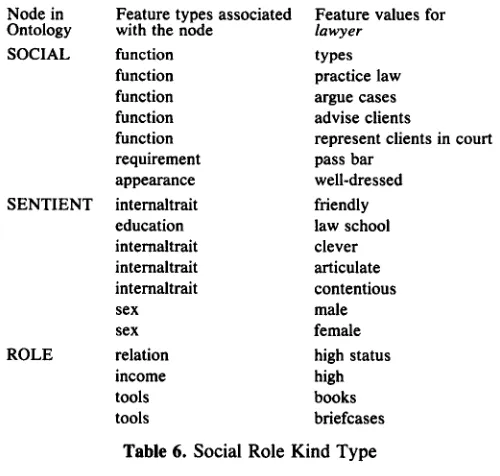
Naive Semantic representations of generic knowledge contain fifteen or more pieces of information per word, relatively more than required by other theories. The magnitude of the lexicon is counterbalanced by con- straints that naturally obtain in the generic knowledge. Study of the protocols of subjects in prototype experi- ments reveals that people conceive of objects in con- strained patterns of feature types. For example, animals are conceived in terms of physical and behavioral properties, while social roles are conceived in terms of functional and relational properties. Thus not all feature types occur in the representations of all nouns (or verbs). The pattern of features relevant to each node in the ontology is called a Kind Type. Each feature is classified by type as a COLOR, SIZE, FUNCTION, I N T E R N A L TRAIT or other. At each node, only certain feature types are applicable. Features at lower nodes inherit feature type constraints from the nodes above them in the ontology. For instance, any node under SOCIAL may have certain feature types, and any node under ROLE may have those feature types inher- ited from SOCIAL, as well as further feature types. Examples contrasting "elephant" and " l a w y e r " are shown in Tables 5 and 6.
Node in Feature types associated Feature values for
Ontology with the node elephant
ENTITY haspart trunk
haspart 4 legs
partof herd
PHYSICAL color grey
size vehiclesized
texture rough
L I V I N G propagation live births
habitat jungle
ANIMAL sex male or female
behavior lumbers
behavior eats grass
Table 5. Animal Kind Type
A lexical augmentation facility is used to create generic entries. This facility exploits the fact that pos- sible feature types for any term are constrained by the ontological attachment of the term, by the Kind Type to which they belong (Dahlgren & McDowell 1986a; Dahl- gren 1988a). For example, it is appropriate to encode the feature type "behavior" for " d o g " but not for " t r u c k . " Similarly, it is appropriate to encode the feature type " g o a l " for " d i g " but not for " f a l l . " The lexical augmentation facility presents the user with appropriate choices for each term and then converts the entries to a form suitable for processing in the system.
2.2 TEXT INTERPRETATION ARCHITECTURE
2.2.1 PARSER
The overall goal of the KT project is text selection based on the extraction of discourse relations guided by
Node in Feature types associated Feature values for
Ontology with the node lawyer
SOCIAL function types
function practice law
function argue cases
function advise clients
function represent clients in court
requirement pass bar
appearance well-dressed
SENTIENT internaltrait friendly
education law school
internaltrait clever
internaltrait articulate internaltrait contentious
sex male
sex female
ROLE relation high status
income high
tools books
tools briefcases
Table 6. Social Role Kind Type
naive semantic representations. This goal motivated the choice of DRT as the compositional semantic formalism for the project. The particular implementation of DRT which we use assumes a simple, purely syntactic parse as input to the DRS construction procedures (Wada and Asher 1986). Purely syntactic parsing and formal se- mantics are unequal to the task of selecting one of the many possible parses and interpretations of a given text, but human readers easily choose just one interpretation. NS representations are very useful in guiding this choice. They can be used to disambiguate parse trees, word senses, and quantifier scope. We use an existing parser (MODL) to get one of the syntactic structures for a sentence and modify it based upon NS information. This allows us to isolate the power of NS representa- tions with respect to the parsing problem. Not only are NS representations necessary for a robust parsing ca- pability, but also in anaphora resolution and discourse reasoning. Furthermore, the parse tree must be avail- able to the discourse coherence rules. Thus our re- search has shown that not only must the NS represen- tations be accessible at all levels of text processing, but purely syntactic, semantic, and pragmatic information that has been accumulated must also be available to later stages of processing. As a result, the architecture of the system involves separate modules for syntax, semantics, discourse and naive semantics, but each of the modules has access to the output of all others, as shown in Figure I.
The parser chosen is the M o d u l a r L o g i c G r a m m a r (McCord 1987), (MODL). Both MODL and KT are written in VM/PROLOG (IBM 1985). The input to MODL is a sentence or group of sentences (a text). In KT we intercept the output of MODL at the stage of a labeled bracketing marked with grammatical features and before any disambiguation or semantic processing is done. In effect, we bypass the semantics of MODL in
[image:7.612.325.575.59.297.2] [image:7.612.65.312.362.539.2]Kathleen Dahlgren, Joyce McDowell, and Edward P. Stabler, Jr. Knowledge Representation for Commonsense Reasoning with Text
order to test our NS representations. In the labeled bracketing each lexical item is associated with an argu- ment structure that can be exploited in semantic inter- pretation. The labeled bracketing output by MODL is slightly processed before being passed to our module DISAMBIG. Here the commonsense knowledge base is accessed to apply rules for prepositional phrase attach- ment (Dahlgren and McDowell 1986b) and word sense disambiguation (Dahlgren 1988a), as well as to assign the correct scope properties to operators and quantifi- ers. The output is a modified parse. All of these modules are in place and functional. The word sense disambig- uation rules are in the process of being converted. An example of the input to DISAMBIG and the resulting output is as follows:
11. Input S:
John put the money in the bank. Input to DISAMBIG:
s(np(n(n(john(Vl)))) &
vp(v(fin(pers3,sg,past,ind),put(V I,V2)) np(detp(the(V3,V4)) & n(n(money(V2))) pp(p(in(V2,VS)) & np(detp(the(V6,VT))
n(n(bank(VS))))))))
Output of DISAMBIG: s(np(n(n(John(Vl))))
vp (v(fln(pers3,sg,past~d),put i (V I,V2 )) np(detp(the(V3,V4)) & n(n(money(V2)))) & pp(p(in(V2,VS)) & np(detp(the(V6,VT)) &
n(n(bank2(VS)))))))
The differences are that the PP "in the bank" is VP-attached in the output of DISAMBIG rather than NP-attached as in the output of MODL, and that the words " p u t " and " b a n k " are assigned index numbers and changed to putl and bank2, selecting the senses indicated by the word sense disambiguation algorithm.
2.2.2 SENTENCE-LEVEL SEMANTICS
The modified parse is then submitted to a semantics module, which outputs a structure motivated in part by current versions of discourse representation theory (DRT) (Kamp 1981; Wada and Asher 1986; Asher and Wada 1988). The actual form of the discourse represen- tation structure (DRS) and its conditions list in the KT system differ from standard formats in DRT in that tense arguments have been added to every predicate and tense predicates link the tense arguments to the tense of the verb of the containing clause. The analysis of questions and negation was carried out entirely with respect to the KT system and to serve its needs. The DRT semantics is in place and functional for most structures covered by MODL. The commonsense knowledge representations are accessed in the DRT module for semantic interpretation of modals, the de- termination of sentence-internal pronoun anaphora (where simple C-command and agreement tests fail), and to determine some cases of quantifier scoping.
2.2.3 DISCOURSE-LEVEL SEMANTICS
As each sentence of a text is processed it is added to the DRS built for the previous sentence or sentences. Thus an augmented DRS is built for the entire text. In the augmentation module the commonsense knowledge rep- resentations are accessed to determine definite noun phrase anaphora, sentence-external pronoun anaphora, temporal relations between the tense predicates gener- ated during sentence-level DRS construction, discourse relations (suc]h as causal relations) between clauses, and the rhetorical structure of the discourse as a whole. The discourse work is being carried out mainly by Dahlgren and is in various stages of completion.
2.2.4 FOL
Since standard proof techniques are available for use with logical forms, the DRS formulated by the sentence- level and discourse-level semantic components is con- verted to standard logic. A number of difficulties present themselves here. In the first place, given any of the proposed semantics for DRSs (e.g., Kamp 1981; Asher 1987), DRSs are not truth functional. That is, the truth walue of a DRS structure (in the actual world) is not generally a function of the truth values of its constituents. For example, this happens when verbs produce opaque contexts (Asher 1987). Since general proof methods for modal logics are computationally difficult, we have adopted the policy of mapping DRSs to naiw ~ , first-order translations in two steps, providing a special and incomplete treatment of non-truth func- tional contexts. The first step produces representations that differ minimally from standard sentences of first- order logic. The availability of this level of representa- tion enhances the modularity and the extensibility of the system. Since first-order reasoning is not feasible in an application like this, a second step converts the logical forms to clausal forms appropriate for the problem solver or the textual knowledge base. We describe each of these steps in turn.
2.2.4.1 THE TRANSLATION TO STANDARD LOGICAL FORMS
The sentence-level and discourse-level semantic com- ponents disambiguate names and definite NPs, so that each discourse reference marker is the unique canonical name for an individual or object mentioned in the discourse. The scoping of quantifiers and negations has also been determined by the semantic processing. This allows the transformation of a DRS to F O L to be rather simple. The basic ideas can be briefly introduced here; a more thorough discussion of the special treatment of queries is provided below. The conditions of a DRS are conjoined. Those conditions may include some that are already related by logical operators (if-then, or, not), in which case the logical form includes the same opera- tors. Discourse referents introduced in the consequent of an if-then construction may introduce r quantifiers: these are given narrow scope relative to quantifiers in the consequent (cf. Kamp's notion of a "subordinate"
Kathleen Dahlgren, Joyce McDowell, and Edward P. Stabler, Jr. Knowledge Representation for Commonsense Reasoning with Text
DRS in Kamp 1981; Asher and Wada 1988). Any quantifiers needing wide scope will already have been moved out of the consequent by earlier semantic proc- essing. The DRSs of questions contain special operators that, like the logical operators, take DRS arguments that represent the scope of the material being questioned. A similar indication is needed in the logical form. In the case of a yes-no question, we introduce a special vacuous quantifier just to mark the scope of the ques- tioned material for special treatment by the problem solver (see below). In the case of wh-questions, a special wh-quantifier is introduced, again indicating the scope of the questioned material and triggering a special treatment by the problem solver. Verbs of propositional attitude and other structures with opaque contexts are treated as, in effect, introducing new isolated subtheo- des or " w o r l d s . " For example, "John believes all men are mortal" is represented as a relation of belief holding between John and a logical form (see below for more detail), though it is recognized that this approach will need to be supplemented to handle anaphora and prop- ositional nominals (cf., e.g., Asher 1988).
2.2.4.2 THE CONVERSION TO SPECIALIZED CLAUSAL FORMS
Considerations of efficiency motivate a further transfor- mation in our logical forms. After the first step of processing, we have standard first-order logical forms, except that they may include special quantifiers indicat- ing questioned material. Consider first those logical forms that are not inside the scope of any question quantifier. These are taken as representations of poten- tial new knowledge for the textual data base. Since the inference system must solve problems without user guidance, it would be infeasible to reason directly from the first-order formulations. Clausal forms provide an enormous computational advantage. For these reasons, we transform each sentence of first-order logic into a clausal form with a standard technique (cf., e.g., Chang and Lee 1973), introducing appropriate Skolem func- tions to replace existentially quantified variables. The textual database can then be accessed by a clausal theorem prover. In the current system, we use efficient Horn clause resolution techniques (see below), so the knowledge representation is further restricted to Horn clauses, since completeness is less important than fea- sible resource use in the present application. Definite clauses are represented in a standard Prolog format, while negative clauses are transformed into definite clauses by the addition of a special positive literal "false(n)," where n is an integer that occurs in no other literal with this predicate. This allows a specialized incomplete treatment of negation-as-inconsistency (cf. Gabbay and Sergot 1986). The definite clause transla- tions of the text can then be inserted into a textual knowledge base for use by the reasoning component. The presence of question quantifiers triggers a special treatment in the conversion to clausal form. Our prob-
lem solver uses standard resolution techniques: to prove a proposition, we show that its negation is incompatible with the theory. Accordingly, the material inside the scope of a question operator is treated as if it were negated, and this implies an appropriately differ- ent treatment of any quantifiers inside the scope of the operators.
2.2.5 REASONER
In the architecture of the system, the reasoning module is broken into two parts: the specialized query process- ing system and a general purpose problem solver. The special processing of queries is described in detail below. The problem solver is based on a straightforward depth-bounded Horn clause proof system, implemented by a Prolog metainterpreter (e.g. Sterling and Shapiro 1986). The depth bound can be kept fixed when it is known that no proofs should exceed a certain small depth. When a small depth bound is not known, the depth can be allowed to increase iteratively (cf. Stickel 1986), yielding a complete SLD resolution system. This proof system is augmented with negation-as-failure for predicates known to be complete (see the discussion of open and closed world assumptions below), and with a specialized incomplete negation-as-inconsistency that allows some negative answers to queries in cases where negation-as-failure cannot be used.
2.2.6 RELEVANCE
The R E L E V A N C E module will have the responsibility of determining the relevance of a particular text to a particular user. The text and user profiles will be processed through the system in the usual way resulting in two textual data bases, one for the target text and one for the profile. Target and profile will then be compared for relevance and a decision made whether to dispatch the target to the profiled user or not. The relevance rules are a current research topic. The commonsense knowledge representations will form the primary basis for determining relevance.
3 NAIVE SEMANTICS IN THE K T SYSTEM
From the foregoing brief overview of the KT system, it should be clear that naive semantics is used throughout the system for a number of different processing tasks. In this section we show why each of these tasks is a problem area and how NS can be used to solve it.
3.1 PREPOSITIONAL PHRASE ATTACHMENT 5 The proper attachment of post-verbal adjuncts is a notoriously difficult task. The problem for prepositional phrases can be illustrated by comparing the following sentences.
12. [S The government [VP had uncovered [NP an entire file [PP about the scheme]]]]. 6
13. [S Levine's lawyer [VP announced [NP the plea bargain] [PP in a press conference]
Kathleen Dahigren, Joyce McDowell, and Edward P. Stabler, Jr. Knowledge Representation for Commonsense Reasoning with Text
14. [S[S The judge adjourned the hearing] [PP in the afternoon]]
Each of these sentences takes the canonical form Sub- ject-Verb-Object-PP. The task for the processing sys- tem is to determine whether the PP modifies the object (i.e., the PP is a constituent of the NP, as in (12)), the verb (i.e., the PP is a constituent of the VP, as in (13)), or the sentence (i.e., the PP is an adjunct to S, as in (14)). Some deny the need for a distinction between VP and S-modification. The difference is that with S-mod- ification, the predication expressed by the PP has scope over the subject, while in VP-attachment it does not. For example, in (15), "in the park" applies to Levine, while in (16), "with 1,000 dollars" does not apply to Levine.
15. Levine made the announcement in the park. 16. Levine bought the stock with 1,000 dollars.
A number of solutions for the problem presented by post-verbal prepositional phrases have been offered. The most common techniques depend on structural (Frazier and Fodor 1978), semantic (Ford, Bresnan, and Kaplan 1982), or pragmatic (Crain and Steedman 1985) tests. MODL (McCord 1987) employs a combination of syntactic and semantic information for PP attachment. Independently, we formulated a preference strategy for PP attachment which uses ontological, generic and syntactic information to cover 99% of the cases in an initial test corpus, and which is 93% reliable across a number of types of text. This is the preference strategy we employ in KT. The PP attachment rules make use of information about the verb, the object of the verb, and the object of the preposition. A set of global rules is applied first, and if these fail to find the correct attach- ment for the PP, a set of rules specific to the preposition are tried. Each of these latter rules has a default. The global rules are stated informally in (17). with example sentences.
17a. time(POBJ)-, s_attach(PP)
I f the object o f the preposition is an expression o f time, then S-attach the PP.
The judge adjourned the hearing in the after- noon.
b. lexical(V+Prep)--~ v p _ a t t a c h ( P P )
I f the verb and preposition form a lexicalized complex verb, then VP-attach the PP.
The defense depended on expert witnesses. c. Prep=of--~ n p _ a t t a c h ( P P )
I f the preposition is of then NP-attach the PP. The ambulance carried the victim of the shoot- ing.
d. i n t r a n s i t i v e ( V ) & m o t i o n ( V ) & p l a c e ( P O B J ) --~ v p _ a t t a c h ( P P )
I f the verb is an intransitive verb o f motion and the object o f the preposition is a place then VP-attach the PP.
The press scurried about the courtroom.
e. 2intransitive(V) & (place(POBJ) O R temporal (POBJ) O R abstract(POBJ)) --* a.attach(PP)
I f the verb is intransitive and the object o f the preposition is a place, temporal, or abstract,
then S-attach the PP.
Levine worked in a brokerage house. f. epistemic(POBJ)--* s_attach(PP)
I f the prepositional phrase expresses a proposi- tional attitude, then attach the PP to the S. Levine was guilty in my opinion.
g. x p ( . . ~_dj-PP...)--~ x p _ a t t a c h ( P P )
I f PP follows an adjective, then attach the PP to the phrase which dominates and contains the adjective phrase.
Levine is young for a millionaire. h. measure(DO)--~ n p _ a t t a c h ( P P )
I f the direct object is an expression o f measure, then NP-attach the PP.
The defendant had consumed several ounces of whiskey.
i. c o m p a r a t i v e - * n p _ a t t a c h ( P P )
I f there is a comparative construction, then NP-attach the PP.
The judge meted out a shorter sentence than usual.
j. m e n t a l ( V ) & medium(POBJ)-~ vp_attach(PP) I f the verb is a verb o f saying, and the object o f the preposition is a medium o f expression then VP-attach the PP.
Levine's lawyer announced the plea bargain on television.
Example 14 is handled by global rule (17a). Example 13 is handled by global rule (17j). The global rules are inapplicable with example 12, so the rules specific to " a b o u t " are called. These are shown below.
18a. intrsmsitive(V) & mental(V)--~ vp_attach(PP) I f the verb is an intransitive mental verb, then VP-attach the PP.
Levine spoke about his feelings. b. Elsewhere--* n p _ a t t a c h ( P P )
Otherwise, NP-attach the PP.
The government had uncovered an entire file about the scheme.
As a filrther example, the specific rules for " b y " uses both generic (19a,b) and ontological (19c) knowledge.
19 a. nom(DO)--~ n p _ a t t a c h ( P P )
I f the direct object is marked as a nominaliza- tion, then NP-attach the PP.
The soldiers withstood the attack by the en- emy.
b. location(DO,POBJ)--~ n p _ a t t a c h ( P P )
I f tJ~e rel~.tion between the d.ireot obJeot and t~he object o f t~he p r e p o s i t i o n Is one o f loos,-
~ion, t h e n lq'P-~t~ch t, he PP.
The clerk a d j u s t e d t h e m i c r o p h o n e b y t h e w i t n e s s stand.
Kathleen Dahlgren, Joyce McDowell, and Edward P. Stabler, Jr. Knowledge Representation for Commortsense Reasoning with Text
c.
proposltional(DO) & sentlent(POBJ)--, np_at-
ta~h(PP)
I f the direct object is propositional and the object of the preposition is sentient, then NP- attach the PP.
The judge read out the statement by Levine. d. Elsewhere---> s_attach(PP)
Otherwise, S-attach the PP.
The lawyers discussed the case by the parking lot.
These PP-attachment preference rules are remarkably successful when applied to real examples from actual text. However, they are not foolproof and it is possible to construct counterexamples. Take the global rule illustrated in (17a). We can construct a counterexample as in (20).
20. John described the meeting on Jan. 20th.
Sentence 20 is ambiguous. Jan. 20th can be the time of the describing or the time of the meeting. Perhaps there is a slight intuitive bias toward the latter interpretation, but the rules will assign the former interpretation. This is a counterexample only because " m e e t i n g " is a TEM- PORAL noun and can plausibly have a time feature. Compare (21), which is identical except for the ontolog- ical attachment of the direct object and which is handled correctly by the global rule.
21. John described the proposal on Jan. 20th.
The problem of the interpretation of event nominals is a research topic we are working on.
The PP attachment rules are applied in the module DISAMBIG, which produces a disambiguated parse from the output of the MODL parser. The first step is to identify the sentence elements that form their inputs for each clause using find..args. The output of find_args is a list of the the direct object, object of the preposition, preposition, and main verb of the clause and the index of the clause (main, subordinate, and so on). The PP-attachment rules are in place and functional for one post-verbal prepositional phrase. Where more than one post-verbal prepositional phrase occurs, the current default is to attach the second PP to the NP of the first PP. However, this will not get the correct attachment in cases like the following.
22. The judge passed sentence on the defendant in a terse announcement.
A planned extension of the PP-attachment functionality will attack this problem by also keeping a stack of prepositions. The top of the stack will be the head of the rightmost PP. The attachment rules will be applied to PPs and the other constituents in a pairwise fashion until all are attached.
3.2 WORD SENSE DISAMBIGUATION
The word sense disambiguation method used in the system is a combined local ambiguity reduction method
(Dahlgren 1988b). The method is local because word senses are disambiguated cyclically, from the lowest S-node up to the matrix node. Only when intrasentential sources of information fail are other sentences in the text considered by the disambiguation method. The algorithm is combined because it employs three sources of information. First it tries fixed and frequent phrases, then word-specific syntactic tests, and finally naive semantic relationships in the clause. If the fixed and frequent phrases fail, the syntactic and naive semantic rules progressively reduce the number of senses rele- vant in the clausal context. The algorithm was devel- oped by considering concordances of seven nouns with a total of 2,193 tokens of the nouns, and concordances of four verbs with a total of 1,789 tokens of the verbs. The algorithm is 96% accurate for the nouns in these concordances, and 99% accurate for the verbs in these concordances.
Fixed phrases are lists of phrases that decisively disambiguate the word senses in them. For example, the noun " h a n d " has 16 senses. Phrases such as " b y hand," " o n hand," " o n the one hand" have only one sense.
Syntactic tests either reduce the number of relevant senses, or fully disambiguate. For nouns, syntactic tests look for presence or absence of the determiner, the type of determiner, certain prepositional phrase modifiers, quantifiers and number, and noun complements. For example, only five of the 16 senses of " h a n d " are possible in bare plural noun phrases. For verbs, syntac- tic tests include the presence of a reflexive object, elements of the specifier, such as particular adverbs the presence of a complement of the verb and particular prepositions. For example, the verb " c h a r g e " has only its reading meaning "indict" when there is a VP- attached PP where the preposition is " w i t h " (as deter- mined by the prepositional phrase attachment rules). Syntactic tests are encoded for each sense of each word. The remainder of this section will illustrate disambiguation using naive semantic information and give examples of the naive semantic rules. (The com- plete algorithm may be found in Dahlgren 1988a).
3.2.1 NOUN DISAMBIGUATION
Naive semantic information was required for at least a portion of the disambiguation in 49% of the cases of nouns in the concordance test. Naive semantic infer- ence involves either ontological similarity or generic relationships. Ontological similarity means that two nouns are relatively close to each other in the ontology, both upwards and across the ontology. If there is no ontological similarity, generic information is inspected. Generic information for the ambiguous noun, other nouns in the clause, the main verb, often disambiguate an ambiguous noun.
Ontological similarity is tested for in several syntac- tic constructions: conjunction, nominal compounds, possessives, and prepositional phrase modifiers. Many
Kathleen Dahlgren, Joyee McDowell, and Edward P. Stabler, Jr. Knowiedge Representation for Commonsense Reasoning with Text
of the 16 senses of " h a n d " are ontologically distinct, as shown in Table 7.
I. HUMAN human body part
2. DIRECTION right or left
3. INSTRUMENT by hand
4. SOCIAL power, authority
5. TEMPORAL applause
6. ROLE laborer
7. ARTIFACT part of a clock
Table 7. Some senses of hand
In (23), only the HUMAN and ROLE senses (I and 6) are possible, by ontological similarity. Generic knowledge of the verb " c l e a r " is inspected for the final disambiguation to sense 6.
23. The farmer and his hand cleared the field.
In contrast, in (24), the relevant senses of " h a n d " are the HUMAN and ARTIFACT senses (1 and 7).
24. His arm and hand were broken.
At the point in the algorithm where naive semantic tests are invoked, syntactic tests have already eliminated the ARTIFACT sense, which does not occur with a per- sonal pronoun. Thus the HUMAN sense is selected. In (25), only the ARTIFACT sense (7) is possible, by ontological similarity of " c l o c k " and " h a n d . "
25. The clock hand was black.
In (26), again the HUMAN and ROLE senses (1 and 6) are the only relevant ones by ontological similarity. Selection restrictions on " s h a k e " complete the disam- biguation.
26. John shook the man's hand.
In (27), sense 4 is selected because "affair" and sense 4 are both SOCIAL.
27. John saw his hand in the affair.
In (28), sense I is selected because both sense 1 and a sense of " p a p e r " are attached to PHYSICAL.
28. The judge had the paper in his hand.
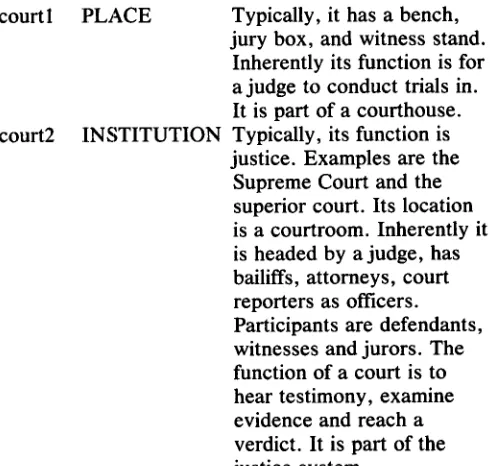
The word sense disambiguation algorithm tests for generic relationships between the ambiguous noun and prepositional phrases modifiers, adjective modifiers, and the main verb of the sentence. Two of the nine senses of " c o u r t " are shown in Table 8. In " t h e court listened to testimony," generic information for the second sense of " c o u r t " can be used to select sense 2. The generic information includes knowledge that one of the functions of courts has to do with testimony. In (29), sense 1 of " c o u r t " is selected because the generic representation of " c o u r t " contains information that witness stands are typical parts of courtrooms.
courtl
court2
PLACE Typically, it has a bench, jury box, and witness stand.
Inherently its function is for a judge to conduct trials in. It is part of a courthouse. INSTITUTION Typically, its function is
justice. Examples are the Supreme Court and the superior court. Its location is a courtroom. Inherently it is headed by a judge, has bailiffs, attorneys, court reporters as officers. Participants are defendants, witnesses and jurors. The function of a court is to hear testimony, examine evidence and reach a verdict. It is part of the justice system.
Table 8. Generic Information for Two Senses of c o u r t 7
29. The witness stand in Jones's court is made of oak.
In (30), the adjective " w i s e " narrows the relevant senses from nine to the two INSTITUTION senses of " c o u r t . "
30. 'The wise court found him guilty.
Generic knowledge of one sense of the verb " f i n d " is then used to select between the court-of-law sense (2) and the-royal-court sense (4). Verb selection restric- tions are powerful disambiguators of nouns, as many computational linguists have observed. In (31), the verb
chargel
charge2
charge3
Table 9.
Typically, if someone is charged, next they are indicted in court, convicted or acquitted. They are charged because they have
committed a crime or the person who charges them suspects they have. Inherently, the charger and chargee are sentient, and the thing charged with is a crime.
Inherently, if someone charges that
something is true, that someone is sentient, his goal is that it be known, and the
something is bad.
Typically, if someone charges someone else an amount for something, the chargee has to pay the amount to the charger, and the chargee is providing goods or services. Inherently, the charger and chargee are sentients, the amount is a quantity of money, and the goal of the charger is to have the chargee pay the amount.
Generic Information for Thi'ee Senses of c h a r g e
[image:12.612.303.548.59.292.2]