Abstract— This paper is devoted to research the dynamic
stress-strain behavior of transtropic massif with a few cavities deep founded from earth surface. Cases of propagation and diffraction of elastic PP-, SV- and SH-waves are considered. Analytical rigorous methods by using theory of cylindrical functions are applied for solving the first and the second fundamental problems of mechanics in the case of stationary diffraction of elastic waves on the few cavities with arbitrary form and location. An influence of physical and mechanical properties of surround massif and falling elastic waves to stress-strain state of transtropic massif with deep-founded cavities is demonstrated.
Index Terms—transtropic massif, deep founded cavities,
mines, tunnels, drifts, diffraction, PP-wave, SV-wave, SH-wave.
I. INTRODUCTION
The earthquake, along with flooding and mudslides, the cyclone is a natural disaster, which as yet can neither inform nor prevented. Harmful effects of earthquakes can be relaxed if we use the achievements of modern theory and practice of dynamic and seismic stability of building. These achievements are mainly related to the optimal construction of facilities on the ground. Meanwhile, in large cities located in seismic areas, the underground space is full of plumbing, gas, sewer objects, parking and other facilities. The underground subway stations and tunnels in fractured obliquely layered media with complex structure are built and expanded.
Many mineral deposits are created on the areas with seismic activity. They are built mainly underground and are going and fixed in the extensive network of different kinds of horizontal and vertical openings (mine tunnels). In mountainous areas prone to seismic shocks, various tunnels: road, rail and hydro are built and extensively exploited.
Underground structures in seismically active regions must meet the requirements of earthquake resistance. But this design is a complicated task. Complexity is due to the fact that the seismic loads are classified by these dynamic effects,
Lyazzat B. Atymtayeva with the Kazakh-British Technical University, Almaty, Republic of Kazakhstan (phone: 8-727-272-15-02; fax: 8-727- 250-
46-51, e-mail: [email protected], [email protected] )
Zhailau K. Masanov with the Institute of Mechanics and Engineering Science named after U. A. Zholdasbekov, Almaty, Republic of Kazakhstan (phone: 8-727-291-33-94; fax: 8-727-291-50-60)
Bagdat E. Yagaliyeva with the Institute of Mechanics and Engineering Science named after U. A. Zholdasbekov, Almaty, Republic of Kazakhstan (phone: 8-727-291-33-94; fax: 8-727-291-50-60, e-mail: [email protected] ).
and accurate prediction of the magnitude and nature of them can not advance because of the complex inhomogeneously- layered structure of the rock massif. Under these conditions the critical analysis of experimental data and field observations on the behavior of underground structures during earthquakes has great meaning.
On the base of natural and technogenic conditions and on the base of nature of impact of seismic effects on underground structures for various purposes we can distinguish two-class facilities: shallow-founded and deep-founded. Moreover, the allocation of shallow-founded structures in a particular class is due to the fact that the calculation of their seismic stability is necessary to conduct an impact not only from volume waves but also from surface waves. It should also be considered the waves reflected from Earth Surface.
The deep-founded structures can be associated with the great complex of mines, as well as transport and hydraulic tunnels with deep foundations, cavity-gas reservoirs, leached in salt deposits, etc. The influence of earthquakes, industrial explosions to the stress-strain state of deep-founded structures is associated only with the direct influence of the longitudinal and transverse waves, without any influence of the surface.
Thus, the basic idea of current research is to take into account more fully the effects of applying the dynamic stress field related to wave propagation, onto the static stress field, which was formed in the inclined-layered rock mass near horizontal underground structures of arbitrary foundation and form in the process of their penetration, fixing, and operation under the impact of the dynamic effects. So we have possibility to determine sequentially the static and dynamic loads on structural elements of buildings. The most fully explored are the problem of determining the static stress field in the rock mass near the facilities. The main difficulties arise in calculating the dynamic fields of stresses and moving near a variety of structures due to wave processes in layered rock massif.
II. REVIEW OF RESEARCHES OF THE PROBLEMS OF WAVE
DIFFRACTION ON THE NON-HOMOGENEITIES
To make an analysis of existing research in the field of wave diffraction on the non-homogeneities and in area of problems of seismic stability of underground structures, we decided do not stop in detail on the description of researches of scientists of the past century such as G.I. Petrashen [1], Delesan E., D. Ruaie [2], Zh. S. Erzhanov, Sh.M. Aitaliyev, L.A. Alekseyeva [3], A.N. Guz, V.D. Kubenko, M.A. Cherevko, V.G. Golovchan, N.A. Shulga [4,5,6], A.S.
Diffraction of Elastic PP- , SV- and SH-
Waves on the Arbitrary Deep-founded Cavities
in the Anisotropic Rock Massif
Kosmodamiansky, V.I. Storozhev, L.B. Obodovsky, [7,8], Y. Pao, C.C..Mow, L.J. Mente, Chao C.C. [9,10,11], Banaf, Goldsmith[12], Sh.G. Napetvaridze[13], N.N Fotiyeva [14], J.K. Masanov, [15], S.G. Lekhnitsky [16], G.N.Savin [17], S.A. Kaloerov, [18], Okamoto C, Kato K., Hamada M.[19], Walter Wittke, Berndt Pierau, Claus Erichsen [20] and their followers which have become part of the fundamental foundations of mechanics for issues of propagation and diffraction of waves in isotropic and anisotropic media, rock mechanics, and for problems of seismic stability of underground structures.
We would like to stop on describing the problems of wave diffraction in media with non-homogeneities(or cavities) and on the issues of rigorous analytical methods for their studies, which take place in recent years.
The problem of wave scattering on the non-homogeneities and cavities, with using of the methods of the complex variable theory and the method of boundary integral equations are studied by the authors J. Hu, F. Khan, J. Louis, [21, 22]. The massif surrounding the object is considered as isotropic [21] or orthotropic [22].
The work of authors Guoqing Wang, Dianku Liu [23] describes the research of the distribution and scattering of SH-waves on the multiple circular cavities in half-space. They considered an isotropic medium, the method of multipolar coordinate system, scattering methods as well as techniques of functions for movement of coordinates. The problem of scattering and propagation of shear waves in the half-space is transformed into the problem of wave propagation in space. The infinite system of linear equations is solved by the reduction method.
Multiply of isotropic medium is taken into account by Jianwen Liang, Hao Zhang, Vincent W. Lee [24, 25]. In the works they studied the solutions in ranks for analysis of displacements on the surface in the presence of underground tunnels in an isotropic medium under the influence of SV-waves [24], and PP-waves [25]. Solutions are sought in the Fourier-Bessel functions. The numerical results show the influence of underground tunnels onto the displacements on the surface.
The paper of Gai Bing-zheng [26] is devoted to problems of using of complex functional method for solving problems of diffraction of elastic waves and finding the dynamic stresses. He considered the case of a simply-connected, multiply connected isotropic medium and the problems of cracks.
In their paper [27] Liu Diankui and Liu Hongwei consider special Green's functions for the study of cylindrical cavity in an isotropic half-plane diffraction of SH-waves. By using of Earl, Fredholm integral equations they transform half-plane into plane.
In the paper of Xu Ping, XIA Tang-dai, HAN Tong-chan [28] we can study the problems of scattering of the compression wave (PP-) in water-saturated isotropic medium. As a model, the authors take the model of Biota and get the amplitude equations for the potential functions of the scattering and reflection of waves, which are solved numerically and analyzed.
Kim, D., C. Conaghai [29] investigated a method to reduce seismic damage in the tunnel through the reinforcement of the tunnel soft and thin linings. It is shown that the tunnels deep in the rocks with a soft and thin linings has only one
degree of freedom, which allows to evaluate the insulating effect with a limited number of key parameters.
V. W. Lee , M. E. Manoogian, S. Chen [30] studied the problem of dynamic state firmly embedded rigid foundation in the presence of an underground rigid circular tunnel at the case of SH-wave diffraction in the isotropic medium. By means of exact analytical solutions for two-dimensional SH-waves near the tunnel and the rigid foundation the authors analyzed displacements and stresses from the impact of different dynamic effects. The test of the displacement amplitude shows a complex wave distribution.
In the works [31] Gao Guang-yun, Li Zhi-yi1, Qiu Chang investigated the effects of Rayleigh wave propagation, based on analytical relations of Lamb and on the theory of elastic wave scattering. They researched the scattering of Rayleigh waves from multiple irregular obstacles in an isotropic medium.
There are many others research in the area of wave diffraction in different media but the scattering and diffraction of waves in rock massif with non-homogeneities has many special characteristics that we should take into account.
A detailed review of the literature above showed that in research of the dynamics of underground structures the issues of diffraction of waves on the underground facilities in anisotropic layered media are not fully explored. In particular, the problems of diffraction of elastic waves in transtropic layered media and dynamic stability of arbitrarily oriented underground facilities, development of which takes place under the current conditions of underground construction are insufficiently studied.
In this paper we try to fill this gap in research and consider the dynamic stress-strain state of horizontal underground structures which are simulated by cavities in an anisotropic layered medium under the conditions of a stationary diffraction of elastic longitudinal (PP) and transverse (SV, SH) waves.
III. DIFFRACTION OF ELASTIC WAVES ON THE ARBITRARY
DEEP-FOUNDED CAVITIES IN THE ANISOTROPIC ROCK MASSIF
Let us consider the modeling of anisotropic rock massif by presenting it as a small-layered transtropic massif with inclined plane of isotropy, the equations of which satisfy the generalized Hooke's law [15]:
D
,
D
bij,i,j1,2,...,6; (1)
11,12,13,22,23,33
,
0
34 24
14 56 46 35 25 15
b b
b b b b b b
where bij , i,j1,6 , - the elasticity coefficients, which
depend on the elastic constants of the environment E1,E2, 1
, 2 , G2and the angle for inclined plane of isotropy .
Objects of underground construction can be modeled by cavities in different forms, from circular to noncircular, through the use of the mapping function [32]:
) (
) ( ~
1
N
m m m
d R
z , 1 2, ,
ei
x i x
In the case of falling the stationary waves of different nature and types - longitudinal and transverse, wave equations can be represented as [33]:
t i
e u
u * , exp[ ( )]
2 2 1 1 *
* U ik nx n x
u (3)
Wave equations (3) differ only by wave amplitude and by wave number.
Schematically, the process of falling the stationary wave to transtropic massif with non-homogeneity (or, in general, non-homogeneities) can be shown in Figure 1.
Fig.1. The scheme of propagation of elastic waves in a layered transtropic massif with non-homogeneities
Let’s consider the general case of multiple cavities of arbitrary profile simulating the deep-founded horizontally extended pipelines, mines, oil wells and other underground structures (Fig. 1). Depending on the conditions of fixing the boundaries of the cavities we can solve the first and the second fundamental problems of mechanics, namely, we consider the cases when the boundary of the cavities is free of load (first fundamental problem) and the boundary of the cavities is absolutely rigidly fixed (second fundamental problem). For the different conditions of fixing the boundaries we can put different boundary equations.
In particular, for the first fundamental problem the conditions are imposed in terms of stresses:
0 )
( *
l
Г
nn
nn
, ( * ) 0
~ ~
l
Г
n
n
, ( * ) 0
3 ~ 3
~
l Г
(4)
For the second fundamental problem conditions depend on the displacements:
0 )
( *
l Г
i
i u
u (5)
IV. SOLUTIONS FOR THE FIRST AND THE SECOND
FUNDAMENTAL PROBLEMS
Let’s study the issues of wave diffraction in the rock massif with non-homogeneities based on the proposed assumptions. We can suggest that this problem may be solved by
transforming the equations of motion, generalized Hooke's law, and Cauchy equations [33] to the equations of the following forms:
0 )
( 3
2 2 2 2 1 1 2 1
0 B B B up
B , up
u1,u2
, (6)where
66 16
16 11 0
b b
b b
B ,
26 66 12
66 12 16 1
2 2
b b b
b b b
B ,
22 26
26 66 2 b b
b b
B ,
2
1 2 1 3
0 0
B (7)
- for longitudinal and transverse (PP- and SV-) waves
and
0 ) , ( } ) / ( ) / ( 2
{ 3 1 2
2 0 2 2 55 44 2 1 55 45 2
1
b b b b u x x . (8)
55 2 2 1 2
0 R /b
, 2 0 2,
1
- angular frequency. - for shift (SH-) waves.
In the case of consideration of the state of plane and antiplane deformations of cavities in transtropic massif in the coordinate system Ox1x2x3, the equations (6) and (8) using
the following affine transformation:
} { } { } { }, { }
{ (')
2 2 ) ( 1 1 ) ( 2 ) ( 1 ) ( 1
i i
i i
i x
x , i1,2,3
) 3 ( 1 ) 2 ( 1 ) 1 ( 1 ) ( 1 }
{
x x x xi
,
) 3 ( 2 ) 2 ( 2 ) 1 ( 2 ) ( 2 }
{
x x x xi
,
) 3 ( 1
) 2 ( 1
) 1 ( 1 )
( 1 }
{
i
,
) 3 ( 2 ) 2 ( 2 ) 1 ( 2 ) ( 2 }
{
i , (9)
where 1 i 2 (at that 20 - positive
definite symmetric matrix) - the root of the characteristic equation of the second degree – may be reduced to the Helmholtz equation in matrix form in the coordinates ( ()
1
i
, () 2
i
):
0 )} , ( ){ }
{
( (i)
2 (i) 1 3 1 0 2 (i)
2
1
B B ui
E . (10.1)
0 ) , ( )
( (3)
2 (3) 1 3 2 0 2
* 2 *
1
u (10.2) In the special case when the elastic coefficients b16=0, 26
b =0 (the case of horizontal and vertical stratification of the massif) equations (10.1) can be split. As a result we obtain the following two equations:
0 ) , ( ) /
( (1)
2 ) 1 ( 1 1 11 2 1 2
) 1 ( 2 ) 1
(
l b u ,
0 ) , ( ) /
( (2)
2 ) 2 ( 1 2 66 2 1 2
) 2 ( 2 ) 2
(
b u
l . (10.1.1)
In general, the points (i)
l
O , i1,2,3 that are centers of local coordinate systems( ()
1
i l
x , () 2
i l
x ),i1,2,3, in the areas of
l
S (l1,L) ( where L-number of cavities) under the transformation (9) become the points (i)
l
O , i1,2,3. They
will be considered as the beginning of the local Cartesian system ( ()
1
i l
, () 2
i l
), i1,2,3 with axes oriented along the coordinate axes ( ()
1
i l
, () 2
i l
) and polar coordinates ( (i)
l
r , (i)
l
) with the readout of the polar angle (i)
l
from the axis
) (i l
O ()
1
i l
.
Solutions of equations in displacements
1, 2, 3
}
{u u u u
u i (10.1.1) and (10.2), in accordance
with the principle of generalized superposition [4] can be represented as an infinite series for the unknown coefficients
) (i nl
A ,i1,2,3, and the cylindrical 1st kind Hankel functions [33]:
L
l n
in i l i n i nl i
i l
e r H A u
1()
) ( ) ( 0 ) 1 ( )
( ( ) () , n,, i1,2,3(11)
By using the theorems of addition of cylindrical functions [33, 34] we can obtain expressions u {ui},i1,2,3in any
of the coordinate system( (i)
l
r , (i)
l
) ( ) ( ) ( ) ( () () 0 ) ( ) ( ) ( ) ( 0 ) 1 ( )
( li i inli
l i n i nl n in i l i n i nl
i A H r e s J r e
u
,( () (i)
lq i
l R
r ), i1,2,3 , l1,L (11.1) where 11 1 ) 1 (
0 / b
, 1 66 )
2 (
0 / b
, 0 ) 3 ( 0
L l q q p n p i i lq i n p i pq i nl i lq e R H A s , 1( )) ( ) ( ) ( 0 ) 1 ( ) ( )
( ( ) () (11.1.1)
( (i)
lq
R , (i)
lq
) - the coordinates of the point (i)
l
O in a coordinate system ( (i)
q
r , (i)
q
).
In expressions (11) as a cylindrical function we use the first kind Hankel function, since the time dependence is given by the multiplier
e
it, and solutions of this problem is characterized by the wave, stretching to infinity.Appropriate to representation of displacements
31
ui i
u in the form (11), the expressions for the stress components can be found using the generalized Hooke's law and the corresponding transformations in the following forms: ) 3 , 1 ( ], ) ( ) ( [ ] ) ( ) ( [ 2 1 , , ) ( ) ( ) ( ) ( ) 1 ( ) ( ) ( 0 1 ) ( ) 1 ( ) ( ) ( 0 1 ) ( ) ( 0 ) ( ) 1 ( ) ( ) ( 0 ) 1 ( 1 ) ( 2
1()
) 1 ( ) ( ) ( 0 ) 1 ( 1 ) ( ) ( 0 ) ( 12 3 22 2 11 1 j e r J G e r J G s e r H G e r H G A i l i l i l i l n i i l i n i j n i i l i n i j i i nl n i i l i n i j i n n i i l i n i j i i nl j ) 2 , 1 ( ], ) ( ) ( [ ] ) ( ) ( [ 2 1 ) 3 ( ) 3 ( ) 3 ( ) 3 ( ) 1 ( ) 3 ( ) 3 ( 0 1 ) 3 ( ) 1 ( ) 3 ( ) 3 ( 0 1 ) 3 ( ) 3 ( 0 ) 3 ( ) 1 ( ) 3 ( ) 3 ( 0 ) 1 ( 1 ) 3 ( ) ( ) 1 ( ) 3 ( ) 3 ( 0 ) 1 ( 1 ) 3 ( ) 3 ( 0 ) 3 ( 3
k e r J G e r J G s e r H x x G e r H G A l l l l n i l n k n i l n k nl n i l n k n n i l n k nl k where ), ( 2 , 1 ), ( 3 , 1 ), ( 3 , 1 45 55 1 44 45 1 2 45 55 ) 3 ( 26 22 12 ) 2 ( 2 66 26 16 ) 1 ( 2 66 26 16 ) 2 ( 66 26 16 ) 2 ( 1 16 12 11 ) 1 ( 1 16 12 11 ) 1 ( b b b b i b b k G b b b g b b b g i b b b j G b b b g b b b g i b b b j G k j j ) ( } { 1 1 2 ) 1( diag
gi , { } ( )
1 2 )
2
( diag
gi , i1,2,l1,L
Now, using the mapping function (2), affine transformations (9), we can find the expressions for points on the contours of the cavities:
- In case of non-circular cavity:
l i l i l i l i l i l N m im i ml im i ml i i l i i l i i l e e e e e r 1 ) ( 1 ) ( 2 ) ( 20 ) ( 10 ) ( ) ( ) ( ) ( ) ( ) ( (12) - In case of circular cavity:} }{ { } }{ { } { () () () () 20 ) ( 10 )
(iei i i ei i i ei i
r
, (12.1)
where } { } { () () 0 ) ( 10 i l i l i
l a R
, { } { () ()} 0 ) ( 20 i l i l i
l b R
, } ) ( { } { () () 0 ) ( 1 m i l ml i l i
ml a R d
, } ) ( { } { () () 0 ) ( 2 m i l ml i l i
ml b R d
, i1,2,3, N
m1, ,l1,L
; 3 , 2 1 , 2 , 1 ), ( 2 1 2 1 2 1 2 1 2 0 i index the if i i index the if E i a , . 3 , 2 1 , 2 , 1 ), ( 2 1 2 1 2 1 2 1 2 0 i index the if i i index the if E i b
(13)
To represent the complex potentials in(11) on the contour of cavities we need to use the theorem of addition of cylindrical functions, requiring the implementation of following conditions: | | | | () 20 ) ( 10 i l i l | | | | ... | || | ... | || | () 10 ) ( 1 ) ( 11 ) ( 2 ) ( 21 ) ( 20 i l i l N i l i l N i l i
l x x l x x l
(14)
These conditions are satisfied, because the matrix 2>0
(positive definite), and the parameter3is greater than zero,
i.e. |a0| > |b0|, therefore | | | | ) ( 20 ) ( 10 i l i l
. In addition we consider the fact that the task is external, i.e. parameter1, hence the process is convergent and the following expression can be implemented:
l l N l Nl Nl l l N N i
l b a d d x xd d aR
l | | | ... || | 0 ) ... 3 2 1 ( 2 1 1 0 0 ) ( 20
Now, applying the theorem of addition of cylindrical functions sequentially, we can write the representation of complex functions for points on the contour of the cavities:
) ( ) ( ) ( ) ( 0 ) 1 ( ( ) () () p ip i npl in i l i n i l il Q e
e r
H ,
) ( ) ( ) ( ) ( 0 ) ( ) ( ) ( p ip i npl in i l i n i l il P e
e r
J (15)
where in the case of non-circular profile of the cavity we can use the following relations:
l j j j j j j p n p n l N Nlp n p n l N j v i jl i jl i v v v i jl i jl i v v i l i l i
v v v v
i l i l i np i npl J J x x J x x H Q 1 ~ ) ( 1 ) ( 1 ) ( 0 ~ ) ~ ( ) ( 2 ) ( 2 ) ( 0 ) ~ ( ) ( 20 ) ( 20 ) ( 0 ) ( ( )(~ ) (~) ) ( 10 ) ( 10 ) ( 0 ) 1 ( ) ( ~ |) | ( ~ |) | ( ~ |) | ( ~ |) | ( ... . ... 2 ) 2 ( 2 2 1 1 2 ) 1 ( 2 1 (16)
l j j j j j j p n p n l N Nlp n p n l N j v i jl i jl i v v v i jl i jl i v v i l i l i
v v v v
i l i l i np i npl J x J x x J x x J P 1 ~ ) ( 1 ) ( 1 ) ( 0 ~ ) ~ ( ) ( 2 ) ( 2 ) ( 0 ) ~ ( ) ( 20 ) ( 20 ) ( 0 ) ( ( )(~ ) (~) ) ( 10 ) ( 10 ) ( 0 ) ( ~ |) | ( ~ |) | ( ~ |) | ( ~ |) | ( ... . ... 2 ) 2 ( 2 2 1 1 2 ) 1 ( 2 1 where . , 0 , , 1 ] ~ 2 ) 1 [( ,] ~ 2 ) 1 [( , 1 , ,..., 0 ; 2 , 1 , | | ~ 1 1 1 2 1 1 1 ) ( 0 ) ( 0 ) ( 1 1 number odd p n if number even p n if v m v m v m v m L l N j k np np N
m m m
N
m m m
l i l k i l k i kol l l
(17)In case of circular cavities the expressions above can be transformed into much easier relations
2 ) ( 2 2 ) ( 2 ) ( 20 ) ( 20 0 ) ( 10 ) ( 10 0 ) 1 ( )
( ( | |)~ ( | |)~ np
p n p n p n i l i l i l i l npl i
npl H J
Q
, 2 ) ( 2 2 ) ( 2 ) ( 20 ) ( 20 0 ) ( 10 ) ( 10 0 ) ( ~ |) | ( ~ |) |
( np np
p n p n i l i l i l i l npl i
npl J J
P
where
. ,
0
, ,
1
; 2 , 1 , | |
~ () 1
0 ) (
0 ) (
number odd
p n if
number even
p n if
k
np np
i l k i
l k i kol
(17.1)
Now displacements (ui)Гl on the contours of cavities can
be represented by the expression ) ( ) (
)
( () ()
) , (
) ( )
( li
l
ip i npl i nl p
n
i npl i nl
Г
i A Q s P e
u
, i1,2,3, l1,L (18)By using the formula for the normal and tangential stresses on the platform with the normal (n1, n2), we transform the boundary conditions (4), (5) to the following equations:
0 ) |' ~ | |' ~
(| 2 2 *
Гl nn
nn
, (|~|' |~|' * ) 0
~ 2 ~
2
l
Г
n
n
,
. 0 ) |' ~ | |' ~
(| *
3 ~ 3
~ Г
(4.1) 0
)
( *
l Г
i
i u
u , i1,2,3 (5.1) Contour expressions for stresses by using the contour relations for displacements and formulas for contour functions of stresses [33, 34, 35] may be defined as following:
2
1(, )
) ( ) ( )
( ) (
2 ) ( )
| ' ~
(| () ()
i np
ip i npl i nl ip i npl i nl
Г
nn l
i l i
l
l A e s e
2
1(, )
) ( ) ( )
( ) ( ~
2
) (
) | ' ~
(| () ()
i np
ip i npl i nl ip i npl i nl
Г
n l
i l i
l
l A e s e
(19)
) , (
) 3 ( ) 3 ( )
3 ( ) 3 ( 3
~ ) ( )
| ' ~
(| (3) (3)
p n
ip npl nl ip npl nl
Г
l l A e l s e l
where (i)
npl
, (i)
npl
, (i)
npl
, (i)
npl
- complex functions for different forms of cavity contours that to be expressed through the cylindrical functions [33 , 34].
Relations for the displacements and stresses on the contour of the cavity on the incident wave (|~|' nn)Г
* 2
,
Г
n )
|' ~
(| *
~ 2
, (|~|' )Г
* 3 ~
, (ui)Г (i 1,3) (uPP,uSV,uSH)Г
*
may be obtained by using the formula of expansion of exponential functions in the harmonic series:
) (
) ( * *)
(
p p i i p i
Г
i U Q e
u
(20) ,
4 ) |' ~
(| 2
1( ) ) ( * 2
* 2
i p
p i i p i
Г
nn U e
R
i
, 4
) |' ~
(| 2
1() ) ( * 2
* ~ 2
i p
p i i p i
Г
n U e
R
i
; )
( ) |' ~ (|
) (
) 3 ( * 3 2 *
3
~
p p i p i
Г R U e
(21)
where (i)
p
Q , (i)
p
, (i)
p
- complex functions that include cylindrical function expressions[33,34].
By using the boundary conditions (4.1) and (5.1) for the first and second fundamental problems, and by equating coefficients on the equal degrees of ip
e , we can obtain a system of linear algebraic equations for the unknown coefficients (i)
nl
A , s(nli) that can be resolved by reduction
method [33, 34, 35]:
2
1 ) ( * 2 2
1( )
) ( ) ( ) ( ) (
4 ) (
i i pl i l
i n
i npl i nl i npl i
nl U
R i s
A
2
1 ) ( * 2 2
1( )
) ( ) ( ) ( ) (
4 ) (
i i pl i l
i n
i npl i nl i npl i
nl U
R i s
A (22)
) 3 ( * 3 2 )
(
) 3 ( ) 3 ( ) 3 ( ) 3
( ) ( )
( i l pl
n nl npl nl npl
U R s
A
V. ANALYSIS OF RESULTS
To analyze the stress-strain characteristics of the cavities in the transtropic massif we considered siltstone with elastic parameters E1 =1,074*10
5 kg/cm2, 2
E = 523*105 kg/cm2,
1
=0,413 , 2=0,198 , G2=0,12*10
5 kg/cm2, the elastic wave extends perpendicular to the longitudinal axis of the cavities at an angle of =0, frequency changes in the range from 1 to 100 Hz.
In accordance with the obtained theoretical solution we develop an algorithm and software by using Programming Environment MatLab 7.0 for the calculation of values of stresses and displacements near the cavities of different forms (from circular to non-circular). We tested program to meet the boundary conditions with an error less than 1% for the amplitude values of the stresses (nn)Г, (n)Г , (3)Г
in reflected waves with respect to the corresponding amplitude values of stresses in the incident wave at the case of solving of the first fundamental problem as well as we checked program to meet the boundary conditions for the displacements in reflected waves with respect to the amplitude values of the displacements in the incident wave - in the case of the solving second fundamental problem. It has also been tested the compliance of our results with the known results of the similar research in area of diffraction of elastic waves.
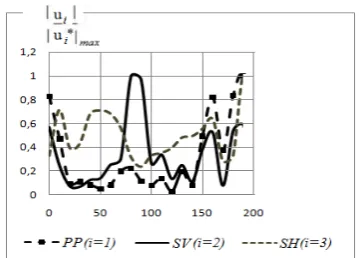
[image:5.595.48.292.328.415.2]Let us give you an example of research of impact of different kinds of waves (PP-, SV-,SH-) into the stress-strain state (Fig.2).
Fig.2. Impact of different kinds of waves into the stress-strain state of cavities in transtropic rock massif (first fundamental problem)
Figure 2 shows the distribution of displacements for different kinds of waves at the case of solving the first fundamental problem (angle of plane of isotropy and angle of falling waves are equal each other - 0, frequency
[image:5.595.336.516.515.644.2]VI. CONCLUSION
In conclusion we can add that this work also contains many other research results regarding to analyzing the stress-strain behavior of rock massif depend on the various physical and geometrical parameters of massif, waves and cavities. We considered the influence of cross-sectional form of cavities, their mutual influence, impact of changing angles of the plane of isotropy in rock massif, and changing of the angle of incidence and frequency of elastic waves onto the stress-strain state of transtropic massif with cavities.
We also can add that this work is a part of researches that are held in the Kazakh-British Technical University and in the Institute of Mechanics and Engineering Science named after U. A. Zholdasbekov, Republic of Kazakhstan over the past decades [32, 33, 34, 35, 36].
REFERENCES
[1] G.I. Petrashen “Propagation of waves in anisotropic elastic mediums”,
Leningrad, Nauka, 1980. - 280 p., Russian
[2] E. Delesan, D. Ruaie “Elastic waves in solids”, Moscow, Nauka, 1982.
– 424 p., Russian
[3] Zh.S.Erzhanov, Sh.M.Aitaliyev, L.A.Alekseeva, “Dynamic of tunnels
and underground pipelines”. – Alma-Ata, Publishing House “Nauka”, 1989, Russian
[4] A.N.Guz, V.D.Kubenko, M.A.Cherevko, “Diffraction of elastic
waves”, Kiev, Publishing House “Naukova dumka”, 1978, Russian.
[5] A.N.Guz, V.T.Golovchan, “Diffraction of elastic waves in
multicoherent bodies”, Kiev, Publishing House “Naukova dumka”, 1972, Russian
[6] N.A.Shulga, V.I. Colodii. “Diffraction of SH-waves on noncircular
cylindrical cavity”, Applied mechanics, 1984, Vol.17, No3, Russian
[7] A.S.Kosmodamianski, V.I.Storozhev, “Dynamical tasks of elasticity
theory for anisotropic environments”, Kiev, Publishing House Naukova dumka”, 1985, Russian
[8] A.S.Kosmodamianski, L.B.Obodovski,V.I.Storozhev “Diffraction of
elastic waves on anisotropic cylindrical inclusion inside the multicoherent areas”, Proceedings of Science Academy of USSR, Vol. A, 1980, No10, pp.38-41,Russian House “Gosstroiizdat”, 1959, Russian.
[9] Y.-H. Pao “Dynamical concentration of stresses in elastic plane,
Applied mechanics” (Proceedings of American Society of Civil Engineers (ASCE)): collection of translations, 1962, No2, pp. 147-154, Russian.
[10] J.Mau, L.Mente “Dynamical stresses and moving near of cylindrical
surface of break from a flat harmonious shear wave”, Applied mechanics (Proceedings of American Society of Civil Engineers (ASCE)): collection of translations, 1963, No4, Russian.
[11] C.C. Chao “Diffraction of flexural wave by a cavity in a elastic plate“
AIAA, Journal , 1964, v. 2, p, 145-152.
[12] Banaf, Goldsmith “Diffraction of stationary elastic waves on the
obstacles of arbitrary forms” // Applied mechanics (Proceedings of American Society of Civil Engineers (ASCE)): collection of translations,. 1963. V.30. - No4. - PP.126-134, Russian
[13] Sh.G. Napetvaridze “Seismic stability of hydraulic facilities in seismic
conditions” ,Moscow,Gosstroiizdat, 1959, Russian
[14] N.N Fotiyeva “Calculation of the linings of underground structures in
seismically active areas”, Moscow, 1980. – 222 p., Russian
[15] Zh.S.Erzhanov, Sh.M.Aitaliyev, Zh.K.Masanov, “Seismically stressed
state of underground constructions in anisotropic layered massif”, Alma-Ata, Publishing House “Nauka”, 1980, Russian
[16] S.G. Lekhnitsky “Elastic theory for anisotropic body” – Moscow,
Nauka, 1977. -367p., Russian
[17] G.N.Savin “Influence of lining to distribution of stresses near the
narrow underground mines”// Notes of Institute of Rock Mechanics, Academy of Science of Ukraine, 1947, No5, Russian
[18] S.A. Kaloerov “Stress state of half-plane with elliptic elastic ring” //
Theoretical and applied mechanics, Kharkov University, 1972, V.3 Russian
[19] Okamoto C, Kato K., Hamada M. “Behavior of Submerged Tunnels
During Earthquake”. Proc. of the 5 WORK, Rome, 1973
[20] Walter Wittke, Berndt Pierau, Claus Erichsen “New Austrian
Tunneling Method (NATM) Stability Analysis and Design” (Statik und Konstruktion der Spritzbetonbauweise. Geotechnik in Forschung und
Praxis), WBI-PRINT 5, VGE-Verlag Glückauf GmbH, Essen 2002, ISBN 3-7739-1305-2
[21] Xu Y., Han F. “Scattering of SH-waves by multiple semi-cylindrical
canyons”. //Dizhen gongcheng yu gongcheng zhendong – 1992. –
Vol.12. - №2, p.12-18.
[22] Lui D., Han F. “Application of the method of complex function to
scattering of SH-wave in anisotropic media” //18-th International Congress Theoretical and Applied Mechanics, Haifa, Aug.22-28, 1992. – Haifa, 1992. – P.95.
[23] Guoqing Wang, Dianku Liu. “Scattering of SH-wave by multiple
circular cavities in half space”. // Journal “Earthquake Engineering and Engineering Vibration”, Vol.1 No.1, June 2002, Article ID: 1671-3664(2002)01-0036-09, P. 36-44.
[24] Jianwen Liang, Hao Zhang and Vincent W Lee. “A series solution for
surface motion amplification due to underground twin tunnels: incident SV waves” // Journal “Earthquake Engineering and
Engineering Vibration”, Vol. 2, Nо 2, December 2003, DOI:
10.1007/s11803-003-0012-x. - Р.289-298.
[25] Jianwen Liang, Hao Zhang and Vincent W Lee. “A series solution for
surface motion amplification due to underground group cavities: Incident P waves”. // Acta Seismologica Sinica, Vol. 17, Nо 3, DOI:
10.1007/s11589-004-0052-y. – Р.296-307.
[26] Gai Bing-zheng. “On the diffraction of elastic wave and dynamic stress
concentration”. //CNKI:SUN:LXJZ.0.1987-04-001
[27] Liu Diankui Liu Hongwei. Scattering and dynamic stress concentration
of SH-wave by interface circular hole // CNKI:ISSN:0459-1879.0.1998-05-009
[28] Xu Ping ,Xia Tang-dai , Han Tong-chun. Scattering of elastic wave by
a cylindrical shell deeply embedded in saturated soils // Acta Seismologica Sinica. - Mar., 2006 Article ID: 1000-9116(2006)02-0191-08, Vol.19 No.2.- P.191-198
[29] D. S. Kim, and K. Konagai. Seismic isolation effect of a tunnel covered
with coating material. //Aseismic design. Available online 11 April 2001.
[30] V. W. Lee, M. E. Manoogian and S. Chen. Antiplane SH-deformations
near a surface rigid foundation above a subsurface rigid circular tunnel. // Earthquake Engineering and Engineering Vibration, Vol.1, No 1, P.27-35, DOI: 10.1007/s11803-002-0004-2.
[31] Gao Guang-yun, Li Zhi-yi1, Qiu Chang. Scattering of Rayleigh wave
from irregular obstacles in elastic half-space // CNKI:SUN:YTGC.0.2005-04-002
[32] Lyazzat Atymtayeva, Zhailau Masanov, Bagdat Yagaliyeva , Gulzada
Myrzakhmetova “Stationary diffraction of elastic SH-waves onto
mutually influencing cavities of arbitrary structure and deep lying in transtropic massif”, Proceedings of the 3rd IASME / WSEAS (CM'08), Cambridge, UK, February 23-25, 2008, ISBN: 978-960-6766-38-1, ISSN: 1790-2769, p. 5-9
[33] Lyazzat Atymtayeva “Research of dynamics of anisotropic multiply
massif under the impact of stationary diffraction of elastic waves at the case of solving the first fundamental problem” //Reports of Kazakhstan Republic National Academy of Science, No2, 2010. - pp.105-113, Russian
[34] Lyazzat Atymtayeva “Research of dynamics of anisotropic multiply
massif under the impact of stationary diffraction of elastic waves at the case of solving the second fundamental problem” //Reports of Kazakhstan Republic National Academy of Science, No4, 2010. - pp.21-24, Russian
[35] Atymtayeva L., Masanov Zh., Yagaliyeva B., Myrzakhmetova G.
“Dynamics of transtropic elastic continuums with non-homogeneities” //Proceedings of World Congress on Engineering 2010, the 2010 International Conference of Mechanical Engineering, London, UK, 30 June-2 July, 2010. - P. 1024-1027.
[36] Atymtayeva L., Masanov Zh., Yagaliyeva B., Myrzakhmetova G.
“Stationary diffraction of elastic waves on the mine tunnels in the anisotropic layered massif” // Proceedings of the International conference “Modern problems of applied mathematics and mechanics: theory, experiment and practice”, Novosibirsk, Russia, May 30 – June