344
©IJRASET: All Rights are ReservedPerformance Analysis of Teaching Learning
Optimization based TCSC Controller Design
Mayur Chouhan1, Sagar Trivedi2, Kapil Parkh3, Raunak Janjid4
1
M.tech Scholar, 2, 3, 4Assistant Professor, Electrical Engineering, SITE, Nathdwara, India
Abstract: Power system faces many problems leading to unstable performance of it. This instability is mainly due to the disturbances which require a good damping controller. These disturbances cause oscillations in power system which further leads to instability. FACTS have shown to be effective in addressing this problem of instability. There are many FACTS controllers but out of its family, Thyristor-Controlled Series Capacitor (TCSC) was focused here to solve the given problem. TCSC not only damps out of these instability causing oscillations, but also improves transient performance of the system. To further improve its ability to solve such issues, it has been associated with several optimization techniques previously such as an Interval Type-2 Fuzzy Logic Controller (IT2FLC), Particle Swarm Optimization (PSO), Genetic Algorithm (GA) and Type-1 Fuzzy Logic Controller (T1FLC). Using all these techniques basically improves its performance to address the above mentioned problem. The controller scheme mentioned here is a lead lag compensating design for TCSC which is making use of Teaching Learning Based Optimization (TLBO). It is tested on Single Machine Infinite Bus (SMIB) power system with the change of point of rotor speed and power angle. The whole scheme was developed in the MATLAB/SIMULINK environment to obtain the required result proving its usefulness in damping out the instability of power system.
Keywords: Thyristor-Controlled Series Capacitor; TLBO Algorithm; Phillips Haffron Model of SMIB System; FACTS devices
I. INTRODUCTION
With the increases of daily usage of electricity i.e. the overall demand of electrical power, it is necessary to transfer power at higher level over the transmission lines.
This has the effect of disturbance in the stability of power system which demands for the up gradation of the whole power system. But as it is well known that now a days to have the permission to establish new transmission line is quite difficult. It incurs a lot of cost and time too.
And other factors like environmental effects have to be considered too. This has led to take a closer look and analysis the power system so as to maintain its stability within the margin while maintain its security. Previously, keeping the power system away from its stability limits ensure the better dynamic control over the whole system. Other studies were also carried out in the area so as to address the problem stability. [3]
There are namely these types of stability in power system, large and small signal. Large signal stability is also known as transient stability. In case of small signal stability when there is no proper damping it occurs.. [5].
With the development of new and better technology to tackle this issue, we now have Flexible AC transmission devices (FACTS). These are electronic based modern devices.
This family of devices has the capability of controlling the factors which affects the performance of the power system. It has ability of repeatability and smoother control resulting in less response time and efficient.
The following work is more focused around compensating series reactance of the line in order to improve the stability especially transient stability. The big family of FACTS includes Static Synchronous Series Compensator (SSSC), Interline Power Flow Controller (IPFC), Thyristor Controlled Series Capacitor (TCSC), Thyristor Switched Series Capacitor (TSSC), Thyristor Controlled Series Reactor (TCSR) and Thyristor Switched Series Reactor (TSSR). But here TCSC has been chosen to show its usefulness in addressing the given problem of stability [30].
345
©IJRASET: All Rights are ReservedII. SYSTEMMODEL
A. Modified Philips Heffron model of SMIB with TCSC
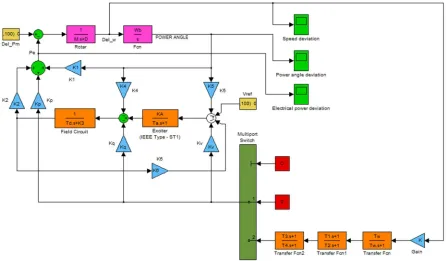
Fig.1 shows SMIB model of Philips Heffron employs TCSC here to improve its system performances.
Fig.1 Modified Philips Heffron Model with TCSC
Here a diagram shows the modeling of it, which uses the electromechanical equations mentioned previously in this chapter after linearizing it. It always works around an operating point [6].
B. Overview of TCSC Controller
Fig.2 shows the controller design used here has a washout block (high pass filter KT), its purpose is to let the signal pass through as it is associated with oscillations of input signal [32]. It also compensates the phase lag present among input and output signal by the use 2-stage phase compensation. Here is the representation of the transfer function of the given controller,
y = K ( )( )( )x (1)
y = output signal x = input signal
TCSC controller used here reduces the low frequency oscillations present in SMIB due to the disturbances so as to improve its
overall stability by contributing a damping torque [7].
346
©IJRASET: All Rights are ReservedC. Objective Function
The main objective of the thesis is to reduce the disturbance causing oscillation with use of TCSC controller. Employment of this increases the stability (in terms of the settling time and overshoot) via the controlling of variation in rotor angle and speed. The
problem is given as an integral time absolute error of the speed deviations, i.e.,
J =∫ |Δw|. t. dt
(2)
III. THE TEACHING LEARNING-BASED OPTIMIZATION (TLBO)
All algorithms based on evo1ution and the intelligence of the swarm are probabilistic algorithms and require common control parameters such as popu1ation size, number of generations, size of e1ites, etc. the transition rate. Similarly, PSO uses inertial weight as well as social and cognitive parameters. The proper setting of the algorithm-specific parameters is a very important factor that affects the performance of the algorithms mentioned above. Incorrect1y tuning a1gorithm-specific parameters increases computational effort or resu1ts in an optimal local so1ution. Therefore, Rao et a1. (2011, 2012a, b), Rao and Savsani (2012), Rao and Pate1 (2012) recently launched the TLBO (Teaching-learning Optimization) algorithm, requiring only the common control parameters and non specific control parameter algorithms. Other scalable algorithms require the control of common control parameters and the control of the algorithm-specific parameters. The load of the tuning control parameters is comparatively lower in the TLBO algorithm. Thus, the TLBO algorithm is simple, efficient and requires relatively less computing effort. Therefore, TLBO was used in this work to test the unrestricted and limited multi-object test functions, and the results were compared to other optimization algorithms. TLBO algorithm, a teacher based on the performance impact of learners in the class, is an algorithm that is based on the teaching and learning proposed by Rao [1]. This algorithm, and interacting, describing the two basic modes of learning (i) by teachers (known as a teacher step) and (ii) other learners (known as a learner’s level) Describe. This optimization algorithm is considered the group of learner is considered as the population will be provided different topics for the learners, to different design variables of the optimization problem considered, "goodness of adaptation" learning outcomes optimization problem value .. The best solution for the entire population is a teacher. The design variable is actually a parameter that relates to the objective function of the given optimization problem, and the optimal solution is the best value of the objective function. The work of TLBO is divided into two parts, "teacher level" and "learner level". The TLBO algorithm has already been tested with several limited and unrestricted benchmark functions and is superior to other advanced optimization techniques [2]
A. Algorithm of TLBO
Below is the steps describing TLBO algorithm.
1) The population (no. of students) size is started in the class N, no. of generation G corresponds to no. of units in distribution system D and limits of design variables. (UL upper and LL lower).
Optimization problem: Minimize f(x), such that LL≤ x ≤ UL
f(x)= objective function x= vector for design variables
2) Generate a random population according to the number of students in the class ( N )and number of subjects offered (D). This population is mathematically expressed as
= , , … … , , , … … , … … … . , , … … , (3)
, = initial grade of jthsubjectof the ithiteration.
3) Evaluate the average grade of each subject offered in the class. The average grade of the jthsubject at generation g is given by = ( , , , , … … . , , ) (4)
4) Based on the objective value sort the population from best to worst. The best solution (teacher) is
= ( ) = (5)
5) Changing grade point of every control variables of every individual student. These are,
( )= + ∗( − ) (6) ( )= + ∗( − [1 + ] ) (7)
347
©IJRASET: All Rights are ReservedIV. RESULT AND DISCUSSIONS
The Sim power system tool boxes are used for analysis and develop the power system model. This is a very useful tool for modeling and simulation. This tool contains power library. Several blocks are available in library such as generators, different types of machines, power electronic converter, excitation system, different drives, transformers, transmission lines etc.
A. MATLAB Model of SMIB System with TCSC Controller
MATALB is a very popular platform for the simulation of different conceptual model. Here too, the same platform has been utilized. SIMULINK is one of the toll boxes provided by MATLAB that is made use of in the present work. Fig.3 shows the model of TLBO based TCSC in Philips Heffron model of SMIB has been developed using the same tools and platform.
TCSC is a prevalent series FACTS controller employed to enhance power transfer capability of transmission lines to ameliorate system stability. This controller is utilized for SMIB model to damp out low frequency oscillations which would enhance transient stability. The entire system is represented in SIMULINK block set of Sim power System tool of MATLAB working platform. This given model of SMIB which employs TCCSC as a controller is designed with the help of linearization of equations. Initial operating conditions are provided in Appendix. Equations K1, K2, K2, K4, K5, K6, KP, KQ,KV has been calculated by the equations which are presented after the linearized equations.
Fig. 3: MATLAB Model of SMIB System with TCSC Controller
[image:4.612.76.524.285.546.2]For the successful operation of TLBO it requires careful selection parameters
Table 1: TLBO Optimized TCSC Controller Parameters for SMIB System
S.N. System
TLBO Optimized TCSC Controller Parameters at Different Loading
Loading Conding K T1 T2 T3 T4
1.
SMIB System
Nominal Loading 99.58 0.8554 0.9166 0.9107 0.0536
Light Loading 100 0.9995 0.0616 0.9996 0.6190
348
©IJRASET: All Rights are Reserved [image:5.612.134.498.93.246.2]Fig. 4 shows the convergence rate of objective functions of SMIB system use TLBO algorithm.
Fig.4 Convergence of fitness role for SMIB power system
B. Simulation Result for SMIB Power System
The results of the developed simulation models under various contingencies are presented and discussed below. The developed model is simulated without & with TCSC tuned by TLBO Algorithm. The analysis of the given model has presented for several operating and fault conditions. All the responses has been capture for the operation the model with TCSC and without the use of the controller mentioned.
[image:5.612.37.576.425.483.2]The power system performance was examined nominal loading, light loading and heavy loading with 5% step increase with mechanical torque input and reference voltage setting. The line reactance is varied according to the load on the system. When the load is of nominal rating it is increased by 10% and in the case of heavy load it is 5% increase. The tow of the different cases for which the analysis has been carried are mechanical torque input and reference voltage setting .The various graphs the change in speed deviation, power angle deviation & electrical power deviation has been shown. Both responses are shown with TLBO and without any control. Table 2 shows different loading conditions of active and reactive power per unit show.
Table 2: Different Loading Conditions of SMIB System
S.No. Loading Conditions P(PU) Q(PU)
1 Nominal Loading 0.9 0.469
2 Light Loading 0.5 0.1695
3 Heavy Loading 1.02 0.5941
[image:5.612.132.480.561.719.2]C. Condition-1: Nominal Loading
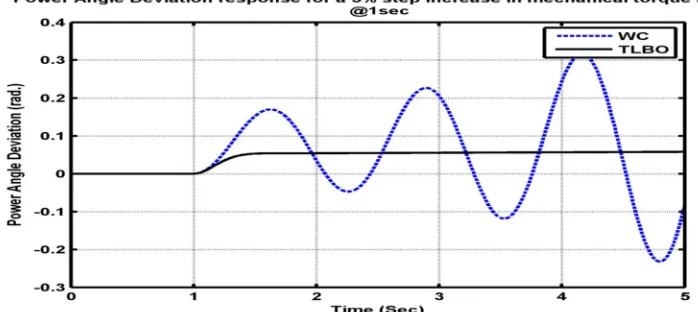
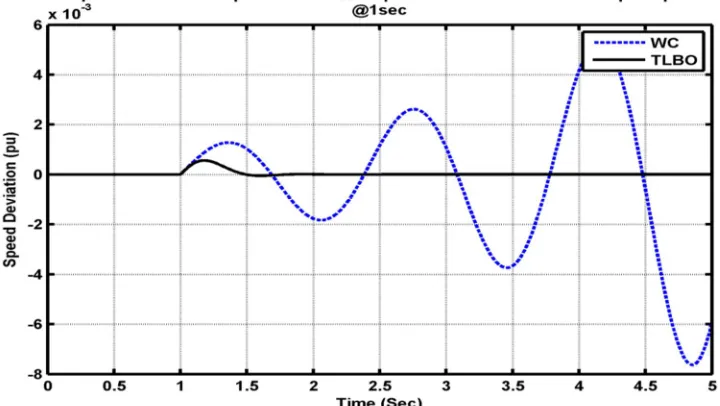
Fig. 5 to 6 shows the performance of the system under nominal loading conditions is seen (P=0.9 pu, Q = 0.469 pu) under 5% step increase mechanical torque input at speed and power angle deviation response . The following results confirm the inadequacy of the system to damp when no controller is present indicating unstable status of the system. Finally get system response is stable & robust when apply TLBO tuned TCSC controller.
349
©IJRASET: All Rights are ReservedFig.6 Power Angle Deviation Response in mechanical Torque input at Nominal Loading Condition
[image:6.612.128.490.310.472.2]D. Condition-2: Line reactance value increased to 50% with Nominal Loading
Fig.7 to 8 shows under the given condition of nominal loading line reactance value is increased to 50% of its initial value. Without control response is poorly damped and the proposed TLBO is relatively effective and robust.
[image:6.612.132.486.504.659.2]Fig.7 Speed Deviation Response in mechanical Torque input at Line Reactance value Increase to 50%
Fig.8 Power Angle Deviation Response in mechanical Torque input at Line Reactance value Increase to 50%
E. Condition-3: Light Loading
350
©IJRASET: All Rights are Reserved [image:7.612.101.491.249.430.2]Fig.9 Speed Deviation Response in mechanical Torque input at Light Loading Conditions
Fig.10 Power Angle Deviation Response in mechanical Torque input at Light Loading Conditions
F. Condition-3: Heavy Loading
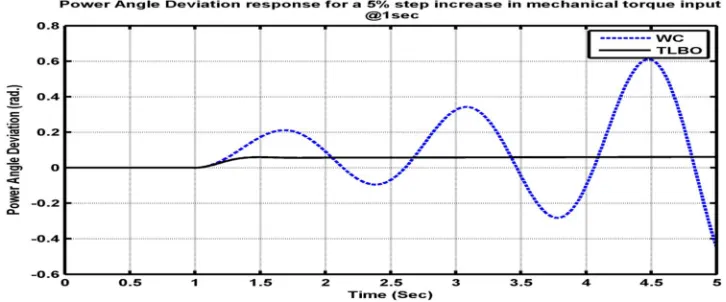
[image:7.612.127.487.519.722.2]Fig. 11 to12 shows the performance of the system under heavy loading conditions is seen (P=1.02 pu, Q = 0.5941 pu) under 5% step increase mechanical torque input. The designed controllers are emphatic and carry out satisfactory operation when employs TLBO tuned TCSC controller and system shows reduce settling time.
351
©IJRASET: All Rights are ReservedFig.12 Power Angle Deviation Response in mechanical Torque input at Heavy Loading Conditions
[image:8.612.127.488.310.473.2]G. Condition-4: Line Reactance Value Increased to 10% with Heavy Loading
Fig. 13 to14 shows (P=1.02 pu, Q = 0.5941 pu) under with 10% increase in line reactance with condition of mechanical torque input of 5% step. Whereas the system is without a controller shows high oscillations. Fig. 13 to14 shows obviously depicts that system is stable with optimal controller.
Fig.13 Speed Deviation Response in mechanical Torque input at Line reactance value increased to 10%
Fig.14Power Angle Deviation Response in mechanical Torque input at Line reactance value increased to 10%
H. Comparison Table without and with TLBO tuned TCSC Controller
352
©IJRASET: All Rights are Reservedcompared to without controller for the same condition, it is observed from the speed deviation, power angle deviation, plots that there is no overshoot contributed by the TLBO tuned TCSC controller response is faster compared to without control.
Table: 5.9: Increase in Mechanical Torque Input without and with TLBO Tuned TCSC Controller in Different Loading Conditions
S.NO. Conditions Deviation Without TCSC
Settling Time(Sec.)
With TLBO tuned TCSC Settling Time(Sec.)
1 Nominal Loading Speed High Oscillatory 0.5719
Power Angle High Oscillatory 0.8918
2 Line reactance value increased to 50% with Nominal Loading
Speed High Oscillatory 0.5719
Power Angle High Oscillatory 0.8918
3 Light Loading Speed High Oscillatory 0.5539
Power Angle High Oscillatory 0.5121
4 Heavy Loading Speed High Oscillatory 0.7675
Power Angle High Oscillatory 1.02235 5 Heavy Loading with 10% decrease
in Line Reactance
Speed High Oscillatory 0.5654
Power Angle High Oscillatory 1.0534
V. CONCLUSIONS
In this paper, TLBO tuned TCSC controller improves power stability. The system is based on MATLAB / Simulink tested and the results of the proposed work with and without Controller TLBO granted. The model of SMIB integrating TCSC usefulness into it has been modeled successfully. The results confirmed the vitality of TCSC in the SMIB. Also, it performs better when the parameters controlling the operations were optimized using TLBO algorithm. The effectiveness of the proposed controllers to improve the stability of the power system is demonstrated for a single infinite machine bus to various conditions such as mechanical torque input at speed deviation and power angle deviation. Show its superiority and a system to reduce the settling time.
REFERENCES
[1] B. Naik, J. Nayak and H.S. Behera, “A TLBO based gradient descent learning-functional link higher order ANN: An efficient model for learning from non-linear data”, Journal of King Saud University – Computer and Information Sciences, 2018, pp. 120–139.
[2] A. Tiwari and M. K. Pradhan, “Applications of TLBO algorithm on various manufacturing processes: A Review”, ICMPC, Materials Today: Proceedings 4, 2017, pp. 1644–1652.
[3] S. Raj and B. Bhattacharyya, “Optimal placement of TCSC and SVC for reactive power planning using Whale optimization algorithm”, Swarm and Evolutionary Computation BASE DATA, 2018, pp. 1-29.
[4] S. Saharana, J. S. Latherb and R. Radhakrishnanc, “Optimization Using Rearrangement of Order of BGP and TLBO Approach”, CSCC 2017, Dec 2017, pp. 7-8.
[5] A. Haldera, N. Palb and D. Mondalc, “Transient Stability Analysis of a Multimachine Power System with TCSC Controller – A Zero Dynamic Design Approach”, Electrical Power and Energy Systems 97, 2018, pp. 51–71.
[6] M. K. Sharma, A. Vijay and G. N. Pillai, “Stable Type-2 Fuzzy Logic Control of TCSC to Improve Damping of Power Systems”, International Conference on Computer, Communications and Electronics (Comptelix), July 2017, pp. 388-393.
[7] E. Yasoubi and Mostafa Sedighizadeh, “Coordinated Design of PSS and TCSC Controllers using Colonal selection algorithm for stability enhancement of dynamical power system”, IEEE, 2017, pp. 580-585.
[8] S. Sahu, A. K. Barisal and A. Kaudi, “Multi-objective optimal power flow with DG placement using TLBO and MIPSO: A comparative study”, Energy Procedia 117, 2017, pp. 236-243.
[9] M. D. Kumar and P. Sujatha, “Design and Development of Self Tuning Controller for TCSC to Damp Inter Harmonic Oscillation”, Energy Procedia 117, 2017, pp. 802-809.
[10] D. K. Mishra, A. Mohanty and P. Ray, “MATLAB/SIMULINK based FA for optimizing TCSC controller in a power system”, ICACCS -2017, Jan 2017. [11] M. Bakhshi, Md. H. Holakooie and A. Rabiee, “Fuzzy based damping controller for TCSC using local measurements to enhance transient stability of power