166
Optimal Path Routing in Partially Connected
Wireless Mesh Network
R. Rama1, Dr. P. Shanthi Bala2
1, 2
Department of Computer Science, Pondicherry University, Puducherry, India
Abstract: The performance of routing in Wireless Mesh Network (WMN) may be degraded due to various factors. Now a day, it is very important to increase the routing performance and it can be achieved through the optimal path. Routing finds the path for the network to send the traffic from one node to another node. Because of high traffic variation, the path in the network is not optimal. The non-optimal path can lead to high level of packet losses and delays. In this paper, a new approach called Brute Force Approach (BFA) has been introduced for finding the optimal path in partially connected Wireless Mesh Network (WMN). The two evaluation metrics such as end-to-end delay and hop count are used to find the performance of overall network. BFA is analysed and evaluated using those metrics. The evaluation result shows that the proposed method finds the best optimal (shortest) path for sending the packets over the network and also BFA limits the packet losses and delays over the partially connected Wireless Mesh Network.
Keywords: Wireless Mesh Network, partial connection, Brute Force Approach, end-to-end delay and hop count.
I. INTRODUCTION
Communication plays a vital role in day to day life over the network, the communication has been done in two ways either through wired and wireless communication. The wireless communication is increased popularly to eliminate the installation cost of wired communication. In the last few years, the Wireless Mesh Network (WMN) is quite popular for communication over the network [1]. In WMN the nodes are interconnected with each other. The components that are used in WMN are Mesh Routers (MR), Mesh Clients and Gateway (GW) [2]. The Mesh Routers are combined to form a backbone for the network, it sends the traffic from clients to gateway using hop communication.
[image:1.612.183.415.514.702.2]The architecture for WMNis designed in three ways such as Infrastructure/Backbone WMN, Client WMN, and Hybrid WMN [3]. In Infrastructure/BackboneWMN, the Mesh Routers create an infrastructure/backbone for wireless clients so that they can connect to the internet. The collection of Mesh Router grouped to form the backbone for mesh client and the internet as shown in Figure 1. Radio technologies are used to build the infrastructure/backbone WMN, the most popularly used technology is IEEE 802.11 (WLAN-Wireless LAN). This is also called as infrastructure meshing, apart from providing the backbone for the wireless client it is also used to make the connection with existing wireless networks. The link between these two networks can be built by using Ethernet cable.
Fig. 1 Infrastructure/Backbone WNM [3]
MR with GW
MR with GW
MR with GW/Bridge
MR with GW/Bridge MR with
GW/Bridge
MR
MR
INTERNET
Wi-Fi/WiMAX Networks
Cellular Networks
Wireless Client
In client WMN, the wireless devices are interconnected with each other to form the network. This type of meshing is also called as
client meshing. Each wireless devices act as a mesh router, it will perform routing and configuration by its own along with the end user application for the client which is shown in Figure 2.
Fig. 2 Clients WMN [3]
[image:2.612.152.455.119.256.2]Hybrid WMN is the process of connecting infrastructure/backbone WMN and Client WMN for the communication. The process of meshing two networks is said to be Hybrid Meshing. If the mesh client needs to access the network it can be done by using a backbone network or directly meshing with other mesh clients which is shown in Figure 3.
Fig. 3 Hybrid WMN [3]
In mesh network, the connection is established either using full mesh topology or partial mesh toplology1. When every node is connected with every other node in a network then the connection is said to be Full Mesh Topology. In this topology, if one of those nodes gets failed then the traffic is directed by any other nodes. Full Mesh yields high redundancy so that traffic failure gets reduced. But the cost of implementation is high in order to reduce the cost many network developers are concentrating on Partial Mesh topology. In partial mesh connection some nodes are grouped to form full mesh scheme, other nodes are connected with one or two nodes in the network. In this paper, partial mesh connection is used. The new search approach called Brute Force Approach (BFA) has been introduced for finding the routing path in the network. In BFA each and every node discovers its own route for sending the traffic over the network.
The remainder of this paper is organized as follows; section 2 presents the related work of routing algorithms and routing metrics in Wireless Mesh Network. Section 3 describes the proposed work and system architecture. Section 4 evaluates the experimental result of our proposed method BFA. Section 5 concludes the paper.
MR with GW
MR with GW
MR MR with GW/Bridge MR with
GW/Bridge
MR
MR
INTERNET
Wireless Client Wireless Mesh
Backbone
Wi-Fi, Sensor
Networks,etc.. Wireless Mesh Clients
1
https://www.computerhope.com/jargon/m/mesh.htm
Mesh Client
166
II. RELATEDWORK
Wireless Mesh Network (WMN) is less expensive than traditional network, it can be easily adaptable and expandable at any environments, this network also support for high demands of public users.
Optimization architecture for routing is used to identify multi-path to increase the quality of service and also performed link selection in the wireless mesh network without any loss of packet [4]. Identifying multi-path and QoS are achieved by using the following steps: First Proximal Optimization Algorithm is used to find the primary problem of the routing and then the primal-dual method is used to resolve the sub-problem of the routing. Formation of loop in routing is one of the essential problems to degrade the network performance in the wireless mesh network. Loop-free Metric Range (LMR) has been proposed to avoid the loop formation [5]. Loop is occurred because of improper update of routing table. LMR limited the range of metric to avoid the loop in routing.
Link quality fluctuation leads to network instability. The metric value of the link may get frequently changed, this may cause out of order delivery of the packet, high jitter, packet losses, and high delays. To overcome this problem Node-Stability based Routing (NSR) is proposed [6]. Stability of the node is achieved with the help of Stability Index Algorithm (SIA). This method checks every link along with the threshold value if the link metric is less than the threshold value then the link is stored in the routing table otherwise it rejects the link. With the help of SIA Link quality fluctuation is avoided. Mobility-Aware Hybrid Routing (MHR) has been developed to increase the performance of Wireless Mesh Network. This approach is applied for both static and mobile networks. MHR used reactive and proactive approaches. In a mobile network, the path is discovered by the reactive approach and the route entry is maintained by a proactive approach even though if any route fails the maintaining process will go on. But in the static network after the route discovery, the route entry is maintained for each and every node. In a mobile network, the topology gets changed every time due to node movement so that the proactive approach used to identify the route failure easily in the mobile network [7]. MHR approach can be applied with any reactive protocol like AODV and DYMO to improve the performance of WMN.
The most commonly used multicast routing approaches are Shortest Paths Trees (SPT) and Minimum Cost Trees (MCT) [8], [9]. The performance of these approaches is compared in Wireless Mesh Network (WMN). These multicast routing approaches route the traffic based on the distance (or cost). Distance from the sender to each receiver is minimized by using SPT and to the overall cost is minimized by using MCT. At the end of the performance evaluation, SPT provided best result than MCT. Anypath routing in wireless medium with the exploitation of spatial diversity and broadcast nature to improve the performance of unreliable wireless network [10]. Anypath routing is a directed acyclic graph, every node is a successor for the source and predecessor for the destination. The packets will not be forwarded again and again in anypath routing. The author analysed the performance of anypath routing with NP-hard and polynomial time constrains. Finally Anypath routing given the best result than Dijkstra’s shortest path algorithm.
In Wireless communication to improve the transmission of information rate and to share the equal amount of bandwidth two algorithms are proposed [11]. One is the Optimal Polynomial-Time algorithm and another one is Reduced Complexity algorithm. These algorithms provided optimal solution within Polynomial-time. To achieve optimal solution, Shortest Path procedure is used.Providing guaranteed bandwidth is on of the problem in Wireless Mesh Network [12]. This is occurred due to the interference in the network. Bandwidth Guaranteed Scheduling (BGS) algorithm helps to allocate the guaranteed bandwidth and uses K-shortest path algorithm to provide the best shortest path. The BGS used the TDMA concept to identify the feasible solution with the required bandwidth and the shortest path algorithm found the best path along with admission control.
TABLE 1
Different routing metric used in WMN
III. PROPOSEDMETHOD
From the analysis of related work, the shortest path routing algorithm provides the best result to increase the performance of Wireless Mesh Network (WMN). In this paper, we proposed the Brute Force Approach (BFA) algorithm with the shortest routing path approach. BFA provides the optimal shortest path along with routing metrics to increase the overall network performance. Route stability, minimum weight path and an algorithm for calculating path are used in proposed method to evaluate the performance of the network.
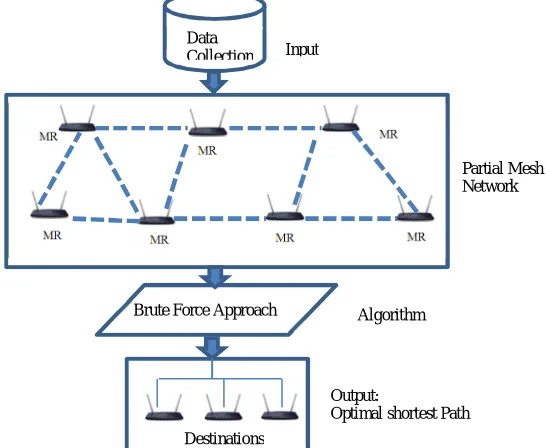
[image:4.612.95.511.105.323.2]In BFA every node does topology discovery on its own and finds routes to all other nodes independently at the beginning of the simulation. This method improves the central routing database and on-demand route calculation. The process of BFA is as follows, 1. Each node "i" in the network gets the topology and check if the node is connected with any other node. If any node is connected then its stores the next hop node and make a connection between those nodes otherwise it does not get connected. 2. After the connection, the routing process takes place. In BFA, the routing table of each node carries only the destination address and next hop.
Fig. 4 Proposed method
AUTHORS ROUTING METRICS PURPOSE
Yaling Yang et al.,
2014
Hop count Finds the number of hops taken by the packet to reach the destination [13].
N.Javais et al., 2014 Quality Link Metric (QLM) and
Inverse Expected Transmission Count (IETC)
QLM measures the quality of the link in the network and IETC measures the transmission count of the packet reached and verifies whether it reached the destination with expected count or not [15].
Wang et al., 2014 Metric based on the uniform
description of Interference and Load (MIL)
MIL measures the interference and the load for the network [16].
Nguyen et al., 2011 Channel Utilisation and
Contention Window Based
(C2WB)
Measure whether the channel of the network is utilized properly or not [17].
Data Collection
MR MR
MR MR MR
MR
MR
Brute Force Approach
Destinations Input
Output:
Optimal shortest Path Algorithm
[image:4.612.174.447.489.713.2]166
Node "i" receives the packet and checks the destination address if the address is the same as the address of node "i"," i" receives the packet otherwise it sends the packet to the next hop. If the node does not have the next hop then it discards the packet. 3. To avoid congestion, the queuing process is used in BFA. This process is based on frame size, if the frame size of the packet exceeds then it discards the packet. The novel routing technique is proposed to increase the routing performance in partially connected Wireless Mesh Network (WMN). As represented in Figure 4. WMN is constructed from the data file, and then the routing is performed using BFA. Finally, with the function of BFA algorithm, it provides the best optimal shortest path for the WMN.A. Algorithm 1: Bfa Algorithm 1) Find and store next hops
int i ;// Node
for (i=0; i<topo --> getNumNode(); i++) if(topo --> getnode(i)=this node) continue; //connected
topo --> calculate shortest path; if(this node --> get NumPaths ()==0 continue; // not connected
2) Handle Message
Packet --> get DestAddr If(DestAddr=My Address) {
Local delivery of packet }
else if {
Forward packet to next hop }
else {
Discard packet }
Print(unreachable)
3) Queuing
Queue is busy = true;
If (endTansmissionEvent --> is scheduled()) Get packet byte length
If (Packet length <= frame capacity) Send (msg, “line$0”) // queued up Else
Packet received but it is discarded Queue is busy = false;
If (queue. isEmpty()) Emit (busy signal)
Packet received and starts transmission
IV. ROUTINGMETRICS
of hop count. So that route stability and weight minimization of link is achieved easily by using this BFA algorithm. BFA uses two evaluation metrics they are end-to-end delay and hop count metrics.
The end-to-end delay is the time taken for a packet to reach the destination from the source across the network. In BFA, end-to-end delay is calculated by using time taken to generate the packet for each node and simulation time to transfer the packet to the destination as given in in Equation 1. The hop count metric counts the number of jumps the packet taken to reach the destination over the network given in Equation 2.
Dend-to-end = ∑ [PKCT + SimT] (1)
Where,
D = Destination of the network PKCT = Packet creation time
SimT = Simulation time to reach the destination
HPpk = count [Links] (2)
Where,
HP = Hop count
pk = packet of each node
Based on these two evaluation metrics, the BFA algorithm evaluates the performance of Wireless Mesh Network (WMN).
V. EXPERIMENTALANALYSIS
We analyzed the performance of the proposed routing technique (BFA) using OMNeT++ simulator. For the simulation, we have used the backbone wireless mesh topology. The connection of the mesh topology is done partially, some nodes grouped to form mesh topology, other nodes are connected with one or two nodes in the network. This topology consists of 53 Mesh Router and 3 gateway/destination router.
The main process of the Brute Force Approach (BFA) is to find the optimal path for the Wireless Mesh Network. The performance of the optimal path is measured with the help of end-to-end delay and hop count. As shown in Figure 5, the proposed method, BFA uses less hop count to send the packet from source to destination. To evaluate the end-to-end delay, the simulation date rate fixed as 1 Mbps for the entire router in the network. We simulated the simulation approximately 45 minutes. Finally, the result given in Figure 6 shows that the overall time taken for the packet to reach the destination along with the packet generation time which is less than a one millisecond.
Fig. 5 Hop count metric
Fig 6 End-to-End Delay
0 5 10 15
D1 D2 D3
Hop Count
H
o
p
Co
un
t
0 0.2 0.4 0.6 0.8 1
D1 D2 D3
end-to-end delay
Simulation Time
P
a
cke
t
C
re
a
ti
o
166
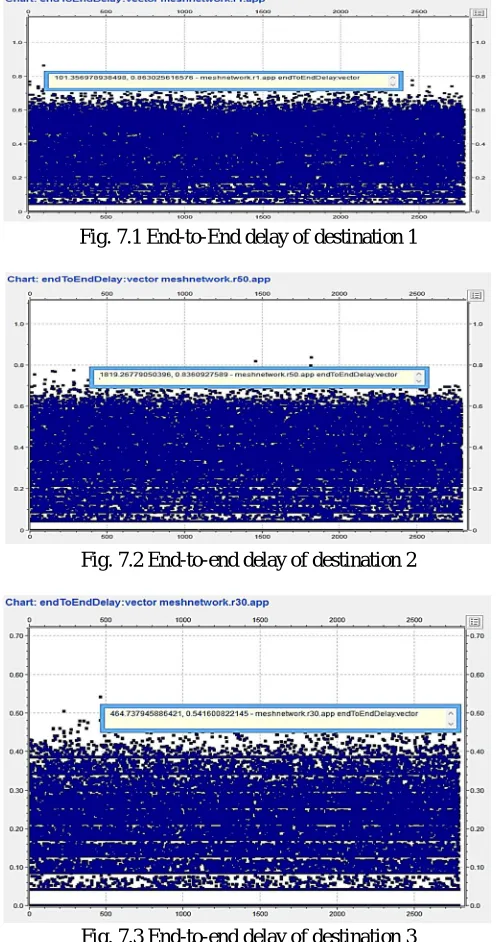
The output of the simulation represented in the vector matrix. The end-to-end delay is calculated by using simulation time along with packet creation time. For destination 1 given in Figure 7.1 overall packet generation time taken to reach the destination is approximately 0.85 ms. Destination 2 given in Figure 7.2 also takes approximately 0.83 s to reach the destination. The destination 1 and 2 are the end nodes for the network. So that it takes up to 0.8 ms to generate the packet and to reach the destination. But the destination 3 given in Figure 7.3 takes only 0.54 ms this is because of the node paced in-between the network.Fig. 7.1 End-to-End delay of destination 1
Fig. 7.2 End-to-end delay of destination 2
Fig. 7.3 End-to-end delay of destination 3
The BFA algorithm finds the best optimal path along with the least end-to-end delay and less hop count. So that the algorithm can be used to implement the real time Wireless Mesh Network to increase the user demands.
VI. CONCLUSION
REFERENCES
[1] Akyildiz, Ian F., Xudong Wang, and Weilin Wang. "Wireless mesh networks: a survey." Computer networks 47.4 (2005): 445-487.
[2] Boushaba, Mustapha, Abdelhakim Hafid, and Michel Gendreau. "Node stability-based routing in wireless mesh networks." Journal of Network and Computer Applications 93 (2017): 1-12.
[3] Alabady, Salah A., and M. Salleh. "Overview of Wireless Mesh Networks." Journal of Communications 8.9 (2013): 134-144.
[4] Li, Yajun, et al. "Optimization architecture for joint multi-path routing and scheduling in wireless mesh networks." Mathematical and Computer Modelling 53.3-4 (2011): 458-470.
[5] Yoshihiro, Takuya, Kenji Kaho, and Takahiro Iida. "A Limiter on Dynamic Metrics to Reduce Routing Loops in Wireless Mesh Networks." Journal of Information Processing 25 (2017): 191-198.
[6] Boushaba, Mustapha, Abdelhakim Hafid, and Michel Gendreau. "Node stability-based routing in wireless mesh networks." Journal of Network and Computer Applications 93 (2017): 1-12.
[7] Kum, Dong-Won, et al. "Mobility-aware hybrid routing approach for wireless mesh networks." 2010 Third International Conference on Advances in Mesh Networks. IEEE, 2010.
[8] Nguyen, Uyen Trang, and Jin Xu. "Multicast routing in wireless mesh networks: Minimum cost trees or shortest path trees?." IEEE Communications Magazine 45.11 (2007): 72-77.
[9] Zheng, Yi, Uyen Trang Nguyen, and Hoang Lan Nguyen. "Data overhead impact of multipath routing for multicast in wireless mesh networks." 2012 Third FTRA International Conference on Mobile, Ubiquitous, and Intelligent Computing. IEEE, 2012.
[10] Fang, Xi, Dejun Yang, and Guoliang Xue. "MAP: Multiconstrained anypath routing in wireless mesh networks." IEEE Transactions on Mobile Computing 12.10 (2013): 1893-1906.
[11] Saad, Mohamed. "Optimal spectrum-efficient routing in multihop wireless networks." IEEE Transactions on Wireless Communications 8.12 (2009): 5822-5826.
[12] Zeng, Ziming, and Liyi Zhang. "Bandwidth Guaranteed Scheduling and Shortest Path Routing in Wireless Mesh Networks." 2007 International Conference on Wireless Communications, Networking and Mobile Computing. IEEE, 2007.
[13] Yang, Yaling, Jun Wang, and Robin Kravets. "Designing routing metrics for mesh networks." IEEE Workshop on Wireless Mesh Networks (WiMesh). 2005.
[14] Geng, Haijun, et al. "Dynamic distributed algorithm for computing multiple next-hops on a tree." 2013 21st IEEE International Conference on Network Protocols (ICNP). IEEE, 2013.
[15] Javaid, Nadeem, et al. "Investigating quality routing link metrics in wireless multi-hop networks." Annals of telecommunications-Annales des
télécommunications 69.3-4 (2014): 209-217.
[16] Wang, Jihong, et al. "Uniform description of interference and load based routing metric for wireless mesh networks." EURASIP Journal on Wireless Communications and Networking 2014.1 (2014): 132.
[17] Nguyen, Lan Tien, Razvan Beuran, and Yoichi Shinoda. "An interference and load-aware routing metric for Wireless Mesh Networks." International Journal
of Ad Hoc and Ubiquitous Computing 7.1 (2011): 25
[18] Javadi, Farshad, Kumudu S. Munasinghe, and Abbas Jamalipour. "A fast and reliable routing technique for wireless mesh networks." Wireless Communications and Mobile Computing 12.9 (2012): 782-796.
[19] Geng, Haijun, et al. "A hop-by-hop dynamic distributed multipath routing mechanism for link state network." Computer Communications 116 (2018):
225-239.
![Fig. 1 Infrastructure/Backbone WNM [3] Networks](https://thumb-us.123doks.com/thumbv2/123dok_us/1244894.650813/1.612.183.415.514.702/fig-infrastructure-backbone-wnm-networks.webp)
![Fig. 3 Hybrid WMN [3]](https://thumb-us.123doks.com/thumbv2/123dok_us/1244894.650813/2.612.152.455.119.256/fig-hybrid-wmn.webp)