
©IJRASET: All Rights are Reserved
2084
A Review on Surface Modification of Aluminium
Alloy using Friction Stir Processing
Ravi Butola
1, Ranganath M. Singari
2, Qasim Murtaza
31, 2, 3Delhi Technological University, Delhi, India
Abstract: Surface Modification of Aluminium alloy have a wide range of applications in aerospace industries, where high strength to weight ratio is required. Different nano-particle reinforcements have different effects on Aluminium alloy as a base material. In this review paper the effects and properties are studied for different nano particle size of reinforcing materials such as boron carbide nano particle. In this paper also studied different type of tool pin profile used for the surface modification of Aluminium alloy. Friction stir processing tool plays an important role for the surface modification of the materials. It decides what types of materials could be manufactured. Properties like hardness, tensile strength, wear resistance etc have been studied rigorously and been summarised. It’s been observed that there is an enhancement in the properties of surface composites so formed on addition different particle of the reinforcing materials to Al alloy surface composites.
Keywords: Surface Composites, Reinforcement, boron carbide, Nano particle.
I. INTRODUCTION
Surface modification is the process of modifying the surface of a matrix material by using physical, chemical characteristics different from the base material. The increasing demand of modified surface properties of the component,in order to meet the functional and design requirement of customers, toward the development of surface composite.The selection of technology to engineer the surface is an integral part of an engineering component design. The first step in surface modification technique to determine the surface and substrate engineering requirements which involves one or more of the properties like wear resistance, fatigue, creep strength, etc. The various surface treatments generally used in engineering practice and presented as under. The importance of Al based surface composites has gained a wide application in recent years. Surface composite(SC) are fast replacing conventional metallic alloys in so many applications in aerospace and defences, marine industries. The Nano-particle reinforcing materials used in the development of new material. This review, turn around the works of various researchersin the field of surface engineering and studying the impact of different type of Nano-particle reinforcements and different types of tool pin profile used for surface modification. Various research papers have been studied rigorously for this review considering the reinforcing materials like B4C Nano particle.
II. SURFACE MODIFICATION VIA FSP
During FSP, softening and plastic deformation of the base materials occur owing to frictional heat generation between the tool rotation and base materials. The stirring process of the tool in heated condition mixes the reinforcement particle with base materials. By the use of FSP, SC can be fabricated via two routes viz. ex situand in situ. For ex situcomposites, RPs are preplaced in/over the base matrix before FSP while in the case of in situcomposites, the reinforcement becomes inside during the composite synthesis which needs certain reactions to be completed. Rana et al, [1] have been reported that explain about the manufacturing of Aluminium 7075-T651- B4C surface composite for various combinations of rotation of tool, tool travel speed and different passes
have been discussed.
©IJRASET: All Rights are Reserved
2085
Various way to incorporate reinforcement particle on the surface composite of aluminium alloys using different strategy. Surfacemodification using friction stir processing is a land mark achievement. It enhances the surface properties by utilizing the Nano particle reinforcement. A typical arrangement of Reinforcement particle in bulk composite and surface composite is shown in Fig.1 (b),(c).
III. LITERATURE REVIEW
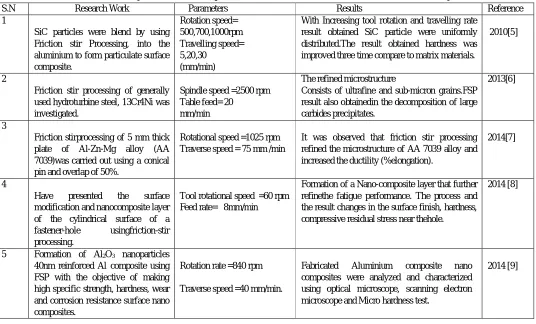
[image:2.595.33.569.428.752.2]The selection of technology to engineer the surface is an integral part of an engineering component design. The first step in surface modification technique to determine the surface and substrate engineering requirements which involves one or more of the properties like wear resistance, corrosion and erosion resistance and thermal resistance, fatigue, creep strength, pitting resistance etc. FSP concept is based on FSW is a new microstructure modification technique, which was invented by The Welding Institute (TWI) of United Kingdom in 1991. Various researchers have contributed immense information in the field of FSW/FSP. An exhaustive literature survey has been done to bring out the research gap in the research area of surface modification using FSP.Adem Kurt et al,[3]have been reported that SiC particles were incorporated by using Friction Stir Processing (FSP), Aluminium alloy toform particulate surface modified. Workpiece were subjected to the rotation of tool and tool traverse ratewith and without SiC particle. It was found microstructure by using optical microscope of the surfaces composite. Mechanical properties such as hardness were also observed. The outcome showed that increasing Tool rotation and Rate of traverse caused a SiC particle uniform distribution on the workpiece. The hardness of surface composite was three times improved as compare to that of matrix materials. [7].Ali Shamsipur et al, [4]have been reported Ti/SiC nano-composite surface layer was successfully manufactured by incorporated nano-particle SiC particles into titanium workpiece by using FSP technique. The processing parameters like rotation of tool and traverse rate were controlled to manufacture defect-free modified surface, however, nano size SiC particle uniformly distributed in the matrix material of titanium was obtained after the second pass.Ravi et al.[32] have been reported they are trying to develop Hybrid matrix composite include RHA, GSA, and other reinforcement like SiC, Graphite. The results obtained from this study will help us to decide that in what proportion of the reinforcement should be mixed.
Table.1 Summary of research work, parameter and result used in surface modification of Al alloys.
S.N Research Work Parameters Results Reference
1
SiC particles were blend by using Friction stir Processing, into the aluminium to form particulate surface composite. Rotation speed= 500,700,1000rpm Travelling speed= 5,20,30 (mm/min)
With Increasing tool rotation and travelling rate result obtained SiC particle were uniformly distributed.The result obtained hardness was improved three time compare to matrix materials.
2010[5]
2
Friction stir processing of generally used hydroturbine steel, 13Cr4Ni was investigated.
Spindle speed =2500 rpm Table feed= 20
mm/min
The refined microstructure
Consists of ultrafine and sub-micron grains.FSP result also obtainedin the decomposition of large carbides precipitates.
2013[6]
3
Friction stirprocessing of 5 mm thick
plate of Al-Zn-Mg alloy (AA
7039)was carried out using a conical pin and overlap of 50%.
Rotational speed =1025 rpm Traverse speed = 75 mm /min
It was observed that friction stir processing refined the microstructure of AA 7039 alloy and increased the ductility (%elongation).
2014[7]
4
Have presented the surface
modification and nanocomposite layer of the cylindrical surface of a fastener-hole usingfriction-stir processing.
Tool rotational speed =60 rpm Feed rate= 8mm/min
Formation of a Nano-composite layer that further refinethe fatigue performance. The process and the result changes in the surface finish, hardness, compressive residual stress near thehole.
2014 [8]
5 Formation of Al2O3 nanoparticles
40nm reinforced Al composite using FSP with the objective of making high specific strength, hardness, wear and corrosion resistance surface nano composites.
Rotation rate =840 rpm
Traverse speed =40 mm/min.
Fabricated Aluminium composite nano
composites were analyzed and characterized using optical microscope, scanning electron microscope and Micro hardness test.
©IJRASET: All Rights are Reserved
2086
6To produce reinforced 90/10 Copper– Nickel surface composites with different carbide-based ceramic particles through FSP
Rotational Speed=
1000,1100, 1200, 1300, 1400 rpm
Traverse Speed= 20, 25, 30, 35, 40 mm/min
Uniform distribution and good bonding of B4C particles inCu-Ni surface composites results in superior microhardness
2017 [10]
7
Friction stir process on the pitting corrosion and the intergranular attack
of 7075 aluminum alloy was
investigated.
Tool traverse speed=of 100 mm/min, Tool rotating speeds = 630, 1000, 1600 rpm.
Microstructural analysis reveals that the processed zonesobtained very fine and equiaxed grain micro structure. It has also foundthat grain size was increased as the tool rotational speed was varies.
2016[11]
8
In this research presented to improve the surface hardness of Al, in-situ TiB2–TiCAl2O3 composite coating was deposited on it by pre-placed laser coatingprocess using precursor mixture. Scan speed=3,2.4 ,2.1,1.8 mm/s Average power= 160,168 w Peak power=2,2.5, 3,3.5kW
Result obtain that relatively high peakpower, more uniform and crack free composite coating produced on aluminium as a base materials for using Al powder in precursor.
2015[12]
9
In this study presented, AZ31 magnesium alloy is subjected to FSP in air (NFSP) and underwater at a fixedprocessing speed.
Tool Rotation speeds =1100, 1300 ,1500
Rev/ min.
Processing speed = 60 mm/min
By increasing tool rotation rpm, the grain size increases for both the NFSP and SFSP sample.Compared with NFSP, SFSP is an effective grain refinement method for AZ31 magnesium alloy
2014[13]
10
Friction stir processing were done to deposit commercial pure Al on medium carbon steel under open atmosphere conditions
Tool spindlespeed =200 to400rpm.
Tool plunge depth= 40mm. Traversing rate =
35mm/min.
FSP wereused to deposit Al on steel and good deposition found under limited combinations of tool rotation rpm and normal load. Tool transverse speed is constant.
2012[14]
11
RFSP has been used to modificationof the surface properties of AA5052 Al-Mg alloy through grain refinement and the distribution of ultrafine hard nanoparticles.
Rotational speeds =1125 ,1200rpm
Traverse Speeds =30,100 mm/min
The result obtained grain refinement and uniform distributed hard nanoparticles on the Wear behavior of the alloy under dry slidingwear condition was evaluated.
2016[15]
©IJRASET: All Rights are Reserved
2087
IV. REINFORCEMENT MATERIALS
The properties of surface composite (SC) to be fabricated are strongly depends on the reinforcement variables which include the following:
A. Types of Reinforcement Particle
B. Size and volume percentage of reinforcing particles. C. Strategies of reinforcement materials.
1) Types of Reinforcement Particles: Most of the work on surface composite fabrication using friction stir processing have been reported using different Nano particle size reinforcement like silicon carbide (SiC) [16], titanium carbide (TiC) [17], boron carbide (B4C) [18,19,33], aluminum oxide (Al2O3) [20], titanium oxide (TiO2), AIN [21], Si3N4 [22], titanium diboride (TiB2) [23, 24], zirconium diboride (ZrB2) [25], carbon particles like graphite [26], carbon tubes [27], nano-hydroxyapatite [28], etc. The selection of the reinforcement is depending upon the application of the component and compatibility of reinforcement and metal matrix. For example, carbides like B4C offers excellent thermal and wear properties
[29, 30, and 31].
Fig. 3 (a) Micro hardness value SC with and without different particle, (b) Stress-strain curves with and without different particles [38]
Fig.4(a)Show the weight loss with the sliding distance with and without B4C particles.
[image:4.595.95.505.306.446.2] [image:4.595.83.516.495.718.2]©IJRASET: All Rights are Reserved
2088
V. TYPES OF TOOL IN FSP
Friction stir tool plays an important role in friction stir processing. It decides what kinds of materials could be processed and the dimension of the workpiece. The shoulder will control the material flow in a certain region, and the pin will generate heat and severe plastic deformation. Eventually, the friction stir tool affects the microstructure and mechanical properties. However, little knowledge about the friction stir processing tool geometry was published before, and information on friction stir welding tool could be reference to understand the tool Thomas et al (34, 35). Zhao et al (36).FSP tool classify into three categories, i.e. fixed, adjustable and self-reacting, as shown in Fig.5.Fixed pin tool consists of to a single piece of both pin and shoulder(Fig. 5a). Fixed tool can only processed a workpiece which have constant thickness because probe length is fixed. Adjustable tool consists of two pieces, i.e. separate shoulder and pin, shown in (Fig 5b). The design of the shoulder and pin can be manufacture using two different materials and pin can be easily detached when damaged.Fixed and adjustable tool required baking plate. The bobbin type tool shown in (Fig. 5c) is consists of three parts: top shoulder, pin and bottom shoulder. Bobbin type tool can accommodatedifferent thickness.But bobbin tool can work only perpendicular to the base materials.
Fig. 5 (a) Fixed,(b) adjustable (c ) bobbin type tools[37]
Fig.6. Outer and end surface features of pin profiles[2]. A. Selection of Tool Profiles
Friction stir processing focuses on two components: heat generation and material flow. So different tool profiles are consider to analysis these two components. That is why different pin profiles are considered in our project. The function of the non-consumable rotating tool probe is to stir the plasticize material and move the same behind it to have good processed zone. Pin profile plays a important role in material flow and in turn control the processing speed of the Friction Stir Processed workpiece. Five different tool profiles i.e. pinless, square, triangular, straight cylindrical and hexagonal have been used to process the aluminium based metal matrix at different welding and travelling speeds [13].
1) Pinless: The purpose of pinless tool profile is to make metal matrix consisting of reinforced material. It is intended to use in the initial phase of processing for covering the reinforced materials in the groove or gap formed on the base plate.
[image:5.595.75.519.268.588.2]©IJRASET: All Rights are Reserved
2089
3) Triangle: The purpose of using triangular pin profile tool is that it reduces the amount of transverse welding load required totraverse the pin along the workpieces interface to form an elongate friction stir processed zone.It is also simpler in design and easy to machine as compared to other complicated designs. Quality of friction stir processed zone produced by triangular tool profile is of fine grain and smooth finish. Also it gives a uniform processed structure.
4) Cylinder: It is simplest in construction considering the machining operations performed in making the cylindrical pin profile.The concentrated friction stir processed zone by cylindrical tool profile is similar to the pinless tool profile. It generates a fine grain and smooth surface finish resulting in higher tensile strength and higher hardness.
5) Hexagon: The quality of processed zone formed using hexagonal tool pin showed plastic deformation and the processed zone was subjected to excessively worked microstructure. However it is complex in construction than any other design comparing the machining operations to be performed via lathe machine.
B. Effect of Tool Profile
The shape of frictionstir process tool play very important role, it consistsof tool shoulder and probe. Vijay and Murugan [40]have been reportedthe impact of different probe shapes (cylindrical, square, and hexagonal) in taper and untapered profile on the tensile strength of FSW Al/TiB2/10. The joint efficiency made by un-tapered square probe obsreved max tensile strength of the base materials comparison to other pin profile. This outcome was later confirmed by Hassan et al. [41]. They have been reported that withouttapered (square, hexagonal) probe profiles to join aluminium matrix composite (Al- 4%Mg, 1% SiCp and 1% graphite particles).Wang et al. [39]have been reported that use of threaded conical pin at 800mm/min high tool travelling ratecompare to a flat cylinder in joining AA2009/SiC/17p led to an increase of the joint efficiency to 97% because of the improvement of the flowability of softened metals. Yigezu et al.[42] in FSW 5 mm thick Al-12%Si/TiC/10 workpiece, different diameter used (18,20, and 22 mm) and threaded probe were used as FSW tool. They have been reported that the tensile strength of the joints varied from 124 MPa to 172 MPa depend on the tooltype and processing parameter. For obtaining maximum UTS 20 mm shoulder diameter is preferable. Kumar et al. [38]have been reported that tensile strength of 5 mm workpiece. In order to show the impact of three shoulder profile on mechanical properties. The result obtained that the more heat input as a outcome of more contact area b/wsurface of shoulder and the sample led to sufficient mixing in the stir zone, as compare with the other two tool profiles.
VI. CONCLUSIONS
In current review paper, the effect of the different types of tool profiles and incorporate different secondary Nano particle size reinforcement such as B4C on the Aluminium alloys are described. As Aluminium alloy has a great potential in aerospace, defence
industries and many other fields because it has high strength, light weight. So to enhance the properties of surface composite using different secondary Nano particle size reinforcements are used. Uniform distribution of Nano particle reinforcementis very tedious task but it can be achieved by solid state plastic deformation i.e. friction stir processing (FSP). Different Nano-particle size reinforcement can be incorporate into Aluminium alloy and to form surface composite.
REFERENCES
[1] RanaH.G., Badheka V.J., Kumar A. (2016).Fabrication of Al7075/B4C surface composite by novel Friction Stir Processing (FSP) and investigation on wear properties,Procedia Technology, 23, 519 – 528.
[2] Rathee S., Maheshwari S. & Siddiquee A.N., (2017). Issues and strategies in composite fabrication via friction stir processing: A review. Materials and Manufacturing Processes, ISSN: 1042-6914 (Print) 1532-2475.
[3] Kurt A., Uygur I., Cete E.,(2011).Surface modifications of aluminium by friction stir processing,Journal of Materials Processing Technology. 211, 313–317. [4] Shamsipur A., kashani-Bozorg S.F., Hanzaki Z.A. (2012). Fabrication of Ti/Sic surface nano-composite layer by friction stir processing.International Journal of
Modern Physics, Conference Series Vol. 5, 367–374.
[5] Kurt, A., Uygur I., Cete E., (2011). Surface modification of aluminium by friction stirs processing. Journal of Materials Processing Technology,211,313–317. [6] Grewal H.S., Arora H.S., Singh H., Agrawal A.(2013). Surface modification of hydroturbine steel using friction stir processing.Applied Surface Science
268,547–555.
[7] Sinhmar S., Dwivedi D.K., Pancholi V., (2014). Friction Stir Processing of AA 7039 Alloy.International Conference on Production and Mechanical Engineering (ICPME’2014).30-31, Bangkok, Thailand.
[8] Panaskar N. J., Sharma A., (2014). Surface Modification and Nanocomposite Layering of Fastener-Hole through Friction-Stir Processing.Materials and Manufacturing Processes, 29, 726-32.
[9] Ahmed M.M.Z., Refat M., El-Mahallawi I., (2014). Manufacturing of nano-surface aa7075 composites by friction stir processing 1417 Light Metals. The Minerals, Metals & Materials Society.
©IJRASET: All Rights are Reserved
2090
[11] Navaser M., Atapour M.,(2017). Effect of Friction Stir Processing on Pitting Corrosion andIntergranular Attack of 7075 Aluminum Alloy.Journal of Materials Science & Technology, 33, 155–165.
[12] Sahu J.K., Sahoo C.K., Masanta M., (2015). In-Situ TiB2-TiC-Al2O3 Composite Coating on Aluminum by Laser Surface Modification. Materials and Manufacturing Processes, 30, 6, 736-742.
[13] Vaibhav Sharma, Ravi Butola, “Optimization of Machining Parameters in CNC Turning of Hybrid Metal Matrix Composites Using Different Techniques: A Review,”IJARI,vol. 5,pp.78-82,2017.
[14] S. J., Reddy J., Kailash S.V., K. U.B., (2012).Surface Modification of Steels using Friction Stir Surfacing. Materials Science Forum, ISSN: 1662 -9752, Vol. 710, 258-263.
[15] Khodabakhshi F., Simchi A., Kokabi A.H.,(2017). Surface modifications of an aluminum-magnesium alloy through reactivestir friction processing with titanium oxide nanoparticles for enhancedsliding wear resistance.Surface & Coatings Technology, 309, 114–123.
[16] Najafi, M.; Nasiri, A.M.; Kokabi, A.H. Microstructure and hardness of friction stir processed AZ31 with SiC. International Journal ofModern Physics B.2008, 22 (18n19), 2879–2885.
[17] Yuvaraj, N.; Aravindan, S.; Vipin Wear characteristics of Al5083 surface hybrid nano-composites by friction stir processing. Transactionsof the Indian Institute of Metals,2016, 1–19.
[18] Rejil, C.M.; Dinaharan, I.; Vijay, S.J.; Murugan, N. Microstructure and sliding wear behavior of AA6360/(TiC þB4C) hybrid surface composite layer synthesized by friction stir processing on aluminum substrate. Materials Science and Engineering: A 2012, 552,336–344.
[19] Sathiskumar, R.; Murugan, N.; Dinaharan, I.; Vijay, S.J. Characterization of boron carbide particulate reinforced in situ copper surface composites synthesized using friction stir processing. Materials Characterization.2013, 84, 16–27.
[20] Du, Z.; Tan, M.J.; Guo, J.F.; Bi, G.; Wei, J. Fabrication of a new Al- Al2O3-CNTs composite using friction stir processing (FSP). MaterialsScience and Engineering: A.2016, 667, 125 131.
[21] Kashani-Bozorg, S.F.; Samiee, M.; Honarbakhsh-Raouf, A. Fabrication of Al/AlN nano-composite layers by friction stir processing of 6061 Al-T6 substrate. Surface and Interface Analysis.2015, 47 (2), 227–238.
[22] Moghaddas, M.A.; Kashani-Bozorg, S.F. Effects of thermal conditions on microstructure in nanocomposite of Al/Si3N4 produced by friction stir processing. Materials Science and Engineering: A.2013, 559, 187–193.
[23] Eskandari, H.; Taheri, R.; Khodabakhshi, F. Friction-stir processing of an AA8026-TiB2-Al2O3 hybrid nanocomposite: Microstructural developments and mechanical properties. Materials Science andEngineering: A.2016, 660, 84–96.
[24] Narimani, M.; Lotfi, B.; Sadeghian, Z. Investigating the microstructure and mechanical properties of Al-TiB2 composite fabricated by friction stir processing (FSP). Materials Science and Engineering: A. 2016, 673, 436–442.
[25] Zhao, Y.; Kai, X.; Chen, G.; Lin, W.; Wang, C. Effects of friction stir processing on the microstructure and superplasticity of in situ nano-ZrB2/2024Al composite. Progress
[26] Thapliyal, S.; Dwivedi, D.K. Microstructure evolution and tribological behavior of the solid lubricant based surface composite of cast nickel aluminum bronze developed by friction stir processing. Journal of Materials Processing Technology, 2016, 238, 30–38.
[27] Lucie, B.J.; Leonard, L.Y.; Edward, S.; Sivaram, A.; Mishra, R.S. Survivability of single-walled carbon nanotubes during friction stir processing. Nanotechnology.2006, 17 (12), 3081.
[28] Farnoush, H.; Sadeghi, A.; Abdi Bastami, A.; Moztarzadeh, F.; Aghazadeh Mohandesi, J. An innovative fabrication of nano-HA coatings on Ti-CaP nanocomposite layer using a combination of friction stir processing and electrophoretic deposition. CeramicsInternational,2013,39(2),1477–1483.
[29] Izadi, H. in Proceedings of the 9th International Conference on Trends in Welding Research. 2012, ASM.
[30] Dinaharan, I.; Sathiskumar, R.; Murugan, N. Effect of ceramic particulate type on microstructure and properties of copper matrix composites synthesized by friction stir processing. Journal of MaterialsResearch and Technology,2016, 5 (4), 302–316.
[31] Anshul Chaudhary, Abhishek Kumar Dev, Anshul Goel, Ravi Butola, Ranganath M.S, “The Mechanical Properties of Different alloys in friction stir processing: A Review,”Mater. Today Proc.,2018, vol. 5, pp. 5553-5562.
[32] Ravi Butola, Dadge Mukesh Shamrao, Ranganath M.Singari, “Comparison Studies on Mechanical Properties of Hybrid Metal Matrix Composite,”IJAPIE,2018vol.3,pp 52-56.
[33] Ravi Butola, Ranganath M.Singari, Ashwani Bandhu, R S Walia, “Characteristics and Properties of Different Reinforcements in Hybrid Aluminium Composites: A Review,”IJAPIE,vol. 511, pp.71-80,2017.
[34] Thomas W.M., Nicholas E.D., Smith S.D.,(2001).Aluminium 2001-Processings of the TMS. Aluminum Automotive and Joining Sessions, TMS, pp. 213. [35] Thomas W.M., Dolby R.E.(2003). Proceedings of the Sixth International Conference on Trends in Welding Research, Pine Mountain, GA, ASM International,
203-211.
[36] Zhao Y., Lin S., Wu L., Qu F., (2005).The influence of pin geometry on bonding and mechanical properties in friction stir weld 2014 al alloy. Materials Letters, 59(23), 2948-2952.
[37] Y. N. Zhang, X. Cao, S. Larose and P. Wanjara; Review of tools for friction stir welding and processing; Canadian Metallurgical Quarterly 51 (2012) 250-261. [38] Yuvaraj N., Aravindan S.,Vipin., (2015). Fabrication of Al5083/B4C surface composite by friction stir processing and its tribological characterization..Journal
ofmaterialresource technology.2 0 1 5,4(4),398–410.
[39] Selvakumar S., Dinaharan I., Palanivel R., Babu B.G., (2017). Characterization of molybdenum particles reinforced Al6082 aluminum matrix composites with improved ductility produced using friction stir processing. Materials Characterization,125, 13-25.
[40] Panaskar N. J., Sharma A., (2014). Surface Modification and Nanocomposite Layering of Fastener-Hole through Friction-Stir Processing.Materials and Manufacturing Processes, 29, 726-32.
[41] Fu P., Jiang C., Wu X., Zhang Z., (2015). Surface Modification of 304 Steel Using Triple-Step Shot Peening. Materials and Manufacturing Processes, 30,6, 693-698.
![Fig. 3 (a) Micro hardness value SC with and without different particle, (b) Stress-strain curves with and without different particles [38]](https://thumb-us.123doks.com/thumbv2/123dok_us/1245345.650889/4.595.83.516.495.718/micro-hardness-different-particle-stress-strain-different-particles.webp)
![Fig. 5 (a) Fixed,(b) adjustable (c ) bobbin type tools[37]](https://thumb-us.123doks.com/thumbv2/123dok_us/1245345.650889/5.595.75.519.268.588/fig-a-fixed-b-adjustable-bobbin-type-tools.webp)