J i n G u o •
National University of Singapore
Tokenization is the process of mapping sentences from character strings into strings of words. This paper sets out to study critical tokenization, a distinctive type of tokenization following the principle of maximum tokenization. The objective in this paper is to develop its mathematical description and understanding.
The main results are as follows: (1) Critical points are all and only unambiguous toke~ boundaries for any character string on a complete dictionary; (2) Any critically tokenized word string is a minimal element in the partially ordered set of all tokenized word strings with respect to the word string cover relation; (3) Any tokenized string can be reproduced from a critically tokenized word string but not vice versa; (4) Critical tokenization forms the sound mathemati- cal foundation for categorizing tokenization ambiguity into critical and hidden types, a precise mathematical understanding of conventional concepts like combinational and overlapping ambi- guities; (5) Many important maximum tokenization variations, such as forward and backward maximum matching and shortest tokenization, are all true subclasses of critical tokenization.
It is believed that critical tokenization provides a precise mathematical description of the principle of maximum tokenization. Important implications and practical applications of critical tokenization in effective ambiguity resolution and in efficient tokenization implementation are also carefully examined.
1. Introduction
Words, and tokens in general, are the primary building blocks in almost all linguistic theories (e.g., Gazdar, Klein, Pullum, and Sag 1985; Hudson 1984) and language pro- cessing systems (e.g., Allen 1995; Grosz, Jones, and Webber 1986). Sentence, or string, tokenization, the process of mapping sentences from character strings to strings of words, is the initial step in natural language processing (Webster and Kit 1992).
Since in written Chinese there is no explicit word delimiter (equivalent to the blank space in written English), the problem of Chinese sentence tokenization has been the focus of considerable research efforts, and significant advancements have been made (e.g., Bai 1995; Zhang et al. 1994; Chen and Liu 1992; Chiang et al. 1992; Fan and Tsai 1988; Gan 1995; Gan, Palmer, and Lua 1996; Guo 1993; He, Xu, and Sun 1991; Huang 1989; Huang and Xia 1996; Jie 1989; Jie, Liu, and Liang 1991a, 1991b; Jin and Chen 1995; Lai et al. 1992; Li et al. 1995; Liang 1986, 1987, 1990; Liu 1986a, 1986b; Liu, Tan, and Shen 1994; Lua 1990, 1994, and 1995; Ma 1996; Nie, Jin, and Hannan 1994; Sproat and Shih 1990; Sproat et al. 1996; Sun and T'sou 1995; Sun and Huang 1996; Tung and Lee 1994; Wang, Su, and Mo 1990; Wang 1989; Wang, Wang, and Bai 1991; Wong et al. 1995; Wong et al. 1994; Wu et al. 1994; Wu and Su 1993; Yao, Zhang, and Wu 1990; Yeh and Lee 1991; Zhang, Chen, and Chen 1991).
Computational Linguistics Volume 23, Number 4
The tokenization problem exists in almost all natural languages, including Japanese (Yosiyuki, Takenobu, and Hozumi 1992), Korean (Yun, Lee, and Rim 1995), German (Pachunke et al. 1992), and English (Garside, Leech, and Sampson 1987), in various media, such as continuous speech and cursive handwriting, and in numerous appli- cations, such as translation, recognition, indexing, and proofreading.
For Chinese, sentence tokenization is still an unsolved problem, which is in part due to its overall complexity but also due to the lack of a good mathematical de- scription and understanding of the problem. The theme in this paper is therefore to develop such a mathematical description.
In particular, this paper focuses on critical tokenization 1, a distinctive type of tokenization following the maximum principle. What is to be established in this paper is the notion of critical tokenization itself, together with its precise descriptions and well-proved properties.
We will prove that critical points are all and only unambiguous token boundaries for any character string on a complete dictionary. We will show that any critically to- kenized w o r d string is a minimal element in the partially ordered set of all tokenized word strings on the word string cover relation. We will also show that any tokenized string can be reproduced from a critically tokenized word string but not vice versa. In other words, critical tokenization is the most compact representation of tokenization. In addition, we will show that critical tokenization forms a sound mathematical foun- dation for categorizing critical ambiguity and hidden ambiguity in tokenizations, which provides a precise mathematical understanding of conventional concepts like combinational and overlapping ambiguities. Moreover, we will confirm that some im- portant maximum tokenization variations, such as forward and backward maximum matching and shortest tokenization, are all subclasses of critical tokenization.
Based on a mathematical understanding of tokenization, we reported, in Guo (1997), a series of interesting findings. For instance, there exists an optimal algorithm that can identify all and only critical points, and thus all unambiguous token bound- aries, in time proportional to the input character string length but independent of the size of the tokenization dictionary. Tested on a representative corpus, about 98% of the critical fragments generated are b y themselves desired tokens. In other words, about 98% close-dictionary tokenization accuracy can be achieved efficiently without disambiguation.
Another interesting finding is that, for those critical fragments with critical ambi- guities, by replacing the conventionally adopted meaning preservation criterion with the critical tokenization criterion, disagreements among (human) judges on the ac- ceptability of a tokenization basically become non-existent. Consequently, an objective (human) analysis and annotation of all (critical) tokenizations in a corpus becomes achievable, which in turn leads to some important observations. For instance, we ob- served from a Chinese corpus of four million morphemes a very strong tendency to have one tokenization per source. Naturally, this observation suggests tokenization disam- biguation strategies notably different from the mainstream best-path-finding strategy. For instance, the simple strategy of tokenization by memorization alone could easily ex- hibit critical ambiguity resolution accuracy of no less than 90%, which is notably higher than what has been achieved in the literature. Moreover, it has been observed that crit- ical tokenization can also provide helpful guidance in identifying hidden ambiguities and in determining unregistered (unknown) tokens (Guo 1997). While these are just some of the very primitive findings, they are nevertheless promising and motivate
us to rigorously formalize the tokenization problem a n d to carefully explore logical consequences.
The rest of the paper is organized as follows: In Section 2, we formally define the string generation a n d tokenization operations that form the basis of our frame- work. In Section 3, we will s t u d y tokenization ambiguities a n d explore the concepts of critical points and critical fragments. In Section 4, we define the w o r d string cover relation a n d prove it to be a partial order, define critical tokenization as the set of min- imal elements of the tokenization partially ordered set, a n d illustrate the relationship between critical tokeniz~ition a n d string tokenization. Section 5 discusses the relation- ship between critical tokenization a n d various types of tokenization ambiguities, while Section 6 addresses the relationship between critical tokenization a n d various types of m a x i m u m tokenizations. Finally, in Sections 7 a n d 8, after discussing some helpful implications of critical tokenization in effective tokenization disambiguation a n d in efficient tokenization implementation, we suggest areas for future research a n d d r a w some conclusions.
2. Generation and Tokenization
In order to address the topic clearly a n d accurately, a precise a n d well-defined formal notation is required. W h a t is used in this paper is primarily from elementary Boolean algebra a n d Formal Language Theory, which can be f o u n d in most graduate-level textbooks on discrete mathematics. This section aims at refreshing several simple terms a n d conventions that will be applied t h r o u g h o u t this paper a n d at introducing the two n e w concepts of character string generation a n d tokenization. For the remaining basic concepts a n d conventions, we mainly follow Aho a n d Ullman (1972, Chapter 0, Mathematical Preliminaries), a n d Kolman a n d Busby (1987).
2.1 Character, Alphabet, and Character String
Definition 1
An
alphabet
G = {a, b, c . . . . } is a finite set of symbols. Each symbol in the alphabet is acharacter. The alphabet size
is the n u m b e r of characters in the alphabet a n d is denotedIGI.
Character strings
over an alphabet G are defined 2 in the following manner:.
2.
.
e is a character string over G. e is called the
empty character string.
If S is a character string over G a n d a is a character in G, then Sa is a character string over G.
S' is a character string over ~ if a n d only if its being so follows from (1) a n d (2).
The
length
of a character string S is the n u m b e r of characters in the string a n d is denoted ISI. Aposition
in a character string is the position after a character in the string. If characters in a character string are indexed from 1 to n, then positions in the string are indexed from 0 to n, with 0 for the position before the first character a n d n for that after the last character.Computational Linguistics Volume 23, Number 4
Example 1
The set of 26 u p p e r case a n d 26 l o w e r case English characters forms the English alphabet ~,, = { a , b , . . . , z , A , B , . . . , Z } . S = thisishisbook is a character string o v e r the alphabet. Its string length is 13.
In this paper, characters are r e p r e s e n t e d w i t h small characters a, b, c, or their subscript f o r m ak, bk, a n d Ck. The capital letter S or its e x p a n d e d f o r m S = c l . . . cn is u s e d to represent a character string. We let G* d e n o t e the set containing all character strings o v e r G including e, a n d G+ d e n o t e the set of all character strings o v e r G b u t excluding e.
2.2 Word, Dictionary, and Word String
Definition 2
Let alphabet ~, = {a, b, c , . . . } be a finite set of characters. A
dictionary
D is a set of character strings o v e r the a l p h a b e t G. That is, D = { x , y , z . . . . } C_ G*. A n y e l e m e n t in the d i c t i o n a r y is a w o r d . Thedictionary size
is the n u m b e r of w o r d s in the d i c t i o n a r y a n d is d e n o t e d IDI.Word strings
o v e r a dictionary D are d e f i n e d in the following manner:.
2.
.
v is a w o r d string o v e r D. v is called the
empty word string.
If W is a w o r d string o v e r D a n d w is a w o r d in D, t h e n W w is a w o r d string o v e r D.
W' is a w o r d string o v e r D if a n d o n l y if its b e i n g so follows from (1) a n d (2).
The length of a w o r d string W is the n u m b e r of w o r d s in the string a n d is d e n o t e d IW I. We let D* d e n o t e the set containing all w o r d strings o v e r D, including v a n d let D + d e n o t e the set of all w o r d strings o v e r D b u t excluding v.
Example 1
(cont.)The set D = {this, is, his, book} is a tiny English d i c t i o n a r y f r o m the English alphabet. Both his a n d book are w o r d s o v e r the English alphabet. The dictionary size is 4, i.e., IDI = 4. "this is his book" is a w o r d string. Its string length is 4.
To differentiate b e t w e e n character string a n d word string, blank spaces are a d d e d b e t w e e n w o r d s in w o r d strings. For example, "this is his book" represents a w o r d string of length 4 (four w o r d s concatenated) while thisishisbook consists of a character string of length 13 (13 characters in sequence). Slash / is s o m e t i m e s u s e d as a (hidden) w o r d delimiter. For instance, this~is~his~book is an e q u i v a l e n t r e p r e s e n t a t i o n to "this is his book".
2.3 Character String Generation
Definition 3
Let E = {a,b,c . . . . } be an alphabet and D = {x,y,z . . . . } be a dictionary over the alphabet. The
character string generation operation
G is a mapping G: D* ~ E* defined as:1. Empty word string v is mapped to empty character string e. That is, G(v) = e.
2. Single word string w 1 is mapped to the character string of the single word. That is, G(w 1) = w.
3. If W is a word string over dictionary D and w is a word in D, then, the word string Ww is mapped to the concatenation of character string G(W) and G(w). That is, G(Ww) = G(W)G(w).
G(W) is said to be the
generated character string
of the word string W from dictio- nary D.Note that the character string generation operation G is a homomorphism (Aho and Ullman 1972, 17) with property G(w I) = w.
Example 1 (cont.)
The character string thisishisbook is the generated character string of the word string "this is his book". That is, G("this is his book") = thisishisbook.
2.4 Character String Tokenization
Definition 4
The
character string tokenization operation
T is a mapping TD: ~* ---* 2 D* definedas: if S is a character string in G*, then TD(S) is the set of dictionary word strings mapped by the character string generation operation G to the character string S. That is, To(S) = {WIG(W) = S, W E D*}. Any word string W in To(S) is a tokenized
word
string,
or simply a tokenization, of the character string S.Sometimes the character string tokenization operation is emphasized as the ex- haustive
tokenization operation
or EToperation
for short. In addition, the tokenized word string or tokenization is emphasized as the exhaustively tokenizedword string
or exhaustive tokenization or ET
tokenization
for short.Note that the character string tokenization operation TD is the inverse homomorphism (Aho and Ullman 1972, 18) of the character string generation operation G.
Example 1 (cont.)
Given character string thisishisbook, for the tiny English dictionary D = {this, is, his, book}, there is TD(thisishisbook) = {"this is his book"}. In other words, the word string "this is his book" is the only tokenization over the dictionary D.
Given dictionary D' = {th, this, is, his, book}, in which th is also a word, there is TD, (thisishisbook) = {"th is is his book", "this is his book"}. In other words, the character string has two tokenizations over the dictionary D r.
Example 2
Computational Linguistics Volume 23, Number 4
2.5 Discussion
Our intention, in formally defining characters and words, is to establish our mathe- matical system clearly and accurately. To keep discussion concise, the definitions of elementary concepts such as strings and substrings, although widely used in this pa- per, will be taken for granted. We limit our basic notion to what has already been defined in Aho and Ullman (1972) and Kolman and Busby (1987).
Mathematically, word strings are nothing but symbol strings, with each symbol representing a word in the dictionary. In that sense, the word string definition is redundant as it is already covered by the definition of character string. However, since the relationships between character strings and word strings are very important in this paper, we believe it to be appropriate to list both definitions explicitly.
What is new in this section is mathematical definitions for character string genera- tion and tokenization. We consider them fundamental to our mathematical description of the string tokenization problem.
There are two points worth highlighting here. The first relates to the introduction of the character string generation operation. In the literature, the tokenization problem is normally modeled independently with no connection whatsoever with the charac- ter string generation problem. By contrast, we model tokenization and generation as inverse problems to each other. In this way, we establish a well-defined mathematical system consisting of an alphabet, a dictionary, and the (generation) homomorphism (operation) and its inverse defined on the alphabet and dictionary. As will be seen throughout this paper, the establishment of the generation operation renders various types of tokenization problems easy to describe. The generation problem is relatively simple and easy to manage, so any modeling of the tokenization problem as its inverse (that is, as the generation problem) should make it more tractable.
The second point is in regard to the tokenization definition. In the literature, the string tokenization operation is normally required to generate a unique tokenized word string. Following such a definition of tokenization, introducing tokenization disam- biguation at the very beginning is inevitable. We believe this to be a pitfall that has trapped m a n y researchers. In contrast, we define the character string tokenization op- eration as the inverse operation (inverse homomorphism) of the character string gen- eration operation (homomorphism). Naturally, the result of the tokenization operation is a set of tokenizations rather than a single word string. Such treatment suggests that we could use the divide-and-conquer problem-solving strategy--to decompose the complex string tokenization problem into several smaller and, hopefully, simpler subproblems. That is the basis of our two-stage, five-step iterative problem-solving strategy for sentence tokenization (Guo 1997).
3. Critical Point and Fragment
After clarifying both sentence generation and tokenization operations, we undertake next to further clarify sentence tokenization ambiguities. Among all the concepts to be introduced, critical points and critical fragments are probably two of the most important. We will prove that, for any character string on a complete tokenization dictionary, its critical points are all and only unambiguous token boundaries, and its critical fragments are the longest substrings with all inner positions ambiguous.
3.1 Ambiguity
Definition 5
The character string S f r o m the alphabet G has tokenization ambiguity on dictionary D, if ]TD(S)] > 1. S has no tokenization ambiguity, if ]TD(S)] = 1. S is i l l - f o r m e d on dictionary D, if ITD(S)] = 0. A tokenization W C To(S) has tokenization ambiguity, if there exists a n o t h e r tokenization W' E To(S), W' ~ W.
Example 2 (cont.)
Since TD(fundsand) = {"funds and", "fund sand"}, i.e., ]TD(fundsand)l = 2 > 1, the character string fundsand has tokenization ambiguity. In other words, it is a m b i g u o u s in tokenization. Moreover, the tokenization "funds and" has tokenization a m b i g u i t y since there exists a n o t h e r possible tokenization "fund sand" for the same character string.
This definition is quite intuitive. If a character string c o u l d be t o k e n i z e d in multiple ways, it w o u l d be a m b i g u o u s in tokenization. If a character string c o u l d only be tokenized in a u n i q u e way, it w o u l d h a v e no tokenization ambiguity. If a character string could not be t o k e n i z e d at all, it w o u l d be ill-formed. In this latter case, the dictionary is incomplete.
Intuitively, a position in a character string is a m b i g u o u s in t o k e ~ z a t i o n or is an a m b i g u o u s t o k e n b o u n d a r y if it is a t o k e n b o u n d a r y in one tokenization b u t not in another. Formally, let S = c l . . . cn be a character string o v e r an alphabet G and let D be a dictionary o v e r the alphabet.
Definition 6
Position p has tokenization a m b i g u i t y or is an a m b i g u o u s token b o u n d a r y , if there are two tokenizations X = x l . . . Xs a n d Y = y l . . . yt in TD(S), such that G ( x l . . . Xu) = Cl... cp and G(xu+l... Xs) = Cp+l...Cn for some index u, and for a n y index v, there is neither G ( y l . . . yv) = c l . . . Cp n o r G(yv+l... yt ) = Cp+l... Cn. Otherwise, the position has no tokenization ambiguity, or is an u n a m b i g u o u s t o k e n boundary.
Example 1 (cont.)
G i v e n a typical English dictionary a n d the character string S = thisishisbook, all three positions after character s are u n a m b i g u o u s in tokenization or are u n a m b i g u o u s to- ken b o u n d a r i e s , since all possible tokenizations m u s t take these positions as t o k e n boundaries.
Example 2 (cont.)
G i v e n a typical English dictionary a n d the character string S --fundsand, the position after the m i d d l e character s is a m b i g u o u s in tokenization or is an a m b i g u o u s t o k e n b o u n d a r y since it is a token b o u n d a r y in tokenization "funds and" b u t not in a n o t h e r tokenization "fund sand".
3.2 Complete Dictionary
To a v o i d ill-formedness in sentence tokenization, w e n o w introduce the concept of a complete tokenization dictionary.
Definition 7
Computational Linguistics Volume 23, Number 4
That is, for a n y character string S = c 1 . . . C n from the alphabet, there exists at least one w o r d string W = w l . . . Wm with S as its generated character string, G ( W ) = S.
Theorem 1
A dictionary D over an alphabet G is complete if a n d only if all the characters in the alphabet are single-character w o r d s in the dictionary.
Proof
On the one hand, every single character is also a character string (of length 1). To ensure that such a single-character string is being tokenized, the single character m u s t be a w o r d in the dictionary. On the other hand, if all the characters are w o r d s in the dictionary, a n y character string can at least be tokenized as a string of single-character words. []
Theorem I spells out a simple w a y of m a k i n g a n y dictionary complete, which calls for a d d i n g all the characters of an alphabet into a dictionary as single-character words. This is referred to as the dictionary completion process. If not specified otherwise, in this paper, w h e n referring to a complete dictionary or tokenization dictionary, w e m e a n the dictionary after the completion process.
3.3 Critical Point and Fragment
Let S = c l . . . c n be a character string over the alphabet ~ a n d let D be a dictionary over the alphabet. In addition, let T o ( S ) be the tokenization set of S on D.
Definition 8
Position p in character string S = c l . . . Cn is a critical point, if for a n y w o r d string
W = w l . . . wm i n T o ( S ) , there exists an index k, 0 < k < m, such that G ( w l . . . Wk) =-
c l . . . Cp a n d G ( W k + l . . . Win) = C p + l . . . Cn. In particular, the starting position 0 a n d the
e n d i n g position n are the two ordinary critical points. Substring cp+l . . . cq is a critical fragment of S on D, if both p a n d q are critical points a n d a n y other position r in between them, p < r < q, is not a critical point.
Example 1 (cont.)
Given a typical English dictionary, there are five critical points in the character string
S = thisishisbook. They are 0, 4, 6, 9, a n d 13. The corresponding four critical fragments
are this, is, his, a n d book.
Example 2 (cont.)
Given a typical English dictionary, there is no extraordinary critical point in the char- acter string S = f u n d s a n d . It is b y itself the only critical fragment of this character string.
Given a complete tokenization dictionary, it is obvious that all single-character crit- ical fragments or, more generally, single-character strings, possess unique tokenization. That is, they possess neither ambiguity nor ill-formedness in tokenization. However, the truth of the statement below (Lemma 1) is less obvious.
Lemma 1
Proof
Let S = cl . . . Cn, n > 1, be a multicharacter critical fragment. Because the tokenization dictionary is complete, the critical fragment can at least be tokenized as a string of single-character words. On the other hand, because it is a critical fragment, for any position p, 1 _< p < n - 1, there must exist a tokenization W = W t . . . W m i n TD(S)
such that for any index k, 0 G k G m, there is neither G ( w l . . . W k ) = c l . . . c p nor
G ( w k + l . . . win) = c p + l . . . C n . As this tokenization differs from the above-mentioned tokenization of the string of single-character words, the critical fragment has at least two different tokenizations and thus has tokenization ambiguity. []
Theorem 2
For any character string on a complete tokenization dictionary, its critical points are
all and only unambiguous token boundaries.
Proof
By Lemma 1, all positions within critical fragments are ambiguous in tokenization. By Definition 8, critical points are unambiguous in tokenization. []
Corollary
For any character string on a complete tokenization dictionary, its critical fragments are the longest substrings with all inner positions ambiguous.
Proof
By Theorem 2. [] 3.4 Discussion
In this section, we have described sentence tokenization ambiguity from three differ- ent angles: character strings, tokenizations, and individual string positions. The basic idea is conceptually simple: ambiguity exists when there are different means to the same end. For instance, as long as a character string has multiple tokenizations, it is ambiguous.
This description of ambiguity is complete. Given a character string and a dic- tionary, it is always possible to answer deterministically whether or not a string is ambiguous in tokenization. Conceptually, for any character string, by checking every one of its possible substrings in a dictionary, and then by enumerating all valid word concatenations, all word strings with the character string as their generated character string can be produced. Just counting the number of such word strings will provide the answer to whether or not the character string is ambiguous.
Some researchers question the validity of the complete dictionary assumption. Here we argue that, even in the strictest linguistic sense, there exists no single character that cannot be used as a single-character word in sentences. In any case, any natural language must allow us to directly refer to single characters. For instance, you could say "character x has many written forms" or "the character x in this word can be omitted" for any character x. 3
Computational Linguistics Volume 23, Number 4
The validity of the complete dictionary assumption can also be justified from an engineering perspective. To ensure a so-called soft landing, any practical application system must be designed so that every input character string can always be tokenized. In other words, a complete dictionary is an operational must. Moreover, without such a complete dictionary, it would not be possible to avoid ill-formedness in sentence tokenization nor to make the generation-tokenization system for character and words closed and complete. Without such definitions of well-formedness, any rigorous formal study would be impossible.
The concepts of critical point and critical fragment are fundamental to our sen- tence tokenization theory. By adopting the complete dictionary assumption, it has been proven that critical points are all and only unambiguous token boundaries while critical fragments are the longest substrings with all inner positions ambiguous.
This is a very strong and significant statement. It provides us with a precise un- derstanding of what and where tokenization ambiguities are. Although the proof itself is easy to follow, the result has nonetheless been a surprise. As demonstrated in Guo (1997), many researchers have tried but failed to answer the question in such a precise and complete way. Consequently, while they proposed many sophisticated algorithms for the discovery of ambiguity (and certainty), they never were able to arrive at such a concise and complete solution.
As critical points are all and only unambiguous token boundaries, an identifica- tion of all of them would allow for a long character string to be broken d o w n into several short but fully ambiguous critical fragments. As shown in Guo (1997), critical points can be completely identified in linear time. Moreover, in practice, most criti- cal fragments are dictionary tokens by themselves, and the remaining nondictionary fragments are generally very short. In short, the understanding of critical points and fragments will significantly assist us in both efficient tokenization implementation and tokenization ambiguity resolution.
The concepts of critical point and critical fragment are similar to those of segment point and character segment in Wang (1989, 37), which were defined on a sentence word graph for the purpose of analyzing the computational complexity of his new tokenization algorithm. However, Wang (1989) neither noticed their connection with tokenization ambiguities nor realized the importance of the complete dictionary as- sumption, and hence failed to demonstrate their crucial role in sentence tokenization.
4. Critical T o k e n i z a t i o n
This section seeks to disclose an important structure of the set of different tokeniza- tions. We will see that different tokenizations can be linked by the cover relationship to form a partially ordered set. Based on that, we will establish the notion of criti- cal tokenization and prove that every tokenization is a subtokenization of a critical tokenization, but no critical tokenization has true supertokenization.
4.1 C o v e r R e l a t i o n s h i p D e f i n i t i o n 9
Let X and Y be word strings. X c o v e r s Y, or X has a c o v e r r e l a t i o n to Y, denoted X < Y, if for any substring Xs of X, there exists substring
Ys
of Y, such that IXsl (IYsl
and G(Xs) =
G(Ys).
If X G Y, then X is called a covering word string of Y, and Y a c o v e r e d w o r d string of X.Y <__ X. Some w o r d strings do n o t cover each other. In other words, shorter w o r d strings do not always cover longer w o r d strings.
Example 1 (cont.)
The w o r d string
"this is his book"
covers the w o r d string"th is is his book",
b u t not vice versa.Example 2 (cont.)
The w o r d strings
"funds and"
a n d"fund sand"
do not cover each other. Definition 9 ILet A a n d B be sets of w o r d strings. A covers B, or A has a cover relation to B, denoted A ~ B, if for a n y Y c B, there is X E A, such that X ~ Y. If A ~ B, A is called a covering word string set of B, a n d B a covered word string set of A.
Example 3
Given the alphabet G = {a, b, c, d}, dictionary D = {a, b, c, d,
ab, be, cd, abe, bed},
a n d char- acter string S =abed
from the alphabet, there isTD(S) = {a/b/c/d, a/b/cd, a/bc/d, a/bcd,
ab/c/d, ab/cd, abe~d}.
A m o n g them, there are{abe~d} < {ab/c/d, a/bc/d}, {ab/cd} <_
{ab/e/d, a/b/ed}, {a/bed} < {a/be/d, a/b/ed}
a n d{ab/c/d, a/be/d, a/b/ed} < {a/b/c/d}.
Moreover, there is{abe~d, ab/cd, a/bcd} ~_ TD(S).
4.2 Partially Ordered Set Lemma 2
The cover relation is transitive, reflexive, a n d antisymmetric. That is, the cover relation is a (reflexive) partial order.
L e m m a 2, proved in G u o (1997), reveals that the cover relation is a partial o r d e r - - a well-defined mathematical structure with good mathematical properties. Conse- quently, from a n y textbook on discrete mathematics (Kolman a n d Busby [1987], for example), it is k n o w n that the tokenization set TD(S), together w i t h the w o r d string cover relation <, forms a partially ordered set, or simply a poser. We shall denote this poset by (TD(S), _<). In case there is no confusion, we m a y refer to the poset simply as
TD(S).
In the literature, usually a poset is graphically presented in a Hasse diagram, which is a digraph with vertices representing poset elements a n d arcs representing direct partial order relations between poset elements. In a Hasse diagram, all connections implied b y the partial order's transitive property are eliminated. That is, if X ~ Y a n d Y < Z, there should be no arc from X to Z.
Example 3 (cont.)
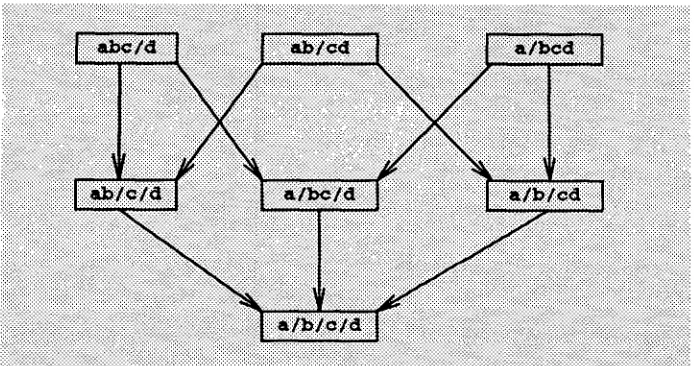
The poset
TD(abcd) = {a/b/c/d, a/b/cd, a/bc/d, a/bcd, ab/c/d, ab/cd, abe~d}
can be graph- ically presented in the Hasse diagram in Figure 1.Computational Linguistics
Volume 23, Number 4
[image:12.468.58.405.52.235.2]}iiiiiii)i}iiiiiiS}i}iiiiiii
i iiiiiii. !:-!:-!:-?
~
~
~
~ ! : . : : ? ~ ! s ~
~
:! :~!~
:-:-2: i iiiii iii ii;iiiiii55iii
!
[::.:!5~::
! i i !
:~ :::: !~ :~):~
~
i
!:::
!~:~:.
:~!:::::i
~:}~!:~:
:~,:/!:!:!:!~:
:::!~:~!~!~i]iiil}iiiiiiiii;iiiiiiiiiiiii25ililiiiiiiiiii!
Figure 1
The Hasse diagram for the poset
TD(abcd) = {a/b/c/d, a/b/cd, a/bc/d, a/bcd, ab/c/d, ab/cd,
abc/d}.
Example
1 (cont.)
The word string
"this is his book"
is both the minimal element and the least element of
both
TD( thisishisbook ) = {"this is his book"}
and
TD, ( thisishisbook )
= {"th
is is his book",
"this is his book"}.
Example 2
(cont.)
The poset
TD(fundsand) = {"funds and", "fund sand"}
has both
"funds and"
and
"fund
sand"
as its minimal elements, but has no least element.
Example
3 (cont.)
The poset
TD(abcd) = {a/b/c/d, a/b/cd, a/bc/d, a/bcd, ab/c/d, ab/cd, abc/d}
has three
minimal elements:
abc/d, ab/cd, a/bcd.
It has no least element.
Note that any finite nonempty poset has at least one minimal element. Any poset
has at most one least element (Kolman and Busby 1987, 195-198).
4.3 Critical Tokenization
This section deals with the most important concept---critical tokenization. Let ~ be an
alphabet, D a dictionary over the alphabet, and S a character string over the alphabet.
In this case,
(TD(S), <_)
is the poset.
Definition 10
The
character string critical tokenization operation CD is amapping
CD: ~* --~
2 D" defined as: for any
S in ~*, CD(S) = {W I W is a minimal elementoftheposet
(TD(S),
G)}. Any word string
W in CD(S)
is a
critically tokenized word string,or
simply a
critical tokenization,or CT
tokenizationfor short, of the character string S.
In other words, the critical tokenization operation m a p s a n y character string to its set of critical tokenizations. A w o r d string is critical if a n y o t h e r w o r d string does not cover it.
Example 1 (cont.)
G i v e n the English alphabet, the tiny Dictionary D =
{th, this, is, his, book},
a n d the character string S =thisishisbook,
there is Co(S) ={"this is his book"}.
This critical tokenization set contains the u n i q u e critical tokenization"this is his book".
N o t e that the only difference b e t w e e n"this is his book"
a n d"th is is his book"
is that the w o r dthis
in the f o r m e r is split into t w o w o r d s
th
a n dis in
the latter. Example 2 (cont.)Given the English alphabet, the tiny Dictionary D =
{fund, funds, and, sand},
a n d the character stringS = fundsand,
there isCD( S) = {"funds and", "fund sand"}.
Example 3 (cont.)
Let E =
{a,b,c,d}
a n d D ={a,b,c,d, ab, bc, cd, abc, bcd}.
There isCD(abcd) = {abc/d,
ab/cd, a/bcd}.
If D' ---{a, b, c, d, ab, bc, cd},
t h e nCo, (abcd) = {a/bc/d, ab/cd}.
Example 4
G i v e n the English alphabet, the tiny Dictionary D =
{the, blue, print, blueprint},
a n d the character string S =theblueprint,
there areTo(S) = {"the blueprint", "the blue print"}
and
Co(S) = {"the blueprint"}.
N o t e that the tokenization"the blue print"
is notcritical
(not a critical tokenization). 4.4 Super- and SubTokenization
Intuitively, a tokenization is a subtokenization of a n o t h e r tokenization if f u r t h e r to- kenizing w o r d s in the latter can p r o d u c e the former. Formally, let S be a character string o v e r an alphabet E a n d let D be a dictionary o v e r the alphabet. In addition, let X = xl . . . x , a n d
Y = yl ...Ym
be tokenizations of S o nD, X, Y c TD(S).
That gives us, the following definition:Definition 11
Y is a s u b t o k e n i z a t i o n of X and X is a s u p e r t o k e n i z a t i o n of Y if, for a n y w o r d x in X, there exists a substring
Ys
of Y such that x =G(Ys). Y
is a true subtokenization of X a n d X is a true supertokenization of Y, if Y is a subtokenization of X a n d X ~ Y. Example 1 (cont.)The tokenization
"th is is his book"
is a subtokenization of the critical tokenization"this
is his book".
Example 4 (cont.)
The tokenization
"the blue print"
is a subtokenization of the critical tokenization"the
blueprint".
4.5 Theorem Lemma 3
Y is a subtokenization of X if a n d only if X < Y. Proof
Computational Linguistics Volume 23, Number 4
single w o r d x. As a n y single w o r d in a w o r d string is also its single-word substring, it can be concluded that for a n y w o r d x in X, there exists a substring Ys of Y, such that x =
G(Ys).
On the other hand, if Y is a subtokenization of X, b y definition, for a n y w o r d x in X, there exists a substring
Ys
of Y such that x = G(Ys). Thus, given a n y substringXs
of X,Xs
= X l . . . x,, for a n y k, 1 < k < n, there exists a substringYk
of Y such thatXk
=G(Yk).
DenoteYs --- Y1. . . Ym,
there isIXsl < IYsl
a n d G(Xs) = G(Ys). By definition,there is X < Y. []
L e m m a 3 reveals that a w o r d string is covered b y another w o r d string if a n d only if every w o r d in the latter is realized in the former as a w o r d string. In other words, a covering w o r d string is in a more
compact
form t h a n its covered w o r d string. Theorem 3Every tokenization has a critical tokenization as its supertokenization, b u t critical to- kenization has no true supertokenization.
That is, for a n y tokenization
Y, Y E To(S),
there exists critical tokenization X, X ECo(S),
such that X is a supertokenization of Y. Moreover, if Y is a critical tokenizationa n d X is its supertokenization, there is X = Y. Proof
By definition, for a n y tokenization
Y, Y E To(S),
there is a critical tokenizationX,
X E Co(S),
such that X _ Y. By L e m m a 3, it w o u l d be the same as saying that Xis a supertokenization of Y. The second part of the theorem is from the definition of critical tokenization. []
Theorem 3 states that no critical tokenization can be p r o d u c e d b y further tokeniz- ing w o r d s in other tokenizations. However, all other tokenizations can be p r o d u c e d from at least one critical tokenization b y further tokenizing w o r d s in it.
Example 3 (cont.)
Given
TD(S) = {a/b/c/d, a/b/cd, a/bc/d, a/bcd, ab/c/d, ab/cd, abc/d},
there isCo(S) =
{abc/d, ab/cd, a/bcd} ~ To(S).
By splitting the w o r dabc
inabc/d E Co(S)
intoa/b/c,
ab/c
ora/bc,
we can m a k e another three tokenizations in To(S):a/b/c/d, ab/c/d
a n da/bc/d.
Similarly, fromab/cd,
we can bring backa/b/c/d, ab/c/d
a n da/b/cd;
a n d fromabc/d,
we can recovera/b/c/d, ab/c/d
a n da/bc/d.
By merging all w o r d strings p r o d u c e dtogether with w o r d strings in
Co(S) = {abc/d, ab/cd, a/bcd},
the entire tokenization setTo(S)
is reclaimed.4.6 D i s c u s s i o n
ones. In the next few sections, we shall further investigate certain important aspects of critical tokenizations.
5. Critical and Hidden Ambiguities
This section clarifies the relationship between critical tokenization and various types • of tokenization ambiguities.
5.1 Critical Ambiguity in Tokenization Definition 12
Let Y, be an alphabet, D a dictionary, and S a character string over the alphabet. The character string S from the alphabet G has critical ambiguity in tokenization on dictionary D if
ICD(S)I > 1. S
has no critical ambiguity in tokenization ifICo(S)I = 1.
A tokenization
W E Tp(S)
has critical ambiguity in tokenization if there exists another tokenizationW' E To(S), W' ~ W,
such that neither W _< W' nor W' _< W holds. Example 2 (cont.)Since
CD(fundsand) -- ("funds and", "fund sand"},
i.e.,ICD(fundsand)l
= 2 > 1, the character stringfundsand
has critical ambiguity in tokenization. Moreover, the tok- enization"funds and"
has critical ambiguity in tokenization since there exists another possible tokenization"fund sand"
such that both"funds and" <_ "fund sand"
and"fund
sand" <_ "funds and"
do not hold.Example 4 (cont.)
Since
CD(theblueprint) = {"the blueprint"},
the character stringtheblueprint
does not have critical ambiguity in tokenization.It helps to clarify that the only difference between the definition of tokenization ambiguity and that of critical ambiguity in tokenization lies in the tokenization set: While tokenization ambiguity is defined on the entire tokenization set TD(S), critical ambiguity in tokenization is defined only on the critical tokenization set
CD(S),
which is a subset ofTo(S).
As all critical tokenizations are minimal elements on the word string cover re- lationship, the existence of critical ambiguity in tokenization implies that the "most powerful and commonly used" (Chen and Liu 1992, 104) principle of maximum to- kenization would not be effective in resolving critical ambiguity in tokenization and implies that other means such as statistical inferencing or grammatical reasoning have to be introduced. In other words, critical ambiguity in tokenization is unquestionably critical.
Critical ambiguity in tokenization is the precise mathematical description of con- ventional concepts such as disjunctive ambiguity (Webster and Kit [1992, 1108], for example) and overlapping ambiguity (Sun and T'sou [1995, 121], for example). We will return to this topic in Section 5.4.
5.2 Hidden Ambiguity in Tokenization Definition 13
Let ~ be an alphabet, D a dictionary, and S a character string over the alphabet. The character string S from the alphabet ~. has hidden ambiguity in tokenization on dictionary D if
TD(S) ~ CD(S). A
tokenizationW c TD(S)
has hidden ambiguity in tokenization if there exists another tokenizationW' E TD(S), W' ~ W,
such thatComputational Linguistics Volume 23, Number 4
Example 4 (cont.)
Let S =
theblueprint, TD(S) = {"the blueprint", "the blue print"},
andCo(S) = {"the
blueprint"}.
SinceTo(S) ~
Co(S), the character stingtheblueprint
has hidden ambigu- ity in tokenization. Since"the blueprint" <_ "the blue print",
the character string"the
blueprint"
has hidden ambiguity in tokenization.Intuitively, a tokenization has hidden ambiquity in tokenization, if some words in it can be further decomposed into word strings, such as
"blueprint"
to"blue print".
They are calledhidden
orinvisible
because others cover them. The resolution of hidden ambiguity in tokenization is the aim of the principle of maximum tokenization (Jie 1989; Jie and Liang 1991). Under this principle, only covering tokenizations win and all covered tokenizations are discarded.Hidden ambiguity in tokenization is the precise mathematical description of con- ventional concepts such as conjunctive ambiguity (Webster and Kit [1992, 1108], for example), combinational ambiguity (Liang [1987], for example) and categorical ambi- guity (Sun and T'sou [1995, 121], for example). We will return to this topic in Sec- tion 5.4.
5.3 A m b i g u i t y = Critical + H i d d e n
Let E be an alphabet, D a dictionary, and S a character string over the alphabet.
Theorem 4
A character string S over an alphabet ~ has tokenization ambiguity on a tokenization dictionary D if and only if S has either critical ambiguity in tokenization or hidden ambiguity in tokenization.
Proof
If S has critical ambiguity in tokenization, by definition, there is
ICD(S)I
> 1. If S has hidden ambiguity in tokenization, by definition, there isTD(S) ~ CD(S).
In both cases, sinceCD(S) c_C_ TD(S),
there must beITD(S)[
> 1. By definition, S has tokenization ambiguity.If S has tokenization ambiguity, by definition, there is
ITo(S)I
> 1. Since any finite nonempty poset has at least one minimal element, there is[Co(S)I
> 0. SinceCo(S) c To(S),
there isTo(S) # Co(S)
ifICo(S)I
= 1. In this case, by definition, S has hidden ambiguity in tokenization. If ICo(S)[ > 1, by definition, S has critical ambiguity in tokenization. []Theorem 4 explicitly and precisely states that tokenization ambiguity is the union of critical ambiguity in tokenization and hidden ambiguity in tokenization. This result helps us in the understanding of character string tokenization ambiguity.
5.4 D i s c u s s i o n
By freezing the problem of token identity determination, tokenization ambiguity iden- tification and resolution are all that is required in sentence tokenization. Consequently, it must be crucial and beneficial to pursue an explicit and accurate understanding of various types of character string tokenization ambiguities and their relationships.
tive example, in Webster and Kit (1992, 1108), both conjunctive (combinational) and disjunctive (overlapping) ambiguities are defined in the manner given below.
1. TYPE h In a sequence of Chinese 4 characters S = a l . . . a i b l . . . by, if a l . . . ai, b l . . . b j , and S are each a word, then there is
conjunctive
ambiguity
in S. The segment S, which is itself a word, contains otherwords. This is also known as
multi-combinational ambiguity.
2. TYPE II: In a sequence of Chinese characters S = a l . . . a i b l . . . bjCl . . . Ck, if a l . . . a i b l . . , bj and b l . . . b j C l . . . Ck are each a word, then S is an
overlapping ambiguous segment, or in other words, the segment S displays
disjunctive ambiguity.
The segment b l . . . bj is known as an overlap, which is usually one character long.The definitions above contain nothing improper. In fact, conjunctive (combina- tional) ambiguity as defined above is a special case of hidden ambiguity in tokeniza- tion, since "al ... a i b l . . , b j " <_ " a l . . . a i / b l . . , b j " . Moreover, disjunctive (overlapping) ambiguity is a special case of critical ambiguity in tokenization, since for the character string S = a l . . . a i b l . . . b j c , . . . Ck, both " a l . . . a i b l . . . bj / C l . . . C k " and " a , . . . a i / b l . . . bye1 • . . Ck" are critical tokenizations.
The definitions above, however, are neither c o m p l e t e nor c r i t i c a l . In our opinion, a definition is complete only if any phenomenon in the problem domain can be properly described (defined). With regard to the character string tokenization problem proper, this completeness requirement can be translated as: given an alphabet, a dictionary, and a character string, the definition should be sufficient to answer the following two questions: (1) does this character string have tokenization ambiguity? (2) if yes, what type of ambiguity does it have?
The definitions above cannot fulfill this completeness requirement. For instance, if a l . . . ai, b l • : . by, Cl . . . Ck, and a l . . . a i b l . . . bjCl . . . Ck are all words in a dictionary, the character string S = a l . . . a i b l . . . bjCl . . . Ck, while i n t u i t i v e l y in Type I (conjunctive am- biguity), is, in fact, captured neither by Type I nor by Type II.
We agree that, although to do so would not be trivial, it is nevertheless possible to make the definitions above complete by carefully listing and including all possible cases. However, c r i t i c a l i t y , which is what is being explored in this paper, would most probably still not be captured in such a carefully generalized ambiguity definition.
What we believe to be crucial is the association between tokenization ambigu- ity and the maximization or minimization property of the partially ordered set on the cover relation. As will be illustrated later in this paper, such an association is exceptionally important in attempting to understand ambiguities and in developing disambiguation strategies.
In short, both the cover relation and critical tokenization have given us a clear picture of character string tokenization ambiguity as expressed in Theorem 4.
6. Maximum Tokenization
This section clarifies the relationship between critical tokenization ( C T ) and three other representative implementations of the principle of maximum tokenization, i.e., forward maximum tokenization (FT), backward maximum tokenization ( B T ) and shortest to- kenization ( S T ) . It will be proven that S T , F T and B T are all true subclasses of C T .
Computational Linguistics Volume 23, Number 4
6.1 Forward M a x i m u m Tokenization
Let G be an alphabet, D a dictionary on the alphabet, a n d S a character string over the alphabet.
Definition 14
A tokenization W = wl ... Wm E TD(S) is a forward m a x i m u m tokenization of S o v e r a n d D, or FT tokenization for short, if, for a n y k, 1 < k < m, there exist i a n d j, 1 < i < j < n, such that 5
.
2. 3.
C ( w l . . . Wk-1) = ci_ ,
Wk = Ci... Cj, a n d
For a n y j', j < j' < n, there is ci... cj, ~ D.
The forward m a x i m u m tokenization operation, or FT operation for short, is a m a p - ping FD: ~* ~ 2 D* defined as: for a n y S E ~*, FD(S) = { W I W is a FT tokenization of S o v e r G a n d D}.
This definition is in fact a descriptive interpretation of the w i d e l y r e c o m m e n d e d c o n v e n t i o n a l constructive f o r w a r d m a x i m u m tokenization p r o c e d u r e (Liu 1986a, 1986b; Liang 1986, 1987; C h e n a n d Liu 1992; Webster a n d Kit 1992).
Example 3 (cont.)
The character string S -- abcd has the w o r d string abc/d as its sole FT tokenization in TD(S) = {a/b/c/d, a/b/cd, a/bc/d, a/bcd, ab/c/d, ab/cd, abc/d}, i.e., FD(S) = {abc/d}. Example 2 (cont.)
Fo(fundsand) = {"funds and"}, i.e., the character string fundsand has its sole FT tok- enization "funds and".
Example 4 (cont.)
FD (S) = {"the blueprint"}, i.e., the w o r d string "the blueprint" is the only FT tokenization for the character string S = theblueprint.
Lemma 4
For all S E ~*, there are IFD(S)I < 1 a n d FD(S) c_ CD(S).
That is to say, a n y character string has, at most, a single FT tokenization. Moreover, if the FT tokenization exists, it is a CT tokenization.
Proof
C e r t a i n character strings d o not h a v e FT tokenization on some dictionaries, e v e n if they h a v e m a n y possible tokenizations. For example, given the alphabet G = {a, b, c, d} a n d the dictionary D = {a, abc, bcd}, there is TD(abcd) = {a/bcd}. But the single tokenization does not fulfill condition (3) in the definition a b o v e for k = 1, because the longer w o r d abc exists in the dictionary.
A s s u m e b o t h X = X l . . . Xm a n d Y = y l . . . ym' are FT tokenizations, X ~ Y. Then, there m u s t exist k, 1 < k < rain(m, m'), such that Xk, = Yk', for all k', 1 < k' < k, b u t Xk # yk. Since G(X) = G(Y), there m u s t be IXkl # lYkl. Consequently, either X or Y is unable to fulfill condition (3) of definition 14. By contradiction, there m u s t be X = Y. In other words, a n y character string at m o s t has single FT tokenization.
A s s u m e the FT tokenization X = xl . . . Xm is not a CT tokenization. By T h e o r e m 3, there m u s t exist a CT tokenization Y = y l . . . ym' such that X # Y a n d Y < X. Thus, b y the c o v e r relation definition, for a n y substring Ys of Y, there exists substring Xs of X, such that IYsl < IXsl and G(Xs) = G(Ys). Since X # Y, there m u s t exist k, 1 < k < m i n ( m , m ' ) , such that Xk, = yk', for all k', 1 <_ k' < k, b u t IXkl <_ lYkl. This leads to a conflict w i t h condition (3) in the definition. In other w o r d s , X c a n n o t be an FT tokenization if it is not a CT tokenization. []
6.2 Backward Maximum Tokenization
Let G be an alphabet, D a dictionary on the alphabet, a n d S a character strings o v e r the alphabet.
Definition 15
A tokenization W = Wl-..Wm C To(S) is a backward maximum tokenization of S over G a n d D, or BT tokenization for short, if for a n y k, 1 < k < m, there exist i a n d j, 1 < i G j < n, such that
1. G ( W k + l . . . W i n ) = C j + l . . . C n ,
2. Wk = Ci . . . Cj, a n d
3. For a n y i', 1 < i' < i, there is ci . . . . cj ~ D.
The backward maximum tokenization operation is a m a p p i n g BD: ~* -~ 2 D" defined as: for a n y S E ~*, Bo(S) = { W I W is a BT tokenization of S o v e r ~ a n d D}.
This definition is in fact a descriptive interpretation of the w i d e l y r e c o m m e n d e d con- ventional constructive b a c k w a r d m a x i m u m tokenization p r o c e d u r e (Liu 1986a, 1986b; Liang 1986, 1987; C h e n and Liu 1992; Webster a n d Kit 1992).
Example 3 (cont.)
For the character string S = abcd, the w o r d string a/bcd is the only BT tokeniza- tion in To(S) = { a / b / c / d , a/b/cd, a/bc/d, a/bcd, ab/c/d, ab/cd, abc/d}. That is, Bo(S) = {a/bcd}.
Example 2 (cont.)
For the character string S = fundsand, there is Bo(fundsand) = {"fund sand"}. That is, the w o r d string "fund sand" is the only BT tokenization.
Example 4 (cont.)
For the character string S = theblueprint, there is BD(S) = {"the blueprint"}. That is, the w o r d string "the blueprint" is the o n l y BT tokenization.
Lemma 5
Computational Linguistics Volume 23, Number 4
That is, a n y character string has at most one
BT
tokenization. Moreover, if theBT
tokenization exists, it is a
CT
tokenization. ProofParallel to the proof for L e m m a 4. [] 6.3 Shortest Tokenization
Definition 16
The shortest tokenization operation
SD
is a m a p p i n gSD: ~* --*
2 D• defined as: for a n yS in ~*, SD(S)
= {W I IW[ =minW'ETD(s)IW'I}"
Every tokenizationW in SD(S)
is a shortest tokenization, or ST tokenization for short, of the character string S.In other words, a tokenization W of a character string S is a shortest tokenization if a n d only if the w o r d string has the m i n i m u m w o r d string length a m o n g all possible tokenizations.
This definition is in fact a descriptive interpretation of the constructive shortest path finding tokenization procedure proposed b y Wang (1989) a n d Wang, Wang, a n d Bai (1991).
Example 3 (cont.)
Given the character string S =
abcd.
For the dictionary D = {a, b, c, d,ab, bc, cd, abc, bcd},
both
abc/d
a n da/bcd
areST
tokenizations inTD(S) = {a/b/c/d, a/b/cd, a/bc/d,
a/bcd, ab/c/d, ab/cd, abc/d}.
That is,SD(S) = {abc/d, a/bcd}.
For D' = {a,b, c, d, ab, bc, cd},
however, there is
SD, (S) = {ab/cd}.
Note, in this case, theCT
tokenizationa/bc/d
is not inSo,(S).
Example 2 (cont.)
For the character string S =
fundsand,
there isSD(fundsand) = {"funds and", "fund
sand"}.
That is, both"funds and"
a n d"fund sand"
areST
tokenizations.Example 4 (cont.)
For the character string S =
theblueprint,
there isSD(S) = {"the blueprint"}.
That is, the w o r d string"the blueprint"
is the onlyST
tokenization.Lemma 6
SD(S) c_ Co(S)
for all S E E*. That is, everyST
tokenization is aCT
tokenization.Proof
Let X be an
ST
tokenization,X E SD(S).
Assume X is not a CT tokenization,X ~ CD(S).
Then, b y Theorem 3, there exists a
CT
tokenizationY ~ CD(S), Y ~ X,
such that Y < X. By the definition of the cover relation, there is IYI < IXI. In fact, as X ~ Y, there m u s t be IY[ < IXI. This is in conflict with the fact that X is anST
tokenization. Hence, the lemma is proven b y contradiction. []6.4 Theorem Theorem 5
Proof
The first part is the combination of Lemma 4, 5, and 6. The second part is exemplified by Example 3 above. []
6.5 Principle of Maximum Tokenization
The three tokenization definitions in this section are essentially
descriptive
restatements of the correspondingconstructive
tokenization procedures, which in turn are realiza- tions of the widely followed principle of maximum tokenization (e.g., Liu 1986; Liang 1986a, 1986b; Wang 1989; Jie 1989; Wang, Su, and Mo 1990; Jie, Liu, and Liang 1991a, b; Yeh and Lee 1991; Webster and Kit 1992; Chen and Liu 1992; Guo 1993; Wu and Su 1993; Nie, Jin, and Hannah 1994; Sproat et al. 1996; Wu et al. 1994; Li et al. 1995; Sun and T'sou 1995; Wong et al. 1995; Bai 1995; Sun and Huang 1996).The first work closest to this principle, according to Liu (1986, 1988), was the
5-4-3-2-1 tokenization algorithm
proposed by a Russian MT practitioner in 1956. This algorithm is a special version of the greedy-type implementation of the forward max- imum tokenization and is still in active use. For instance, Yun, Lee, and Rim (1995) recently applied it to Korean compound tokenization.It is understood that forward maximum tokenization, backward maximum to- kenization and shortest tokenization are the three most representative and widely quoted works following the general principle of maximum tokenization. However, the principle itself is not crystal-clear in the literature. Rather, it only serves as a gen- eral guideline, as different researchers make different interpretations. As Chen and Liu (1992, 104) noted, "there are a few variations of the sense of maximal matching." Hence, many variations have been derived after decades of fine-tuning and modifi- cation. As Webster and Kit (1992, 1108) acknowledged, different realizations of the principle "were invented one after another and seemed inexhaustible."
While researchers generally agree that a dictionary word should be tokenized as itself, they usually have different opinions on how a non-dictionary word (critical) frag- ment should be tokenized. While they all agree that a
certain form
of extremes must be attained, they nevertheless have their own understanding of what theform
should be. Consequently, it should come as no surprise to see various kinds of theoretical generalization or summarization work in the literature. A good representative work is by Kit and his colleagues (Jie 1989; Jie, Liu, and Liang 1991a, b; Webster and Kit 1992), who proposed a three-dimensional structural tokenization model. This model, called ASM for Automatic Segmentation Model, is capable of characterizing up to eight classes of different maximum or minimum tokenization procedures. Among the eight procedures, based on both analytical inferences and experimental studies, both forward maximum tokenization and backward maximum tokenization are recommended as good solutions. Unfortunately, in Webster and Kit (1992, 1108), they unnecessarily made the following overly strong claim:It is believed that all elemental methods are included in this model. Furthermore, it can be viewed as the ultimate model for methods of string matching of any elements, including methods for finding English idioms.
The shortest tokenization proposed by Wang (1989) provides an obvious coun- terexample. As Wang (1989) exemplified 6, for the alphabet G = {a, b, c, d, e} and the