444
D
IMS
IM: An Accurate Chinese Phonetic Similarity Algorithm based on
Learned High Dimensional Encoding
Min Li
IBM Research [email protected]
Marina Danilevsky
IBM Research [email protected]
Sara Noeman
IBM
Yunyao Li
IBM Research [email protected]
Abstract
Phonetic similarity algorithms identify words and phrases with similar pronunciation which are used in many natural language process-ing tasks. However, existprocess-ing approaches are designed mainly for Indo-European languages and fail to capture the unique properties of Chinese pronunciation. In this paper, we pro-pose a high dimensional encoded phonetic similarity algorithm for Chinese, DIMSIM. The encodings are learned from annotated data to separately map initial and final phonemes into n-dimensional coordinates. Pinyin pho-netic similarities are then calculated by aggre-gating the similarities of initial, final and tone. DIMSIM demonstrates a 7.5X improvement on mean reciprocal rank over the state-of-the-art phonetic similarity approaches.
1 Introduction
Performing the mental gymnastics of
transform-ing ‘I’m hear’ to ‘I’m here,’ or, ‘I can’t so
but-tons’ to ‘I can’tsewbuttons,’ is familiar to anyone who has encountered autocorrected text messages, punny social media posts, or just friends with bad grammar. Although at first glance it may seem that phonetic similarity can only be quantified for audible words, this problem is often present in purely textual spaces, such as social media posts or text messages. Incorrect homophones and syn-ophones, whether used in error or in jest, pose challenges for a wide range of NLP tasks, such as named entity identification, text normalization
and spelling correction (Chung et al., 2011;Xia
et al.,2006;Toutanova and Moore,2002;Twiefel et al.,2014;Lee et al.,2013;Kessler,2005). These tasks must therefore successfully transform incor-rect words or phrases (‘hear’,’so’) to their phonet-ically similar correct counterparts (’here’,’sew’), which in turn requires a robust representation of phonetic similarity between word pairs. A
reli-Pinyin initial final tone
xi1 x i 1
fan4 f an 4
Table 1: Example Pinyins.
偶(ou2,我wo2)稀饭(xi1fan4,喜欢xi2huan1)你。 I like you.
杯具(bei1ju4,悲剧bei1ju4)啊,为一个女孩纸
(zhi2,子zi5)这么香菇(xiang1gu1,想哭xiang2ku1)。 Sadly, I am heart broken for a girl.
Table 2: Microblogs using phonetic transcription.
able approach for generating phonetically
simi-lar words is equally crucial for Chinese text (Xia
et al.,2006).
Unfortunately, most existing phonetic
similar-ity algorithms such as Soundex (Archives and
Administration, 2007) and Double Metaphone (DM)Philips(2000) are motivated by English and designed for Indo-European languages. Words are encoded to approximate phonetic presentations by ignoring vowels (except foremost ones), which is appropriate where phonetic transcription consists of a sequence of phonemes, such as for English. In contrast, the speech sound of a Chinese char-acter is represented by a single syllable in Pinyin
consisting of two or three parts: an initial
(op-tional), afinalorcompound finals, andtone1 (Ta-ble1). As a result, phonetic similarity approaches designed for Indo-European languages often fall short when applied to Chinese text. Note that we use Pinyin as the phonetic representation because
it is a widely accepted Romanization system (San,
2007; ISO, 2015) of Chinese syllables, used to
teach pronunciation of standard Chinese. Table2
shows two sentences from Chinese microblogs, containing informal words derived from phonetic transcription. The DM and Soundex encodings for
Words DM Soundex 稀xi1饭fan4 S:S,FN:FN X000,F500
喜xi2欢huan1 S:S,HN:HN X000,H500
[image:2.595.92.271.62.106.2]泄xie4愤fen4 S:S,FN:FN X000,F500
Table 3: DM and Soundex of Chinese words.
zh
ch
sh
z
c
s
Figure 1: Grouping initials by phonetic similarity.
near-homonyms of喜欢from Table 2are shown
in Table 3. Since both DM and Soundex ignore
vowels and tones, words with dissimilar pronun-ciations are incorrectly assigned to the same
en-coding (e.g. 稀饭 and 泄愤), while true
near-homonyms are encoded much further apart (e.g.
稀饭 and 喜欢). On the other hand, additional
candidates with similar phonetic distances such as
心xin1烦fan2,西xi1方fang1 for稀饭should be
generated, for consumption by downstream appli-cations such as text normalization.
The example highlights the importance of con-sidering all Pinyin components and their charac-teristics when calculating Chinese phonetic simi-larity (Xia et al., 2006). One recent work (Yao,
2015) manually assigns a single numerical
num-ber to encode and derive phonetic similarity. How-ever, this single-encoding approach is inaccurate since the phonetic distances between Pinyins are not captured well in a one dimensional space.
Fig-ure 1 illustrates the similarities between a
sub-set of initials. Initial groups “z, c”, “zh, ch”, “z, zh” and“zh, ch” are all similar, which can-not be captured using a one dimensional represen-tation (e.g., an encoding of “zh=0,z=1,c=2,ch=3”
fails to identify the “zh, ch” pair as similar.)
ALINE (Kondrak, 2003) is another illustration
of the challenge of manually assigning numer-ical values in order to accurately represent the complex relative phonetic similarity relationships across various languages. Therefore, given the perceptual nature of the problem of phonetic simi-larity, it is critical to learn the distances based on as
much empirical data as possible (Kessler, 2005),
rather than using a manually encoded metric.
This paper presents DIMSIM, a learned n
-dimensional phonetic encoding for Chinese along with a phonetic similarity algorithm, which uses the encoding to generate and rank phonetically
similar words. To address the complexity of rel-ative phonetic similarities in Pinyin components, we propose a supervised learning approach to
learnndimensional encodings for finals and
ini-tials where ncan be easily extended from one to
two or higher dimensions. The learning model derives accurate encodings by jointly considering Pinyin linguistic characteristics, such as place of articulation and pronunciation methods, as well as high quality annotated training data sets. We
com-pare DIMSIM to Double Metaphone(DM),
Mini-mum edit distance(MED) and ALINE
demonstrat-ing that DIMSIMoutperforms these algorithms by
7.5Xon mean reciprocal rank,1.4Xon precision
and1.5X on recall on a real-world dataset. Our
contributions are:
1. An encoding for Chinese Pinyin leveraging Chinese pronunciation characteristics. 2. A simple and effective phonetic similarity
algorithm to generate and rank phonetically similar Chinese words.
3. An implementation and a comprehensive evaluation showing the effectiveness of DIM
-SIMover the state-of-the-art algorithms.
4. A package release of the implemented algo-rithm and a constructed dataset of Chinese
words with phonetic corrections.2
2 Generating Phonetic Candidates
DIMSIM generates ranked candidate words with
similar pronunciation to a seed word. Similarity is measured by a phonetic distance metric based on
n-dimensional encodings, as introduced below.
2.1 Phonetic Comparison for Pinyin
An important characteristic of Pinyin is that the three components, initial, final and tone, can be in-dependently phonetically compared. For example, the phonetic similarity of the finals “ie” and “ue”
is identical in the Pinyin pairs {“xie2”,“xue2”} and {“lie2”,“lue2”}, in spite of the varying ini-tials. English, by contrast, does not have this char-acteristic. Consider as an example, the letter group “ough,” which is pronounced quite differently in “rough,” “through” and “though.”
Note that depending on the initials, a final of same written form can represent different finals. For instance,¨uis written asuafterj, qandx;uois
written asoafterb, p, m, f orw. There are a total
[image:2.595.137.224.143.193.2]of six rewritten rules in Pinyin (ISO,2015). Since these rules are fixed, we preprocess the Pinyins ac-cording to these rules, transforming them into the original form for our internal representation (e.g., we representjuasj¨uandboasbuo.)
2.2 Measuring Phonetic Similarity
DIMSIM represents a given word w as a list of
characters{ci|1 ≤ i ≤K}whereK is the
num-ber of characters andpci denotes the Pinyin ofith character. The initial, final, and tone components ofpciare denoted aspIci,p
F ci, andp
T
ci, respectively.
Formally, the phonetic similaritySbetween the
pronunciation ofciandc0iis computed using
Man-hattan distance as the sum of the distances be-tween the three pairs of components, as follows:
X
1≤i≤K
S(ci, c0i) =
X
1≤i≤K
{Sp(pIci, p
I c0i)+
Sp(pFci, p
F c0
i) +ST(p
T ci, p
T c0
i)} (1)
Manhattan distance is an appropriate metric since the three components are independent. Any sin-gle change does not affect more than one com-ponent, and any change affecting several compo-nents is the result of multiple independent and additive changes. It follows that the similarity between two words is computed as the sum of the phonetic distances of characters. For
exam-ple, the Pinyins of “童鞋” and “同学” are
“tong2xie2” and “tong2xue2”. The distance be-tween “童(tong2)” and “同(tong2)” is zero; the
distance between “鞋(xie2)” and “学(xue2)”
is calculated as S( “鞋” , “学” ) = Sp(x, x) +
Sp(ie, ue) + ST(2,2). Although the characters
“鞋(xie2)” and “学(xue2)” are completely dif-ferent, their Pinyins only differ in their finals. 2.3 Learning Pinyin Encodings
The next task is to compute encodings for initials, finals, and tones. While tonal similarity is easily
handled (see Section 2.4), pairwise similarity for
initials and finals is more complex. We adopt a supervised learning approach to obtain these en-codings, using linguistic characteristics combined with a labeled dataset. The latter consists of word pairs, with specific pairs of initials or finals man-ually annotated for phonetic similarity. The set of annotated pairs between initials and finals are then
used to learn then-dimensional encodings of
ini-tials and finals, which will in turn be used for gen-erating phonetically similar candidates.
200 201 202 203 204 205 206 207 208 209 210 211 212 213 214 215 216 217 218 219 220 221 222 223 224 225 226 227 228 229 230 231 232 233 234 235 236 237 238 239 240 241 242 243 244 245 246 247 248 249 250 251 252 253 254 255 256 257 258 259 260 261 262 263 264 265 266 267 268 269 270 271 272 273 274 275 276 277 278 279 280 281 282 283 284 285 286 287 288 289 290 291 292 293 294 295 296 297 298 299
Confidential Review Copy. DO NOT DISTRIBUTE.
For instance, u¨ is written as u after j, q, x. uo
is written asoafterb, p, m, f orw. There are a
total of six rewritten rules in Pinyin (ISO,2015). Since these rules are fixed, it is straightforward to preprocess the Pinyins according to these rules to turn them into the original form of Pinyins as a internal representation before conducting phonetic comparison. For example, we representjuasju¨, boasbuo. After the preprocessing step, we inde-pendently compare components.
2.2 Measuring Phonetic Similarity
DIMSIM represents a given Chinese wordw as a
list of Chinese characters{ci|1 i K}where Kis the number of characters inwandpcidenotes the Pinyin ofith character. The initial, final, and
tone components of the Pinyinpci are denoted as
pIci,p
F ci, andp
T
ci, respectively.
Formally, the phonetic similaritySbetween the pronunciation of two characters,ciandc0iis
com-puted using Manhattan distance as the sum of the distances between the three pairs of components, as follows:
X
1iK
S(ci, c0i) =
X
1iK
{Sp(pIci, p
I c0
i)+
Sp(pFci, p
F c0
i) +ST(p
T ci, p
T c0
i)} (1)
Manhattan distance is an appropriate metric since the three components are independent. A single change in a Pinyin is therefore a change to the ini-tial, the final, or the tone, but not to more than one of the components simultaneously. A change that affects more than one component is the re-sult of multiple independent and therefore additive changes.
Following the same logic, the phonetic sim-ilarity between two words w and w0 is
com-puted as the sum of the distances between the Pinyins. For example, the Pinyins of “Âã”
and “ f” are “tong2xie2” and “tong2xue2”
respectively. The distance between “Â(tong2)”
and “ (tong2)” is zero; the distance between “ã(xie2)” and “f(xue2)” is calculated as S(ie, ue) =Sp(x, x) +Sp(ie, ue) +ST(2,2). We
see that although the characters are completely dif-ferent, “ã(xie2)” and “f(xue2)” only differ
in their finals, but not their initials and tones.
2.3 Learning Pinyin Encodings
Therefore, the next task is to generate an accurate representation of phonetic similarity for every pair of initials, finals, and tones. As there are only5
Labial Alveolar Retroflex Alveolo- Velar palatal
Plosive (u) b d g Plosive (a) p t k Nasal m n
Affricate (u) z zh j Affricate (a) c ch q Fricative f s sh x h Liquid l r
[image:3.595.314.522.70.178.2]Semivowel yandw (u) = unaspirated, (a) = aspirated
Table 4: Table of Pinyin initials (colors denote clusters).
tones in Chinese, pairwise tonal similarity is eas-ily handled (see section2.4). However, pairwise similarity for initials and finals is more complex and must be learned. We use a supervised machine learning approach that uses Pinyin linguistic char-acteristics combined with manually labeled data sets of phonetic similarity. The training data sets consist of word pairs that highlight a pair of ini-tials (or finals), and are used as the context for an annotator-provided phonetic similarity score. The manually labeled scores are transformed into sim-ilarity scores. The set of initials (or finals) is then mapped to then-dimensional encodings by
mini-mizing the difference between the resulting pair-wise distances, and the distances obtained from the training data sets.
2.3.1 Generating Similar Word Pairs
Phonetically similar word pairs are used to create annotations representing the phonetic similarity of a pair of initials, or finals. Chinese has253pairs
of initials and 666 pairs of finals. Manually an-notating each pair similarity requires a very large number of examples: assuming ten or twenty word pairs are provided as context for each pair, the task quickly blows up to nine or eighteen thousand an-notations. We observe that the phonetic similar-ity of Chinese Pinyin is greatly impacted by the pronunciation methods and the place of articula-tion. Leveraging known Pinyin linguistic charac-teristics can improve the accuracy of our model and reduce the size of the annotation task. Specif-ically, this is done by grouping the Pinyin compo-nents into initial clusters according to the Pinyin pronunciation tables (ISO,2015) and only anno-tating the pairs within each cluster along with a single pairwise distance between clusters.
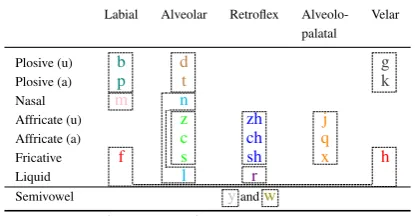
Table 4shows the the clustering of initials ac-cording to the Pinyin linguistic characteristics. We partition initials into 12 clusters, consisting
Figure 2: Table of Pinyin Initials.
2.3.1 Generating Similar Word Pairs
Phonetically similar word pairs are used to create annotations representing the phonetic similarity of initials, or finals. Chinese has253pairs of initials
and666 pairs of finals. Annotating examples of
all these pairs is labor intensive and error-prone. Assuming twenty word pairs are provided as con-text per pair, the task quickly blows up to eigh-teen thousand annotations. However, we observe that the phonetic similarity of Pinyin is greatly im-pacted by the pronunciation methods and the place of articulation - this allows us to improve the accu-racy and simplify the annotation task. Specifically, this is done by grouping Pinyin components into initial clusters and only annotating pairs within each cluster, and representative cluster pairs.
Figure2partitions initials into12clusters, con-sisting of “bp”,“dt”,“gk”,“hf”,“nl”,“r”, “jqx”,
“zcs”, “zhchsh”, “m” ,“y” and “w”, based on the
pronunciation method and the place of articula-tion. “f” and “h” are grouped together as they are both fricative and sound very similar, especially for people from the southeast of China (Zhishihao,
2017). We then eliminate the comparison of pairs
that are highly similar or highly dissimilar. For ex-ample, as the semivowel initials “y” and “w” are
dissimilar to all other initials, we label every ini-tial pair containing one of them with the lowest possible score. To compare between clusters, we randomly choose one initial from each cluster and generate just those comparison pairs. The number of pairs of initials decreases from253to59.
We use a similar method for finals, partition-ing them into six groups by the six basic vow-els (“a,o,e,i,u,¨u”) (e.g., “i,in,ing” are clustered
to-gether.) We then use edit distance and common sequence length constraints to guide the pair gen-eration; specifically, we compare a pair of finals
the length of finals on average is two, an edit dis-tance of three means a complete change to the fi-nal, resulting in pairs with the lowest similarity. To compare finals across clusters, since the edit distance between any such pair is at least two, we compare pairs only when the length of the com-mon sequence is at least two (for example, “ian” and “uan”), and otherwise assign the lowest possi-ble similarity to the pairs. This drops the number
of comparison pairs of finals down to113.
After generating the comparison pairs, we cre-ate word pairs whose Pinyins only differ in the these pairs. We identify and account for several confounding factors that may affect annotation: 1) the position of the character containing the initial or final being compared; 2) the word length; and 3) the combination of initials and finals. Since most Chinese words are of length two, we only gener-ate word pairs of length two for this task. Provid-ing word pairs of length greater than two would not make much difference to learned encodings as long as word pairs are representative.
For a given initial (or final) pair (p1, p2), such
as(b, p), we first generate the all possible Pinyins
with a component of p1 such as bao and bing.
For each Pinyin py, we retrieve all the words
with length two in the dictionary which also have
first or second character with the same py.
Ex-ample words forpy=“bao00 include包bao1袱fu2.
For each created word w, we change the initial
(or final) from p1 to p2, retrieve the
correspond-ing words from the dictionary and generate the word pairs to compare. One such example is
(包bao1袱fu2, 泡pao4芙fu2). Finally, from the
full list we randomly select five word pairs that vary the first character, and five word pairs that vary the second character.
We invite three native Chinese speakers to per-form the annotations. For each word pair, the an-notators give a label on a 7 point scale represent-ing their agreement, where the labels range from
’Completely Disagree’ (1) to ’Completely Agree’
(7). We calculate Krippendorff’s α (Hayes and
Krippendorff,2007) for the initials and finals an-notations to be 0.69 and 0.54, representing the inter-annotator agreement. For each word pair, we
use Equation2to calculate the distanceθwith the
average value φ of labels across the annotators.
Equation2inverts the labels so that the output can be used as a distance metric (phonetically similar initials or finals are closer together), and scales the
b p
m
f d
t
n l
g k
h
j q x
zh
ch sh
r z
c s
[image:4.595.307.514.62.270.2]-30 -20 -10 0 10 20 30
Figure 3: Learned initial encodings, n=1.
b p m
f d t
n l
g k
h
j q x
zh ch sh r
z c
s
-1000 -500 0 500 1000 1500 2000
-1500 -1000 -500 0 500 1000
Figure 4: Learned initial encodings, n=2.
result to more accurately measure phonetic simi-larities. The parametersaandbare set4and104
by default, but we also show that the performance of our method is not sensitive to the parameter set-tings (see Section3.2).
θ(φ) = 1/aφ∗b (2)
2.3.2 Learning Model
Once the average distances between pairs are com-puted from the annotated data sets, we define a constrained optimization to compute encodings of the initials and finals. The final goal is to map each initial (or final) to ann-dimensional point.
The distance Sp of a pair p of points
(x1, x2, ..., xn),(y1, y2, ..., yn)is calculated using
Euclidean distance as shown in equation3.
Sp =
s X
1≤i≤n
(xi−yi)2 (3)
The model aims to minimize the sum of the ab-solute differences between the Euclidean distances of component pairs and the average distances ob-tained from the annotated training data across all pairs for initials (or finals)C. We also incorporate
a penalty function,τp, for pairs deviating from the
manually annotated distance θso that more
pho-netically similar pairs are penalized more highly
(we discussτ further in Section3.2). Equation4
represents the cost function:
minX
p∈C
One main advantage of our learning model is that it is generic and can easily extend to any n-dimensional space. Based on the structured of
Table 2, we intuit that extending beyond one
di-mension will yield more accurate encodings.
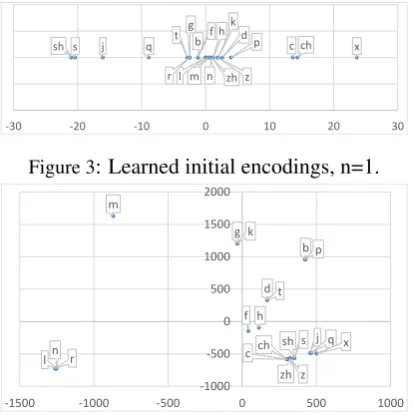
Fig-ures 3 and 4 visualize the computed encodings
of initials when settingn=1 andn=2 We see that
when n = 2, the locations of initial coordinates
align well with Table2,. In particular, the twelve groups are clustered in a pattern that is defined in Section2.3.1. For example, “bp,gk,jqx” are
sep-arated into different clusters. However, while Ta-ble 2 indicated the basic clusters for the initials,
our learned model goes further than Table2by
ac-tually quantifying the inter- and intra-cluster sim-ilarities. Specifically, clusters “c, ch, j, q, x” are
tighter than clusters “c, c, h” and “d, t”, whereas
the clusters “m” and “n, r, l” are well separated
from other clusters. Interestingly, the learning al-gorithms organically discovers new clusters that are not reflected in Table2; namely that “r,n” and
“r,l” are pairs of phonetically similar initials.
When n = 1, the learned model collapses the
coordinates into one dimension (Figure 3). We
observe that the predefined clusters are not well aligned, and many clusters are mixed together (e.g., “bp,gk,nl,dt”), preventing DIMSIM from
considering variations within a cluster to be more similar than variations between clusters. Visually
comparing Figures3and4gives the intuition for
why DIMSIM with n = 2 performs better than
DIMSIMwithn= 1, which is in turn reflected in
our evaluation results. Section 3 presents the
ef-fects that varying the number of dimensions has on evaluation results.
2.4 Phonetic Tone Similarity
There are five tones in Chinese, represented by a
tone number scaleranging from1to5. It is sim-ple to use tone numbers for tone encodings and the difference between the tones of two Pinyins as the
raw measure of distance, ranging in value from1
to5(e.g.,ST(xue2, xue4) = 4−2 = 2). One
ex-ception is that we encode tone3as the numerical
value of2.5since tone3is more similar to tone2
compared to tone4according to the relative pitch
changes of the four tones (ISO, 2015). However,
this measure must first be scaled to be compara-ble to the pairwise phonetic distances of initials and finals. There is an additional constraint: any pairwise difference in initials or finals must have
Input :W ord w, T hreshold th, Dict dict; Output:W ords outws;
begin
pys=getPinyins(w,dict);
headP ys=
getSimPinyins(pys(0), th);
headW ords=
getWordswithHeadPy(headP ys, dict); forcw∈headW ordsdo
ifcw.size6=w.sizethen continue;
end
sim=getSimilarity(cw,w); ifsim≤ththen
outws.add(cw); end
end
sortByAscSim(outws);
return outws; end
Algorithm 1:Generating phonetic candidates.
a greater negative effect on the phonetic similarity between characters than any difference in tones. For example,S(xue1,lue1)< S(xue1,xue5) even
though xue1 and xue5 are at opposite ends of
the tone scale. We therefore scale ST such that
M ax(ST)< M in(Sp).
2.5 Candidate Generation and Ranking Having determined the phonetic encodings and the mechanism to compute the phonetic similarity us-ing learned phonetic encodus-ings, we now describe how to generate and rank similar candidates in
Al-gorithm1. Given a wordw, a similarity threshold
th, and a Chinese Pinyin dictionary dict, we
re-trieve the Pinyin py ofw from dict. We derive
a list of PinyinsP ys whose similarity topy falls
within the thresholdth. These are used to
gener-ate a list of words with the same Pinyin in P ys
and the same number of characters asw. We
cal-culate the similarity of each candidate word with
w using Equation1 and filter out candidates that
fall outside the similarity thresholdth. Thus, th
is a parameter that affects the precision and recall
of the generated candidates. A largerthgenerates
more candidates, increasing recall while
decreas-ing precision.3 Finally, we output the candidates
ranked in ascending order by similarity distance.
3 Evaluation
We collect 350 words from social media (Wu,
2016), and annotate each with 1-3
phoneti-cally similar words. We use a
community-maintained free dictionary to map characters to
Pinyins (CEDict, 2016). We compare DIMSIM
with Double Metaphone (DM) (Philips, 2000),
ALINE (Kondrak, 2003) and Minimum edit
dis-tance (MED) (Navarro, 2001) in terms of
preci-sion (P), recall (R), and average Mean Reciprocal
Rank (MRR) (Voorhees and et al.,1999). We
cal-culate recall automatically using the the full test
set of word pairs (Wu, 2016). Since downstream
applications will only consider a limited number of candidates in practice, we evaluate precision via a manual annotation task on the top-ranked candi-dates generated by each approach. DM consid-ers word spelling, pronunciation and other mis-cellaneous characteristics to encode the word into a primary and a secondary code. DM as one of the baselines is known to perform poorly at
rank-ing the candidates (Carstensen, 2005) since only
two codes are used. We therefore use our method
(Equation 1) to rank the DM-generated
candi-dates, to create a second baseline, DM-rank.4 The
third baseline, ALINE, measures phonetic similar-ity based on manually coded multi-valued articu-latory features weighted by their relative impor-tance with respect to feature salience (again, man-ually determined). MED, the last baseline, com-putes similarity as the minimum-weight series of edit operations that transforms one sound compo-nent into another.
3.1 The Effectiveness of DIMSIM
Recall and MRR:We compare DIMSIMto DM,
DM-rank, ALINE and MED. DIMSIM1 and DIM
-SIM2 denotes DIMSIMencoding dimensionn= 1
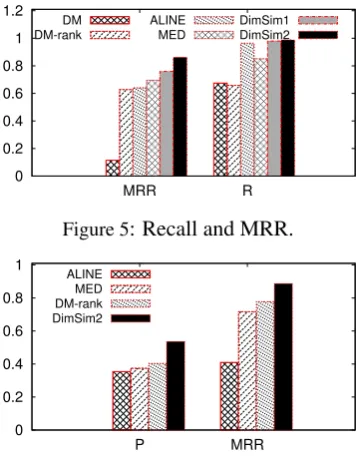
andn = 2, respectively. As shown in Figure 5,
DIMSIM2 improves recall by factors of1.5, 1.5, 1.3and1.2, and improves MRR by factors of7.5,
1.4, 1.03 and 1.2 over DM, DM-Rank, ALINE
and MED, respectively. DM performs relatively poorly, as it is designed for English, and does not accurately reflect Chinese pronunciation.
Rank-ing DM candidates usRank-ing the DIMSIM phonetic
distance defined in Equation 1 improves its
av-erage MRR by a factor of 5.5. However, even
DM-Rank is outperformed by the simple MED 4We do not compare with Soundex as DM is accepted to
be an improved phonetic similarity algorithm over Soundex.
0 0.2 0.4 0.6 0.8 1 1.2
MRR R DM
DM-rank
ALINE MED
[image:6.595.320.501.67.297.2]DimSim1 DimSim2
Figure 5: Recall and MRR.
0 0.2 0.4 0.6 0.8 1
P MRR ALINE
MED DM-rank DimSim2
Figure 6: Precision and MRR.
baseline, demonstrating the inherent problem with DM’s coarse encodings. While ALINE has a
similar recall to DIMSIM, it performs worse on
MRR than DIMSIM2 because it does not have
a direct representation of compound vowels for Pinyin. It measures distance between compound vowels using phonetic features of basic vowels which leads to inaccuracy. In turn, MED strug-gles with representing accurate phonetic distances between initials, since most initials are of length 1, and the edit distance between any two characters of length1is identical. In contrast, DIMSIM
en-codes initials and finals separately, and thus even a
1-dimensional encoding (DIMSIM1) outperforms
the other baselines. Finally, the intuition of Fig-ures3and4is reflected in the data, as DIMSIM2
outperforms DIMSIM1 by 14% (MRR).
Precision and MRR: Here we evaluate the quality of the candidate ranking since in practice, downstream applications consider only a small number of possible candidates for every word. We ask two native Chinese speakers to annotate the
quality of the generated candidates. Choosing100
words randomly from the test set, we use
DM-rank, MED, ALINE and DIMSIM2 to generate
top-K candidates for each seed word (K = 5).5
The annotators mark each candidate as phoneti-cally similar to the seed word (1) or not (0), also marking the one candidate they believe to be the
most similar-sounding (2), which may be any of
5We do not evaluate DM and DIMSIM1 as they perform
the top-K candidates. We then compute precision and average MRR using the obtained annotations.
We achieve inter-level agreement(ILA) of0.75for
P and ILA of 0.84 for average MRR. DIMSIM
once again outperforms MED and DM-Rank by up to1.4X for precision and1.24Xfor MRR. Since
the only criteria for picking the best top-K candi-date is phonetic similarity, this demonstrates that
DIMSIMranks the most phonetically similar
can-didates higher than the other baselines.
τ(φ)
θ(φ) 1/2
φ 1/4φ 1/φ2 1/φ4
∗102 ∗104 ∗102 ∗103
None F10 F20 F30 F40
2φ F11 F21 -
-4φ F12 F22 -
-φ2 - - F33 F34
[image:7.595.101.261.213.319.2]φ4 - - F43 F44
Table 4: Variations ofθ,τ.
0.1 1 10 100 1000 10000
[image:7.595.328.509.301.399.2]1 2 3 4 5 6 7 F10 F20 F30 F40
Figure 7: Distance byθ.
0.6 0.7 0.8 0.9 1
MRR R F10
F11 F12
F20 F21 F22
F30 F33 F34
F40 F43 F44
Figure 8: Impact of varyingθ,τ.
3.2 Impact of Scoring and Penalty Functions We study the sensitivity of DIMSIMto varying the
scoring and penalty functions, using recall and
av-erage MRR for evaluation. Table4shows four
dif-ferent scoring functions θ and penalty functions
τ (including the variation of not using a penalty
function) to convert the annotator scoresφto pair-wise distancesS, following Equation4.
Figure7 depicts the values of the four scoring
functions θ as a function of the annotator scores
on a log 10 scale, to demonstrate the effect of
varying a and b, as well as using φ as the base
or exponent. Figure8demonstrates how sensitive
our model is to the different combinations of scor-ing and penalty functions. We see that although Recall is entirely insensitive to the variations, the performance of MRR is impacted. There is a clear preference for the variations on the
“diago-nal” of Table4: F11, F22, F33, F44, but the
near-identical performance of these variations demon-strates DIMSIM’s robustness to the particular
scor-ing and penalty functions used. Note that not usscor-ing a penalty function impacts MRR significantly.
0.6 0.7 0.8 0.9 1
MRR R n=1 n=2 n=3 n=4
Figure 9: Impact of varyingn.
3.3 Impact of the Encoding Dimensions As demonstrated above, encoding initials and fi-nals into a two-dimensional space is more
ef-fective than a one-dimensional space. Figure 9
presents the results of continuing to increase the
number of dimensions, n = [1,4]. We observe
that recall is barely affected, with all variations able to successfully identify the targeted words
98%to99%of the time. We also see that moving
from n=1 to n=2 increases the average MRR by
1.14X. However, further increasing the number
of dimensions to n>2 no longer improves average MRR, indicating that learning a two-dimensional encoding is enough to capture the phonetic rela-tionships between Pinyin components.
3.4 Impact of the Distance Threshold
We examine how the similarity distance thresh-old (th) impacts DIMSIMby varyingthfrom2to
4096(Figure10) (using the scoring function F22).
Asthincreases, recall increases from0.75to0.99,
converging whenthreaches2048. By increasing
[image:7.595.91.271.368.631.2]0.6 0.7 0.8 0.9 1
1 4 16 64 256 1024 4096
[image:8.595.93.280.68.171.2]MRR R
Figure 10: Impact of varyingth.
lar to the first character of the given word, which in turn increases the number of candidates within the distance. Thus, the probability of including the la-beled gold standard words in the results increases.
MMR is less sensitive toth, converging whenth
reaches 128. However, the generated set of
can-didate words is reduced too much for th < 128,
hurting the performance of MMR. To ensure both
high recall and MRR we setth= 2500.
0.6 0.7 0.8 0.9 1
1 4 16 64 256 1024 4096
MRR R
Figure 11: Varying candidatenc.
3.5 Impact of Number of Candidates
While generating more candidates improves the recall, presenting too many candidates to a down-stream application is not desirable. To find a bal-ance, we study the impact of varying the upper
limit of the number of generated candidates nc
from 2 to 2048 (Figure 11). We find that MRR
converges at 64 candidates, while recall takes longer; however, setting the upper limit at 64
can-didates already achieves almost 98% recall,
sug-gesting it as a reasonable cutoff in practice. Unless
otherwise mentioned, we setnc = 1,000for
ex-periments, to isolate the impact of this parameter.
3.6 Error Analysis
We analyze and summarize three types of errors
made by DIMSIM. The first occurs when targeted
words are out of vocabulary(OOV). For instance,
for the original word “药丸” , the targed word is
“要完” which is OOV. As is commonly the case in
text normalization applications which convert in-formal language to well-formed terms, our method works as long as the targeted words are in the dic-tionary. This shortcoming is generally alleviated by adding new terms to the dictionary. Second,
DIMSIM cannot derive phonetic candidates from
dialects that are not encoded in our mapping ta-ble. For example, for “冻(dong4)蒜(suan4)” , the
targeted word “当(dang1)选(xuan2)” is obtained using the pronunciation of southern Fujian dialect. However, our approach can easily be extended to incorporate and capture such variants by learning mapping tables for each dialect and using them to generate corresponding candidates. Finally, we
constrain DIMSIMto not identify candidates that
differ in length from the seed word, as we observe that most transcriptions have the same word length - though some corner cases do occur.
4 Related Work
There is a plethora of work focusing on the phonetic similarities between words and
characters (Archives and Administration, 2007;
Mokotoff, 1997;Taft, 1970;Philips, 1990, 2000;
Elsner et al., 2013). These algorithms encode words with similar pronunciation into the same
code. For example, Soundex (Archives and
Administration, 2007) converts words into fixed length code through a mapping table of initial groups to ordinal numbers. These algorithms fail to capture Chinese phonetic similarity since the conversion rules do not consider pronunciation properties of Pinyin. Linguists in the phonetic and phonology community have also proposed several
phonetic comparison algorithms (Kessler, 2005;
Mak and Barnard,1996;Nerbonne and Heeringa,
1997; Ladefoged, 1969; Kondrak, 2003) for de-termining the similarity between speech forms. However, as features of articulatory phonetics are manually assigned, these algorithms fall short in capturing the perceptual essence of phonetic similarity through empirical data (Kessler,2005).
In contrast, DIMSIM achieves high accuracy by
learning the encodings both from high quality training data sets and linguistic Pinyin features.
Several works in Named Entity translation (Lin
and Chen,2002;Lam et al.,2004;Kuo et al.,2007;
[image:8.595.93.280.356.457.2]Chinese words in basic phoneme units and apply edit distance algorithms to compute the similar-ity. Training frameworks are then used to learn the similarity. However, the phonetic similarity used in these systems cannot be applied to Chi-nese words since Pinyin has its own specific char-acteristics, which do not easily map to English, for determining phonetic similarity. Another main ap-plication of phonetic similarity algorithms is text normalization (Xia et al., 2006; Li et al., 2003;
Han et al.,2012;Sonmez and Ozgur,2014;Qian et al., 2015), where phonetic similarity is mea-sured by a combination of initial and final simi-larities. However, the encodings used in these ap-proaches are too coarse-grained, yielding low F1
measures. DIMSIM learns separate high
dimen-sional encodings for initials and finals, and uses them to calculate and rank the distances between Pinyin representations of Chinese word pairs. Karl
Stratos (Stratos, 2017) proposes a sub-character
architecture to deal with the data sparsity problem in Korean language processing by breaking down each Korean character into a small set of primitive phonetic units. However, this work does not ad-dress the problem of the phonetic similarity and is thus orthogonal to DIMSIM.
5 Conclusion
Motivated by phonetic transcription as a widely observed phenomenon in Chinese social media and informal language, we have designed an
accu-rate phonetic similarity algorithm. DIMSIM
gen-erates phonetically similar candidate words based on learned encodings that capture the pronunci-ation characteristics of Pinyin initial, final, and tone components. Using a real world dataset,
we demonstrate that DIMSIMeffectively improves
MRR by 7.5X, recall by1.5X and precision by
1.4Xover existing approaches.
The original motivation for this work was to im-prove the quality of downstream NLP tasks, such as named entity identification, text normalization and spelling correction. These tasks all share a de-pendency on reliable phonetic similarity as an in-termediate step, especially for languages such as Chinese where incorrect homophones and syno-phones abound. We therefore plan to extend this
line of work by applying DIMSIMto downstream
applications, such as text normalization.
References
National Archives and Records Administra-tion. 2007. The Soundex Indexing System. https://www.archives.gov/research/
census/soundex.html.
Adam Carstensen. 2005. An Introduction to Double Metaphone and the Principles Behind Soundex. http://www.b-eye-network.
com/view/1596.
CEDict. 2016. CC-CEDICT. https: //www.mdbg.net/chindict/chindict.
php?page=cc-cedict.
Jen-Ming Chung, Fu-Yuan Hsu, Cheng-Yu Lu, Hahn-Ming Lee, and Jan-Hahn-Ming Ho. 2011. Automatic english-chinese name translation by using web-mining and phonetic similarity. In IEEE Interna-tional Conference on Information Reuse and Inte-gration, pages 283–287.
Micha Elsner, Sharon Goldwater, Naomi Feldman, and Frank Wood. 2013. A joint learning model of word segmentation, lexical acquisition, and phonetic vari-ability. InProc. EMNLP.
Bo Han, Paul Cook, and Timothy Baldwin. 2012. Au-tomatically constructing a normalisation dictionary for microblogs. InProc. of the joint conference on EMNLP and CoNLL, pages 421–432. ACL.
Andrew F. Hayes and Klaus Krippendorff. 2007. An-swering the call for a standard reliability measure for coding data. Communication Methods and Mea-sures, 1(1):77–89.
ISO. 2015. ISO 7098: Romanization of Chi-nese. https://www.iso.org/standard/ 61420.html.
Brett Kessler. 2005. Phonetic comparison algo-rithms. Transactions of the Philological Society, 103(2):243–260.
Grzegorz Kondrak. 2003. Phonetic alignment and sim-ilarity. Computers and the Humanities, 37(3):273– 291.
Jin-Shea Kuo, Haizhou Li, and Ying-Kuei Yang. 2007. A phonetic similarity model for automatic extraction of transliteration pairs. ACM Transactions on Asian Language Information Processing (TALIP), 6(2):6.
Peter Ladefoged. 1969. The measurement of phonetic similarity. InProceedings of the 1969 conference on Computational linguistics, pages 1–14. Association for Computational Linguistics.
Wai Lam, Ruizhang Huang, and Pik-Shan Cheung. 2004. Learning phonetic similarity for matching named entity translations and mining new transla-tions. InProc. ACM SIGIR, pages 289–296.
pronunci-Hong-lian Li, Wei He, and Bao-zong Yuan. 2003. An kind of chinese text strings’ similarity and its appli-cation in speech recognition. Journal of Chinese In-formation Processing, 17(1):60–64.
Wei-Hao Lin and Hsin-Hsi Chen. 2002. Backward ma-chine transliteration by learning phonetic similarity. InProc. CoNLL, pages 1–7. ACL.
Brian Mak and Etienne Barnard. 1996. Phone clus-tering using the bhattacharyya distance. InSpoken Language, 1996. ICSLP 96. Proceedings., Fourth International Conference on, volume 4, pages 2005– 2008. IEEE.
Gary Mokotoff. 1997. Soundexing and genealogy. Avotaynu.
Gonzalo Navarro. 2001. A guided tour to approximate string matching. ACM computing surveys (CSUR), 33(1):31–88.
John Nerbonne and Wilbert Heeringa. 1997. Measur-ing dialect distance phonetically. InProceedings of the Third Meeting of the ACL Special Interest Group in Computational Phonology (SIGPHON-97). Lawrence Philips. 1990. Hanging on the metaphone.
Computer Language, 7(2):6.
Lawrence Philips. 2000. The double metaphone search algorithm. C/C++ users journal, 18(6):38–43. Tao Qian, Yue Zhang, Meishan Zhang, Yafeng Ren,
and Dong-Hong Ji. 2015. A transition-based model for joint segmentation, pos-tagging and normaliza-tion. InEMNLP, pages 1837–1846.
Duanmu San. 2007. The Phonology of Standard Chi-nese. Oxford University Press.
Cagil Sonmez and Arzucan Ozgur. 2014. A graph-based approach for contextual text normalization. In EMNLP, pages 313–324.
Karl Stratos. 2017. A sub-character architecture for korean language processing. InProceedings of the 2017 Conference on Empirical Methods in Natural Language Processing, pages 721–726.
Robert L Taft. 1970. Name search techniques. 1. Bu-reau of Systems Development, New York State Iden-tification and Intelligence System.
Kristina Toutanova and Robert C. Moore. 2002. Pro-nunciation modeling for improved spelling correc-tion. In Proc. ACL, ACL ’02, pages 144–151, Stroudsburg, PA, USA.
Johannes Twiefel, Timo Baumann, Stefan Heinrich, and Stefan Wermter. 2014. Improving domain-independent cloud-based speech recognition with domain-dependent phonetic post-processing. In AAAI, pages 1529–1536.
Ellen M Voorhees and et al. 1999. The trec-8 question answering track report. InTrec, volume 99, pages 77–82.
You Wu. 2016. Commonly used phonetic vocab-ulary. http://www.51wendang.com/doc/
97585e99067d692a1bbaec92.
Yunqing Xia, Kam-Fai Wong, and Wenjie Li. 2006. A phonetic-based approach to chinese chat text nor-malization. InProc. ACL, pages 993–1000.
Mabus Yao. 2015. An algorithm for Chinese Simi-larity based on phonetic grapheme coding. http:
//mabusyao.iteye.com/blog/2267661.
Zhishihao. 2017. Differentiating f and h. http://