528
Learning Dense Representations for Entity Retrieval
Daniel Gillick
∗Google Research
Sayali Kulkarni
∗Google Research
Larry Lansing
∗Google Research
Alessandro Presta
∗Google Research
Jason Baldridge
Google Research
Eugene Ie
Google Research
Diego Garcia-Olano
†University of Texas at Austin
Abstract
We show that it is feasible to perform entity linking by training a dual encoder (two-tower) model that encodes mentions and entities in the same dense vector space, where candidate entities are retrieved by approximate nearest neighbor search. Unlike prior work, this setup does not rely on an alias table followed by a re-ranker, and is thus the first fully learned en-tity retrieval model. We show that our dual encoder, trained using only anchor-text links in Wikipedia, outperforms discrete alias ta-ble and BM25 baselines, and is competitive with the best comparable results on the stan-dard TACKBP-2010 dataset. In addition, it can retrieve candidates extremely fast, and gen-eralizes well to a new dataset derived from Wikinews. On the modeling side, we demon-strate the dramatic value of an unsupervised negative mining algorithm for this task.
1
Introduction
A critical part of understanding natural language is con-necting specific textual references to real world entities. In text processing systems, this is the task ofentity res-olution: given a document where certain spans of text have been recognized asmentionsreferring to entities, the goal is to link them to unique entries in a knowledge base (KB), making use of textual context around the mentions as well as information about the entities. (We use the termmentionto refer to the target span along with its context in the document.)
Real world knowledge bases are large (e.g., English Wikipedia has 5.7M articles), so existing work in entity resolution follows a two-stage approach: a first compo-nent nominates candidate entities for a given mention and a second one selects the most likely entity among those candidates. This parallels typicalinformation re-trievalsystems that consist of an index and a re-ranking model. In entity resolution, the index is a table mapping
aliases(possible names) to entities. Such tables need to be built ahead of time and are typically subject to
∗
Equal Contributions †
Work done during internship with Google
arbitrary, hard cutoffs, such as only including the thirty most popular entities associated with a particular men-tion. We show that this configuration can be replaced with a more robust model that represents both entities and mentions in the same vector space. Such a model allows candidate entities to be directly and efficiently retrieved for a mention, using nearest neighbor search.
To see why a retrieval approach is desirable, we need to consider how alias tables are employed in entity reso-lution systems. In the following example,Costarefers to footballerJorge Costa, but the entities associated with that alias in existing Wikipedia text areCosta Coffee,
Paul Costa Jr,Costa Cruises, and many others—while excluding the true entity.
Costahas not played since being struck by the AC Milan forward...
The alias table could be expanded so that last-name aliases are added for all person entities, but it is im-possible to come up with rules covering all scenarios. Consider this harder example:
...warned Franco Giordano, secretary of the Refoundation Communistsfollowing a coali-tion meeting late Wednesday...
It takes more sophistication to connect the colloquial expressionRefoundation Communiststo theCommunist Refoundation Party. Alias tables cannot capture all ways of referring to entities in general, which limits recall.
Alias tables also cannot make systematic use of con-text. In theCostaexample, the context (e.g.,AC Milan forward, played) is necessary to know that this mention does not refer to a company or a psychologist. An alias table is blind to this information and must rely only on prior probabilities of entities given mention spans to manage ambiguity. Even if the correct entity is retrieved, it might have such a low prior that the re-ranking model cannot recover it. A retrieval system with access to both the mention span and its context can significantly improve recall. Furthermore, by pushing the work of the alias table into the model, we avoid manual process-ing and heuristics required for matchprocess-ing mentions to entities, which are often quite different for each new domain.
• We define a novel dual encoder architecture for learning entity and mention encodings suitable for retrieval. A key feature of the architecture is that it employs a modular hierarchy of sub-encoders that capture different aspects of mentions and entities.
• We describe a simple, fully unsupervisedhard neg-ative miningstrategy that produces massive gains in retrieval performance, compared to using only random negatives.
• We show that approximate nearest neighbor search using the learned representations can yield high quality candidate entities very efficiently.
• Our model significantly outperforms discrete re-trieval baselines like an alias table or BM25, and gives results competitive with the best reported accuracy on the standard TACKBP-2010 dataset.
• We provide a qualitative analysis showing that the model integrates contextual information and world knowledge even while simultaneously managing mention-to-title similarity.
We acknowledge that most of the components of our work are not novel in and of themselves. Dual encoder architectures have a long history (Bromley et al.,1994;
Chopra et al., 2005; Yih et al., 2011), including for retrieval (Gillick et al.,2018). Negative sampling strate-gies have been employed for many models and appli-cations, e.g. Shrivastava et al.(2016). Approximate nearest neighbor search is its own sub-field of study (Andoni and Indyk,2008). Nevertheless, to our knowl-edge, our work is the first combination of these ideas for entity linking. As a result, we demonstrate the first accu-rate, robust, and highly efficient system that is actually a viable substitute for standard, more cumbersome two-stage retrieval and re-ranking systems. In contrast with existing literature, which reports multiple seconds to re-solve a single mention, we can provide strong retrieval performance across all 5.7 million Wikipedia entities in around 3ms per mention.
2
Related work
Most recent work on entity resolution has focused on training neural network models for the candidate re-ranking stage (Francis-Landau et al.,2016;Eshel et al.,
2017; Yamada et al., 2017a; Gupta et al., 2017; Sil et al., 2018). In general, this work explores useful context features and novel architectures for combin-ing mention-side and entity-side features. Extensions include joint resolution over all entities in a document (Ratinov et al.,2011;Globerson et al.,2016;Ganea and Hofmann,2017), joint modeling with related tasks like textual similarity (Yamada et al.,2017b;Barrena et al.,
2018) and cross-lingual modeling (Sil et al.,2018), for example.
By contrast, since we are using a two-tower or dual encoder architecture (Gillick et al.,2018;Serban et al.,
2018), our model cannot use any kind of attention over both mentions and entities at once, nor feature-wise comparisons as done byFrancis-Landau et al.(2016). This is a fairly severe constraint – for example, we can-not directly compare the mention span to the entity title – but it permits retrieval with nearest neighbor search for theentirecontext against a single, all encompassing representation for each entity.
3
Data
As a whole, the entity linking research space is fairly fragmented, including many task variants that make fair comparisons difficult. Some tasks include named entity recognition (mention span prediction) as well as entity disambiguation, while others are concerned only with disambiguation (the former is often referred to as end-to-end. Some tasks include the problem of predicting aNILlabel for mentions that do not correspond to any entity in the KB, while others ignore such cases. Still other tasks focus onnamedor proper noun mentions, while others include disambiguation of concepts. These variations and the resulting fragmentation of evaluation is discussed at length byLing et al.(2015) andHachey et al. (2013), and partially addressed by attempts to consolidate datasets (Cornolti et al.,2013) and metrics (Usbeck et al.,2015).
Since our primary goal is to demonstrate the viability of our unified modeling approach for entity retrieval, we choose to focus on just the disambiguation task, ignor-ing NIL mentions, where our set of entity candidates includes every entry in the English Wikipedia.
In addition, some tasks include relevant training data, which allows a model trained on Wikipedia (for exam-ple) to be tuned to the target domain. We save this fine-tuning for future work.
Training data Wikipedia is an ideal resource for train-ing entity resolution systems because many mentions are resolved via internal hyperlinks (the mention span is the anchor text). We use the 2018-10-22 English Wikipedia dump, which includes 5.7M entities and 112.7M linked mentions (labeled examples). We partition this dataset into 99.9% for training and the remainder for model selection.
Since Wikipedia is a constantly growing an evolv-ing resource, the particular version used can signifi-cantly impact entity linking results. For example, when the TACKBP-2010 evaluation dataset was published, Wikipedia included around 3M entities, so the number of retrieval candidates has increased by nearly two times. While this does mean new contexts are seen for many en-tities, it also means that retrieval gets more difficult over time. This is another factor that makes fair comparisons challenging.
Costa has not played since
being struck by the AC Milan forward.
Span Encoder
Left Encoder
Right Encoder Mention context
Encoder Mention Encoder
Title Encoder
Paragraph Encoder
Categories Encoder Entity content
Encoder Entity Encoder
(a) Dual Encoder Cosine Similarity
(d) Compound Encoder Concatenated encoder inputs
FF Layer [200 nodes]
FF Layer [200 nodes]
(c) Sparse Encoder Avg embedding [300-d]
FF Layer [50 nodes]
Sentence Encoder
Mention span
First paragraph Left
context
Entity title Right
context
Sentence Categories
(b) Text Encoder Input text Avg unigram embedding [300-d]
Avg bigram embedding [300-d]
[image:3.595.77.523.64.287.2]FF Layer [200 nodes]
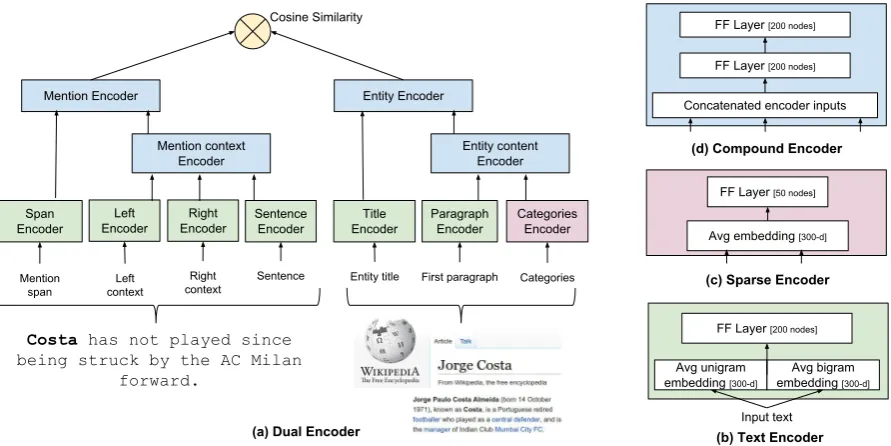
Figure 1: Architecture of the dual encoder model for retrieval (a). Common component architectures are shown for (b) text input, (c) sparse ID input, and (d) compound input joining multiple encoder outputs. Note that all text encoders share a common set of embeddings.
dataset1is the most widely used evaluation that matches
our constraints and allows us to compare to a reasonable variety of prior work. It includes 1020 annotated men-tion/entity pairs derived from 1013 original news and web documents. While there is a related development set associated with this evaluation set, we do not use it for any fine-tuning, as explained above.
To further validate our results, we also include a new evaluation set calledWikinews, which includes news pages from Wikinews2 in English for the year
2018. It includes 2263 annotated mention/entity pairs derived from 1801 original documents. Because we pulled these documents at the same time as the Wikipedia dump, the entity annotations are consistent with our training set and have not been subject to the kind of gradual rot that befalls older evaluation data as the updated KB diverges from the annotations. This data is available here: https://github. com/google-research/google-research/ tree/master/dense_representations_
for_entity_retrieval/.
4
Entity retrieval model
We use nearest neighbor search to retrieve entities based on a mention in context, after learning dense, fixed-length vector representations of each.
4.1 Dual Encoder model
Thedual encoderis a two-tower architecture suitable for retrieval (Gillick et al.,2018). It has one network struc-ture for encoding mentions (including their contexts),
1
https://tac.nist.gov/
2https://en.wikinews.org
a second for encoding entities (including KB features), and a cosine function to compute similarity between representations (which must be the same dimension). A key property of this architecture is that there is no direct interaction between the encoders on each side. This enables efficient retrieval, but constrains the set of allowable network structures. The dual encoder learns a mention encoderφand an entity encoderψ, where the score of a mention-entity pair(m, e)defined as:
s(m, e) = cos(φ(m), ψ(e)) (1)
Figure1shows the full model architecture and the fea-ture inputs to each encoder. We use acompound encoder
(Figure1d) to add useful sub-structure to each tower. The mention-side encoder first combines the context features, and then combines the result with the mention span encoding. Similarly, the entity-side encoder first combines the entity paragraph and categories, and then combines the result with the entity title encoding.
The mention encoder uses four text features to capture both the span text and the textual context surrounding it. The context features include the five tokens immediately to the left and right of the span. In the sentence feature, the mention span is replaced by a special symbol.
A shared embedding look-up is used for all text fea-tures (Figure1b). Specifically, we embed all unigrams and bigrams to get 300-dimensional averaged unigram embeddings and 300-dimensional averaged bigram em-beddings for each text feature. Unigram emem-beddings are initialized from GloVe vectors (Pennington et al.,2014), and we use 5M hash buckets for out-of-vocabulary uni-grams and biuni-grams(Ganchev and Dredze,2008). These averaged embeddings are concatenated and then passed through a feed-forward layer. For the category features, each entity category name is treated as a sparse input, and the embeddings for all categories for an entity are averaged to produce a 300-dimensional representation, which in turn is passed through a feed-forward layer (Figure1c).
Our experiments show that this architecture is highly effective for both retrieval and resolution. Nevertheless, we expect that additional modeling ideas will further improve performance, especially for resolution. Re-cent work such asDurrett and Klein(2014) has shown improvements derived from better, longer-range, con-text features; similarly, there are many more potentially useful KB-derived features. More complex encoder architectures that use some form of attention over the input tokens and features could also be beneficial.
4.2 Training
Our training data is described in Section3. The inputs to the entity encoder are constructed from the true entity referred by the landing page. The inputs to the mention encoder are constructed from the source page, using the mention span and surrounding context.
These pairs constitute only positive examples, so we usein-batch random negatives(Henderson et al.,2017;
Gillick et al.,2018): for each mention-entity pair in a training batch, the other entities in the batch are used as negatives. Computationally, this amounts to building the all-pairs similarity matrix for all mentions and enti-ties in a batch. We optimize softmax loss on each row of the matrix, so that the model is trained to maximize the score of the correct entity with respect to random entities. This is a version of the sampled softmax ( Joze-fowicz et al.,2016), which we use in place of the full softmax because the normalization term is intractable to compute over all 5.7M entities.
The softmax loss is not directly applied to the raw cosine similarities. Instead, a scalar multiplier a is learned to map the similarities (in the range [−1,1]) to unboundedlogits. For each training pair(mi, ei)in a
batch ofBpairs, the loss is computed as:
L(mi, ei) =−f(mi, ei) + log B
X
j=1
exp(f(mi, ej))
(2) where
f(mi, ej) =a·s(mi, ej) (3)
We track in-batch recall@1 (accuracy) on the held out set during training. For each instance, the model
gets a score of 1 if the correct entity is ranked above all in-batch random negatives, 0 otherwise. We stop training after the metric flattens out (about 40M steps). For all experiments, we use a batch size of 100, stan-dard SGD with Momentum of 0.9 and a fixed learning rate 0.01.
Our aim here is to demonstrate a pure retrieval sys-tem, so we train our models solely from Wikipedia and refrain from tuning them explicitly on in-domain docu-ments from the evaluation tasks.
4.3 Hard negative mining
Random negatives alone are not enough to train an ac-curate entity resolution model because scoring the cor-rect entity above random alternatives can typically be achieved just by comparing the mention text and en-tity title. More challenging negative examples must be introduced to force the model to exploit context. This strategy is somewhat akin to Importance Sampling ( Ben-gio et al.,2003), for example.
After learning an initial model using random nega-tives, we identify hard negatives via the following steps:
1. Encode all mentions and entities found in training pairs using the current model.
2. For each mention, retrieve the most similar 10 en-tities (i.e., its nearest neighbors).
3. Select all entities that are ranked above the correct one for the mention as negative examples.
This yields new negative mention/entity pairs for which the model assigns a high score. It crucially relies on the fact that there is just one correct entity, unlike other tasks that consider general similarity or relatedness (and which are well served by random negatives). For ex-ample, negatives mined in this way for paraphrasing or image captioning tasks could actually turn out to be positives that were not explicitly labeled in the data. It is precisely because the distribution over candidate entities that match a contextualized mention tends to have such low entropy that makes negative mining such a good fit for this task.
After merging these with the original positive pairs to construct a classification task, we resume training the initial dual encoder model using logistic loss on this new set of pairs. To retain good performance on random negatives, the new task is mixed with the original soft-max task in a multi-task learning setup in which the two loss functions are combined with equal weight and opti-mized together. For a pair(m, e)with labely∈ {0,1}, the hard negative loss is defined as:
Lh(m, e;y) =−y·logf(m, e)
−(1−y)·log(1−f(m, e)) (4)
where
Here,g(x) = 1/(1 +e−x)is the logistic function, and
ahandbhare learned scalar parameters to transform the
cosine similarity into a logit.3
For the hard negatives task, we trackArea Under the ROC curve(AUC) on a held out set of pairs. We stop training when the average of the evaluation metrics for the two tasks stabilizes (about 5M steps).
Finally, we iteratively apply this negative mining pro-cedure. For each round, we mine negatives from the current model as described above and then append the new hard examples to the classification task. Thus each subsequent round of negative mining adds fewer and fewer new examples, which yields a stable and naturally convergent process. As we show in our experiments, iterative hard negative mining produces large perfor-mance gains.
4.4 Inference
Once the model is trained, we use the entity encoder to pre-compute encodings for all candidate entities (includ-ing those that do not occur in train(includ-ing). At prediction time, mentions are encoded by the mention encoder and entities are retrieved based on their cosine similarity. Since our focus is on model training, we use brute-force search in our evaluation. However, for online settings and larger knowledge bases, an approximate search al-gorithm is required. In Section5.2we show that, when using approximate search, the system retains its strong performance while obtaining a nearly 100x speedup on an already fast retrieval.
5
Experiments
5.1 Evaluation setup
We demonstrate our model performance as compared to a baseline alias table. As is standard, it is built by counting all (mention span, entity) pairs in the training data. The counts are used to estimate prior probabilities
P(e|m)of an entity given a mention span (alias); for each entity, the aliases are ordered according to these priors and limited to the top 100 candidates.
P(e|m) = Pcount(e, m)
e0∈E
count(e0, m) (6)
Here,count(e, m)is the number of occurrences of men-tionmlinked to entitye, andEis the set of all entities appearing in the data.
Since alias table construction is often extended with various heuristics, we also include a variant that includes unigrams and bigrams of the mention text as additional aliases. This can help when the entities (specifically per-son names) are referenced as last/first name at inference time.
Finally, since we are primarily concerned with demon-strating performance of a retrieval system (as opposed
3The additive parameter is only needed for the logistic loss
component, as the softmax function is invariant to translation.
System R@1 Entities
AT-Prior 71.9 5.7M
AT-Ext 73.3 5.7M
Chisholm and Hachey(2015) 80.7 800K
He et al.(2013) 81.0 1.5M
Sun et al.(2015) 83.9 818K
Yamada et al.(2016) 85.2 5.0M
Nie et al.(2018) 86.4 5.0M
Barrena et al.(2018) 87.3 523K
[image:5.595.312.520.62.183.2]DEER (this work) 87.0 5.7M
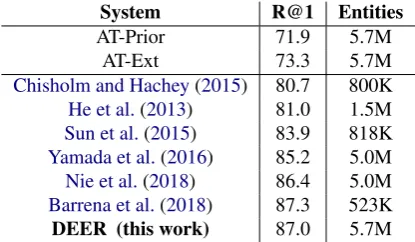
Table 1: Comparison of relevant TACKBP-2010 results using Recall@1 (accuracy). While we cannot control the candidate entity set sizes, we attempt to approximate them here.
to a re-ranking system) or a combination of the two, we include results using the standard BM25 retrieval algorithm (theGensimimplementation4). We found that
indexing each entity using its title gave much better re-sults than indexing with the first paragraph text (or the full document text).
We measure recall@k (R@k), defined as the propor-tion of instances where the true entity is in the topk
retrieved items. We report R@1 (accuracy of the top retrieved result), which is standard for TAC/KBP-2010, as well R@100, which better captures overall retrieval performance.
We refer to the models with these abbreviations:
• AT-Prior: The alias table ordered byP(e|m).
• AT-Ext: The heuristically extended alias table.
• BM25: The BM25 retrieval algorithm, where each entity is indexed using its title.
• DEER: Our Dual Encoder for Entity Resolution, as described in section4.
5.2 Results
Table1provides a comparison against the most rele-vant related work. While there are some reported im-provements due to collective (global) resolution of all mentions in a document (Globerson et al.(2016) report 87.2% and Nie et al.(2018) report 89.1%), we limit comparisons tolocalresolution. We also limit compar-isons to systems that ignore NIL mentions (referred to asin-KB accuracy), so all those reported in the table evaluate precisely the same set of mentions. As noted earlier, we cannot control the candidate sets used in each of these experiments, and we are at some disadvantage given our larger set of candidates.
Retrieval performance Table2provides the percent of mentions for which the correct entity is found in the top 100 retrieved results, using the different baselines
4https://radimrehurek.com/gensim/
System TACKBP-2010 Wikinews
AT-Prior 89.5 93.8
AT-Ext 91.7 94.0
BM25 68.9 83.2
[image:6.595.95.268.62.122.2]DEER 96.3 97.9
Table 2: Retrieval evaluation comparison for TACKBP-2010 and Wikinews using Recall@100.
and the DEER model. The learned representations de-liver superior performance and do not require special handling for unigrams versus bigram lookups, counts for entity prominence, and so on.
Resolution performance To put DEER’s architecture and performance in context, we compare it with prior work in some more detail here.
He et al.(2013) use a dual encoder setup to train a re-ranker, but start with unsupervised training to build representations of contexts and entities using Denoising Autoencoders. They use an alias table for candidate gen-eration, and then train a ranking model using mention-specific batching to obtain hard in-batch negatives. Our results suggest that the autoencoder pretraining is not necessary and that our unsupervised negative mining can outperform heuristic selection of negatives.
Sun et al.(2015) also use a dual encoder that has similar structure to ours. LikeHe et al.(2013), they use it to score entries from an alias table rather than directly for retrieval. Their mention encoder is a con-siderably more complex combination of mention and context rather than the simple compounding strategy in our architecture. Their alias table method not only maps mentions to entities, but also uses additional filters to reduce the set of candidate entities based on words in the mention’s context. They report that this method has a recall of 91.2% on TACKBP 2010, while our direct retrieval setup gives Recall@100 of 96.3% (see Table2). They train their representations for each true mention-entity pair against a single random negative mention-entity for the mention, whereas our method takes advantage of the entire batch of random negatives as well further refinement through hard negative mining.
Yamada et al.(2016) use an alias table derived from the December 2014 Wikipedia dump, restricted to the fifty most popular entities per mention. They tune their model on the TACKBP 2010 training set. Architec-turally, they include features that capture the alias table priors and string similarities, both of which are not feasi-ble in a dual encoder configuration that precludes direct comparison between mention- and entity-side features. DEER’s better results indicate that learned representa-tions of menrepresenta-tions and entities can be powerful enough for entity retrieval even without any cross-attention.
Nie et al.(2018) define a complex model that uses both entity type information and attention between the mention string and the entity description. To augment the small 1500 example training data in TACKBP, they
Method
Mean search time (ms)
Wikinews R@100
Brute force 291.9 97.88
AH 22.6 97.22
AH+Tree 3.3 94.73
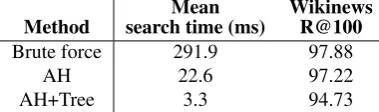
Table 3: Comparison of nearest-neighbor search meth-ods using the DEER model. The benchmark was con-ducted on a single machine. AH indicates quantization-based asymmetric hashing; AH+Tree adds an initial tree search to further reduce the search space.
also collected 55k mentions found in Wikipedia that were active in TACKBP 2010 to train this model. DEER is simply trained over all entities in Wikipedia and uses no cross-attention or explicit type information, yet de-livers better resolution performance.
Most standard entity linking models build a single ranking model on top of the candidate set provided by an alias table.Barrena et al.(2018) instead train 523k mention-specific deep classifiers—effectively treating entity linking as a special form of word sense disam-biguation. They do this by pre-training a single LSTM that predicts among 248k mentions, and then the param-eters of this model are used to warm start each of the 523k mention-specific models. In doing so, they learn an effective context encoding, and can then fine-tune each mention model to discriminate among the small set of popular candidate entities for the mention (their alias table uses a cutoff of the thirty most popular entities for each mention). DEER in contrast, has a single mention encoder that is simple and fast, and performs nearly equivalently while retrieving from a much larger set of entities.
Approximate search Tables 1and 2 report perfor-mance using brute force nearest-neighbor search. That is, we score each mention against all 5.7M entities to get the topkneighbors. However, a major motivation for using a single-stage retrieval model is that it can allow scaling to much larger knowledge bases by reducing retrieval time via approximate search.
To estimate performance in a real-world setting, we repeat the evaluation of DEER using the quantization-based approaches described byGuo et al.(2016). Ta-ble3shows the trade-off between search time and recall on Wikinews. Compared to brute force, search time can be reduced by an order of magnitude with a small loss in R@100, or by two orders of magnitude while losing less than 3 points. This is crucial for scaling the approach to even larger KBs and supporting the latency requirements of real-world applications.
[image:6.595.320.510.63.119.2]append-40% 60% 80% 100%
[image:7.595.306.529.60.340.2]0 1 2 3 4 5
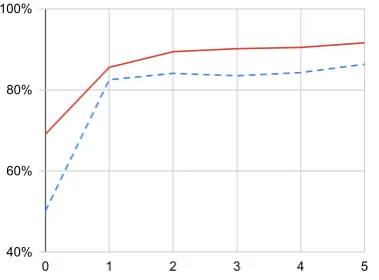
Figure 2: Recall@1 improvement for successive itera-tions of hard negative mining for Wikinews (solid) and TACKBP-2010 (dashed).
ing each new set of hard negatives to the previously mined ones means that each new set has proportion-ately less influence—this trades off some opportunity for improving the model in favor of stability.
5.3 Qualitative analysis
Here, we show a variety of examples to elucidate how DEER effectively models context, and to provide intu-ition for the learned entity representations.
First, we compare entities retrieved by DEER with those retrieved by the alias table baseline. Table5shows some instances where the alias table does not contain the correct entity for a given mention text (in the top 100 neighbors) or it fails to return any entity at all. In all of these cases, it is clear that context is essential. While a scoring stage is intended to leverage context, it is limited by the set of retrieved entities; our approach uses context directly.
For example, mentions like Costa and Justin are linked to the correct entities in the alias table, but with such low prior probability that we would need to re-trieve far more than the top 100 entities to consider them. At the other extreme, mentions like Refounda-tion CommunistsandEuropean EADSare missed by the baseline because they don’t have direct string matches in the alias table. Additional extensions to our alias table allowing token re-ordering could help catch the former (though this might reduce precision too much), but it’s unlikely that any alias table could connect Eu-ropean EADSwithAirbusin the absence of an explicit anchor-text link. This example helps highlight how a fully learned retrieval model can generalize to new data.
Second, Table6shows more directly how modifying the context around a mention span changes the retrieved entities. For example, the model correctly differenti-ates between Phoenix the city, Phoenix the band, and Phoenix in mythology based on the sentence surround-ing an identical mention span.
Third, since our model produces encodings for all 5.7M entities, we can retrieve nearest neighbors for any
Entity Nearest neighbors
Jorge Costa Jos´e Alberto Costa, Eduardo Costa, Peter Shilton, Rui Costa, Nuno Gomes, Ricardo Costa (Portuguese footballer), Andr´e Gomes, Bruno Ribeiro, Diego Costa
Costa Cruises
MSC Cruises, P&O Cruises, Princess Cruises, Island Cruises, AIDA Cruises, Silversea Cruises, Carnival Corpora-tion & plc, Costa Concordia, Celebrity Cruises
Arctic sea ice decline
Arctic ice pack, Measurement of sea ice, Arctic geoengineering, Arctic sea ice ecology and history, Climate Change Science Program, Abrupt climate change, Sea ice thickness, Antarctic sea ice, Marine ice sheet in-stability
Pink Floyd Led Zeppelin, The Who, Duran Duran, Syd Barrett, The Velvet Underground, Eddie Floyd, The Beatles, The Aus-tralian Pink Floyd Show, Roger Wa-ters
Table 4: Nearest neighbors retrieved by DEER for a sample of entities.
entity. Some examples are shown in Table4. The model tends to prefer related entities of the same type, and often ones that share portions of their names, probably because entity titles are so important to linking with mentions. The nearest neighbors forJorge Costa, our running example, include a variety of retired Portuguese football players, many of whom haveCostain their names.
Finally, Figure3is a t-SNE projection of the entity encodings for a selection of cities, bands, and people (nobel literature winners). The cities and bands were chosen to have high word overlap, e.g.Montreal (city)
andOf Montreal (band), to demonstrate how our en-tity embeddings differ from standard word embeddings. Note also the sub-clusters that form within each type cluster. Latin American authors cluster together, as do the Existentialists; the cities have some geographical proximity, though Brazil and Portugal are neighbors, presumably because of shared language and culture.
6
Conclusion
[image:7.595.90.280.70.210.2]Mention Baseline predictions Model predictions Costahas not played since being struck by the AC
Milan forward
Costa Coffee, Paul Costa Jr, Comstock-Needham system, Costa Cruises, Achille Costa
Ricardo Costa (Portuguese foot-baller), Fernando Torres, Pedro (footballer born 1987), Jorge Costa
Australia beat West Indies by five wickets in a World Serieslimited overs match
World Series, ATP International Series, 2010 World Series
World Series Cricket, The Uni-versity Match (cricket), Australian Tri-Series
Justinmade his second straight start for Harbaugh, who has a knee injury
Justin (historian), Justin Martyr, Justin (consul 540)
Paul Justin, Joe Montana, Dale Steyn
plays for the Cape Town-basedCobrasfranchise Cobra, AC Cobra, Indian Cobra Cobra, Snake,Cape Cobras OSIreports profit on overseas cancer drug sales Open Systems Interconnection,
Open Source Initiative, OSI (band)
Health Insurance Portability and Accountability Act,OSI Pharma-ceuticals, James L. Jones EVN imposedrotating power cutsearlier this year
as the worst drought in a century dropped water levels
no matches Cogeneration, Power outage,
Scram
warned Franco Giordano, secretary of the Refoun-dation Communistsfollowing a coalition meeting late Wednesday
no matches League of Communists of
Yu-goslavia,Communist Refounda-tion Party, Communist Party of Spain
TheEuropean EADSconsortium, which makes the Eurofighter Typhoon, said it was not comfort-able with the NATO-member countries’ bidding process
no matches Airbus, Airbus A400M Atlas,
NATO
such as the record California wildfires, high tem-perature extremes, retreating glaciers, and melting snow cover, thedecline of sea ice, rising sea lev-els with increasing ocean acidification and coastal flooding
[image:8.595.71.535.77.389.2]no matches Moskstraumen,Arctic sea ice de-cline, Glacier, Sea ice
Table 5: Examples of test mentions that require making use of context, where the alias table does not retrieve the correct entity. We show the top entities returned by both systems, with the correct entity in bold.
Mention Model predictions
From 1996,Cobrawas brewed under contract by Charles Wells Ltd and experienced strong growth in sales for the next ten years.
The Cobra Group,Cobra Beer, Cobra (Tivoli Friheden)
Guys fondly rememberedCobra- the band from Memphis featuring Jimi Jamison and Mandy Meyer who released one Album - Frist Strike - before the Band split!
Cobra (American band), Wadsworth Jarrell, Cobra Records, Cobra (Japanese band)
Since the late 18th century,Parishas been famous for its restaurants and haute cuisine, food meticulously prepared and artfully presented.
Paris, Nice, Bucharest
Kim Kardashian may be a household name now, but that wasnt always the case -and it may all be because of palParis.
Paris,Paris Hilton, Paris syndrome
Rory andParisare the only two people on Gilmore Girls who share the same goals. Paris, Paris (mythology),Paris Geller Texaswas finally annexed when the expansionist James K. Polk won the election
of 1844 who ordered General Zachary Taylor south to the Rio Grande on January 13, 1846.
Texas, Texas annexation, Texas in the American Civil War
Fronted by Sharleen Spiteri,Texashave released eight studio albums and are known for songs such as ’I Don’t Want a Lover’, ’Say What You Want’, ’Summer Son’ and ’Inner Smile’
Texas (band), Texas, Tich (singer)
There is an amazing piece of historic architecture set in downtownPhoenixthat was build in 1929 in the Spanish Baroque style and features intricate murals and moldings.
Phoenix, Arizona, Prescott, Arizona
Phoenixonce again played another late night show, now they have Late Night with Jimmy Fallon where they played a great rendition of ’Lisztomania’
Phoenix (band), Joaquin Phoenix, Phoenix, Arizona
According to Greek mythology, thePhoenixlived in Arabia next to a well where the Greek sun-god Apollo stopped his chariot in order to listen to its song.
Phoenix (mythology), Phoenix (son of Amyntor),Phoenix (son of Agenor)
[image:8.595.70.530.458.717.2]Figure 3: A 2D projection of cities, bands, and people embeddings (using t-SNE), color coded by their category.
fast retrieval, and is likely to scale reasonably to much larger knowledge bases.
We also note that the dual encoder approach allows for interesting extensions beyond traditional entity link-ing. For example, the context encodings provide a nat-ural model for building entity expectations during text processing, such that entities relevant to the context can be retrieved and used for reference resolution as a document is processed incrementally. We expect this will be useful for collective entity resolution as well as modeling coherence.
Finally, while we focus on training with English Wikipedia,Sil et al.(2018) show that using cross-lingual datasets can help to refine the context information more effectively. Since English constitutes only a fraction of the total Wikipedia, and entity IDs are (mostly) language-independent, there is great opportunity to ex-tend this work to far more training examples across far more languages.
Acknowledgements
The authors would like to thank Ming-Wei Chang, Jan Botha, Slav Petrov, and the anonymous reviewers for their helpful comments.
References
Alexandr Andoni and Piotr Indyk. 2008. Near-optimal hashing algorithms for approximate nearest neighbor in high dimensions. Communications of the ACM
51(1):117.
Ander Barrena, Aitor Soroa, and Eneko Agirre. 2018. Learning text representations for 500k classification tasks on named entity disambiguation. InCoNLL. pages 171–180.
Yoshua Bengio, Jean-S´ebastien Sen´ecal, et al. 2003. Quick training of probabilistic neural nets by impor-tance sampling. InAISTATS. pages 1–9.
Jane Bromley, Isabelle Guyon, Yann LeCun, Eduard S¨ackinger, and Roopak Shah. 1994. Signature verifi-cation using a” siamese” time delay neural network. InAdvances in Neural Information Processing Sys-tems. pages 737–744.
Andrew Chisholm and Ben Hachey. 2015. Entity disam-biguation with web links. Transactions of the ACL
3:145–156.
Sumit Chopra, Raia Hadsell, and Yann LeCun. 2005. Learning a similarity metric discriminatively, with application to face verification. InCVPR. IEEE, vol-ume 1, pages 539–546.
Marco Cornolti, Paolo Ferragina, and Massimiliano Cia-ramita. 2013. A framework for benchmarking entity-annotation systems. InProceedings of the 22nd inter-national conference on World Wide Web. ACM, pages 249–260.
Jacob Devlin, Ming-Wei Chang, Kenton Lee, and Kristina Toutanova. 2019. BERT: Pre-training of deep bidirectional transformers for language under-standing. InNAACL-HLT. pages 4171–4186.
Greg Durrett and Dan Klein. 2014. A joint model for entity analysis: Coreference, typing, and linking. In
Yotam Eshel, Noam Cohen, Kira Radinsky, Shaul Markovitch, Ikuya Yamada, and Omer Levy. 2017. Named entity disambiguation for noisy text. In
CoNLL. Vancouver, Canada, pages 58–68.
Matthew Francis-Landau, Greg Durrett, and Dan Klein. 2016. Capturing semantic similarity for entity linking with convolutional neural networks. InNAACL-HLT. San Diego, California, pages 1256–1261.
Kuzman Ganchev and Mark Dredze. 2008. Small sta-tistical models by random feature mixing. In Pro-ceedings of the ACL-08: HLT Workshop on Mobile Language Processing. pages 19–20.
Octavian-Eugen Ganea and Thomas Hofmann. 2017. Deep joint entity disambiguation with local neural attention.CoRRabs/1704.04920.
Daniel Gillick, Alessandro Presta, and Gaurav Singh Tomar. 2018. End-to-end retrieval in continuous space .
Amir Globerson, Nevena Lazic, Soumen Chakrabarti, Amarnag Subramanya, Michael Ringaard, and Fer-nando Pereira. 2016. Collective entity resolution with multi-focal attention. InACL.
Ruiqi Guo, Sanjiv Kumar, Krzysztof Choromanski, and David Simcha. 2016. Quantization based fast inner product search. InArtificial Intelligence and Statis-tics. pages 482–490.
Nitish Gupta, Sameer Singh, and Dan Roth. 2017. En-tity linking via joint encoding of types, descriptions, and context. InEMNLP. pages 2681–2690.
Ben Hachey, Will Radford, Joel Nothman, Matthew Honnibal, and James R Curran. 2013. Evaluating entity linking with wikipedia.Artificial intelligence
194:130–150.
Zhengyan He, Shujie Liu, Mu Li, Ming Zhou, Longkai Zhang, and Houfeng Wang. 2013. Learning entity representation for entity disambiguation. In ACL. Sofia, Bulgaria, pages 30–34.
Matthew Henderson, Rami Al-Rfou, Brian Strope, Yun-hsuan Sung, Laszlo Lukacs, Ruiqi Guo, Sanjiv Ku-mar, Balint Miklos, and Ray Kurzweil. 2017. Effi-cient natural language response suggestion for smart reply. arXiv preprint arXiv:1705.00652.
Yangfeng Ji, Chenhao Tan, Sebastian Martschat, Yejin Choi, and Noah A. Smith. 2017. Dynamic entity representations in neural language models. CoRR
abs/1708.00781.
Rafal Jozefowicz, Oriol Vinyals, Mike Schuster, Noam Shazeer, and Yonghui Wu. 2016. Exploring the limits of language modeling. arXiv preprint arXiv:1602.02410.
Xiao Ling, Sameer Singh, and Daniel S Weld. 2015. Design challenges for entity linking.Transactions of the ACL3:315–328.
Feng Nie, Yunbo Cao, Jinpeng Wang, Chin-Yew Lin, and Rong Pan. 2018. Mention and entity descrip-tion co-attendescrip-tion for entity disambiguadescrip-tion. InAAAI. Vancouver, Canada, pages 5908–5915.
Jeffrey Pennington, Richard Socher, and Christopher D. Manning. 2014. Glove: Global vectors for word representation. InIn EMNLP.
Lev Ratinov, Dan Roth, Doug Downey, and Mike An-derson. 2011. Local and global algorithms for disam-biguation to wikipedia. InACL-HLT. Stroudsburg, PA, USA, pages 1375–1384.
Iulian Vlad Serban, Ryan Lowe, Peter Henderson, Lau-rent Charlin, and Joelle Pineau. 2018. A survey of available corpora for building data-driven dialogue systems: The journal version.D&D9(1):1–49.
Abhinav Shrivastava, Abhinav Gupta, and Ross Gir-shick. 2016. Training region-based object detectors with online hard example mining. InProceedings of the IEEE Conference on Computer Vision and Pattern Recognition. pages 761–769.
Avirup Sil, Gourab Kundu, Radu Florian, and Wael Hamza. 2018. Neural cross-lingual entity linking. In
AAAI. Vancouver, Canada, pages 5465–5472.
Yaming Sun, Lei Lin, Duyu Tang, Nan Yang, Zhenzhou Ji, and Xiaolong Wang. 2015. Modeling mention, context and entity with neural networks for entity disambiguation. InTwenty-Fourth International Joint Conference on Artificial Intelligence.
Ricardo Usbeck, Michael R¨oder, Axel-Cyrille Ngonga Ngomo, Ciro Baron, Andreas Both, Martin Br¨ummer, Diego Ceccarelli, Marco Cornolti, Didier Cherix, Bernd Eickmann, et al. 2015. InProceedings of the 24th international conference on World Wide Web. pages 1133–1143.
Ikuya Yamada, Hiroyuki Shindo, Hideaki Takeda, and Yoshiyasu Takefuji. 2016. Joint learning of the em-bedding of words and entities for named entity dis-ambiguation. arXiv preprint arXiv:1601.01343.
Ikuya Yamada, Hiroyuki Shindo, Hideaki Takeda, and Yoshiyasu Takefuji. 2017a. Learning distributed rep-resentations of texts and entities from knowledge base.
TACL5:397–411.
Ikuya Yamada, Hiroyuki Shindo, Hideaki Takeda, and Yoshiyasu Takefuji. 2017b. Learning distributed rep-resentations of texts and entities from knowledge base.
CoRRabs/1705.02494.
Wen-tau Yih, Kristina Toutanova, John C Platt, and Christopher Meek. 2011. Learning discriminative projections for text similarity measures. InCoNLL. pages 247–256.