541
Model Transfer with Explicit Knowledge of the Relation
between Class Definitions
Hiyori Yoshikawa and Tomoya Iwakura
Fujitsu Laboratories Ltd., Kanagawa, Japan
{y.hiyori, iwakura.tomoya}@jp.fujitsu.com
Abstract
This paper investigates learning methods for multi-class classification using labeled data for thetargetclassification scheme and another la-beled data for a similar but different classi-fication scheme (supportscheme). We show that if we have prior knowledge about the re-lation between support and target classification schemes in the form of aclass correspondence table, we can use it to improve the model per-formance further than the simple multi-task learning approach. Instead of learning the in-dividual classification layers for the support and target schemes, the proposed method con-verts the class label of each example on the support scheme into a set of candidate class labels on the target scheme via the class cor-respondence table, and then uses the candi-date labels to learn the classification layer for the target scheme. We evaluate the proposed method on two tasks in NLP. The experimental results show that our method effectively learns the target schemes especially for the classes that have a tight connection to certain support classes.
1 Introduction
Machine learning based methods have shown high performance in many NLP tasks, which typically are formulated as some kinds of classification problems. Although there has been a remarkable progress in methods utilizing unlabeled resources, many tasks still require a large amount (at least thousands, in some cases millions or billions) of high quality labeled data to achieve high accuracy. For many tasks, however, classification schemes vary depending on fields of application or other factors, and large and high quality labeled data following a single scheme is insufficient. Named entity recognition (NER) (Nadeau and Sekine, 2007) and text classification (TC) (Joachims, 1998) are typical examples that allow variable
classification schemes. For example, there are two kinds of NE type definitions for Japanese NER: IREX (Sekine and Isahara,2000) with eight entity types and Sekine’s extended NE (ENE) hierarchy with 200 entity types (Sekine et al., 2002). These two schemes are relevant but not in complete correspondence, i.e., a class in ENE is not necessarily a proper subclass of a class in IREX and vice versa. For example, entities withLOCATIONtype in IREX are (a subtype of)
LOCATION orFACILITY in ENE, while some entities withFACILITYtype in ENE can also be
ORGANIZATIONin IREX. It is also the case that a classification scheme for an existing model is revised. In the case of news categolization, for example, a new category such as world cup
would be added at a certain point of time; or the articles about eSports would newly categorised the existingsportscategory.
To obtain labeled data following the desired scheme, it is often required to create them al-most from scratch or modify existing annotation because the existing data follow partly different schemes. However, the annotation processes to create such on-demand labeled data usually take too much cost to obtain enough data.
classes that are tightly connected to those of the support scheme. This corresponds to the follow-ing practical situation. We have a model work-ing on some systems, and are required to modify it to adapt to a new classification scheme given only a small amount of examples related to the change of the scheme. It is also required that the performance of the retrained model is almost un-changed for the input examples that is not related to the change of the scheme. In the simple multi-task learning, the classification layer for the target scheme is learned only from the small labeled data for the target scheme. Such small data are often insufficient to learnexistingclasses in spite of the shared input representation.
In this paper, we propose a method to exploit the relation between the two classification schemes which is given in the form of a class correspon-dence table described in Section 3. Instead of learning the individual classification layers for the support and target schemes, the proposed method converts the class label of each example on the support scheme into a set of candidate class labels on the target scheme via the class correspondence table, and then uses it to learn the classification layer for the target scheme using thelearning with multiple labels framework (Jin and Ghahramani, 2002). The difference from the typical multi-task learning methods is that the large amount of labeled data on the support scheme are directly used to learn the classification layer for the target scheme. It enables the model to learn the target scheme while preserving the performance on those classes which are tightly connected to the support scheme effectively. We conduct experiments for two tasks in NLP to verify the effectiveness of our proposed method.
The contribution of this paper is as follows.
• We propose a method to utilize the known re-lation of the two classification schemes by us-ing the relation as an explicit constraint.
• We evaluated the proposed method on two task with public data and original but repro-ducible classification schemes.
The proposed method has the following advan-tages.
• We can utilize the prior knowledge on the re-lation between the support and the target clas-sification schemes to effectively constrain the model.
• The method can learn the classes existing in the support scheme, even when the target la-beled data contain few or no examples on these classes.
• It can also be used for such tasks in which the output is structured and difficult to be sepa-rated,e.g., NER.
• The proposed method can be applied to the most of current neural network based models which output a probability distribution and take loss to update parameters with learning method such as SGDs. There is no need to violate the original network architecture.
2 Preliminaries
2.1 Problem Settings
The goal is to learn a classification scheme ( tar-get scheme) fT : X → YT for a certain input space X (e.g., sentences) and a set of class la-belsYT. We assume that the model to learn takes an input x ∈ X and predicts a probability distri-butionpT(y|x;θT) overYT, whereθT represents the model parameters to learn. We focus on the situation that we have only a small amount of la-beled dataDT={(xi, yi)}Ni=1T. Instead, we have a large amount of labeled dataDS ={(xi, yi)}Ni=1S, wherexi is from the same input spaceX and the same domain distribution butyiis from a different set of class labelsYS. We denotefS : X → YS by the classification scheme (support scheme) fol-lowed by DS. In addition, we have prior knowl-edge about the relation between these two schemes
fS andfT. We introduce the relation formally in Section3.
In general, we can assume multiple support and target schemes. But this paper describes the cases of a single support scheme and a single target scheme for simplicity. Note that the formulation in the following can be extended to multi-support and multi-target cases straightforwardly.
2.2 Multi-task Learning
We first review simple multi-task learning on two tasks, which we use as a baseline as well as the basis of the proposed method.
parame-ters specific to the support model. Then the prob-ability distributions on the support and the target schemes can be written as pS(y|x;θR, θCS) and
pT(y|x;θR, θCT), respectively.
For training, the following loss function is min-imized:
LMT=LT+λLS, (1)
where
LT =−
1 NT
X
(x,y)∈DT
logpT(y|x;θR, θCT), (2)
LS =−
1 NS
X
(x,y)∈DS
logpS(y|x;θR, θCS), (3)
andλis a real-valued hyperparameter for specify-ing the weight of the support loss.
2.3 Learning with Multiple Labels
In learning with multiple labels (LwML) frame-work, each training example(x, Y)consists of an inputx and a set of candidate labelsY instead of a single true label. It is assumed that the only one label inY is correct for x, and the objective is to learn a classifier that maps inputs to the correct la-bels. To deal with the problem, the loss fucntion consists of the likelihood for the predicted distri-bution to be high within the candidate label set:
lML(x, Y, p) = log
X
y∈Y
p(y|x). (4)
3 Proposed Methods
In this section, we introduce relations between schemes in the form ofclass correspondence ta-ble, and how it is used for training a classifier for the target scheme.
3.1 Class Correspondence Table
We suppose that the two schemes introduced in Section 2.1 have a strong relation in that for an inputx, the candidates for its class on the target scheme can be limited by its class on the support scheme. Here we give examples for two scheme sets introduced in Section 1. For Japanese NE type definitions, an entity withLOCATIONtype in IREX definition can be (a subtype of)LOCATION
or FACILITY in ENE, but it cannot be other type such asPERSON,DISEASEorCOLOR. For
news categolization,sportscategory in the tar-get scheme comes only fromsportsand the cat-egories which include articles about eSports in the support scheme.
Formally, we consider the following class cor-respondence table. The class correspondence ta-bleT is a map from a class inYSto a set of classes in YT. It functions as a constraint on the target schemefT. Namely, the class yT = fT(x)must be a member ofT(yS), whereyS=fS(x).
There are some possible ways to construct a class correspondence table. One is to define it by hands. For example, if the ontology related to the classification scheme is known, it is straightfor-ward to define the class correspondence table ac-cording to the ontology. Another way is to define it from data. First, we apply the model learned for the support scheme to the examples in the labeled data for the target scheme. Then, we obtain pairs of labels on the support and the target schemes. The class correspondence table can be defined by allowing the pair that appears in the dataset at a certain frequency. While the method can automat-ically define the relation, there is a risk to drop the possible relation that is not found in the given dataset, or because of the insufficient model accu-racy. We propose a model to alleviate the problem in Section3.3.
3.2 Multi-Task Learning with Multiple Candidate Labels
For training, the following loss function is mini-mized:
LCS =LT+λLSCS, (5)
where
LSCS=−
1 NS
·
X
(x,y)∈DS
lML(x,T(y), pT(y|x;θR, θCT)),
(6)
To get an intuition, let us see the special cases. If the support scheme is equal to the target scheme and the class correspondence is identity, then the loss (5) behaves just like a single-task learning with labeled data consisting of the support and the target data. If the class correspondence table al-lows all class shift for all classes in the support scheme, thenLSCSis always zero and so the sup-port dataset has completely no effect on training.
3.3 Combination with Simple Multi-Task Learning
While CS model can exploit the prior knowl-edge about class correspondence, it has a potential problem that the class correspondence table can work inadequately. For example, if we construct the class correspondence table from some data au-tomatically, there can be some overlooked relation because they just do not exist in the given data.
To overcome this problem, we propose an ex-tention of the CS model which relaxes the class shift constraint by combining it with the loss from the simple multi-task learning:
LMTCS=LT+λ{µLSCS+ (1−µ)LS}, (7)
with an additional hyperparameterµ∈ [0,1]. We call this model as Multi-Task with Class Shift constraint(MTCS) model.
3.4 Training
For the following experiments with neural-based models, we adopt training by stochastic gradient descent (SGD) with mini-batches. For each it-eration, we sample b examples from each of the support and the target labeled data, wherebis the mini-batch size. Then the loss is calculated by (5) or (7) for the batch.
We suppose that the model is trained with a large amount of labeled data on the support scheme. When such labeled data is unavailable, however, it is possible to obtain pseudo-labeled data by applying the model for the support scheme to unlabeled data, and use them to train the model for the target scheme.
4 Experiments
We evaluated the proposed method on two tasks: named entity recognition (NER) and text classifi-cation (TC).
To examine the effectiveness of the proposed method, we adopted datasets that are not only
large but also accompanied with well-organized ontology. We defined the target schemes follow-ing the exsitfollow-ing shared tasks, while we defined dif-ferent support schemes according to their ontol-ogy so that the labels correspond to the different level or granularity in the same ontology. By do-ing so, we can compare the proposed method with an ideal settings where all data is labeled accord-ing to the target scheme, which can be seen as an upper bound.
4.1 Named Entity Recognition (NER) task
We conducted NER task on GENIA corpus. GE-NIA corpus (Kim et al., 2003) was developed as a resource for text mining in biomedical litera-ture. It contains annotated text for 2,000 Medline abstracts, and the annotated information includes term annotation for entities related to biological components such as proteins, genes and cells.
As described in (Kim et al.,2003), the entities are annotated according to hierarchical ontology, and have 36 types. BioNLP / JNLPBA shared task (Kim et al.,2004) is organized by GENIA project as well. The task is to extract named entities of 5 types, which is defined by integrating the above 36 types following the ontology.
We used the JNLPBA definition as the target scheme, and made another definition for the sup-port scheme. We show the class correspondence in Table1. Note that theO(no tag) class in the tar-get scheme corresponds to Nucleic acid and
O classes in the support scheme. It means that the shift from the support scheme to the target scheme involves both class subdivision and inte-gration. We also note that we follow BIOES ( Col-lobert et al., 2011) representation to convert the NE tags into the word-level class labels. It means that each NE class (sayXXX) exceptOcorresponds to 4 word-level classes (S-XXX,B-XXX,I-XXX, and E-XXX). We construct the class correspon-dence table by associating the labels with same prefix for each corresponding label pair. For in-stance, if a classXXX in the support scheme cor-responds to the label YYY in the target scheme, the word-level class labelS-XXX corresponds to
S-YYY, and so on. This setting is based on a strong assumption that the modification of the tag-ging scheme does not change the range of named entity mentions. As it is not always true, the re-laxed formulation (7) is expected to work better.
Support scheme Target scheme Original GENIA ontology Nucleic acid DNA DNA(5 types)
RNA RNA(5 types)
O(no tag) polynucleotide,nucleotide Protein Protein protein(7 types)
O(no tag) Cell type cell type Cell line cell line
[image:5.595.125.474.62.175.2]O(no tag) others (15 types)+no tag
Table 1: Class correspondence table for NER task.
Support
Sentences 14838
Types Nucleic acid 6954
Protein 26777
Target Train Dev Test
Sentences 2966 742 3856
Types DNA 1868 412 1056
RNA 206 50 118
Protein 3634 1257 5067
Cell type 887 241 1921
Cell line 635 176 500
Table 2: Data statistics of NER task.
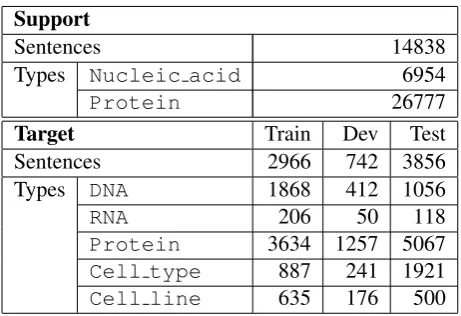
scheme from the original GENIA corpus. For to-kenization we used NLTK (Bird et al.,2009), and then broke tokens at the start and the end of the en-tity mentions. Since the task does not allow over-lap of entity mentions, we chose the shortest men-tions and discarded longer ones when menmen-tions are nested in the original corpus. We used JNLPBA dataset as the input for the target scheme. Table2 shows the statistics of the dataset.
4.2 Text Classification (TC) task
For TC, we used DBpedia ontology classification dataset created by (Zhang et al.,2015). Each sam-ple in the dataset consists of the description text and the class of a DBpedia (Lehmann et al.,2015) entry. The entries are chosen from 14 ontology classes. We use these classes as the target scheme, and defined the support scheme by integrating the categories into 5 classes. The class correspon-dence is shown in Table 3. Table 4 shows the statistics of the dataset.
4.3 Baseline Methods
We compare the following methods with the pro-posed methods CS and MTCS described in Sec-tion3.
• Target Onlytrains a model with only labeled data on the target scheme.
• Finetunemethod first trains a model with la-beled data on the support scheme. Then, the model for the target scheme is trained for an-other set of labeled data with the shared part
θRof the parameters initilaized with the value trained on the support data (Razavian et al., 2014).
• MT is the multi-task learning method de-scribed in Section2.2.
• ALL Targetrepresents training on an ideal situation that all training examples are la-beled according to the target scheme. The to-tal number of training examples of each task is the sum of the number of labeled data for the support and the target schemes.
We also initialized model parameters for MT, CS and MTCS with the Finetune method.
4.4 Models and Training Settings
For NER, we used the model similar to the one de-scribed in (Ma and Hovy,2016) with the same net-work parameters, except that we used the sum of word-level loss as in (Collobert and Weston,2008) instead of the structural loss12, mainly because of the computation time. As a result, the model is trained as a simple word-level label classification. For TC, we used a simple softmax model which is similar to fastText (Grave et al., 2017) model with the same network parameters except we use pretrained word embeddings; we use simple soft-max instead of hierarchical softsoft-max; and only bag-of-words features are used to construct input rep-resentation.
1
It is reported that its performance is competitive to the structural loss (Chiu and Nichols,2016).
2The training of CRF with multiple label candidates can
[image:5.595.71.302.216.374.2]Support scheme Target scheme
Org Company, EducationalInstitution
Artist Artist
Non-artist Athlete, OfficeHolder
Work Album, Film, WrittenWork
[image:6.595.97.502.62.161.2]Other MeanOfTransportation, Building, NaturalPlace, Village, Animal, Plant
Table 3: Class correspondence table for TC task.
Support
Sentences 500000
Types Org 70688
Artist 35419
Non artist 70544
Work 106162
Other 212187
[image:6.595.75.289.203.361.2]Target(14 classes) Train Dev Test Sentences 5000 60000 70000 Sentences / class 357.1 4285.7 5000 (ave.)
Table 4: Data statistics of TC task. We show only the average number of sentences per class for target since the data is highly balanced.
Hyperparameter NER TC
dropout rate 0.5 0.5
batch size 10 10
initial learning rate 0.1 0.075 learning rate decay 0.1 0.05 gradient clipping 0.5 0.5
λ(MT) 1.0 1.25
λ(CS) 1.0 1.0
λ(MTCS) 1.5 1.25
µ(MTCS) 0.5 0.6
Table 5: Hyperparameter settings.
For both models, all parameters except the soft-max layers on the top are shared. We implemented these models using DyNet (Neubig et al.,2017) li-brary.
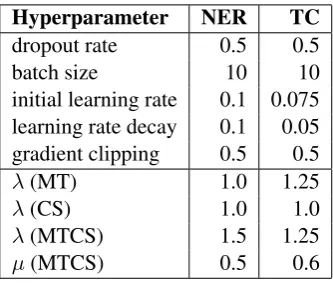
The models are trained by SGD with mini-batches as mentioned in Section3.4, and some op-timization techniques are used including dropout, learning rate decay and gradient clipping follow-ing (Ma and Hovy,2016). The result of hyperpa-rameter tuning on development data is described in Table5.
We used pretrained word embeddings from
Method NER (F1) TC (Acc.)
Target Only 66.02 93.29 Finetune 68.29 94.71
MT 68.73 94.91
CS 68.73 95.81
MTCS 69.12 95.67
[image:6.595.325.507.203.304.2]All Target 72.23 96.81
Table 6: Results for NER and TC task.
PMC open access subset (commercial use ver-sion)3 for NER and from Wikipedia dump (2010/10/11)4for TC.
4.5 Experimental Results
All of the following results are averaged over five runs.
Table6 shows the F1 scores for NER task and accuracy scores for TC task. For NER, the perfor-mance of CS is competitive to MT, but by com-bining them (MTCS) we had the improved perfor-mance. On the other hand, for TC task CS outper-forms MT in a certain degree. The effect of their combination of (MTCS) is limited on this task.
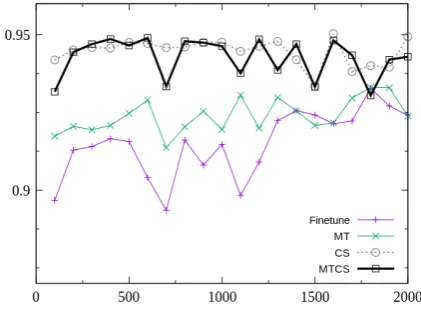
We also evaluated the effect of the class shift constraint when the amount of labeled data for the target scheme is quite small. Figure1and Figure2 show how the scores improve as the size of the la-beled data for the target scheme increases. We can see that the advantage of CS and MTCS methods are significant especially when the size of the la-beled data for the target scheme is very small.
Next, we evaluated how the models preserve
the classification performance on the classes that are tightly connected to some classes in the sup-port scheme. We first trained a model on the support scheme (support model) using the labeled data for the support scheme. Next we transfer the model for the target scheme with the labeled data
3
[image:6.595.98.265.418.562.2]Figure 1: F1 scores with different data size on target scheme for NER task.
Figure 2: Accuracy scores with different data size on target scheme for TC task.
for the target scheme using Finetune, MT, CS, or MTCS. Then, test data are labeled by both the sup-port model and the transferred model. By doing so, we can compare the classification performance of the support model and the transferred models on theunchangedclasses for these tasks, namely
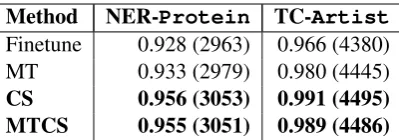
Proteinfor NER andArtistfor TC. We first check the performance of the transferred models on these classes with the small size of labeled data for the target schemes. Figure3and Figure4show the results. Compared to Finetune and MT, the performance of CS and MTCS is high even when the size of labeled data for the target scheme is very small. It suggests that the proposed methods effectively use the knowledge from support mod-els for recognizing these classes. Table 7 shows the number of examples that are correctly classi-fied by the transferred models out of those
cor-Figure 3: F1 scores with different data size on the target scheme forProteinclass in NER task.
Figure 4: Accuracy scores with different data size on the target scheme forArtistclass in TC task.
rectly classified by the support model. For NER task, the support model extracted 3193 out of 5067
Protein mentions correctly. For TC task, the support model categorized 4534 out of 5000 text withArtistlabels correctly. We can see that the proposed methods succeed to prevent performance deterioration more effectively than Finetune and MT.
5 Related Work
Improving model performance with knowledge from other models or data sources is one of the central research topics in machine learning.
[image:7.595.312.523.296.453.2] [image:7.595.80.289.297.455.2]Method NER-Protein TC-Artist Finetune 0.928 (2963) 0.966 (4380) MT 0.933 (2979) 0.980 (4445)
CS 0.956 (3053) 0.991 (4495) MTCS 0.955 (3051) 0.989 (4486)
Table 7: The proportion of performance preservation from the support model on unchanged classes. The numbers in the brackets represent the number of ex-amples correctly classified by both the support and the target models.
not the classicication scheme.
Multi-task learning approaches with nerual net-works often achieve this by sharing input repre-sentation among different tasks. The objectives of jointly learned tasks are often different and the mapping from the shared representation to the out-put for each task is learned independently (Liu et al., 2015;Hashimoto et al., 2017). Therefore, the relation between classification schemes is not directly considered.
Some studies focus on adding model capabili-ties to handle new tasks without storing all train-ing data for old tasks. The central issue is to avoid catastrophic forgetting (Li and Hoiem,2017), and several approaches have been explored ( Lopez-Paz et al., 2017; Kirkpatrick et al., 2017; Triki et al.,2017). As with standard multi-task learning, many studies in this line assume different tasks with task-specific output models. iCaRL (Rebuffi et al., 2017) assumes a different problem named class-incremental learning. A stream of new class examples is observed and the model is required at any time to perform as a multi-class classifier on the classes observed so far. However, modifying the classification scheme on observed samples is not considered in this framework.
Knowledge distillation (Hinton et al., 2015) is another topic of knowledge transfer, which can be used to simplify a large complex classification model such as ensemble model by letting a sim-ple model imitate the output distributions of the complex model instead of predicted labels. It is also used for preventing catastrophic forgetting in continual learning (Rebuffi et al.,2017;Shmelkov et al.,2017).
Learning with Hierarchy and Exclusion (HEX) graph (Deng et al., 2014) is a promising method utilizing pre-defined relationship between class la-bels. HEX graph can express exclusion and
sub-sumption relations between class labels. Despite that it is originally used for a different kind of problems (multi-class classification which allows multiple labels for an input), it is possible to solve our problem setting in this framework. In fact, we can construct a HEX graph by assigning exclusive edges to all class pairs within the same scheme and to class pairs from different schemes which do not correspond in the class correspondence table. One of the main advantages of our method is the computational cost. Inference with HEX graph is sometimes computationally prohibitive depending on the graph structure, while inference with our model is not affected by the structure of the class correspondence table. In addition, HEX graph ap-proach requires parameters of both support and target classes even at inference. Hence it is not suitable if the classification scheme can change many times.
Another related framework is semi-supervised learning, which use both labeled and unlabeled data. The approaches include use of classifiers trained with automatically generated training data from unlabeled data (Ando and Zhang,2005), use of automatically labeled data (Suzuki and Isozaki, 2008), language model (Peters et al.,2017,2018) trained from unlabeled data, and so on. In discrim-inative models, knowledge from unlabled data is often incorporated in the models as improved in-put representation or additional features. Since our method does not restrict input representation, such semi-supervised methods can be easily combined.
6 Conclusion
We have proposed a training method for the set-ting where we have only a small amount of labeled data for the target scheme, but have access to a large amount of labeled data for a related support scheme with the class correspondence table. The experimental results on a named entity recognition task and a text classification task showed that our proposed methods outperform finetune and simple multi-task learning methods.
[image:8.595.82.282.61.131.2]with different schemes, experiments on multi-support and multi-target settings, and extensions to the case where input domain of labeled data for support and target schemes are different.
References
Rie Kubota Ando and Tong Zhang. 2005. A high-performance semi-supervised learning method for text chunking. InProc. of ACL, pages 1–9.
Steven Bird, Ewan Klein, and Edward Loper. 2009.
Natural Language Processing with Python, 1st edi-tion. O’Reilly Media, Inc.
Rich Caruana. 1997. Multitask learning. Machine learning, 28(1):41–75.
Jason Chiu and Eric Nichols. 2016. Named entity recognition with bidirectional LSTM-CNNs. Trans-actions of the Association for Computational Lin-guistics, 4:357–370.
Ronan Collobert and Jason Weston. 2008. A unified architecture for natural language processing: Deep neural networks with multitask learning. InProc. of ICML, pages 160–167.
Ronan Collobert, Jason Weston, L´eon Bottou, Michael Karlen, Koray Kavukcuoglu, and Pavel Kuksa. 2011. Natural language processing (almost) from scratch. Journal of Machine Learning Research, 12(Aug):2493–2537.
Koby Crammer and Yishay Mansour. 2012. Learning multiple tasks using shared hypotheses. InProc. of NIPS, pages 1484–1492.
Wenyuan Dai, Qiang Yang, Gui-Rong Xue, and Yong Yu. 2007. Boosting for transfer learning. InProc. of ICML, pages 193–200.
Hal Daum´e III. 2007. Frustratingly easy domain adap-tation. InProc. of ACL, pages 256–263.
Jia Deng, Nan Ding, Yangqing Jia, Andrea Frome, Kevin Murphy, Samy Bengio, Yuan Li, Hartmut Neven, and Hartwig Adam. 2014. Large-scale ob-ject classification using label relation graphs. In
Proc. of ECCV, pages 48–64.
Edouard Grave, Tomas Mikolov, Armand Joulin, and Piotr Bojanowski. 2017. Bag of tricks for efficient text classification. In Proc. of EACL, pages 427– 431.
Kazuma Hashimoto, Yoshimasa Tsuruoka, Richard Socher, et al. 2017. A joint many-task model: Grow-ing a neural network for multiple nlp tasks. InProc. of EMNLP, pages 1923–1933.
Geoffrey Hinton, Oriol Vinyals, and Jeffrey Dean. 2015. Distilling the knowledge in a neural network. InNIPS Deep Learning and Representation Learn-ing Workshop.
Rong Jin and Zoubin Ghahramani. 2002. Learning with multiple labels. InProc. of NIPS, pages 921– 928.
Thorsten Joachims. 1998. Text categorization with support vector machines: Learning with many rel-evant features. InProc. of ECML, pages 137–142.
Jin-Dong Kim, Tomoko Ohta, Yuka Tateisi, and Jun’ichi Tsujii. 2003. GENIA corpus – a semanti-cally annotated corpus for bio-textmining. Bioinfor-matics, 19(Supplement 1):i180–i182.
Jin-Dong Kim, Tomoko Ohta, Yoshimasa Tsuruoka, Yuka Tateisi, and Nigel Collier. 2004. Introduction to the bio-entity recognition task at jnlpba. InProc. of JNLPBA, pages 70–75.
James Kirkpatrick, Razvan Pascanu, Neil Rabinowitz, Joel Veness, Guillaume Desjardins, Andrei A Rusu, Kieran Milan, John Quan, Tiago Ramalho, Ag-nieszka Grabska-Barwinska, et al. 2017. Overcom-ing catastrophic forgettOvercom-ing in neural networks. Proc. of the National Academy of Sciences U.S.A.
Jens Lehmann, Robert Isele, Max Jakob, Anja Jentzsch, Dimitris Kontokostas, Pablo N Mendes, Sebastian Hellmann, Mohamed Morsey, Patrick Van Kleef, S¨oren Auer, et al. 2015. DBpedia–a large-scale, multilingual knowledge base extracted from Wikipedia. Semantic Web, 6(2):167–195.
Zhizhong Li and Derek Hoiem. 2017. Learning with-out forgetting. IEEE Transactions on Pattern Anal-ysis and Machine Intelligence.
Xiaodong Liu, Jianfeng Gao, Xiaodong He, Li Deng, Kevin Duh, and Ye-Yi Wang. 2015. Representation learning using multi-task deep neural networks for semantic classification and information retrieval. In
Proc. of NAACL, pages 912–921.
David Lopez-Paz et al. 2017. Gradient episodic mem-ory for continual learning. InProc. of NIPS, pages 6467–6476.
Xuezhe Ma and Eduard Hovy. 2016. End-to-end sequence labeling via bi-directional LSTM-CNNs-CRF. InProc. of ACL, pages 1064–1074.
David Nadeau and Satoshi Sekine. 2007. A sur-vey of named entity recognition and classification.
Lingvisticae Investigationes, 30(1):3–26.
Matthew Peters, Waleed Ammar, Chandra Bhagavat-ula, and Russell Power. 2017. Semi-supervised se-quence tagging with bidirectional language models. InProc. of ACL, pages 1756–1765.
Matthew E. Peters, Mark Neumann, Mohit Iyyer, Matt Gardner, Christopher Clark, Kenton Lee, and Luke Zettlemoyer. 2018. Deep contextualized word rep-resentations. InProc. of NAACL.
Ali Sharif Razavian, Hossein Azizpour, Josephine Sul-livan, and Stefan Carlsson. 2014. CNN features off-the-shelf: An astounding baseline for recognition. InProc. of CVPR workshops, pages 806–813.
Sylvestre-Alvise Rebuffi, Alexander Kolesnikov, and Christoph H. Lampert. 2017. iCaRL: Incremental classifier and representation learning. pages 5533– 5542.
Satoshi Sekine and Hitoshi Isahara. 2000. IREX: IR & IE evaluation project in japanese. InProc. of LREC, pages 1977–1980.
Satoshi Sekine, Kiyoshi Sudo, and Chikashi Nobata. 2002. Extended named entity hierarchy. InProc. of LREC’02.
Konstantin Shmelkov, Cordelia Schmid, and Karteek Alahari. 2017. Incremental learning of object de-tectors without catastrophic forgetting. In 2017 IEEE International Conference on Computer Vision (ICCV), pages 3420–3429.
Jun Suzuki and Hideki Isozaki. 2008. Semi-supervised sequential labeling and segmentation using giga-word scale unlabeled data. InProc. of ACL, pages 665–673.
Amal Rannen Triki, Rahaf Aljundi, Matthew B. Blaschko, and Tinne Tuytelaars. 2017. Encoder based lifelong learning. Proc. of ICCV, pages 1329– 1337.
Yuta Tsuboi, Hisashi Kashima, Shinsuke Mori, Hiroki Oda, and Yuji Matsumoto. 2008. Training condi-tional random fields using incomplete annotations. InProc. of COLING, pages 897–904.