Proceedings of the 23rd Conference on Computational Natural Language Learning, pages 260–270 260
Improving Neural Machine Translation by Achieving Knowledge Transfer
with Sentence Alignment Learning
Xuewen Shi1,2, Heyan Huang1,2, Wenguan Wang1,3, Ping Jian1,2∗, Yi-Kun Tang1,2
1School of Computer Science and Technology, Beijing Institute of Technology, Beijing, China 2Beijing Engineering Research Center of High Volume Language Information Processing
and Cloud Computing Applications
3Inception Institute of Artificial Intelligence, UAE
{xwshi, hhy63, wenguanwang, pjian, tangyk}@bit.edu.cn
Abstract
Neural Machine Translation (NMT) optimized by Maximum Likelihood Estimation (MLE) lacks the guarantee of translation adequacy. To alleviate this problem, we propose an NMT approach that heightens the adequacy in ma-chine translation by transferring the seman-tic knowledge learned from bilingual sentence alignment. Specifically, we first design a discriminator that learns to estimate sentence aligning score over translation candidates, and then the learned semantic knowledge is trans-fered to the NMT model under an adversarial learning framework. We also propose a gated self-attention based encoder for sentence em-bedding. Furthermore, anN-pair training loss is introduced in our framework to aid the dis-criminator in better capturing lexical evidence in translation candidates. Experimental results show that our proposed method outperforms baseline NMT models on Chinese-to-English and English-to-German translation tasks. Fur-ther analysis also indicates the detailed seman-tic knowledge transfered from the discrimina-tor to the NMT model.
1 Introduction
Recently, with the renaissance of deep learn-ing, end-to-end Neural Machine Translation (NMT) (Kalchbrenner and Blunsom, 2013; Cho et al., 2014a; Sutskever et al., 2014; Bahdanau et al., 2014) has gained remarkable perfor-mance (Wu et al., 2016; Gehring et al., 2017;
Vaswani et al., 2017). Early NMT solutions are typically optimized to maximize the likelihood es-timation (MLE) of each word in the ground truth translations during the training procedure. How-ever, such an objective cannot guarantee the suffi-ciency of the generated translations in the NMT model, due to the lack of quantitative
measure-∗
Corresponding author: Ping Jian
yi zhi xiao mao pa zai cao shang
a little cat lays on grass pitch
a small cat lays on a straw mat Source
NMT1 NMT2
[image:1.595.309.524.222.290.2]dian
Figure 1: Comparison between two Chinese-to-English translation examples of two independent NMT systems.Lines between Source and NMTs rep-resent model generated alignments (each source word cannot be covered more than once). Words in boxes are key words and red dotted dashed boxes indicate in-correct translations. Based on the model generated at-tention weights, NMT2 covers more source words than NMT1, which is opposite to human judgments.
ment for the information transformational com-pleteness from the source side to the target side.
Some existing work alleviates this problem by directly incorporating coverage or fertility mech-anisms to an NMT model (Tu et al., 2016; Feng et al.,2016;Kong et al.,2019). However, the prob-lem is that attention weights based coverage calcu-lation for NMT is insensitive and sometimes even inaccurate to translation errors. Furthermore, it is unreasonable to consider the coverage of all kinds of source words equally, since various words con-tribute differently to sentences in semantics and syntax. For example, as illustrated in Fig.1, trans-lation errors are recorded as positive examples, and the alignments between function words also dilute the impact of key words alignments.
In this paper, we address the problem of inade-quate translation by introducing a novel sentence alignment constrain under an adversarial training framework (Goodfellow et al., 2014; Lu et al.,
alignment pairs (Ma, 2006) at a sentence repre-sentation level; and ii) a standard NMT model G
aims to produce an appropriate translation with the highest ranking score (assigned byD) in the can-didate list. To better capture the semantic align-ment evidence of the input data, we also propose a novel gated self-attention based encoder for bilin-gual sentences encoding in discriminatorD. Then, anN-pair training loss (Sohn,2016) is introduced to select appropriate translation results from the candidates. We also leverage Gumbel-Softmax (GS) (Jang et al., 2017; Kusner and Hern´andez-Lobato, 2016) approximation for G to solve the problem of discrete samples, making the response fromDtoGdifferentiable.
To sum up, the proposed approach has the fol-lowing advantages:
• We apply a novel end-to-end NMT adver-sarial training framework that heightens ad-equacy in translation. Under the framework, an NMT model is encouraged to generate translations that match semantic knowledge learned by a discriminator for sentence align-ing, which can be viewed as an instance of “knowledge transfer”.
• Benefited from the gated self-attention mech-anism, the proposed encoder learns to focus on important lexical evidence for sentence aligning and enhance the contribution of the key words. This knowledge will be transfered toGthrough the proposed framework.
• The N-pair loss (Sohn, 2016; Lu et al.,
2017) encourages samples closed to the gold-standard one to get higher score. Unlike a bi-nary classification used in previous work (Yu et al., 2017; Yang et al., 2018; Wu et al.,
2018), translations that are correct but dif-ferent from the ground-truth ones will not be over penalized.
We use one of the state-of-the-art NMT models, Transformer (Vaswani et al.,2017), as the baseline model architecture and conduct experiments on Chinese-to-English and German-to-English trans-lation tasks. Experimental results show that our proposed approach achieves significant improve-ments on both language pairs. We also evalu-ate the performance of the discriminator on both sentence alignment and translation candidate re-ranking tasks, which proves its independence and
transferability. Further analyses show the specific alignment-oriented knowledge that the discrimi-nator transfers to the NMT model.
2 Related Work
Most of the state-of-the-art NMT models are opti-mized by MLE-based objectives (Wu et al.,2016;
Gehring et al., 2017; Vaswani et al., 2017), but likelihood fails to measure whether the source in-formation is completely transformed to the target side. Thus, it cannot handle translation adequacy problem (Tu et al.,2017).
One way to alleviate these problems is to apply coverage and fertility to NMT model. Feng et al.
(2016) aim at controlling the fertilities of source words by appending additional additive terms to train objectives. Tu et al.(2016) employ coverage vector or coverage ratio as a lexical-level indicator to represent whether a source word is translated or not.
On the other hand, some recent efforts introduce additional source side constraints and explore du-ality properties of NMT (He et al.,2016; Cheng et al., 2016; Xia et al., 2017; Tu et al., 2017).
Cheng et al.(2016) present a semi-supervised ap-proach to train bidirectional NMT models and re-construct the monolingual corpora using an auto-encoder (Socher et al.,2011).Tu et al.(2017) add a re-constructor to traditional NMT model, which introduces an auxiliary score to measure the ad-equacy of translation. Dual learning (He et al.,
2016) and dual supervised learning (Xia et al.,
2017) are also proposed to exploit the probabilis-tic correlation between dual tasks to regularize the training process. These previous approaches apply a reconstruction reward by comparing the source input and the reconstructed sentence, while we use alignment score directly to model the discrepancy between the source and the translation.
those approaches rarely take account of transla-tion adequacy. Furthermore, the discriminators of those work refer the target sentence in the corpus as the single gold-standard regardless the quality of model generated translations, which will pun-ish too much to the good model generated trans-lations. Kong et al.(2019) propose an adequacy-oriented discriminator which is trained to estimate the Coverage Difference Ratio (CDR) given the source and the generated translation. However, CDRis unable to distinguish translation errors and it also neglects the importance of diversity be-tween different words (as the examples shown in Fig.1).
Unlike the discriminators in (Wu et al., 2018;
Yang et al., 2018; Kong et al., 2019), our alignment-oriented discriminator learns a specific function to measure alignment score between source and target sentences, which is trained to-tally independently by the NMT generator. The proposed discriminator assigns different weights to words and is sensitive to translation errors. We also apply N-pair loss for training D to ensure that D will not punish the translations closed to the gold-standard overly.
3 Approach
In this section, we describe our approach that can transfer knowledge from a sentence alignment ori-ented discriminatorDto an NMT modelG. Our approach mainly consists of two sub-models: i) a discriminatorDlearns to estimate the alignment score and sort the translation candidates, and ii) an NMT modelGaims to generate translations with higher score assigned byD. A sketch of the pro-posed training framework is shown in Fig.2: for each sentence pair(X,Y)sampled from the train-ing corpus, the NMT modelG generates a trans-lationYˆ givenX, and queries the discriminatorD
with Yˆ to get feedback and update itself. In or-der to obtain more stable training, we also lever-age a teacher-forcing (Li et al., 2017) step to our approach.
3.1 NMT Generator
In this paper, we take the Transformer (Vaswani et al., 2017), one of the popular state-of-the-art NMT models, as the specific implementation of the NMT model G. This helps to better illus-trate the effectiveness of the proposed method. The Transformer in this paper follows the
con-1: Pre-train a generatorG (see section3.1) and a discriminatorD(see section3.2), individu-ally.
2: fornumber of training iterationsdo 3: Sample(X,Y+)from training corpus
4: SampleYˆ∼G(X)with a Gumbel-Softmax sampler (see section3.4)
5: Compute lossLG for(X,Y)ˆ using D(see section3.3)
6: UpdateGwith the learning rateη:
θG←θG−η5θGLG (1)
7: Teacher-Forcing: update G on (X,Y+)
(see section3.5)
8: end for
Figure 2: A brief overview of the proposed training framework. See section3for more details.
ventional encoder-decoder framework (Cho et al.,
2014b). Specifically, the encoder contains a stack of six identical layers. Each layer is consist of two sub-layers: i) a multi-head self-attention mecha-nism, and ii) a position-wise fully connected feed-forward network. A residual connection is applied around each of the two sub-layers, followed by layer normalization (Ba et al.,2016). The decoder is also composed of a stack of six identical lay-ers. Besides the two sub-layers stated above, a third sub-layer is inserted in each layer that per-forms multi-head attention over the output of the encoder.
Following the base model setups of the Trans-former (Vaswani et al., 2017), we use 8 atten-tion heads, 512-dimensional output vectors for each layer, and 2048-dimensional inner-layer of the feed-forward network.
3.2 Discriminator
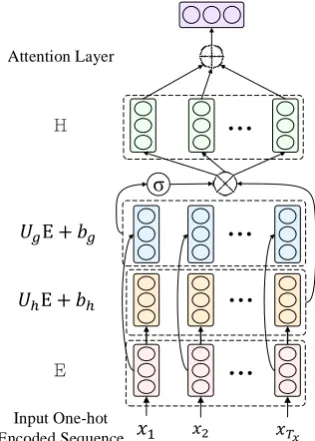
For the discriminator D, we propose a gated self-attention based sentence encoder to perform source and target sentence encoding, and then cal-culate the alignment score using the encodings pair.
impor-Input One-hot Encoded Sequence
Attention Layer
σ
...
...
...
...
[image:4.595.102.260.62.283.2]
Figure 3: Model architecture of the gated self-attention sentence encoder. See section3.2for more details.
tant lexical evidences to estimate the alignment score between two sentences.
Given a one-hot encoded input sequenceXand a word embedding lookup table D ∈ R|V|×d, where d is the model dimension. The input X
will be represented as a corresponding word em-bedding matrix E ∈ RTx×d. We apply a gating
mechanism (Dauphin et al.,2017) to compute the hidden layerH:
H = (UhE +bh)⊗σ(UgE +bg), (2)
whereUh andUg ∈ Rd×d, σ(·)is a logistic
sig-moid function and⊗is element-wise product be-tween matrices. Then the self-attention weightsW
is computed as:
W = softmax(tanh(UaH)), (3)
whereUa ∈ Rd×d. The output of the gated
self-attention encoder is formulated as:
e=Uo(W×H) +bo, (4)
where e ∈ Rd, and U
o ∈ Rd×d. We add layer
normalization (Ba et al.,2016) to the output layer. The model dimensiondis set to 512.
Alignment Score and Discriminator Loss.With the source and target sentence encodings ex and
ey, the alignment score s(X,Y) can be computed as:
s(X,Y) =e>xey. (5)
Given the candidate target sentences list Y, the discriminator produces a distribution over Y and aims to maximize the log-likelihood of the gold-standard alignment sentenceY+. Since sentence-level alignments in automatic extracted corpora are usually not very precise, we expect the loss function for training D not to be too strict with candidates that are closed to the gold-standard one. Therefore, following Lu et al. (2017), we apply a metric-learning multi-class N-pair loss (Sohn,2016) to our model, which can be de-fined as:
LD =LN−pair({X,Y+,{Y−n}Nn=1−1})
= log(1 + N X
n=1
exp(s(X,Y−
n)−s(X,Y+))),
(6)
where Y+ is alignment target sentence to the source language X, and Yn− is one of the N−1
unaligned samples.
Compared to cross entropy loss used in previous work (Yu et al.,2017;Yang et al.,2018;Wu et al.,
2018), theN-pair objective encourages the score of target sentences which are similar to the given golden-standard one to be higher than the dissim-ilar ones. In this way, translations that are correct but different from the ground truth will not be over penalized, and thus this can be useful to provide a reliable signal for the generator.
In later sections, we will analyze the semantic information learned by the model through some visualization examples, shown in section5.1, and the experimental results show that it achieves suf-ficient accuracy for scoring the alignment between source and target sentences.
3.3 Discriminative Losses for Generative Training
In our framework, G aims to generate a transla-tion score higher than the golden-standard, under the premise of encoders and the scoring function learned byD. Specifically, for each sentence pairs
(X,Y+)in training sets, first, Gsamples transla-tion Yˆ given X with greedy searching. Second,
D takes Yˆ as well as(X,Y+) as inputs to com-pute alignment scores, and thenGgets the feed-back from D. Eq. (7) gives the perceptual loss thatGaims to optimize.
LG=L1−pair({X,Y+,Yˆ})
= log(1 + exp(s(X,Y+)−s(X,Y)ˆ )).
Intuitively, updating generator parameters to minimizeLGcan be interpreted as learning to pro-duce a translationYˆ that “fools” the discriminator into believing that this answer should score higher than the human responseY+under theD’s scor-ing function.
3.4 Gumbel-Softmax Sampler
The process of sampling a translationYˆ withGis not differentiable, since it includesargmax(·) op-erator to perform one-hot encoding. We leverage the Gumbel-softmax (Jang et al.,2017) sampler to solve this problem. Formally, at the decoding step
j, suppose thatpj ∈RVy contains the model
out-put log-probabilities over target vocabulary, and
gj ∈ RVy includes i.i.d samples drawn from the
standard distributionGumbel(0,1). A sampleyj is transformed as:
ˆ
yj = softmax((pj+gj)/τ), (8)
where τ is a temperature parameter and is set to 0.5 in our experiments.
3.5 Teacher-forcing Step
SinceLGin Eq. (7) mainly considers the discrep-ancy of alignment and integrity between the model output and the ground-truth, it rarely inspects grammar correctness and language fluency. To al-leviate this problem, following (Li et al.,2017;Lu et al.,2017), we adopt the similar teacher-forcing step to our training process.
We perform two different teacher-forcing ob-jectives for comparison: i) a likelihood objective
OLMand ii) a BLEU score reward (RBLEU), un-der the training strategies of MLE and MRT (Shen et al.,2016), respectively.
4 Experiments
4.1 Datasets and Setups1
We evaluate the proposed approach on Chinese-to-English (Zh-En) and Chinese-to-English-to-German (En-De) translation tasks. For both of the two translation tasks, we tokenize all corpora with the Moses to-kenizer2. Sentences longer than 100 words are discarded, and all the sentences are encoded with byte-pair encoding (bpe) (Sennrich et al.,2016).
1The demo data and source codes will be
re-leased online athttps://github.com/PolarLion/ Sentence-Alignment-Learning
2https://github.com/moses-smt/ mosesdecoder/blob/master/scripts/ tokenizer/tokenizer.perl
Chinese-to-English. For Chinese-to-English translation, our training data are extracted from four LDC corpora3. The training set contains to-tally 1.3M parallel sentence pairs. For prepro-cessing, the Chinese part for both training and testing sets is segmented by the LTP Chinese word segmentor (Che et al.,2010) before applying bpe (Sennrich et al.,2016) to the corpus. We get a Chinese vocabulary of about 39K tokens, and an English vocabulary of about 30K tokens. We use NIST2005 dataset for validation and NIST2002, NIST2003, and NIST2004 datasets for testing. In the following parts of the paper, the Chinese exam-ples are presented by segmented italic romanized form, and different Chinese characters are delim-ited by single quotation marks.
English-to-German. For English-to-German translation, we conduct experiments on the pub-licly available corpora WMT’14 En-De. The train-ing set of En-De task totally contains 4.5M sen-tence pairs, and we use a shared source-target vocabulary of about 39K tokens. We use new-stest2013 as the validation set and report the re-sults on newstest2014.
Discriminative Corpus Construction. Differ-ent from parallel sDiffer-entence pairs for training gen-erative models, the corpus for training D needs to provide a candidate translations list for each source sentence. Therefore, we need to manually construct the corpus for trainingDusing the orig-inal parallel corpus. For each source sentence, we set the size of candidate list to 100. The trans-lation candidates are preferentially obtained from the context of the golden standard translation in the comparable paragraph. If the context sentence numberNcis less than 99, we will randomly sam-ple another99−Ncsentences from the whole rest target corpus. As for the data format, we follow most ofDas et al.(2019).
Evaluation. As for generative models, follow-ingVaswani et al.(2017), we report the result of a single model obtained by averaging the 5 check-points around the best model selected on the velopment set. We apply beam search during de-coding with the beam size of 6. The transla-tion results in this paper are measured in case-insensitive BLEU (Papineni et al., 2002) by the
3LDC2005T10, LDC2003E14, LDC2004T08 and
multi-bleu.perl script4. For the discriminator, the performance is evaluated on recall@k and mean rank score.
4.2 Training Details
Pre-train discriminator and NMT model. Dur-ing the trainDur-ing procedure, we first pre-train the discriminator and the generator separately for a warm start. We pre-train the model until the per-formance of D and G on development set dose not improve. For training discriminator on all lan-guage pairs, we use the Adam optimizer withβ1 =
0.8, β2 = 0.99 and a base learning rate of 4 ×
10−4. The mini-batch size is 100 and the dropout rate is set to 0.1. As for the NMT model, we fol-low the base model of Transformer (Vaswani et al.,
2017) for most of training setups, except the label smoothing (Szegedy et al.,2016).
Frozen discriminator v.s. adversarial dis-criminator. We also study the effects of two training setups of the discriminator: updating D
(adversarial D) or not (frozenD) with the NMT model. When we perform frozen D, the NMT model is learned with a combination discrimina-tive perceptual loss (Lu et al.,2017) and teacher-forcing loss (Li et al.,2017;Lu et al.,2017). Each mini-batch contains 30 sentence pairs due to the limitation of memory size of a single GPU. For the adversarial discriminator, We alternately update
G and D under the adversarial learning frame-work (Yang et al., 2018; Wu et al., 2018; Kong et al.,2019). An adversarialDis to maximize the score of the human translationY+ and minimize the score of the generated translationYˆ. Then the training loss for adversarialDcan be represented as:LD =−LG.
4.3 Machine Translation Results
We report the experimental results on machine translation in this section. Table 1 shows the BLEU scores of Zh-En and En-De translation tasks. Our approach achieves an improvement up to +0.76 BLEU points averagely on Zh-En ing sets and +0.64 BLEU points on En-De test-ing set. It should be noted that we do not ap-ply label smoothing (Szegedy et al.,2016) due to using Gumbel-Softmax approximation, which re-sults in a decline in En-De translation performance
4https://github.com/moses-smt/ mosesdecoder/blob/master/scripts/ generic/multi-bleu.perl
compared to the reported result of BLEU 27.3 in
Vaswani et al.(2017).
We compare two setups of frozenD(Row 3-4) and adversarial D (Row 5-6) for the discrimina-tor. Experimental results show that continuing to updateDalong withGgains best BLEU score for the both translation tasks. It means that fine-tuning
Dwith the model generated data can further im-prove training quality. We also evaluate two dif-ferent training objectives for the teacher-forcing step (Row 3,5 vs Row 4,6) and Row 2 is another baseline for training only on RBLEU (similar to MRT (Shen et al., 2016)). We can see from the results that applying MLE or BLEU reward does not make much difference. These results indicate that the proposed method makes up for the short-comings of MLE training.
4.4 Discriminative Results
The format of the test datasets for discriminator is similar to the training set described in section4.1, where each input corresponds to one hundred can-didate translations extracted from the document context. The goal of the discriminator is to rank the correct translation as high as possible. We present recall@k and mean rank of the discrimi-nator on Zh-En and En-De test sets in Table2. It shows that for all test sets of both language pairs, our proposed discriminator performs steadily at high recall rate of more than 96% on recall@1 and nearly 100% on recall@5 and recall@10. Both of the high recall@k and ranking mean closed to 1 indicate that the ground-truth translations are al-ways assigned to high alignment score.
Empirical and principled studies indicate that high initial accuracy of binary classification based discriminator may lead to worse model perfor-mance for GANs (Salimans et al.,2016;Arjovsky and Bottou, 2017;Yang et al.,2018). In this pa-per,Gis trained with a specific 1-pair loss defined on sentence alignment score, instead of Jensen-Shannon divergence (Arjovsky and Bottou,2017;
Arjovsky et al.,2017) between two data distribu-tions, which could avoid the vanishing gradient problem in GANs. Therefore, the high accuracy of the proposed discriminator would not make nega-tive impact onG.
5 Analysis
ex-# Model Zh-En En-De NIST2002 NIST2003 NIST2004 Average newstest2014 1 Transformer 41.56 39.95 42.05 41.19 26.52 2 +RBLEU 42.30 40.47 42.46 41.74 26.73 3 + frozenD+OLM 42.51 40.74 42.42 41.89 27.10 4 + frozenD+RBLEU 41.63 40.06 42.16 41.28 26.77 5 + adversarialD+OLM 42.67 40.67 42.51 41.95 27.16 6 + adversarialD+RBLEU 42.75 40.28 42.67 41.90 27.05
Table 1:BLEU scores on Zh-En and En-De translation task. Transformer is the baseline model. “Average” is the averaged BLEU scores on testing sets. FollowingVaswani et al.(2017), we report the result of a single model obtained by averaging the 5 checkpoints around the best model selected on the development set. See section4.3 for more details.
Testset R@1 R@5 R@10 Mean NIST2002 97.04 99.77 99.89 1.06 NIST2003 97.50 99.34 99.67 1.10 NIST2004 97.25 99.94 99.94 1.05 newstest2014 96.60 99.43 99.73 1.12
Table 2: Discriminator performance on Zh-En and En-De test sets. R@kand Mean are abbreviations for recall@kscore and mean rank score, respectively. See section4.4for more details.
perimental results. We also give a specific transla-tion example to illustrate how knowledge transfer-ring improves NMT performance.
5.1 What kind of Knowledge DoesD Transfer toG?
In this paper, we propose a discriminator that di-rectly learns to measure alignment and then trans-fers the learned knowledge to an NMT model.
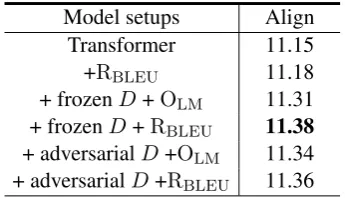
D is designed to capture lexical evidence for sentence alignment by learning a self-attention encoder. We give averaged sentence alignment scores between translations and source inputs on different model setups in Table 3. Those align-ment scores are estimated by a pre-trainedD. Ta-ble3shows that the output alignment scores of the proposed approaches are all higher than the base-line methods, which illustrates thatGcan learn the knowledge on measuring alignment fromDunder the proposed training frameworks.
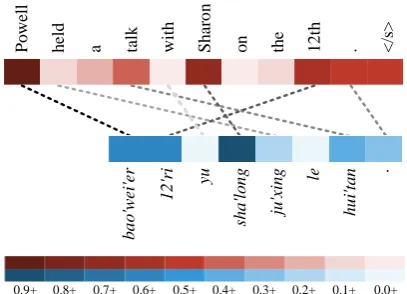
In order to illustrate the lexical-level knowledge learned byD, we give a visual example in Fig.4. It shows self-attention weights of the encoders for the given source and the target sentence. In the example, the source sentence is “bao’wei’er 12’ri
yu sha’long ju’xing le hui’tan” and the target
sen-tence is “Powell hold a talk with Sharon on the
Model setups Align Transformer 11.15 +RBLEU 11.18 + frozenD+OLM 11.31 + frozenD+RBLEU 11.38 + adversarialD+OLM 11.34 + adversarialD+RBLEU 11.36
Table 3:Averaged sentence alignment scores on Zh-En NIST2002∼2004 test sets. “Align” means the av-eraged sentence alignment score estimated byD. The higher score represents the better alignment quality in
D’s view. See section5.1for more details.
12th .” We notice that the source language words
“bao’wei’er”, “12’ri” and “sha’long”, and their
corresponding target language words “Powell”, “12th” and “Sharon” are assigned higher atttion weights than others. This means that the en-coders regard those words as important lexical ev-idences for estimating the alignment score. Those self-learned attention weights share the same spirit with the weighted translation pairs in Champol-lion (Ma, 2006). During the training process, G
leans to treat those important words carefully and avoid missing them to get higher score with the judgment ofD. This process can be considered as transferring the semantic knowledge leaned byD
toG.
5.2 Can discriminator distinguish good and bad translation results?
[image:7.595.330.503.250.349.2]Po
well
h
eld a talk with Shar
o
n
on the 12
th
. </s
>
b
a
o
'w
ei
'er
12
'ri yu
sh
a
'lo
n
g
ju
'xin
g le
h
u
i'
ta
n .
[image:8.595.79.283.63.210.2]0.9+ 0.8+ 0.7+ 0.6+ 0.5+ 0.4+ 0.3+ 0.2+ 0.1+ 0.0+
Figure 4: Example of the self-attention weights for the source (lower) and the target (upper) language encoders. Sentences in the example are selected from NIST2002 Zh-En test set. All weights in this exam-ple are scaled by Min-Max scaling method for better visualization and darker colors represent higher atten-tion weights. Aligned words are manually connected by dashed lines. See section5.1for more details.
we conduct further experiments on translation re-ranking task on the baseline Transformer (Vaswani et al., 2017) model on Zh-En translation. More-over, in order to obtain more translation candi-dates, we expand the beam size to 24 and then re-order theN-best translation candidates by D. Experimental results are shown in Table 4. We can observe that the larger beam search size leads to the worse performance, since the likelihood score for decoding tends to score short transla-tions higher than long sentences. Larger search-ing space also brsearch-ings more good translation can-didates, andDre-orders them by alignment score and gains better BLEU scores than most baseline setups as shown in Table 4. The above observa-tion indicates that Dcan successfully handle the unseen data generated by NMT models. Previous work (Wu et al.,2016;Koehn and Knowles,2017) introduces length normalization to solve the above beam search decoding problem, whose results are also presented in Table4for a fair comparison.
5.3 Example Translations
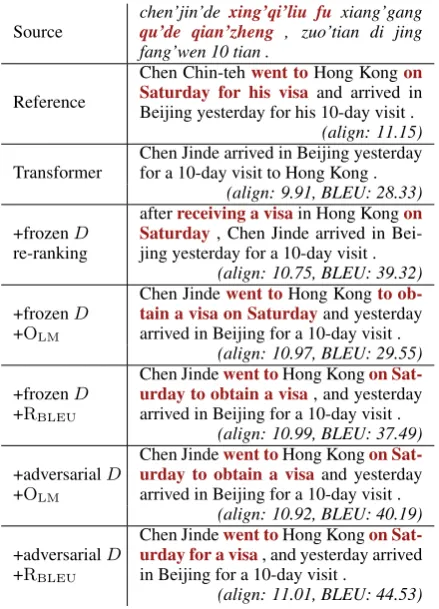
We provide example translations on Zh-En trans-lation task in Fig.5. From Fig.5, we can see that though the translation results of the baseline model is correct in syntax, its logic is wrong on account of missing an important source information of “went to Hong Kong on Saturday for a visa”. All the translations generated by our proposed method do not make this mistake, since it is learned and
[image:8.595.312.523.63.134.2]Setups NIST02 NIST03 NIST04 beam 6 41.56 39.95 42.05 beam 24 40.72 38.64 41.13 +length penalty 41.93 40.26 42.49 +re-ranking 42.22 40.20 42.56
Table 4: BLEU scores on Zh-En translation re-ranking task. The “beamN” represents the decoding beam search size. The “+length penalty” means using length normalization (Wu et al.,2016) when perform-ing beam search. The “+re-rankperform-ing” represents that the translation candidates are re-ranked by D. See sec-tion5.2for more details.
transfered from the discriminator where the verb “went”, nouns ‘Saturday’ and “visa” are important lexical evidence for estimating alignment score. We also show a translation re-ranking example, which gains a similar result to other proposed methods. An alignment score evaluated by the dis-criminator and a sentence-level BLEU5 (Papineni et al.,2002) score are also shown under the corre-sponding translations. Both the golden reference and the model generated translations gain higher alignment score fromD, which illustrates the ra-tionality of discriminator design.
6 Conclusion
In this work, we propose a novel training frame-work which achieves sentence alignment oriented knowledge transfer to improve the NMT. We de-sign a discriminator to measure sentence align-ment by mainly considering lexical evidence via a gated self-attention mechanism. Then, a dis-criminative loss as well as a teacher-forcing ob-jective is used to make NMT model generate suf-ficient and fluent translations during training pro-cedure. Experimental results on different lan-guage pairs show that our proposed approach out-performs standard NMT models. Further analy-sis indicates the proposed discriminator well cap-tures the weighted lexical relationships among sentences and successfully transfers the knowl-edge to the NMT model.
In the future, we would like to make dis-criminator learn more semantic related knowledge like dependency, and combine our approach with other advanced techniques in reinforcement learn-ing and adversarial learnlearn-ing (Yu et al.,2017;Yang et al.,2018;Kong et al.,2019).
5Evaluated by Moses (Koehn et al.,2007) sentence-bleu
Source
chen’jin’de xing’qi’liu fu xiang’gang
qu’de qian’zheng , zuo’tian di jing fang’wen 10 tian .
Reference
Chen Chin-tehwent toHong Kongon Saturday for his visa and arrived in Beijing yesterday for his 10-day visit .
(align: 11.15)
Transformer
Chen Jinde arrived in Beijing yesterday for a 10-day visit to Hong Kong .
(align: 9.91, BLEU: 28.33)
+frozenD re-ranking
afterreceiving a visain Hong Kongon Saturday, Chen Jinde arrived in Bei-jing yesterday for a 10-day visit .
(align: 10.75, BLEU: 39.32)
+frozenD +OLM
Chen Jindewent toHong Kongto ob-tain a visa on Saturdayand yesterday arrived in Beijing for a 10-day visit .
(align: 10.97, BLEU: 29.55)
+frozenD +RBLEU
Chen Jindewent toHong Kongon Sat-urday to obtain a visa, and yesterday arrived in Beijing for a 10-day visit .
(align: 10.99, BLEU: 37.49)
+adversarialD +OLM
Chen Jindewent toHong Kongon Sat-urday to obtain a visaand yesterday arrived in Beijing for a 10-day visit .
(align: 10.92, BLEU: 40.19)
+adversarialD +RBLEU
Chen Jindewent toHong Kongon Sat-urday for a visa, and yesterday arrived in Beijing for a 10-day visit .
[image:9.595.72.292.61.366.2](align: 11.01, BLEU: 44.53)
Figure 5:Example translations on the Zh-En trans-lation task. The example is selected from the NIST2002 testing set. “Source” and “Reference” are the source input and one of the four given references.
Words in red bold fonts represent the missing part of the translation generated by the baseline model. A alignment score (align) and a sentence-level BLEU are given below the target sentence. See section 5.3for more details.
Acknowledgments
We thank all anonymous reviewers for their valu-able comments. This work was supported by the National Key Research and Development Pro-gram of China (Grant No. 2017YFB1002103) and the National Natural Science Foundation of China (No. 61732005).
References
Mart´ın Arjovsky and L´eon Bottou. 2017. Towards principled methods for training generative
adver-sarial networks. In 5th International Conference
on Learning Representations, ICLR 2017, Toulon, France, April 24-26, 2017, Conference Track Pro-ceedings.
Mart´ın Arjovsky, Soumith Chintala, and L´eon Bottou. 2017.Wasserstein GAN. CoRR, abs/1701.07875.
Lei Jimmy Ba, Ryan Kiros, and Geoffrey E. Hinton. 2016.Layer normalization.CoRR, abs/1607.06450. Dzmitry Bahdanau, Kyunghyun Cho, and Yoshua Bengio. 2014. Neural machine translation by
jointly learning to align and translate. CoRR,
abs/1409.0473.
Wanxiang Che, Zhenghua Li, and Ting Liu. 2010.LTP:
A chinese language technology platform. In
COL-ING 2010, 23rd International Conference on Com-putational Linguistics, Demonstrations Volume, 23-27 August 2010, Beijing, China, pages 13–16.
Yong Cheng, Wei Xu, Zhongjun He, Wei He, Hua Wu, Maosong Sun, and Yang Liu. 2016. Semi-supervised learning for neural machine translation. InProceedings of the 54th Annual Meeting of the As-sociation for Computational Linguistics, ACL 2016, August 7-12, 2016, Berlin, Germany, Volume 1: Long Papers.
Kyunghyun Cho, Bart van Merrienboer, Dzmitry Bah-danau, and Yoshua Bengio. 2014a. On the proper-ties of neural machine translation: Encoder-decoder
approaches. In Proceedings of SSST@EMNLP
2014, Eighth Workshop on Syntax, Semantics and Structure in Statistical Translation, Doha, Qatar, 25 October 2014, pages 103–111.
Kyunghyun Cho, Bart van Merrienboer, C¸ aglar G¨ulc¸ehre, Dzmitry Bahdanau, Fethi Bougares, Hol-ger Schwenk, and Yoshua Bengio. 2014b. Learning phrase representations using RNN encoder-decoder
for statistical machine translation. InProceedings of
the 2014 Conference on Empirical Methods in Nat-ural Language Processing, EMNLP 2014, October 25-29, 2014, Doha, Qatar, A meeting of SIGDAT, a Special Interest Group of the ACL, pages 1724– 1734.
Abhishek Das, Satwik Kottur, Khushi Gupta, Avi Singh, Deshraj Yadav, Stefan Lee, Jos´e M. F. Moura, Devi Parikh, and Dhruv Batra. 2019. Visual
di-alog. IEEE Trans. Pattern Anal. Mach. Intell.,
41(5):1242–1256.
Yann N. Dauphin, Angela Fan, Michael Auli, and David Grangier. 2017. Language modeling with
gated convolutional networks. InProceedings of the
34th International Conference on Machine Learn-ing, ICML 2017, Sydney, NSW, Australia, 6-11 Au-gust 2017, pages 933–941.
Shi Feng, Shujie Liu, Nan Yang, Mu Li, Ming Zhou, and Kenny Q. Zhu. 2016.Improving attention mod-eling with implicit distortion and fertility for
ma-chine translation. In COLING 2016, 26th
Inter-national Conference on Computational Linguistics, Proceedings of the Conference: Technical Papers, December 11-16, 2016, Osaka, Japan, pages 3082– 3092.
Jonas Gehring, Michael Auli, David Grangier, De-nis Yarats, and Yann N. Dauphin. 2017.
Convo-lutional sequence to sequence learning. In
Machine Learning, ICML 2017, Sydney, NSW, Aus-tralia, 6-11 August 2017, pages 1243–1252.
Ian J. Goodfellow, Jean Pouget-Abadie, Mehdi Mirza, Bing Xu, David Warde-Farley, Sherjil Ozair, Aaron C. Courville, and Yoshua Bengio. 2014.
Gen-erative adversarial networks.CoRR, abs/1406.2661.
Di He, Yingce Xia, Tao Qin, Liwei Wang, Nenghai Yu, Tie-Yan Liu, and Wei-Ying Ma. 2016. Dual
learning for machine translation. In Advances in
Neural Information Processing Systems 29: Annual Conference on Neural Information Processing Sys-tems 2016, December 5-10, 2016, Barcelona, Spain, pages 820–828.
Eric Jang, Shixiang Gu, and Ben Poole. 2017. Cate-gorical reparameterization with gumbel-softmax. In 5th International Conference on Learning Represen-tations, ICLR 2017, Toulon, France, April 24-26, 2017, Conference Track Proceedings.
Nal Kalchbrenner and Phil Blunsom. 2013. Recurrent
continuous translation models. In Proceedings of
the 2013 Conference on Empirical Methods in Natu-ral Language Processing, EMNLP 2013, 18-21 Oc-tober 2013, Grand Hyatt Seattle, Seattle, Washing-ton, USA, A meeting of SIGDAT, a Special Interest Group of the ACL, pages 1700–1709.
Philipp Koehn, Hieu Hoang, Alexandra Birch, Chris Callison-Burch, Marcello Federico, Nicola Bertoldi, Brooke Cowan, Wade Shen, Christine Moran, Richard Zens, Chris Dyer, Ondrej Bojar, Alexandra Constantin, and Evan Herbst. 2007. Moses: Open source toolkit for statistical machine translation. In ACL 2007, Proceedings of the 45th Annual Meet-ing of the Association for Computational LMeet-inguis- Linguis-tics, June 23-30, 2007, Prague, Czech Republic.
Philipp Koehn and Rebecca Knowles. 2017. Six
chal-lenges for neural machine translation. In
Pro-ceedings of the First Workshop on Neural Machine Translation, NMT@ACL 2017, Vancouver, Canada, August 4, 2017, pages 28–39.
Xiang Kong, Zhaopeng Tu, Shuming Shi, Eduard H. Hovy, and Tong Zhang. 2019. Neural machine
translation with adequacy-oriented learning. InThe
Thirty-Third AAAI Conference on Artificial Intelli-gence, AAAI 2019, The Thirty-First Innovative Ap-plications of Artificial Intelligence Conference, IAAI 2019, The Ninth AAAI Symposium on Educational Advances in Artificial Intelligence, EAAI 2019, Hon-olulu, Hawaii, USA, January 27 - February 1, 2019., pages 6618–6625.
Matt J. Kusner and Jos´e Miguel Hern´andez-Lobato. 2016. GANS for sequences of discrete elements
with the gumbel-softmax distribution. CoRR,
abs/1611.04051.
Jiwei Li, Will Monroe, Tianlin Shi, S´ebastien Jean, Alan Ritter, and Dan Jurafsky. 2017. Adversarial
learning for neural dialogue generation. In
Proceed-ings of the 2017 Conference on Empirical Meth-ods in Natural Language Processing, EMNLP 2017, Copenhagen, Denmark, September 9-11, 2017, pages 2157–2169.
Jiasen Lu, Anitha Kannan, Jianwei Yang, Devi Parikh, and Dhruv Batra. 2017. Best of both worlds: Trans-ferring knowledge from discriminative learning to
a generative visual dialog model. In Advances in
Neural Information Processing Systems 30: Annual Conference on Neural Information Processing Sys-tems 2017, 4-9 December 2017, Long Beach, CA, USA, pages 313–323.
Xiaoyi Ma. 2006. Champollion: A robust parallel text
sentence aligner. In Proceedings of the Fifth
In-ternational Conference on Language Resources and Evaluation, LREC 2006, Genoa, Italy, May 22-28, 2006., pages 489–492.
Kishore Papineni, Salim Roukos, Todd Ward, and Wei-Jing Zhu. 2002. Bleu: a method for automatic
eval-uation of machine translation. InProceedings of the
40th Annual Meeting of the Association for Compu-tational Linguistics, July 6-12, 2002, Philadelphia, PA, USA., pages 311–318.
Tim Salimans, Ian J. Goodfellow, Wojciech Zaremba, Vicki Cheung, Alec Radford, and Xi Chen. 2016.
Improved techniques for training gans. InAdvances
in Neural Information Processing Systems 29: An-nual Conference on Neural Information Processing Systems 2016, December 5-10, 2016, Barcelona, Spain, pages 2226–2234.
Rico Sennrich, Barry Haddow, and Alexandra Birch. 2016.Neural machine translation of rare words with
subword units. InProceedings of the 54th Annual
Meeting of the Association for Computational Lin-guistics, ACL 2016, August 7-12, 2016, Berlin, Ger-many, Volume 1: Long Papers.
Shiqi Shen, Yong Cheng, Zhongjun He, Wei He, Hua Wu, Maosong Sun, and Yang Liu. 2016. Minimum
risk training for neural machine translation. In
Pro-ceedings of the 54th Annual Meeting of the Associ-ation for ComputAssoci-ational Linguistics, ACL 2016, Au-gust 7-12, 2016, Berlin, Germany, Volume 1: Long Papers.
Richard Socher, Jeffrey Pennington, Eric H. Huang, Andrew Y. Ng, and Christopher D. Manning. 2011. Semi-supervised recursive autoencoders for
predict-ing sentiment distributions. InProceedings of the
2011 Conference on Empirical Methods in Natu-ral Language Processing, EMNLP 2011, 27-31 July 2011, John McIntyre Conference Centre, Edinburgh, UK, A meeting of SIGDAT, a Special Interest Group of the ACL, pages 151–161.
Kihyuk Sohn. 2016. Improved deep metric learning
with multi-class n-pair loss objective. InAdvances
Systems 2016, December 5-10, 2016, Barcelona, Spain, pages 1849–1857.
Ilya Sutskever, Oriol Vinyals, and Quoc V. Le. 2014. Sequence to sequence learning with neural
net-works. InAdvances in Neural Information
Process-ing Systems 27: Annual Conference on Neural In-formation Processing Systems 2014, December 8-13 2014, Montreal, Quebec, Canada, pages 3104– 3112.
Christian Szegedy, Vincent Vanhoucke, Sergey Ioffe, Jonathon Shlens, and Zbigniew Wojna. 2016. Re-thinking the inception architecture for computer
vi-sion. In 2016 IEEE Conference on Computer
Vi-sion and Pattern Recognition, CVPR 2016, Las Ve-gas, NV, USA, June 27-30, 2016, pages 2818–2826.
Zhaopeng Tu, Yang Liu, Lifeng Shang, Xiaohua Liu, and Hang Li. 2017.Neural machine translation with
reconstruction. In Proceedings of the Thirty-First
AAAI Conference on Artificial Intelligence, Febru-ary 4-9, 2017, San Francisco, California, USA., pages 3097–3103.
Zhaopeng Tu, Zhengdong Lu, Yang Liu, Xiaohua Liu, and Hang Li. 2016. Modeling coverage for neural
machine translation. InProceedings of the 54th
An-nual Meeting of the Association for Computational Linguistics, ACL 2016, August 7-12, 2016, Berlin, Germany, Volume 1: Long Papers.
Ashish Vaswani, Noam Shazeer, Niki Parmar, Jakob Uszkoreit, Llion Jones, Aidan N. Gomez, Lukasz Kaiser, and Illia Polosukhin. 2017. Attention is all
you need. InAdvances in Neural Information
Pro-cessing Systems 30: Annual Conference on Neural Information Processing Systems 2017, 4-9 Decem-ber 2017, Long Beach, CA, USA, pages 6000–6010.
Lijun Wu, Yingce Xia, Fei Tian, Li Zhao, Tao Qin, Jianhuang Lai, and Tie-Yan Liu. 2018. Adversarial
neural machine translation. InProceedings of The
10th Asian Conference on Machine Learning, ACML 2018, Beijing, China, November 14-16, 2018., pages 534–549.
Yonghui Wu, Mike Schuster, Zhifeng Chen, Quoc V. Le, Mohammad Norouzi, Wolfgang Macherey, Maxim Krikun, Yuan Cao, Qin Gao, Klaus Macherey, Jeff Klingner, Apurva Shah, Melvin Johnson, Xiaobing Liu, Lukasz Kaiser, Stephan Gouws, Yoshikiyo Kato, Taku Kudo, Hideto Kazawa, Keith Stevens, George Kurian, Nishant Patil, Wei Wang, Cliff Young, Jason Smith, Jason Riesa, Alex Rudnick, Oriol Vinyals, Greg Corrado, Macduff Hughes, and Jeffrey Dean. 2016. Google’s neural machine translation system: Bridging the gap
between human and machine translation. CoRR,
abs/1609.08144.
Yingce Xia, Tao Qin, Wei Chen, Jiang Bian, Neng-hai Yu, and Tie-Yan Liu. 2017. Dual supervised
learning. In Proceedings of the 34th International
Conference on Machine Learning, ICML 2017, Syd-ney, NSW, Australia, 6-11 August 2017, pages 3789– 3798.
Zhen Yang, Wei Chen, Feng Wang, and Bo Xu. 2018. Improving neural machine translation with
condi-tional sequence generative adversarial nets. In
Proceedings of the 2018 Conference of the North American Chapter of the Association for Compu-tational Linguistics: Human Language Technolo-gies, NAACL-HLT 2018, New Orleans, Louisiana, USA, June 1-6, 2018, Volume 1 (Long Papers), pages 1346–1355.
Lantao Yu, Weinan Zhang, Jun Wang, and Yong Yu. 2017. Seqgan: Sequence generative adversarial
nets with policy gradient. In Proceedings of the