Individual-Based Model to Simulate Crowd
Dynamics Using Artificial Potential Fields
Mohamed H. Mabrouk
Abstract — Crowd dynamics has been investigated for several years by many researchers. Computer based models prove to offer the optimum way to simulate the crowd dynamics especially in situations that need simulation of realistic behaviour such as in the emergency situations. In this paper, an individual-based model to simulate the behaviour of human crowd is developed. Using the artificial potential fields, a new approach to link the behaviour of each member in the crowd and the components of the environment is presented. Generalized Morse potential (GMP) is used to describe the interaction forces between each member and the environment on one side and amongst the crowd members on the other side to add realistic flavour to the predicted crowd behaviour along with simple calculations that are required especially for crowds with large number of individuals. Numerical results that match the observations of human crowd behaviour prove the efficiency and applicability of the model .
Index Terms— Pedestrian Dynamics, Agent-Based Modeling, Artificial Potential Fields, Generalized Morse Potential, Lyapunov stability.
I.INTRODUCTION
he study of human crowd dynamics has recently become of growing interest, as the population grows dramatically in many countries. This fact drags the attention of researchers in the field to the need for developing reliable models to predict the behaviour of crowds especially in critical situations such as evacuation processes [1-5].
Pedestrian motion has been investigated using many approaches. Some used the approaches that count on empirical data and observation to help further investigation in the field [2,6-8], others used the computer based modeling approaches [9-11] as the computer model has the ability to be re-run many times, altering parameters to evaluate different situations. Generally, the individual-based modeling approach, in which crowd members behave individually, becomes more practicable as computer power and storage capacity has recently increased.
Manuscript received March 22, 2011. M. H. Mabrouk received his PhD in Mechanical Engineering from the University of Strathclyde, Glasgow, UK in 2009. He is currently a lecturer in the Mechanical Equipment Department, MTC, Cairo, Egypt. (phone :(002)0114014090; e-mail: [email protected].)
As the majority of the available studies investigated a crowd as a collection of isolated individuals, each having his own speed, direction of motion, and destination point [1, 9, 12, 13].
The computer based models that predict the evacuation of a group of pedestrian from a room demonstrates a noticeable transition from aggregate to individual-level modeling. The term ‘group’ refers in such models to number of pedestrians that happen to exist close to each other rather than individuals who have social ties such as friends or family members. The behaviour according to social ties amongst the crowd members is considered out of scope of this paper and is currently under the investigation as a future work.
Most recently, more investigations are based on the ‘physics’ of crowd motion [14-16]. The physical definition of interaction force is “the negated gradient of the potential” [17]. Different forces are associated with specific potentials such as the Columb potential, van der Waals potential, generalized Morse potential (GMP) and the Lennard-Jones potential. The idea that many physical systems attempt to relax their configuration to a minimum-energy state is employed using the artificial potential field method for describing the interactions amongst members in crowds as will be explained in the following section.
II.THE INDIVIDUAL-BASED MODEL
The artificial potential field method (APF), introduced by [18], has been an important method for describing the self-driven forces of multi-agent systems [19-21]. In APF, both attractive and repulsive fields are formed separately and then added to form a global potential field. Many types of potentials can be used for both the attractive and repulsive potentials. GMP is preferable because its exponentially decaying nature defines a realistic way of constructing the field [22] as well as its simpler computations required especially when dealing with a large number of crowd members. These two main advantages of the GMP also make it preferable for repulsive forces. Although the artificial potential field method has been used to describe the interactions amongst groups of interacting particles by many researchers [22-24], fewer attempts were presented in the field of pedestrian dynamics which either did not present realistic way to define the interactions amongst
the crowd members [25-27] or were based on methods that demand high calculations especially for the large crowds [8, 28-30].
To define the model components which determine behaviour of each individual in each time period of the simulation and to achieve a non-colliding individual motion neither with the obstacles nor with other individuals, the potential fields are defined by assigning repulsive potentials (repulsive forces) to the obstacle positions and other crowd members while assigning attractive potentials (attractive forces) to the goal positions.
The model is considered here for the ith individual with mass mi, position ri and velocity vi. A dissipative
friction force with coefficientβi is added to control the ith
individual’s speed. The global potential affecting the ith
individual is characterised by attractive goal and repulsive obstacle potential fields of strength Cig and Cio
with ranges lig and lio respectively and an individual interaction potential function Vinteraction(ri) that includes
only the individual’s repulsive potential field of strength
Cri with range lri. This means of defining the interaction amongst the individuals define each individual to have no attractive force to any of the other individuals in the environment which matches former approaches to study the pedestrian dynamics [31].
The equations of motion of the ith individual are as follows:
i
i r
v =& (1)
) ( i global i i i i i V
mv& =−
β
v −∇ r (2)where the global potential corresponding to the ith
individual, Vglobal(ri), is defined as follows:
goals obstacles n
interactio
global V V V
V = + + (3)
The obstacles potentials is defined as:
z io z o i z o l io N z io
obstacles C e
V r −r−r
=
∑
= 1 )
( (4)
ig g i k g l ig N k
goals C e
V −r−r
=
∑
− =
1 (5)
∑
≠ − − = p j r j i j N i j l r iineraction C e
V (r) r r
(6)
Therefore the global potential is defined as:
ig g i k g z io z o i z o p j r j i j l ig N k l io N z N i j l r i
global C e C e C e
V r r r r r −r−r
= − − = ≠ − −
∑
∑
∑
+ − = 1 1 ) ( (7)where No is the total number of point obstacles that constitute the boundaries (walls), Np is the number of
crowd members, Ng is the total number of goals
(destination points), rgk is the kth goal position and roz is
the zth obstacle point position. Eq. (1-3) have the advantages of taking the physical terms of velocity and acceleration into account as well as the relatively simple required calculations. This way of defining the model elements gives the model the advantages of adaptation to real situations especially in crisis situation, e.g evacuation situations, in addition to the employment of Morse potential to define the social forces amongst the individuals that gives more realistic flavour to the model. This is the key concept to be developed in this paper.
The main elements of the model include the environment in which the individual navigates, the individual’s perception about the environment, and the individual’s behaviour. Utilising perception techniques in biological systems can be useful to increase the perception of the individual about the environment [32], which is simplified here by representing the repulsion potential range (lio) affecting the ith individual as a
function of an obstacle constant (lo), which characterises
the physical nature of the obstacle, and the individual repulsion potential range (lri) that characterises the
individuals minimum distance to its nearest neighbours. This means of defining (lio) increase each
individual’s perception about the obstacles (boundaries and other individuals) in the environment, while the repulsion potential strength affecting the ith individual (Cio) can be represented as the obstacle constant (Co) for
simplification. Also for simplification, the attraction potential range of the goal affecting the ith individual (lig)
can be represented as a function of the goal constant (lg),
which characterises the physical nature of the goal, while the attraction potential strength of the goal affecting the
ith individual (Cig) can be represented as the goal constant
(Cg) such that
o
io C
C = (8)
ri o
io l l
l = + (9)
g
ig C
C = (10)
g
ig l
l = (11)
III.STABILITY ANALYSIS
Now, the approach from [32] is adopted to prove the stability of a system of interacting particles where the system members tend to relax into a minimum energy state [33].
A. Model analysis for obstacle free scenario
) ( i global i i i
i v V r
r&=−β −∇
& (12)
where Vglobal(ri) is the global potential that affects the ith individual. From Eq. (3) – Eq. (7) and for an obstacle free system, the global potential function for a single individual at position ri attracted by a goal is
defined as
g
ig l
g global C e
V =− −|r |/
(13)
Then, the system effective energy
φ
, for Npmembers of the system that behave individually, will be defined as follows
global i +V
= 2
2 1 v
φ
(14) so that its time derivative is
i global i i
iv V v
v. +∇ .
= & &
φ
(15)Substituting from Eq. (2) in Eq. (15), it can be seen
that
2
i
v
β
φ&=− (16)
Since β >0, it is clear that
φ
&
<
0
and therefore the system is Lyapunov stable [32-33].B. Model analysis for problem scenario
According to Eq. (1-7), and for a single individual at position ri, it can be seen that
) ( )
( ig i obstacles io
goal i i
i v V r V r
r& =−β −∇ −∇
& (17)
where Vgoal(rig) is the potential field of a single goal and Vobstacles(rio) is the obstacles potential field that affect the ith individual. However, from Eq. (4-7) it can be seen that z io z o i z o l io N z io
obstacles C e
V r −r−r
=
∑
= 1 )
( (18)
where No is the number of obstacles. Then, from Eq.
(18) it can be seen that
z z io z o i z z o io l io io N z io obstacles i e l C
V (r ) r r rˆ 1 − − =
∑
− = ∇ (19)Noting that Cio is given very small values compared
to Cg to avoid formation of local minimum inside the trap
[18 ], then the term∇iVobstacles(rio)≈0, then Eq. (17) will approximate as ) ( ig goal i i
i r V r
r& + & = −∇
& β
(20)
which is the equation for a damped oscillator (due to the linear dissipation term) with an external forcing term generated by the goal [34]. This indicates the tendency of the individual to move to the goal position and then come to rest.
IV.NUMERICAL RESULTS
Models to simulate crowd dynamics during emergency situations are considered the most recent amongst the crowd dynamics simulation attempts [2, 4, 12, 35-36]. From the observations recorded and presented in [1], the behaviour of people in panic situations is irrational due to the fact that people get nervous, therefore they try to escape in a speedy random fashion, which is too unmanageable to be predicted and is considered out of the scope of this paper.
However, if people do not panic in emergency situations, their behaviour at bottlenecks will be different. They seem to follow the crowd members, who succeed to pass the neck, with higher speed than that in the normal conditions. Also the number of pushing pedestrians becomes less with time as the crowd members pass the neck which increases the chance to evacuate the room in lower time than that in the normal conditions. All the aforementioned characteristic features are taken into consideration during the design of the model presented in this paper by linking the behaviour of each individual to the environment (destination point, boundaries, and other individuals in the crowd) using Eq. (3) – Eq. (11). Also using the potential fields to define a destination point for every individual makes them all have the same desire to reach their destinations at the same time giving realistic flavour to the predicted behaviour. In order to illustrate the use of the model in a simple way, we will investigate a problem of low population crowd members, from random initial positions and velocities, to evacuate a single-exit room in both normal and emergency situations.
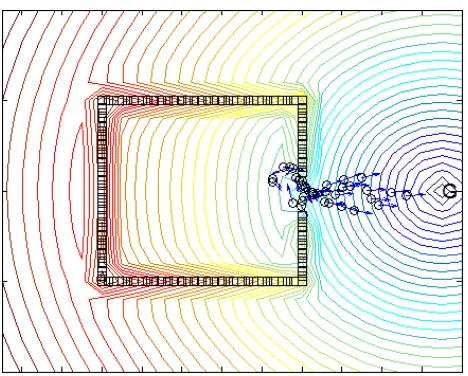
Fig.1.a. Simulation of crowd members that attempt to leave a trap to a destination point (G) in normal conditions, t = 5
Fig.1.b. Simulation of crowd members that attempt to leave a trap to a destination point (G) in normal conditions, t = 32
Fig.1.c. Simulation of crowd members that attempt to leave a trap to a destination point (G) in normal conditions, t = 50
Fig.1.d. Simulation of crowd members that attempt to leave a trap to a destination point (G) in normal conditions, t = 65
Fig.1.e. Simulation of crowd members that attempt to leave a trap to a destination point (G) in normal conditions, t = 93
Fig.1.g. Simulation of crowd members that attempt to leave a trap to a destination point (G) in normal conditions, t = 150
Fig.1.h. Simulation of crowd members that attempt to leave a trap to a destination point (G) in normal conditions, t = 165
Fig.1.i. Simulation of crowd members that attempt to leave a trap to a destination point (G) in normal conditions, t = 200
Fig.1.Simulation of crowd members that attempt to leave a trap to a destination point (G) in normal conditions.
Fig.2.a. Simulation of crowd members that attempt to leave a trap to a destination point (G) in emergency situation, t = 5
Fig.2.b. Simulation of crowd members that attempt to leave a trap to a destination point (G) in emergency situation, t = 15
Fig.2.d. Simulation of crowd members that attempt to leave a trap to a destination point (G) in emergency situation, t = 40
Fig.2.e. Simulation of crowd members that attempt to leave a trap to a destination point (G) in emergency situation, t = 54
Fig.2.f. Simulation of crowd members that attempt to leave a trap to a destination point (G) in emergency situation, t = 61
[image:6.612.324.556.268.463.2]Fig.2.g. Simulation of crowd members that attempt to leave a trap to a destination point (G) in emergency situation, t = 76
Fig.2.h. Simulation of crowd members that attempt to leave a trap to a destination point (G) in emergency situation, t = 90
[image:6.612.58.289.273.461.2]Fig.2.Simulation of crowd members that attempt to leave a trap to a destination point (G) in emergency situation.
Fig. 3. Individuals’ average velocity with time during normal conditions for (200 – 100 – 50 ) members crowds denoted by
[image:6.612.57.288.485.680.2] [image:6.612.330.553.528.621.2]Fig. 4. Individuals’ average velocity with time during emergency conditions for (200 – 100 – 50 ) members crowds
denoted by (blue ‘x’– green‘o’ – black‘∆’) respectively.
Fig.5. Path of center of a 300-members crowd until reaching a destination point (red line during normal conditions – blue
line during emergency situation).
V. Discussion and Summary
The simulation results shown in Fig. 1 demonstrate the behaviour of crowd members that attempt to leave the room in a normal situation through a neck exit using random initial positions and velocities. It can be seen that some individuals pass the neck according to their close initial positions to the neck as shown in Fig. 1(a-b), hence the rest of the individuals seem to follow them and aggregate around the neck as shown in Fig. 1(c-f). The aggregated members leave the room in a line which can be clearly seen in Fig. 1(e-f). The process continues until each individual reaches the destination point while keeping a distance from its nearest neighbour in the crowd as shown in Fig. 1(g-i). The path of crowd centre
rc is calculated as (
∑
=
= p
N
i i p c
N 1
1 r
r ) [37]. Fig. 5 shows the
path of the crowd in normal condition (shown in red line) as straight line which emphasis that there are no much fluctuations (pushings) amongst the crowd members.
The simulation results shown in Fig. 2 demonstrate the behaviour of crowd members that attempt to leave the room in emergency situation through a neck exit using
random initial positions and velocities. It can be seen that some individuals pass the neck according to their close initial positions to the neck as shown in Fig. 2 (a-b), hence the rest of the individuals haste towards the exit and aggregate around the neck pushing those individuals who are nearest to the exit which makes them squeezed out of the room as shown in Fig. 2(c-d). The number of individuals left in the room decreased with time which decreases the pushings amongst the individuals and the evacuation process becomes faster as can be seen in Fig. 2 (e-f). The evacuation process continues until each individual reaches the destination point while keeping a distance from its nearest neighbour in the crowd as shown in Fig. 2 (g-h). The notches in the path of crowd centre shown in Fig. 5 (shown in blue line for emergency situation), emphasis that there are more fluctuations (pushings) amongst the crowd members during the evacuation process in emergency situation than that in the normal conditions. It is important to note that the crowd behaviour shown in Fig. 1, Fig. 2 does not fulfil the conditions defined by [38] for swarming behaviour. In both results, each individual is repelled from other individuals, which represents the concept of dealing with the problem on an individual basis.
The individuals’ average velocity of crowd members
vc is calculated as (
∑
=
=
p
N
i i p c
N 1
1
v
v ) [37]. It is shown in
Fig. 3 and Fig. 4 for the normal conditions and emergency situation respectively. It can be seen that the average velocity in case of emergency situation is generally higher than that in the normal situation. Also for both cases, the average velocity is almost the same for crowds with higher population at the start of the evacuation process then as the process continues with time, individuals’ average velocity is higher for higher crowd populations.
This is due to the fact that during the aggregation of the individuals around the neck in the early regime of the process, there is no enough space for the individuals to have higher speeds, then crowds of different populations almost has same average velocities. Then with time, the number of individuals left in the room decreased which increases the space around the individuals. This makes the pushings amongst the individuals (consequently the average velocity) higher for the crowds of higher populations.
Then crowds member in both cases tend to come to rest when reaching the destination point. This match the stability analysis of the model which proves that the crowd members tend to relax into a minimum energy state achieving real features of crowd members, who desire not to move too far in a short amount of time and to reach their destinations while avoiding other members in the crowd. This matches the observed data that attempted to be simulated by other models [2, 8, 36] yet with lower calculations required.
[image:7.612.56.297.207.404.2]VI.CONCLUSION
This paper presents a computer based model to predict human crowd dynamics. The model uses an efficient way to describe the motion, taking the physical terms of velocity and acceleration into account, employing generalized Morse potential to define the interaction forces amongst the individuals, and linking the behaviour of each individual to the environment components (boundaries, destination point). This way of defining the model elements gives the model the advantages of adaptation to real situations especially in crisis situations as well as the relatively simple required calculations. The stability analysis proves that, using this model, each pedestrian tends to relax to a minimum energy state which achieves the desire of individuals not to move too far in a short amount of time and to reach their destinations while avoiding other individuals. The numerical results which match the real observed data in similar situations show the ability of the model to predict the human crowd behaviour in both normal and emergency situations which means that it can be used effectively to evaluate the evacuation process with the possibility of changing many parameters to adapt the different emergency situations scenarios.
REFERENCES
[1] D. Helbing, “ Traffic and related self-driven many-particle systems,”
Reviews of Modern Physics, V. 73, 2001
[2] M. Batty, “Agent-based pedestrian modelling,” Ucl working papers series, paper 61, ISSN 1467-1298, 2003.
[3] C. Castle, “Developing a prototype agent-based pedestrian evacuation model to explore the evacuation of king’s cross st pancras under-ground station,” Ucl working papers series, paper108 , ISSN 1467-1298, 2006.
[4] S. Hoogendoorn and W. Daamen, “Pedestrian behaviour at bottlenecks,” Transportation Science, 39: 147–159, 2005.
[5] T. Kretz, “Pedestrian traffic: On the quickest path”, Journal of
Statistical Mechanics: Theory and Experiment, P03012, 2009.
[6] M. Moussaid, D. Helbing, S. Garnier, A. Johansson, M. Combe, et al., “Experimental study of the behaviour al mechanisms underlying self-organization in human crowds,” in Proceedings of the Royal Society B: Biological Sciences, 276: 2755–2762, 2009.
[7] T. Kretz, A. Gru¨nebohm, and M. Schreckenberg, “Experimental study of pedestrian flow through a bottleneck,” Journal of Statistical
Mechanics: Theory and Experiments, P10014, 2006.
[8] P. Scovanner and M. Tappen, “Learning pedestrian dynamics from the real world,” IEEE International Conference on Computer Vision, ISSN: 1550-5499, 381-388, 2009.
[9] G. Antonini, M. Bierlaire, and M. Weber, “Discrete choice models of pedestrian walking behaviour,” Transportation Research Part B 40: 667–687, 2006.
[10] C. Castle, “Guidelines for assessing pedestrian evacuation software applications,” Ucl working papers series, paper115 , ISSN 1467-1298, 2007.
[11] M. Chraibi and A. Seyfried, “Pedestrian dynamics with event-driven simulation,” Pedestrain and evacuation dynamics, Part 2, 713-718, DOI: 10.1007/978-3-642-04504-2_69, 2010.
[12] A. Seyfried, M. Boltes, J. K¨ahle, W. Klingsch, A. Portz, T. Rupprecht, A. Schadschneider, B. Steffen, and A. Winkens,”Enhanced empirical data for the fundamental diagram and the flow through bottlenecks,”
Pedestrian and Evacuation Dynamics, Springer, 2008
[13] M. Schultz, T. Kretz, and H. Fricke, “Solving the direction field for discrete agent motion," in S. Bandini et al. Cellular Automata for Research and Industry (ACRI) 2010, Springer Berlin / Heidelberg, 2010.
[14] D. Helbing, A. Johansson, and H. Al-Abideen, “The dynamics of crowd disasters: an empirical study,” Physical Review E, 75: 046109, 2007.
[15] W. Yu and A. Johansson, “Modeling crowd turbulence by many-particle simulations,” Physical Review E, 76: 046105, 2007. [16] A. Johansson, D. Helbing, and P. Shukla, “Specification of the social
force pedestrian model by evolutionary adjustment to video tracking data,” Advances in Complex Systems, 10: 271–288, 2007.
[17] L. Streit, “Functional integral methods,” in Lecture notes on mathematical physics, International Graduate College, 2006. [18] O. Khatib, “Real-time obstacle avoidance for manipulators and mobile
robots,” Int. J. for Robotics Research, vol. 5, no. 1, pp. 90–99, 1986. [19] A. Badawy and C. McInnes, “Robot motion planning using
hyperboloid potential functions,” WCE2007, paper ICME 15, 2007. [20] Y. Chuang, Y Huang., M. D’Orsogna and A. Bertozzi, “Multi-vehicle
flocking: Scalability of cooperative control algorithms using pair-wise potential,” in Proc. of the IEEE International Conference on
Robotics and Automation, 2292-2299, 2007.
[21] M. Mabrouk, “Multi-agent system path-planning using the agent perceptual model and dynamic artificial potential fields”, in
Proceedings of 14th International Conference On Applied Mechanics
and Mechanical Engineering, pp 1-15, 2010.
[22] M. Mabrouk and C. McInnes, “Non-linear stability of vortex formation in swarms of interacting particles,” Physical Review E, 78: 012903, 2008.
[23] M. R. D’Orsogna, Y. L. Chuang, A. L. Bertozzi, and L. Chayes, “Self-propelled agents with soft-core interactions: patterns, stability, and collapse,” Phys. Rev. Lett., vol. 96, 104302, 2006.
[24] C. McInnes, “Vortex formation in swarm of interacting particles,”
Physical Review E, 75: 032904, 2007.
[25] A. Schadschneider, “Bionics-inspired cellular automaton model for pedestrian dynamics” in M. Fukui, Y. Sugiyama, M. Schreckenberg, and D. Wolf, eds., Traffic and Granular Flow ’01. Springer-Verlag Berlin Heidelberg, Nagoya, pp. 499–509, 2003.
[26] K. Nishinari, A. Kirchner, A. Namazi, and A. Schadschneider, “Extended floor field ca model for evacuation dynamics,” IEICE Trans. Inf. & Syst., E87-D (2004) 726–732, cond-mat/0306262v1, 2004.
[27] R. Tsai, H. Zhao, And S. Osher, “Fast sweeping algorithms for a class of hamilton-jacobi equations,” Siam Journal Of Numerical Analysis, 42, 6, 2005.
[28] A. Treuille, S. Cooper, and Z. Popovic, “Continuum crowds,” in
Proceedings of the Association for Computing Machinery's Special
Interest Group on Graphics and Interactive Techniques (ACM
SIGGRAPH) pp. 1160–1168, 2006.
[29] T. Kretz, C. B¨onisch, and P. Vortisch, “Comparison of various methods for the calculation of the distance potential field,” in C. Rogsch, W. Klingsch, A. Schadschneider, and M. Schreckenberg, eds., “Pedestrian and Evacuation Dynamics” 2008. Springer Berlin Heidelberg New York, Wuppertal, 2009.
[30] T. Kretz, C. Bönisch, and P. Vortisch, "Comparison of various methods for the calculation of the distance potential field", in Pedestrian and Evacuation Dynamics 2008, W.W.F. Klingsch, C. Rogsch, A. Schadschneider, and M. Schreckenberg, eds., pp. 335-346. Springer-Verlag Berlin Heidelberg (2010). ISBN: 978-3-642-04503-5.
[31] D. Helbing, P. Molnar, “Social force model for pedestrian dynamics,”
Physical Review E, 51: 4282–4286, 1995.
[32] A. Mogilner, L. Edelstein-Keshet, L. Bent, and A. Spiros, “Mutual interactions, potentials, and individual distance in a social aggregation,” Journal of Theoretical Biology, 47, 353–389, 2003. [33] J. Hale, “Asymptotic behaviour of dissipative systems,” American
Mathematical Society, Providence, Rhode Island, 1988.
[34] P. Beer, E. Johnston, and W. Clausen, “Vectors mechanics for engineers: Dynamics,” McGraw-Hill Higher Education. ISBN 978-007-127360-2, 2007.
[35] M. Kwan and J. Lee, “Emergency response after 9/11: The potential of real-time 3DGIS for quick emergency response in micro-spatial environments,” Computers, Environment, and Urban Systems, 29: 93-113, 2005.
[36] T. Kretz, "The Dynamic distance potential field in a situation with asymmetric bottleneck capacities," in S. Bandini et al. Cellular Automata for Research and Industry (ACRI) 2010, Springer Berlin / Heidelberg, 2010.
[37] I. Couzin, J. Krause, R. James, G. Ruxton, and N. Franks, “Collective memory and spatial sorting in animal groups,” Journal of Theoretical Biology, 218, 1-11, 2002.