Research Bachelor Assignment
‘Process improvement of the
change processes within the
global Sensata Technologies
organization’
Communication interface between
the Netherlands and China
Chantal Dekker
University of Twente
Student BSc Business Administration s0138355
Everhardt van der Marckstraat 51 7521 VN Enschede
The Netherlands
Supervisors:
Dr. R. Harms University of Twente Drs. J. Veldman University of Twente Ir. A.J.H van der Kuij Sensata Technologies Ing. G. Borghuis Sensata Technologies Ir. Ing. W. Kleissen Sensata Technologies
Date: 09-09-2009
Chantal Dekker | Process improvement of the change processes within Sensata Technologies
‘Process improvement of the
change processes within the
global Sensata Technologies
organization’
Chantal Dekker | Process improvement of the change processes within Sensata Technologies
PREFACE
In order to finish my bachelor study Business Administration at the University of Twente in Enschede I have ended up at the last phase, which is writing a bachelor thesis on a research assignment. A copy is lying in front of you.
Because of my interests in being and studying abroad I contacted Gerrit Borghuis, who is Electrical Protection Engineering Manager at Sensata Technologies in China (Changzhou). Together with two of his colleagues he came up with an assignment on reviewing the business process of change management, and understanding the bottlenecks in this process. I accepted the challenge and completed the project with some advice based on facts based on findings. The Production Part Approval Process and 8D procedures within Sensata Technologies will be reviewed alike. Before, all these things were managed locally in Almelo. As Sensata became a more globalised organization, activities had to be split and activities and responsibilities are settled in a new, less experienced organization. The aim for Sensata is to anchor the processes tasks and responsibilities clearly and unambiguously to facilitate continuity and improvement. I chose to participate in this project because of my interest in innovation, and my follow up master in Entrepreneurship and Innovation Management.
The assignment is supervised by Ir. A.J.H van der Kuij, Ing. G. Borghuis and Ir. Ing. W. Kleissen from Sensata Technologies, and Dr. R. Harms and Drs. J. Veldman from the University of Twente. I would like to thank them all for their ideas and support.
Enschede, 9 september 2009
Chantal Dekker | Process improvement of the change processes within Sensata Technologies
VOORWOORD
Voordat ik mijn bachelorstudie Bedrijfswetenschappen aan de Universiteit Twente in Enschede af kan ronden is er nog maar een laatste stap die genomen moet worden, het schrijven van bachelorscriptie over een onderzoeksopdracht. Een kopie van deze scriptie ligt op dit moment voor u.
Vanwege mijn interesses in het studeren in het buitenland, nam ik contact op met Gerrit Borghuis. Hij is Engineering Manager voor de afdeling Electrical Protection van Sensata Technologies in China (Changzhou). Tezamen met twee van zijn Nederlandse collega’s in Almelo kwam hij met de opdracht om het bedrijfsproces van verandermanagement te bekijken. Hierbij is er tevens het doel om de bottlenecks van dit proces te begrijpen. Voor het afronden van het project zullen er dan ook adviezen worden uitgebracht voor procesverbetering die voornamelijk zijn gebaseerd op de feiten. Tegelijkertijd worden de Production Part Approval Process (PPAP) en 8D (klanten klachten) processen binnen Sensata Technologies op de zelfde manier geanalyseerd. Voorheen werden al deze processen lokaal in Almelo gemanaged. Maar als een meer geglobaliseerde organisatie, zijn de activiteiten gesplitst en zijn de verantwoordelijkheden verplaatst naar een relatief gezien nieuwe en onervaren organisatie. Het doel van Sensata is om de processen en bijbehorende taken en verantwoordelijkheden te verankeren, om zodoende meer duidelijkheid en minder ambiguïteit te creëren, om continuïteit en vooruitgang te faciliteren.
Ik heb ervoor gekozen om in dit project te participeren, vanwege mijn interesse voor innovatie en mijn toekomstige master in Innovatiemanagement. Het project is begeleid door Dr. R. Harms and Drs. J. Veldman vanuit de Universiteit Twente en Ir. A.J.H van der Kuij, Ing. G. Borghuis and Ir. Ing. W. Kleissen vanuit Sensata Technologies. Ik wil hen allen graag bedanken voor hun bijdrage aan dit project.
Enschede, 9 september 2009
Chantal Dekker | Process improvement of the change processes within Sensata Technologies
MANAGEMENT SUMMARY
This is a report of the research after the change management process of Sensata Technologies. Reason for this study is the communication problems that have become into existence after moving the product design, production, and supplies of the Electrical Protection products from Almelo to Changzhou. Sensata Technologies has procedures for all of her business processes, and in that way as well for change management. That is why the assignment was mainly meant to map the process in accordance with the existing procedures, as well to map the current process, and to find the bottlenecks in communication. The mean question that is answered in this report is: ‘What does the process of change management at the moment look like, and how can this process be improved when looking at the communication streams?’
Three steps have been taken two answer this question. First, the process as it should be, is mapped according Sensata’s Change Management Procedure, which is set up after ISO and TS quality requirements. Secondly, the current Change Management processes have been described, and actual communication streams during the process have been described and mapped. Finally, the communication problems during the change have been described, using the outcomes of depth-interviews with Change team members. To collect all the necessary information I have been analyzing the process, and interviewed the participants in the process. With the collected information in hands I should be able to give opportunities to improve the change management processes. What I found, were indeed a lot of communication issues and that they mostly have to do with the physical distance, cultural and lingual matters.
Chantal Dekker | Process improvement of the change processes within Sensata Technologies
SAMENVATTING
Dit rapport geeft de resultaten weer van een onderzoek naar de verandermanagement processen van Sensata Technologies. Reden voor deze studie is het communicatieprobleem die is ontstaan bij het verandermanagement proces, maar ook bij andere bedrijfsprocessen. Deze problemen zijn ontstaan toen het product design, de productie en leveranciers voor de Electrical Protection producten vanuit Almelo zijn verplaatst naar Changzhou. Sensata Technologies heeft voor al haar bedrijfsprocessen procedures en zo ook voor verandermanagement. Vanuit dat punt bezien was deze opdracht voornamelijk bedoeld om het veranderproces conform de procedures in kaart te brengen, als ook het huidige proces in kaart te brengen en om bottlenecks in de communicatie te vinden. De hoofdvraag die in dit rapport beantwoordt wordt is: ‘Hoe ziet het proces van verandermanagement er op dit moment uit en hoe kan dit proces verbeterd worden met betrekking tot de communicatiestromen?’
Om deze vraag te kunnen beantwoorden zijn er drie belangrijke stappen genomen. In de eerste plaats is het veranderproces in kaart gebracht zoals deze zou moeten zijn volgens Sensata’s Change Management Procedure, welke is opgezet naar ISO en TS kwaliteitseisen. Daarna is het huidige verandermanagement proces in kaart gebracht en beschreven, ook zijn de bijbehorende communicatiestromen beschreven. Uiteindelijk zijn de communicatieproblemen die tijdens het verandermanagement proces optreden onderzocht, door middel van het gebruik van diepte interviews met teamleden uit het veranderteam. Om alle noodzakelijke informatie te vergaren is er gebruik gemaakt van diepte interviews en zijn er analyses gemaakt van de bestaande procedures en tools.
Door gebruik te maken van de informatie die daarbij vrij zou komen zou ik mogelijkheden moeten kunnen aangeven om het verandermanagement proces te verbeteren. Voornamelijk door de resultaten van de interviews kwam ik er achter dat er inderdaad een heel aantal communicatie problemen zijn en dat deze voornamelijk in de afstand tussen de verschillende teamleden, en culturele en talige oorzaken kunnen worden gevonden.
Chantal Dekker | Process improvement of the change processes within Sensata Technologies
CONTENTS
Preface ... 4
Voorwoord ... 5
Management summary ... 6
Samenvatting ... 7
Contents ... 8
1. Glossary ... 10
2. Introduction ... 12
2.1 Problem description ... 12
2.2 Pre-story ... 12
2.3 Why Change Management? ... 14
2.4 Background ... 15
2.5 Goal & Acccountability ... 15
3. Problem definition & research questions... 16
4. Theoretical Framework ... 17
4.1 Business process analyses ... 17
4.2 Change management ... 19
4.3 Change and distributed teams ... 22
4.4 Brainstorm on research ... 23
5. Methodology ... 25
6. Process of change according the global procedures ... 27
6.1 Global change management process flow... 27
6.2 Product realization process ... 29
6.3 communication lines according procedure ... 29
7. Actual change management process ... 32
7.1 Focus on the change management process steps ... 32
7.2 Actual communication lines ... 35
8. Communication problems in the change management procedure... 37
9. Observations ... 40
9.1 Three change types ... 40
9.2 Organizational upper laying problems ... 41
10. Conclusion ... 45
10.1 Current change management process ... 45
10.2 Opportunities for improvement... 46
10.3 Implemenation plan ... 48
11. Literature ... 50
Chantal Dekker | Process improvement of the change processes within Sensata Technologies
1. GLOSSARY
List of abbreviations
CS Customer service
CQE Customer quality engineer
DE Design engineer
FAE Field application engineer FSE Field sales engineer MFG Manufacturing MKTG Marketing
PE Process engineer
PL Planning
PM Project manager/coordinator PRO Procurement (Purchase) SQE Supplier quality engineer
QRA Quality and reliability assurance (Quality engineer)
List of definitions
8D Problem solving process that is started when there is a customer complaint. The 8D Process is a problem solving method for product and process improvement. It is structured into 8 steps (the D's) and emphasizes team. This is often required in automotive industries.
BC Business Center
CAD Customer approval documentation: CJF Change Justification Form:
CM Change Management:
CM Matrix Change Management Matrix: technical support system for executing Change Management. This system enables sharing of change management features, like proposals for change management, uploading important files, sending e-mails when continuing to the next phase etc.
Chantal Dekker | Process improvement of the change processes within Sensata Technologies CRB Change Review Board: board of managers within Sensata that has to evaluate the impact of the change using the submitted change justification form (CJF). This board can approve, hold or reject the change.
ECN Engineering Change Notice: simplified change management process, in most of the times only used in case of small text errors. ECN is also used in CM to update drawings.
FMEA Failure Mode and Effect Analyses: methodology for analyzing potential reliability problems early in the development cycle where it is easier to take actions to overcome these issues, thereby enhancing reliability through design. FMEA is used to identify potential failure modes, determine their effect on the operation of the product, and identify actions to mitigate the failures.
GCM Global Change Management: all changes which are identified as product, process or supplier-related that generally impact the customer requirements of fit, form, function, performance, durability, and/or capacity are to be coordinated and managed.
GNDP Global New Product Development: the development of a new product platform. Change Management uses the shortened version of the NPD Checklist.
NCS New Component Sourcing: This is one of the components (tools) of CM that is used for new components and/or new supplier sources.
OEM Original Equipment Manufacturer. A producer that provides a product to its customers, who proceed to modify or bundle it before distributing it to their customers.
Oracle Business planning system of Sensata
OTP Operational Transfer Price: refers to the pricing of contributions transferred within an organization, used by Sensata to analyze the financial impact of a change.
PPD Product Parent Documentation: part of the organization responsible for the design of products
PPAP Production Part Approval Process: a process used in the automotive supply chain to establish confidence in component suppliers and their production processes, by demonstrating that: "....all customer engineering design record and specification requirements are properly understood by the supplier and that the process has the potential to produce product consistently meeting these requirements during an actual production run at the quoted production rate." RA Risk assessment / analyses, with parts like FMEA’s or business risks.
Chantal Dekker | Process improvement of the change processes within Sensata Technologies
2. INTRODUCTION
2.1 PROBLEM DESCRIPTION
In the first meeting with my supervisors from Sensata Technologies (after this: Sensata) the necessity for improving response time and quality in business processes, like change management, customer complaints (8D) and Product Part Approval Processes (PPAP), was expressed. Especially the communication between sites in different locations around the world is seen as a bottleneck. In the past these processes were managed under one local ‘roof’. Customer needs identification, product design, production, and supplies were all completely managed in Almelo. Also the quality procedures according to ISO9001 (ISO14001) and TS16949 standards, important for Sensata for doing business, were managed in Almelo.
The change process has now become global, the customer relations and business plans are set up in Almelo, and the drawing of products and production is done in the Changzhou organization. The Changzhou organization is therefore responsible for some of the quality procedures. The communication lines between Almelo and Changzhou are thin due to different causes, for example language barriers, culture differences, resource constraints and level of expertise. However this communication is judged to be essential by Sensata in order to guide the process in the rapid changing business environment, avoiding big dips in business performance and keeping up high performance in the market place.
This assignment is mainly focused on the change processes and the communication interface between the Almelo and Changzhou organizations. Aligned to the change process, also the 8D and PPAP processes will be observed and mapped. The responsibilities, deliverables and expectations of both organizations seem to be unclear. That is why the business processes needs to be mapped, to improve the efficiency and the response quality and time internally (per location) and externally (over more locations, including suppliers and customers).
For Sensata changes are to be found in a broad category: all changes which are identified as product, process or supplier-related that generally impact the customer requirements of fit, form, function, performance, durability, and/or capacity are to be coordinated and managed. When it comes to change management there are also a lot of functions that have to be involved. There are a design engineer, quality engineer, process engineer, supplier quality engineer, customer service, planner, purchaser, marketer, manufacturing engineer, and sales engineer involved when it comes to a big change. All these functions have to communicate and work together in order the reach the best change results.
2.2 PRE-STORY
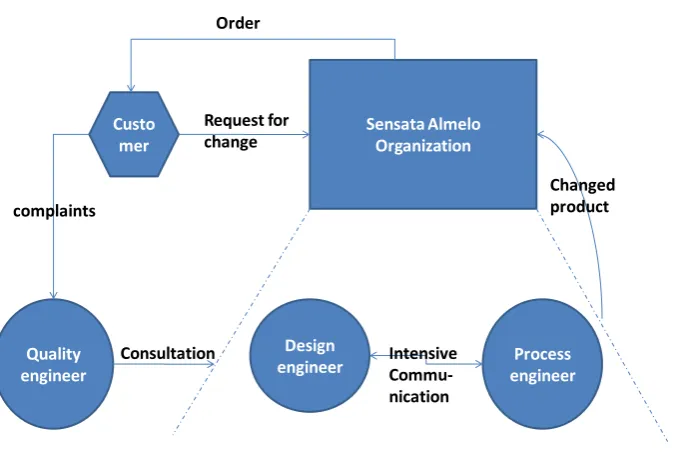
When changes had to be managed in one location (Almelo) this was relatively easy, when comparing this to the management of this same process over more locations. In Almelo, the customer brought in a new request for a change of an existing product, the design engineer made the drawing and went to the manufacturing lines (only a couple of meters away) to discuss with the process engineer or line operator how to realize the change. Samples could be made fast and easily, and all problems that appeared were solved directly in the lines. This was a fast communication process, with the biggest disadvantage that the knowledge about these changes were only ‘stored’ in the heads of the employees (see also figure 1).
Chantal Dekker | Process improvement of the change processes within Sensata Technologies most information was in the heads of the employees. With the movement of the manufacturing lines, the change management processes became harder. The design engineers were not able anymore to simply walk to the production lines to solve some problems if they appeared. The importance of storing knowledge came into sight, and some small communication issues were already visible. It was clear that managing everything in one location is a lot easier.
A couple of years after that, Sensata had to make the decision to make another ‘line move’ to China. In first place there was decided to do this in a slower and more structured way, but with sights on the economic crisis the production lines had to be moved quickly. During the second half of 2008, and the first half of 2009 the transfer took place, so since the beginning of this year Sensata Electrical Protection does not have production lines in Europe anymore. This was a way to reduce costs, and because of decreasing demands from customers an effective time to do so, since Sensata was still able to assemble what was ordered. With this second move there were more things that had to be changed. Besides the decrease in responsibility for the process and manufacturing, also responsibility for the design of the products had to be moved to China. For the Chinese location this meant that they gained these new responsibilities in a relatively small amount of time, and there was the need to hire and train a lot of new engineers. For the European organization this meant that the responsibility for design and quality engineering disappeared. Former design engineers became a field application engineer, which means that there role is now more related towards customers’ application, to fulfill their needs at a high level. They are the internal voice of the customer (technical). They have to make the decision on conception (functional & constraints.
Custo mer
Sensata Almelo Organization Request for
change
Design
engineer IntensiveCommu- engineerProcess nication
Quality engineer complaints
Changed product Order
[image:13.595.88.429.383.611.2]Consultation
Figure 1: Managing changes in one location
Chantal Dekker | Process improvement of the change processes within Sensata Technologies to China to control the production lines, and to provide some on-the-job training. At the moment all the employees in Hungary are already dismissed. For all the employees in Europe and China there are travel restrictions, and after the line moves too less people from the Almelo organization has been in China to see how the lines are working.
2.3 WHY CHANGE MANAGEMENT?
People may ask, why an organization wants to change, if it is such a difficult and time consuming activity. The reasons for Change Management (CM) can come from different causes. Sometimes changes are required when looking at the ISO-9001 and automotive ISO/TS 16949 quality requirements, that have to be followed in the industry Sensata is operating:
- change of a part depending on altered function or production requirements - change in the application of a part
- introduction of a new part - replacement of a part - withdrawal of a part
- correction of errors on a document - bringing an old document up-to-date
But in most of the times, the change management process within Sensata, is needed because of a product change due to the following reasons:
- changes in the customer specification
- faults in the interpretation of customer demands into technical requirements - difficulties in parts fabrication or assembly
- weaknesses in the product identified during prototype - quality problems with some subsystem or component - development for future product revisions
In short, there are technical and commercial reasons to change products, processes and/or suppliers from time to time. In order to reduce the amount of changes, Sensata treats changes that do not hit the above conditions with a simplified process, named Engineering Change Notice (ECN). When a whole new product is set up, Sensata uses a New Product Development (NPD) process, which is also created along the ISO quality standards. This report is only about Change Management, not about Engineering Change Notice or New Product Development. But, ECN is always part of the Change Management Procedure.
Besides the difficulties that Sensata has due to the line moves from Europe to China, the Change Management process, and the Change Management process in particular, is in literature associated with some difficulties. In the first place there are many departments affected when documents have to be changed. To perform the change in the best way possible and fulfill the wishes of all parties, the process should be performed in a cross-functional environment. The difficulty in that is mostly that different departments have different goals (Malmqvist & Pikosz, 1998). For Sensata this becomes clear when looking at differences between Europe and China. In Europe the different departments are totally focused on customer satisfaction, in China everyone is paid off for the volume in products. This means that Europe is really change centered, were the Chinese organization does not like to change at all.
A second obstacle is that the Engineering Change Management processes are related to long lead times, caused by the following factors: the process requires extensive document management, and the process requires meetings with all affected functions, to satisfy all departments (Malmqvist & Pikosz, 1998). Also on this point we can find that especially the meetings are difficult, since there are travel restrictions, and time differences.
As a third difficulty there is a long learning time for new employees, since the change process can be very complex. This may cause a lack of knowledge and understanding, why employees might be unwilling to use the process.
Chantal Dekker | Process improvement of the change processes within Sensata Technologies an EC process, it means that designers have to redesign something they have already done before. The design engineer might feel accused of having done something wrong, which is something that can slow down the process (Malmqvist & Pikosz, 1998).
2.4 BACKGROUND
Sensata has two business units: Sensors Products and Control Products. The Control Products unit consists of Electrical Protection and some portfolios obtained during recent acquisitions. The assignment is carried out in the Electrical Protection part of the Sensata business. Sensata is a company with business centers, production locations and sales offices around the globe. The three business centers are situated in Attleboro (Headquarters near Boston, U.S.), Japan (covering the Asian market) and Almelo (taking care mainly for European market). Due to the rapid evolution of business in China, Sensata has manufacturing sites in Baoying and Changzhou. The latter location is becoming responsible for Product Parent Documentation (PPD), drafting and probably growing out towards a business center role as well.
The Electrical Protection portfolio contains mainly products having a sensing and switching bimetal part to control temperature and/or avoid fire in applications. The in the business well known ‘Klixon’ brand name, is referring to the rapid switch off and on of electricity. This also called snap function is needed to obtain high quality products. Switch of electricity can be initiated by over-temperature (thermostat), over-current (circuit breaker) or an overload of temperature in combination with current (motor protector). Sensata thermostats, circuit breakers and motor protectors can be found in a wide range of applications like household appliances (compressors of refrigerators, coffeemakers …), automotive electric motors (wiper motors, sun roofs, window lift motors …) and high end aerospace applications. Sensata customer portfolio contains for example Askoll (pumps), ACC (refrigerators), Danfoss (compressors) and Bosch (automotive electric motors).
Good communication between Europe and China is essential to sustain and to grow the European business of Sensata, during and after the transition (of manufacturing lines and PPD responsibilities) period. To do so ISO-9001 and automotive ISO/TS 16949 quality procedures, and responsibilities for the process and process steps have to be clear. Implementing this will positively impact response quality and time, resulting in high quality offerings to Sensata’s customers.
2.5 GOAL & ACCCOUNTABILITY
The assignment is focused as well on business processes and the communication interface between China and Almelo, as on the responsibilities and the deliverables of both organizations to improve the efficiency and the response quality and time internally and externally. The business process which will be reviewed is Change Management. Sensata Technologies will map the PPAP and 8D processes by herself parallel to the mapping of the change process. The interface that will be reviewed during the assignment: Asia (Changzhou, Baoying, Shanghai) – Europe (Almelo). Out of scope are the interfaces Asia – Attleboro and Europe – Attleboro.
The relevance of this topic can be summarized in four major points:
1. The general importance and influence of change management within distributed organizations.
2. The importance for Sensata Technologies to have a clear procedure documentation of the process of change management within her organization.
3. The literature on change management can be strengthened with the outcomes of the research.
Chantal Dekker | Process improvement of the change processes within Sensata Technologies
3. PROBLEM DEFINITION & RESEARCH QUESTIONS
In the introduction the following problem definition is outlined: The processes of implementing changes for European products were all managed in Almelo. Based on experience and expertise built over the years, the Almelo organization was capable to cover gaps in procedures. These days, due to the split of activities and responsibilities to a new, less experienced organization; deliverables, responsibilities and expectations of both organizations are unclear. It is judged essential by the Sensata organization that processes, tasks and responsibilities are unambiguously anchored for continuity and improvement. According to my supervisors at Sensata most problems are to be found at the communication interface, which is why the assignment has to be focused on the communication streams.
From the above given problem definition the following Main Question (MQ) can be derived:
MQ: What does the process of change management at the moment look like, and how can this process be improved when looking at the communication streams?
This research question can be split up in the next three sub questions (SQ), in order to make it easier to give an answer to the main question:
SQ1: What is the process of change according to the standard change procedures of the global Sensata Technologies organization?
SQ2: What does the change management process at this moment look like?
SQ3: What are the communication problems in the current change processes?
Changes will in this report seen as followed:
- Change: All changes which are identified as product, process or supplier-related that generally impact the customer requirements of fit, form, function, performance, durability, and/or capacity are to be coordinated and managed. Within Sensata technologies there is given a kind of ranking to the different changes:
- Examples of changes that belong to change management and so are of importance for this research:
- Material
- Supplier (source, facility, process) - Equipment/ tooling modification - -Manufacturing line layout - Process flow
- Test/inspection method - New equipment/ tooling
Chantal Dekker | Process improvement of the change processes within Sensata Technologies
4. THEORETICAL FRAMEWORK
This research is primarily focused on mapping the business process of change management, with focus on the communication streams. Besides the observation of what is done at the moment, the research is also focused on giving advice on how to improve the current processes. That is why this framework starts with an introduction on how business processes can be analyzed (4.1). Continued by an explanation for which technique is chosen, and how this technique can be applied to the assignment. After that some general information on change management, specific will be given (4.2). That will be followed by an outline of difficulties with distributed teams (4.3), and finally there is a brainstorm on how to apply all these theories (4.4).
4.1 BUSINESS PROCESS ANALYSES
There are four different ways in which processes can be analyzed (Biazzo 2000) (see appendix 1): (1) Action analysis; (2) Process mapping; (3) Coordination analysis; and (4) Social grammar analysis. The search for organization knowledge can be conducted from the outside and inside. When gathering data using information generated by the organization the research is done from the outside. In case that the researcher becomes part of the organization; which is characterized by the assumption that organizational phenomena must be understood through immersion within the flow of proceedings, research is conducted from the inside. There are two alternative strategies, representing the inside and outside approaches, for analyzing business processes: (1) rational reconstruction strategy; and (2) pragmatic reconstruction strategy. Both strategies include two forms of analyzing the current situation of business processes.
One of the forms of rational reconstruction of business processes is process mapping, which can help trying to understand a process by creating a map. In this map the relationships between activities, employees, information and objects involved are graphically drawn in a model. Process mapping methods are widely recognized for the reason that such models can offer useful, and relatively inexpensive, descriptions which can help towards improving and re-designing business processes (Colquhoun et al., 1996; In: Biazzo, 2000).
There are different kind of techniques for process mapping in existence, but independent of the technique there are couple of phases that always have to be proceeded: (see, for example Hunt, 1996):
- Define the boundaries and of the customers of the process, of the main inputs and outputs
and of the actors involved in the workflow;
- Interview those who are responsible for the various activities within the process and study
of available documentation;
- Create the model on the basis of the information acquired and step by step revision of the
model following the logic of the `author-reader' cycle.
Creating a process map of the change management process within Sensata will help understanding the desired process and actual processes of change.
The other form to analyze business processes is the coordination analyses. As Malone (1988) recognized the activities of separate actors within a business process can be coordinated, where all communication and decision making tasks can be scaled as coordination tasks. When using this form for analyzing the change management process, the research will have to consist of identifying the actors involved, interviewing the individuals and examining documents that describe standard operating procedures in order to discover the following items:
(1)What kind of information the actors receive; (2)From whom they receive it;
(3)How they receive it;
Chantal Dekker | Process improvement of the change processes within Sensata Technologies (5)To whom they sent messages as a result (Crowston, 1997; In Biazzo, 2000, p. 106).
The forms of the pragmatic reconstruction of business processes are social grammar analyses and action analyses. Pragmatic is the opposite of rational, where the pragmatic approach tries to go beyond the traditional idea of structure as a set of formal and abstract relations which restrict action. Where the rational analyses might make processes look like they are independent of human actions and interpretations, the pragmatic reconstruction seeks to subjectivist theoretical positions. The analysis of action needs to be the precursor to a further research after the sequence of actions, social grammars. The foundation of action analysis lies in the concept of `move' as defined by Pentland (1992; In Biazzo, 2000), which is a socially relevant activity of an actor. ‘Move’ is by other authors also described as ‘action’, that is also how we will call this in this report.
Action analysis means the identification of the actions within a given process and a thoroughly exploration of the structural conditions within which the individual actions take place. In that way, business processes are studied through explorations of the ``elementary cells''. This offers the idea of a conception of processes as a network of actions, as can be seen in appendix 2. When analyzing such a network the researcher should be questioning why some sequences appear, and others don’t. Besides there should be given a thought to what dimensions create the set of sequences, and what effects they have. To make this analysis of the sequence of actions, the following points can be followed:
(1)Identify the lexicon that is of the set of `actions' - of the process being studied; (2)Observe a large enough number of `instances';
(3)Explore the basic rules that underlie the existence of the varieties of assemblies found in practice.
Within the field of pragmatic reconstruction strategy, grammatical analysis shifts the emphasis of study from the actor to the system, that is, to the set of structural factors that regulate the assemblies of actions carried out by the individual actors (Biazzo, 2000, p. 109-110). Looking at the change management process at this way, might give another approach since it is more likely that Sensata usually will be more looking at the procedures themselves.
Process mapping
Process mapping is one of the above mentioned ways to analyze a business process. This is an important approach for this research, since a lot of Change Management process steps are unclear at the moment, and using this method can help understanding the process. There are several ways of process mapping and in this research there is a mix of two approaches used. Before process maps can be drawn information is be derived on how process maps can be made and how information of the business processes can be gathered.
Mapping a process can provide tools and a verified methodology for mapping the ‘As-Is’business process, and is an option to design a ‘To-Be’ roadmap for reengineering business processes / organizations Hunt (1996, p. 1). It is a way to ensure that a reengineering team can understand and improve business processes. To be able to identify and to map the current process flow of change management process mapping will be used, and process mapping will also be used for advice on reengineering the change management process. The ‘As-Is’ and ‘To-Be’ process maps that have to be created will be made using the 11 key process mapping steps of Hunt (1996, p. 25-26):
1. Determine if you need a process roadmap (there are a couple of reasons why you would want to use a process roadmap: improve customer satisfaction, process understanding, quality goals, adoption of multifunctional teams, or continue to improve the process)
Chantal Dekker | Process improvement of the change processes within Sensata Technologies 5. Understand the value of process mapping
6. Apply the process mapping methodology in your own business 7. Create a process mapping team
8. Find the right process mapping tools
9. Collect process map information and process details via focused interviews 10.Implementation of process mapping
11.Just ‘Change it!’
‘A process map consists of graphic hierarchical diagrams, supporting text, and a glossary of common terms and process definitions, all cross-referenced to one another. The major output of the process map is a workflow diagram (Hunt, 1996, p. 15).’ Activities will be shown as boxes and arrows will represent data and interfaces. When the steps of Hunt will be followed this will lead to a current and a ‘To-Be’ map of the business process, in case of Sensata this will be a current map of the change management process and a ‘To-Be’ map of the procedures of that same process.
It is proven that many people failed in process understanding and improvement without a solid methodology for understanding the processes. A solution might be found in detail process charts that can provide the level of understanding that is essential for effective analysis (Graham, 2007a). These process charts provide the perfect foundation for improvement of business processes, and they are as well excellent training tools if they include enough detail to support common sense decisions (Graham, 2004b). The best results can be derived when using process maps that are used for improving effectiveness and efficiency of the business processes. Reasons for choosing such an improving project might be the generation of costly errors, long lead times, or audit fails etc. (Graham, 2004b).’ According to Graham (2007a) the best process maps can be defined by asking six questions two all the involved people: what, why, when, how, where and who? He says when the why-question cannot be answered, that the recommendation should be that the process step should be eliminated. When all the questions are asked the final question can be addressed; “How is it done and why is it done that way?” (Graham, 2007a). What might help me answering sub questions two and three, finding the current deliverables and bottlenecks.
Both, Hunt and Graham focus on several forms flowcharting, with from basic flowcharting promoted by IBM in the 60s till IDEF (Hunt, 1996, p. 96-118; Graham, 2007b). Hunt promotes IDEF process mapping methodologies and Graham promotes Detail Process Charting methodology developed by Graham in the 1940s, with totally different symbols (Graham, 2007b). A combination of both methods is used to map the process as it should be according to the Global Change Management Procedure.
4.2 CHANGE MANAGEMENT
In this research there are lots of different changes that belong to the Change Management Process. We are talking about changes in products, processes or suppliers. Further, does this report focus on communication problems, which is why we also take a look at the people’s side of change. Sensata’s goal is in the end making benefits from her processes, what leads us to ‘Best-in-Class’ performances.
Change Management: the people side of change
Change management has grown out as a big body of knowledge, which is why there is a growing confusion about what change management really is. This can particularly bother business leaders in creating a clear picture of change management for their employees.
Chantal Dekker | Process improvement of the change processes within Sensata Technologies of simply following steps. Given that no two changes are exactly alike, following a recipe for change management is not enough. For Sensata this means that only following the checklist for Global Change Management will not make a success of every change. There should be considered a specific approach in every situation. If employees do not understand why they are changing the products, processes, or suppliers; there is a big chance that the change will fail even when the standard procedures and processes are followed. Research with hundreds of project teams has shown that a "one size fits all" approach is not sufficient. To be effective at leading change, an organization will need to customize and scale her change management efforts based on the unique characteristics of the change (Creasey & Hiatt, 2003, p.14).
When it comes to change management there are some key principles; when the change Program Manager understands and applies these principles, it will be easier to apply the techniques and processes that belong to the specific change situation. These concepts are:
- Change agents must be conscious of both a sender’s meaning and a receiver’s interpretation. - Employee resistance is the norm, not the exception.
- Visible and active sponsorship is not only desirable but necessary for success.
- Value systems and the culture of the organization have a direct impact on how employees
react to change.
- The size and type of the change determines how much and what kind of change management
is needed. Just because a change is small does not mean that change management is not required.
- The "right" answer is not enough to successfully implement change.
- Employees go through the change process in stages and go through these stages as
individuals.
The employees’ perspective, individual change management, and the managers’ perspective, organizational change management, are two change management approaches to put these key principles into practice. The first approach, individual change management, is frequently overlooked by change management models. The approach consists of tools and processes that change leaders use with their employees to manage individual actions through change. This employee-oriented component of change management is the critical ingredient that allows a project team to:
1. Help employees through the change process
2. Create a feedback loop to business leaders and identify points of resistance 3. Diagnose gaps in communications and training
4. Implement corrective action (Creasey & Hiatt, 2003, p.40).
The managers’ perspective, organizational change management, includes processes and tools for managing the people side of the change at an organizational level. These tools include a structured approach that can be used to effectively transition teams or organizations through change (Creasey & Hiatt, 2003, p. 53).
When both perspectives on change management are combined and understood, the tools provide a framework for managing the people side of change. The model that is proposed by Creasy and Hiatt (2003) describes five blocks that can help organizations to successfully realize change at the individual level. Awareness, Desire, Knowledge, Ability and Reinforcement. Predecessors also apply a linear, staged model for implementing change, for example Lewin (1951): Unfreeze-Change-Refreeze.
Best performance
To achieve the best performance and improve decision-making in change management there are also four other fundamentals that have to be addressed:
Chantal Dekker | Process improvement of the change processes within Sensata Technologies 2. Formally analyze the impact of change on the product across the lifecycle and the supply
chain, including technical and commercial considerations
3. Collaborate visually about product change with visualization and virtual meeting technology 4. Develop and execute formal change implementation plans to put the decision into action
(Boucher & Brown, 2007, p.3).
As other organizations, Sensata has to recognize that change management in product development and engineering can drive top-line benefits, and that developing processes can improve speed to market. Good change management has always been a fundamental process, but in today’s market it has even more importance – it is now being viewed as a competitive tool to increase product profitability through improved market responsiveness in addition to improving efficiency (Boucher & Brown, 2007). Especially the conditions of market conditions manufacturing companies like Sensata The market conditions that manufacturing companies are leading to high demands in terms of flexibility in production, and with that to engineering changes in production.
Quality issues and changing market requirements are also driving a focus on change. Once a product has been released, companies still need to get product updates to market quickly. Change management can help initial product launch, and also ongoing product management. Quality and product improvement changes seem to be critical to market success and profitability.
Managing changes is getting more difficult than before, because of increased complexity of the processes, the number of people and departments affected by the change, and the related costs to managing changes. The greatest benefits from change management can be found in the following six performance criteria:
- Meet change deadline targets - Meet design product budgets - Achieve product cost targets
- Achieve product lifecycle cost targets - Achieve product performance objectives
- Achieve product quality goals (Boucher & Brown, 2007, p.6).
-When looking at change management there are five key categories supporting change management: (1) process (how companies are executing change management in their business); (2) organization (corporate focus and collaboration among stakeholders); (3) knowledge management (contextualizing data and exposing it to key stakeholders); (4) technology (selection of appropriate tools and intelligent deployment of those tools); and (5) performance measurement (the ability of the organization to measure the efficiency and effectiveness of change management) 9(Boucher & Brown, 2007, p.9). For each category there will be outlined what kind of approaches in these categories will support the change management processes. Best performers in change management take a more structured approach to change processes
Companies good in change management have implemented two critical processes more frequently than their competitors: formal impact analysis and formal change implementation plans (Boucher & Brown, 2007, p10). A more structural approach helps understanding and managing changes more successfully (Cao et al, 2004, p. 123).
Chantal Dekker | Process improvement of the change processes within Sensata Technologies The Change management support can also be found in integrating supporting information to improve change decision-making on a change request. Further, implement centralized access to the status of change orders decisions can also be helpful. They also provide centralized access to the change history which creates more accountability on the decisions made. Finally, to be able to improve change management, companies must measure it.
Turning to technology to support the change processes might also be helpful. The technology enablers can be divided into two groups, knowledge and execution. Having the right information is the key to making better decisions. Frequently the information for engineering change is better communicated visually than verbally; use design visualization and markup technology. Document visualization is common among organizations good in change management performance.
To improve change management, organizations have to measure it, to do so, organizations can use formal metrics to track the effectiveness of the change control process (Boucher & Brown, 2007, pp.10-12).
The organizations that are good in Change Management are more likely to use a more structured approach to their change processes, to facilitate that they incorporate technology tools into the change management process. To ensure that the information reaches the right decision makers promptly, companies can use workflows. This allows them to ensure they are involving the right people to make the decisions (Boucher & Brown, 2007).
4.3 CHANGE AND DISTRIBUTED TEAMS
The Sensata Change Management team members are geographically distributed, and must often communicate via technology. Research points out that geographically distributed teams operate differently, and experience different outcomes than traditional teams. The distribution of teams might have an important impact on the Change Management processes, which is why the possible consequences are analyzed over here. In literature a distributive and collaborative engineering process, like the change process within Sensata is also called concurrent engineering , where individuals in various disciplines from differing corporations cooperate to design a product and develop related processes.
There are two main characteristics that distinguish distributed teams from traditional(collocated) ones. Namely, being distant from team members and relying on technology to mediate communication and collaborative work. Both, distance and technological mediation can lead to conflicts (Hinds & Bailey, 2003). Research points at precursors to conflict that are unique to distributed teams. All conflict types, task, affective, and process, are proven to be harmful to the performance of distributed teams. Task conflict refers to disagreements focused on work content. Affective refers to team disagreements that are characterized by anger or hostility among group members. Process conflict refers to disagreements over the team's approach to the task, its methods, and its group processes. Affective conflict has been differentiated from task conflict, and from process conflict, partly in an effort to explain contradictory findings regarding the impact of conflict on team performance (Hinds & Bailey, 2003).
Advantages of distributed teams are: expertise around the globe, continue work around the clock, and create a closer relationship with oversees customers. These benefits can be diminished by the conflict caused by distance and technology mediation. For both causes the reasons will be outlined below.
Chantal Dekker | Process improvement of the change processes within Sensata Technologies technology, through which team members for example can share their information on working times and holidays. It might be difficult for teams, when they are at distance, to develop a shared understanding because of the lack in common behavioral norms, the difficulty in establish a shared temporal rhythm, or to become entrained. These kinds of difficulties may lead to conflicts as team members find their expectations of others unmet and their work processes incompatible. Normally, familiarity can develop if teams are co present. Lack of familiarity increases conflict about roles and responsibilities (Hinds & Bailey, 2003, pp. 617-618). It becomes more difficult to coordinate teams if work habits of other team members are unknown. Research on friendship suggests that distributed teams will experience less friendship and, thus, less affective conflict. Distance is likely to reduce homogeneity among team members might lead to more task and affective conflict. Increased heterogeneity, particularly cultural differences, that will reduce the similarity of team members (Hinds & Bailey, 2003, p. 618).
Technology mediates both communication and collaborative work for distributed teams. The effects of technology mediation can be categorized according to their impact on relational outcomes, information transfer, and coordination. Technology mediation has negative relational outcomes, and will lead affective conflict. The effects of this, for example reduced cohesion and group identity, may cause lower trust, familiarity, and a sense of belonging on the team. Effects of information transfer may also cause affective conflict. Uneven distribution of information, which can lead to frustration and misplaced blame, increases the potential for affective conflict. The coordination problems imposed by technology mediation may precipitate conflict of all types. Process conflict, because of for example difficulties in the coordination of shared resources. Task conflict, can be expected when individuals have not examined the same materials as their colleagues or when they work on the basis of different information. And affective conflict can be caused by frustration and misconceptions, because coordination work is as good as impossible (Hinds & Bailey, 2003, pp. 619-622).
Teams may be able to moderate the negative effects of distance and use of mediating technologies in at least five ways:
- ‘To dislodge distance: increase the frequency and length of face-to-face meetings. This
promotes interpersonal relationships, and so, more familiarity and friendship.
- Purposely conveying contextual information: for example by sharing information about
vacation schedules or office politics. By understanding each other’s background, the opportunities to build familiarity and friendship increases.
- Creating similar contexts at different sites: some standardization of work processes, tools,
and systems can help mitigate conflict in distributed teams .
- Particular structure of technology use: as teams learn more about the technologies they use,
they will be better able to communicate, share information, and coordinate.
- Adapt communication technologies: When team members elect to use technologies that
more effectively convey the affect and information demanded at the time, they may mitigate the effect of mediating technologies’ (Hinds & Bailey, 2003, pp. 625-626)
Teams may be able to mitigate many of the negative effects of distance and reliance on mediating technologies using the above options, other researchers (Chen et al, 2001) offer other solutions to the practice of concurrent engineering by providing a system, that will increase product development capability and quality, reduce the lead time and cost, and increase product marketability. Since these systems are complex, take some time to implement in the organization, and expensive this research will not focus on that. Because there is already a system in place (CM Matrix) to support the process, and the improvements need to be aligned to the current Change Management Procedure of Sensata.
4.4 BRAINSTORM ON RESEARCH
Chantal Dekker | Process improvement of the change processes within Sensata Technologies taken into account: ‘the analysis must concentrate on factors that can be modified over a reasonable time period and must use simple research methods, since change projects are obviously characterized by tight constraints both on time and financial resources’. That makes clear that, in the context of a change initiative, ‘pragmatic reconstruction cannot be an alternative to rational reconstruction; (re)engineers need first to know and understand all the ``hard'' elements of the process (work flows and information flows) before they can decide which activities to eliminate, which to combine and which to overlap (Biazzo, 2000).’
For this research I will make use of a combination of both strategies for analyzing the change management process. For rational reconstruction process mapping is used, for a good understanding of the current process, but also for creating a ‘Should-Be’ map according the Global Change Management Besides the action analyses is used for creating a network of actions. That is especially meant to see the communication streams. Only a simplified version is given in the report, the action analyses model and description of it can be found in the appendices, and is especially created for Sensata.
For process mapping I will use both given sights on process mapping, the eleven steps of Hunt and the six questions of Graham, which can also help me setting up good interview questions, drawing process maps and giving advice on how the process change flow should be. The process map might also be needed for the understanding of the process for the team members of change management, and for continuity of process improvement. Not all the key process mapping steps of Hunt can be followed, because the process mapping will not be done in a team and the implementation of the ‘To-Be’ map and changing the present process is not part of the assignment, but will be part of the advice that will be given on the overall change processes. The literature on communication and implementing product changes will in the end be used for giving advice on improvements of the change process.
Chantal Dekker | Process improvement of the change processes within Sensata Technologies
5. METHODOLOGY
Between May 2009 and August 2009 the use of the Change Management procedure and belonging tools is examined in the Sensata Technologies organization. During the research in-depth interviews are used to examine the following:
- Opinions and definitions of Change Management - Communication streams, methods and struggles - Team feeling and conflicts
Besides the existing procedure of Global Change Management, the Change Management Matrix, and all other belong tools are analyzed via Sensata’s intranet. The following things are determined:
- Number of Change Management programs started up in Matrix - Percentage of Change Management programs finished in Matrix - Availability of CRB boards
- Sort of changes (product, process, supplier) in Matrix
- Other tools for processing a specific change, like a line move or supplier change.
[image:25.595.87.480.369.580.2]The in-depth interviews are a qualitative analysis; social research data is analyzed without converting them to a numerical format (Babbie, 2007). The biggest part of this research is based on qualitative information, which is linked to existing literature. The questions that need to be answered in this research were not easily Field research can be divided in a couple of categories; Table 1 gives an overview (Van der Zee, 2004).
Table 1: Different categories in field research (Van der Zee, 2004).
During the whole research I participated within the organization as an insider and I will make unaware (1.1) and aware (1.2) observations. When participating, I was critical to what is said by colleagues, how they are communicating and what kind of company culture they have. Besides I have been doing as many face-to-face interviews as possible with everyone who is involved in the change managment teams. These interviews were open (2.1) to get as much qualitative information as possible. I have also participated in some teleconferences, especially oversees (Almelo – Changzhou) to test whether this is a good means of communication or not, and whether this can influence the processes in a negative way. Some interviews were done by phone, since the people of the sales departments are most of the times located in Italy.
All the interviews are worked out en compared. Other kinds of observations are recorded by making a diary every day. In this diary all the outstanding and remarkable things I will be seeing
1) Observation as outsider unaware (1)
aware (2)
participating unaware (3)
Aware (4)
2) Inquiry face-to-face Open (1)
Closed (2)
telephonically Open (3)
Closed (4)
by letter Open (5)
Closed (6)
world-wide-web Open (7)
Closed (8)
Chantal Dekker | Process improvement of the change processes within Sensata Technologies and hearing are noted. In the last chapter of this report my personal opinion will be given based on experiences and diary notes.
The interview questions and background can be found in Appendix 12.1.
Sub question one (procedure)
For the first sub question I have done some desk research. Standard documents and procedures for the global change processes within Sensata have been investigated. When analyzing these documents a process flow of the desired change process by the global Sensata Technologies organization has been set up. This flow chart has been used to understand the responsibilities of the team members and the different organizations; it is used for setting up the in-depth interview questions.
Sub question two (actual process)
It might have been the case that the responsibilities of all functions were very clear, but that deliverables did not point to that. It is important to know whether that is the case or not. There might be a communication problem or tasks may not be clear for the employees. For the second question I had to find out which organization is delivering which parts of the product change process at this moment. To do that I have made a segmentation of the process. Using the process flow of the desired process (together with the checklist) of change the deliverables of the different team members were assigned to the different process steps. The following functions were found in Sensata’s product development/change process teams:
- Program manager/coordinator - Field application engineer - Design engineer
- Process engineer - Quality engineer
- Supplier quality engineer - Customer service
- Planning
- Procurement (Purchasing) - Marketing
- Manufacturing
When answering this second sub question the deliverables were allocated to the different functions as given, and after that these deliverables and functions were assigned to the Almelo or the Changzhou organization. The main objective of this sub question was mapping the present flow chart in terms of deliverables of the different functions. This map includes all the process steps, who delivers what to whom and when is it delivered. The map is made based on the conducted interviews with all team members, only a simplified version is given.
Sub question three (communication problems)
Chantal Dekker | Process improvement of the change processes within Sensata Technologies
6. PROCESS OF CHANGE ACCORDING THE GLOBAL PROCEDURES
Sensata Technologies has standard procedures for the global organization. Reasons for having these procedures are smoothening business processes and ensure that information will be stored properly. The change process is adapted from the norms that can be found in ISO9001 (ISO14001) and TS16949, so quality requirements can be easily met. For change management the most important document for Sensata should be the Global Change Management Procedure, belonging to this procedure there is a checklist (see appendix 3) that needs to be followed by a program manager for good change management practices. It is recommended that changes made to automotive parts are managed using this checklist. This checklist is made for the different Business Centers, PPD and Make sites; and all sites should use this checklist as a lead for change management.
Even though there is a checklist, this desired process of change management has not been mapped by the organization and that will be done in this report by using the global change management checklist. The three phases and thirty-five steps will be placed in a process flow, which will be called the change process according to the global procedures. There must be said that the steps in the original checklist are not numbered. According to a change management expert within Sensata (Personal communication, May 5, 2009) this is done on purpose, because the list is just a guideline and not all these steps have to be processed in this exact sequence. The checklist of change management according to the global change management and procedure is mapped.
6.1 GLOBAL CHANGE MANAGEMENT PROCESS FLOW
When all the steps of the global change management checklist are followed, and if the procedure is held beside these steps, we can come to a process map. This map can be found in Appendix 5. Before starting this change management process, there is a selection upfront, for selecting the right process, more about this can be found in chapter 8.
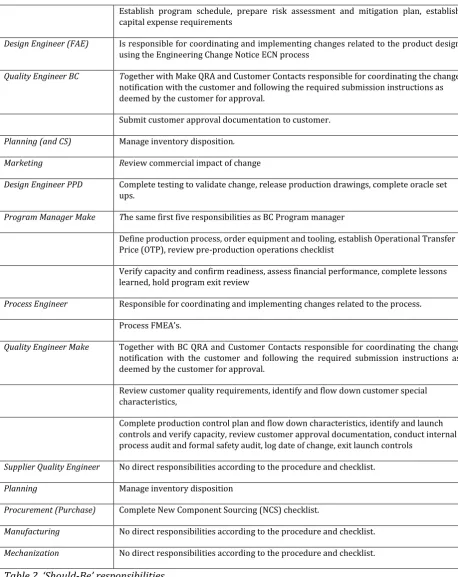
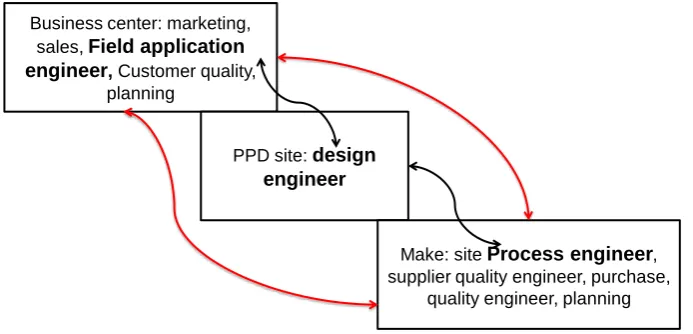
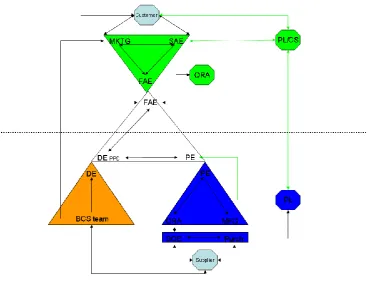
We have to look at the responsibilities that belong to the change procedure and checklist. For the Business Center site in Almelo the following functions are of importance: Program Manager BC, Design Engineer (FAE), Quality Engineer, Planning/Customer Service, and Marketing. For the PPD site there is only one team member that should be involved, the Design engineer. At the Make site the following team members are involved: Program Manager Make, Process engineer, Quality engineer, Supplier quality engineer, Customer service, Planning, Procurement (Purchasing), Marketing, Manufacturing, and Mechanization. In the table below the responsibilities are listed per function.
Program manager BC Selecting the appropriate change management checklist (CCL) for the change
management (CM) program, generally this would be the based on the industry where the product will be used (automotive/commercial or aerospace/commercial),
Initiating and preparing the Change Justification Form (CJF) for each change (BC for BC site changes),
Defining the Change Management Team,
Ensuring the use of the Global Change Management Checklist as a guide to identify and monitor the tasks and team responsibilities for each change, and
Chantal Dekker | Process improvement of the change processes within Sensata Technologies Establish program schedule, prepare risk assessment and mitigation plan, establish capital expense requirements
Design Engineer (FAE) Is responsible for coordinating and implementing changes related to the product design using the Engineering Change Notice ECN process
Quality Engineer BC Together with Make QRA and Customer Contacts responsible for coordinating the change notification with the customer and following the required submission instructions as deemed by the customer for approval.
Submit customer approval documentation to customer.
Planning (and CS) Manage inventory disposition.
Marketing Review commercial impact of change
Design Engineer PPD Complete testing to validate change, release production drawings, complete oracle set ups.
Program Manager Make The same first five responsibilities as BC Program manager
Define production process, order equipment and tooling, establish Operational Transfer Price (OTP), review pre-production operations checklist
Verify capacity and confirm readiness, assess financial performance, complete lessons learned, hold program exit review
Process Engineer Responsible for coordinating and implementing changes related to the process.
Process FMEA’s.
Quality Engineer Make Together with BC QRA and Customer Contacts responsible for coordinating the change notification with the customer and following the required submission instructions as deemed by the customer for approval.
Review customer quality requirements, identify and flow down customer special characteristics,
Complete production control plan and flow down characteristics, identify and launch controls and verify capacity, review customer approval documentation, conduct internal process audit and formal safety audit, log date of change, exit launch controls
Supplier Quality Engineer No direct responsibilities according to the procedure and checklist.
Planning Manage inventory disposition
Procurement (Purchase) Complete New Component Sourcing (NCS) checklist.
Manufacturing No direct responsibilities according to the procedure and checklist.
[image:28.595.67.526.66.644.2]Mechanization No direct responsibilities according to the procedure and checklist.
Table 2. ‘Should-Be’ responsibilities