CREATIVE SPACE IN ARCHITECTURE
1
Seyyed Ali Nouri
1
Department of Architecture,
2
Sama technical and vocational training collage, Islamic Azad University, Kerm
3
Young Researchers and Elite Club, Kermanshah Branch, Islamic Aza
ARTICLE INFO ABSTRACT
Today more than ever the need to provide
necessary. The main feature of this process is creativity as one of the factors that increase these features, the physical environment. This study aims to enhance creativity and architectural innovation, taking into account the psychology of the environment and the virtues and characteristics of the physical environment, to create stimulating environment for creative architects are free of thought and expression. The choice of case study research strategy us
techniques to study, which is required after the secondary literature review for research was obtained through semi
evaluated and stimul
personal and group conflicts with the space (collective creative environment) as drivers of creativity, mining and theoretical principles derived from scientific studies the i
qualitative, effective design offered in order to solve the problem.
Copyright©2017, Seyyed Ali Nouri et al. This is an open access article distributed under the Creative Commons Att use, distribution, and reproduction in any medium, provided the original work is properly cited.
INTRODUCTION
Today, all human progress depends on successfully and fertile ideas, dynamic and effective and is the most complex and creative thinking in the highest manifestation of human thought. Creativity as one of the most important factors for the creation of architecture has been focused training and creativity, needless to say creating innovative designs of one of the most important parameter is to measure the success of architects in the field of architecture having a clear picture of the nature and may or may develop in the future of architectural creativity can be very effective. One way to foster creativity is due to the learning environment. The rise and prosperity requires environmental conditions and the result of interaction between the artist and the environment. With the advancement of science in the 1950s and 1960s approaches in the interpretation of human behavior with their surroundings were so inseparable that people but was not actually the operating environment and the operating environment in the behavior of individuals. This approach in a dynamic and constantly change the relationship human relationship to the environment and can define different levels of relationship between humans and the environment. Psychology and
*Corresponding author: Mina Ganji Morad,
Young Researchers and Elite Club, Kermanshah Branch, Islamic Azad University, Kermanshah, Iran.
ISSN: 0975-833X
Citation: Seyyed Ali Nouri, Sahar Khodabakhshi and Mina Ganji Morad,
Research, 9, (08), 56166-56172.
Available online at http://www.journal
Key words:
Creativity, Physical features, Places of architectural education.
Article History:
Received 10th May, 2017 Received in revised form 19th June, 2017
Accepted 16th July, 2017 Published online 31st August, 2017
RESEARCH ARTICLE
CREATIVE SPACE IN ARCHITECTURE
Nouri,
2Sahar Khodabakhshi and *
,3Mina Ganji Morad
Department of Architecture, North Tehran Branch, Islamic Azad University, Tehran, Iran
technical and vocational training collage, Islamic Azad University, Kermanshah branch, Kermanshah, Iran
Young Researchers and Elite Club, Kermanshah Branch, Islamic Azad University, Kermanshah, Iran
ABSTRACT
Today more than ever the need to provide reproductive potential growth and architects seem necessary. The main feature of this process is creativity as one of the factors that increase these features, the physical environment. This study aims to enhance creativity and architectural innovation, king into account the psychology of the environment and the virtues and characteristics of the physical environment, to create stimulating environment for creative architects are free of thought and expression. The choice of case study research strategy using a combination of strategies and techniques to study, which is required after the secondary literature review for research was obtained through semi-structured interviews and results, through the narrative analysis the concepts were evaluated and stimulating natural elements, diversity and flexibility, aesthetic characteristics and personal and group conflicts with the space (collective creative environment) as drivers of creativity, mining and theoretical principles derived from scientific studies the i
qualitative, effective design offered in order to solve the problem.
is an open access article distributed under the Creative Commons Attribution License, which use, distribution, and reproduction in any medium, provided the original work is properly cited.
Today, all human progress depends on successfully and fertile ideas, dynamic and effective and is the most complex and creative thinking in the highest manifestation of human thought. Creativity as one of the most important factors for the itecture has been focused training and creativity, needless to say creating innovative designs of one of the most important parameter is to measure the success of architects in the field of architecture having a clear picture of develop in the future of architectural creativity can be very effective. One way to foster creativity is due to the learning environment. The rise and prosperity requires environmental conditions and the result of vironment. With the advancement of science in the 1950s and 1960s approaches in the interpretation of human behavior with their surroundings were so inseparable that people but was not actually the operating environment and the operating environment in the behavior of individuals. This approach in a dynamic and constantly change the relationship human relationship to the environment and can define different levels of relationship between humans and the environment. Psychology and
Young Researchers and Elite Club, Kermanshah Branch, Islamic Azad
Thinkers believe that quality of architecture can provide an opportunity for imagination and the underlying formation is a creative place. As we know, always learning environments and spaces must appropriate form of required human behavior. The main disadvantage of the existing education system today is not how to teach their students the capacity and capability by their intelligence and trained "largely "produced by confined spaces that are not desirable of the structure and function . With the development of technology and changes in the education system and the lack of consideration academic educational psychology in space environment archi community has been faced with numerous problems. The results indicate that most students do not complete satisfaction of the educational environment and the lack of appropriate educational environment full of creativity, the architects into the world of mystery and is a follower. The consequences of these disorders can be in city walls and streets of Iran today. If we look at the past three decades realistically, we will see in Architectural works ever made will not exceed the count fingers at a trace of the presence of other works of thought influential and innovative creativity cannot be seen.As a result, the need for an architectural space has been strongly felt components and drivers of creativity and attention to the topic in this direction is necessary in environmental psychology in the design. When a set of psychological characteristics are all living space marks. The aim of what is involved in this study to identify factors affecting the physical and spatial International Journal of Current Research
Vol. 9, Issue, 08, pp.56166-56172, August, 2017
Seyyed Ali Nouri, Sahar Khodabakhshi and Mina Ganji Morad, 2017. “Creative space in architecture
Available online at http://www.journalcra.com
Mina Ganji Morad
c Azad University, Tehran, Iran
anshah branch, Kermanshah, Iran
d University, Kermanshah, Iran
reproductive potential growth and architects seem necessary. The main feature of this process is creativity as one of the factors that increase these features, the physical environment. This study aims to enhance creativity and architectural innovation, king into account the psychology of the environment and the virtues and characteristics of the physical environment, to create stimulating environment for creative architects are free of thought and ing a combination of strategies and techniques to study, which is required after the secondary literature review for research was obtained structured interviews and results, through the narrative analysis the concepts were ating natural elements, diversity and flexibility, aesthetic characteristics and personal and group conflicts with the space (collective creative environment) as drivers of creativity, mining and theoretical principles derived from scientific studies the information gathered is
ribution License, which permits unrestricted
Thinkers believe that quality of architecture can provide an opportunity for imagination and the underlying formation is a As we know, always learning environments and spaces must appropriate form of required human behavior. The main disadvantage of the existing education system today is not how to teach their students the capacity and capability by ned "largely "produced by confined spaces that are not desirable of the structure and function . With the development of technology and changes in the education system and the lack of consideration academic educational psychology in space environment architectural community has been faced with numerous problems. The results indicate that most students do not complete satisfaction of the educational environment and the lack of appropriate educational environment full of creativity, the architects into rld of mystery and is a follower. The consequences of these disorders can be in city walls and streets of Iran today. If we look at the past three decades realistically, we will see in Architectural works ever made will not exceed the count ace of the presence of other works of thought influential and innovative creativity cannot be seen.As a result, the need for an architectural space has been strongly felt components and drivers of creativity and attention to the topic necessary in environmental psychology in the design. When a set of psychological characteristics are all living space marks. The aim of what is involved in this study to identify factors affecting the physical and spatial
INTERNATIONAL JOURNAL OF CURRENT RESEARCH
characteristics of creativity and the architectural approach to design a place that in order to grow architectural creativity and the quality of architectural creativity of the architectural design brought to perfection and fragility of today's architecture heal. And to answer the question of how an architect can design a place that the body of the cutter creativity and help create innovative designs? This question stems from the basic premise that promote creativity a result of the interaction architect added to the physical environment and in that context the ideas and thoughts of the mind and heart of the current artist gets drunk on power and start to create. In this regard, the answer to the first principles of environmental psychology, relying on the needs of creative search, study and were interviewed, and the drivers are provided in the form of scientific results, which are outlined below.
Concepts, perspectives and Theoretical basis
Creativity and the factors affecting it
In general, there are many definitions for creativity. One of the most widely accepted definition is provided by Amabile says: "The creativity is a new ideas and useful in all fields" (Amabile, 1983). Creativity key word in explaining the process design and creative education in all areas of design are considered. Recognition and understanding of the definition can be more creative and more successful in achieving the lead architectural design process. Creativity is one of the main directions of research artistic phenomenon is concerned. Of course, any change that occurs in contemporary art, the creativity and psychological motivators are always put at the center of debate. It can be said basically the same creativity and performance art is a profound educational effect that the average fresh look at the person and his relationship with humans and other objects and forced him to revise research and find new ways of analyzing new solutions. In addition the emergence of artistic creativity as creativity in other fields of science and education need help and involvement of some subjective and dependent on environmental factors (Saif, 1995). High creativity and passive knowledge of a special place in the minds of the creators. Hence every artist in a way appropriate to the characteristics of his art, it is very important to stimulate and reproductive counts (Khiabanian, 2011). Explore the components of creativity makes it clear that creativity is not a personality trait that no change is latent in man, but one of the issues that is quite affected or obstacles
strengthened, weakened or even destroyed. Some
circumstances provide grounds for the emergence and spread of creativity, while some situations in the creative fields dried human existence. In a general classification can divided factors to influencing individual creativity into two general categories (internal) and environmental (extrinsic). Individual factors or internal factors that personal characteristics and personality are due to external environmental factors or are related to situations where a person is placed in relation to others or the environment (Khorushi, 2010). Creative applied environmental factor is the most important factor of production. From the perspective of behavioral psychology-oriented activity and creative behavior in the chain of triggers and responses can be searched and analyzed. Creativity, behavior that is learned from the environment and is affected by environmental conditions. Creative environment stimulates people and people who are ready to receive these stimulants are creative responses "(Jahani, 2009). Creativity in Public talent is human-like intelligence and memory-and everyone is more or less
creative natural talent in terms of the environment and other conditions more or less favorable environment for creativity. There are favorable environments for creativity would flourish, grow and expand it. There are other areas where the greatest potential for creativity, there cannot occur (Bessis and Hobert, 2000).
Creativity is creativity that led to the creation of a new element. Mahdavinejad studies showed that students develop creativity and creativity for many learners strategy suggested in this research operating environment as the most important factor is the formation of creative ideas. In this approach, the environment, conditions and the formation of a work of art placed in the spotlight. Interested in this attitude believe that the most important factor in the formation of ideas is creative and practical ideas without the possibility of forming a creative
environment and promotion of creativity there are
(Mahdavinejad, 2005). Because of this factor, "the environment" as a contributing factor in the creative process is intended.
The fundamental concepts of human behavior and environment
[image:2.595.336.514.653.783.2]The term has different meanings environment that allows you to reach a unified definition of it difficult. Oxford dictionary definition of the scope or terms defined its environment is that every phenomenon or living or working in it. Environment and everything around it, is the potential for a person associated with the refers (Pour Jafar, Sadeqi, 2008). In psychology, environment, human environment within his behavior and activities, and they introduced it as a physical headquarters. In this view, the underlying assumption is that human behavior and experience regardless of ambient conditions cannot be examined separately (Mortazavi, 1997). Environment includes a set of behavioral headquarters are located inside each other and put together common ground. These are then behavior has two basic elements, a typical pattern of behavior and a physical environment (Barker, 1968) Physical structure space the body is comprised of interrelated levels and specific pattern of open and closed spaces, buildings, rooms and layout of the space (Lang, 2002).In fact, individual experiences in life and business skills that are related to environmental conditions and the interaction between the individual and the environment in which it lives encourage. The opportunity and the impact of man behavior puts (Rahbarimanesh, Rahmatzadeh, 2012). An environment where people are doing their programs and activities, with the interrelations is mutual, people affect the environment and people affect the environment. In this regard perception on how the environment affects space activities (Daneshgar Moghadam, 2001: 29).
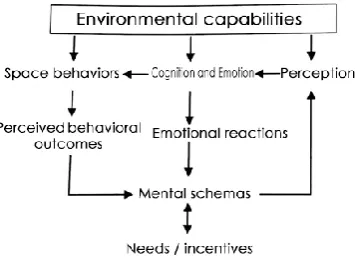
Environment to meet human experience and behavior of potential there. The basic process of human interaction and the environment is shown in the following figure.Although the perception of different opinions is about the existing reference and there is no discussion in this regard but the accepted conventional approach in this regard is the common way of expressing this is that how the senses to the environment and the place where they are to react. This is based on the rate of exchange of the interaction of people and the environment implies (Daneshgar, 2012:30).
Educational facilities and Importance of Environmental Psychology
Environmental education is one of the areas of architectural space that plays a major role in a community. The role of education in the development of education is undeniable. Since education is a space that belongs to several people and people with different social roles are shared something very striking in design. Social behavior does not occur in a vacuum, so many ways of social behavior is related to the physical environment. Social interactions in the natural environment and on the other hand actually reflect the same behavior can be traced to the
physical world (Kamelnia, 2009). Physical learning
[image:3.595.49.266.444.522.2]environment and is a cultural and social context in which learning takes place. Perception of how a learning environment that effectively is essential to design an architectural environment (Mozafar, Mehri Zadeh, Mir Moradi, 2009). "Washburn" is one of the pioneers and experts in the area of education and learning, believes that in order to understand how a proper learning environment, need to identify factors influencing the learning process. These factors is expressed in the following diagram (Gregory, 2007).
Figure 2. Conceptual framework of architecture educational environment (akrami, 2008)
Therefore, according to this view, architecture educational environment as a factor and perhaps the most efficient learning process, and should also interact with the physical environment and the social environment only if and deep relationship with the environment that needs experience training will be fulfilled (Gregori, 2007). By understanding the thoughts and ideas of architectural space training to the conclusion that the architecture of these spaces can be a stimulus for learning or learning a silent killer (akrami, 2008). Learn the central part of the life of every person. Even when we do not think it will happen, with the understanding that behavior does not occur in a vacuum, so many ways of behavior is related to the physical environment. The learning environment will be formed from the components and elements that are meaningful together. Features and qualities of each of these elements are effective in shaping behavior different (Lotf Ata, 2008).
The role of the physical environment to foster creativity in educational space
One of the most influential factors in the development of creative behavior after intrinsic factor, the environment and
environmental factors. "Earnest Will" believes that one important method of crystallizing a creativity stimulus space, numerous and generally creative, he believes that the creation of a creative environment to offer new ideas and original is the most important factor (Saeedikia, 2006, 52) has been shown in research that changes in an underlying physical space and foundation for changes behavior in these spaces, and consequently if this change to the shape and enhance creativity is formed, will be able to strengthen the innovative behavior (dul, 2011). "Woodman" physical environment as an influence the underlying knows (Woodman, 1993). Martens believes that the physical environment can be effective incentives to work and the creative process and change (Martens, 2011). If layering of a creative learning environment we provide, it should be said at the highest level, the physical environment is training as container supports all behaviors into space. At the lower level of the physical environment, organizational structure and office, which oversees the training environment and the social environment as the active medium on factors effect on creativity (Kaplan, 2006 Azafhmy quotes, 2013, 133). Relations between the workplace and the physical space as a receptacle for nurturing creativity or fragments in a physical environment that can enhance the work environment and individual creativity as well as effective cooperation between creative groups, is a very important issue In research It is known that changes in the physical space of the substrate and a fundamental behavioral change in these spaces, and consequently if this change to the shape formed and strengthened the creative, innovative will be able to strengthen behavior in the both aspect (Dul, 2011). But despite showing the importance of this organizing the physical environment, there is always the question of how physical space environment can increase our creativity and how it can help us to communicate? This case is not only our educational space, work space, but we will in the future also under the impact. Because creativity and its components in the future world will be transformed into the most important and the most attention (Afhami, 2012, 134). Various research on the influence of the physical environment to promote creativity shows each independently of environmental factors included an increase in the growth of creativity. One of the most important in the beginning to design creative environment focused on various aspects of it. In many public research in this area, on a broader level work such as managing creativity and social environment, politics and culture of the organization's work, but at this stage focus on the physical aspects of the environment is very important. Physical factors can be defined as a group of elements of the tangible and visible in the space that has two functions are, in the first dimension suppliers need physical space to fulfill its functions should be considered and the second new approach in order to have creativity (Afhami, 2012,134).
Research Methodology
formed and 40 of which were selected randomly and were asked of their mental vision about the features of a physical space for the development of architectural education and architectural creativity to bring innovative designs on paper. Finally, the results of interviews validity was evaluated through analysis and scientific study factors obtained after architectural approach to create a creative environment in order to solve the problem presented.
RESULTS AND DISCUSSION
[image:4.595.40.288.272.428.2]Since the population interviewed in different age groups and have graduated from different universities were different views in size and diversity. The views were scattered in the form of declarative sentences sorted in Table 1 are some examples of these statements.
Table 1. Items of interviews with architects (Source: author)
Percent Proposition
85% Connection between elements inside and outside the
natural elements so that the human sense of natural space in the building become fresh
76% The use of natural elements (plants, water, light, etc.) and
create an atmosphere favorable
59% Some space in such a way that its students can
manipulate it and create a different perspective.
53% Visibility around and interact with the environment, and
provide visibility
32% Spaces in a way that creates a sense of space
65% Atelier and communication spaces in a way that enhances
communication and social interaction
43% Contrast the use of natural and artificial light in space
16% Use appropriate colors and textures using the
psychological factor
Statements obtained was analyzed several times and data encryption to achieve this through to a conclusion. Then all this was title propositions for each statement, so that a representative and identify the statements and eventually led to the concepts of the categories mentioned in table (2) is referred to it.
Results derived from interviews to confirm the accuracy of scientific study through attitude was theorists and architectural solutions were introduced for continuing to pay its description.
The diversity and flexibility of space
According to the results of the interview, according to architects factor "spatial diversity and flexibility" would be more than other factors on the development of architectural creativity in an educational environment for effective architectural merit. Literally means of coordination with the situation and all environments (Moien, 1992) and in general
the ability to change bodies and objects is said to be (Eini Far,2003) and in architectural and design and specifically in the design of educational space the term flexibility, organize man-made climate change is to achieve the conditions, needs and new data (Alaghebandrad, 2003). It's all psychologists agree that the motivation factor that stimulates the person's behavior will lead to certain (Murray, 1975). The internal and external factors motivating or discouraging effective. But it should be noted that external motivation of incentives and environmental consequences, so the environment as one of the motivating factors, different needs of individuals and their differences must be held accountable (Marshall Rio, 2008). One of the biggest components according to user-centric environment to creativity and the ability to change the setting by the user according to your liking (Afhami, 2012). An environment that would encourage users to navigate and explore the space and curiosity could provoke him on the creativity of individuals (Greuther, 1996). The environment should be easily changeable and flexible to respond and suitable for individuals and their changing needs and provide different locations (Shaterian, 2008). With space diversity in inclusive education environments to compare and understand their similarities and differences and the uniformity of intelligence Perth that undermines mental and intellectual faculties (Alexander, 2002). Due to the dynamic environment that is flexible, adaptive and positive charge, despite having different experiences in different people. This means that the environment should be of sufficient compatibility and the ability to change the inevitable changes in its components benefit, so that to be able to survive. In to this view, the physical space of, not only a dry environment lifeless and without impact on the learning process is not alive, but as a factor in the quality of educational activities, admitted to respond to the need for flexibility in humans (Mardomo, Dlsha, 2010). Space education need to levels many students and answer their mood and all of them inside a wide range of spatial diversity rather than Dhnd. Asthis all helps to meet your needs, introvert or extrovert working environment according to their own spirit and this spirit through small External stimuli,
could be the best space that it creates a sense of friendship and intimacy meet (gahhagherT1993). Space diversity and flexibility of spaces, motivated researchers to increase the presence in that space is clear if designed atmospheres and in every corner of it designed the space, there is a special atmosphere, you can taste a wider variety of covers (Bisady, Mozafar, Hosseini, 2012).
Stimulating the natural elements
Nature impact in nurturing creativity is undeniable, so that it can be searched for traces of it in the study of creativity
Table 2. The findings of the Environmental Triggers contributing to the enhancement of creativity (Source: author)
Dependent variable Independent Variable
Creati
v
ity
Stimulating creativity in study
Triggers findings on effective promotion of creativity Envir
on
m
enta
l
fa
ctors
Stimulating the natural elements Diversity and flexibility
The role of aesthetic characteristics Color
Light
Unusual aesthetic space
[image:4.595.53.550.540.639.2](Antoniadis, 2002, 401) Perhaps we can say that all creative people, living in nature as an inspiration for effective counting (The same. 402). As a creative individual contestants are sensitive to sensory experience (Barron, 1969; MacKinnon, 1962T quoted mac coy & Evans, 2002) of multiple sensory stimuli in the natural elements to be creative behavior (Ackerrman, 1991; Ulrich1993 to quotes mac coy, 2002). And in relation to the nature of the information, sensitive and aware of the environment (Acer, 2013). Nature and mysterious existence are full of spaces that at any given moment. So mobile people to think about the architecture of nature, natural human space enables to use as the basis for activation think
[image:5.595.50.551.69.181.2](Shafie Arestani quoted by Majed, 2008, 71). Create the perspective of the natural environment in the development of effective creativity (McCoy and Evans, 2002 quoted by Khorrami and others 2014). Even indoor plants affect the mood and the creative process (Shibata and Suzuki, 2004 quoted by Khorrami and others 2014). Exposure to nature, is an important part of the process of helping mental health and mental clarity, self-confidence and independence helps people. Proximity to nature reduces stress and increases efficiency. One of the main focus on the nature of space needed for training in urban environments. It enhances the emotional relationships between human beings. The results show that
Table 3. Solutions in the physical components of diversity and flexibility (source: the author)
Stimulates of creativity Solutions Flexi b le of enviro nm ent Abi lity to res p o n d to ch an gin g co nditions
Factors of flexibility - Multi-functional of spaces
- Live the path of communication and transport space by transforming the narrow corridor to areas to learn
Varia b ility (co nvertibili ty ) Versatili ty (irri tabi lity ) Varia b ility (ex pendabil ity)
- The creation of active and passive activities in the whole collection created by the mass range can be changed using Multifunctional
- Transparency and the possibility to participate in all activities across entire collection while visually - The relationship between inside and outside space along the learning range depending on the half-open and open spaces like terraces
- Devote a lot of space occurred classes for multiple activities - Use flexible and non-fixed furniture
[image:5.595.73.527.213.333.2]- Ability to increase or decrease the space according to the needs of people
Table 4. Physical component solutions stimulating the natural elements (Source: author)
Stimulates of creativity Solutions Stim u latin g o f t he na tu ra l el em ent s Th e abi lity t o enhanc e a se nse o f c ontrol and sel f-es teem and g rowt h -ori en ted be h avior Factors of flexibility -Zoom in and respect for the environment through the reflection in the water
-Link separate elements in architecture by the streams of water
Sun Inst allat ions Wind Wate r
-Create cascades and the waterfront as part of the architecture for a closer relationship between man and environment
-Absorb noise in the environment due to the presence of water.
-Bringing water to the environment and create a sense of comfort, dynamism and ferment -Create a central atrium in the building and move and exist plants indoors to reduce the stress and tensions within the environment
- Exposure to nature through the creation of open and semi-open space and merge with nature. -Create large windows, allowing visual connection with nature
-Allow sense of being in a safe place created by the natural landscape
Table 5. Solutions of aesthetic structural components (source: the author)
Stimulates of creativity Solutions Aesthet ic s Be autifu l b u ildings, ple asin g and u n u sual s p ace effic ient in stim ulat ing flexibility factors Use the yellow, orange, light beige, light green and blue colors training classes to infuse a sense of creativity
Dispersion of light in space Use the window at all levels, using high aperture reflection of
light from surfaces and objects around, conscious alignment equipment, lighting and the type of surface
Colo r Natu ral lig h t Unu su al aest hetic s p ace
Avoid reflections and glare light as much as possible
Control glare and reflection through the curtains, shutters and materials and prevent its negative effects on learners
The correct placement for optimum use of space with the use of natural lighting Due to the amount of natural light throughout the day at
different times
Use a variety of static and dynamic space that could encourage learner to discover. Preferred create environments using a combination of readability, mystery. Creating Space charm with more attention to the environment and landscape Increasing curiosity by creating complexity in building volume
The use of curved form as one of the most important factors in creating peace of mind and creativity
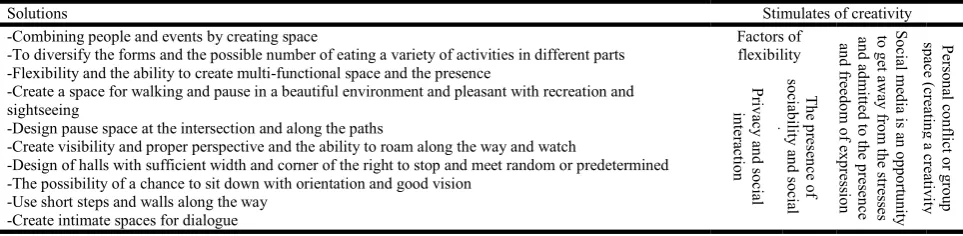
Table 6. Solutions in the physical components of personal involvement and group space (source: the author)
Stimulates of creativity Solutions Perso n al c o nf lict or grou p space (cr eati n g a crea tiv ity Soc ial me d
ia is a
n opp o rt uni ty to get awa y fr o m the st ress es and adm itte d to t he p res ence and fr eed o m o f e xpress ion Factors of flexibility -Combining people and events by creating space
-To diversify the forms and the possible number of eating a variety of activities in different parts
Th e p rese n ce of socia b ility a nd soci al envi ro nm en ts Pr iv acy a n d soci al inte ra ction
-Flexibility and the ability to create multi-functional space and the presence
-Create a space for walking and pause in a beautiful environment and pleasant with recreation and sightseeing
-Design pause space at the intersection and along the paths
-Create visibility and proper perspective and the ability to roam along the way and watch
-Design of halls with sufficient width and corner of the right to stop and meet random or predetermined -The possibility of a chance to sit down with orientation and good vision
[image:5.595.64.563.364.504.2] [image:5.595.58.540.535.653.2]learners prefer to become associated with the environment and have permission to intervene and understand it and the other visual connection with the natural environment is one of the most essential training in the design space is (Kaplan, 2004). The natural environment is much unexpected role in the process of developing mental clarity (Kaplan, 1977).
Aesthetic characteristics
Color
Perhaps the most obvious way to attract students and enhance learning and stimulate their creativity, use of color, materials and textures. With the stimulation of all the senses, stimulate learning and learning a variety of large-scale (Taylor, 1975). This a fact that color on the body, mind and spirit of those great effects. Color is perfect for classrooms can reduce anxiety, apprehension and promote a sense of wellbeing. According to "Lioyd" loud colors foster big ideas in mind. The research group Communicative international survey carried out on behalf of Xerox Canada, eighty percent of the participants have acknowledged that they can color in the environment enhances creativity and new thinking in spite of their dreams (Afhami, 2012, 141). Wexner among the students did a study in 1954 and concluded that affect students of color on mood states (Tabatabaian et al, 2011). A coloring agent as an agent for lightness and enjoy effective internal spatial perception and absence of color, as an aspect of the environment is negative. Studies have shown that people with the presence of more than three San in a colorful room, arousal higher, more relaxed and have won higher levels of emotional ability (Gallagher, 1999).
Light
Natural lighting is one of the important factors in the design of high-quality education space and memory observant and non-observant significant impact on people. Also because of ultraviolet light on one of the factors causing natural rhythm systems biological studies have shown students and scholars in an environment of natural lighting clearly will have a better performance. The use of daylight in the communication space with nature and reduce anxiety will follow (Akbari, 2006). Traditional architects of modern, more light, and the dimensions are considered from the perspective of aesthetics, space, landscape and clear focus, but improved educational space, the dimensions are more willing to mentally stimulating factor (Gallagher, 1999).
Unusual aesthetic space
Beautiful buildings, pleasing and unusual spaces is very efficient in stimulating creativity. Of course, this means creating a building design process is not diverse, the need for spatial variation in the whole space of no importance and only space unusual new small-scale change in relation to learners with space and the space transformation during the short period of time will also be able to experience a very important factor in raising curiosity and creativity become (Gump, 1974). The environment must be new data show a change in perspective. Landscape that has remained hidden from view for a long time and contains information that can understand it differently, raising curiosity and fluidity increases in problem-solving and providing new perspective on them open (Kaplan, 1983). Preferred environment should be a combination of
readability, mystery and a haven for activities. As defined understanding of space and mystery, additional information on the form in which to explore, the ability to achieve it you'll have (Balling, 1982). A stronger relationship between aesthetic understanding of space and there are emotional reactions and low satisfaction with the quality of the environment, to quickly deal of discontent within the physical or environmental stress occurs (Afhami, 2012, 157).
Personal or group conflict with space (social interaction)
Social media a chance to get away from stress, social interaction and meeting people and groups and admission to attend, freedom of expression and its instrument in space (Sennette, 1974,215) interaction of creativity that a lot of effective physical space (Natyhaily, 1996). Potential in an environment, makes up unforeseen activities. These activities take place in the environment because of the new nature, a creative activity that gave birth to it in a public space, the creative is. The amount and type of community engagement has a positive impact on the creative process (hornecker, 2005) Paolus Studies (2000) acknowledged the creativity of individuals working together for mutual influence on each other ideas flourish (Shafaie, Madani, 2009). Freedom of capacity and capabilities in a collaborative environment occurs and causes a synergistic effect on society is people's creativity and ultimately achieve a creative layout makes it possible (Sharifian, Jahani 2013). According to surveys conducted studies and spatial characteristics stimulating the natural elements, diversity and flexibility, aesthetic characteristics and personal and group conflicts with the space (collective creative environment) can provide the necessary conditions for the development of creativity and design learners in a learning environment architecture provides creative and innovative creations for its ability to facilitate library should refresh the basis of this scientific survey conducted physical suggestions to solve the problem presented in the following tables they have been considered:
Conclusion
REFERENCES
Afhami. Reza (creative educational spaces designed to improve the quality of training. Tehran: the modernization, development and equipping schools.
Akrami, Gholamreza. 2003. Definition of architecture, the first step is education (the challenges and contradictions) magazine of aesthetic art. NO.16. Pp 33-48.
Alexander, Christopher 2002. Architecture and the secret of immortality, Tehran, Shahid Beheshti University
Amabile, Teresa M. 2012. Componential theory of Creativity, Harvard Business School (Pdf )Versio
Antoniads. Antony C 2002. Architectural poetics, translated by Ahmad Reza Ay. Tehran: the publication of Soroush. Bysadi, Mona, Mozafar, Farhang, Hosseini, Seyed Bagher
2012. Spatial characteristics influencing creativity
researchers of architecture and urban studies, Journal of Technology Education, Volume 7, Number 3
Daneshgar Moghadam, Golrokh.bahrainy, Syed Hossein.Eini Far, Alireza. 2011. Social analysis of the physical environment affects human perception of nature in art.Publication of honaryaye ziba, No 45.Pp 25-36
Gallagher, Winifred. 1993. The Power of Place: How Our Surroundings Shape Our Thoughts, Emotions and Actions. New York: Poseidon Press.
Greuther, Jorg Kurt 1996. Aesthetic in architecture, Translator: Jahanshah Pakzad, Publications Center of Shahid Beheshti University, Tehran
Gump, Paul V. 1974. “Operating Environments in Open and Traditional Schools,” The SchoolReview, Augustno. 84, pp. 575-593.
Hornecker Eva., Space and Place –Setting Stage for Social Interaction, universiting of Sussex, 2005.
Jahani. Jaafar 2009. Trining creativity of the idea to act.Tehran: Institute of Social and Cultural Studies.
Kamelnia. Hamed 2009. Design language environments learning instruction. Tehran: Sobhan Noor. Second publication
Kaplan, Rachel. 1983. “The Role of Nature in the Urban Context.” In Altman, I, and J F Wohlwill, Editors. Human Behavior and Environment: Vol. 6: Behavior and the Natural Environment. NewYork: Plenum, pp. 127-161.
Khiabanian, Ali. 2011. Creativity in the architectural design process.
Khorrami, Fatemeh. Ghafoorian. Yazdanfar.Moti, Shima 2014. The second International Congress of architecture, structure and development urbans. Iran. Tabriz.
Khorushi, Pooran. 2010. A review of the concepts of creativity and innovation to strengthen and weaken it in knowledge. Third Conference of Creativity (TRIZ) engineering and management and innovation in Iran.
Lang, J. 2002. The creation of architectural theory: the role of behavioral science in environmental design. Translated by Y, Eini far. Tehran: Tehran University Press.
Mahdavi Nejad, Mohammad Javad. 2005. Creation and creative learning process, Honarhaye Zyba Publication. No.21.Pp66-57
Mardomi, Karim. Delshad, Mahsa. 2010. Flexible learning environments. Scientific Research Society of Architecture and Urbanism.Iran.No.1.Pp109-118.
Marshall Rio, John 1999. Motivation and excitement, Translator: Yahya Seyed Mehdi, publication of Virayesh, Tehran.
Mccoy M., Evans. J. and Gary W. 2002. The Potential Role of the Physical Environment in Fostering Creativity, Creativity Research Journal, Vol .14, No.3.
Mortazavi. Shahnaz 1997. Educational spaces from
psychologist’s view. Tehran: Schools Renovation
Organization
Rapoport, Amos 2005.Means of built environment, translated by Farah Habib. Tehran: Processing and city
Saif, Ali Akbar 2005. Educational psychology (Psychology of Learning and Teaching).Sixth edit. Tehran: Agah
Shafaie, Minoo, Madani, Ramin 2010. Children's educational space design principles based on the model of Technology, Shaterian, Reza. 2011.Design and architectural space, second
publish, Simaye danesh publication
Shibata S.andSuzuki N. 2004. Effects of an Indoor Plant on
Creative task Performance and Mood, Scanned g Psyched,
Vol.45, No.5.
Tabatabaeian, Seyede Marzieh et al. 2011. Viewpoints of high school weights favorable and unfavorable learning environment and ways to improve the quality of the color space innovations, No.38, Pp93-106