EFFECT OF VARIOUS SUBSTRATE STERILIZATION METHODS AND AGE OF SPAWN ON THE
GROWTH AND BIOEFFICIENCY OF
Kathir
Department of Biochemistry, Kongunadu Arts and Science College (Autonomous),
ARTICLE INFO ABSTRACT
This study was designed to investigate the effect of various substrate sterilization methods and age of spawn on the growth and bioefficiency of
florida
days were chosen for the study. The processed paddy straw substrate was used for preparing the mushroom beds. The substrate was sterilized using three different methods viz. chemical, boiling water and steam. The days for spawn run, days for pin headed appearance, days for first harvest, second harvest and third harvest, yield in first harvest, second harvest and third harvest were observed and recorded. All the parameters were compared and results
sterilized by steam gave better results with fast and optimum growth followed by boiling water sterilization. Chemically sterilized substrate gave low yield compared to other substrates. Among the different age of spawn u
spawn inoculated beds gave low yield than others. Accordingly, bioefficiency was also high in steam sterilized substrate followed by boiling water sterilization and chemical steriliz
confirmed that steam sterilized substrate and 35 days spawn are very appropriate for the cultivation of white oyster mushroom,
Copyright©2016, Kathiravan and Krishnakumari. This
unrestricted use, distribution, and reproduction in any medium, provided the original work is properly cited.
INTRODUCTION
Fungi is one of the most prominent and biodiverse organism to inhabit and influence this planet. The number of fungi recorded in India exceeds 27,000 species, the largest biotic community after insects (Sarbhoy et al., 1996). Fungi are present almost everywhere and they are important in ecosystems because they are able to biodegrade the substrate (Falandysz
Manzi et al., 2001). Fungi can exploit marginal living conditions in large part because they produce unusual enzymes capable of performing chemically difficult reactions (Viswanath et al., 2008; Shraddha et al., 2011). A mushroom is a macrofungus with a distinctive fleshy fruiting body that can be either hypogeous (underground) or epigeous (above ground), large enough to be picked up by han
2001). Most mushrooms require lignocellulosic substrates for growth. Fortunately, lignocellulosic substrates are very abundant in our forest ecosystems, in our woodlands, in our grasslands, and in the wide spectrum of agricultura
*Corresponding author: Krishnakumari, S.
Department of Biochemistry, Kongunadu Arts and Science College (Autonomous), Coimbatore – 641 029, Tamil Nadu, India
ISSN: 0975-833X
Article History:
Received 24th September, 2016
Received in revised form 11th October, 2016
Accepted 22nd November, 2016
Published online 30th December,2016
Key words:
P.florida,
Paddy straw substrate, Age of spawn, Mycelium spreading, Sterilization methods.
Citation: Kathiravan, S. and Krishnakumari, S. 2016
of Pleurotus florida”, International Journal of Current Research,
RESEARCH ARTICLE
EFFECT OF VARIOUS SUBSTRATE STERILIZATION METHODS AND AGE OF SPAWN ON THE
GROWTH AND BIOEFFICIENCY OF
PLEUROTUS FLORIDA
Kathiravan, S. and *Krishnakumari, S.
Department of Biochemistry, Kongunadu Arts and Science College (Autonomous),
Tamil Nadu, India
ABSTRACT
This study was designed to investigate the effect of various substrate sterilization methods and age of spawn on the growth and bioefficiency of Pleurotus florida, white oyster mushroom. The spawn of
florida was prepared from the culture slants. The spawn of varying age viz. 25 days, 35 days and 45
days were chosen for the study. The processed paddy straw substrate was used for preparing the mushroom beds. The substrate was sterilized using three different methods viz. chemical, boiling and steam. The days for spawn run, days for pin headed appearance, days for first harvest, second harvest and third harvest, yield in first harvest, second harvest and third harvest were observed and recorded. All the parameters were compared and results showed that paddy straw substrate sterilized by steam gave better results with fast and optimum growth followed by boiling water sterilization. Chemically sterilized substrate gave low yield compared to other substrates. Among the different age of spawn used, 35 days spawn gave better results compared to 45 days spawn. 25 days spawn inoculated beds gave low yield than others. Accordingly, bioefficiency was also high in steam sterilized substrate followed by boiling water sterilization and chemical steriliz
confirmed that steam sterilized substrate and 35 days spawn are very appropriate for the cultivation of white oyster mushroom, Pleurotus florida.
This is an open access article distributed under the Creative Commons Att use, distribution, and reproduction in any medium, provided the original work is properly cited.
Fungi is one of the most prominent and biodiverse organism to inhabit and influence this planet. The number of fungi recorded in India exceeds 27,000 species, the largest biotic community , 1996). Fungi are present almost where and they are important in ecosystems because they are able to biodegrade the substrate (Falandysz et al., 2001; , 2001). Fungi can exploit marginal living conditions in large part because they produce unusual enzymes chemically difficult reactions ., 2011). A mushroom is a macrofungus with a distinctive fleshy fruiting body that can be either hypogeous (underground) or epigeous (above ground), large enough to be picked up by hand (Kirk et al., Most mushrooms require lignocellulosic substrates for growth. Fortunately, lignocellulosic substrates are very abundant in our forest ecosystems, in our woodlands, in our grasslands, and in the wide spectrum of agricultural crop
Department of Biochemistry, Kongunadu Arts and Science College 641 029, Tamil Nadu, India.
residues generated by our farmers, which are often discarded as waste. Mushroom enzymes can break down lignin, cellulose, and hemicelluloses present in these organic materials into simpler molecules, which the mushrooms then use their growth and metabolism (Ch
use of mushrooms is totally different from traditional because, lot of research has been done on the chemical composition of mushrooms, which revealed that mushrooms can be used as a diet to combat diseases. The early history
mushrooms in different countries has been reviewed by number of workers (Buller, 1915; Rolfe, 1925; Singer, 1961). Edible mushrooms once called the “food of the gods” and still treated as a garnish or delicacy can be taken regularly a of the human diet or be treated as healthy food or as functional food. The extractable products from medicinal mushrooms, designed to supplement the human diet not as regular food, but as the enhancement of health and fitness, can be classified into the category of dietary supplements/mushroom nutraceuticals (Chang and Buswell, 1996). In general, mushrooms are quite high in protein, with an important content of essential amino acid, but low in fat (Mattilda et al
fungi supply a large amount of carbohydrates and fibre and a nutritionally significant content of vitamins (B
D) and mineral elements (Ca, K, Mg, Na, P, Cu, Fe, Mn and
International Journal of Current Research
Vol. 8, Issue, 12, pp.42734-42738, December, 2016
INTERNATIONAL
2016.“Effect of various substrate sterilization methods and age of spawn on the growth and bioefficiency
International Journal of Current Research, 8, (12), 42734-42738.
EFFECT OF VARIOUS SUBSTRATE STERILIZATION METHODS AND AGE OF SPAWN ON THE
PLEUROTUS FLORIDA
Department of Biochemistry, Kongunadu Arts and Science College (Autonomous), Coimbatore – 641 029,
This study was designed to investigate the effect of various substrate sterilization methods and age of white oyster mushroom. The spawn of P.
nts. The spawn of varying age viz. 25 days, 35 days and 45 days were chosen for the study. The processed paddy straw substrate was used for preparing the mushroom beds. The substrate was sterilized using three different methods viz. chemical, boiling and steam. The days for spawn run, days for pin headed appearance, days for first harvest, second harvest and third harvest, yield in first harvest, second harvest and third harvest were observed showed that paddy straw substrate sterilized by steam gave better results with fast and optimum growth followed by boiling water sterilization. Chemically sterilized substrate gave low yield compared to other substrates. Among the sed, 35 days spawn gave better results compared to 45 days spawn. 25 days spawn inoculated beds gave low yield than others. Accordingly, bioefficiency was also high in steam sterilized substrate followed by boiling water sterilization and chemical sterilization. The study confirmed that steam sterilized substrate and 35 days spawn are very appropriate for the cultivation of
under the Creative Commons Attribution License, which permits
generated by our farmers, which are often discarded as waste. Mushroom enzymes can break down lignin, cellulose, and hemicelluloses present in these organic materials into simpler molecules, which the mushrooms then use for (Chang and Miles, 2004). Present use of mushrooms is totally different from traditional because, lot of research has been done on the chemical composition of mushrooms, which revealed that mushrooms can be used as a diet to combat diseases. The early history regarding the use of mushrooms in different countries has been reviewed by number of workers (Buller, 1915; Rolfe, 1925; Singer, 1961). Edible mushrooms once called the “food of the gods” and still treated as a garnish or delicacy can be taken regularly as part of the human diet or be treated as healthy food or as functional food. The extractable products from medicinal mushrooms, designed to supplement the human diet not as regular food, but as the enhancement of health and fitness, can be classified into the category of dietary supplements/mushroom nutraceuticals In general, mushrooms are quite high in protein, with an important content of essential amino
et al., 2001). Furthermore, these upply a large amount of carbohydrates and fibre and a nutritionally significant content of vitamins (B1, B2, B12, C and
D) and mineral elements (Ca, K, Mg, Na, P, Cu, Fe, Mn and INTERNATIONAL JOURNAL OF CURRENT RESEARCH
Se) (Mattilda et al., 2001). Mushrooms also contain many phenols, which are very efficient scavengers of peroxy radicals (Murcia et al., 2002). Phenolic compounds in mushrooms are reported to be excellent antioxidants and synergists that are not mutagenic (Ishikawa et al., 1984). Moreover, their medicinal properties have been reported such as anti-tumour and immunomodulating effects (Ferreira et al., 2010), inhibition of platelet aggregation (Hokama and Hokama, 1981), reduction of blood cholesterol concentrations (Jeong et al., 2010), prevention or alleviation of heart disease and reduction of blood glucose levels (Jeong et al., 2010), and antimicrobial activity (Hirasawa et al., 1999). Some of the mentioned properties are attributed to bioactive products with antioxidant activity such as phenolic compounds (Ferreira et al., 2009; Barros et al., 2009).
The cultivation of edible fungi, commonly called mushrooms, is a true microbial technology and represents large scale controlled application of microbial technology for the profitable conversion of lignocellulosic wastes into food and feed and in the economic terms the importance may be next to the yeast only (Wood, 1989). The genus Pleurotus is now widely consumed as food worldwide. One reason is that oyster mushrooms are by far the easiest and least expensive to grow of all industrially cultivated edible mushrooms. Another reason is that there is a wide choice of species available for cultivation under different climatic conditions. There can be year-round production of the mushrooms using different species or varieties in different seasons (Chang and Miles, 2004).
Pleurotus florida has antioxidant and antitumor activities (Nayana and Janardhanan, 2000; Manpreet et al., 2004),
Pleurotus sajor-caju has hypertensive effects through its active ingredients which affect the rennin-angiotensinsystem (Chang, 1996). Cultivation of the Pleurotus species has increased greatly throughout the world during the last few decades. It is the 3rd largest cultivated mushroom in the world. Its popularity has been increasing due to its ease of cultivation, high yield potential and, high nutritional and medicinal values (Upadhyay, 2011). The present study has been designed to investigate the effect of various substrate sterilization methods and age of spawn on the growth of Pleurotus florida.
MATERIALS AND METHODS
Selection and collection of mushroom culture
In the present study, the mushroom culture of Pleurotus florida was procured from Vijaya mushrooms, Coimbatore, Tamil Nadu, India and used. The cultures were subcultured and stored as agar slants.
Preparation of mushroom spawn (Kathiravan and Krishnakumari, 2015)
The mushroom spawn was prepared on white sorghum grain. The mature grain procured from local market was well cleaned and boiled in water for 30 min. The boiled grain was mixed with 2% calcium carbonate. 300g of calcium carbonate mixed grain was filled in polypropylene bags of size 11 inch x 5 inch and sterilized for 15 psi for one hour. The sterilized bags were cooled to room temperature and inoculated with the mushroom culture maintained in slants. The culture inoculated bags were kept undisturbed at room temperature and taken at different age for the present study.
Cultivation technology of Pleurotus florida (Krishnakumari
et al., 2014)
Paddy straw was chosen as the substrate for cultivation of
P.florida. The cut paddy straw was soaked in water overnight and washed in water thoroughly. Sterilization is being done in three ways. In chemical sterilization of paddy straw, chopped paddy straw was soaked in water containing formalin, bavastin and malathion overnight. In boiling water sterilization, Paddy straw was allowed to boil in water for 45 min. In steam sterilization of substrate, the washed paddy straw was steam sterilized for 45 min and shade dried. The matured spawn of
Pleurotus florida was taken and dispersed carefully in a sterile bowl. The polypropylene bag was taken and initially, a handful of paddy straw was taken and dispersed at the bottom of the bag which forms the first layer. A handful of spawn was taken and dispersed over the first layer of paddy straw. Thus, first layer is made. Next, a layer of paddy straw was made with the spawn spreaded over it. Likewise, alternate layers were made with spawn and paddy straw. The packed bag was tied with the rope and hanged in the mushroom unit for mycelium spreading. The mushroom unit was maintained at a temperature of 18 – 23 °C.
The Bioefficiency of the mushrooms can be calculated using the formula,
Bioefficiency (%) =Yield of fresh mushroom (g)/Total weight of dry substrate used (g) x 100.
Statistical Analysis
Statistical comparison was done at significance level, P<0.05 using SPSS package version 20.0. One way ANOVA followed by DMRT analysis of LSD was performed.
RESULTS AND DISCUSSION
Three different methods of substrate sterilization were followed for the cultivation of white oyster mushroom,
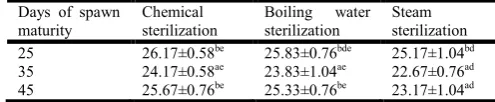
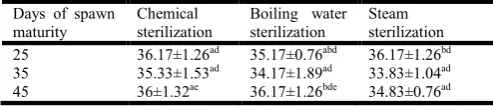
[image:2.595.307.555.676.727.2]Pleurotus florida. The effect of chemical sterilization, boiling water sterilization and steam sterilization was studied along with the three different age of spawn viz. 25 day, 35 day and 45 day on the growth of Pleurotus florida. The days for spawn run, the days for pin headed appearance, the days for first harvest, second harvest, third harvest were recorded and tabulated in Table. 1 & 2. The days of first harvest, second harvest and third harvest obtained in the substrates sterilized by three different methods and three different age group of spawn were tabulated in the Tables.3, 4 and 5.
Table 1. Effect of various substrate sterilization methods and days
of spawn maturity on the days for spawn run of Pleurotus florida
Days of spawn maturity
Chemical sterilization
Boiling water sterilization
Steam sterilization
25 26.17±0.58be 25.83±0.76bde 25.17±1.04bd
35 24.17±0.58ae 23.83±1.04ae 22.67±0.76ad
45 25.67±0.76be 25.33±0.76be 23.17±1.04ad
All the values are expressed as mean ± SD; n=6
beds was found to be significant. Next to the steam sterilized substrate, boiling water sterilized substrate gave better result with days for spawn run ranging from 23.83±1.04days to 25.83±0.76days and followed by chemically sterilized substrate with spawn run ranging from 24.17±0.58 days to 26.17±0.58 days. Mondal et al., 2010 reported 24.25 days for the spawn run of Pleurotus florida in paddy straw substrate comparing which our result is much better in steam sterilized substrate.
Table 2. Effect of various substrate sterilization methods and days of spawn maturity on the days for pin headed appearance of
Pleurotus florida
Days of spawn maturity
Chemical sterilization
Boiling water sterilization
Steam sterilization
25 27.67±0.76bd 27.67±1.04bd 27.17±0.76bd
35 25.83±0.76ae 25.17±1.04ade 24.33±0.58ad
45 27±0.5be 27.17±1.04be 24.67±0.76ad
All the values are expressed as mean ± SD; n=6
[image:3.595.37.285.215.267.2]Mean values in the same column followed by different alphabets (a-c) and mean values followed by different alphabets (d-f) in the same row in the superscripts are significantly different (P<0.05, ANOVA, DMRT). The pin headed appearance in the mushroom beds were in accordance with the result obtained in the days of spawn run in all the three substrate sterilization methods and three age group of spawn. The pin heads appeared in the steam sterilized substrate initially and those obtained in the steam sterilized substrates were found to be significant with that of obtained in the chemically sterilized substrate and boiling water sterilized substrate except in the 25 day spawn inoculated beds of substrates sterilized by all the three methods. Similarly, the days of pin head appearance in the 35 day spawn inoculated beds of all three methods of substrate sterilization were found to be significant with that of obtained in the 25 day and 45 day spawn inoculated beds except in the steam sterilized substrate where 35 day and 45 day spawn inoculated beds showed pin heads almost during same days.
Table 3. Effect of various substrate sterilization methods and days
of spawn maturityon the days for first harvest of Pleurotus florida
Days of spawn maturity
Chemical sterilization
Boiling water sterilization
Steam sterilization
25 29.83±0.76bd 29.83±0.76cd 29.83±0.76cd
35 27.83±0.58ae 26.5±1.32ad 26.33±0.58ad
45 28.33±0.29ae 28±1.32bde 27.17±0.76bd
All the values are expressed as mean ± SD; n=6
Mean values in the same column followed by different alphabets (a-c) and mean values followed by different alphabets (d-f) in the same row in the superscripts are significantly different (P<0.05, ANOVA, DMRT).
Table 4. Effect of various substrate sterilization methods and days of spawn maturityon the days for second harvest of
Pleurotus florida
Days of spawn maturity
Chemical sterilization
Boiling water sterilization
Steam sterilization
25 36.17±1.26ad 35.17±0.76abd 36.17±1.26bd
35 35.33±1.53ad 34.17±1.89ad 33.83±1.04ad
45 36±1.32ae 36.17±1.26bde 34.83±0.76ad
All the values are expressed as mean ± SD; n=6
[image:3.595.308.564.359.541.2]Mean values in the same column followed by different alphabets (a-c) and mean values followed by different alphabets (d-f) in the same row in the superscripts are significantly different (P<0.05, ANOVA, DMRT).
Table 5. Effect of various substrate sterilization methods and days
of spawn maturityon the days for third harvest of Pleurotus
florida
Days of spawn maturity
Chemical sterilization
Boiling water sterilization
Steam sterilization
25 46.67±1.53bd 46.5±1.32bd 46.83±1.61bd
35 45.5±1.5abd 44.33±2.08ad 43.67±1.53ad
45 44.67±1.53ad 45.83±1.26abd 44.17±2.25ad
All the values are expressed as mean ± SD; n=6
Mean values in the same column followed by different alphabets (a-c) and mean values followed by different alphabets (d-f) in the same row in the superscripts are significantly different (P<0.05, ANOVA, DMRT). The results obtained in the above three tables gives an idea of the influence of substrate sterilization method on the days for first, second and third harvest of mushrooms where steam sterilized substrate gave better results with 35 day old spawn compared to the substrates sterilized by other methods and inoculated with different aged spawn.
Fig. 1. Effect of various substrate sterilization methods and age of
spawn on total yield of Pleurotus florida
Fig. 2. Effect of various substrate sterilization methods and age of
[image:3.595.43.280.552.604.2] [image:3.595.307.558.591.749.2] [image:3.595.38.285.731.784.2]Fig.1 shows the effect of various substrate sterilization methods and age of spawn on total yield of Pleurotus florida
and Fig.2 shows the effect of various substrate sterilization methods and age of spawn on the bioefficiency of Pleurotus florida. Among the sterilization methods, steam sterilized substrate gave better yield followed by boiling water sterilized substrate and chemically sterilized substrate. In the steam sterilized substrate, the 35 day spawn inoculated beds gave maximum bioefficiency of 95.07% followed by 45 day spawn inoculated beds with a bioefficiency of 93.57% and 25 day spawn inoculated beds with 91.67% bioefficiency. Ahmed et al., 2009 also reported the bioefficiency of 92.45% for
Pleurotus florida cultivated on paddy straw and 89.40 % when cultivated in wheat straw. Velusamy et al., 2014 reported the bioefficiency as 70.23%, Mago et al., 2014 reported the bioefficiency as 95.7%. Among the age group of spawn, the 35 day spawn inoculated beds gave more yield in substrates sterilized by all the three methods, that is followed by 45 day spawn inoculated beds and 25 day spawn inoculated beds. The results showed that the spawn of age 35 days and steam sterilization was ideal for the better growth and yield of
Pleurotus florida. The 35 day spawn seem to be well matured enough to be inoculated in the mushroom beds, where as 25 day spawn seem to be not matured enough for inoculation in beds. Some loss of yield in 45 day spawn inoculated beds may be due to the loss of vigour of mushroom culture and loss of actively growing mycelia. In the chemically sterilized substrate packed beds, it was observed that the mycelial running was not as perfect as observed in the steam sterilized and boiling water sterilized substrate packed beds. This may be due to the fact that presence of chemical components, some impurities and chances of microbial contamination may reduce the yield of mushrooms. Reports say that steam pasteurization of substrate is essential for eliminating the pathogenic microorganisms and provide a nourishing substrate for mycelial colonization. Hence, from this study it was concluded that the 35 day aged spawn and steam sterilized substrate is conducive for cultivation of Pleurotus florida. Biswas et al. (2009) reported that oyster mushroom (Pleurotus florida) cultivation is popular due to low cost technology and easy availability of various substrates for its cultivation. In Asia, rice straw and in Europe, wheat straw is widely accepted as the main substrate to cultivate oyster mushroom (Mandeel et al., 2005).
Conclusion
Pleurotus florida is a popular white oyster mushroom well suited for the growth in Indian climatic conditions. This mushroom have several advantages such as fast mycelia growth, high yield, disease tolerance, excellent nutritional supplement and efficient lignocellulose degrader. This mushroom is commercially largest cultivated oyster mushroom in India and the production quantity is in rise. Based on the above study, it is inferred that the steam sterilization of substrate is very appropriate sterilization method for the cultivation of Pleurotus florida for better yield and bioefficiency of the mushroom. Cultivation of this mushroom can fetch more profit for the people involved in it there by creating employment opportunities for the masses and increasing the economic level of the society.
Acknowledgement
Our sincere gratitude to University Grants Commission (UGC), New Delhi, India (F. No. 42 - 648/2013(SR)) and
Management of Kongunadu Arts and Science College (Autonomous), Coimbatore, TamilNadu, India for the financial support offered to carry out the research work.
REFERENCES
Ahmed, S, A., Kadam, J.A., Mane, V.P., Patil, S.S. and Baig, M.M.V. 2009. Biological efficiency and nutritional contents of Pleurotus florida (Mont.) Singer cultivated on different agro-wastes. Nature and Science; 7(1), 44-48. Barros, L., Dueñas, M., Ferreira, I.C.F.R., Baptista, P.,
Santos-Buelga, C. 2009. Phenolic acids determination by HPLC-DAD-ESI/MS in sixteen different Portuguese wild mushrooms species. Food Chem. Toxicol. 47, 1076–1079. Barros, L., Dueñas, M., Ferreira, I.C.F.R., Baptista, P.,
Santos-Buelga, C. 2009. Phenolic acids determination by HPLC-DAD-ESI/MS in sixteen different Portuguese wild mushrooms species. Food Chem. Toxicol., 47, 1076–1079. Biswas, S., Hoque, M.S., Ahmed, K.U. 2009. Effect of a
mineral supplement on growth, yield and nutritional status of oyster mushroom (Pleurotus ostreatus). Bang. J. Mush., 3(2): 51-58.
Buller, A.H. 1915. The fungus lore of the Greeks and Romans.
Transactions of the British Mycological Society; 5: 21-26. Chang, R. 1996. Functional properties of mushrooms. Nutr.
Rev. 54: 91-93.
Chang, S.T and Miles, P.G. 2004. Mushrooms: Cultivation, Nutritional Value, Medicinal effect and Emvironmental impact. 2 nd ed.pg.3.
Chang, S.T. and Buswell, J.A. 1996. Mushroom nutraceuticals,
World J. Microb. Biotechnol., 12, 473–476.
Falandysz, J., Szymezyk, K., Ichihashi, H., Bielawski, L., Gucia, M. and Frankowska, A. 2001. “ICP/MS and ICP/AES elemental analysis (38 elements) of edible wild mushrooms growing in Poland”. Food Add.Cont., 6: 503 – 513.
Ferreira, I. C. F. R., Barros, L., Abreu, R. M. V. 2009. Antioxidants in wild mushrooms. Current Medicinal Chemistry, 16, 1543-1560.
Ferreira, I.C.F.R., Vaz, J.A., Vasconcelos, M.A., Martins, A. 2010. Compounds from wild mushrooms with antitumor potential. Anti Canc. Agents Med. Chem. 10, 424–436. Hirasawa, M., Shouji, N., Neta, T., Fukushima, K., Takada, K.
1999. Three kinds of antibacterial substances from
Lentinusedodes (Berk.) Sing. (shiitake, an edible mushroom). Int. J. Antimicrob. Agents 11, 151–157. Hokama, Y., Hokama, J.L.R.Y. 1981. In vitro inhibition of
platelet aggregation with low dalton compounds from aqueous dialysates of edible fungi. Res. Comm. Chem. Pathol. Pharmacol. 31, 177–180.
Ishikawa, Y., Morimoto, K., Hamasaki, T. 1984. Falvoglaucin, a metabolite of Eurotiumchevalieri, its antioxidation and synergism with tocopherol. Journal of American Oil Chemical Society, 61, 1864−1868.
Jeong, S.C., Jeong, Y.T., Yang, B.K., Islam, R., Koyyalamudi, S.R., Pang, G., Cho, K.Y., Song, C.H. 2010. White button mushroom (Agaricus bisporus) lowers blood glucose and cholesterol levels in diabetic and hypercholesterolemic rats.
Nutr.Res. 30, 49–56.
Kathiravan Subramanian and Krishnakumari
Kirk, P.M., Cannon, P.F., David, J.C., Stalpers, J.A. 2001. Ainsworth &Bisby's Dictionary of the Fungi (9thed.).
International Mycological Institute, CAB International, Wallingford, UK.
Krishnakumari S, Kathiravan S, Angeline Christie Hannah. M, Rancy Ann Thomas and Nagalakshmi M. 2014. Better Life with Mushrooms. Kongunadu Arts and Science College, Coimbatore. 1st ed., 28 - 32.
Mago, P., Gunwal, I., Singh, L., Awasthi, D. 2014. Commercial production of Oyster mushroom. Journal of Environmental Science, Toxicology and Food Technology.
8(6) Ver. III, 04-09.
Mandeel, Q.A., Al-Laith, A.A., Mohamad, S.A. 2005. Cultivation of oyster mushrooms (Pleurotus spp) on various lignocellulosic wastes. World J. Microb. Biotech. 21: 601–607.
Manpreet, K., Giridhar, S. and Khanna, P. K. 2004. In vitro
and in vivo antioxidant potentials of Pleurotus florida in experimental animals. Mushroom Res. 13: 21-26.
Manzi, P. Marconi, S. Arguzzi, A. Pizzoferrato, L. 2001. Commercial Mushrooms: nutritional quality and effect of cooking. Roma Italy-54600178.
Manzi, P., Aguzzi, A. and Pizzoferrato, L. 2001. “Nutritional value of mushrooms widely consumed in Italy”, Food Chem., 73: 321 – 325.
Mattila, P., Konko, K., Eurola, M., Pihlava, J.M., Astola, J., Vahteristo, L., Hietaniemi, V., Kumpulainen, J., Valtonen, M., Piironen, V. 2001. Contents of vitamins, mineral elements, and some phenolic compounds in cultivated mushrooms. Journal of Agriculture and Food Chemistry; 49(5): 2343-2348.
Mondal, S, R., Rehana M, J., Noman, M, S and Ad Hikary S,K. 2010. Comparitive study on growth and yield performance of oyster mushroom (Pleurotus florida) on different substrates. J.Bangladesh Agril. Univ; 8(2); 213-220.
Murcia, A. M., Martinez-Tome, M., Jimenez, A. M., Vera, A. M., Honrubia, M., & Parras, P. 2002. Antioxidant activity of edible fungi (truffles and mushrooms): Losses during industrial processing. Journal of Food Protection, 65, 1614−1622.
Nayana, J and Janardhanan, K. K. 2000. Antioxidant and antitumour activity of Pleurotusflorida. Curr. Sci. 9: 941-943.
Rolfe, R.T and Rolfe, F.W. 1925. The Romance of the fungus world. Chapman and Hall Ltd. London; 309.
Sarbhoy, A. K., Agarwal, D. K. and Varshney, J. L. 1996.
Fungi of India 1982–1992, CBS Publishers and Distributors, New Delhi; pp. 350.
Shraddha, R., Shekher, S., Sehgal, M., Kamthania., A. Kumar. 2011. “Laccase: microbial sources, production, purification, and potential biotechnological applications,”
Enzyme Research, vol. 2011, Article ID 217861, 11 pages. Singer R. 1961. Mushrooms and Truffles, Leonard Hill Books
Ltd.; 272.
Upadhyay, R. C. 2011. Oyster mushroom cultivation. In M. Singh, B. Vijay, S. Kamal,G. C. Wakchaure (Eds.),
Mushrooms cultivation, marketing and consumption
(pp.129–138). Solan, India: Directorate of Mushroom Research (ICAR).
Velusamy, K., Subramanian, C.S., Karuppan, P. 2014. Continuous Production of Pleurotus florida and Calocybe indica by utilizing locally available lignocellulosic substrates for additional income generation in rural area.
Int. J. Pharm. Sci. Rev. Res., 29(1); 196-199.
Viswanath, B., M. Subhosh Chandra., H. Pallavi., B. Rajasekhar Reddy. 2008. “Screening and assessment of laccase producing fungi isolated from different environmental samples,” African Journal of Biotechnology, vol. 7, no. 8, pp. 1129–1133.
Wood, D.A. 1989. Mushroom Biotechnology. International Industrial Biotechnology. 9: 1.