A STUDY OF DEPRESSION AND ANXIETY PROBLEMS AMONG IT
*,1
Dr. Archana
1
Director, SKN Sinhgad Business School, Pandharpur(MS), India
2
Director, Sinhgad Institute of Computer Sciences, Pandharpur (MS), India
ARTICLE INFO ABSTRACT
Information Technology is an era which has changed the life of human being in all respect. The profession in IT
and opportunity to work in abroad but at other side, wi mostly in place, IT
innovative computer applications which enhance the competitive position. These diverse characteristics of IT
the problem of depression and anxiety. The paper focuses on depression and anxiety problems among IT-Professionals. It also studies, verious side effects of these depression and an
more among male and female. Data collected from 535 IT research.
Copyright © 2015 Dr. Archana Ghatule and Dr. Arjun P. Ghatule
which permits unrestricted use, distribution, and reproduction in any medium, provided the original work is properly cited.
INTRODUCTION
Information Technology (IT) era is an opportunity
has got to explore and prosper. It humbly started with advancement in hardware and then rapid changes in technology and software. In last three decades it has took a leapfrog jump and have changed human being’s life in all aspects. It has affected every profession, individual’s daily life and what not. Today, we cannot imagine our life without IT instrument. With the rapid advancement, IT has generated tremendous employability environment also. Today, it has reached to the status that IT is biggest job generating industry. India is no exception. In fact, today, India, with its vast network of high-quality computer education centres and high competence in communication in English language provides trained personnel for the rest of the world (
2003). India thus is at the crest. The profession in IT differs from other professions (M. Siva Kumar
At one side it gives high salary, good status, and opportunity to work in abroad but at other side, with basic, computerize reporting systems mostly in place, IT-Professionals are being relied upon to produce, with often demanding deadlines, innovative computer applications which enhance the competitive position.
*Corresponding author: Dr. Archana Ghatule,
Director, SKN Sinhgad Business School, Pandharpur(MS), India 413304.
ISSN: 0975-833X
Vol.
Article History:
Received 23rd August, 2015
Received in revised form 15th September, 2015
Accepted 08th October, 2015
Published online 30th November,2015
Citation: Dr. Archana Ghatule and Dr. Arjun P. Ghatule
International Journal of Current Research, 7, (1 Key words:
IT-Professionals, Depression, Anxiety, IT-Cluster, Gender.
RESEARCH ARTICLE
A STUDY OF DEPRESSION AND ANXIETY PROBLEMS AMONG IT-PROFESSIONALS
Dr. Archana Ghatule and
2Dr. Arjun P. Ghatule
Director, SKN Sinhgad Business School, Pandharpur(MS),
India-Director, Sinhgad Institute of Computer Sciences, Pandharpur (MS), India
ABSTRACT
Information Technology is an era which has changed the life of human being in all respect. The profession in IT-Industry differs from other professions. At one side it gives high salary, good status, and opportunity to work in abroad but at other side, with basic, computerized reporting systems mostly in place, IT-Professionals are being relied upon to produce, with often demanding deadlines, innovative computer applications which enhance the competitive position. These diverse characteristics of IT-Profession may lead IT-Professional to high stress and these professionals suffer the problem of depression and anxiety. The paper focuses on depression and anxiety problems among
Professionals. It also studies, verious side effects of these depression and an
more among male and female. Data collected from 535 IT-Professionals is being studied for this research.
Ghatule and Dr. Arjun P. Ghatule. This is an open access article distributed under the Creative use, distribution, and reproduction in any medium, provided the original work is properly cited.
Information Technology (IT) era is an opportunity that man has got to explore and prosper. It humbly started with advancement in hardware and then rapid changes in technology and software. In last three decades it has took a leapfrog jump and have changed human being’s life in all every profession, individual’s daily life and what not. Today, we cannot imagine our life without IT With the rapid advancement, IT has generated tremendous employability environment also. Today, it has job generating industry. India is no exception. In fact, today, India, with its vast quality computer education centres and high competence in communication in English language provides trained personnel for the rest of the world (Mohsin Aziz,
). India thus is at the crest. The profession in IT-Industry
M. Siva Kumar et al., 2011).
At one side it gives high salary, good status, and opportunity to work in abroad but at other side, with basic, computerized Professionals are being relied upon to produce, with often demanding deadlines, innovative computer applications which enhance the
Sinhgad Business School, Pandharpur(MS),
India-It leads to the job with long working hours, tight deadlines
(Archana R. Ugale et al., 2011
Professionals are faced with rapidly and continuously changing technologies and methodologies, a phenomenon likely not evidenced before in history. While technological change had an impact on individuals in many professions, this change is even more immediate, more direct for the IT worker. S/He is often forced to change working languages,
even entire development paradigms amidst comprehensive re structuring with its initial ambiguities and amidst ever increasing demands.
This increases stress among IT
et al., 2003). Stress is caused d
factors. Continuous exertions of mind leads to tension that no one can tolerate for long. Many IT
interviews expressed a desire to retire early or to change careers in their forties, due to stress and
dissatisfaction with work, and family/ personal problems
(Carol Upadhya et al., 2006).
As a reflection of this, one does find a number of forty something individuals in Bangalore who have left lucrative jobs in the large IT companies and are now engaged in activities such as organic farming, photography, or running a restaurant.
International Journal of Current Research
Vol. 7, Issue, 11, pp.22478-22482, November, 2015
INTERNATIONAL
Dr. Archana Ghatule and Dr. Arjun P. Ghatule, 2015. “A study of depression and anxiety problems among it , 7, (11), 22478-22482.
PROFESSIONALS
-413304
Director, Sinhgad Institute of Computer Sciences, Pandharpur (MS), India-413304
Information Technology is an era which has changed the life of human being in all respect. The Industry differs from other professions. At one side it gives high salary, good status, th basic, computerized reporting systems Professionals are being relied upon to produce, with often demanding deadlines, innovative computer applications which enhance the competitive position. These diverse Professional to high stress and these professionals suffer the problem of depression and anxiety. The paper focuses on depression and anxiety problems among Professionals. It also studies, verious side effects of these depression and anxiety problems are Professionals is being studied for this
is an open access article distributed under the Creative Commons Attribution License, use, distribution, and reproduction in any medium, provided the original work is properly cited.
It leads to the job with long working hours, tight deadlines
., 2011). In addition, the
IT-Professionals are faced with rapidly and continuously changing ologies, a phenomenon likely not evidenced before in history. While technological change had an impact on individuals in many professions, this change is even more immediate, more direct for the IT worker. S/He is often forced to change working languages, equipment, and even entire development paradigms amidst comprehensive re-structuring with its initial ambiguities and amidst ever
This increases stress among IT-Professionals (Chandraiah
). Stress is caused due to combination of various factors. Continuous exertions of mind leads to tension that no one can tolerate for long. Many IT-Professionals in informal interviews expressed a desire to retire early or to change careers in their forties, due to stress and burnout, dissatisfaction with work, and family/ personal problems
As a reflection of this, one does find a number of forty-something individuals in Bangalore who have left lucrative jobs in the large IT companies and are now engaged in activities such as organic farming, photography, or running a
INTERNATIONAL JOURNAL OF CURRENT RESEARCH
Because of the high salaries and other perks prevalent in this industry, such mid-life career changes are feasible for IT-Professionals, unlike most other workers or managers – but what is striking is the fact that so many do not find satisfaction in their current careers. Women expressed a desire to leave the industry more than men.
This type of stress can lead to physical ailments like blood pressure, headaches, diabetes and mind ailments like Depression and Anxiety. More importantly, it can lead to various mental illnesses that might call for constant attention by psychologists and psychiatrists. Depression may lead to decreased enthusiasm, poor concentration, reduced appetite, Decreased Interest in Pleasurable activities, Pessimistic thinking, Feeling work as pressure or burden, Ideas of hopelessness, helplessness and worthlessness and Suicide laudations. Likewise anxiety may lead to Apprehension, Feeling tensed, Tremulousness, Excessive sweating, Feeling of avoiding work, Irritability, Restlessness and Palpitation. These factors can be referred as side effects (Kaloyan Stolinov,
2007).
Women in particular appear to be subject to depression and stress; because of the difficulties they face in trying to handle both work and domestic roles. They often feel guilty about going home late or missing important events in their children’s lives. Many depend on their in-laws or own parents to look after their children and handle the domestic front, which makes them feel all the guiltier that they are not helping out more. The late hours are especially stressful for women, especially if they are living in joint families, because even if they work late they are expected to do domestic work once they get home. Even when both husband and wife are working in the software industry, women are expected to look after the house as well -- although one does find more husbands helping out at home among younger professionals. These factors create stress not only on women but also on marriages and within the family.
Pune(India) is emerging as a new IT-Cluster since 2000. Of the known and unknown population of whole Pune(India) city, 8 to 10% is directly or indirectly related to IT sector. This population is affected by the working environment, working time, working locations and work pressure that IT-Professionals feel. It is affecting overall Pune(India) city, its culture, tradition and ambience also. As Pune (India) is emerging as a new IT-Cluster, the number of migrated people is increasing rapidly and it is taking heavy toll in terms of crowd, pollution, civic amenities and many more.
The literature study shows that fewer researchers have concentrated on Pune(India) as IT-Cluster for Occupational Stress. So, it is imperative that Pune(India) should be concentrated about occupational hazards in IT-Professionals. Pune(India) has developed at the rate of 150% annually for last 7 to 10 years and the occupation-induced depression and anxiety problems may also have been increased.
Theoretical Framework
Theoretical framework in the Figure 1 shows that Gender is one of the independent variables considered.
Long working hours, tight deadlines and expectation to produce innovative computer application leads to generating tremendous stress among IT-Professional. Some of the symptoms of stress are Depression and Anxiety which are Dependent Variables (DVs) considered for the study. Depression and anxiety problems are analysed each by different 8 side effects. Literature says that these side effects may be different among male and females.
Statement of the Problem
The literature indicates that IT-Professionals are suffering from stress related symptoms like depression and anxiety. The study tries to explore these symptoms more. It is needed to observe which side effects of depression and anxiety are observed in IT-Professionals mostly. The study also tries observing whether the side effects are dependent on gender and whether are different for male and female.
Objectives
The study goes with following objectives to achieve
To study the depth of the depression and anxiety problems.
To study which side effects of depression are observed more.
To study whether these problems are different for gender.
Scope
The study is related to Pune (India) IT-Cluster.
Hypotheses
H0: Depression problems faced by male and female IT-Professionals are same.
H1: Depression problems faced by female are more than male.
H0: Anxiety problems faced by male and female IT-Professionals are same.
H1: Anxiety problems faced by female are more than male.
Research Methodology
Type of Research: Descriptive Quantitative Research Population: IT-Professionals in Pune (India) city Sampling Unit: Pune (India) City
Sampling Technique: Non-probability snowball sampling Sampling Size: 535 IT-Professionals in Pune (India) city (Male-339, Female-196)
Data Collection Method: Questionnaire, Scheduled Interviews, Circulation of questionnaire through mail
Data Analysis &Interpretation: Tables and graphs using MS Excel.
Hypotheses testing techniques: One tailed Z-test for comparison of two means
Data Analysis
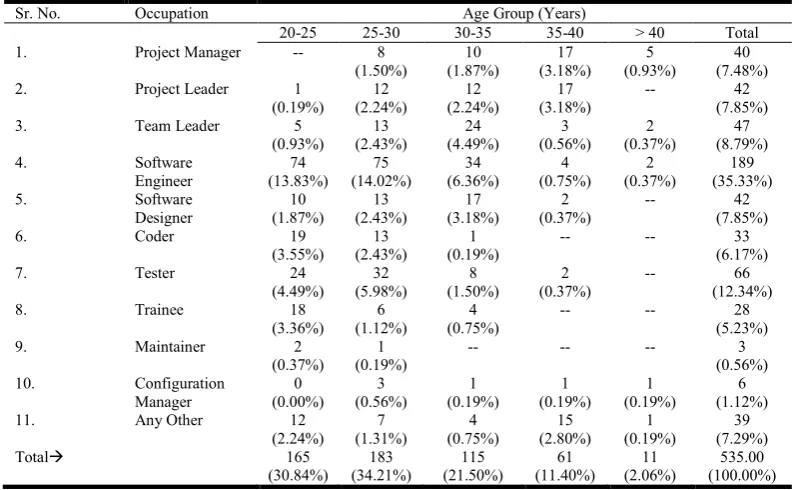
The questionnaire of 15 questions was made and circulated among IT-Professional physically and through mail. The side effects of depression were analysed by 8 items on 5 point scale (No, rarely, occasionally, frequent and continuos). Similarly, anxiety problems were analysed by 8 items on similar 5 point scale. This section gives analysis and interpretation of this data. Table 1 gives occupation wise and age wise distribution of samples. Ten occupation options are given in questionnaire. The percentage of software engineers is more i.e. 35.33%. Then percentage of software tester is 12.34. The lowest percentage is of software maintenance engineer because now IT-Industry has fewer jobs under the heading maintainer.
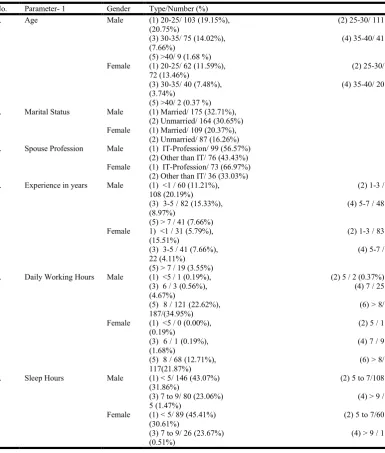
[image:3.595.85.519.64.308.2]The project managers under the age 20 to 25 are zero. It may be because of less age group and high occupation standard. Researcher has collected more data of age group 25 to 30 i.e. 34.21%. IT-Professionals of age more than 40 are only 2.06% of overall samples. Table 2 gives other sample characters like age, marital status, spouse profession, experience and daily working hours. Table 3 shows Means, SDs and ‘z’ values for 8 side effects of anxiety based on gender. The results obtained in the table shows significant difference in the mean side effect score among female than male in items like decreased enthusiasm, poor concentration, reduced appetite, pessimistic thinking.
Fig. 1. Theoretical Framework
Table 1. Occupation wise and age wise distribution of samples
Sr. No. Occupation Age Group (Years)
20-25 25-30 30-35 35-40 > 40 Total 1. Project Manager -- 8
(1.50%)
10 (1.87%)
17 (3.18%)
5 (0.93%)
40 (7.48%) 2. Project Leader 1
(0.19%) 12 (2.24%)
12 (2.24%)
17 (3.18%)
-- 42 (7.85%) 3. Team Leader 5
(0.93%) 13 (2.43%)
24 (4.49%)
3 (0.56%)
2 (0.37%)
47 (8.79%) 4. Software
Engineer
74 (13.83%)
75 (14.02%)
34 (6.36%)
4 (0.75%)
2 (0.37%)
189 (35.33%) 5. Software
Designer
10 (1.87%)
13 (2.43%)
17 (3.18%)
2 (0.37%)
-- 42 (7.85%) 6. Coder 19
(3.55%) 13 (2.43%)
1 (0.19%)
-- -- 33 (6.17%) 7. Tester 24
(4.49%) 32 (5.98%)
8 (1.50%)
2 (0.37%)
-- 66 (12.34%) 8. Trainee 18
(3.36%) 6 (1.12%)
4 (0.75%)
-- -- 28 (5.23%) 9. Maintainer 2
(0.37%) 1 (0.19%)
-- -- -- 3 (0.56%) 10. Configuration
Manager
0 (0.00%)
3 (0.56%)
1 (0.19%)
1 (0.19%)
1 (0.19%)
6 (1.12%) 11. Any Other 12
(2.24%) 7 (1.31%)
4 (0.75%)
15 (2.80%)
1 (0.19%)
39 (7.29%)
Total 165
(30.84%) 183 (34.21%)
115 (21.50%)
61 (11.40%)
11 (2.06%)
[image:3.595.101.501.362.607.2]For other items like decreased interest in pleasurable activities, feeling work as pressure, Ideas of hopelessness, helplessness and worthlessness and Suicide laudations are same among males and females. In overall, for 8 items, z value is -6.83, which comes in rejections area, so Ho that is “Depression problems faced by male and female IT-Professionals are same.”
Is rejected and H1 that is “Depression problems faced by
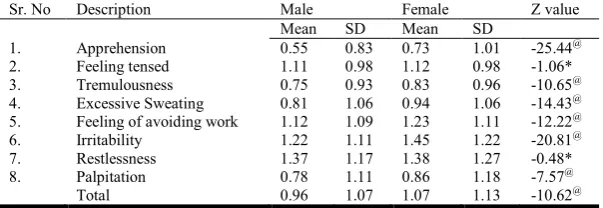
[image:4.595.107.493.74.528.2]female are more than male” is accepted. Table 4 shows Means, SDs and ‘z’ values for 8 side effects of anxiety based on gender. The results shows significant difference in the mean side effect score among female than male in items like apprehension, tremulousness, excessive sweating, feeling of Table 2. Other Sample Characters
No. Parameter- 1 Gender Type/Number (%)
1. Age Male (1) 20-25/ 103 (19.15%), (2) 25-30/ 111 (20.75%)
(3) 30-35/ 75 (14.02%), (4) 35-40/ 41 (7.66%)
(5) >40/ 9 (1.68 %)
Female (1) 20-25/ 62 (11.59%), (2) 25-30/ 72 (13.46%)
(3) 30-35/ 40 (7.48%), (4) 35-40/ 20 (3.74%)
(5) >40/ 2 (0.37 %) 2. Marital Status Male (1) Married/ 175 (32.71%),
(2) Unmarried/ 164 (30.65%) Female (1) Married/ 109 (20.37%),
(2) Unmarried/ 87 (16.26%) 3. Spouse Profession Male (1) IT-Profession/ 99 (56.57%)
(2) Other than IT/ 76 (43.43%) Female (1) IT-Profession/ 73 (66.97%)
(2) Other than IT/ 36 (33.03%)
4. Experience in years Male (1) <1 / 60 (11.21%), (2) 1-3 / 108 (20.19%)
(3) 3-5 / 82 (15.33%), (4) 5-7 / 48 (8.97%)
(5) > 7 / 41 (7.66%)
Female 1) <1 / 31 (5.79%), (2) 1-3 / 83 (15.51%)
(3) 3-5 / 41 (7.66%), (4) 5-7 / 22 (4.11%)
(5) > 7 / 19 (3.55%)
5. Daily Working Hours Male (1) <5 / 1 (0.19%), (2) 5 / 2 (0.37%) (3) 6 / 3 (0.56%), (4) 7 / 25 (4.67%)
(5) 8 / 121 (22.62%), (6) > 8/ 187/(34.95%)
Female (1) <5 / 0 (0.00%), (2) 5 / 1 (0.19%)
(3) 6 / 1 (0.19%), (4) 7 / 9 (1.68%)
(5) 8 / 68 (12.71%), (6) > 8/ 117(21.87%)
6. Sleep Hours Male (1) < 5/ 146 (43.07%) (2) 5 to 7/108 (31.86%)
(3) 7 to 9/ 80 (23.06%) (4) > 9 / 5 (1.47%)
Female (1) < 5/ 89 (45.41%) (2) 5 to 7/60 (30.61%)
(3) 7 to 9/ 26 (23.67%) (4) > 9 / 1 (0.51%)
Table 3. Means, SDs and ‘z’ values for 8 side effects of depression based on gender
Sr. No. Description Male Female Z value Mean SD Mean SD
1. Decreased Enthusiasm 0.97 1.05 1.09 1.19 -11.12@
2. Poor Concentration 1.02 0.98 1.24 1.13 -23.44@
3. Reduced Appetite 1.01 0.95 1.15 1.13 -15.71@
4. Decreased interest in pleasurable activities 1.16 1.09 1.16 1.14 -0.18* 5. Pessimistic thinking 0.96 1.04 1.02 1.11 -5.35@
6. Feeling work as pressure or Burdon 0.88 0.95 0.88 1.1 -0.07* 7. Ideas of hopelessness, helplessness and worthlessness 1.19 1.05 1.19 1.12 0.31* 8. Suicide laudations 1.08 1.03 1.08 1.09 0.66* Total 1.03 1.02 1.10 1.13 -6.83@
[image:4.595.104.494.559.664.2]avoiding work, irritability and palpitation. For other items like feeling tensed and restlessness are same among males and females. In overall, for 8 items, z value is -10.62, which comes in rejections area, so Ho that is “Anxiety problems faced by male and female IT-Professionals are same.” is rejected and H1 that is “Anxiety problems faced by female are
more than male” is accepted.
DISCUSSION
From Table 2 which gives general characters, most of the IT-Professionals have their spouse also working in the same professionals (Sample Character 3). For male IT-Professional, the percentage of Professionals whose wife is also an IT-Profession is 56.57% and that of female IT-IT-Professionals whose husband is also an IT-Professional is 66.97%. Same professions of both life partners may lead to increase in stress on both. Most of the IT-Professionals are of the age 25 to 35 for both males and female (Sample Character 2). The number of professionals whose experience is 1 to 5 years is more (Sample Character 4). So, in terms of experience also these professionals are facing problems and are victims of stress problems. Their daily working hours are more than eight (Sample character 5).
For male percentage of such heavy working hours profession is approximately 57% and for that of female is 41 %. Long duty hours is one of the most important characteristic which causes stress and may lead to depression and anxiety. The other important character that leads to stress is insufficient sleep. The percentage of male IT-Professionals who take less than five hours sleep is 44% and that of female is 46%. From overall data analysis through Table 3 and 4, it is clear that IT-Professionals have the problem of side effects of depression and anxiety. Mean for depression side effects is 1.03 and that of anxiety is 0.96. They face the problem side effects of anxiety. Out of total sixteen listed side effects, most frequent is “Ideas of hopelessness” and “Irritability”.
Observations concerned to Gender
From listed Z values, it is seen that most of the side effects are seen more in female than male. In depression, there is more difference among male and female for side effect of poor concentration because z value is highest (-23.44), then reduced appetite (-15.71) and Decreased Enthusiasm (-11.21). In anxiety, more difference in apprehension (-25.44), irritability (-20.81), excessive sweating (-14.43) and then feeling of avoiding work (-12.22).
Conclusion
From overall study, it can be concluded that IT-Professionals are facing problems of Depression and Anxiety and also the side effects of it. These side effects are more in female than male. Side effects of depression like poor concentration, reduced appetite and decreased enthusiasm is seen more in female than male. For anxiety, the side effects that are seen more in female are apprehension, irritability, excessive sweating and feeling of avoiding work. The study concludes that IT-Professional are having problems of side effects of Depression and Anxiety.
REFERENCES
Brigitte Froneberg, I.L.O Geneva, 2003. ‘Psychological stress and being at work’, Asian-passific news letter on occupational health and safety, 10: pp 28-30.
Carol Upadhya, A. R. Vasavi, Work, Culture and Sociality in the Indian IT-Cluster: A sociological Study, Report submitted to Indo-Dutch programme for alternatives in development, Aug. 2006.
Chandraiah, K., Agrawal, S. C., Marimuthu, P. and Manoharan, N. May-August 2003. Occupational Stress and Job Satisfaction Among Managers, Indian Journal of Occupational and Environmental Medicine Vol. 7, No. 2, pp. 6-11.
Dr. Archana R. Ugale and Dr. Arjun P. Ghatule, A Comparative Study of Effect of Job Characteristics on Stress of IT- Professionals and IT-Teachers, International Conference on Economics, Trade and Development, IPEDR vol.7 (2011) © (2011) IACSIT Press, Singapore, pp. 98-102.
http://www.timberlineknolls.com/mood-personality/ depression/signs-effects accessed on
Kaloyan Stolinov, 2007. ‘Recognizing Side Effects of Depression’, http://ezinearticles. com/?Recognizing-Side-Effects-Of-Depression&id=721227, accessed on Dec.10, 2012.
Mohsin Aziz, ‘Occupational Role Stress among Indian Information Technology Professional’, Asia-Pacific Newsletter of Occupational Health and Safety 2003, pp.31-33.
Siva Kumar, M. and Dr. A. Siddique Mohammed, ‘A Study On Occupational Stress among IT-Professionals’, Chennai, International Journal of Management Research and Review, Dec. 2011, Volume-1, Issue-5, Article No-12, pp. 210-215.
[image:5.595.146.448.85.189.2]********
Table 4. Means, SDs and ‘z’ values for 8 side effects of anxiety stress effects based on gender
Sr. No Description Male Female Z value Mean SD Mean SD
1. Apprehension 0.55 0.83 0.73 1.01 -25.44@
2. Feeling tensed 1.11 0.98 1.12 0.98 -1.06* 3. Tremulousness 0.75 0.93 0.83 0.96 -10.65@ 4. Excessive Sweating 0.81 1.06 0.94 1.06 -14.43@
5. Feeling of avoiding work 1.12 1.09 1.23 1.11 -12.22@
6. Irritability 1.22 1.11 1.45 1.22 -20.81@
7. Restlessness 1.37 1.17 1.38 1.27 -0.48* 8. Palpitation 0.78 1.11 0.86 1.18 -7.57@ Total 0.96 1.07 1.07 1.13 -10.62@