A Neighborhood Method for Statistical Analysis
of fMRI Data
Fayyaz Ahmad1, Ghanim Ullah2, Sung-Ho Kim1
1Department of Mathematical Sciences, Korea Advanced Institute of Science and Technology,
Daejeon, Korea
2Theoretical Biology and Biophysics, Los Alamos National Laboratory, Los Alamos, USA
Email: [email protected], [email protected], [email protected]
Received October 28, 2011; November 30, 2011; accepted December 7, 2011
ABSTRACT
In an effort to cope with the fact that functional magnetic resonance imaging (fMRI) data are spatiotemporally corre- lated, we propose a novel statistical method with a view to improve the detection of brain regions with increased neu-ronal activity in fMRI. In this method, we make use of information from neighboring voxels of a voxel, for estimation at the voxel. We examined performance of the method against the statistical parametric mapping (SPM) method using both simulated and real data. The proposed method is shown to be considerably better than the SPM in the context of receiver operating characteristics (ROC) curves.
Keywords: Statistical Parametric Mapping; Autoregressive Model; Initial Values; ROC Curve; GLM; Regions of Interest
1. Introduction
Functional magnetic resonance imaging data analysis are evolving quickly in a fast growing community, because of the excellent temporal and spatial resolution of these data and the innocuous aspect of their acquisition in hu-man brains. One of the major objectives of fMRI studies is to determine which areas of the brain are activated in response to a stimulus or task. Functional imaging data are based on the principles of magnetic resonance and the fact that increases in neural activity are accompanied by changes in regional cerebral blood flow (rCBF) and blood oxygenation. This blood oxygenation level dependent (BOLD) effect is the basis for most of the fMRI studies for mapping patterns of activation in the working human brain. Lueck et al. [1] and Friston et al. [2] are among the first to develop a statistical parametric mapping package (SPM) by using MATLAB (programming language) to map patterns of activation based on a fMRI data, which are available in the public domain
(www.fil.ion.ucl.ac.uk/spm).
fMRI data have a time sampling that allows for a pre-cise estimation of the neuronal response to various ex-perimental conditions. SPM is typically analyzed fMRI data to various conditions with a massively univariate app- roach, where a univariate general linear model (GLM) is fit independently at every voxel. In SPM, there is a major problem for fitting the univariate GLM, the successive fMRI scans of every voxel of the brain are not independent
or spatiotemporally correlated. A solution to this problem was given by Worsley and Friston [3,4] which provided a general framework for the spatiotemporally correlated fMRI scans. In their framework, they estimate the error covariance matrix l l lof size s × s from the fMRI data, by employing the restricted maximum likeli-hood estimate method (ReMLE) [5]. They used
λQ
V
1, 2
l
Q l constraints in the form of Q1Is and
2 :
i j
Q e i j where Is is an identity of size s
(total number of time points) of fMRI data, i1, , s
and j1, , s In the V matrix, they estimate global hyperparameters λl ( error variance components ) from the autoregressive model ( AR(1) + wn ) based on pooled data from all the interested voxels. They used this esti-mated error covariance matrix in SPM package in the form of
ˆ
V
1 2 ˆ
W Vˆ to make independent successive
fMRI scans of every voxel of the whole brain. Finally, they used this independent fMRI data for fitting the GLM of every voxel of the brain to get SPMs or activity map.
es-timation at voxel v. This proposed method is shown to improve the detection of brain regions with increased neu- ronal activity which is statistically more powerful as com-pared to the ReMLE approach of SPM.
2. The Proposed Method
We propose regularizing the autocorrelations based on neighboring voxel as described in details in the next Sec-tion (2.1). In practice the estimated autocorrelaSec-tion pa-rameters
vary considerably about their true values. Even when no correlation is present, it is well known that the standard deviation of the sample autocorrelation ϱ is about
2
, ξ
ρ σ
1 n by [7]. Some method of regularization that reduces this variability seems desirable. Purdon et al. [8] achieve this by spatial smoothing of the likelihood before estimating the autocorrelation parameters.
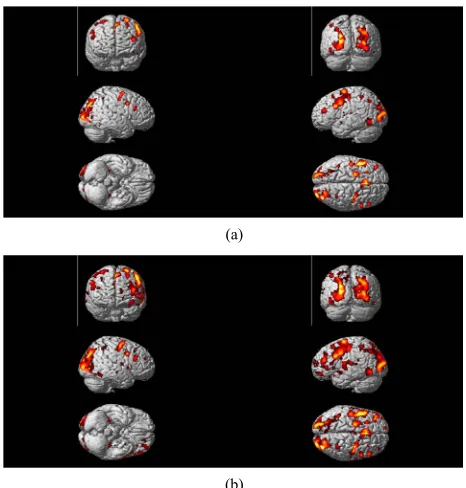
We analyzed the fMRI data with regard to temporal correlation, the SPM does not consider any relationship among voxels to make independent data for fitting GLM. For the efficient analysis, SPM estimates a global value of ϱ by using model AR(1) + wn based on pooling the sample autocorrelations of the fMRI raw data that create bias result. In the fMRI data set, there were variations in the strength of correlation and SPM’s global ϱ cannot adapt to these local changes. This supports the need for local autocorrelation modeling based on neighboring vo- xels information in order to ensure unbiased result in the form of accurate detection of activation, p-values and valid inferences at every voxel. The estimates of pa-rameters ˆρ and the variance of the white noise of model (3) of all the voxels of a middle slice from real fMRI data of Section 3.3 are shown in Figure 1.
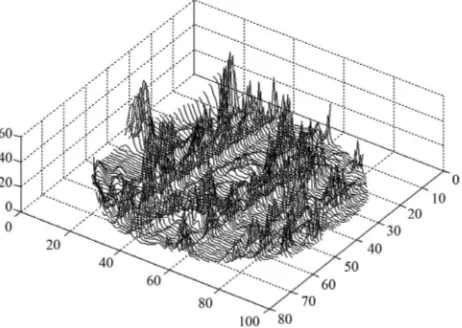
More-over the variations in the estimated variance values of all the voxel of a same slice in Figure 2 can also be
clearly observe in the form of bird-view. Due to these variation of the parameters and incorporates the spatial correlation between neighboring voxels, we propose an accurate pre-whitening strategy with estimation made at every voxel in the brain. We will call this strategy a neigh- borhood method (NH). We compare our approach by modifying the SPM code to functional imaging with the ReMLE method which has been established by Friston et al. [4] and Worsley et al. [5].
2
ˆξ
σ
2
ˆξ σ
2.1. Neighborhood Algorithm
In our method, we denote an fMRI data set consisting of
[image:2.595.308.540.86.228.2] [image:2.595.309.540.304.468.2]s time points or scans at n voxels as the s × n matrix Y. In mass-univariate GLM model [Friston et al. 1995], these data are explained in terms of a s × m design matrix X, containing the values of m regressors at s time points, and a m × n matrix of regression coefficients β, contain-ing m regression coefficients at each of the n voxels. The model is written
Figure 1. Estimated variance ˆ2 and ξ
σ ρˆ (histogram) val- ues of model (3) of all the voxels of a middle slice of real data. The x-axis represents voxel labels (top panel) and thê values (bottom panel). The estimates are from the NH me- thod.
Figure 2. A bird-view of the estimated variance values of model (3) of all the voxels of a middle slice of real data.
2 ˆξ
σ
β
Y X ε (1) where is a ε sn error matrix.
1) The GLM of the variable Y at voxel from n
voxels is given by
1
v
1 1 1 1, 1~ 0,
v v βv εv εv N V
Y X v1
(2)
where v1 is error covariance matrix.
2) Estimate the values, 1 1 v1 where V
ˆ ˆv v
Y Y
1 1ˆ
ˆ
v v βv1
Y X
ˆ
and regression coefficient ˆv1 i.e.,
11 1 1 1
T
v v v v
β T 1
v
X X X Y from model (2). 3) Obtain
2 1
1 1 2
1
1
s ξv
v v
v
σ
V ρ
ρ by using the following sim-
plest model of autocorrelation AR(1) proposed by Bull- more et al. [9] and [10-13].
1 1 1 1
v v v
Where
1
, 21 ~ 0,
v ξv
ξ t N σ ρ 1 is a coefficient of the model and ρs is a square matrix whose
i j, th entry is ρi j , i j, 1, , s. i.e.2 1
2
1 2 3
1 1
1
s
s
s s s
ρ ρ ρ
ρ ρ ρ
ρ ρ ρ
s ρ
In the model (3) scans are equally spaced in time and the errors from previous time point, , are mixed up with a white noise into the error of the current time point, .
1 1
v
ε t
1 v ξ t
1 v ξ t4) Calculate the error covariance matrix Wˆv1 as 1 2 1 1 ˆ ˆ v v
W V . Multiply the general linear model (2) by
1:
ˆ
v
W
1 1 1 1 1 1 1
* * * *
1 1 1 1
ˆ ˆ ˆ
v v v v v v v
v v v v
β ε
or β ε
W Y W X W
, Y X
(4)
where *
2
1~ 0,v s
ε N σ I , , ,
and regression coefficient
*
1 1 1
ˆ
v v v
W Y Y
* 1
v
*
1 1 1
ˆ
v v v
W X X
β is then estimated as
* * * *
1 1 1 1
ˆ T
v v v v
β 1 *
1
T v
X X X Y (5)
a) For a neighboring voxel of , set initial val- ues of the estimates as:
2
v v1
* 0 *
2 1
* 0 * 0
2 1 2 1 2 2
2
* 0 2
2 1 2
1 1/ 2
0 * 0
2 2
ˆ ˆ ,
ˆ
ˆ ˆ
ˆ ,
ˆ
ˆ ˆ ,
ˆ 1
ˆ ˆ .
v v
v v v v v v
s ξv
v v v v v β β ε β σ
W Y W X
V ρ
ρ
W V
where is computed based on by using model (3).
2 2 ˆξv
σ * 0
2 ˆv
ε
b) Repeat updating * 1, and
2 ˆ k
v
β * 1
2 ˆ k
v
ε * 1
2 ˆ k
v
W until convergence takes place (e.g., * * 1
2 2
ˆ k ˆ k 0.001
v v
β β
,
* * 1
2 2
ˆ k ˆ k 0.001
v v
ε ε and * * 1
2, 2,
ˆ k ˆ k 0.001
v ij v ij
W W ,
1 *2 2 2
1 *
2 2 2
1
* * * * *
2 2 2 2
* * * *
2 2 2 2
2
* 2
2 2 2
2
* 1 2
2 2 ˆ ˆ ˆ ˆ ˆ , ˆ
ˆ ˆ ,
ˆ 1 ˆ (ˆ ) .
k
v v v
k
v v v
k T T
v v v v
k k
v v v v
s
k ξv
v v v k k v v β ε β σ
X W X
Y W Y
c) If a voxel has more than one voxels where esti- mation is already made, then we take averages of the es- timates from the neighboring voxels for the initial values of the parameters
1 v
, , V, and W. In other words, the right-hand sides of the equations in step 4a are re- placed with the corresponding averages of the estima- tes.
5) Apply step 4 to all the voxels of the brain that are involved in the data.
6) Finally, to detect the effect or activity in terms of optimal βˆ* from step (4b), we test the null hypothesis
that the effect is zero for every voxel of the brain. An effect of interest, such as a difference between stimuli, can be specified by Cβˆ*, where C is a row-vector of
contrast of m conditions. It is estimated by E C βˆ*
with standard deviation S σˆ2CT
X X*T *
1C byusing estimated error covariance matrix Wˆ Vˆ1 2. The
test statistic is the T-statistic
T E S (6) which is an exactly t-distribution because S is a square root of χ2 distribution with degrees of free-
dom (p is number of parameters ) whereas Worsley and Friston [3] used Satterthwaite approximation [14] for
T-statistic and effective degrees of freedom in SPM be-cause in their ReMLE method denominator of T is not a square root of
j s p
2
χ distribution.
3. Experimental Results
3.1. Simulated fMRI Data
In order to evaluate our proposed method, we generated a Gaussian artificial signals in a 4-D fMRI human brain data by using the Fayyaz et al. [15] models (7) and (8) for four region of interest (ROI) of the brain, with the size of 6 × 5 × 5 voxels per volume. This 4-D fMRI hu-man brain data contain 80 volumes and each volume has BOLD/EPI acquisitions consisting of 35 slices (image volume size in voxels: x = 128, y = 128, z = 35) which means each volume of the data is a matrix of size 128 × 128 × 35 The co-ordinates of each ROI or volume of ar- tificial signals are shown under the columns xl, l and
l in Table 1. Moreover, for better visualization of four
ROIs, we showed three image of slices of a volume of the data in Figure 3. In this figure, the regions inside
black circles demonstrated artificial activation areas in the dimension of
y z
xlyl
.2
v
X X X Y
Y X
V ρ
ρ
W V
il l iβ εil
Y X (7)
2; ~ ,5 , 1, ,150
il li il il N μ i
Z Y a a (8)
Table 1. Artificial activation in four different regions of interest (ROI).
ROI Voxels Co-ordinates Mean SD Artificial activa-tion
xl yl zl
1 150 51 - 56 65 - 69 14 - 18 729.66 99.51 N(20, 52)
2 150 74 - 79 65 - 69 14 - 18 733.54 105.23 N(20, 52)
3 150 63 - 69 95 - 99 18 - 22 984.44 183.90 N(15, 52)
4 150 63 - 69 31 - 35 4 - 8 844.10 130.07 N(20, 52)
Figure 3. Three slice views of a volume of fMRI data and the regions inside black circles demonstrated artificial acti- vation areas in the dimension of (xl× yl).
150 × 4 corresponding to the co-ordinates of
x y zl, l, l
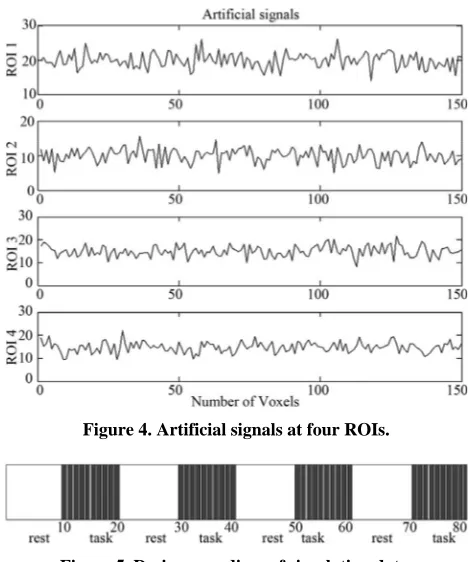
four ROIs. The fluctuations of weak and strong artificial signals ilof Gaussian distribution with means μ= (15,
20) and variance of four different ROI are also shown in Figure 4.
a
σ252
This 4-D fMRI human brain data consist of 80 vol-umes or time points or scans and we made this data in the form of alternative blocks of 40 non-active (rest: no arti-ficial signals) and 40 active (task: artiarti-ficial signals by using model (7) and (8) volumes, beginning with non- active volumes. 80 acquisitions or volumes were made: 8 blocks and 10 reps in each block for rest and task con- ditions. In the 10 repetitions block, we assume a task stimulus, and rest conditions for the next 10 repetitions block. Successive blocks alternated between rest and task settled up a blocked paradigm as shown Figure 5, and
the design matrix X of size 80 × 2 represented as.
2 20
0 0 1 1 0 0 1 1
1 1 1 1 1 1 1 1
T
X
here elements 0’s and 1’s repeated alternatively 10
3.2. Analysis of Simulated fMRI Data
ed and ana-w
times in the first row of X for rest and task conditions and all 1’s in second row used only for computation of GLM.
The simulated fMRI data were preprocess
lyzed using SPM latest package (SPM8b; Welcome De-partment of Cognitive Neurology London) which is based on MATLAB. To avoid the errors, preprocessing steps are necessary before the GLM analysis of any real or simulated fMRI human brain data. Our simulated data
Figure 4. Artificial signals at four ROIs.
Figure 5. Design paradigm of simulation data.
lso based on a real fMRI experiment of a subject at res- a
ting state. In the preprocessing steps, (1) the whole im-ages data were realigned according to the first volume for the correction of head motion, (2) the images were cor-rected for difference in slice timing, (3) images were normalized to the Montreal Neurological Institute (MNI) template using parameters defined from the normaliza-tion of the anatomical scan to the MNI template and fi-nally, (4) images were smoothed with a Gaussian kernel of 8 mm full-width at half-maximum to reduce noise. For the rest and task conditions of the design matrix X, GLM analysis to estimate βˆ*was performed at every voxel of
this preprocessed sim ted fMRI data by using ReMlL approach of SPM and NH method.
A volume table of SPM {t} maps ula
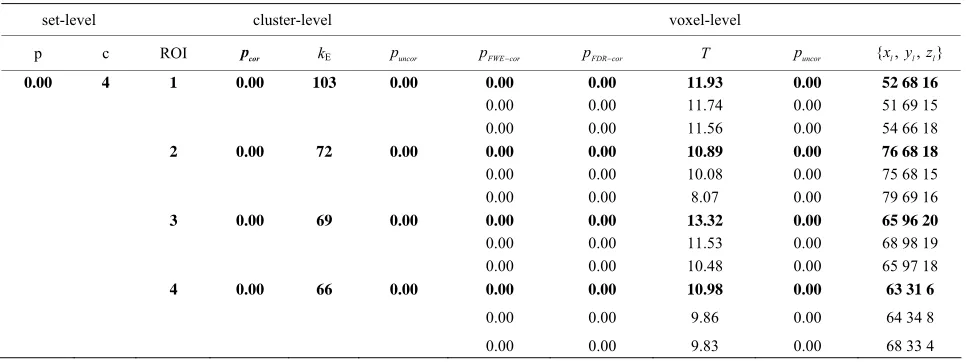
of the effect β or ar-tificial activity from the whole data were constructed corresponding to the hypothesis “task > rest” at p < 0.001 (uncorrected) level of significance by using the SPM method as shown in Table 2 and by using the NH
method as shown in Table 3. A standard volume table of
SPM {t} map showed only top three significant voxel of each cluster or region with three digits of p-values and remaining all significant voxels with the full length of
p-values (p < 0.001) we showed in the Figure 6. In
[image:4.595.56.287.111.308.2]the SPM method where p-values adjusted for search volume in
[image:5.595.57.540.111.292.2]-level voxel-level
Table 2. Results of the test of simulated fMRI data by using four ROIs.
set-level cluster
p c ROI pcor kE puncor pFWE cor pFDR cor T puncor { ,x y zl l, }l
0.00 4 1 0.00 103 0.00 0.00 0.00 11.93 0.00 52 68 16
0.00 0.00 11.74 0.00 51 69 15
0.00 0.00 11.56 0.00 54 66 18
2 0. 7 0.
0. 6 0.
0. 6 0.
00 2 00 0.00 0.00 10.89 0.00 76 68 18
0.00 0.00 10.08 0.00 75 68 15
0.00 0.00 8.07 0.00 79 69 16
3 00 9 00 0.00 0.00 13.32 0.00 65 96 20
0.00 0.00 11.53 0.00 68 98 19
0.00 0.00 10.48 0.00 65 97 18
4 00 6 00 0.00 0.00 10.98 0.00 63 31 6
0.00 0.00 9.86 0.00 64 34 8
0.00 0.00 9.83 0.00 68 33 4
able 3. Results of the test of simulated fMRI data by using the NH method where p-values adjusted for search volume in
-level voxel-level
T
four ROIs.
set-level cluster
p c ROI pcor kE puncor pFWE cor pFDR cor T puncor { ,x y zl l, }l
0.00 4 1 0.00 128 0.00 0.00 0.00 14.55 0.00 55 65 15
0.00 0.00 13.98 0.00 55 64 14
0.00 0.00 13.76 0.00 56 66 17
2 0. 8 0.
0. 97 0.
0. 9 0.
00 9 00 0.00 0.00 12.17 0.00 75 66 15
0.00 0.00 12.04 0.00 78 67 16
0.00 0.00 11.01 0.00 66 69 17
3 00 00 0.00 0.00 16.48 0.00 65 96 20
0.00 0.00 13.20 0.00 67 98 20
0.00 0.00 11.12 0.00 65 98 19
4 00 1 00 0.00 0.00 13.86 0.00 64 32 7
0.00 0.00 11.83 0.00 65 35 8
0.00 0.00 10.81 0.00 68 34 5
x y zl, l, l
sents the m
: coordinates in the ROIs space instead of epre-MNI space. In the tabular data the bold numbers r
ost “significant” voxel within the cluster at the level p < 0.001 (uncorrected) and there are four sig-nificant cluster
c4
which are our ROI3, ROI1, ROI4 and ROI2 respectively. The number of voxels in the ac-tivated ROIs clearly shows that the NH method increases substantially the statistical significance of the four acti-vated regions. Finally, in the analysis of simulated data, the NH method detects, over four ROIs, 20%, 19%, 29% and 27% more activated voxels as shown in Table 3 thanthe SPM method as shown in Table 2.
A comparison of the two methods is also made with all the uncorrected p-values (p < 0.001) o
Figure 6. The uncorrected p-values (p < 0.001) of all
acti-vo e (2) cluster-level: the chance (p) of finding a
vated voxels which are tested at voxel-level by using the SPM method (dotted line) and the NH method (solid line).
lum
cluster with this many (KE) or a greater number of
vox-els, corrected
p
d uncorrected
puncor
forsearch volume (3 l-level: the chance ( ding (under the null hypothesis) a voxel with this or a greater height (T-statistic), corrected family-wise error
cor
) vox an
e p) of fin
FWE cor
p , corrected false discovery rate
pFDR
, cor and uncorrected
puncor
for search volume and (iv)f activated voxel which are tested at voxel-level. The SPM method de-tected 310 voxels whereas the NH method dede-tected 405 voxels from the total 600 voxels of our four ROIs; the
[image:5.595.57.542.327.511.2]figure shows that the NH method has smaller p-values of activated voxels than the SPM. The p-values by the NH method are dispersed over a much wider range than the SPM method which is reflected in the ROC curves de-scribed in the Section (3.3) with larger true positive rate and smaller false positive rate for the NH method.
3.3. ROC Curve
We will make use characteristics (ROC
of the well-known receiver operating ) curve analysis Kim et al. [16] and
ctivated voxels and 1 false posi-tiv
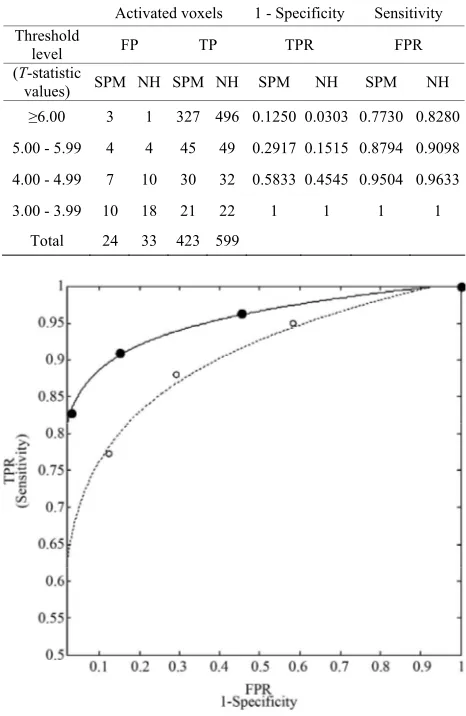
Fayyaz et al. [15] to compare the SPM and NH methods. A ROC curve is a graphical representation of the true positive rate (TPR) or sensitivity versus the false positive rate (FPR) or (1-specificity) for a binary classifier system over a range of its discrimination threshold. The TPR and FPR values obtained by using the number of true positive (TP) and false positive (FP) activated voxels at specific threshold level in a volume of SPM {t} maps. A volume of SPM {t} maps of both methods corresponding to any
p-value or threshold level (T-statistics) can be obtain with the use of SPM package (SPM8b). The TP and FP activated voxels are obtained from the volumes of SPM {t} maps of both methods by applying the lower four sequentially threshold levels as shown in Table 4. More-
over, these obtained TP voxels of simulated data demon-strated those voxels which activated within our prede-fined areas of ROI whereas FP voxels activated some-where else in the brain.
In the Table 4, the measures of NH method would
yield 496 true positives a
e activated voxel, with a true-positive rate (sensitivity) of 496/599 = 0.8280 and a false-positive rate (1-speci- ficity) of 1/33 = 0.0303. Similarly, 49 true positives and 9 false positives had level between 5.0 and 5.99. Thus, if any value of level greater than 4.99 were taken as an in-dication of NH method, this measure would yield 496 + 49 = 545 true positives activated voxels and 1 + 4 = 5 false positive activated voxels, with a true-positive rate of 547/599 = 0.9098 and a false-positive rate of 5/33 = 0.1515. And similarly so on for SPM and HM method for the other levels, 4.00 to 4.99, and 3.00 to 3.99.
We plotted true positive verses false positive rates and fitted a simple logarithmic curve (ˆ b
r r
y ax ) to the four bi
e of acti
variate pairs of sensitivity and (1-specificity) for each method, with xr = false-positive rat vated voxels,
yr = true-positive rate of activated voxels. The fitted lo-
garithmic curves represented as the ROC curves of each method as shown below in Figure 7 where solid line
curve is for the NH and dots line curve is for the SPM method. The area under the ROC curve from each of the two methods is 95.11% and 89.25% respectively for the NH and the SPM method. The ROC curve and Table 4
demonstrating the superiority of the NH method because
Table 4. ROC curve analysis with the SPM and NH methods.
Activated voxels 1 - Specificity Sensitivity Threshold
level FP TP TPR FPR
(T-statistic
values) SPM NH SPM NH SPM NH SPM NH
≥6.00 3 1 327 496 0.1250 0.0303 0.7730 0.8280
5. 4 4 45 49 0.2917 0.1515 0.8794 0.9098
4.00 - 1
10 18
423 599 00 - 5.99
4.99 7 0 30 32 0.5833 0.4545 0.9504 0.9633
3.00 - 3.99 21 22 1 1 1 1
Total 24 33
Figure 7. ROC curves for the NH method (solid line) and SPM method (dotted line). The markers represented the
has: (1) larger true positive rate; (2) lo- er false positive rate; (3) larger number of true positive
and the NH methods with from a visual block design
ex-.5T
points of four bivariate pairs of sensitivity and (1-specificity) of each method.
the NH method w
activated voxel; (4) a larger area under the ROC curve by the NH than by the SPM and finally; (5) the closer the curve follows the left-hand border and then the top bor-der of the ROC space, the more accurate the test.
3.4. Real fMRI Data
We also compared the SPM real fMRI data obtained
periment, which is available in the public domain at
[image:6.595.306.539.102.460.2]ac-quisition took 160 seconds, with the scan-to-scan repeti-tion time (TR) set to 2 secconds. A total of 80 acquisi-tions were made: 8 blocks of 20 seconds each (i.e., 8 blocks of 10 reps each). During each 20 second block, it was presented 4 stimuli of bird pictures, in each for 5 seconds. Successive blocks alternated between hard and easy learned birds and a control condition of familiar birds (crows and swans), starting with learned birds. The pattern was as in Table 5.
A “2D” T1 anatomical (same plane and section as the BOLD image; Series 2) and a “3D” image (124 Sagi- tta
of Real fMRI Data
ps of the condition ethod of the above
od, we assume that each voxel is highly neighboring voxels partly due
k design of a real fMRI data.
B Block 8
lslices, Series 4) were also acquired to be used as struc-tural images.
3.5. Analysis
We obtained a volume of SPM {t} ma (“easy and hard > control”) for each m
real fMRI data by using the same preprocessing steps (1) to (5) as discussed in the Section (3.2) corresponding to FWE-corrected p < 0.05 and contrast C = [1 –2 1] value. Results are overlaid on a volume rendered brain. The area of activated voxels of each method clearly observed in views of dorsal, lateral and ventral surface of the brain. Yellow and red areas reflect the “easy and hard” condi-tion causing higher brain activities than the control con-dition as shown in Figure 8. Finally, our proposed me-
thod has more activated regions with substantially in-creased statistical significance, which makes it possible to decide with more confidence if a certain brain region is activated or not.
4. Dicussion
In the NH meth
spatio-correlated with the
[image:7.595.306.539.82.326.2]to the smoothing of the data images and we make use of the information from neighboring voxels of a voxel, for estimation at the voxel. Whereas in the SPM, the error covariance matrix, V, does not consider any spatio-corre- lation among the voxels and hyperparameters of, V, also do not vary over voxels [3,4]. Due this phenomenon some weak signals can not be detected with the use of ReMLE approach of SPM. On the other hand, we admit more heterogeneity of the covariance matrix or variance-cova- riance structure in the NH method. The distinction of the ROC curves between the NH and the SPM methods be-comes more apparent for simulate data as we discussed in the Section (3.3).
Table 5. Bloc
Block 1 lock 2 Block 3 Block 4 Block 5 Block 6 Block 7
20 sec 20 sec 20 sec 20 sec 20 sec 20 sec 20 sec 20 sec
10 TRs 10 TRs 10 TRs 10 TRs 10 TRs 10 TRs 10 TRs 10 TRs
4 easy
(a)
(b)
Figure 8. Regions are rendered in yellow and red colors o the MNI template of SPM o tivated regions of the brain as a result of “higher active and hard conditions
matrix V which is re-e
n f ac
” of easy
than the control condition. Active regions detected with the use of the SPM method (a), and the NH method; (b) corre-spond to p < 0.05 (FWE-corrected).
Worsley et al. [3] used pre-whitening strategy with a patially varying error covariance
s
p ated at every voxel to estimate regression coefficient β
in (2) without using information from neighboring voxels. Zhang et al. [17] and [18,19] used the matrix V1 2 to
estimate regression coefficient βof whitened model and then applied Durbin-Watson (AR(1) correlation test) on the residuals of whitened model to improve on the accu-racy of the autocorrelation model. The variation of the autocorrelation coefficient (ρ) calls for the need for auto-correlation modeling with initial estimates borrowed from neighboring voxels in order to attain more accurate in-ferences at every voxel.
Finally, In the analysis of simulated data, the NH method detects (405 – 310)/405 = 23% more activated voxels over all the ROIs as shown in Tables 2 and 3 than
the SPM method, and real data detects 40% more acti-vated voxels. The proposed method detects voxels more accurately of the simulated data even in case of weak but true artificial signals than the SPM with a better ROC performance. The true positive rate and higher activation of voxels of simulated data showed validity of the pro-posed method and it is more apparent as far as the real data are concerned. The ROC curves and the p-values of activated voxels show that the NH method is superior than the SPM method based on the true simulated activa-tions.
[image:7.595.58.288.679.735.2]heterogeneity of the parameters, in particula riance structure of the noise in the the assumption that the parameter
ReMLE approach of SP
im through the National Research Found-26895).
. P. Deiber, P. Cope, a, C. Kennard and S. Frackowiak, “The Colour Centre in the Cerebral Cor-tex of Man,” N 32, 1989, pp.
386-5. Conclusions
In this paper, we proposed a method in an effort to cope
with the r the
error variance-cova fMRI data. Under
timates do not change abruptly between neighboring vox-els, we employed an estimate-transfusion approach bet- ween neighboring voxels by using the estimates from neigh- boring voxels as initial values of the estimates for their new neighboring voxels. Since the intial values may af-fect the final result of the estimate Wu [20] and Kim [21], it is desirable that we apply the estimate-transfusion ap-proach to obtain the estimates that are affected by the estimates from neighboring voxels.
In both of the experiments, one with artificial data and the other with real data, we showed superiority of the proposed NH method over the traditional SPM method in the context of the ROC curve. In the
M, we assume a variance-covariance structure contains hyperparameters which do not vary over voxels. This may possibly deteriorate the detection accuracy of the activated voxels when the signals are relatively small. This kind of undesirable phenomenon can be avoided by applying the NH method.
6. Acknowledgements
The research reported in this paper has been supported for Sung-Ho K
ation of Korea (No. R2011-00
REFERENCES
[1] C. J. Lueck, S. Zeki, K. J. Friston, M
V. J. Cunningham, A. A. Lammertsm R.
ature, Vol. 340, No. 62 389. doi:10.1038/340386a0
[2] K. J. Friston, P. J. Jezzard and R. Turner, “Analysis of Functional MRI Time-Series,” Human Brain Mapping, Vol. 1, No. 2, 1994, pp. 153-171.doi:10.1002/hbm.460010207 [3] K. J. Worsley and K. J. Friston, “Analysis of fMRI Time-
Series Revisited-Again,” NeuroImage, Vol. 2, No. 3, 1995, pp. 173-181.doi:10.1006/nimg.1995.1023
[4] K. J. Friston, A. P. Holmes, J. B. Poline, P. J. Grasby, S. C. Williams, R. S. Frackowiak and R. Turner, “Analysis of FMRI Time Series Revisited,” NeuroImage, Vol. 2, No. 3, 1995, pp. 45-53.doi:10.1006/nimg.1995.1007
[5] D. A. Harville, “Bayesian Inference for Variance Com-ponents Using Only Error Contrasts,” Biometrika, Vol. 61, No. 2, 1974, pp. 383-385.doi:10.1093/biomet/61.2.383 [6] P. A. Valdes-Sosa, “Spatio-Temporal Autoregressive Mo-
dels Defined over Brain Manifolds,” Neuroinformatics, Vol. 2, No. 2, 2004, pp. 239-250. doi:10.1385/NI:2:2:239 [7] K. J. Worsley, “Non-Stationary FWHM and Its Effect on
Statistical Inference for fMRI Data,” NeuroImage, Vol. 15, No. 346, 2002, pp. 779-790.
[8] P. L. Purdon, V. Solo, R. M. Weissko and E. Brown, “Lo- cally Regularized Spatio-Tem Poral Modeling and Model Comparison for Functional MRI,” NeuroImage, Vol. 14, No. 4, 2001, pp. 912-923.doi:10.1006/nimg.2001.0870
, [9] E. T. Bullmore, S. Rabe-Hesketh, R. G. Morris, C. R.
Steven, L. Gregory, J. A. Gray and M. J. Brammer, “Func-tional Magnetic Resonance Image Analysis of a Large-Scale Neurocognitive Network,” NeuroImage, Vol. 1, No. 4 1996, pp. 16-33.doi:10.1006/nimg.1996.0026
[10] N. R. Draper and H. Smith, “Applied Regression Analy- sis,” 3rd Edition, Wiley Academic Press, New York, 2003. [11] B. Everitt and E. Bullmore, “Mixture Model Mapping of
Brain Activation in Functional Magnetic Resonance Im-ages,” Human Brain Mapping, Vol. 7, No. 1, 1999, pp. 1- 14.
doi:10.1002/(SICI)1097-0193(1999)7:1<1::AID-HBM1> 3.0.CO;2-H
[12] G. S. Watson, “Serial Correlation in Regression Analy-sis,” Biometrika, Vol. 42, No. 3-4, 1955, pp. 327-341. doi:10.1093/biomet/42.3-4.327
[13] G. A. F. Seber, “Linear Regression Analysis,” Wiley Press,
s- ,” Biometrics, Vol. 2, No. New York, 1977.
[14] F. E. Satterthwaite, “An Approximate Distribution of E timates of Variance Components
6, 1946, pp. 110-114. doi:10.2307/3002019
[15] A. Fayyaz, M. Maqbool and L. Namgill, “Regularization
5, 2011, pp.
, pp. 724-727.
of Voxelwise Autoregressive Model for Analysis of Func-tional Magnetic Resonance Imaging Data,” Concepts in Magnetic Resonance Part A, Vol. 38, No.
187-196.
[16] H. Y. Kim, H. Yong and J. O. Giacomantone, “A New Technique to Obtain Clear Statistical Parametric Map by Applying Anisotropic Diffusion to FMRI,” ICIP, Vol.3, No. 5, 2005
[17] H. Zhang, W. L. Luo and T. E. Nichols, “Diagnosis of Single-Subject and Group FMRI Data with SPMd,” Hu-man Brain Mapping, Vol. 27, No. 5, 2006, pp. 442-451. doi:10.1002/hbm.20253
[18] P. A. Bandettini, A. Jesmanowicz, E. C. Wong and J. S. Hyde, “Processing Strategies for Time-Course Data sets in Functional MRI of the Human Brain,” Magnetic Re-sonance Medicine, Vol. 30, No. 2, 1993, pp. 161-173. doi:10.1002/mrm.1910300204
[19] S. J. Richard, Frackowiak, K. J. Friston, J. D. Raymond, J. P. Cathy and P. William, “The General Linear Model,”
Human Brain Function, 2nd Edition, Willey Academ Press, Oxford, 2003.
ic
[20] C. F. J. Wu, “On the Converengence Properties of the EM Algorithm,” The Annals of Statistics, Vol. 11, No. 1, 1983, pp. 95-103. doi:10.1214/aos/1176346060