WAVELET TRANSFORM BASED QR CODE WATER MARKING ALGORITHM
*Priyanka Shivshankar
Arunoday colony
ARTICLE INFO ABSTRACT
In the digital world copyright protection and authentication have become more significant, in order to achieve this digital different watermarking techniques are introduced for the security. We propose an algorithm in wavelet domain using wavelet transform
embedded into a QR code image. In our method we embed a binary image logo considered as watermark embedded into one of selected wavelet subband. The experimental results show that our method has more robustn
copyright protection and authentication.
Copyright © 2015 Priyanka Shivshankar Kannurkar. This
unrestricted use, distribution, and reproduction in any medium, provided the original work is properly cited.
INTRODUCTION
Barcode becomes widely known because of their accuracy, and superior functionality characteristics. QR Code is a kind of 2D (two dimensional) Barcode symbol which is categorized in matrix code. It contains information in both the vertical and horizontal directions, whereas a 1D (one dimensional) Barcode symbol contains data in one direction only. QR Code holds a considerably greater volume of information than a 1D Barcode. QR Code developed by Denso Wave (
wave.com/qrcode/indexe. html). Bar codes are linear one dimensional codes and can only hold up to 20 numerical digits, whereas QR codes are two-dimensional (2D) matrix barcodes that can hold 7,089 numeric characters and 4,296 alphanumeri characters, and 1,817 kanji characters of information Chou Chuang et al., 2010).
In this paper, we describe a novel method to embed the QR code into still digital images. Most of the recent work in watermarking can be grouped into two categories:
domain methods, and frequency domain methods. Because frequency domain methods have better robustness than spatial domain, almost a11 techniques embed watermarks in the frequency domain, such as DCT and DWT (
2000; Alattar, 2004). To increase robustness against JPEG degradation of the watermarked image, we embed the watermark in low frequency domains of DWT.
*Corresponding author: Priyanka Shivshankar Kannurkar Arunoday colony, Block no-674 N-5 CIDCO, Aurangabad
ISSN: 0975-833X
Vol.
Article History:
Received 25th September, 2015
Received in revised form 07th October, 2015
Accepted 09th November, 2015 Published online 21st December,2015
Key words:
QR,
Copyright protection, Authentication.
Citation: Priyanka Shivshankar Kannurkar, 2015. “
Current Research, 7, (12), 23537-23541.
RESEARCH ARTICLE
WAVELET TRANSFORM BASED QR CODE WATER MARKING ALGORITHM
Priyanka Shivshankar Kannurkar
Arunoday colony, Block no-674 N-5 CIDCO, Aurangabad
ABSTRACT
In the digital world copyright protection and authentication have become more significant, in order to achieve this digital different watermarking techniques are introduced for the security. We propose an algorithm in wavelet domain using wavelet transformation for a digital invisible watermarking is to embedded into a QR code image. In our method we embed a binary image logo considered as watermark embedded into one of selected wavelet subband. The experimental results show that our method has more robustness to attacks in different considerations and it can achieve a viable copyright protection and authentication.
This is an open access article distributed under the Creative Commons Att use, distribution, and reproduction in any medium, provided the original work is properly cited.
Barcode becomes widely known because of their accuracy, and superior functionality characteristics. QR Code is a kind of 2D (two dimensional) Barcode symbol which is categorized in information in both the vertical and , whereas a 1D (one dimensional) Barcode symbol contains data in one direction only. QR Code holds a considerably greater volume of information than a 1D Barcode. (http://www.denso-. Bar codes are linear one-dimensional codes and can only hold up to 20 numerical digits,
dimensional (2D) matrix barcodes that can hold 7,089 numeric characters and 4,296 alphanumeric characters, and 1,817 kanji characters of information
(Jun-In this paper, we describe a novel method to embed the QR code into still digital images. Most of the recent work in watermarking can be grouped into two categories: spatial domain methods, and frequency domain methods. Because frequency domain methods have better robustness than spatial domain, almost a11 techniques embed watermarks in the (Lumini and Maio, . To increase robustness against JPEG degradation of the watermarked image, we embed the watermark in low frequency domains of DWT.
Corresponding author: Priyanka Shivshankar Kannurkar 5 CIDCO, Aurangabad.
II.QR CODE
A. QR code (http://en.wikipedia.org/wiki/QR_code
QR (Quick Response) Codes, are 2
encode text strings and were introduced by the Japanese corporation Denso Wave Incorporated
considered as the evolution of the one dimensional barcodes. They are able to encode information in both vertica horizontal direction, thus able to encode several times more information than the one dimensional barcodes. QR codes consist of black and white modules which represent the encoded data.
B. QR Code structure
Here we use as an example version 2, see size that is most widely used, and based on 2010; Russ Cox. QArt Codes, 2012
Tutorial, 2012; Esponse. Innovative QR Code campaigns (About QR codes), 2013) analyze the structure of the
(1) Finder Pattern: The three identical structures that are located in the upper corners and in the bottom left corner enable the decoder software to recognize. the QR code and determine the correct orientation. These patterns also allow 360 degree (omni-directional) high
code. These structures consist of a 3 X 3 black square International Journal of Current Research
Vol. 7, Issue, 12, pp.23537-23541, December, 2015
INTERNATIONAL
, 2015. “Wavelet transform based QR code water marking algorithm
WAVELET TRANSFORM BASED QR CODE WATER MARKING ALGORITHM
In the digital world copyright protection and authentication have become more significant, in order to achieve this digital different watermarking techniques are introduced for the security. We propose an ation for a digital invisible watermarking is to embedded into a QR code image. In our method we embed a binary image logo considered as watermark embedded into one of selected wavelet subband. The experimental results show that our ess to attacks in different considerations and it can achieve a viable
is an open access article distributed under the Creative Commons Attribution License, which permits
http://en.wikipedia.org/wiki/QR_code)
are 2-dimensional bar codes that encode text strings and were introduced by the Japanese corporation Denso Wave Incorporated (6). QR codes are considered as the evolution of the one dimensional barcodes. They are able to encode information in both vertical and horizontal direction, thus able to encode several times more information than the one dimensional barcodes. QR codes consist of black and white modules which represent the
Here we use as an example version 2, see Figure 1, which is the size that is most widely used, and based on (Kieseberg et al., Russ Cox. QArt Codes, 2012; Thonky.com. QR Code Esponse. Innovative QR Code campaigns analyze the structure of the QR Code
Finder Pattern: The three identical structures that are located in the upper corners and in the bottom left corner enable the decoder software to recognize. the QR code and determine the correct orientation. These patterns also allow directional) high-speed reading of the code. These structures consist of a 3 X 3 black square
INTERNATIONAL JOURNAL OF CURRENT RESEARCH
surrounded by white modules that are again surrounded by black modules.
(2) Separators: The white separators that surround the Finder Patterns have width of one pixel and make it easier to distinguish the patterns.
(3) Timing pattern: A sequence of black and white modules that help the decoder software to determine the width of a single module.
(4) Alignment Pattern: This pattern allows the QR reader to correct for distortion when the code is bent or curved. The alignment pattern appears on version 2 and higher and the number of alignment patterns used depends on the version selected fro the encoding.
(5) Format Information: This section consists of 15 bits and contains the error correction rate and the selected mask pattern of the QR code. The error correction level can be identified from the first two modules of the timing pattern (see Figure 2.2). The format information is read first when the QR code is decoded.
(6) Data: After the data is converted into Reed-Solomon-encoded data bits, it is stored in 8 bit parts (codewords) in the data section.
(7) Error Correction: The data codewords are used in order to generate the error correction (EC) codewords, which are stored in the error correction section.
[image:2.595.311.557.48.233.2](8) Remainder Bits: This section contains empty bits if the data or the error correction bits cannot be divided into 8 bit codewords without a remainder.
Figure 1. Structure of QR Code Version 2 (from Kieseberg et al., 2010)
III. The proposed watermarking process
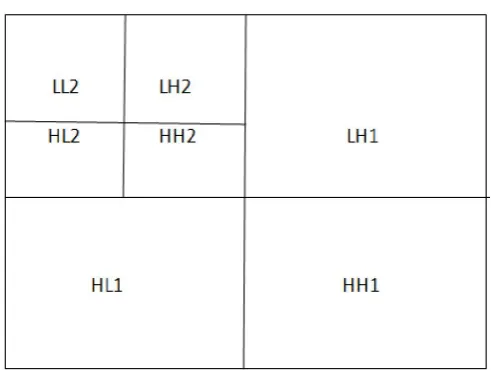
In this paper we have chosen a watermark as binary image of Burapha University logo. In the frequency domain we perform the embedding process on QR code image using watermark. As shown in the figure we have to decompose the QR code image by two levels using two-dimensional wavelet transformation. To recover the embedded watermark we do not need the original QR code image subsequently.
In our algorithm have two steps: watermark embedding and watermark extraction.
A. Watermark Embedding
The following outlined procedure is for the embedding process (Fig.3)
Step of watermark image with secret key
i. The watermark image was produced as a bit sequence of
watermark S. The data and background values were set to 1 and –1, respectively.
S = ,1 ≤ ≤ , {−1,1} (1)
where N is the total number of pixels in the watermark image.
ii. The pseudo-random sequence (P) whose each number can
take a value either 1 or –1 was randomly generated with a secret key for embedding and extracting of the watermark.
P = ,1 ≤ ≤ , {−1,1} (2)
Step of QR code image
I. The two-level DWT of × image ( ) was computed
for QR code image.
II. A watermark was then embedded in subband LH2 or HL2
or HH2. According to the rule:
′ = + . . , = 1,2, … ,
(3)
where is input image. ′is output image with watermark. is
a magnitude factor which is a constant determining the watermark strength.
III. After that, the inverse DWT (IDWT) was then applied to
obtain the watermarked image.
IV. Compute PSNR.
B. Watermark Extraction
is however needed. Thus, a prediction of the original value of the pixels was performed using noise elimination technique.
Fig. 3. Watermark Embedding Process
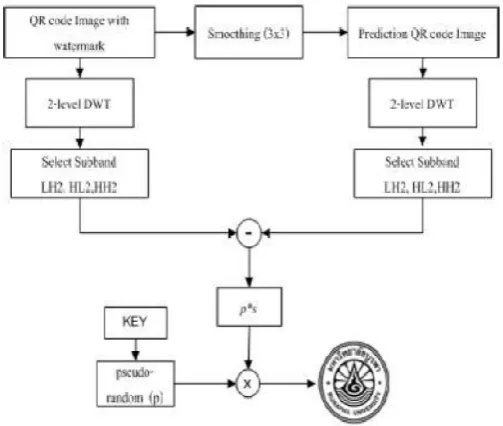
In this paper, we use an averaging 3×3 mask whose elements were fixed to 1/9. The extraction process are outlined as follows (Fig.4):
I. The predicted image could be obtained by smoothing the
input image ∗ with a spatial convolution mask. The
prediction of the original value can be defined as:
= 1
×
∗ (4) ×
where c is the size of the convolution mask. The watermarked image and the predicted image were DWT transformed independently.
II. The estimate of the watermark is indicated by the
difference between ∗ as:
= ∗ − = . . (5)
III. The sign of the difference between the predicted and the
actual value is the value of the embedded bit:
( ) = . (6)
IV. Compute NC
[image:3.595.309.561.126.339.2]The watermark was then estimated by multiplying pseudo- random number to the embedded bit. If an incorrect pseudo random sequence was to be used, the scheme would not work.
Fig. 4. Watermark Extracting Process
IV. RESULTS
Subband PSNR NC Extracted watermark
LH 43.0615 0.9525
HL 43.1514 0.9611
Table III
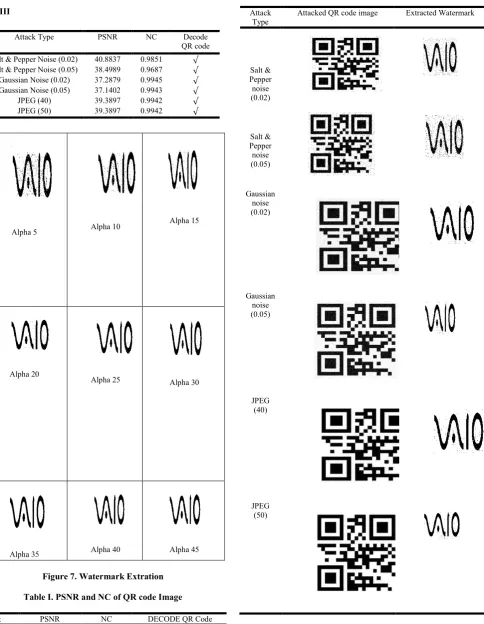
Attack Type PSNR NC Decode QR code
Salt & Pepper Noise (0.02) 40.8837 0.9851 √
Salt & Pepper Noise (0.05) 38.4989 0.9687 √
Gaussian Noise (0.02) 37.2879 0.9945 √
Gaussian Noise (0.05) 37.1402 0.9943 √
JPEG (40) 39.3897 0.9942 √
JPEG (50) 39.3897 0.9942 √
Alpha 5 Alpha 10
Alpha 15
Alpha 20
Alpha 25 Alpha 30
[image:4.595.60.545.48.673.2]Alpha 35 Alpha 40 Alpha 45
[image:4.595.36.289.660.759.2]Figure 7. Watermark Extration
Table I. PSNR and NC of QR code Image
α PSNR NC DECODE QR Code
5 47.1617 0.9826
10 44.1514 0.9934
15 42.3905 0.9961
20 41.1411 0.9967
25 40.1720 0.9975
30 39.3802 0.9980
35 38.7107 0.9986
40 38.1308 0.9991
45 37.6193 0.9995
Attack Type
Attacked QR code image Extracted Watermark
Salt & Pepper noise (0.02)
Salt & Pepper noise (0.05)
Gaussian noise (0.02)
Gaussian noise (0.05)
JPEG (40)
JPEG (50)
REFERENCES
“Denso wave incorporated,” http://www.denso-wave.com/ qrcode/indexe. html.
Alattar AM. 2004. Reversible watermark using the difference expansion of a generalized integer transform. IEEE Trans. Image Process. 13: 1147- 1156.
DENSO Wave Incorporated. What is a QR Code?, 2013. http://www.qrcode. com/en/. Accessed 10 Feb 2013. Esponse. Innovative QR Code campaigns (About QR codes),
2013. http://www.esponce.com/about-qr-codes. Accessed 23 Mar 2013.
Jun-Chou Chuang, Yu-Chen Hu & Hsien-Ju Ko. A Novel Secret Sharing Technique Using QR Code, International Journal of Image Processing (IJIP), Volume (4) : Issue (5), pp. 468-475, 2010.
Kieseberg P., M. Leithner, M. Mulazzani, L. Munroe, S. Schrittwieser, M. Sinha, E. Weippl. Qr code security. In Proceedings of the 8th International Conference on Advances in Mobile Computing and Multimedia, MoMM ’10 (2010), pp. 430–435.
Kieseberg P., M. Leithner, M. Mulazzani, L. Munroe, S. Schrittwieser, M. Sinha, E. Weippl. Qr code security. In Proceedings of the 8th International Conference on Advances in Mobile Computing and Multimedia, MoMM ’10 (2010), pp. 430–435.
Lumini A and Maio D 2000. A wavelet-based image watermarking scheme In:Proc. Int. Conf. Information Technology: Coding and Computing. pp.122-127.
Russ Cox. QArt Codes, 2012. http://research.swtch.com/qart. Accessed 05 Mar 2013.
Thonky.com. QR Code Tutorial, 2012. http://www.thonky. com/qr-code-tutorial/ Accessed 10 Feb 2013.