Some Results on Vertex Equitable Labeling
P. Jeyanthi1, A. Maheswari2
1
Research Centre, Department of Mathematics, Govindammal Aditanar College for Women, Tiruchendur, India 2
Department of Mathematics, Kamaraj College of Engineering and Technology, Virudhunagar, India Email: [email protected], [email protected]
Received December 15, 2011; revised January 23, 2012; accepted February 18, 2012
ABSTRACT
Let G be a graph with p vertices and q edges and let = 0,1, 2, , . 2 q A
A vertex labeling f V G:
A ie a vertex equitable labeling of G if it induces an edge labeling
s said to
b f* given by f*
uv = f u
f v
such that
1vf a vf b and f*
E = 1, 2, 3,,q
, where vf
a is the number of vertices v with f v
=a for aA.to be a h if it adm tex equitable labeling. In this paper, we the equitable labeling of a Tp-tree,
A graph G is said r abl
vertex
vertex equitable grap its ve est ish
n
TK where T is a Tp-tree with even number of vertices, bistar B n n
, 1 ,
the caterpillar S x x
1, 2,,x
and crown2 1 .
n n
C K
n ,P
eywords: Vertex Equitable Labeling; Vertex Equitable Graph
1. Introduction
d here are simple, finite, connected
K
All graphs considere
and undirected. We follow the basic notations and termi-nologies of graph theory as in [1]. The symbols V G
and E G
denote the vertex set and the edge se graph et G p q
,
be a graph witht of a
G. L p=V G
vertices and q=
edges. A labeling fG is a mappin ns elements of a graph to the set of numbers (usually to positive or non-negative integers). If the domain of the mapping is the set of vertices (the set of edges) then we call the labeling vertex labeling (edge labeling). The labels of the vertices induce labels of the edges. There are several types of labeling. A detailed survey of graph labeling can be found in [2]. A vertex labeling f is said to be difference labeling if it induces the label
E G g that assig
of a graph
f x f y for each edge xy which is called as
weigh .
A difference labeling t of the edge xy
f of a graph G is said to be
k-tree and u0 and be tw
to the length of the path -v. If the edge is
de-such a transformation of lled an elemen ry par-allel transformation (or a pt, for short) e edge
is called transformable edge.
by a sequence of ept can be reduce a path, then T is called a Tp tree (transformed tree) and such
se-quence is regarded as a composition of mappings (ept’s) denoted by P, is called a parallel transformation of T. The path, the image of T under P is denoted as P(T).
A Tp tree and a sequence of two ept’s reducing it to a
path are illustrated in Figure 1.
Definition 1.2 The corona of the graphs G1 and G2 is obtained by taking of G1 (with p ver-tices) and p copies of G2 an ing the vertex of G1 to every vertex of the G2.
Definition 1.3 Caterpilla operty
that the removal of its pendant vertices leaves a path.
Definition 1.4 The square graph G2 of a graph G has the vertex set
equitable if for each weight induced by f on the edges of G appears exactly k times. If a graph G has a k-equi- table labeling then G is said to be k-equitable. Equitable labeling of graphs was introduced by Bloom and Ruiz in [3]. A brief summary of definitions which are useful for the present study is given below.
Definition 1.1 [4] Let T be a v0
nd o adjacent vertices in T. Let u and v be two pe ant vertices of T such that the length of the path u0-u is equal
0
leted from T and u and v are joined by an edge uv, then v
T is ca n e
’s, T
0 0 u v
ta and th
d to 0 0
u v If
1 2
G G one copy d then join
copy of
r is a tree with the p
th
i
r
th
i
2
=
V G V G with adjacent in G2 whenever
,
u v
, 2d u v in G. x
x.
denotes the smallest integer r than or equal to
The concept of mean labeling was introduced by S. Somasundaram and R. Ponraj in [5] and further studied in [6-8]. A. Lourdusamy and M. Seenivasan introduced a vertex equitable labeling in [9]. In a vertex equitable la-beling we use the labels
greate
f two ept’s reducing it to a p Figu Tp-tree and a sequenc
the number of times the different vertex labels appear
re 1. A e o ath.
cannot differ by more than one. The induced edge labels are defined as the sum of the incident vertex labels. They proved that the graphs like path, bistar combs
bipartite complete frie graph for quadrilateral snake,
k
if and only if , ladder graph arbi-trary super path and cycle
, ,B n n ndship 1,
n
P K
t
2,n,
K
3
C t2,
2 1, 1,n 1,n
K mK K K
1 k 3
division of a
2
= ,
n n
L P K
n
C with n0 or3
mod4
equitable.the graph
are vertex 1,n
Also they proved that K if n4,
or 2
modEulerian graph with n edges where n1
aph n
r
4 , the wheel Wn, the complete g K if n> 3 and triangular cactus with q edges where q0 or 6 or 9
mod12
are not vertex equitable. Moreover they proved that if G is a graph with p vertices and q edges, q is even and p<q 22 then G is not vertex equitable.tion 1.5 [9] Suppose a graph with
Defini G is p
q Let
ces and edges. A= 0,1, 2,
,q 2 .
A vertex la-beling f V: A induces an edge labeling f* defined by *
=
f uv f u f v for all edges uv. For aA, let vf
a be the number of vertices v with f v
= .ax la-A graph G is vertex equitable if there ex s a verte beling f such that for all a and b in A,
ist
vf
b 1 and the induced e e labels are 1, 2, 3,, .qP. Je i and A. M ri proved in [10,11] that tadpoles, Cm Cn, armed crowns, [Pm;
2
n
C ] and,
f
v a
dg
yanth aheswa
1,
m n
P oK , the graphs obta cating an arbi-trary vertex and
ined by dupli
n arbitrary edge of a cycl , total
ex equitable graphs. blish t
a
he
e C
f a
n
graph of Pn, splitting graph of Pnand fusion of two edges
of a cycle Cn are vert In this paper,
we esta vertex equitable labeling o Tp-tree,
n
T ere is a p-tree with even number o
ces, the bistar B n n
, 1 ,
K wh T T f
verti- the r
1, 2, , n
S x x x and the crown CnK P1, n2.
caterpilla
2. Main Results
Theorem 2.1 Let G1
p1, 2n
and G2
p q2, 2
ble labelin vertices of G1
be any two vertex equitable gr ith equita g f and
g respectively. Let and G2
respectively such that aphs w u and v be the
=f u n and Then the graph
= 0.g v
1 f* 2 g obtainedces u and v is
G G
tifying the verti
from by
iden-Proof. Clearly
G1 and G2 a vertex equitable graph.
G1 f* G2 g has 2nq2 edges and1 2 1
p p vertices. Let
1 1
2 2
= , :1 1 ,
= , :1 1 .
i i
V G u u i p
V G v v i p
21 2
2
: * 0,1, 2, ,
2
f g
n q
h V G G
Define
by
i =
ih u f u for 1 i p11, h v
= f u
and
i =g u
i nh v for 1 i p21. Clearly,
20
1 .
2
f h
g
v a if a n
v a q
v a if n a n
Therefore,
=
1h h
v a v b and the labels of the edges of the copy of G1 are 1, 2,, 2n and the labels of the edges of the copy of G2 are
2
2n1, 2n2,, 2nq . Hence,
G1 f* G2 g is aquitable graph.
Theorem 2.2 Let vertex e
p, 2n1
ith et u and v be th h that
1 1
G nd G p q, 2 be
equitable graphs w a
equit g f
nd
2 2
able labelin e vertices of G1 a
1
any two vertex and g respectively. L
G2 respectively suc f u
=n and
v = 0. Then the graph G obtained by joining u and v by an edge is vertex equitable.Proof. Clearly G has 2 2 2 edge and p1 p2 g
n q s
vertices. Let
1 = , i:1 1 1 ,
2 = , i:1 2 1
V G u u i p V G v v i p .
Define
2 2 2:V G 0,1, 2, , n q 2 h
by h w
= f w
, if w V G
1 ,h w =g w
nbels of the edges of the copy of G1 he labels of the edges of the
2
2 4, , 2 2
n n n q and
1
if la
are and t
2 .w V G The
1, 2,, 2n1
G2 are copy of 2 3,
* = = 2
h uv h u h v n2.
ce, G is a verte table graph.
Theorem 2.3 Tp-tree is quitable
graph.
Proof. Let T be a Tp-tree with n vertices. By the
defini-tion of a transformed tree there exists a parallel ansfor-mation P of T such that for the path we have 1)
2)
Hen x equi
Every a vertex e
tr
P T
P T
=V
V T , E P T
=
d from Td p
E T E E where
d
E is the set of edges delete and Ep is the set
of edges newly added through the sequence
of the epts P use e path
.P T Clearly, Ed an
1 2
= , , , k
P P P P d to arrive th
d Ep have ber of ed
the same num ges.
Now denote the vertices of P T
successively as 1, 2, , nv v v starting from one pendant vertex of P T
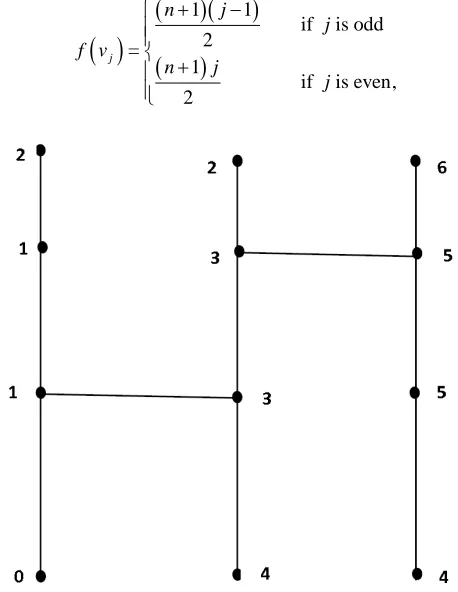
right up to the other.For 1 i n, define the labeling f as
1
if is odd =
f v 2
if is even 2
i
i
i
i
i
Then f is a vertex equitable labeling of the path P T
n and Let be any edge of T withat deletes this edge an
i j
v v pt th
1i< j d add the edge
1 P
j t
be the e v vi t
the where is the distance of fr
an t ce of
i
v om vi t and also
dist vj from vj t.
ma at contains P1 as one of the constituent epts.
Since v vi t j
Let P
is an edge of the path
be a parallel transfor-tion of T th
t T
, itfol-lows that = 2
P j i 1 = jt
i t which implies t 1. Therefore e of opposite parity
is given by i and j ar . The induced label of the edge v vi j
* *
2 1 =
i j i i t
f v v f v v
2 1 =
2
if is even
2 2
=
if odd
2 2
= , 1
i i t
f v f v
i i t
i
i i
i
i t i n
1 2 1
is t
Now
* *
1 =
= , 1 .
i t
f v v f v v
i t i n
1
=
i t j t i t
i t i t
f v f v
Therefore, we have f*
v vi j = f*
v vi t
and hencef is a vertex equitable labelin
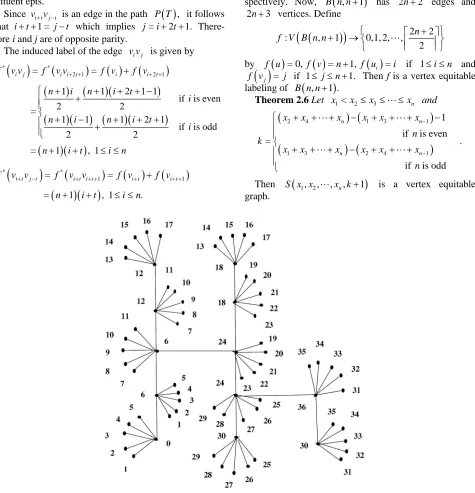
An example for the vertex equitable labeling of a Tp-
tree with 12 vertices is given in Figure 2.
Theorem 2.4 Let T be a T -tee with even number of vertices. Then the graph
j t
g of the Tp-tree T.
p
n
TK is a vertex equitable
f. L order m and
r-graph for all n1.
Proo et T be a Tp-tree of even the ve
tex set V T
=
v v v1, 2, 3,,vm
. Let 1, 2, ,j j n
u u
the pendant vertices joined with vj
1 jm
by an edge. Thenj
be u
=
, j:1 ,1
.
K m
inition of a ts a parallel i
n j i
V T v u i n j
By the def Tp-tree, there exis
transformat on P ofT such that for the path P T
we have 1) V P T
=V T
, 2)
T
= d
Eps deleted from T
where dge
E P E T E
d
E is the set of e and Ep
e sequ is ed through th ence the set of edges newly add
1 P2,,Pk
of the epts= ,
P P P used to arrive the path
.P T Clearly, Ed and Ep have the same number of
edges.
P T ndant v
Now denote the vertices of successively as starting from one pe ertex of 1, 2, , m
v v v P T
right up to the other. The labeling f defined by
1 1
if is odd 2
= 1
if is even, 2
j
n j
j f v
n j
j
[image:3.595.308.537.408.704.2]
Figure 2. Vertex equitable labeling of a Tp-tree with 12
1 1
if is odd
n j
2
= , 1
1 2
if is even.
2
j i
i j
f u i n
n j
i j
Therefore, we have f*
v vi j = f v v
and thus f is
i t j t
a vertex equitable labeling of
TKn.
An example for the vertex equitable labeling of TK5,
is a vertex equitable labeling graph.
Let be any edge of T with let be th that deletes this edge
ere t is the distance
where T is a T-tree with 12 vertices is shown in Figure 3. Let
p
, 1
B n n be a graph obtained from K2 by at-taching ges at one vertex and dant edges at the other vertex.
Theorem 2.5 The bistar is a vertex equi-table graph.
Proof. Let
n pendant ed n1 pen
i j
v v e ept
wh
1i< jm and adds th of vi from v
1 P
dge B n n
, 1
e e
i t j t
v v i t and
also the V K
2 = u v, and ui
1 i n
and
1 1
j n
distance of vj from vj t.
ains
Let P be a 1
P as one of the c parallel
on-transformation of T ont
stituent epts.
Since is an edge in the path it follows that which implies . There-fore i and j are of opposite parity.
The induced label of the edge is given by that c
i t j t
v v
1 =
,
P T
= 2
j i t
i t jt 1
i j
v v
* *
2 1 2 1
= =
1 1 2 1 1
if is even
2 2
=
1 1 1 2 1
if is odd
2 2
= 1 , 1
i j i i t i i t
f v v f v v f v f v
n i n i t
i
n i n i t
i
n i t i n
* *
1 1
= =
= 1 , 1 .
i t j t i t i t i t i t
f v v f v v f v f v
n i t i n
v j be the vertices adjacent to u and v
re-
, 1
B n n
spectively. Now, has 2n2 edges and
2n3 vertices. Define
2 2: , 1 0,1, 2, ,
2
n f V B n n
by f u
= 0, f v
=n1, f u
i
=i if 1 i n and
j =f v j if 1 j n 1. Then f is a vertex e labeling of
quitable
, 1 .
B n n
orem 2.6 L
The et x1<x2x3xn and
x2 x4 xn
x1 x3 x 1
1
2 4 1
if
is odd
n
n x x xn
n
1 3
is even
= n .
k
x x x
if
Then S x x
1, 2,,x kn, 1
is a x equitablegraph.
verte
5
[image:4.595.62.281.88.145.2] [image:4.595.63.538.227.720.2]Proof. By Theorem 2.5, S x x
1, 11
is a vertexeq-uitable graph. Let f1 S x Cons
be the ing vertex
equi-table labeling of . Since
correspond
. Let y1 x2
e graphs
1,x11
. ider th
1
= x 1
1, 1 1
S x x 1< 2, 1 0
x x y and
Now,
.Therefore, by Theorem 2.1,
1, 1 1 .
S y y T
1, 1 1
S x x is
he ber o . num
1
2x 2
f edges of the graph
1 1 1 1
1 1
1 1 1 1 1 2 1
, 1 * , 1
= , 1, 1 = , , 1
f f
S x x S y y
S x x y y S x x y
1, 1 1 1, 1
S x x y y
2
1 is a vertex equitable graph. Let f be the corresponding vertex equitable labeling of S x x y
1, 2, 11 .
Again
, ,y11
is even. =x x x 1 1the number of edges of
Now take . Hence
Als
1 2
S x x
= y 1
2 3 1 3 2 1
y x
o 2 0.
y
1 2 1 2 2
2 1
1 2 1 2 2
1 2 3 2
, , 1 * , 1
= , , 1, 1
= , , , 1 .
f f
S x x y S y y
S x x y y y
S x x x y
Therefore, by Theorem 2.1, S x x x y
1, 2, 3, 21
is ax equitable graph and th r
verte P
e numb 2th step
er of edges is even. oceeding like this, at the
we get
1, 2, 3, , n 1, n 2 1
S x x x x y is a vertex equitable graph
where
n
2 4 1 1 3 2
2
1 3 1 2 4 2
1 if is even
= .
if is odd
n n
n
n n
x x x x x x
n y
x x x x x x
n
Let fn1 be the corresponding vertex equitable label-ing of S x
1,x x2, 3,,xn1,yn21
. Take
2 4 1 3 1
1
1 3 2 4 1
1
if is even
= .
if is odd
n n
n
n n
x x x x x x
n y
x x x x x x
n
Clearly yn2yn11 =xn. Now,
1 2 3 1 2 1 1
1 1
1 2 3 1 2 1 1
1 2 3
, , , , , 1 * , 1
= , , , , , 1 , 1
= , , , , , 1 .
n n f n n f
n n n n n n
S x x x x y S y y
S x x x x y y y
S x x x x k
Therefore, S x x x
1, 2, 3,,xn1,x kn, 1
is a vertex equi-table graph.An example for the vertex equitable labeling of
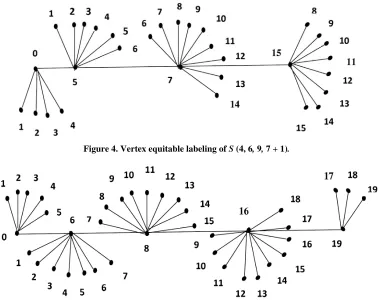
4, 6, 9, 7 1
S if n odd is given in Figure 4.
ple for the vertex equitable labeling of is
An exam
5, 7, 9,10, 2 1
[image:5.595.111.489.421.721.2]S if n is even is given in Figure 5.
Figure 4. Vertex equitable labeling of S (4, 6, 9, 7 + 1).
Theorem 2.7 The crown is a vertex equita-ble graph.
Proof: Let be the vertices of the cycle Cn
and let vi jacent to ui for Then
the vertex set
1
n
C K
1, 2, n
u u u be the vertex ad
1 i n.
1
V C K
, :1
n u vi i in and the edge
set n K1 u ui 1
n 1
1
, ,
i u vi i u u un
: 0,1, 2
,:1
n nv i
,
1
E C n .
ne
Defi f V C K n for the following cases:
Case 1. n0
mod4
.
1
for = 1, 3, 5, , 12
= for = 2, 4, 6, ,
2
for 1 ,
2
i
n
i i
n
f u i i
n
i i n
for = 1, 3, 5, , 1 2 = 1 for = 2, 4, 6, ,
2
for 1 .
2
i
n
i i
n
f v i i
n
i i n
Case 2. n1
mod4 .
for = 1, 3, 5, ,
, n i i n f u n 2
= 1 for = 2, 4, 6, ,
2
for 1
2
i i i
n i i
1 for = 1, 3, 5, , 2 = for = 2, 4, 6, ,
2
for 1 .
2
i
n
i i
n
f v i i
n i i n
Case 3. n2
mod4
.
1
for = 1, 3, 5, , 2 = for = 2, 4, 6, ,2
for 2 ,
2
i
n
i i
n
f u i i
[image:6.595.354.490.84.214.2]n i i
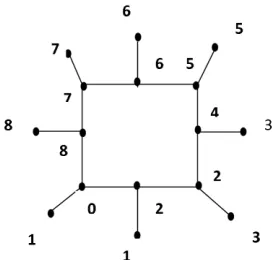
Figure 6. Vertex equitable labeling of C8K1.
for = 1, 3, 5, ,
2
= 1 for = 2, 4, 6, , 1
2
for 3 .
2
i
n
i i
n
f v i i
n i i n
2 1 2 2
2 1
= , = 1,
2 2 = 2. 2 n n n n n
f v f v
n f u
Case 4. n3
mod4 .
1
for = 1, 3, 5, , 2 = for = 2, 4, 6,2
for 1 ,
2
i
n
i i
n
f u i i
n i i , n
for = 1, 3, 5, , 2 = 1 for = 2, 4, 6, , 1
2 for . 2 i n i i n
f v i i
n
i i n
In all the above cases, f i ence C
1
n
s a vertex equitable labeling. H is a vertex equitable graph.
An ex for the vertex equitable labeling of is shown in Figure 6.
Theorem 2.8 The graph is a vertex equitable graph.
Proof. Let be the path Clearly, has n vertices
1
nK
ample C8K1
2
n
P
1, 2, , n
u u u and 2n 3
.
n
P Pn2
edges. Define
2 2 3 : 0,1, 2, ,2
n
n f V P
by f u
i =i1, 1 i . table graph.n Evidently, is a vertex equi
REFERENCES
[1] F. Harary, “Graph Theory,” Addison Wesley, Massachu-setts, 1972.
[2] J. A. Gallian, “A Dynamic Survey of Graph Labeling,”
The Electronic Journal of Combinatorics, Vol. 18, 2011, Paper #DS6.
[3] G. Bloom and S. Ruiz, “Decomposition into inear Forest
Mathematics
doi:10.1016/0166-218X(94)90201-1
2
n
P
L
and Difference Labelings of Graphs,” Discrete Applied
, Vol. 49, 1994, pp. 61-75.
[4] S. M. Hegde and S. Shetty, “On Graceful Trees,” Applied Mathematics E-Notes, Vol. 2, 2002, pp. 192-197. [5] R. Ponraj and S. Somasundram, “Mean Labeling of
Graphs,” National Academy Science Letters, o 2003, pp. 210-213.
Ponraj and S. Somasundram, “Non-Existence of Mean
ci-atics &
[7] R. Ponraj and S. Somasundram, “Some Results on Mean Graphs,” Pure and Applied Mathematical Sciences, Vol. 9, 2004, pp. 47-58.
S. Som rth
s,” Proceedings f SACOEFERENCE, Na-tional Level Conference, Dr. Sivanthi Aditanar College of Engineering, 2
[9] M. Seenivasan Equitable
tography, Vol. 11, No. 6, 2008, pp. 727-
t. l.
V 26,
[11] P. Jeyanthi and A. Maheswari, “Vertex Equitable Labeling of Cycle and Path Related Graphs,” Utilitas Mathematica, Article in Press.
[6] R.
Labeling for a Wheel,” Bulletin of Pure and Applied S ences (Mathem Statistics), Vol. 22E, 2003, pp. 103-111.
[8] R. Ponraj and asundram, “Fu er Results on Mean Graph
005, pp. 443-448.
and A. Lourdusamy, “Vertex
Labeling of Graphs,” Journal of Discrete Mathematical Sciences & Cryp
735.