1
FOOD FOR LIFE: AN EXPLORATION OF CONTEXT, METHODOLOGY
AND RESEARCH IMPACT OF A COMPLEX PROGRAMME
EVALUATION
Mathew Richard Joseph Jones
A thesis submitted in partial fulfilment of the requirements of the
University of the West of England, Bristol for the degree of Doctor
of Philosophy
Section A: Commentary
Faculty of Health and Applied Sciences, University of the West of England, Bristol
June 2017
3
Acknowledgements
4
Abstract
5
Contents
Acknowledgements ... 3
Abstract ... 4
Tables and figures ... 6
Acronyms and abbreviation ... 6
Note on citations for works submitted in support of the DPhil award ... 6
1 Introduction ... 7
2 Context of research linked to Food for Life Phase 1, 2007-12 ... 12
3 Research outputs arising from the evaluation of the Food for Life Phase 1 programme ... 17
3.1 Introduction ... 17
3.2 Creating an integrated account ... 19
3.3 Investigating connections between mechanisms and outcomes ... 21
3.4 Understanding stakeholders ... 22
3.5 Discussion ... 25
4 Context of the research linked to Food for Life Phase 2, 2013-15 ... 28
5 Research works arising from the evaluation of Food for Life Phase 2 ... 31
5.1 Introduction ... 31
5.2 Taking a critical realist approach ... 33
5.3 Developing a socio-ecological account ... 35
5.4 Creating a wider account of value ... 36
5.5 Understanding matters of scale and transition ... 37
5.6 Discussion ... 41
6 Impact of the DPhil publications ... 42
6.1 Introduction ... 42
6.2 Citations arising from the DPhil works ... 42
6.3 Presentations arising from the DPhil works... 43
6.4 Influencing programme development ... 45
6.5 Wider related research activities, outputs and outcomes ... 47
6.6 Understanding the research on Food for Life in wider international context ... 50
7 Summary and conclusions ... 52
8 References ... 57
Appendix 1 Research training requirement ... 72
Appendix 2 Statement on work submitted for another academic award ... 72
6
Phase 1 Evaluation reports, peer reviewed articles and book section ... 73
Phase 2 Evaluation reports and peer reviewed articles ... 74
Appendix 4 Bibliography of conference presentations and invited presentations ... 76
Appendix 5. Citations of the evaluation research articles and reports ... 79
Appendix 5 Impact of the research on programme commissioning decisions ... 85
Appendix 6 Statement on author’s contribution to the works submitted ... 87
Summary of methods ... 87
Confirmation and responses from co-authors ... 91
Appendix 7 Doctoral Descriptors ... 94
Tables and figures
Table 1: Publications submitted in support of the award……… 7Table 2: ‘Phase 1’ submitted papers. Summary of intellectual contribution and research professional development……… 18
Table 3: ‘Phase 2’ submitted papers. Summary of intellectual contribution and research professional development……… 31
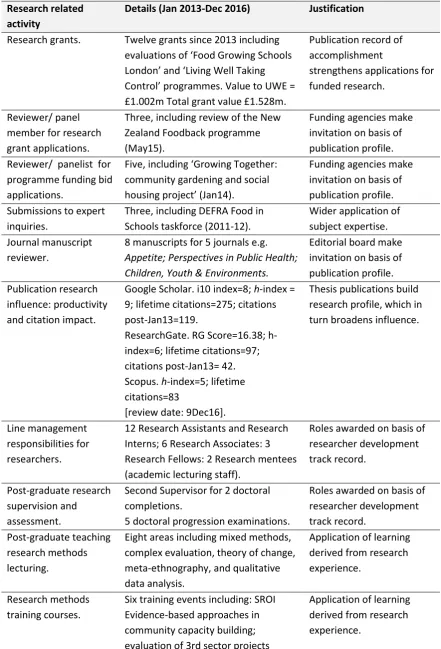
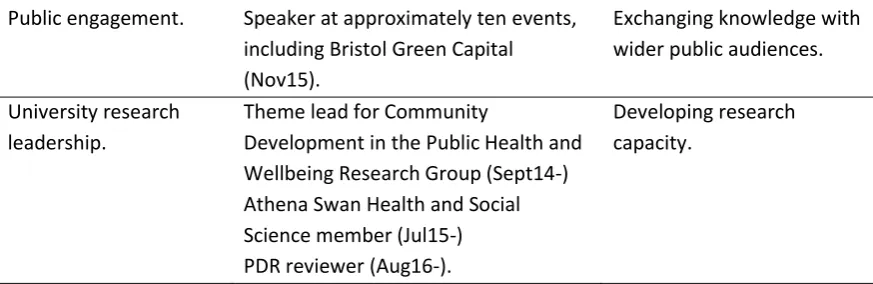
Table 4: Wider research activities, outputs and outcomes post completion of Phase 1 Food for Life research……… 48
Figure 1: Food for Life Phase 1 Research impact timeline……….. 44
Acronyms and abbreviation
BLF Big Lottery Fund DoH Department of Health CFT Children’s Food Trust FFL Food for Life
FFLCM Food for Life Catering Mark QAA Quality Assurance Agency SA Soil Association
SROI Social Return on Investment TOC Theory of Change
Note on citations for works submitted in support of the DPhil award
7
1 Introduction
This thesis involves the submission of published academic work with a critical commentary, in accordance with the regulations of UWE for DPhil degrees. Fourteen works are submitted, published between 2008 and 2017. These include nine peer reviewed journal articles, one book chapter section, and three externally reviewed research reports. These works share a common concern with the intersections between food, public health and sustainability, and the majority draw upon two phases of evaluative research on the Food for Life programme conducted between 2007 and 2016. A list of the works is presented in Table 1.
Table 1: Works submitted in support of the DPhil award*
‘Phase 1’ Peer Reviewed Articles, Book Section and Evaluation Report
Paper 1 Jones, M. and Daykin, N. (2015) Sociology and Health. Case study: the social
determinants and social construction of diet. In: Naidoo, J. and Wills, J., eds. (2015) Heath Studies: an Introduction. 3rd ed. London: Palgrave Macmillan, pp.155-195 (case study: pp.185-187). [Originally published in 2nd ed: 2008] ISBN:
9780230545205
Paper 2 Orme, J., Jones, M., Kimberlee, R., Weitkamp, E., Salmon, D., Dailami, N., Morley, A. Smith, A., and Morgan, K. (2011) Food for Life Partnership Evaluation. University of the West of England, Bristol. Full report available at:
http://eprints.uwe.ac.uk/14456 ISBN: 9781860435317
Paper 3 Jones, M., Dailami, N., Weitkamp, E., Kimberlee, R., Salmon, D. and Orme, J. (2012)
Food sustainability education as a route to healthier eating: evaluation of a multi-component school programme in English primary schools. Health Education Research. 27 (3), pp.448-458. doi.org/10.1093/her/cys016 ISSN: 0268-1153 Paper 4 Jones, M., Dailami, N., Weitkamp, E., Kimberlee, R., Salmon, D. and Orme, J. (2012)
Engaging secondary school students in food-related citizenship: achievements and challenges of a multi-component programme. Education Sciences, 2, pp.77-90.
doi.org/10.3390/educsci2020077 ISSN: 2227-7102
Paper 5 Jones, M., Weitkamp, E., Kimberlee, R., Salmon, D. and Orme, J. (2012) Realizing a
8 Paper 6 Weitkamp, E., Jones, M., Salmon, D., N., Kimberlee, R., Salmon, D. and Orme, J.
(2013) Creating a learning environment to promote food sustainability issues in primary schools? Staff perceptions of implementing the Food for Life Partnership Programme. Sustainability. 5 (3), pp.1128-1140. doi.org/10.3390/su5031128 ISSN: 2071-1050
Paper 7 Orme, J., Jones, M., Salmon, D., Weitkamp, E. and Kimberlee, R. (2013) A process evaluation of student participation in a whole school food programme. Health Education. 113 (3), pp.168-182. doi.org/10.1108/09654281311309819 ISSN: 0965-4283
Paper 8 Kimberlee, R., Jones, M., Orme, J. and Salmon, D. (2013) Whole school food programmes and the kitchen environment. British Food Journal, 115 (5), pp.756-768. doi.org/10.1108/00070701311331535 ISSN: 0007-070X
Paper 9 Salmon, D., Jones, M., Weitkamp, E., Kimberlee, R. and Orme, J. (2013) Take home messages on sustainable food: surveying parent perceptions of the effects of a primary school programme. British Journal of Education, Society and Behavioural Science.3 (4), pp.490-503. 10.9734/BJESBS/2013/4211 ISSN: 2278-0998
‘Phase 2’ Peer Reviewed Articles and Evaluation Reports
Paper 10 Jones, M., Pitt, H., Orme, J., Bray, I., Gray, S., Kimberlee, R., Means, R., Oxford, L.,
Powell, J., Salmon, D. and Weitkamp, E, (2016) Evaluation of Food for Life 2013-15. Summary and Synthesis Report. Bristol: University of the West of England. Full
report available at: http://eprints.uwe.ac.uk/29454 ISBN: 9781860435300
Paper 11 Jones, M., Pitt, H., Oxford, L., Bray I., Kimberlee, R. and Orme J. (2017) Association
between Food for Life, a whole setting healthy and sustainable food programme, and primary school children’s consumption of fruit and vegetables: a cross-sectional study in England. International Journal of Environmental Research and Public Health, 14, 639. doi:10.3390/ijerph14060639 ISSN 1660-4601
Paper 12 Jones, M., Pitt, H., Oxford, L., Orme, J., Gray, S., Salmon, D., Means, R., Weitkamp,
E., Kimberlee, R. and Powell, J. (2016) Food for Life: a Social Return on Investment Analysis of the Locally Commissioned Programme. Full Report. Bristol: University of
the West of England. Available at: http://eprints.uwe.ac.uk/31897 ISBN: 9781860435294
9 Promotion International, pp.1-10. doi.org/10.1093/heapro/dax017ISSN:
0957-4824
Paper 14 Pitt, H. and Jones, M. (2016) Scaling up and out as a Pathway for Food System Transitions. Sustainability. 8 (10), pp.1025-1041. doi.org/10.3390/su8101025
ISSN: 2071-1050
* Papers clustered by phase of work and type of research, not necessarily in chronological order.
I argue in this commentary that these works represent cumulative body of academic conceptual and empirical enquiry on the development, implementation and impacts of complex community-based initiatives. By December 2016, the research findings in these publications had been cited by 54 works, both nationally and internationally, and underpinned several government programme grants and commissions. My submission of published works is complemented by 23 conference presentations, which are listed in a bibliography (Appendix 4). The submitted works that are linked to earlier stage – or ‘Phase 1’ - of the research supported a UWE Impact Case Study for the Research Excellence Framework Unit of Assessment 22 in 2014.
My interests in food, health and sustainability go back to my early career as a community development worker engaged in urban renewal projects and, later, as a higher education lecturer in sociology and social policy for health and welfare professionals. Between 2000 and 2007, I became increasingly active as a researcher. This involved working on twelve externally funded research projects with community and voluntary sector agencies, both as principal investigator and co-investigator. This research, and the training that accompanied it, allowed me to acquire a range of research skills, following from project inception through to the production of a range of peer-reviewed publications (Salmon et al. 2015; Jones, 2004; de Viggiani, Jones and Naidoo, 2004; Salmon and Jones, 2004; Jones et al., 2004; Jones, Salmon and Orme, 2004; Kimberlee, Jones and Powell, 2003; Powell, Kimberlee and Jones, 2003; Jones and Salmon, 2001; Salmon and Jones, 2001). In 2007, the research with the national Food for Life programme represented a step change for me in terms of the scale, complexity and policy significance of the research.
10 of reference in the UWE regulations is the requirement for submissions to meet six doctoral descriptors, which are summarised as follows:
1) Creation and interpretation of new knowledge
2) Critical understanding of the current state of knowledge 3) Conceptualise, design and implement a project
4) Critical understanding of the methodology of enquiry 5) Judgement of issues and ideas
6) Critically reflect and evaluate strengths and weaknesses (See Appendix 7 for descriptors in full)
For monograph-based PhDs there is an extensive stock of precedents to draw upon for the presentation and examination of submissions, and for judgements to be made on the extent to which submissions meet doctoral descriptors. By contrast, conventions for the DPhil - or thesis by publication - are less rehearsed in UWE and elsewhere, such that one commentator characterised the DPhil as ‘the pioneering option’ (Merga, 2015, p.303) for candidates seeking to undertake doctoral studies. This is partly because DPhils differ considerably in the specific composition and characteristics of the portfolios of works submitted. Recently, guidance from the QAA and empirical studies of the field have helped to clarify some of the less well-defined aspects of doctorates by publication. The QAA state that for a DPhil:
“A candidate presents a portfolio of interconnected, published research papers contextualised by a coherent narrative, demonstrating overall an original contribution to knowledge. Such publications may include papers, chapters, monographs, books, scholarly editions of a text, technical reports, creative work in relevant areas, or other artefacts.” (2015, p.8)
Studies of the content of DPhils, the process of their development and their examination suggest that the narrative – or commentary- has an important role in helping to clarify issues that are sometimes less visible in comparison to monograph theses (Guerin, 2016; Merga, 2015; Sharmini et al., 2015). Notably, commentaries provide the opportunity to demonstrate overall coherence of
11 et al., 2012; Simera et al., 2010; Von Elm et al., 2007). Thirdly, I present my development as a social
science researcher and scholar - following QAA recommendations - and show how my work corresponds to a broader trajectory in research and scholarship. Fourthly, I clarify my personal intellectual contribution to the multi-authored works. Finally, this commentary will provide an account of the influence and impact of the works.
I decided to organise the commentary in the form of a reflective and historically organised narrative. This trajectory helps show the order of decision-making, my cumulative development as a researcher and how each successive sub-study arose from questions left unanswered by those that went before. The use of a timeline also serves to lay out much of the impact of the research and, in so doing, help gauge the contribution to existing knowledge. It is important to note that there is a matter of methodology and method with respect to the commentary itself. This is a retrospective account and, as such, entails a number of challenges concerned with the status of the knowledge claims presented and the process by which they have been put together. I have sought to adopt a structured and reflexive approach to my collation of sources to draw upon for the commentary. This involved, for example, reviewing original research proposals, protocols, ethics submissions and internal reports that underpin the submitted works. A second point to note is that, whilst peer-reviewed works sit at the core of the DPhil submission, I have also submitted technical reports along with a critical reflection on their validation. As well as being substantive scholarly works in their own right, these reports are important components that bring together the overall thesis.
12
2 Context of research linked to Food for Life Phase 1, 2007-12
Food for Life (FFL) is an England-wide programme led by the Soil Association developed with an overall aim to promote ‘good food culture’ in schools and other institutional and catering settings1. Its origins lie in a Soil Association campaign in 2003 that sought to expose the poor state of school meals and to highlight the opportunity reform the food procurement system in schools (Soil Association, 2003). Pilot work with a small number of schools and their caterers brought together a number of food related issues. These included the importance of cooking and food growing skills in an educational context, the connections between dietary health and children’s performance in school and food sustainability issues such as those related to local food economies, organic food, fair trade and animal welfare.
The Soil Association’s report was timely. It connected with the Hungry for Success school food enquiry underway in Scotland (Scottish Government Executive, 2002 and 2003) and chimed with work led by the Caroline Walker Trust on school nutritional standards (Crawley, 2005). The report came at a point of a significant upturn in government investment in education and child and family services. Notably, the Labour government’s 2003 Comprehensive Spending Review led to an increase in funding for schools and was accompanied by a busy period in policy formulation that connected fields of education, public health, social exclusion, area based initiatives and environmental sustainability (Toynbee, 2011). Whilst the Labour government retained much of the market inspired reform mechanisms of the previous Conservative administrations, the early 2000s saw shifts towards greater guidance, planning and regulation of public services, such as schools, and their ‘ancillary services’, such as school caterers (Morgan, 2006; Passmore and Harris, 2004, Morgan and Sonnino, 2008).
We can also see the origins of Food for Life in the context of broader societal trends. For example, the early 2000s saw steady economic growth, and a move amongst consumers to purchase ‘local’, organic, fair trade and animal products with higher welfare standards or, at least according to consumer surveys, to look more favourably on such foods (Cabinet Office Strategy Unit, 2008). At the same time, major changes were taking place in the global food system, in all aspects of production, processing, distribution, through to retail (Lang, 2005). Much of this transformation was linked to greater market penetration of low cost (at point of purchase) ultra-processed foods and changing patterns of food consumption (Moodie et al., 2013). In Paper 1, I reviewed some of these wider processes, with a focus on social anxieties surrounding food and eating practices and
13 the persistence of diet-related health inequalities. This account showed the contribution of sociological theory, and ranged from macro-perspectives of globalisation, to micro-perspectives on the connections between food, meaning and (in)security. Some of these societal tensions, became manifest in public debates about the role of food in the education and wellbeing of children (Alcock, 2014), and was fuelled through close media attention in the early 2000s (Pike, 2008).
More widely, Food for Life was influenced by discourses surrounding the notion of a sustainable food system. Ideas that food exists in a ‘system’, or number of ‘systems’, are longstanding –albeit they are often ones in which the system of interest has been circumscribed to the relationships between production, processing and consumption (Erikson, 2008). In the twentieth century, Lang and Heasman (2004) have argued that the policy attention on food systems has been primarily directed through a productionist paradigm. In this worldview, improvements in human welfare are driven through the industrialisation of food and farming, and the application of the principles and logic of industrial production to drive efficiencies, increase food output, and lower consumer costs. The interests of farmers, and those linked to the farming industry, obtained precedence in public policy on the food system. Although the origins lie in the industrialisation of food and farming over the last 200 years, the productionist paradigm became pre-eminent in the reconstruction period that followed World War Two (Lang and Heasman, 2004, p2.6). By the twenty first century, this ‘conventional food system’ has come to be “fundamentally characterized by social and economic change [featuring] a marked intensification of food production, rapid growth of processing and packaging of food products, corporate concentration in retailing and distribution, and the rising influence of large numbers of urban consumers” (Erikson, 2008, p.234). It also became highly energy and capital-intensive, globally integrated, and increasingly economically consolidated (Feenstra, 2002).
Rising concerns about the hegemony of the productionist paradigm and its harmful impacts have produced reactions from diverse quarters (Lang and Heasman, 2004; Ashe and Sonnino, 2013). Early usages of the phrase ‘sustainable food system’ appeared in the works of environmentally minded agricultural scientists (e.g. Dahlberg, 1979; Knorr, 1983) as a means of framing alternatives to the ecologically destructive practices of mainstream agri-business2. By the 1980s, Hinrichs (2010) observes that food also became a concern for those working in the nascent sustainable development field, and who found expression in the Brundtland Commission (1987)’s balance of environmental, social, and economic pillars for sustainable development. In a further current of
2 Although it should be noted that ideas of sustainability appear in earlier agro-ecological thought including those linked
14 concern, dysfunctions of the food system attracted the attention of campaigners who primarily sought to promote ‘sustainable livelihoods’ for the world’s poorest citizens through greater food and income security (Hinrichs, 2010).
As a consequence, multiple narratives and aspirations have come to sit behind the notion of food system sustainability (Hinrichs, 2010). Whilst attention towards ecological sustainability in farming practices is a major focus, commentators have also sought to emphasise the need for greater economic sustainability, for example with respect to protections for small scale producers and local food distribution systems – particularly in the face of global industrial actors (for example, Feenstra, 2002). Others have prioritised questions of social sustainability through drawing attention to the nutrition and diet-related rights of disadvantaged groups, and the health implications of poor diets (for example, Allen, 2004). To this, cultural dimensions of sustainability have been added, for example in terms of the preservation of culinary traditions (Johns and Sthapit, 2004). Thus, there have been shifting notions of what needs to be sustained with respect to an ever more expansive conceptualisation of the food system (Ambler Edwards et al., 2009).
The theory and action in relation to sustainable food systems has therefore developed over time to encompass a wider range of issues and public values. Many of the key debates on courses of action resemble those of green thinking more widely (Dobson, 2000; Paterson, 2013), and in particular the tensions between bio-environmentalists, social greens and institutionalists (Clapp and Dauvergne, 2005). Given the expansiveness of interests in the field of sustainable food systems, it is little surprise that much food-related social movement action (Ashe and Sonnino, 2013) and policy development (Lang and Barling, 2013) has been dispersed or weakly integrated. Effort led by the Food and Agriculture Organisation alongside the UN Environment Programme and Bioversity in 2010 produced an important consensus definition on sustainable diets (Burlingame and Dernini, 2012) however, traction of the definition encounters major challenges, not least in part due to its conceptual breadth and complexity (Lang and Barling, 2013).
15 It was notable that the original Food for Life partnership did not seek to employ one consistently phrased goal for the programme. For example, in some of communications ‘sustainability’ constituted the overarching term for all aspects of the agency’s agenda for the food system. In other communications, Food for Life disaggregated or elided sustainability with ‘organic’, ‘local’, ‘fair’ or ‘ethical’. Similar processes have been noted in other contexts of activism on food (Flynn and Bailey, 2014), and may have helped mask potential sources of tension between different interest groups (Morgan, 2010), green identities (Horton, 2003), or moral sentiments in relation to food (Sassatelli, 2004; Warde, 1997). As lead agency behind FFL, the Soil Association’s mission to promote organic food was something of a moot point, where some argued that agendas on ‘sustainable food’ needed to gain greater prominence within the organisation. This matter never achieved resolution in development of the programme. Along with ideas such as ‘good food culture’, the notion of a sustainable food system tended to be articulated through emblematic examples of practice rather than definitional statements.
In 2004, Channel 4 commissioned chef Jamie Oliver to front a series campaigning for improved food standards in school meals. The series drew a large national audience and, following major media reporting, obtained a commitment in April 2005 from Prime Minister Tony Blair to introduce tougher school meal standards and create a new body to raise food quality in schools (Blair, 2006; School Meals Review Panel, 2005). Ideologically and pragmatically committed to the role of the
third sector in driving social change, ministers appear to have also given the steer to the Big Lottery Fund (BLF) to get behind the school food reform agenda. Third sector agencies, as in other fields of public policy, were being increasingly charged by the Labour government to lead on sensitive areas of public policy (Taylor, 2011; Macmillan, 2010; Carmel and Harlock, 2008; Lewis, 2005). Having learnt from some difficult experiences, the Big Lottery Fund had evolved its approach to making grant awards. The 2006 Wellbeing Programme reflected much of this learning in the form of a large award scheme designed for major consortia-led applications (Big Lottery Fund, 2006).
16 approach and to ally the organic food agenda to those of other food movements such as those of local food lobbyists. Food in school offered wider long-term opportunities for the Soil Association including the chance to raise children’s awareness of organic and more widely sustainable food issues and perhaps to influence food attitudes at home. In addition to changing the school menu, a further opportunity for the Soil Association was to bring children and parents in closer contact with organic food producers through farm visits. Three other partners all brought their own interests. Garden Organic would lead on the promotion of food growing in schools. Focus on Food concentrated on cooking and food preparation skills. The Health Education Trust led on pupil, staff and parental involvement and some nutritional aspects of the programme. In late 2006, the Soil Association learnt that their bid for a £17m five-year programme had been successful.
Details on the design and characteristics of the Food for Life programme are provided in Paper 2. Here it is worth highlighting that the programme goals were to create an England-wide scheme that would be taken up by 4800 schools over the grant funding period. The initiative centred on an award-based framework that was intended to reflect school and caterer led action across a number of domains, which included procurement practices, the dining room environment, curriculum, stakeholder engagement and leadership reform. The Food for Life partnership would recruit 180 schools to become ‘flagships’ for piloting innovation and exemplifying best practice. It is also worth noting that early into the development of the programme, the Soil Association launched the Food for Life Catering Mark (FFLCM), an initiative closely aligned but initially separate to the Food for Life Partnership (Soil Association, n.d.). FFLCM was not only available to public sector caterers, such as those in the school food sector, but to private sector providers.
17
3 Research outputs arising from the evaluation of the Food for Life
Phase 1 programme
3.1 Introduction
This section sets out a group of works (Papers 2-9) submitted as part of the DPhil that draw upon my role as part of a UWE-led research team that successfully secured the £250k evaluation contract in 2007 (Orme et al., 2007).
The brief presented by the research commissioners sought for an agency that could address a number of questions through an evaluation of the programme (Soil Association, 2007). These included understanding the impact of FFL works with flagship schools with respect to both specific behavioural outcomes (such as diet) and wider processes of change (such as engagement and inclusiveness). The evaluation brief did not specify the methodologies or methods to be adopted, but referred to the potential role of interview, case study and survey based work. It was also evident that the Soil Association was looking for an evaluation that would have a degree in independence and would address the interests of a broad range of stakeholders, including the Big Lottery Fund, government policy leads, head teachers, caterers and parents. The open-ended nature of the brief presented an opportunity to develop innovative evaluation project. However, this also raised challenges for colleagues and myself because, at the time of writing the evaluation proposal, we had few details about the design and organisation of the programme itself. In addition, in 2007, we were relatively new to this scale of work, and I had no previous direct experience of undertaking an evaluation of a programme with national reach, major grant funding and substantial political sensitivity.
18 the works. Appendix 6 provides further details on my intellectual contribution, and confirmation of this contribution from co-authors.
Table 2: ‘Phase 1’ submitted papers. Summary of intellectual contribution and indicative research
professional development
Title of Paper (abbreviated) Intellectual contribution [mapped to Vancouver
Protocol+]
Indicative research professional development [mapped to RDF*
Paper 1
Jones, M. & Daykin, N. (2015) Sociology and Health section. In: Naidoo, J. & Wills, J., eds. (2015) Heath Studies.
Daykin produced this chapter in an earlier edition of the book (2001). For case study section in the 2008 and 2015 editions, I led the conception, literature review, interpretation and all drafts. I revised the main chapter with Daykin for the 2008 edition and for the 2015 I led the revision process.
Literature review and synthesis of heterogeneous sources. Writing skills. Subject and theoretical knowledge.
Paper 2
Orme, J., Jones, M., et al. (2011) Food for Life. Full report.
Lead project manager overseeing all aspects of data collection, analysis and interpretation. I designed, developed and led all drafts. I led on sign off and majority of linked presentations.
Managing research contract. Project planning and delivery. Cross-university team working Risk management. Research ethics application process. Research synthesis, critical realism and evaluand validation.
Paper 3
Jones, M., Dailami, N., et al. (2012) Food sustainability education…HER.
Lead author. I led the research design, data collection and analysis. I conceived, designed, developed and led all drafts of the paper, including major revisions. I assisted with statistical aspects of the study.
Historical cohort research design.
Measurement properties of tools. SPSS data management and analysis. Application of inferential statistics.
Problem solving. Responding to peer review feedback. Paper
4
Jones, M., Dailami, N., et al. (2012) Engaging secondary school students... Ed. Sci.
Lead author. I led data collection, analysis and interpretation. I conceived, designed, developed and led all drafts of the paper.
Theory of Change methodology.
Disseminating politically sensitive findings. IPR and copyright. Paper
5
Jones, M., Weitkamp, E., et al. (2012) Realizing a holistic approach to food through school gardens…CYE.
Lead author. I led data collection, analysis and interpretation. I conceived, designed, developed and led all drafts of the paper, including major revisions.
Creativity: argument construction.
19 Paper
6
Weitkamp, E., Jones, M., et al. (2013) Creating a learning environment…Sustainability.
Co-author. I was involved in conception, design,
development and final drafts of the paper.
Research communication with policy and practice audiences.
Paper 7
Orme, J., Jones, M., et al. (2013) A process evaluation of student participation… Health Ed.
Co-author. I was involved in conception, design,
development and final drafts of the paper.
Peer informed research, with elements of co-production. Interview and focus group skills.
Addressing ethical risks. Paper
8
Kimberlee, R., Jones, M., et al. (2013) Whole school food programmes and the kitchen environment… Br Food J.
Co-author. I oversaw data collection and analysis. I was involved in designing, planning and making final revisions to this paper.
Management and analysis of complex datasets.
Questionnaire design. Designing mixed methods study.
Paper 9
Salmon, D., Jones, M., et al. (2013) Take home messages on sustainable food... Br J Ed Soc & Bhvr Sci.
Co-author. I was involved in conception, design,
development and final drafts of the paper.
Sequential mixed methods design.
Time management.
Team working and collegiality. + ICMJE [International Committee of Medical Journal Editors] (2009) Vancouver Protocol on authorship
*RDF: Vitae (2011) Researcher Development Framework
3.2 Creating an integrated account
As well as forming a central point of reference for the peer-reviewed articles, the Food for Life Partnership Full Evaluation Report (Paper 2) is an important research output in its own right because it provides a comprehensive account of the entire research programme. At 170 pages and 62,000 words the report is a substantial document that summarises the research and policy context, most elements of the methodology and findings across eight work-streams. The final report was preceded by four interim reports produced in 2010 (Jones, Dailami and Orme, 2010a; Jones et al., 2010b; Jones et al., 2010c; Kimberlee et al., 2010) and developed on the basis on a revised research protocol agreed with the Soil Association in early 2010. Having agreed an overall framework with the Principal Investigator, it was my role to lead on the production of the first full draft of the report, to lead on writing nine out the 14 chapters, to coordinate the input from colleagues on specific sections, and to lead on drafting overall interpretation of the research. As well as a full report, I led on drafting the summary version and checking of all publicity messages being sought by FFL partners, the Big Lottery and other stakeholders.
20 December 2010. I led on the revisions to comments, which went through four rounds before final sign off for the report in May 2011.
For the report I sought to create methodological coherence by presenting the overarching theory of change (Connell and Kubisch, 1998) to summarise the evaluation of the programme as a whole. Then for each of the work-streams I co-developed and presented ‘sub-theories of change’ for each of the evaluation work-streams, focusing on the context, inputs, outputs, short-term and longer-term outcomes for each work-stream. One of the tensions in reporting the evaluation was that of presenting results either for the entire programme or for specific elements. This became a particular challenge at the point of deciding on how to present the findings through peer reviewed journal outlets, where it was clear that the short word length of conventional journal articles restricted the scope for producing a holistic account that was also rooted in empirical research. The following sections discuss each of the journal articles arising from the main report. However, before I do so, it is worth noting some aspects of the main report that I led on, but did not subsequently report through academic journals. Two areas of research concern the impact on the programme on (1) school meal take up and (2) school performance, student behaviour and attainment.
21 of our evaluation, I learnt how to employ content analysis (Krippendorff, 2004) of Ofsted school reports combined with semi-structured reports from lead teachers. This approach provided a basis making judgements with reference to the views of internal and external experts. The study found that school leads assessment of impacts on Ofsted ratings and commentaries broadly concur with the documentary evidence from Ofsted itself.
3.3 Investigating connections between mechanisms and outcomes
The paper “Food sustainability education as a route to healthier eating” (Paper 3) started from the premise that, while the benefits of practical food education (such as cooking and growing) in schools have been widely reported, less was known about the potential for strategies that focus on food sustainability issues. These issues cover the promotion of awareness about local, seasonal, organic, fair trade and higher animal welfare foods. In primary schools, the article reported that higher self-reported fruit and vegetable consumption was associated with a range of indicators of school participation in the FFL programme. Working with a statistician, in this element of the research I learnt how to test and develop a scale to measure awareness of food sustainability issues and to assess the validity of self-report dietary measures. The pre-post design of the study needed to be revised over the course of the evaluation to fit the time and recruitment constraints of the evaluation. The final version of the article was the result of substantial revisions, with one external reviewer helpfully signposting me to similar research that had used a historical case-control design. I drew upon this research to help communicate the design of the research in line with the conventions of the quantitative health research community. A further benefit to arise from the process of revising the original manuscript was to set out a clearer and more comprehensive account of the limitations of the study with regard to the external validity of the results.
Paper 3 illustrates how Connell, Kubisch, Fulbright-Anderson and Weiss’s Theory of Change (TOC)
22 and written request on questions regarding their expectations of how the programme was meant to work, both in terms of key elements and as a coordinated effort. I was able to use this feedback surface the theoretical underpinnings of the Food for Life programme in terms of the links between activities, outputs and intended outcomes. This process helped define the main measures for the data collection and the connections between food sustainability education and dietary outcomes that I explored in the paper.
3.4 Understanding stakeholders
While Paper 3 was almost exclusively focused on the relationship between quantifiable outcomes and outputs, the other academic articles arising from the Phase 1 evaluation explicitly sought to report on findings arising from the mixed methods approach used in the evaluation.
Contributing to a special education on food and citizenship in the journal Sustainability, Paper 4 focused on the opportunities and challenges for the implementation of FFL in secondary schools. This built upon argument that food sustainability issues are of relevance for young people as their lives progress towards becoming independent consumers and citizens with the capacity to shape food systems of the future (Scott, 2011). The article, using a two stage multi-methods design, reported on limited evidence of FFL to engage young people on these issues and pointed towards the organisational barriers in school settings and the complexity of the programme itself as sources of explanation. I also discussed potential limitations with the research design as a further explanation for the lack of evidence of impact of the programme. Whilst this remains a possibility, the consistent patterns of results from both the quantitative pre-post surveys and the self-reports of teachers and students indicated that there was an insufficient basis to adopt an alternative case-control based study to assess the effects of the programme. For this study, I was involved in all elements of the development of sampling and recruitment, tools and fieldwork. I found one of the greatest challenges concerned the development of appropriate questionnaire tools to assess students’ attitudes towards sustainable food issues. Although I led on creating a number of measures, a limitation of the work was the restricted extent to which we were able to do piloting and validation work.
23 range of indicators of programme activities outputs and perceived outcomes, in order to understand the synergy between different elements of the programme. A main theme from the findings was that local adaptation stakeholders were able to develop school garden activities even in the adverse circumstances of low space, low skills and competing pressures. I argued that FFL provided a mandate for lead staff to develop the growing area as an outdoor classroom, to formalize the role of the food growing as part of curricular study and to create more personalized learning. In this way, school gardens could act as a locus for exploring issues such as local sourcing, ecological sustainability and socially just methods of food production. As with Paper 3, this element of the research included the development, testing and implementation of measures to assess complex constructs such as level of diversification in fruit and vegetable production and scale of linkage between food growing and the curriculum. Through participant checks and structured comparisons (Morgan, 2007) I developed approaches to triangulate qualitative and quantitative data sources in order to create a greater depth of account of change than might not otherwise be found in studies that are limited to one type of data.
Paper 6 examined FFL from the perspective of education for sustainable development (ESD), which
is a specific field of enquiry within scholarship and practice in educational studies. My colleague (EW) developed the premise of this paper, which was that there had been relatively little reported on multi-component approaches to food education for sustainable development. The article reported on what appeared to be a number of innovative successes of the programme with regard to the initiation of whole school coordinated reforms, the fostering of connections between curricular and extra-curricular activities and the specific contributions from experts, for example in food procurement, organic gardening and farm-link education. However, we also reported significant challenges relating to communicating messages, equity of delivery and on-going implementation. My role in the co-authorship of this article enabled me to make links between the ESD and public health agendas on food, and to help show connections between mainstream pedagogical debates and those that take place in health education and science communication. Paper 7, Paper 8 and Paper 9 all share a concern with the role of stakeholders in the
24 the evidence that research in this field needs to adopt a more multi-dimensional and contextual account of user involvement. This element of the research built heavily on previous research with three of my co-authors (JO, RK and DS) in the context of schools-based health initiatives.
By extension, Paper 9 sought to understand the perceived impacts and engagement with FFL by parents. In ‘Take home messages on sustainable food’ we sought to fill a gap in the research on parental experiences of food sustainability and public health nutrition school programmes. Using a mixed methods approach the research found that health promotion programmes could enhance their impact and sustainability through reinforcing the processes by which parents become engaged and can adopt programme messages in the home environment. As with Paper 7, this research arose from some years of sustained collaboration with my co-authors. I took an active role in the conception of the paper, the co-development of tools and measures and the collection and analysis of the data. My central place in the evaluation enabled me to frame the issues from the literature, and to identify some common themes from other components of the evaluation, for example with regard to the theory of change mechanisms by which the programme could influence food related practices in the home environment. The research was innovative in that it was able to test out key processes such as how children motivated families to change shopping and cooking habits, or how fuller engagement with parents on school food issues and school meal improvements helped set an agenda for change for families and the wider local community.
Paper 8 outlined the role of kitchen staff in FFL and illustrated the key dimensions and barriers that
25 Papers 4-9 are distinct in that they address the influence of co-production research methodologies.
The idiom of co-production has been widely adopted both as a description of a mode of engagement and as a normative goal in practice, policy and research settings (Jasanoff, 2004). Co-production can be seen as a process in which two or more parties co-operate – or co-produce – an outlook, activity or outcome (Heron, 1996). One example of the application of co-production is with respect to the aim of the FFL programme team to improve the diets of school children. During the first 18 months of the programme it was evident that a wide range of improvements were sought, but that there was not necessarily agreement between school staff, programme staff, researchers and children themselves on how this might best be defined and assessed. I worked through a process of pilot research projects to narrow down some core areas for focus in our enquiries. Fruit and vegetable consumption proved to be an area for consensus between the schools, programme teams and the evaluators. The second example concerned narrowing down the key areas of programme inputs and activities to focus on both as key performance indicators for staff and as ‘key ingredients’ from an evaluation perspective. The question arose from early pilot assessments of the programme delivery in schools where research fieldworkers, programme staff and school staff found themselves overloaded with data recording and collection. Through dialogue with the programme team, it was my role take oversight on what to keep and what to discard in cases where the information was uninformative or where its complexity and sensitivity was disproportionate to the goals of the evaluation. On two occasions, I needed to consult the Chair of Faculty Research Ethics Committee to check that we were adhering to the terms of the original research ethics protocol. Thirdly, the programme and evaluation teams collaborated to refine the theory base of the programme. Whilst the programme designers were able to draw upon practice-experiences of effective working in schools, the evaluation team brought evidence from research on other programmes to the discussion. Through this dialogue, both parties were able to agree on conceptualising the programme as a ‘whole settings-based’ scheme, in line particularly with the WHO healthy settings framework. This helped both programme and evaluation team draw upon external points of reference to understand the organising principles of the programme.
3.5 Discussion
26 of the effects of combining approaches within school environments. In addition, there had been relatively little research on initiatives bridging the links between dietary health and food sustainability issues. The research found evidence of a range of positive outcomes arising from this approach in diverse ‘real world’ school settings. My role in the research was central in creating an understanding of the key mechanisms and contexts that supported or inhibited programme delivery. We identified central challenges in the form of the organisational structures and cultures of school environments, alongside the issues with the complex delivery and idealism of the programme itself. In this series of papers, the research highlighted the importance of key groups of actors – children and young people, teachers, kitchen staff and parents – in helping to interpret and embed the programme at the local level.
My work on the Food for Life evaluation reflects broader shifts in the social sciences towards the value of the pragmatic, yet theory-driven, use of mixed methods research (Morgan, 2007; Tashakkori and Creswell, 2007; Onwuegbuzie and Leech, 2005). One feature that I sought to develop over the course of the FFL evaluation was to apply a mixed methods approach towards the evaluation. A key indicator of mixed methods research is the integration, or purposeful mixing, of qualitative and quantitative methods (Creswell, 2009). This integration can occur at a number of phases in the research process, and has led to Creswell and Plano Clark (2011) to propose a number of ‘mixed methods designs’ to characterise the alternative approaches. Using the terms of Creswell and Plano Clark, my research on Phase 1 of Food for Life followed a ‘convergent parallel’ mixed methods design. This approach fitted with the overall goal to compare different perspectives from both qualitative and quantitative data sources. A central idea in this approach is collect data through the use of similar constructs and variables (ibid.). In my research, the qualitative and quantitative data were collected in parallel work-streams, initially analysed separately, then compared in the later phase of synthesis and interpretation. A central premise underpinning my choice of this approach was that the use of quantitative and qualitative approaches, in combination, would provide a better understanding of research problems than either approach alone. An important driver for the parallel data collection plan was the character of the central research questions adopted in the evaluation. These entailed not only an understanding of the effects of the programme but also a need to account for the processes by which these might come about. As discussed above, this required learning from the perspectives of key actors. Interview based and focus group qualitative research was therefore a central feature for the data collection strategy for Papers 2, 4-9, alongside pre- and post- quantitative measures to capture change. The decision to
27 Comparison between the different data sources created challenges that have been reported elsewhere in reviews of mixed methods research (Morgan, 2007; Brown et al., 2015; Fàbregues and Molina-Azorín, 2017). These included: questions about the compatibility of the data types in the school meal take-up study in Paper 2; highly incommensurate data derived from school records and interviewees (teachers and students) in Paper 7; and gaps in both qualitative and quantitative data collection, that made limited opportunities for integration in Paper 8.
It was evident that the scale of the programme also lent itself to quantification. In the first instance, I had assumed that this would be restricted to the use of descriptive statistical analysis. However, over the course of the evaluation I developed new quantitative skills with respect to, for example, case-control research design; sampling techniques; the design, validation and administration of questionnaire tools; and descriptive and inferential statistical analysis of data. This was particularly the case for Paper 3, which involved use more complex statistical tests than had been used in the other sub-projects. The combination of pre- and post- qualitative data collection phases and the use of pre-post quantitative data collection proved to have a strong influence on how the results were organised and disseminated in the peer review publications for this phase of the evaluation. The presentation of findings in different contexts raised some ethical considerations for me given that, without clear access to the wider evaluation reports, audiences might be left with a partial or skewed picture of the programme and its evaluation. We sought to address this through clear signposting between the articles.
28 FFL programme. This was due not least to the scale and complexity of the initiative, but was also a function of the specific character of the evaluation questions – most of which lent themselves to parcelled short research articles on particular dimensions of the scheme. A benefit to emerge from the research process was that it led to a set of sub-studies, each of which offered a perspective (albeit partial) on the programme as a whole. In this sense the mixed methods sub-studies provided a form of ‘triangulation’ (Creswell, 2009) on the programme when put alongside one another. This section has discussed Papers 2-9. I have sought to provide further depth to the research and the rationale to some of the key decisions involved. Much of the learning from research on the Phase 1 programme shaped the research agenda for Phase 2. In the next section, I outline the context to Phase 2 of the evaluation and how I had a role in identifying new areas for research enquiry.
4 Context of the research linked to Food for Life Phase 2, 2013-15
This section presents the programme context and methodological issues raised in the second set of works referred to in this report [Papers 10-14]. These works are based on the Phase 2 FFL programme, which ran between 2013 and 2015. The section outlines the Phase 2 programme in terms of the rationale and policy drivers. I then discuss four methodological themes organised with respect to (1) critical realism, (2) settings and socio-ecological theory (3), blended social value, and (4) scaling and policy transfer. These areas followed on from the research on Phase 1, but also reflected a shift in the focus and ambition of the research to encompass wider research questions, systemic in character, about the FFL programme. Essentially, I argue that evaluation methodologies of complex community-based initiatives need to respond directly to complexity whilst retaining a pragmatic focus on the importance of evaluation for informing social action.
29 Association, 2012). The programme plans also responded to the requirements of the BLF. The conditions of the BLF grant were that FFL was to receive a second stage funding to put some of its services on a commissionable footing and to test out the model in new contexts. The BLF presented itself as a development and innovation funder rather than as a funder of established services on an ongoing basis, FFL and SA could not anticipate open-ended funding from the BLF over a long-term basis.
Whilst the shape of the Phase 2 programme developed in response to the institutional concerns of the funder and delivery agency, it can also be seen in the context of social, economic and political climate of the time. By 2013, austerity in local government funding was becoming a main driver for the commissioning and support of services. The central government requirement to make savings – or cuts - in local authority spending was leading commissioning groups to de-commission, suspend and mothball selected services. Budget constraints also appeared to be leading to short term-ism in contracts and performance targets where commissioners are uncertain about future funding settlements. This was undoubtedly the case for Public Health where the local authority budget was due to cease to become ring fenced by April 2015. In this context, it was especially important to be able to demonstrate economic benefits of investment in health improvement (RSPH, 2014, p.13). Austerity was associated with measures to pool budgets and integrate contracts as commissioners looked for efficiency savings and responded to central government financial incentives for this direction (see for example, Commissioning Support Programme, 2012). These forced decisions opened up an opportunity for stakeholders to change and re-orientate the policy agenda, for example in the integration of 0-19 Years services or the creation of cross-sector catering contracts. They also sharpened the debate about the boundary between statutory and non-statutory duties – and definition of core and non-core services.
30 academies acting in consort, potentially through ‘academy chains’, appeared to be emerging in some areas. Under the coalition new central government initiatives – such as the School Food Plan – were set to keep the debate about coordinated action alive (Dimbleby and Vincent, 2013). Austerity was also shifting the discourse around the role of evidence and evaluation in commissioning and service development. Evidence-based practice (and policy) – or EBP -agenda had gained pace under the Labour governments of the early 2000s especially as one element in the reform of NHS, but also to a more uncertain degree in local government and the third sector. EBP and commissioning had attracted widespread criticism where it became linked to process-focussed target setting and the micro-management of services. Since 2009, the Labour government and subsequently the coalition government have sought to put greater emphasis on outcomes rather than processes. Notably this had become a major driver in public health with the arrival of the Public Health Outcomes framework in 2011 (PHE, 2011). Local authorities have a duty to conduct a Joint Strategic Needs Assessment (JSNA) on an annual basis. The JSNA is intended to summarise needs at a population level and to inform priorities that can have implications for a range of sectors and fields of service delivery- including those outside the direct influence of local government. Health and Wellbeing Boards (HWBs) build upon JSNAs to define periodically their Health and Wellbeing Strategy: the longer term, crosscutting strategy for the local authority area. HWBs differed in their configuration and might incorporate other governance structures concerned with, for example, local economic development. The transfer of key public health functions to local government in 2013 has created recent impetus for cross-sectorial working and, given the importance of EBP in public health, may be influencing the character of commissioning practices.
31 fatigue (Keller and Lehmann, 2008; O’Dell, 2008), social programmes are vulnerable to a loss of momentum overtime due to a number of factors. Some of these include the challenges of implementation, loss of faith in the promise and mission of the programme, changes of leadership and sponsors, and the rise of competing initiatives. By 2013, FFL was no longer the new scheme of 2007, and shifting public concerns about food – such as food banks and food insecurity – and presented challenges for FFL.
5 Research works arising from the evaluation of
Food
for
Life
Phase
2
5.1 Introduction
[image:31.595.92.546.501.742.2]I frame this section in relation to four methodological issues arising from the evaluation of the Food for Life Phase 2 programme. These derived from a combination of unanswered questions and learning that arose from the Phase 1 evaluation and in response to the new context and priorities of the programme itself. For Phase 2, I led the grant application, acted as Principal Investigator of the £200k evaluation and was assisted by a team of nine colleagues at UWE (Jones et al., 2013). I was responsible for the overall conception and design of the evaluation, and delegated specific work streams to colleagues in line with their field of specialism. Table 3 provides a summary of how I contributed to the development of the works and outlines research skills that I developed. Table 3: ‘Phase 2’ submitted papers. Summary of intellectual contribution and indicative research
professional development.
Title of Paper (abbreviated) Summary of intellectual contribution [mapped to
Vancouver Protocol+]
Indicative research professional development [mapped to RDF*]
Paper 10
Jones, M., Pitt, H., et al. (2016)
Food for Life…Phase 2 full report.
Principal investigator
overseeing all aspects of data collection, analysis and interpretation. I conceived, oversaw and edited all drafts. I led on sign off and majority of linked presentations.
Conceptualisation and innovation in research methodology and application of theory. Leadership of a complex research programme under tight timescales. Devolution of researcher roles.
Development and mentoring of staff. Quality and risk management.
32 Paper
11
Jones, M., Pitt, H., et al. (2017) Association between Food for Life, … and consumption of fruit and vegetables . IJERPH.
Lead author. I led data collection and analysis. I conceived, designed, developed and led all drafts of the paper, including major revisions. I assisted with statistical aspects of the study.
Cross sectional study design Adaptation and piloting of validated research tools Creative problem solving. Dissemination to new academic research audiences.
Paper 12
Jones, M., et al. (2016) Food for
Life Locally Commissioned Programme: SROI report.
Lead author. I led data collection and analysis. I conceived, designed, developed and led all drafts of the work, including major revisions.
Economic evaluation. Synthesis of multiple data sources.
Creative problem solving. Stakeholder validation. Dissemination of complex research in non-academic settings.
Paper 13
Gray, S., Jones, M., et al. (2017) Inter-sectoral transfer of the Food for Life settings framework in England. H Prom Int.
Co-author. I was involved in conception, design,
development and final drafts of the paper, including major revisions.
Conceptualising systems change in the context of integrated and complex programmes.
Paper 14
Pitt, H. and Jones, M. (2016) Scaling up and out as a pathway for food system transitions. Sustainability.
Co-author. I was involved in conception, design,
development and final drafts of the paper, including major revisions.
Application of policy analysis methods.
Negotiating an inter-disciplinary conceptual framework.
+ ICMJE [International Committee of Medical Journal Editors] (2009) Vancouver Protocol on authorship
*RDF: Vitae (2011) Researcher Development Framework
Paper 10, the Summary and Synthesis Evaluation Report of the Phase 2 FFL programme, sought to
33 My role in the development of the report was to create the conceptual framework, to lead on the overall interpretation of the findings arising from separate work streams, and to lead on the production of sections of the report. It soon became apparent that the main report would become overly cumbersome if I sought to integrate fully the previous interim reports into a single document, so a function of the summary and synthesis format was to collate the key material, while also signposting the reader to the wider body of reporting.
I cover important aspects of the research on the Phase 2 FFL programme in further detail below with respect to subsequent published works. Whilst previous research has often examined the development and initiation of programmes similar to FFL, less has been reported on the embedding and extension of such initiatives over time. The report showed how the programme was gaining recognition within a range of local and national policies and organisations and was appreciated as a mechanism for facilitating change. The research identified a number of key mechanisms underpinning the consolidation and evaluation of the programme, such as the role of the standards for quality in catering, tested approaches for working with the local priorities of commissioners and policy advocacy work. The report sought to set out the agenda for the future of the programme. While the initiative worked through multiple institutional routes, what remained less clear is what additional benefits accrued through combining and connecting them to create a strategic approach capable of driving systemic change. The report also highlighted some limitations to the research, which mainly revolved around the short timescale available for the evaluation of the Phase 2 programme given that wider research tells us that the impacts of this type of programme were only likely to become visible over an extended period.
5.2 Taking a critical realist approach
34 study design. By the time of this study, I already had considerable experience of managing schools-based surveys of the nature required and the administration of validated tools.
The cross-sectional study design reported in Paper 11 was intended to address these issues. It can be understood as a response to the need to find pragmatic methodological solutions in evaluative research. A key problem faced by this study concerned the definition of a Food for Life school. This was not as simple as might appear at first sight. Food for Life commissions with local authorities involved different types of engagement with schools. Some were comprehensive, and had an expectation that Food for Life would work with all state-maintained schools in the local authority area. Others were selective, and required Food for Life to target schools – mainly on the basis of indicators of social deprivation or diet-related poor health. As well as the degree to which schools were subject to Food for Life contacts, a second form of definition of Food for Life engagement revolved around the degree to which schools had met Food for Life award criteria, recorded in terms of ‘enrolment’, bronze, silver and gold. A Food for Life school could therefore be defined as ‘subject to Food for Life inputs’ or ‘enrolled with the Food for Life award’ or a combination of both of these processes.
35 Some further challenges I experienced with this study included managing a complex fieldwork process and negotiating access with schools. This involved making sure that research fieldworkers focused on logging and feeding back information that in turn could help me prioritise the work of the team. I also needed to draw selectively on the advice of a statistician colleague to check that I was using the most appropriate procedure, for example in terms of the type of statistical test. Furthermore, the results of the study proved quite challenging to interpret, particularly after seeking to factor in the role of potential confounders in the analysis. Overall, the development and publication of the paper therefore involved me having to make a series of decisions with respect to managing timescales, the contributions of experts and thresholds of acceptability for the rigour of the research.
5.3 Developing a socio-ecological account
Organisational settings such as schools, workplaces and hospitals are well recognised as key environments for health promotion (Whitelaw et al., 2001). Paper 13 arose from the observation that, whilst there is extensive literature on specific types of settings, little empirical research has investigated the transfer of frameworks between sectors.
The methodological backdrop to Paper 13 was heavily informed by socio-ecological theory applied to the context of organisational reform. Socio-ecological theory is inspired by ecological thought in the biological and environmental sciences and applies the metaphor of the ecosystem to sociological phenomena (Bronfenbrenner, 1979). A starting place for socio-ecological thinking is the importance of the whole system and the connections between elements within the system (Boyd et al., 2007). This focus is not the same as assuming that an examination of all elements individually
36 It is useful to consider first the application of socio-ecological perspectives with respect to the Food for Life programme before discussing their application in the context of the evaluation research methodology. By 2013, Food for Life had fully adopted the World Health Organisation’s whole school settings framework as a conceptual point of reference for the programme. This framework is explicitly socio-ecological in orientation (Dooris, 2006; Poland et al., 2009). It emphasises that health is determined by environmental, organisational and personal factors, which interact in complex ways. The framework presents settings in terms of dynamic inputs, throughputs, outputs and impacts – and that these interact in complex ways. It also places a focus on introducing change across the whole organisation or system through engaging actors at multiple levels and contexts. One limitation of the Phase 1 evaluation was that the research did not extensively examine these ecological or systematic changes. The Phase 2 programme created a unique opportunity to address this because it included an aspiration to adapt the schools-based Food for Life framework for use in hospitals, care homes, universities and early years nurseries. The component of the evaluation presented in Paper 13 reports on a study, using an organisation case study design, that aimed to understand the transfer of the framework across settings. This involved abstracting the different systemic characteristics of the programme, which were over and above the concrete components of the programme. This methodological perspective helped us create an analysis of the relationship between the settings in each institutional sector, and the respective role of differing programme processes. This drew attention to the distinctive organisational features of each setting, some of the central obstacles involved in translation and some key systemic opportunities that could leverage change. I supported the development of the case study framework and interpretation of the findings – particularly with regard to the process of making comparisons between different types of settings. I also undertook underpinning literature review research on the scale of the issue and available ways to conceptualise the issue, and also teased out the importance of ‘frame-working’ and ‘benchmarking’ as pivotal developmental activities. I argued that these processes are critical in the transfer of learning from between sectors in a form that balances commonality with sufficient flexibility to adapt to specific settings. I, and my co-authors, felt that this subject would be of interest in a range of national contexts, which led us to submit the manuscript to Health Promotion International.
5.4 Creating a wider account of value
Paper 12 is concerned with understanding the social, health, economic and environmental value of
37 of conception to the final report. The study arose from the need for an analysis to inform audiences about the costs and benefits of the locally commissioned Food for Life programme and to support the development of area and settings-based food strategies. This was not the first occasion in which an economic analysis had been conducted on the Food for Life programme. Previous research had focussed on FFL catering procurement practises and their contribution to the local economy and the natural environment (Kersley et al., 2011). There was little evaluative research concerned with impacts on health, wellbeing,