Development of a Decision Support Framework to Aid
Selection of Construction Supply Chain Organisations for
BIM-Enabled Projects
ABDUL-MAJEED MAHAMADU
A Thesis submitted to the Faculty of Environment and Technology,
University of the West of England, Bristol in partial fulfilment of requirements
for the award of Degree of Doctor of Philosophy (PhD)
i
DECLARATION
ii
ABSTRACT
With the emergence of Building Information Modelling (BIM), a critical criterion for the qualification of a suitable Construction Supply Chain (CSC) for projects is the ability of individual organisations to deliver through the use of BIM. Despite emerging research on BIM capability assessment, there are very few studies which look specifically at the qualification (pre-qualification and selection) of CSC organisations for projects. Furthermore, there is a general dearth of knowledge about the links between often pre-emptive qualification criteria and actual delivery success, particularly, in the BIM or CSC context. This research identifies the most relevant BIM qualification criteria for CSC organisations, as well as investigating their relative importance and influence on various aspects of BIM delivery success.
A sequential exploratory mixed method research strategy was adopted in a three-phase design. The first phase explored BIM expert views on appropriate BIM qualification criteria in the UK, through interviews with BIM specialists (n=8). The next phase consisted of two rounds of a Delphi study with experienced construction practitioners (n=30 and n=25) to ascertain the most critical among the BIM qualification criteria derived from the first phase. This was achieved through statistical determination of Delphi participant consensus with the inter-rater agreement (rwg) test. The final phase involved a survey of practitioners on BIM-enabled projects in
the UK (n=64) in order to empirically establish the relationship between the critical BIM qualification criteria and various dimensions of BIM delivery success in practice. This was achieved through survey respondents’ independent appraisal of CSC organisations on recent projects in relation to quality of BIM deliverables, delivery of BIM within schedule and on budget, plus collaboration, coordination and integration of project CSC through BIM. Various multivariate statistical analysis techniques including correlation analysis, mean weighted contribution analysis, multiple regressions modelling and analysis of variance (ANOVA) were engaged to identify qualification criteria influence on success. A decision support framework (DSF) was developed and proposed, based on the coefficients and weightings computed from the inferential statistical analysis of survey data. The research findings and DSF were validated through convergence analysis, as well as elicitation of expert respondent feedback to ensure adequacy, suitability and relevance in practice.
iii
TABLE OF CONTENTS
DECLARATION ... i
ABSTRACT ... ii
TABLE OF CONTENTS ... iii
LIST OF FIGURES ... ix
LIST OF TABLES ... x
LIST OF EQUATIONS ... xii
LIST OF ABBREVIATIONS ... xiii
DEDICATION ... xv
ACKNOWLEDGEMENTS ...xvi
CHAPTER 1: INTRODUCTION ... 1
1.1 BACKGROUND ... 1
1.2 THE NEED FOR BIM IN THE CONSTRUCTION SUPPLY CHAIN ... 2
1.3 BIM CAPABILITY WITHIN CONSTRUCTION SUPPLY CHAIN ... 3
1.4 BIM CAPABILITY AND BIM DELIVERY SUCCESS ... 4
1.5 THE KNOWLEDGE GAP ... 5
1.6 RESEARCH QUESTIONS ... 7
1.7 RESEARCH AIM ... 8
1.8 RESEARCH OBJECTIVES ... 8
1.9 TIMELINESS AND IMPORTANCE OF STUDY ... 8
1.10 SCOPE OF RESEARCH ... 9
1.10.1 Key Research Terminology ... 9
1.11 OUTLINE OF PROPOSED METHODOLOGY ... 10
1.12 ORGANISATION OF CHAPTERS ... 11
1.13 CHAPTER SUMMARY ... 14
CHAPTER 2: BIM AND THE CONSTRUCTION SUPPLY CHAIN ... 15
2.1 INTRODUCTION ... 15
2.1.1 Definition of BIM ... 15
2.1.2 BIM Implementation in UK Construction Industry ... 16
2.2 BIM AND CONSTRUCTION SUPPLY CHAIN ... 19
2.2.1 The Concept of Construction Supply Chain ... 19
2.2.2 Fragmentation in the Construction Supply Chain ... 21
iv
2.2.4 Integration of the Construction Supply Chain through BIM ... 24
2.2.5 BIM Benefits to the Construction Supply Chain ... 25
2.2.6 Challenges to BIM Implementation in Construction ... 27
2.3 CAPABILITY OF THE CONSTRUCTION SUPPLY CHAIN TO DELIVER THROUGH BIM ... 29
2.3.1 BIM Qualification and the Selection of the Construction Supply Chain ... 30
2.3.2 UK Standards and BIM Qualification ... 31
2.4 CHAPTER SUMMARY ... 34
CHAPTER 3: BIM QUALIFICATION - A REVIEW OF BIM CAPABILITY FRAMEWORKS ... 35
3.1 INTRODUCTION ... 35
3.2 BIM CAPABILITY ASSESSMENT ... 35
3.2.1 Definition of Concepts Related to BIM Capability ... 36
3.2.2 BIM Capability and the Qualification of the Construction Supply Chain ... 37
3.3 A REVIEW OF BIM CAPABILITY FRAMEWORKS AND TOOLSETS ... 38
3.3.1 Capability - Maturity Assessment Frameworks and Toolsets ... 38
3.3.2 Other BIM Assessment Frameworks and Toolsets ... 46
3.3.3 Empirical Studies on BIM Maturity ... 52
3.4 BIM CAPABILITY CRITERIA USED IN EXISTING FRAMEWORKS ... 53
3.5 PRE-QUALIFICATION AND SELECTION WITH EXISTING CAPABILITY FRAMEWORKS ... 56
3.6 CHAPTER SUMMARY ... 60
CHAPTER 4: BIM QUALIFICATION AND DELIVERY SUCCESS ... 61
4.1 INTRODUCTION ... 61
4.2 THE CONCEPT OF SUCCESS AND CONSTRUCTION PROJECTS ... 61
4.2.1 Key Construction Success Indicators ... 61
4.2.2 The Concept of Critical Success Factors ... 63
4.3 SUCCESS AND THE QUALIFICATION OF ORGANISATIONS FOR PROJECTS ... 64
4.3.1 The Pre-qualification and selection Process ... 64
4.3.2 Predicting Success during the Qualification Process ... 66
4.3.3 Empirical Studies on Impact of Qualification Criteria on Delivery Success ... 67
4.3.4 Success Indicators Used in Existing Empirical Studies ... 70
4.3.5 Success in the BIM and Construction Supply Chain Context ... 71
4.3.6 Predicting BIM Delivery Success through Qualification ... 74
4.3.7 Identifying BIM Qualification Criteria ... 76
4.4 DECISION SUPPORT FRAMEWORKS AND BIM QUALIFICATION ... 77
v
CHAPTER 5: METHODOLOGY AND RESEARCH DESIGN ... 80
5.1 INTRODUCTION ... 80
5.2 RESEARCH PHILOSOPHY ... 81
5.2.1 Adopted Philosophical Position ... 83
5.3 METHODOLOGICAL CHOICE ... 84
5.3.1 Quantitative Research (mono method) ... 84
5.3.2 Qualitative Research (mono method) ... 85
5.3.3 Mixed and Multi Methods Research ... 86
5.3.4 Methodological Choice for Study ... 88
5.4 RESEARCH STRATEGIES ... 89
5.4.1 Experiments ... 90
5.4.2 Surveys ... 90
5.4.3 Archival Research ... 91
5.4.4 Case Study Research ... 91
5.4.5 Ethnography ... 92
5.4.6 Action Research ... 92
5.4.7 Grounded Theory ... 93
5.4.8 Narrative Research ... 93
5.4.9 Phenomenological Research ... 93
5.4.10 Adopted Research Strategies ... 93
5.5 RESEARCH TIME HORIZON ... 94
5.5.1 Time Horizon for Study ... 94
5.6 TECHNIQUES AND PROCEDURES ... 95
5.6.1 Interviews ... 95
5.6.2 Questionnaires ... 96
5.6.3 Observation ... 97
5.6.4 The Delphi Technique ... 97
5.6.5 Adopted Techniques and Procedures ... 101
5.7 OVERALL RESEARCH DESIGN ... 102
5.7.1 Phase 1: The Qualitative Enquiry (Interviews) ... 103
5.7.2 Phase 2: The Quantitative Enquiry (Surveys) ... 104
5.8 ETHICAL CONSIDERATIONS FOR RESEARCH ... 104
5.9 CHAPTER SUMMARY ... 105
vi
6.1 INTRODUCTION ... 106
6.2 THE INTERVIEW PROCEDURE ... 106
6.2.1 Development of Interview Protocol... 107
6.2.2 Analysis of Interview Data ... 108
6.3 INTERVIEW FINDINGS ... 111
6.3.1 The Importance of BIM Qualification in Pre-qualification and selection... 111
6.3.2 Proposed BIM Qualification Criteria ... 113
6.3.3 Comparison of Proposed BIM Qualification Criteria with Existing Frameworks ... 119
6.4 SUMMARY OF INTERVIEW FINDINGS... 122
6.5 CHAPTER SUMMARY ... 123
CHAPTER 7: ANALYSIS AND RESULTS OF THE QUANTITATIVE ENQUIRY ... 124
7.1 INTRODUCTION ... 124
7.2 DATA ANALYSIS - THE QUATITATIVE ENQUIRY ... 124
7.3 THE DELPHI SURVEY (Quantitative - Part 1) ... 125
7.3.1 Delphi Participant Selection ... 125
7.3.2 Delphi Participant Backgrounds ... 127
7.3.3 Statistical Techniques for Delphi Data Analysis ... 130
7.3.4 Determination of Delphi Stability and Consensus ... 131
7.3.5 Delphi Results – Identification of Critical BIM Qualification Criteria ... 134
7.4 THE GENERAL SURVEY (Quantitative - Part 2) ... 141
7.4.1 The Development of Survey Instrument ... 141
7.4.2 Sampling of Survey Respondents ... 142
7.4.3 Statistical Techniques for Preliminary Analysis of General Survey ... 146
7.4.4 General Survey Results ... 148
7.4.5 Influence of BIM Qualification Criteria on Overall BIM Delivery Success ... 152
7.4.6 Weighted Contribution of Criteria to Overall BIM Delivery Success ... 157
7.5 MODELLING THE INFLUENCE OF BIM QUALIFICATION CRITERIA ON DELIVERY SUCCESS .. 159
7.5.1 Statistical Techniques for Modelling BIM qualification Criteria Influence ... 159
7.5.2 Index Construction for Multivariate Analysis... 165
7.5.3 Correlation between BIM Qualification Criteria and Success ... 167
7.5.4 Relationship between Project Complexity and BIM Delivery Success ... 169
7.6 THE DEVELOPMENT OF PREDICTIVE MODELS FOR BIM DELIVERY SUCCESS ... 171
7.6.1 Predictive Regression Model for BIM Modelling Success ... 171
vii
7.7 Project Complexity and the Predictive Capacity of Regression Models ... 179
7.7.1 Mediating Influence of Project Complexity on BIM Delivery Success ... 180
7.7.2 Moderating Influence of Project Complexity on BIM Delivery Success ... 182
7.7.3 Overall Regression Model Reliability ... 186
7.8 INFLUENCE OF ORGANISATION’S CHARACTERISTICS ON BIM DELIVERY SUCCESS ... 187
7.9 SUMMARY OF RESULTS ... 191
7.10 CHAPTER SUMMARY ... 193
CHAPTER 8: DISCUSSIONS AND DEVELOPMENT OF DECISION SUPPORT FRAMEWORK ... 194
8.1 INTRODUCTION ... 194
8.2 DISCUSSION OF BIM QUALIFICATION IMPORTANCE IN THE SUPPLY CHAIN ... 194
8.2.1 Proposed BIM Qualification Criteria ... 195
8.2.2 Discussion of Competence-Related Criteria ... 197
8.2.3 Discussion of Capacity and Resources-Related Criteria ... 200
8.2.4 Discussion of Culture and Attitude Related Criteria ... 205
8.2.5 Discussion of Cost as a BIM Qualification Criteria ... 206
8.2.6 The most Critical BIM Qualification Criteria ... 207
8.3 THE CONTRIBUTION OF BIM QUALIFICATION CRITERIA TO DELIVERY SUCCESS ... 208
8.3.1 Contribution of BIM Qualification Criteria to Overall BIM Delivery Success ... 209
8.3.2 Contribution of Criteria to BIM Modelling Success... 212
8.3.3 Contribution of Criteria to Supply Chain Success through BIM ... 213
8.3.4 The Influence of Project and Organisational Characteristics ... 216
8.3.5 BIM Capability and Delivery Success ... 217
8.3.6 BIM Delivery Success and Qualification of the CSC ... 218
8.4 DEVELOPMENT OF DECISION SUPPORT FRAMEWORK ... 219
8.4.1 Decision Criteria Hierarchy for the Decision Support Framework ... 220
8.4.2 Computational Structure for the Decision Support Framework ... 220
8.5 CHAPTER SUMMARY ... 233
CHAPTER 9: RESEARCH VALIDATION ... 234
9.1 INTRODUCTION ... 234
9.2 External Validation ... 234
9.2.1 The Validation Survey ... 235
9.2.2 Respondent Feedback on Research Findings ... 238
9.2.3 Internal Validation ... 241
viii
CHAPTER 10: CONCLUSION AND RECOMMENDATIONS ... 243
10.1 INTRODUCTION ... 243
10.2 REVIEW OF RESEARCH OBJECTIVES ... 243
10.3 RESEARCH LIMITATIONS ... 251
10.4 REVIEW OF RESEARCH FINDINGS ... 252
10.5 CONTRIBUTION TO KNOWLEDGE ... 254
10.5.1 Practical Contribution ... 256
10.6 CONCLUSIONS ... 257
10.7 RECOMMENDATIONS... 257
10.7.1 Recommendations for Industry ... 257
10.7.2 Recommendations for Policy Makers ... 258
10.7.3 Recommendations for Future Research ... 259
10.8 CHAPTER SUMMARY ... 260
REFERENCES ... 261
APPENDICES ... 289
Appendix A: Sample Invitation Letters and Information Sheets ... 289
Appendix B: Interview Protocol ... 293
Appendix C: Sample Delphi Survey Questionnaire ... 294
Appendix D: Sample General Survey Questionnaire... 297
Appendix E: Sample Validation Feedback Form ... 301
Appendix F: Research Statistics ... 306
ix
LIST OF FIGURES
Figure 1.1: Organisation of the Chapters in the Thesis ... 12
Figure 2.1: Progression through BIM Maturity and Relevant Standards and Documentation ... 17
Figure 2.2: CSC Process and Information Delivery Challenges ... 22
Figure 3.1: Framework for Owner Competence Assessment ... 44
Figure 3.2: BIM Maturity Determination Flow Chart... 45
Figure 3.3: BIM Quick Scan Chapters ... 47
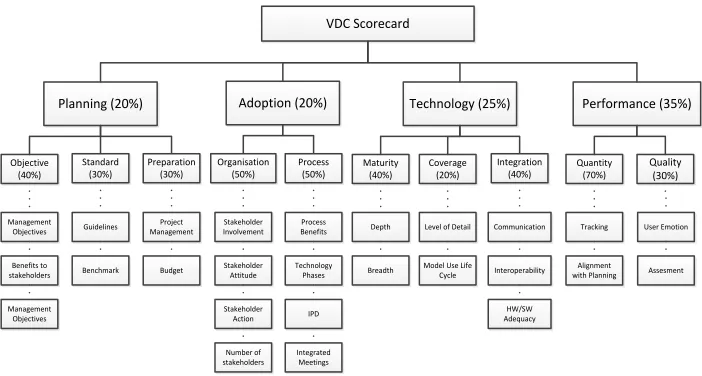
Figure 3.4: Evaluation Criteria Hierarchy for the VDC Scorecard ... 49
Figure 5.1: The Elements of Research Design ... 81
Figure 5.2: Methodological Flow Chart of Methods used in Study ... 103
Figure 6.1: Thematic Map of BIM Qualification Criteria from Interview Data ... 113
Figure 7.1: Termination of Rounds in Delphi ... 132
Figure 7.2: Complexity of Projects Assessed by Survey Respondents ... 151
Figure 7.3: Histogram of Standardised Residuals for BIM Modelling Success ... 173
Figure 7.4: Normal P-P Plot of Regression Standardised Residual for BIM Modelling Success ... 174
Figure 7.5: Scatterplot-Standardised Residual against Predicted Value (BIM Modelling Success) .... 175
Figure 7.6: Histogram of Standardised Residuals for CSC Success through BIM ... 177
Figure 7.7: Normal P-P Plot of Regression Standardised Residual for CSC Success through BIM ... 178
Figure 7.8: Scatterplot-Standardised Residual against Predicted Value (CSC Success through BIM) 179 Figure 7.9: Relationships between Predictors of BIM Modelling Success ... 185
Figure 7.10: Relationships between Predictors of CSC Success through BIM ... 186
Figure 7.11: Influence of CSC Organisation Type on Attainment BIM Modelling Success ... 188
Figure 7.12: Influence of CSC Organisation Type on Attainment CSC Success through BIM ... 189
Figure 8.1: Decision Hierarchy of DSF ... 221
x
LIST OF TABLES
Table 2.1: Summary of BIM Benefits to the CSC ... 27
Table 2.2: Description of BIM Project Execution Documentation (PAS 1192:2, 2013, pp.8) ... 33
Table 3.1: The NBIMs Capability Maturity Matrix (NIBS, 2007) ... 41
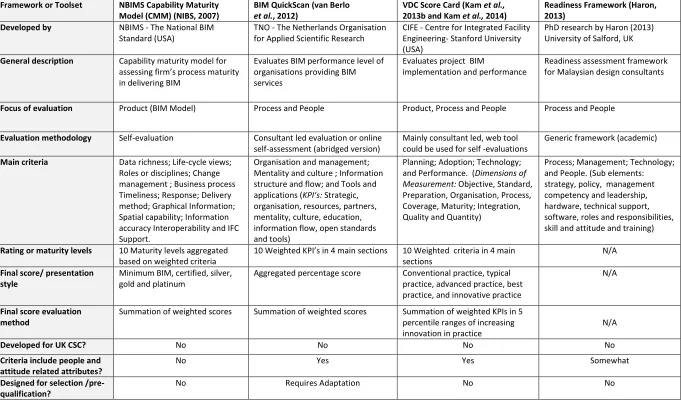
Table 3.2: A Review of Relevant BIM Capability Frameworks and Toolsets (Part 1)... 58
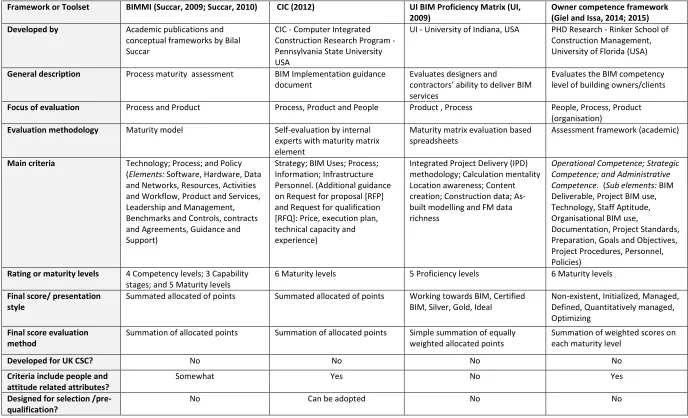
Table 3.3: A Review of Relevant BIM Capability Frameworks and Toolsets (Part 2) ... 59
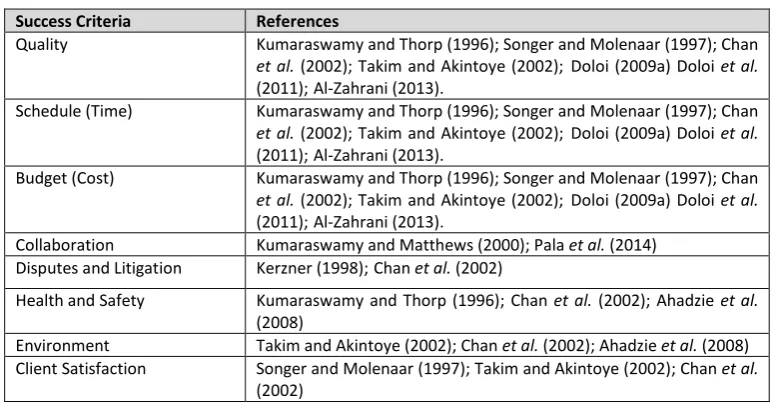
Table 4.1: Summary of Widely Used Success Indicators in Construction ... 62
Table 4.2: A Summary of Key Indicators of BIM Delivery Success in Supply Chain Context ... 75
Table 5.1: Delphi compared with Other Group Techniques ... 99
Table 5.2: A Review of the Application of Delphi in Construction Research ... 100
Table 5.3: Advantages Associated with the Delphi Technique (Okoli and Pawlowski, 2004) ... 101
Table 5.4: Strategies Chosen to Address Research Objectives ... 102
Table 6.1: Background of Interviewees ... 108
Table 6.2: Interviewees Opinion about the Importance of BIM Qualification ... 112
Table 6.3: Summary of Competence Related BIM Qualification Criteria from Interviews ... 115
Table 6.4: Summary of Capacity and Resources Related BIM Qualification Criteria ... 116
Table 6.5: Summary of Culture, Attitude and Cost Related BIM Qualification Criteria ... 118
Table 6.6: Comparison of Proposed Qualification Criteria with Relevant Frameworks (Part 1) ... 120
Table 6.7: Comparison of Proposed Qualification Criteria with Relevant Frameworks (Part 2) ... 121
Table 7.1: Data Analysis Techniques for Quantitative Enquiry ... 125
Table 7.2: Delphi Survey Response and Retention Rate ... 126
Table 7.3: Background of Delphi Respondents ... 128
Table 7.4: Delphi Participants’ Experience ... 129
Table 7.5: Determination of Critical Competence Related BIM Qualification Criteria ... 136
Table 7.6: Determination of Critical Capacity and Resources Related Criteria ... 138
Table 7.7: Determination of Critical Culture, Attitude and Cost Related Criteria ... 140
Table 7.8: Response to General Survey ... 146
Table 7.9: General Survey Respondent's Background ... 149
Table 7.10: Background of Supply Chain Organisations Assessed By Survey Respondents ... 150
Table 7.11: Background Details of Projects Assessed by Survey Respondents ... 151
Table 7.12: Descriptive Analysis of Influence of BIM Criteria on Overall Delivery Success... 153
Table 7.13: The Attainment of BIM Delivery Success by CSC Organisations in Survey ... 155
Table 7.14: Comparison of Criteria Importance - Delphi Study and General Survey ... 156
Table 7.15: Overall Weighted Contribution of Criteria to Delivery Success ... 158
Table 7.16: Correlation between BIM Qualification Criteria and Key BIM-CSC Success Indicators ... 168
Table 7.17: Correlation between Project Complexity and BIM Success Indicators ... 170
Table 7.18: Regression Analysis Results for BIM Modelling Success ... 172
Table 7.19: Regression Results for Overall Supply Chain Success through BIM ... 176
Table 7.20: Comparison of Original and Mediation Regression Models for BIM Modelling Success 181 Table 7.21: Comparison of Original and Mediation Regression Models for CSC Success ... 182
Table 7.22: Moderating Influence of Complexity Charecteristics on BIM Modelling Success ... 183
Table 7.23: Moderating Influence of Complexity Characteristics on Overall Supply Chain Success .. 184
Table 7.24: Influence of CSC Organisation Type on the Attainment of BIM Delivery Success ... 187
xi
Table 8.1: Description of Competence Criteria for DSF ... 222
Table 8.2: Description of Culture, Attitude and Cost Criteria for DSF ... 222
Table 8.3: Description of Capacity and Resources Criteria for DSF ... 223
Table 8.4: Guidance for Competence Criteria Rating Scales for DSF... 229
Table 8.5: Guidance for Capacity and Resources Criteria Rating Scales for DSF ... 230
Table 8.6: Guidance for Culture and Attitude Criteria Rating Scales for DSF ... 231
Table 8.7: Guidance for Cost and Specified Performance Criteria Rating Scales ... 232
Table 9.1: Validation Respondent's Profile ... 236
Table 9.2: Test of Agreement for Validation of Findings ... 237
Table 9.3: Results of Respondent Feedback for Validation of Findings ... 238
xii
LIST OF EQUATIONS
Equation 7.1: Relative Importance Index (RII) ... 131
Equation 7.2: Spearman’s Correlation Coefficient ... 134
Equation 7.3: Sample Size Determination Formula ... 143
Equation 7.4: Computation of Sample Size for General Survey ... 144
Equation 7.5: Adjusted Sample Size Formula ... 144
Equation 7.6: Adjusted Sample Size Computation ... 144
Equation 7.7: Computation of Survey Sample Size ... 145
Equation 7.8: Weighted Mean Contribution ... 147
Equation 7.9: Pearson’s Product-moment Correlation Coefficient ... 160
Equation 7.10: Regression Model Equation ... 162
Equation 7.11: The main Hypothesis of ANOVA... 164
Equation 7.12: Formula for Construction of Index ... 166
Equation 7.13: Regression Equation for Predicting BIM Modelling Success ... 171
Equation 7.14: Regression Equation for Predicting CSC Success through BIM ... 176
Equation 8.1: Computation of Overall Score for DSF ... 225
Equation 10.1: Regression Equation for Predicting BIM Modelling Success ... 256
xiii
LIST OF ABBREVIATIONS
AEC Architecture Engineering and Construction AHP Analytical Hierarchy Process
ANN Artificial Neural Network
ANP Analytical Network Process
BEACON Benchmarking and Readiness Assessment for Concurrent engineering
BEP BIM Execution Plan
BIM Building Information Modelling
BIMCS Building Information Modelling Cloud Score
BIMe BIM Excellence
BIMSCAT BIM Owners Competence Assessment Framework
BIS Department of Business and Innovation BS(I) British Standards Institute
CICa Construction Industry Council
CICb Computer Integrated Construction
CIFE Center for Integrated Facility Engineering
CMM Capability Maturity Models
CPIC Construction Project Information Committee
CSC Construction Supply Chain
CSCMM Construction Supply Chain Maturity Model
DSS Decision Support System
DSF Decision Support Framework
DST Decision Support Framework
EIR Employers Information Requirement
IFC Industry Foundation Class
IT Information Technology
xiv
JIT Just-In-Time
MCDM Multi-criteria Decision Support Methodologies
NBIMS National Building Information Model Standard NBS National Building Specifications
MIDP Master Information Delivery Plan NIBS National Institute for Building Sciences
NN Neural Network
PAS Publicly Available Specification
PIP Project Implementation Plan
PM2 Project Management Process Maturity
RFI Request for Information
RFQ Request for Qualification
RM Responsibility Matrix
SCCS Supply Chain Capability Summary
SCM Supply Chain Management
SEI Software Engineering Institute
SPICE Standardized Process Improvement for Construction Enterprise
TIDP Task Information Delivery Plan
TQM Total Quality Management
VDC Virtual Design and Construction
xv
DEDICATION
xvi
ACKNOWLEDGEMENTS
I wish to extend my gratitude to all those individuals that have contributed to the success of this
research. I am very grateful to my Director of Studies, Professor Lamine Mahdjoubi for the excellent
guidance and support. I also wish to extend my sincere gratitude to my second supervisor, Associate
Professor Colin Booth, for his tutelage and encouragement throughout the conduct of this research.
Special thanks to Reverend Peter Fewings for his contribution at the very beginning of this journey. I
am also grateful to Dr Patrick Manu, Dr Christian Henjewele, Dr Emmanuel Manu, Mrs. Gloria Appiah,
Aisha Abu, Sadick Abdul-Manan and Dr Dominic Ahiaga-Dabgui for their time and contributions.
Special thanks to Arc. Kunle Ogunaike, Teslim Balogun and all my friends and PhD research colleagues
at the Faculty of Environment and Technology, UWE. Thank you for the friendly research environment
1
CHAPTER 1:
INTRODUCTION
1.1
BACKGROUND
Building Information Modelling (BIM) is recognised as a vital collaborative information technology that
could assist Construction Supply Chain (CSC) in achieving integrated practice (Vrijhoef, 2011; BIS
2013a; 2013b). This is expected to be achieved through centralised digital exchange of data to
eliminate current information flow inefficiencies that contribute to poor performance (Arayici et al.,
2012). BIM is, therefore, increasingly becoming a prerequisite for construction projects, yet wider
uptake of BIM across project supply chain remains a challenge due to varying levels of capability or
even willingness to use it among other reasons (Gu and London, 2010; Succar et al., 2012). There is a
significant risk of failure if the CSC selected for projects lacks the ability to operate within a BIM
environment as well as the capacity to adopt the processes and related technologies. Ample evidence
demonstrates the need for metrics in evaluating organisations’ ability to deliver BIM as well as attain
BIM success amidst a lack of a standardised and accepted approach for establishing these (Succar et
al., 2012; Haron, 2013).
Despite the proliferation of frameworks and toolsets for evaluating BIM performance of firms, there
remains a lack of a specifically tailored approach to predicting a firm’s propensity to succeed in the
delivery of BIM during the pre-qualification and selection stage. In order to address this, there is a
need for the identification of qualification criteria that can be used in assessing a CSC organisation’s
ability to deliver through BIM. Furthermore, there is a need for a deep understanding of the
contribution of such criteria to the successful use of BIM. Despite the growing number of studies on
BIM capability evaluation, there remains a lack of studies specifically tailored for CSC pre-qualification
or selection. Furthermore, no studies have identified the relationship between the mostly pre-emptive
qualification criteria and BIM delivery success in the CSC context. The relevance of this cannot be
overemphasised at a time that the UK Government expects up to 33% cost reduction, 50% time
2
implementation of BIM across the CSC central to the attainment of these targets (BIS, 2011; 2013a).
The services delivered by the various segments of the CSC accounts for up to 80% of the value of
projects; thus the use of BIM for their effective coordination and management will impact on the
attainment of the UK Government strategy performance targets (BIS, 2013a; 2013b) and invariably
the wider attainment of project success (Robson et al., 2014).
1.2
THE NEED FOR BIM IN THE CONSTRUCTION SUPPLY CHAIN
A typical construction project is delivered through an amalgam of firms rather than a single
homogeneous unit, to the extent that the industry’s structure has been referred to as a loosely
coupled system (Egan, 1998). The recent proliferation of subcontracting practice has further
exacerbated the already fragmented structure as the production of goods and services evolves further
downstream to smaller organisations in a delivery chain (Vrijhoef, 2011). According to Tardif, Murray
and Associates, on the average, a construction project of an estimated value of $10 million dollars will
typically involve up to 400 different organisations and 850 individuals in the delivery process (Eastman
et al., 2008). These firms are referred to as the CSC, a concept borrowed from the manufacturing
industry to explain the complex interactions between disparate organisations involved in the delivery
of infrastructure and facilities (Pryke, 2009). The structure of the CSC is, however, characterised by
communication bottlenecks and lack of collaboration, resulting in process inefficiencies that
contribute to a serious lack of performance (Mohamed, 2003; Briscoe and Dainty, 2005).
A critical contributor to this inefficiency is the lack of effective management of information in often
information-intense construction project environments (Xue et al., 2010). According to Atkin (1995),
a typical construction project (valued between £5-350 million) may generate between 30,7500 to
446,500 pieces of information, including drawings, revisions, contracts, tender, variations and site
instructions. The generation, transmittal and storage of such large volumes of information across
diverse stakeholders and participants remain one of the most challenging aspects of managing
3
keep individualised libraries and databases of information. Zhao and Ding (2010) argue that poor
quality of information management results in poor project predictably which consequently affects
quality, timely delivery and budget.
According to Khalfan and McDermott (2007), the fragmented nature of the CSC has necessitated calls
for an integrated approach to working where information management is facilitated by centralised
information systems. The functional separations between the key construction life cycle phases
(design, production and operation) and consistent reconstitutions of teams for every new project
(temporary organisation) underscores the need for effective systems that facilitate data management,
particularly the storage and reuse of information or knowledge (Dainty et al., 2001; Khalfan and
McDermott, 2007).
BIM promises a revolution in the way projects are run providing a single digital platform for all CSC
communications and information management (Khalfan et al., 2015). The benefits of such a system
include real time information availability and access to early decision taking, reduction in lead-time
and accountability (Dainty et al., 2001; Mohamed, 2003). However, the establishment of a system to
facilitate such inter-organisational communication is a challenging task as firms try to develop the
necessary capabilities to improve their utilisation capacity (Succar et al., 2012).
1.3
BIM CAPABILITY WITHIN CONSTRUCTION SUPPLY CHAIN
Despite an increase in the level of BIM usage within the industry, evidence still points to a slow rate
of adoption across segments of the CSC as a result of varying degrees of proficiency (Robson et al.,
2014). To facilitate wider adoption in the UK, BIM is being mandated on projects, particularly public
projects (BIS, 2011). The resultant emerging guidance documents, protocols and standards require
principal suppliers (mainly main contractors and consultants in contract with client) to demonstrate
that the rest of their CSC can deliver through BIM (PAS1192:2, 2013; Al-Ahbabi and Alshawi, 2015). UK
government standards pre-qualification questionnaires now include a section specifically dedicated
4
requiring principal suppliers to submit a Supply Chain BIM Capability Summary (SCCC) for each project
as part of the qualification process (PAS1192:2, 2013).
Despite the need for demonstration of BIM capability there remains a lack of standardised approaches
for qualifying the CSC based on their BIM capabilities. There has been a proliferation of capability,
maturity, readiness and competence assessment frameworks and toolsets. Despite their
development, there remains a lack of frameworks specifically tailored for cross comparative
assessments during pre-qualification and selection phase. Most of the existing tools have been
primarily developed to assist firms to identify priority areas affecting BIM implementation rather than
qualification for projects. The existing tools are, thus, susceptible to omissions and additions which
render them unsuitable for CSC pre-qualification or selection.
1.4
BIM CAPABILITY AND BIM DELIVERY SUCCESS
Project success is generally described as the attainment or exceeding of project objectives (Takim and
Akintoye, 2002). This has traditionally been observed in relation to quality, cost and delivery on
schedule (Takim, 2005). More recently, collaboration and integration have similarly become important
success indicators particularly in relation to the CSC context (Vrijhoef, 2011). To reduce the risk of
failure, qualification of construction firms must be based on prediction of the firm(s) with the highest
propensity towards success (Doloi, 2009a). Thus, there is a need for knowledge about the contribution
of qualification criteria to project success (Al-Zahrani, 2013).
Construction firm qualification has evolved resulting in many empirical studies investigating the
relevant attributes, criteria and computational models required for selecting most suitable candidates.
Many Decision Support Frameworks and Tools (DSFs/DSTs) have been developed in this regard to aid
decision makers to choose the best firms out of several alternatives. This has, however, been done
without significant attention to the relationships between qualification criteria and delivery success
5
need for identifying critical BIM qualification criteria as well as establishing the relationship between
such criteria and BIM delivery success.
Emerging standards, frameworks and tools provide basis for identifying appropriate BIM qualification
criteria for selecting CSC on BIM-enabled projects (Succar, 2009; van Berlo et al., 2012; NIBS, 2012;
CIC, 2013b; Kam et al., 2013a, b; Succar et al., 2013; Du et al., 2014; Giel and Issa, 2014). However,
none of these initiatives provide the necessary links between BIM utilisation capacity of an
organisation and delivery success particularly. While some studies have explored the role of BIM
maturity in project performance generally (Smits et al., 2016), there remain no studies specifically
looking at BIM delivery success rather than overall project success especially in the CSC context.
Therefore, while these initiatives have provided useful guidance for assessment of BIM capability in
general, their application to the qualification (pre-qualification or selection) process requires further
attention. Most existing tools are designed for BIM implementation or general performance
assessments. Consequently, questions remain regarding their suitability as DSF’s during the
pre-qualification or selection process.
1.5
THE KNOWLEDGE GAP
The dearth in literature and lack of specifically tailored BIM assessment frameworks for qualification
of CSC on projects leaves a significant research gap that needs to be filled. Several limitations exist in
relation to the use of existing BIM capability assessment frameworks and toolsets. One of the key
limitations is the fact that, most of the tools have been designed to measure capability for the
purposes of BIM implementation or project performance monitoring rather than qualification or
selection (Succar, 2010; Haron, 2013; Kam et al., 2014). The qualification process is, however, unique
and requires a more holistic, but concise approach, as well as a precise prediction of the likelihood of
success. Existing capability frameworks are, however, limited in this regard.
Most of the existing tools and frameworks focus on hard measures pertaining to the physical resources
6
organisational factors (Sebastian and van Berlo, 2010; Chen et al., 2016). Sackey (2014) has described
BIM capability discourse as technologically deterministic to the neglect of the socio-technical nature
of its use in practice. Sackey’s (2014) assertions are confirmed by the multiplicity of frameworks that
focus on assessing BIM as a product or technical process to the neglect of many people related
attributes (see NIBS, 2007; IU, 2009; NIBS, 2012; Du et al., 2014). The soft human behavioural or
organisational factors that influence the competence to deliver BIM have not been adequately
considered by most frameworks despite evidence of the role of these factors in BIM delivery success
(Sebastian and van Berlo, 2010; Haron, 2013). There are, however, a few frameworks that have
considered all these dimensions of capability (see Succar, 2010; van Berlo et al., 2012; CIC, 2013b; Giel
and Issa, 2014; Kam et al., 2014). However, none of these were developed for the purposes of
selection or for the UK CSC context. Furthermore, the complementary application of different
frameworks is challenging due to the disparities in the types of evaluation criteria considered as well
as their importance weighting which renders them generally incompatible
(
Sebastian and van Berlo,2010).
Aside limitation related to criteria used, there are also methodological challenges as well as lack of
empirical validation of most existing frameworks. Firstly, there is a relative lack of reliance on robust
computational methods for prioritising criteria used in existing BIM capability frameworks
(Mahamadu et al., 2015). Generally, the relative importance of criteria in these frameworks has either
been arbitrarily allocated or based on their contribution to BIM maturity (Succar, 2010; CIC, 2013b)
rather than their contribution to delivery success. Secondly, scientific underpinning for validating most
existing tools is unclear (van Berlo et al., 2012; Kam et al., 2013b). This is attributed to the fact that a
good number of these frameworks have been developed for commercial reasons rather than for
academic research purpose (Giel and Issa, 2014). Furthermore, some of these tools were developed
as part of BIM implementation guidance rather than for academic purposes, thus, lack the necessary
academic rigour in the determination of criteria or criteria importance (see Succar, 2010; CIC, 2013b;
7
BIM capability attributes in relation to their use as qualification criteria, as well as their influence on
BIM delivery success from a UK or CSC perspective.
While the possession of BIM capability indicates ability to implement or deliver tasks (Succar, 2009),
it is unclear how capability influences successful delivery of broader BIM usage objectives (success).
Emerging studies have, however, only investigated the role of maturity in project performance rather
than BIM delivery performance or success (Smits et al., 2016). Furthermore, some of these studies
have sometimes provided contradictory results regarding which BIM capability criteria are the most
important (van Berlo et al., 2012; Kam et al., 2013b; Giel and Issa, 2014). In order to select the most
suitable candidates for projects, the qualification process (pre-qualification or selection) requires
detailed understanding of the relationship between various BIM capability attributes and delivery
success. Thus, there remains a need for detailed understanding of BIM capability attributes, their use
as qualification criteria, as well as influence on BIM delivery success. Furthermore, the identified
weaknesses in existing frameworks could be addressed with the development of a more tailored
approach that suits the CSC BIM qualification process with the most relevant BIM criteria.
The following research questions were posed to address the research gap.
1.6
RESEARCH QUESTIONS
The research intends to answer the following questions:
What are the most critical BIM qualification criteria for the CSC?
What are the relationships and contributions of qualification criteria to the successful delivery
8
1.7
RESEARCH AIM
The study aims to examine the contribution and relationship between BIM qualification criteria and
successful delivery of BIM in the supply chain context. This is to aid the proposition of a novel approach
to assessing CSC firms’ likelihood to succeed in the delivery of BIM on construction projects.
1.8
RESEARCH OBJECTIVES
To address the research questions and study aim, the following step-wise objectives will be addressed:
1. To develop an understanding of BIM capability attributes, their uses as qualification criteria for the CSC, as well as their role in successful delivery of BIM in the supply chain context;
2. Identify and categorise BIM qualification criteria in order to develop a hierarchy of assessment criteria for CSC pre-qualification or selection purposes;
3. Identify the most critical criteria and prioritise them based on their relative contribution to the successful delivery of BIM;
4. Ascertain the impact of qualification criteria on specific BIM delivery success areas in the supply chain context of BIM use; and
5. Develop and validate a Decision Support Framework (DSF) to aid the pre-qualification or selection of CSC for BIM-enabled projects.
1.9
TIMELINESS AND IMPORTANCE OF STUDY
The UK Government regards BIM as central in achieving real cultural change within an industry that
has been criticised for under-achievement and inefficiency in industry reviews (Latham, 1994; Egan
1998). Government's targets include increased efficiency of delivery, improved carbon performance
and up to 33% cost reduction on public projects through deployment of BIM with most of such
9
construction strategy, BIM has been mandated on all public projects at a minimum maturity level two
by 2016 in a road map towards attainment of level three in the near future (BIS, 2011; 2013b). This
study, therefore contributes to knowledge of BIM implementation success through characterisation
of criteria for BIM qualification and modelling of determinants of success in the UK CSC selection
process.
1.10
SCOPE OF RESEARCH
The research focus is BIM use in CSC practice in the UK. The study is of primary relevance to principal
suppliers (such as clients or main contractors) who normally perform pre-qualification or selection
activities prior to commencement of projects. Currently, most published and validated BIM evaluation
frameworks from academic studies have been developed outside the UK. Thus there is a need for a
specific framework for the UK and CSC context.
1.10.1
Key Research Terminology
The key research terminology is defined below in the context within which they have been used in this
thesis.
Construction supply chain (CSC): Organisation with a role in the project delivery process right from
conception through to demolition and recycling.
Principal supplier: An organisation with direct contractual relationship with a client and responsible
for supervising other CSC organisations.
BIM capability: The ability to implement or deliver tasks. BIM capability in this study is therefore used
broadly to represent all related concepts such as BIM maturity, BIM competence and BIM readiness.
BIM qualification: BIM qualification in this thesis is used to represent the assessment of BIM
10
1.11
OUTLINE OF PROPOSED METHODOLOGY
Methodological pluralism, which encourages the use of multiple methodological approaches, is
proposed as an appropriate research method to break the barriers of limited literature and data
sources due to novelty of BIM as a research area (Creswell et al., 2003; Knight and Ruddock, 2008). In
this regard, a pragmatic philosophical stance is adopted and incorporates both qualitative and
quantitative strategies to address the outlined objectives. Pragmatism is a widely associated paradigm
for the conduct of mixed method research (Creswell, 2003). Furthermore, it focuses on adoption of
the most appropriate research strategies, which answer each aspect of the research question
adequately, hence its pluralistic and practical nature (Amaratunga et al., 2002). It, therefore, works
well across both interpretive (qualitative) and positivist (quantitative) paradigms (Creswell, 2003).
Moreover, as both the construction and information sciences represent a multi-disciplinary domain of
interconnecting areas of specialism, it makes the identification and use of one appropriate research
methodology challenging, hence the need for a balanced approach.
A sequential exploratory mixed method research strategy is adopted. The first phase explores BIM
expert views on appropriate CSC BIM qualification criteria based on their experience as part of tender
evaluation process in the UK. This is achieved through interviews with 8 construction BIM specialist
with managerial roles in leading UK construction organisations. The interviews were used to generate
a wide range of possible qualification criteria for the CSC. The interview phase was followed by Delphi
survey of 30 construction practitioners with BIM experience resulting in the return of 25 valid final
Delphi responses. This was used to ascertain most critical BIM qualification criteria to be used for
framework development. Critical criteria were determined through statistical determination of Delphi
participant consensus through the inter-rater agreement statistic (rwg) with the aid of ‘R’ software package.
A subsequent survey of practitioners on (n = 64) BIM-enabled projects in UK was used to establish the
11
through survey respondent’s independent appraisal of CSC organisations on the surveyed projects.
Various multivariate statistical analysis techniques were engaged to identify qualification criteria
influence on success with the aid of SPSS 19 software. The statistical techniques employed included
correlation analysis, mean weighted contribution analysis, multiple regressions modelling and Analysis
of Variance (ANOVA). A DSF was developed and proposed based on coefficients and weights
computed from the survey findings and multiple regression analysis. The research findings and DSF
were validated through a test of agreement between the main survey and validation survey of experts
as part of a convergence analysis. Another set of experts were engaged to validate the general findings
and DSF in relation to adequacy, suitability and relevance in practice. Justification for the use of
methods and mode of enquiry is explained in the research methodology chapter.
1.12
ORGANISATION OF CHAPTERS
This thesis consists of 10 chapters organised as indicated in Figure 1.1.
Chapter 1: In this chapter the research background is presented highlighting the relevant research
gaps. The justification for the research is highlighted. This chapter includes a brief introduction of the
CSC and the relevance of BIM in CSC qualification for projects, as well as gaps in knowledge. The aim
and objectives as well as a general overview of methods and organisation of the thesis report are
presented in this chapter.
Chapter 2: This chapter seeks to provide a general overview of the concepts of supply chain and the
role of BIM in CSC discourse. An introduction to CSC concept and the role of BIM in the integration of
CSC is presented in this chapter. A case for CSC BIM capability evaluation as part of their qualification
12
Chapter 1 Introduction
Chapter 5
Methodology and Research Design Literature Review
Chapter 2
BIM and The Construction Supply
Chain
Chapter 3
BIM Qualification: A Review of Capability
Frameworks
Chapter 4
BIM Qualification and Delivery Success
Objective 1
Chapter 6 Analysis and Findings of
Qualitative Enquiry
Chapter 7 Analysis and Results of
Quantitative Enquiry
Chapter 8
Discussion of Findings and Decision Support Framework Development
Chapter 9 Research Validation
Chapter 10
Conclusion and Recommendation
Objective 2
Objectives 3 and 4
[image:29.595.100.502.66.609.2]Objective 5
13
Chapter 3: This chapter presents a review of literature on existing approaches for BIM capability and
assessment. A review of existing frameworks and their use in toolsets is performed to identify relevant
assessment criteria and limitations. The frameworks reviewed in this chapter include academic and
professional BIM capability assessment initiatives including capability, maturity, competence and
readiness frameworks.
Chapter 4: This chapter provides a definition of success in construction and its relevance during
pre-qualification or selection phase. A review of previous studies investigating the impact of pre-qualification
criteria on project success is presented. The review reveals a lack of studies on the relationship
between BIM qualification criteria and successful delivery of BIM especially in the CSC context.
Chapter 5: In this chapter, an outline is provided detailing the research methodology and strategies
adopted for this study. A justification is provided for choosing a sequential exploratory mixed method
strategy. The choice of interviews, the Delphi technique and a general survey is also justified in this
chapter.
Chapter 6: Qualitative data collected from interviews exploring BIM qualification criteria is
summarised and presented in this chapter. This includes a review of the approach to data analysis, a
presentation and summary of the key findings.
Chapter 7: Quantitative data collected from a Delphi and general survey is presented in this chapter.
This includes a review of the data analysis techniques and justification for the chosen methods. This
chapter includes a presentation of results and summary of key findings from the quantitative enquiry.
Chapter 8: In this chapter, the key research findings are discussed with reference to existing
knowledge and literature. The discussions draw distinctions and parallels between the current study
and previous related research. The chapter further details the consolidation of the findings into a DSF
14
representation of the DSF including a computational framework and adopted scales to aid scoring of
qualification criteria is also presented and discussed.
Chapter 9: This chapter discusses the methods adopted to ensure research validity. This includes an
expert validation survey, as well as respondent feedback on the key findings and DSF.
Chapter 10: The conclusions and recommendation from this research are presented in this chapter.
The contribution to knowledge is highlighted both in terms of practice and theory. Other identified
but unaddressed gaps discovered in the course of the research are presented as precursor for future
research in this area of study.
1.13
CHAPTER SUMMARY
A background to this research has been provided highlighting the lack of frameworks for CSC BIM
qualification process for projects. A need for knowledge on the influence of qualification attributes on
delivery success is highlighted. The research aim and objectives have also been presented. The next
three chapters (2, 3 and 4) provide a review of literature to highlight the gap and set the tone for rest
15
CHAPTER 2:
BIM AND THE CONSTRUCTION SUPPLY CHAIN
2.1
INTRODUCTION
This chapter presents a review of literature on the role of BIM in the Construction Supply Chain (CSC),
as well as the need for assessing CSC’s ability to deliver BIM during selection of candidates for projects.
The literature review is in three main parts. The first part presents an overview and contextual
definition of BIM. In the second part, the evolution of BIM within the UK construction industry as well
as impact on the CSC management is also discussed. The review provides a general overview of the
challenges related to managing the CSC and the role of BIM in alleviating these challenges. Finally, the
case for BIM qualification in CSC procurement is discussed.
2.1.1
Definition of BIM
There remains some ambiguity relating to the definition and meaning of BIM. Three major distinctions
can be drawn from the definitions and meanings attributed to BIM within the literature. Some refer
to BIM as a software application, design and documentation of the building information process or
even an entirely new approach to practice. However, one of the most widely cited is the National
Institute of Building Science (NIBS) definition, which describes BIM as “a digital representation of
physical and functional characteristics of a facility and a shared knowledge resource for information about a facility forming a reliable basis for decisions during its life-cycle” (NIBS, 2007, p.7). According
to Azhar et al. (2007) BIM is the development and use of a computer-generated model for planning,
design, construction and the operation of a facility. The BIM model is data-rich, object-oriented,
intelligent and parametric with all stakeholders having the capability to extract, analyse and generate
information that can be used for decision making (Azhar et al., 2007). BIM has also been described as
a new approach for the description and display of information required for the design, construction
and operation of constructed facilities (BuildingSmart, 2012).
The NIBS definition of BIM is adopted for this study in view of its encapsulation of the major related
16
solution for the CSC hence the need for a holistic definition. According to Eastman et al. (2008) and
Arayici et al. (2011), BIM represents an embodiment of policies, processes and technologies for the
integrated management of construction data throughout a facility’s life-cycle. These definitions of BIM
highlight the potentially expansive nature of BIM and its coverage of various digital, collaborative and
integrated construction technologies.
2.1.2
BIM Implementation in UK Construction Industry
In the UK, the Government’s promotion of the use of BIM in the 2011 Construction Strategy has
instigated great attention to BIM within the construction sector. All public projects are expected to
use BIM at maturity level two by 2016 in a road map towards universal adoption (BIS, 2011). Maturity
is used to describe progressive stages in BIM implementation (Succar, 2009). The standard BIM
maturity classification as stipulated in the PAS1192:2 (2013) are explained below.
BIM Stage 1 (level 0-1)
This represents the progression from unmanaged to managed Computer Aided Design (CAD), both in
2D or 3D formats. At this stage, project stakeholders are engaged with industry standards and
processes such as the BS1192 in completely individualised or non-connected data and software
systems (PAS1192:2, 2013). This may include stand-alone, design, engineering, communication,
finance, or cost management packages (Succar, 2010).
BIM Stage 2 (Level 2)
This stage refers to the 3D model-based collaboration envisaged as the main form of data
management (Succar, 2010). This will, however, be based on data produced and held in separate
discipline based proprietary tools (Succar et al., 2012). The standards required for their production
should however allow high degrees of interoperability, object based with sufficient levels of
information detail and parametrisation (PAS1192:2, 2013). Integration at this stage can be achieved
17 BIM Stage 3 (level 3)
This stage represents the maturity level where network-based integration is to be achieved with the
aid of fully open and interoperable processes enabled by standards, such as Industry Foundation Class
(IFC) (Succar, 2009). Most of the available commercial BIM software applications already possess such
IFC data exchange capabilities (such as Autodesk Revit, Archicad, Vico, Bentley Micro Station), though
the extent to which they are fully utilised is not clear. Data and information is managed by a
collaborative single platform model server with functionality that supports every CSC discipline’s data
uses (PAS1192:2, 2013). The progression of BIM maturity is depicted in Figure 2.1.
Re-used with permission from ©Bew and Richards (2008/10)
Figure 2.1: Progression through BIM Maturity and Relevant Standards and Documentation
Adoption of level two BIM, as envisaged by Government, will require all project data to be managed
in a 3D virtual environment, where individual CSC disciplines contribute or extract data with
proprietary tools that have high inter-operable data exchange capabilities, that are supported by
project data exchange protocol and standards (PAS1192:2, 2013). This will require the use of
18
CSC discipline (BIS, 2011). The Government’s aim of using BIM level two includes the expectation of
performance improvements and overall improved project success rates. The targeted improvement
areas include project delivery efficiency, improved carbon performance and up to 33% cost reductions
(BIS, 2011; 2013a). It is expected that, BIM will stimulate these improvements as a result of its many
touted benefits.
Level three maturity represents entire system integration, through single model server platforms
where individual CSC contribute to projects in common or completely synchronised data
environments (PAS1192:2, 2013). It is, however, envisaged that as the CSC matures (level three and
beyond) in their level of BIM adoption, tighter organisational coupling and collaboration within the
CSC becomes a prerequisite. This may, therefore, introduce newer organisational challenges in
addition to traditional fragmented structures, which often results in functional barriers to effective
information exchange (McAdam, 2010; Robson et al., 2014).
Since the announcement of UK government strategy on BIM, there has been a steady rise in the level
of adoption across the CSC. A survey of BIM use within UK and Europe at large, revealed 35% to 36%
BIM use among respondents (McGraw-Hill, 2010). The national building specification (NBS) survey of
an estimated 1350 professionals and organisations revealed that almost 39% of respondents were
using BIM in UK, with 71% agreeing to the importance of BIM in future construction information
management (NBS, 2011). A significant proportion (74%) of respondents, however, alluded to the
prevalence of a lack of clarity about how to implement BIM effectively (NBS, 2011). BIM adoption is
generally believed to be led by architects, followed by engineers and contractors (McGraw-Hill, 2010;
2012; 2014) with most other CSC organisations generally perceived to be lagging behind in terms of
BIM adoption (Robson et al., 2014).
Based on a survey of the CSC of a major contractor in UK, Robson et al. (2014) reported that a quarter
of respondents had used BIM with another 44% not currently using BIM at all. The latest NBS national
19
Majority (86%) of respondents in the latest NBS survey intend to increase BIM use within a year with
97% planning to adopt BIM in the next five years.
2.2
BIM AND CONSTRUCTION SUPPLY CHAIN
Building Information Modelling is recognised as a vital collaborative information technology that could
assist the CSC in achieving integrated practice (Vrijhoef, 2011). It is expected that future project
processes will be streamlined through the centralisation of communication and information flows on
virtual digital platforms (Succar et al., 2012). It is believed that a centralised digital exchange of data
will eliminate the current information flow inefficiency that contributes to poor performance of CSC
on projects (Arayici et al., 2012). BIM is, therefore, increasingly becoming a prerequisite for projects.
However, lack of uptake remains a challenge due to (among other reasons) varying levels of maturity,
capability, competence or even willingness to use it across the CSC (Gu and London, 2010; Succar et
al., 2012).
A significant risk of failure remains if project participants (or the CSC) lack the ability to operate within
a BIM environment. More importantly, it is also argued that for the benefits to be realised, BIM must
effectively diffuse across the CSC, which accounts for the majority of activities (up to about 80% of
total value) in the delivery process (Robson et al., 2014). Thus, for every project, there is a need for
the assessment of the CSC’s ability to deliver through BIM successfully.
2.2.1
The Concept of Construction Supply Chain
The concept of the CSC originates from Supply Chain Management (SCM). Despite disputed claims
over the origins of SCM, it is believed that it was pioneered as a result of the need to improve
performance within the manufacturing industry through adoptions of concepts such as just-in-time
(JIT) and total quality management (TQM) in the 1980’s (Manu, 2014). The promotion of SCM was as
a result of the realisation that strategic and cooperative supplier-buyer relationships often lead to
20
in business process reengineering (BPR) led to more emphasis on the redesign of operational and
strategic organisational structures to reduce waste and increase efficiency (Pryke, 2009). Thus,
organisational and process improvements initiatives collectively lead to developments in a
management paradigm, SCM.
The International Centre for Competitive Excellence defined SCM as “an integration of key business
processes from end user through original product suppliers with the aim of providing products, services and information that add value for customers and other stakeholders” (cited in Cooper et al., 1997, p.
2).
Performance challenges also led to the adoption of SCM principles in construction. This has been on
the back of industry reviews that called for improvements in productivity with more focus on
efficiency through integration, teamwork and partnerships among firms in the supply and delivery
process (Latham, 1994), as well as re-engineering of the construction production and organisational
processes (Egan, 1998). The recommendations from these reports resulted in the promotion of project
procurement structures that promote the coupling of firms in the construction delivery chain. Based
on such integrative principles, the CSC needs to be designed in the form of a dynamic network of
interdependent organisations that can collaborate more efficiently to satisfy the overall attainment
of project goals through better co-operation and co-ordination of individual actors (Pryke, 2009).
A CSC firm is sometimes referred to as a ‘supplier’ and this represents any firm that contributes to the
effective delivery of a project or activities of a client or a main contractor. The CSC may, therefore,
include the main contractor, but is mostly used to refer to consultants, sub-contractors and other
21
2.2.2
Fragmentation in the Construction Supply Chain
For the past 30 years, a proliferation of subcontracting practice has however increased levels of
fragmentation within the CSC pushing key activities within the production process across a diverse
group of small firms with varying levels of capability (Pryke, 2009). The wide variety of firms with
different levels of specialist labour as well as the casualisation of workforce have exacerbated the loss
of central control (Vrijhoef, 2011). Some have referred to the construction industry as a loosely
coupled system rather than an industry (Egan, 1998; Briscoe and Dainty, 2005).
At the project level, a typical construction project will consist of many separate organisations
operating together as a single production unit (Briscoe and Dainty, 2005). Furthermore, the
configuration within most project organisations is usually disconnected with virtually two separate
units, focussed on design or management and production activities respectively (Vrijhoef, 2011). The
level of disconnection between design, management and production often results in conflicting goals
and viewpoints which exacerbate the levels fragmentation (Khalfan et al., 2007).
The most pervasive problem with the project CSC structure is inter-organisational boundaries, which
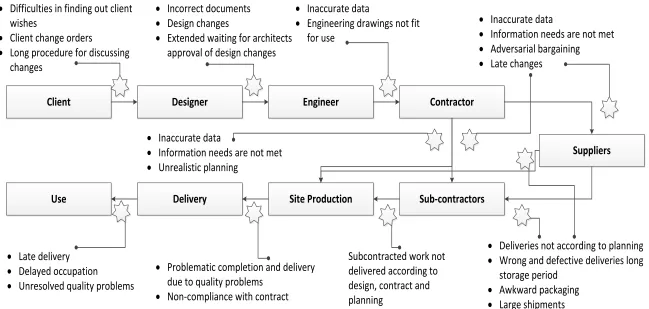
often create information flow issues as depicted in Figure 2.2. The critical points where information
related problems often occur are highlighted on the diagram. They include inaccurate data, incorrect
documents, change, and difficulties in interpreting client requirements, non-compliance and overall
poor delivery success.
The typical structure of the CSC consists of tiers or organisations with varying levels of participation
and responsibility (Dainty et al., 2001). The top tier often consists of organisations directly in contract
with owners and clients that may include main contractors or consultants who are referred to as
principal suppliers. The middle tiers often include firms directly procured by the top tier and typically
include sub-contractors and consultants. The lower tiers often include firms in direct contract with the
22
Client
Use
Designer
Delivery
Engineer
Site Production
Contractor
Sub-contractors
Suppliers
Difficulties in finding out client
wishes
Client change orders
Long procedure for discussing
changes
Incorrect documents
Design changes
Extended waiting for architects
approval of design changes
Inaccurate data
Engineering drawings not fit
for use
Inaccurate data
Information needs are not met
Adversarial bargaining
Late changes
Late delivery
Delayed occupation
Unresolved quality problems
Problematic completion and delivery
due to quality problems
Non-compliance with contract
Subcontracted work not
delivered according to
design, contract and
planning
Deliveries not according to planning
Wrong and defective deliveries long
storage period
Awkward packaging
Large shipments
Inaccurate data
Information needs are not met
Unrealistic planning
[image:39.842.96.745.111.420.2]23
2.2.3
Information Technology and the Integration of the Construction Supply Chain
According to Atkin (1995) a typical construction project (value between £5-350 million) may generate
between 30,750 to 446,500 pieces of information including drawings, revisions, contracts, tender,
variations and site instructions. Furthermore, estimations from several construction projects reveal
that, projects (average value US$ 10 million) generate up to 56,000 pages of documents of vital
information (Tardif, Murray and Associates (Canada), cited in Eastman et al, 2008, pp. 2-3). It is
estimated that this is shared between 420 firms and up to 850 individuals. The generation, transmittal
and storage of such large volumes of information across diverse stakeholders, therefore remains one
of the most challenging aspects of managing construction. Each of the CSC organisations usually
maintains a huge library requiring regular updating and management. In some cases these are
maintained and managed by third party intermediaries. The information exchange process could,
however benefit from recent advances in IT (Zhao and Ding, 2010; Xue et al., 2012). The greatest value
associated with the use of IT is the ability to allow users to develop networks beyond the borders of
the individual firm boundaries for the purposes of data sharing and management (Zhao and Ding,
2010).
Many tools have emerged promoting integrated CSC communication and practices. These are often
referred to as integrative or collaborative IT communication tools which may involve centralised
communication either from a single IT platform or inter-communications between separate systems
(Adriaanse et al., 2010). This includes first generation collaboration and integration tools within
construction such as intranet, extranet and enterprise resource planning systems (ERP) (Xue et al.,
2012). Real-time information availability is therefore one of the major ways of managing an integrated
CSC as