Research Article
e-Leadership through strategic alignment:
an empirical study of small- and
medium-sized enterprises in the digital age
Weizi Li
1, Kecheng Liu
1, Maksim Belitski
2, Abby Ghobadian
2, Nicholas O
’
Regan
31Informatics Research Centre, Henley Business School, University of Reading, Reading, UK;
2Leadership, Organisations and Behaviour, Henley Business School, University of Reading, Reading, UK; 3
Bristol Business School, University of West England, England, UK
Correspondence:
A Ghobadian, Leadership, Organisations and Behaviour, Henley Business School, University of Reading Greenlands, Henley-on-Thames, Oxfordshire RG9 3AU, UK.
Tel: +44 (0) 1491 418756;
E-mail: [email protected]
Abstract
Small- and medium-sized enterprises (SMEs) play an important role in the European economy. A critical challenge faced by SME leaders, as a consequence of the continuing digital technology revolution, is how to optimally align business strategy with digital technology to fully leverage the potential offered by these technologies in pursuit of longevity and growth. There is a paucity of empirical research examining how e-leadership in SMEs drives successful alignment between business strategy and digital technology fostering longevity and growth. To address this gap, in this paper we develop an empirically derived e-leadership model. Initially we develop a theoretical model of e-leadership drawing on strategic alignment theory. This provides a theoretical foundation on how SMEs can harness digital technology in support of their business strategy enabling sustainable growth. An in-depth empirical study was undertaken interviewing 42 successful European SME leaders to validate, advance and substantiate our theoretically driven model. The outcome of the two stage process – inductive development of a theoretically driven e-leadership model and deductive advancement to develop a complete model through in-depth interviews with successful European SME leaders – is an e-leadership model with specific constructs fostering effective strategic alignment. The resulting diagnostic model enables SME decision makers to exercise effective e-leadership by creating productive alignment between business strategy and digital technology improving longevity and growth prospects.
Journal of Information Technology(2016)31,185–206. doi:10.1057/jit.2016.10
Keywords: e-leadership; small- and medium-sized enterprises; strategic alignment; organisa-tional change; digital technology
The online version of this article is available Open Access
Introduction
S
mall and medium sized enterprises play an important role within the European Union (EU) economy and the United Kingdom is no exception. Not surprisingly, success and failure of SMEs has been studied extensively with the aim of identifying contributory factors, for example, strategic planning (O’Regan and Ghobadian, 2005a). E-leadership and its potential contribution to the success of SMEs is an area where the research evidence is light. We aim tofill this gap, not least because the dawn of the digital age has dramatically altered the rules of the game enablingfirms to reach marketsand customers directly through multi-channels and platforms (Cohen and Schmidt, 2013). The digital era is creating new opportunities, rendering the capability to effectively harness and utilise information technology (IT) critical to a
firm’s survival and prosperity. Key technologies with the potential to change the basic tenet of competition and reshape traditional industries include cloud computing, social media, the internet of things, mobile computing and big data analytics (LEAD, 2014). Such technological developments will speed up and improve the way new innovative products and
services are conceived, developed, produced and accessed (Yooet al., 2010).
Within the EU, SMEs account for 99.8% of all enterprises (Wymengaet al., 2012). In the United Kingdom, at the start of 2013, there were 4.9 million SMEs (99.9% of all private businesses) (Department for Business Innovation & Skills, 2013). UK SMEs employed 14.4 million people and accounted for more than half of the UK’s private firms’ turnover (Department for Business Innovation & Skills, 2013; Lukács, 2005). The majority of new jobs in the United Kingdom have been created by smallfirms employing fewer than 50 people (Anyadike-Daneset al., 2013). On average, between 1998 and 2010, small firms generated 34% of 2.61 million new jobs (approximately 870,000 jobs) in the United Kingdom, while start-ups (nine out of ten have fewer than five employees) accounted for 33% of these jobs (Anyadike-Daneset al., 2011). The digital age offers SMEs significant opportunities to develop entirely new high-value products and services, add value to existing products and services, reduce costs, develop new export markets and add value to existing activities (e.g., cloud computing, the internet of things, etc.). The transformation of the business environment by digital tech-nologies is disrupting the existing order–opening opportu-nities for new entrants and new product markets with SMEs playing a pivotal enabling role (Deloitte, 2013).
However, failures of SMEs are frequent and are often thought to be because of management and leadership weak-ness (Avolioet al., 2001; ACCA, 2012; Arham et al., 2013). The virtual marketplace is rapidly fostering the growth of new business models, as well as dictating frequent renewal of existing business models and value chains (O’Regan and Ghobadian, 2005b). In the digital era, SMEs’inability to align business and technology strategy is a major hindrance to their survival and growth (Welsum and Lanvin, 2012). On the other hand, evidence suggests leadership and alignment can improve SMEs’ success (Ghobadian and O’Regan, 2002; O’Regan and Ghobadian, 2004). One of the main challenges that SME leaders face today is how to optimally integrate business and information technology systems within their organisations to fully leverage the potential of digital technol-ogies (Ferneley and Bell, 2006). Not surprisingly, SME leaders capable of effectively aligning business and digital strategy are more likely to succeed. However, to the best of our knowledge, there is little research examining how e-leadership within SMEs drives the successful alignment between business needs and technology innovation in pursuit of enhanced competi-tiveness. This alignment thinking is important for effective e-leadership and for successful implementation of digital projects (Avolioet al., 2001, 2014).
In the absence of well-articulated e-leadership theory, we adopt strategic alignment as the theoretical foundation to aid the initial development of our e-leadership model. Strategic alignment theory illustrates the dynamic alignment between businesses needs and digital technologies, emphasising both strategic and structural alignment. In this paper we develop an e-leadership model, drawing on theoretical lenses of strategic alignment and proceed to validate this model using a qualita-tive–explorative approach. We have conducted 42 interviews exploring the construct of e-leadership and how successful SMEs achieve effective strategic alignment through e-leader-ship. By combining theoretical propositions and empirical analysis, we develop an e-leadership model demonstrating
how SME leaders can leverage business and digital alignment to unleash the potential of digital technologies.
The study combines inductive and deductive research. Initially we developed an e-leadership domains and capabilities framework drawing on strategic alignment theory. In the deductive phase of research we test the validity of our theoreti-cally driven model and refined it by conducting 42 in-depth interviews with leaders of successful European SMEs operating infive European countries across different industries (including ICT and non-ICT SMEs). The choice of in-depth interviews rather than a survey was dictated by a lack of established constructs. This research is based on the project ‘LEAD – e-Leadership Skills: for Small and Medium Sized Enterprises’ funded by the European Commission DG ENTR–Unit ENTR-E4–Key Enabling Technologies and Digital Economy (LEAD, 2014). The primary aim is to develop targeted actions for start-ups and fast-growing SMEs developing their relevant e-leader-ship skills. This research contributes to both e-leadere-leader-ship theory and managerial practice in SMEs. Drawing on strategic align-ment theory, we construct an e-leadership model delineating domains and capabilities. The validity of this model was tested in the field and refined where appropriate. From a practical stance, the empirical phase of the research offered encouraging signs demonstrating that the application of the model improved the effectiveness of e-leadership facilitating closer alignment between business and digital technology strategy.
This paper is structured as follows: The section ‘e-leader-ship foundations’reviews leadership in enterprise systems as well as the e-leadership concept at micro, meso and macro levels, followed by strategic alignment theory as the theoretical underpinning for e-leadership domains and capabilities. The data collection and analysis process is discussed in the section ‘Methods’. Then, in the section ‘e-leadership qualities and strategic alignment: empirical findings’, we present our empiricalfindings followed by a more reflective synthesis in the section ‘The development of an e-leadership model for SMEs’. Finally, in the section‘Conclusions and future work’, we summarise and discuss our results, contribution and offer avenues for future research.
e-Leadership foundations
In this section we start with an overview of key applications of digital technology – enterprise systems and enterprise social systems –with a focus on the role of leadership (the section ‘Leadership in enterprise systems’and‘Leadership in enterprise social systems’). The e-leadership concept is discussed in the section‘The emergence of e-leadership’at different levels, micro, meso and macro in the section‘e-leadership concept at micro and meso level’, followed by identification of gaps in the current literature – at macro and strategic levels in the section ‘e-leadership concept at macro level’. Our research willfill this gap at a macro level based on strategic alignment theory described in the section‘Strategic alignment theory’, from which we developed the theoretical e-leadership exercising capabilities framework (Table 1) to guide the empirical investigations.
Waldmanet al., 2001). By contrast, transformational leaders are those who are capable of having profound and extra-ordinary effects on followers by the force of their personal abilities (House, 1971). Because they can appeal to their followers’ emotions, transformational leaders motivate their followers to efforts that ‘go above and beyond’ the instru-mental returns promised/delivered by transactional leaders (Klein and House, 1995; Podsakoffet al.,1997).
The emergence of digital technologies has changed the rules of the game to the point where the leadership needs to co-evolve with the development of the organisation. Digital technology has changed boundaries, economies of scale and scope, the value-capture rules and provider–user interaction. Put simply, digital technology is increasingly delivering boun-daryless organisational structures and a collaborative business environment. Leadership plays an important role in the successful adoption of digital technology.
Leadership in enterprise systems
Enterprise systems enable the integration of transaction-oriented data and business processes throughout an organisa-tion and potentially throughout the entire inter-organisaorganisa-tional supply chain (Markus and Tanis, 2000). Enterprise systems include enterprise resource planning (ERP) software and such related packages as advanced planning and schedul-ing, sales force automation, customer relationship manage-ment and product configuration. They emerged in the 1990s and provide capability in support of business growth and
improved competitiveness by integrating business processes and reducing cost.
However, empirical studies indicate thatfirms have found it difficult to successfully implement enterprise systems resulting in lower than expected gains in competitiveness (Donget al., 2009). For example, Standish Group International (2006) reported that only 35% of companies in the United States completed their information systems (IS) implementation on time and within budget. Incidences of underperformance and failure are as high as 90% (Loonam and McDonagh, 2004) with up to 50% of IS initiatives being abandoned or failing outright, with an additional 40% of IS initiatives being delivered late and over budget. The primary cause of lower than expected gains is poor alignment between business needs and technology (Bloch et al., 2012). The high-performing enterprise system team usually establishes a clear view of the initiative’s strategic value–one that goes beyond the technical content. They make sure the project aligns with the company’s overarching business strategy and undertake detailed analyses of stakeholder positions (Blochet al., 2012).
[image:3.595.44.568.82.404.2]The extant literature suggests that leadership and top manage-ment support is one of the most critical success factors. Furthermore, scholars argue that leadership plays a critical role in effective implementation of enterprise systems and organisa-tional culture change (Armstrong and Sambamurthy, 1999; Waldmanet al., 2001; Vera and Crossan, 2004). Leaders (e.g., CIOs and senior managers) perform the crucial functions of transformational leadership, facilitation and marketing the project to the users (Akkermans and van Helden, 2002).
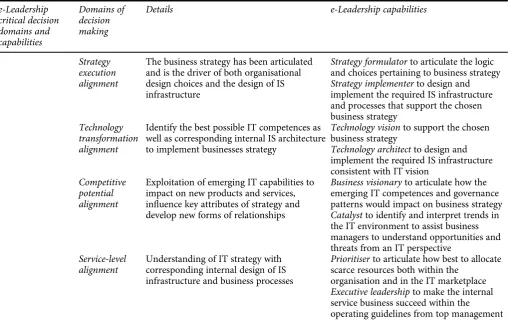
Table 1E-Leadership domain and capabilities framework (Adapted from Henderson and Venkatraman, 1993)
e-Leadership critical decision domains and capabilities
Domains of decision making
Details e-Leadership capabilities
Strategy execution alignment
The business strategy has been articulated and is the driver of both organisational design choices and the design of IS infrastructure
Strategy formulatorto articulate the logic and choices pertaining to business strategy
Strategy implementerto design and implement the required IS infrastructure and processes that support the chosen business strategy
Technology transformation alignment
Identify the best possible IT competences as well as corresponding internal IS architecture to implement businesses strategy
Technology visionto support the chosen business strategy
Technology architectto design and implement the required IS infrastructure consistent with IT vision
Competitive potential alignment
Exploitation of emerging IT capabilities to impact on new products and services, influence key attributes of strategy and develop new forms of relationships
Business visionaryto articulate how the emerging IT competences and governance patterns would impact on business strategy
Catalystto identify and interpret trends in the IT environment to assist business managers to understand opportunities and threats from an IT perspective
Service-level alignment
Understanding of IT strategy with corresponding internal design of IS infrastructure and business processes
Prioritiserto articulate how best to allocate scarce resources both within the
organisation and in the IT marketplace
In particular, IS literature suggests that leaders’vision, attitude and behaviour significantly influence employees’perceptions of the benefits of IT innovation, and hence its adoption outcomes (Orlikowski, 1992; Boyntonet al., 1994; McKenneyet al.,1997; Purviset al., 2001). As far as ERP implementation is concerned, leadership is consistently identified as the main determinant of successful ERP implementation (Bingiet al., 1999; Al-Mudimigh
et al., 2001; Umble et al., 2003). Leadership support leads to increased system usage (Bardi et al., 1994; Guimaraes and Igbaria, 1997), positive user perceptions (Igbaria et al., 1997), improved IT adoption and diffusion (Ramamurthy and Premkumar, 1995; Bruque-Camara et al., 2004) and better performance (Bardiet al., 1994). Furthermore, leadership facil-itates smooth change management (Bingiet al., 1999). Leader-ship can also be seen as the propagated approach of individuals and champions who can effectively implement change programmes such as enterprise social systems (Al-Mashari
et al.,2001).
Leadership in enterprise social systems
With business today moving at an accelerated pace, the need for enterprise social networking is greater than ever. Current communication software and enterprise systems such as ERP, customer relationship management (CRM) and supply chain systems don’t support the collaboration required to speed up critical processes (Vmware, 2013). Communications still remain fragmented as users try to communicate and collabo-rate in a piecemeal fashion. Digital technologies, by combining social technologies with data analysis and mobile technologies, are enhancing organisations’ability to connect with key direct stakeholders (customers, suppliers), respond more quickly and effectively to market changes, enable employees to work on the tasks that most benefit the organisation at any given point in time, and deploy multi-channels and platforms (McKinsey, 2012). Enterprise social systems then emerge by integrating technologies such as social media into the regular workday experience to promote employee collaboration, pro-ductivity and innovation. The benefit of enterprise social systems is‘sharing information’, a key to employees‘thriving’, as opposed to merely being ‘satisfied’. Enterprise social systems provide a repository for and access to corporate knowledge, accelerated R&D-led innovations, improved deci-sion-making and even increased employee morale, which are essential for SME growth.
However, in reality, organisations tend to focus on provid-ing a communication technology platform rather than deliver-ing a social solution that targets specific business value (Gartner, 2010). Instead, the real value-adding opportunities of social technologies lie in exploiting their capabilities to reshape organisations’ business models. This is where the failure to deliver surfaces in many organisations (Willcocks and Sykes, 2000). Improving business competitiveness is more than just implementing technology; it is about parallel intro-duction of major human, cultural, and organisational changes. Therefore a successful enterprise social system is more about the transformation of the culture, strategy, skills and processes –where all of these work together as an integral social system. Leadership is regarded as the key driver in aligning enterprise social systems to business goals (Sarker and Lee, 2003). Effective leadership will drive the rethinking of how business is done by letting enterprise social systems permeate
business processes rather than exist in parallel with them. Therefore SME leaders should be able to bring on enterprise social technologies to support every aspect of business prac-tice. Though leadership has been identified by many research-ers as one of the key factors in the success of enterprise systems, there is a paucity of research on how specifically leadership drives business success through technology. Dong
et al.(2009) identified three types of top management support in successful IS implementation. The first type of support is resource provision to supply key resources such as funds, technologies, staff and user training programmes. The second type refers to change management to foster organisational receptivity of a new IS. The third type of support is vision sharing related to ensuring that lower level managers develop a common understanding of the core objectives and ideals for the new system. The behaviours (or non-behaviours) of top managers have a direct influence on IS implementation out-comes and leaders need to actively exhibit supportive actions to ensure that strategic visions are internalised. As enterprise system implementations tend to introduce foreseeable and unforeseeable organisational changes (Davenport, 1998; Markus and Tanis, 2000), leaders need to adapt the content of support tofit what is needed at different stages of‘readiness’ in implementing the enterprise social system (Robertset al., 2003). The visibility of leadership throughout the entire process of implementing enterprise systems is also important to publicly demonstrate leaders’ determination, vision and appreciation via a steady execution of concrete action and communication (Fox and Amichai-Hamburger, 2001). Furthermore, leadership also plays an important role in building key in-house IT capabilities prior to introducing an enterprise social system. Willcocks and Sykes (2000) have identified IT leadership as one of the most important in-house IT capabilities. Leaders must behave as knowledgeable strate-gic executors and be able to align investments in IT with strategic business priorities. The focus of the current research is on leadership associated with implementing large-scale information systems (e.g., ERP). Very little research has focused on how leadership drives success in the digital age by embracing social systems. There are significant differences between large businesses and SMEs (Ghobadian and Gallear, 2001). Hence it is important to examine the relationship between leadership, business strategy and technology in the digital age. The research presented in this paper addresses this gap by investigating how effective e-leadership maximises business competitiveness of SMEs in the digital age. In the following section we examine the e-leadership concept from different perspectives and highlight the focus of our research exploring the strategic role of e-leadership in building compe-titive capabilities.
The emergence of e-leadership
direct and supervise the execution of plans (Avolio and Kahai, 2003).
Theoretical suggestions that leadership and technology influence each other date back to 1990, as emphasised by Weick (1990), Orlikowski et al. (1995) and Avolio and Gardner (2005). In particular, adaptive structure theory (AST; DeSanctis and Poole, 1994) has been used by Avolioet al.(2001) as a foundational theoretical framework to examine e-leadership, especially in determining how the appropriation of information by leaders and their peers or followers can affect how those leaders lead through technology, and how leadership itself affects the use of technology. With the emphasis placed on what constitutes the source of e-leader-ship and how the source of leadere-leader-ship is transmitted when it is mediated through digital technologies, e-leadership can be studied at meso, micro and macro levels. We will introduce these three levels in the following sections but with a focus on e-leadership at the macro level where our research in this paper resides.
e-Leadership concept at micro and meso level
The e-leadership focus at the micro level is primarily on distant communication with virtual teams and communica-tion skills in the technology-mediated environment (Gurr, 2004; Malhotraet al., 2007; Avolioet al., 2009). e-Leadership is mainly studied as the management of distributed teams whose members predominantly communicate and coordi-nate their work through electronic media (Kerfoot, 2010). Leaders’behaviour at geographical distance is also studied to see if the traditional core set of leadership behaviours is effective in the distributed working environment and how those behaviours impact on the team’s performance (Watson, 2007).
e-Leadership at a micro level can originate from individuals assuming the role of leader and/or follower, leader–follower dyads with members operating in a virtual group, or within the context where these entities are embedded. According to Avolioet al.(2014), recent trends in social media, mobile, big data analytics, cloud computing and the internet of things have broadened both the range of micro-organisational beha-viour sources of e-leadership influence and the way in which it is transmitted and received by those involved in its interactive and dynamic processes. Features of digital technol-ogy can either enhance or diminish the effects of leaders and followers exerting e-leadership influence depending on the source of e-leadership, its mechanisms for transmission and the technology being used (Kahaiet al., 2013). According to Hernandez et al. (2011), e-leadership can be transmitted (similar to leadership in the face-to-face context) via the traits (i.e., who one is), behaviours (i.e., what one does), cognitions (i.e., what and how one thinks) and affects (i.e., what one feels) associated with leaders and followers. Each of these mechan-isms provides a unique way for leadership influence to be transmitted and received by others and offers implications for e-leadership theory. On the other hand, e-leadership at a meso level is described as changes occurring at work and how they are influencing the loci and mechanisms of leadership. The changes include increasing use of information in organisa-tions, greater transparency and openness, the rise of social networks, constant contact and increased use of tracking devices (Kahaiet al., 2013; Avolioet al., 2014).
e-Leadership concept at macro level
Our research will focus on the e-leadership concept at a macro level. At a macro level e-leadership refers to strategic implica-tions of e-leadership in organisational change and transforma-tion (Avolio et al., 2014). The strategic implication refers to strategic change and transformations in organisations, as well as how organisations relate to each other within and between markets. The strategic implication is addressed by the IT, organisational theory and leadership literatures (Henderson and Venkatraman, 1992). Despite this burgeoning literature there is a paucity of sound theoretically based empirical research examining the role of e-leadership and digital technol-ogy in facilitating or inhibiting organisational change, and its impact on leadership and organisational transformation.
Henderson and Venkatraman (1992) were among thefirst authors to discuss the need for strategic alignment between IT implementation and organisational change. The extant litera-ture suggests that investing in IT as part of the organisational change process is an important asset for leveraging organisa-tional change (see, for example, Holtet al., 2007; Gilleyet al., 2009). Besson and Rowe (2012) conducted a 20-year review of the literature on IT-enabled organisational transformation, concluding that relatively little attention was paid to examin-ing the effects of leadership on such transformation. To this end Avolioet al.(2014) concluded that we still know very little about how e-leadership, information technology and their interaction affect strategic leadership and organisational transformation.
To address this theoretical and empirical gap we focus on e-leadership at the macro level paying particular attention to strategic alignment. The aim of this paper is to develop and empirically test an e-leadership conceptual model focusing on how leadership in SMEs leverages business and digital tech-nology by addressing the following two critical questions: (1) What are the e-leadership constructs contributing towards effective strategic alignment? and (2) What leadership prac-tices do successful SMEs engage in to leverage the benefits of IT? We contribute to the literature through in-depth explora-tion of different dimensions of e-leadership constructs and how they interrelate to achieve effective strategic alignment.
Strategic alignment theory
business and IS strategies can act as mutual drivers; third, strategic IS alignment ‘is not an event but a process of continuous adaptation and change’ (Henderson and Venkatraman, 1993). It is reasonable to assume that these arguments equally, if not more so, apply to digital technology, which is inherently more pervasive and multi-layered.
The strategic alignment theory proposed by Henderson and Venkatraman (1989, 1993) points to the dynamic alignment between business and IS strategies, stressing the importance of both strategic and structural alignment. The aim is to expli-citly identify the range of strategic choices in an organisation and their interrelationships with IS. In particular, the strategic and functional integration of both business and IS aspects constitute key alignment dimensions, which further lead to four domains of strategic choice: business strategy, organisa-tional infrastructure and processes, IS strategy and IS infra-structure and processes. Effective management requires a balance among the choices made across all four domains. Effective e-leadership strives to attain close alignment by considering how choices made in the IS domain impact on (i.e., enhance or threaten) those made in the business domain and vice versa. Strategic alignment theory identifies the domains of decision-making and leadership capabilities required to attain close alignment. As shown in Table 1, the four domains critical to alignment between business and IT strategy are: strategy execution, technology transformation, competitive potential and service level. These four domains drive the e-leadership capabilities (Table 1). Managers through exercising these capabilities enhance the likelihood of alignment leveraging the benefit of digital technology in business competiveness. The e-leadership critical decision domains and capabilities, on one hand, address IS function-ality to both shape and support business strategy where digital technology becomes an important source of strategic advan-tage. On the other hand, they deal with the criticality of ensuring internal coherence between the organisational requirements and delivery capability within the IS function.
The four domains described offer leaders a tool to align their business and digital (IT) strategy. The question is, how to conceptualise e-leadership that will effectively drive the above alignments? These alignment factors and their relationship in SMEs have rarely been empirically analysed and tested. The e-leadership domain and capabilities framework (Table 1) provides the theoretical basis for us to address this gap through an in-depth empirical study focusing on European SMEs operating in different sectors. Specifically, the e-leader-ship domain capabilities model will support the empirical investigation in the following ways (for a detailed discussion see the section‘Methods’). First, the four e-leadership domains will guide the codification process to classify data codes into categories and subcategories (the section ‘Data analysis’), as well as development of the constructs, subcategories and categories that systematically interrelate towards the e-leader-ship model (the sections‘e-leadership qualities and strategic alignment: empirical findings’ and ‘The development of an e-leadership model for SMEs’). Second, e-leadership capabil-ities will guide the design of the interview protocol and interviewee selection criteria (the section ‘Data collection’) according to different capabilities of leaders (as shown in Table 1: strategy formulator and implementer; technology vision and architect; business visionary and catalyst; prioritiser and executive leadership).
Methods
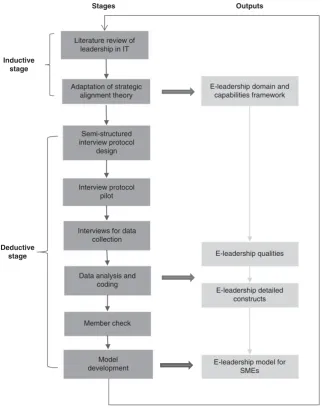
To meet our aims we used a three-stage qualitative – explorative research method. First, we conducted a compre-hensive literature review to identify factors leading to success and/or failure of digital/IT technology implementations and identify appropriate theories/frameworks. Second, we exam-ined the relevance of theories unearthed and adapted strategic alignment theory because of its clarity in identifying key integration domains and the appropriate leadership capabil-ities. This leads to the inductive development of the e-leader-ship domain and capabilities framework. Third, we conducted
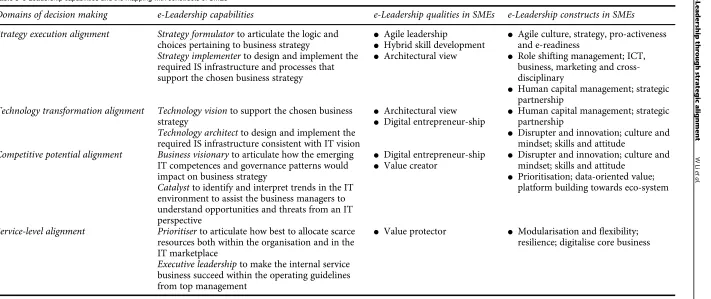
field work and analysed the data (see Figure 1). This stage involved deductive advancement through in-depth interviews to identify SME e-leadership qualities (Figure 2 in the section ‘e-leadership qualities and strategic alignment: empiricalfi nd-ings’) and constructs for each quality (Figure 3 in the section ‘The development of an e-leadership model for SMEs’). The outcome of the analysis resulted in a comprehensive SME e-leadership model highlighting the key e-leadership capabil-ities necessary for effective alignment between business and digital strategy. The research process is depicted in Figure 1.
Data collection
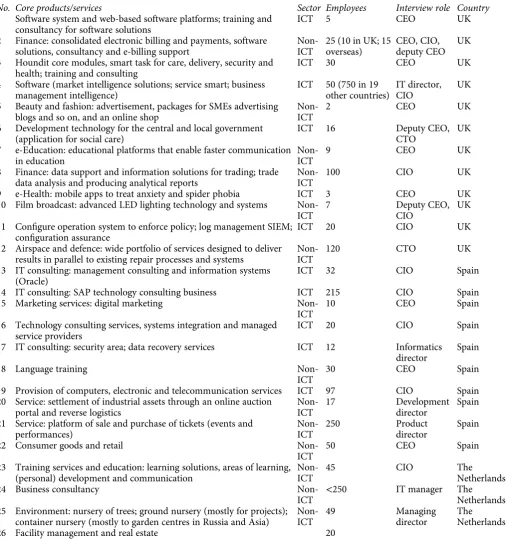
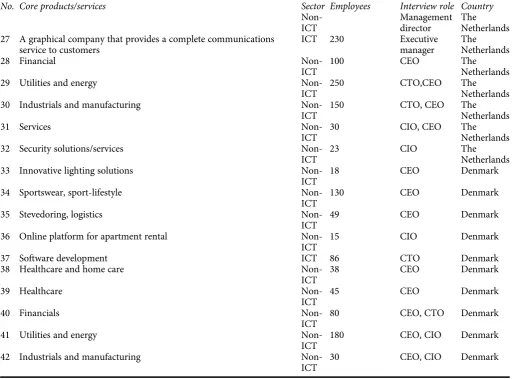
The sample for this study was drawn from among SMEs operating in the United Kingdom, Spain, Demark and the Netherlands. SMEs are the life blood of the economy. Further-more, SMEs are different to large organisations particularly when it comes to the implementation of new processes (Ghobadian and Gallear, 1997). The key differences are lack of slack resources (that is, available resources are scarce) resulting in a low tolerance of strategic mistakes, a narrower cognitive window and a more limited boundary-spanning horizon. The sample selection criteria were developed by the research grant holders as this paper is based on a European research project entitled: e-Leadership Skills for SMEs (LEAD, 2014). The team of researchers consisted of 20 consultants and academics from five European business schools (from Ger-many, Spain, Bulgaria, France, the United Kingdom and Denmark). The process for developing the selection criteria included a one-day workshop and three teleconference ses-sions. Thefinal selection criteria were: (1) size of SMEs:firms with 10 to 250 FTEs employees as well as micro enterprises (<10 employees is exceptional, e.g. innovative business model and potential market); (2) the maturity stage of SME-gazelles (OECD, 2010):‘enterprises which have been employers for a period of up to 5 years with average annualised growth in employees (or in turnover) greater than 20% per year over a three-year period and with 10 or more employees at the beginning of the observation period’; (3) successful SMEs can be gazelles or be recognised by a well-regarded third party as successful (e.g., Thames Valley 100 best SMEs unveiled in Business Magazine in the United Kingdom). The reason we focus on successful SMEs is that we aim to explore best practices when building the diagnostic e-leadership model – with successful companies that are aware of e-leadership and use it in their business to contribute to business competitiveness and growth.
the Netherlands (10) and Denmark (10). Furthermore, draw-ing on the concept of theoretical replication (Yin, 2009; Buchwaldet al., 2014), we tried to achieve sufficient variation across the organisations with respect to industry and number of employees, as well as having the appropriate ratio of IT and non-IT companies to avoid bias in this regard. These compa-nies range across different fields and industries (details in Appendix A). In particular, there are 19 IT related companies (comprising 45% of the sample) and 23 non-IT related companies (comprising 55% of the sample). The percentage of non-IT companies is slightly higher because evidence shows that firms whose main business is not IT or IT-related face different sets of challenges when it comes to the strategic use of IT thanfirms whose business is IT.
We aimed to interview the top and middle managers (e.g., CIO, CTO, CEO, IT directors deputy CEO) of these
firms. We chose the interviewees by identifying key persons and decision makers who execute leadership for business and digitalisation strategies, in particular with a strategic align-ment focus (see Table 1) on strategy execution, technology transformation, competitive potential and service
management. More specifically, the interviewees were selected based on the various roles of strategic alignment according to Henderson and Venkatraman (1993). Therefore the top and middle managers, with the roles of strategy formulator and implementer; technology vision and architect; business visionary and catalyst (based on strategic alignment theory in Table 1), were selected as interviewees. The interviewees were recruited by means of invitation emails and 68 inter-viewees were recruited from the 42 companies. Eventually we conducted 42 interviews: 19 involving one interviewee; 20 involving two interviewees simultaneously; and three involving three interviewees simultaneously. The 42 inter-views were conducted between February and October 2014.
The design of the interview protocol was guided by the e-leadership theory presented previously (Table 1). As was noted, the theory and model were adapted to align with the SME context. The interview protocol consisted offive main parts: background and overview of the successful SME, demand for e-skilled professionals, overview of a significant innovation from the past year, future demand for e-leaders
Inductive stage
Adaptation of strategic alignment theory
Deductive stage
Semi-structured interview protocol
design
Interview protocol pilot
Interviews for data collection
Data analysis and coding
Model development
Stages Outputs
E-leadership domain and capabilities framework
Member check
E-leadership qualities
E-leadership detailed constructs
E-leadership model for SMEs Literature review of
[image:7.595.137.460.68.478.2]leadership in IT
and engagements with educational institutions. These resulted in 24 questions. The detailed questions in ‘e-skilled profes-sionals, overview of a significant innovation, and future demand for e-leaders’ were designed with the focus on e-leadership capabilities (see Appendix B). We pre-tested the interview protocol by holding four sessions within the project team and included an SME top manager to provide external feedback. Before the interviews, pilot interviews were con-ducted in February 2014, with both IT and non-IT companies, to test the understanding of and relevance of questions and the e-leadership model. The interviewees were informed of the length of the interview (1.5 h) beforehand in order to address time constraints and increase the likelihood of cooperation. Furthermore, in order to ensure consistency in understanding of e-leadership between interviewers and interviewees and to avoid misunderstandings and ensure validity of content, we asked the participants for their understanding of e-leadership. During each interview we compared the interviewee’s under-standing with our initial e-leadership and strategic alignment definition and used the interviewee’s answers to steer the conversation picking up on emergent themes and aspects specific to the interviewee. All the interviews were then transcribed and stored in a database.
Data analysis
We began the data analysis by identifying the concepts that either contributed to business success through e-leadership or caused problems that thefirms had to overcome, as well as the impact of e-leadership on strategic alignment within our sample of SMEs. Furthermore, we searched for similarities and differences between the sample organisations, which enabled us to identify patterns that could potentially be included in an e-leadership model to explain its role in strategic alignment. The interviews thus helped us to gradually identify the constituent elements of the framework. Two researchers involved in this paper coded the interview
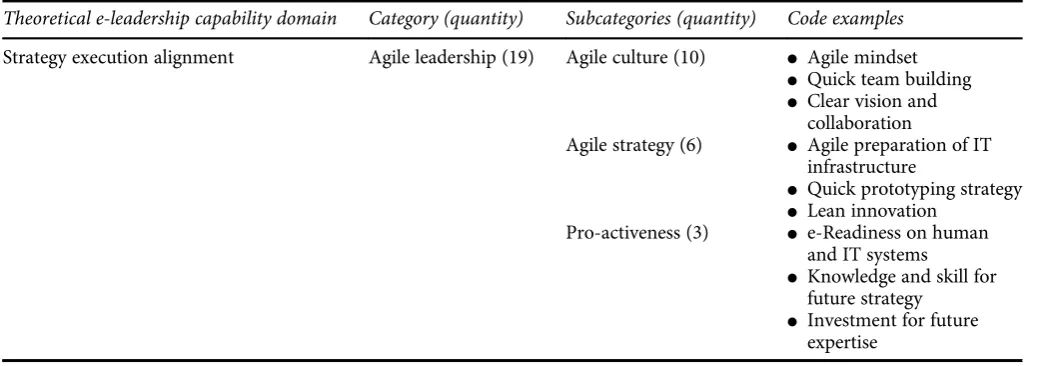
transcripts. We started our data analysis with the theoretically highlighted e-leadership domain and capabilities framework (Table 1) for guidance. All the data was initially open-coded and then further analysed by dividing, comparing, forming and categorising the data into meaningful elements that support the theoretical framework (Saldaña, 2012). Thus we scanned the interview transcripts for similarities and differ-ences and assigned codes to them. By merging analogous codes and resolving conflicting codes the constructs identified in the coding process were grouped into synthesising cate-gories. We then condensed the codes resulting from the coding process into 6 categories and 16 subcategories.
Table 2 provides a summary of excerpts from the codes that were included in exemplary categories and subcategories. The categories and subcategories provide a basis for e-leadership qualities and specific constructs in the model. In order to derive the propositions in our model, we not only identified constructs in our transcripts, but also marked how these constructs relate to the theoretical e-leadership domain and capabilities framework. The empirical grounding of each proposition is thus provided alongside. A member check was also undertaken after completing the data analysis. The report on the results of our study with descriptive statistics and the proposed e-leadership model was presented at a project work-shop held in Brussels in November 2014, where nine inter-viewees from four SMEs (two IT and two non-IT) were invited to attend. We received positive feedback, in particular on how the report and model supported their understanding of e-leadership.
e-Leadership qualities and strategic alignment: empirical
findings
We draw extensively on interviewees’ responses to describe the successful e-leadership characteristics contributing to effective strategic alignment. Guided by the e-leadership domain and capabilities in the section ‘Strategic alignment
Hybrid skill development
Architectural view
Digital entrepreneurship
Technology transformation
alignment
Competitive potential alignment
e-Leadership Strategy execution
alignment
Service-level alignment Value protector
Value creator Agile leadership
[image:8.595.134.466.65.305.2]e-Leadership capabilities domains e-Leadership qualities
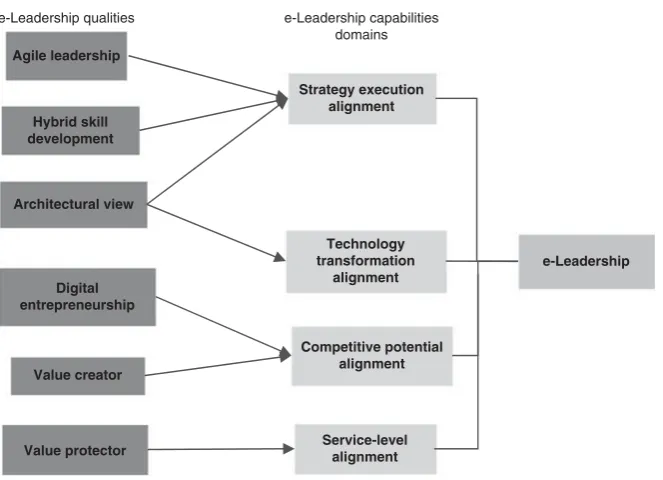
theory’, we have delved deep into the data to develop a more profound understanding of e-leadership capabilities in strat-egy execution alignment, technology transformation align-ment, competitive potential alignment and service-level alignment. As shown in Figure 2, six e-leadership aspects have been identified from the empirical data that have a relation-ship to strategic alignment perspectives. Propositions are made on how these aspects contribute to strategic alignment in e-leadership.
Qualities in strategy execution and technology transformation alignment
Agile leadership is the most frequently identified feature of e-leadership. Agility refers to a leader’s quick response to opportunities and threats in a business environment using IT. Agile leadership in the digital age therefore refers to the ability of a leader to lead effectively in different circumstances especially new, changing and sometimes ambiguous situations
Technology transformation
alignment
Competitive potential alignment
E-leadership Hybrid skill
development Role shifting
management
ICT, business, marketing and cross-disciplinary
Architectural view Human capital
management
Strategic partnership
Digital entrepreneurship Disrupter and
innovation
Culture and mind-set
Strategy execution alignment
Service-level alignment Skills and attitude
Agile leadership Agile culture
Agile strategy
Pro-activeness and e-readiness
Prioritisation
Value creator
Platform building towards ecosystem
Data-oriented value
Modularisation and flexibility
Value protector Resilience
Digitalise core business
E-leadership capabilities domains E-leadership qualities
[image:9.595.99.500.69.612.2]Constructs
with disruptive technologies. Thirty out of 42 interviewees indicate that CIOs and CTOs succeed or fail depending on their ability to exploit emerging digital capabilities in the creation of new products and services. Thus a leader’s agility influences key elements of business strategy. Agility affects the efficiency and development of new products and enables managers to build relationships with customers and suppliers within vertical and horizontal value chains. Agile leadership enables alignment in strategy execution by quickly articulating and prototyping the strategy into business logic choices, as well as IS infrastructure and processes.
Interviewees stated that agility was linked to pro-activity and foresight in detecting changes in the environment. Skills, IS infrastructure, functions and processes required in articu-lating and prototyping the strategy were considered important in preparing SMEs to quickly respond to the changing environment. For example, a software firm alluded to the importance of investing in training and development, prepar-ing and equippprepar-ing staff to take advantage of future technolo-gies. The firm supported and encouraged IT staff to attend international conferences and in-house training (seminars) to equip them with the necessary IT and marketing skills to respond to forthcoming technology and strategy. This invest-ment in people is seen as important in maximising value in the future, especially when related IS strategy is implemented. A CEO of afinance organisation mentioned,‘we pro-actively work in association with a number of freelancers to develop the design of the IS infrastructure for them. Although this effort for readiness increases the workload prior to the implementation of business strategy, it leverages the contin-gencies and enables agile execution of business and IS strategy well in advance’. Therefore we propose:
Proposition 1: Agile leadershipenables alignment in strat-egy execution by quickly articulating and prototyping the strategy into business logic choices as well as IS infrastruc-ture and processes. Agile leadership enhances success in changing and sometimes ambiguous situations with disrup-tive technologies.
Hybrid skills were found to be important in strategy execution alignment to better exploit new technologies and embed them into the business model of the organisation.
It may be that‘native’digital enterprises (e.g., web entrepre-neurs) have ‘innate’ e-leadership skills and leapfrog other
firms employing IT innovation. Nevertheless, this does not mean that they are competent in integrating business and market knowledge with available IT or that they have a full range of embedded e-leadership skills. The hybrid skill embraces business, strategy and IT skills. The demand for hybrid skills is driven by the need to exploit IT in order to respond rapidly to market changes, digital patterns and new business opportunities. In particular, from the strategy per-spective,firms need hybrid skills to develop new customers and retain existing ones. This will help firms to be more efficient in decision-making and new product development, understanding growth and digital patterns and defining priorities. From the sales perspective,firms need hybrid skills to grow sales, build ‘data supply chains’, negotiate with customers and suppliers of interim materials, and undertake business analytics. From the IT perspective,firms need hybrid skills to nurture and develop apps systems, optimise data storage and to exchange and link to customers through social media, maintaining privacy and cyber security of their data. Some interviewees commented on the implications of out-sourcing. For example, in one case: ‘in-house staff (project coordinators) to be more capable of querying delivery of solutions provided by the private sector’. This respondent noted that skills are lost because of outsourcing and with them an ability to respond to new technologies. It was highlighted that SMEs faced‘silos of knowledge–not specifically because information sharing is poor but because the organisation is small and we have specialists in individual areas’.
[image:10.595.41.565.80.263.2]Eight out of 42 organisations highlighted leadership in ‘understanding of the business and bridging the gap with the organisation’s vision’, and ‘understanding of the business objectives driving IT choices’. The breadth of skills for leaders who can play multiple roles in a team and who have knowl-edge of different technologies to support business partners is important for both business-driven and ICT-enabled align-ments (Henderson and Venkatraman, 1993). For instance, a CTO from the aerospace sector commented,‘better CEOs and other executives understand digital technology and its impact on organisations’. A CEO from cyber security noted the need for, ‘quality managers who understand much more than
Table 2Sample categories of codes from interviews
Theoretical e-leadership capability domain Category (quantity) Subcategories (quantity) Code examples
Strategy execution alignment Agile leadership (19) Agile culture (10) ● Agile mindset
● Quick team building
● Clear vision and collaboration
Agile strategy (6) ● Agile preparation of IT infrastructure
● Quick prototyping strategy
● Lean innovation Pro-activeness (3) ● e-Readiness on human
and IT systems
● Knowledge and skill for future strategy
simple economics–people are the key resource to be managed and encouraged, not beaten into submission’. A possible negative to the idea of the‘hybrid manager’arises from several participants pointing to the importance of IT people being properly involved in selling the organisational strategy and getting it over the line and into delivery.
The interviewees pointed out that the distinction between managerial leaders and IT leaders is likely to disappear over time. Managers, regardless of speciality, general or IT, need to understand the problems that customers face and offer appro-priate solutions in terms of new or modified products, services or processes. Therefore technical leaders with organisational and IT skills could work on a broader basis, offering a wider choice of solutions to clients on how they want solutions/ products to be designed, monitored and controlled.‘ Compil-ing data, technology application and analysis, writCompil-ing up a report are secondary, but formulation and negotiating a strategy to articulate logically the best business choices becomes primary’, a CIO concludes.
The e-leaders are not necessarily experts in technology, with hands-on skills in technology or business, but they must be independent learners and thinkers with hybrid skills. The combination of management, market, ICT and industry-specific skills are seen to be essential for ‘hybrid e-leaders’ who could take more responsibility and be ready to lead organisational change and practice. Both knowledge and personality drive e-leaders to keep learning and to lead change. A CEO from an SME in software says, ‘effective e-leaders get creative at work,find solutions, expertise, knowl-edge, remain alert at all times, thinking, who can they talk to as customers?’.‘This is something like“magic dust” –a combi-nation of skills, experience and teamwork that enables innova-tion and creative soluinnova-tions’, the CEO of an SME in IT solutions added. Therefore we propose:
Proposition 2: Hybrid skills facilitate strategy execution alignment through better exploiting new technologies and embedding them into the organisation and its business activities. This constitutes e-leadership in terms of embra-cing business strategy and IT skills, according to need, in order to exploit IT and to respond rapidly to market changes, digital patterns and new business opportunities.
A proper architectural view was also identified as an important part of e-leadership, providing an overarching blueprint of the structure and operation of SMEs and their external partnerships, enabling SMEs to most effectively achieve their objectives with limited resources. It was recog-nised by the interviewees that a leader’s architectural view facilitates strategy execution and technology transformation alignment, where design logic and process arrangement, skills, organisational and systems architecture supporting the rea-lisation of business and IT vision are provided.
In the interviews, 20 managers of SMEs stated that architectural views on workforce management and partner-ship building are important for e-leaderpartner-ship. An architec-tural view is recognised as an important aspect in an SME, while a proper strategic alliance mechanism will help in gaining knowledge and expertise. Alliances or joint ventures, where SMEs and collaborators jointly develop organisational and IS infrastructure, appear to be an effective approach in helping SMEs to support business strategy and competitive-ness. For example, an SME in an IT services exchange shared
IS infrastructure with a knowledge service provider through a joint venture. Each complemented each other’s capabilities in building up value and IS architecture where the joint venture produces more value than a single SME with limited resources. A majority of SMEs had formed alliances with external partners, especially where architectural issues were considered important. An architectural view was considered by many e-leaders (either in IT or non-IT sector) as an effective way to build up business competence. The combina-tion of IT architecture (technologies, funccombina-tions, hardware, and data communications) and organisational architecture (organisational structure and processes on top of the IT architecture) will inform what is needed and how they work together to support business strategy.
Therefore an architectural view helps SMEs to forge a value network with the necessary expertise. A number of applications in areas such as production, supply ment, sales and customer management, and data manage-ment (engineering, entitlemanage-ments, supply managemanage-ment, contract enforcement, supply and data management) cover an array of complex inter- and intra-organisation relation-ships. e-Leaders’architectural views will guide the formation of each relationship within and outside SMEs. For example, a software SME runs its business through project developers (project sponsor) with an IT team, working together, both within the SME and with external partners. The e-leader, working with the CEO, created an architectural portfolio including business applications, data architecture and tech-nical infrastructure and personnel related to the project. The method of collaboration is then developed according to the architectural view of the project, on what is needed and how the internal team and external partners work together. Therefore we propose:
Proposition 3: An architectural view facilitates strategy execution and technology transformation alignment. It constitutes e-leadership by providing a design logic and arrangement in value, process, skills, organisational and systems architecture that supports business and IT ‘ align-ment and strategy achievealign-ment’.
Qualities in competitive potential alignment
While agile leadership, hybrid skills and an architectural view are recognised as important e-leadership constructs in strategy execution and technology transformation alignment, digital entrepreneurship was identified by interviewees as a key con-struct in competitive potential alignment. Digital entrepreneur-ship here refers to the establishment of a new organisation, as well as the growth of an existing organisation that relies on ICT for its operations and/or its products and services through the inspiration of human assistance and use of ICT. Interviewees from 10 SMEs pointed out that digital entrepreneurship facil-itates identification and interpretation of trends in the IT environment helping firms to articulate how the emerging IT competences would impact on business strategy.
technologies and the role of digital entrepreneurship in business strategy were alluded to by the CEO of a broadcasting SME. He stated,‘digital entrepreneurship and innovation may involve up to 75 to 80% of the total budget. This cost is split across application development, operations, maintenance and customer intimacy technologies involved in the innovation cycle’. The same strategy has been alluded to by other CIOs and CEOs of SMEs operating in both IT and non-IT industries. Therefore we propose:
Proposition 4: Digital entrepreneurship enables competi-tive potential alignment. It constitutes e-leadership by facilitating the identification and interpretation of trends in the IT environment, enabling articulation of how emerging IT competences inspire business innovation.
Creating competitive value using digital technologies was also mentioned by interviewees, referring to creating‘ tomor-row’s value’by reconfiguring the value chain and creating new ecosystems and markets. The empirical data (from 23 SMEs) suggests that the leader as a value creator plays an important role in competitive potential alignment, in particular exploit-ing digital technologies to impact on new products and services, influencing key elements of strategy and developing new value propositions.
It would appear from the interviews, that using data is one of the major ways of creating competitive value. Data analytics on market and customer information was identified as an important technology competence serving to create value. It enabled collection, processing and analysis of large sets of data supporting key decisions such as market positioning. A business intelligence SME identified the innovation to build up business competence using data analytics. The SME built a mobile app to access the quality of performance of automotives for car dealers all over the world. Using existing big data analysis including data from Facebook, Twitter and other social media, the application assists business managers to understand potential opportu-nities and threats in the automotive market.
A CIO from an aerospace and defence SME mentioned, ‘Our business competitiveness is predicated on providing the right data at the right time to enable our customers to make the right decisions. Our business competence closely relies on the combination of software and data analytics technolo-gies that support customers’ business processes’. This SME aggregates a large set of airlines’ data. They provide this information to their customers (airlines) as a service helping them with customers’ supply management and contracts improving efficiency and lowering costs. In this case, IT competences and their orchestration collectively provide powerful support for their business scope and competence. The CIO says,‘we hold a unique position in the industry and are regularly acknowledged in the press by customers. To maintain this position, we continuously need to update our technology competence and refine IT strategy to create more value, especially in the information-rich digital age’. There-fore we propose:
Proposition 5: A competitive value creator facilitates com-petitive potential alignment. This constitutes e-leadership by exploiting digital technologies to impact new products and services, an influential key attribute of strategy and creating new competitive value.
Qualities in service-level alignment
Although being a digital entrepreneur and value creator is essential for e-leaders to drive competitive potential, being a
value protector was identified as the basic requirement for e-leaders to keep up to speed and not lag behind competitors through the use of technologies. The value protector refers to the ability to ensure that IT infrastructure could enhance internal and external processes supporting SME’s operations and core capabilities across the whole value chain. It is defined as executive leadership enabling the internal service business to succeed through ICT support. It was pointed out by the interviewees that a value protector enables service-level align-ment where an internal-service business succeeds through digitisation.
One of the basic requirements for e-leadership was
identi-fied as the effective use of technology to optimise organisa-tional and IS infrastructure. The aim is to enhance the daily operation of SMEs. A CIO from afinancial information SME stated, ‘IT is used to increase production and to improve operation excellence. It improves the core processes for production through computerised processes. IT also enhances the connection with customers, increases the quality of customer service with better responsiveness (e.g. Facebook, Twitter and Salesforce software to exchange experiences, receive and respond to comments)’. This is how the IS infrastructure optimises the production process and‘speaks’ to customers. Another example is afinancial service SME that applies computerised processes of e-billing supporting their clients’business processes. Its CEO stated,‘Technology is used to increase efficiency and reliability in operational and admin-istration processes in the enterprise and for clients. It increases
flexibility and responsiveness and contact with customers in order to support the operations for core capabilities of our organisation. All members of our company are using their IT and business expertise to deliver 100% service in time through our IS infrastructure–this is how we optimise our operation in this digital age’. Therefore we propose:
Proposition 6: A value protector facilitates service-level alignment. This constitutes e-leadership in optimising pro-cesses and services across the value chain through using data, digitising core business and allocating limited resources.
The development of an e-leadership model for SMEs
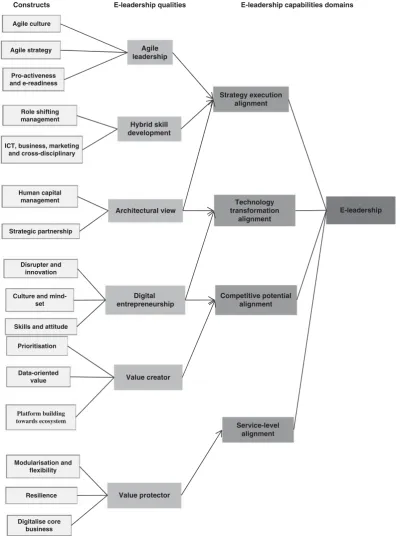
In addition to the six aspects of e-leadership discussed, we further synthesise the empirical findings into detailed char-acteristics of e-leadership based on the concepts of agile leadership, hybrid skills, architectural view, digital entrepre-neurship, competitive value creating and value protecting. We define and describe 16 constructs that constitute the six aspects and conclude this section by proposing the e-leader-ship model (Figure 3) and propositions for how the constructs contribute to different aspects of e-leadership.
Agile leadership
In many cases, interviewees declared that leaders need to be agile themselves but, more importantly, able to promote/ enhance theagile culturein the organisation. Theagile culture
continuous improvement, and demands constant close com-munication with customers (BCS, 2015). A CEO from con-sumer goods and retail commented, ‘Our business partners now demand agile IT responsiveness because the markets they serve place similar demands upon them’. New technologies increase the speed of information exchange and communica-tions. Particularly in the digital age, the leadership agenda will be dominated by this simple ultimatum– agility or redun-dancy, be quick or die. The primary measure of a leader’s success, in addition to the price and reliability of a product, will be the speed of service delivery and the‘ability to foresee customer preferences, often identified through talking effec-tive communication with customers’, added a CEO of a trading service. The empirical evidence from the interviews confirms that the most influential attribute and trait of a successful leader is an ability to change and control the organisational and professional attitude in facing digital and business opportunities. Therefore we propose:
Proposition 7: Agile culture is important in e-leadership for leaders to build vision, belief and attitude in the organisation towards agile response in a changing business and digital environment.
Whileagile cultureenables change of mindset,agile strategy
is important in making changes happen in order to realise business value through technologies. According to the empiri-cal evidence,agile strategyfor e-leadership is the approach of prototyping business strategy with digital vision in order to identify value pools. Agile strategy is likened to an experi-mental journey to rapidly test and define products and approaches and then scale what works with iterative deploy-ment. Eleven out of 42 interviewees emphasise that in a competitive landscape, and to enable this journey, leaders should have an agile prototype strategy including clear vision and KPIs, priorities, investments and governance in order to regularly review and adjust business and digital strategy. Therefore we propose:
Proposition 8: Agile strategyenables leaders to prototype/ implement business and digital strategies in order to realise business value in an agile way.
In addition to agile culture and strategy, pro-activeness to achieve readiness with adequate capabilities is important in facing a new and changing digital environment. Pro-active-ness in both busiPro-active-ness and IT infrastructure was mentioned by respondents from 15 organisations as an important factor for strategy execution. Thispro-activenessmeans that, instead of passively adapting organisational and IT infrastructure to maintain the status quo, e-leaders should deploy foresight attempting to foresee changes in the business environment, mainly driven by markets and customers, and respond strategically. One senior manager from afinance SME men-tioned that, ‘lack of urgency and slow response to business ecosystem changes, is one of the main threats to competive-ness in the digital age’. A CEO from service consulting commented that,‘It’s all about capability. Don’t be a kid in a sweetshop! Looking at new technology features makes us feel excited. New features are only useful if they deliver a benefit. It’s a simple concept, sometimes hard to achieve, rarely done’. Seventeen interviewees in our study came up with the importance of pro-activeness by managers, in relation to the
SME’s readiness in both human and IT systems, to building their company’s future strategy. This was thought to include process re-engineering, architecture development and devel-opment of employee skills, investing in employees’further IT and business education and training offsite, participating in open knowledge-exchange events (e.g., conferences, work-shops, industrial exhibitions and fairs). This pro-activeness to new technology coming from both middle and top level managers is needed and was mentioned by 17 out of 42 interviewees. The ability of IT, business and marketing specialists, as well as other managers to be pro-active and respond rapidly and efficiently to market demands through an increase in the processes of interaction between humans and technology could be termed‘e-readiness’. e-Readiness should be a fundamental part of strategy rather than a bolt-on option or afterthought, because agility will not come if IT depart-ments are overreliant on software code engineering. Therefore we propose:
Proposition 9: Leaders’ pro-activeness determines an SME’s capability in both business and IT to respond rapidly and efficiently to market demand.
Hybrid skills development
Role shifting managementwas recognised by interviewees as an important means to develop hybrid skills. New disruptive technologies challenge managers’skills, but also create oppor-tunities in terms of new roles and responsibilities. For example,‘the marketing manager is now taking care of cloud and information sharing between customers’, stated a trading services CEO.Role shifting management entails management helping, incentivising and rewarding employees to change role, for example, from IT specialist roles to business related roles and vice versa. Twenty out of 42 interviewees pointed out that role shifting was an important contributor toflexibility and broadeningfirms’cognitive boundaries. Role shifting may take place from one day to a week; it could involve individuals or teams. A CEO from the manufacturing sector stated that, ‘we do need more technology specialists, but we are also desperately short of other IT skills, such as business analysis, big data, project and programme management, technology risk management and IT-enabled change management. These are essential to support the shift to true digital operation’.
There is a clear message from our empirical data that SME leaders need to drive IT professionals to be business savvy and vice versa. This can help to‘re-plumb’the business, and so to maximise the potential of existing and new technologies to improve company competitiveness, customer service, effi -ciency, productivity and innovation. It requires IT profes-sionals to be able to bridge the gap between technology and customer needs, between technology and human resource management, technology and e-readiness, technology and recognition of opportunities and leveraging threats and,
cross-disciplinary skills, opportunities might be missed and, more likely, technologies will become a‘bolt-on’to existing working practice instead of being a strategic weapon to leverage investment benefits and minimise losses. The empirical evidence reveals that role shifting management will forge intelligent links between IT specialists on one side and business and market specialists on the other. In the digital age this ensures that IT is better understood and aligned, especially in the step change from old to new ways of working and leading. For example, an automotive con-sulting CEO mentioned that,‘New employees will be doing client presentations for consulting projects, but they’ll also be debugging a software setup. Their skills will be further enhanced by“practice”towards solution experts in certain subject areas combined with more industry-specific skills. Their job is exactly to bring the business side of things and the scientific processes into our technology solutions and provide the best combination of the two’. Therefore we propose:
Proposition 10: Role shift management facilitates the development of hybrid skills – business, IT and cross-disciplinary skills– allowing business and technologies to be better understood, exploited and aligned.
Architectural view
Architectural workforce managementrefers to the landscape and architectural vision to build up human capital to provide the requisite infrastructure and expertise. It was mentioned by interviewees that the proper architectural view on organisa-tional expertise is important for building up both business and IT infrastructure considering the resource constraints that challenge most SMEs. A CEO from the manufacturing sector commented,‘SMEs face harsher choices in terms of sourcing their needed e-leadership skills. Given our limited resources, we will have to be careful and invest well in the priority skills most functional to our business model’. Leaders need to either rely on external service providers or hire new resources or train existing staff, but need an architectural vision to identify what combination of expertise will drive optimal technological capabilities. A point supported by Keen and Williams (2013), stating that IT is a hub for contracting relationships and enabling the source of human capital upon which thefirm can draw. IT needs a new style of talent chain and partner chain management. A COO from utilities and energy mentioned, ‘Our organisation operates on a lean staffing model, with skills augmented from external service providers. The model envi-sages the system landscape and architecture to be designed in-house and bringing in external suppliers to provide the requisite infrastructure and applications’. Therefore we propose:
Proposition 11: Architectural workforce management is important to a leader’s architectural view in order to identify the combination of expertise that drives optimal business and technological capability.
In addition to the architectural view on the workforce, external partnership through value architecture was another important issue alluded to by interviewees.Alliance architec-ture refers to the architectural view aiming to identify an appropriate approach to forging inter- and intra-firm
relationships taking into account what is required and joint working methods in a digital value chain. Keen and Williams (2013) highlight the need for value architecture aligned with the needs of business built on digital opportunity. Our data supports this notion as 14 respondents suggested that the most fundamental opportunity for IT is to recast the discussion of cloud computing and managed networks, to consider such investments as variable rather than fixed cost, and take into consideration its intangible relation-building potential. When digital intensity increases and digital business strategy takes hold, improving business competiveness for SMEs is more likely to be based on alliances and partnerships through shared digital assets with otherfirms in the business ecosystem across different traditional industry boundaries. Increasingly, leaders need to build digital alliances with differentfirms to pull together the requisite scale and resources in areas where they do not see competitive advantage. Therefore we propose:
Proposition 12: Alliance architecture plays an important role in a leader’s architectural view identifying an appro-priate way to forge inter- and intra-firm relationships in the digital value chain.
Digital entrepreneurship
Digital entrepreneurship requires a new type of e-leader who acts as the innovative disrupter. Innovative disrupterrefers to a person who unravels the complexity of IT, increases accessi-bility to technology and is open to new ideas, with the aaccessi-bility to work with peers on getting the right things done. The empirical evidence from 12 organisations supports the view that disruptive innovation is required to drive the business vision of the top management team, to think outside the box and to envisage new scenarios for digital business acrossfirms and industries. A CEO from ICT services and consultancy commented, ‘We need to leverage the company’s resources and capital, not just react to technology disruption but rather to embrace and interweave digital technologies throughout our company to drive the disruptions ourselves and gain advantage’. The potential lies in creativity in recreating and redefining business model to create competitive advantage. Therefore we propose:
Proposition 13: Being aninnovative disrupteris important in a leader’s digital entrepreneurship, to be open to new ideas of competitive digital business.
In addition to innovative disrupter, theculture and mindset
of the digital entrepreneur were recognised as further traits of e-leaders. The interviewees highlighted that the CIOs, espe-cially in non-ICTfirms, for too long have been identified as the strategic and commercial weak link rather than people adding tangible value across the business. A CIO from