2,3-Dimethylphenyl benzoate
B. Thimme Gowda,a* Sabine Foro,b K. S. Babithaaand Hartmut Fuessb
a
Department of Chemistry, Mangalore University, Mangalagangotri 574 199, Mangalore, India, andbInstitute of Materials Science, Darmstadt University of Technology, Petersenstrasse 23, D-64287 Darmstadt, Germany
Correspondence e-mail: [email protected]
Received 28 March 2008; accepted 7 April 2008
Key indicators: single-crystal X-ray study;T= 299 K; mean(C–C) = 0.003 A˚; Rfactor = 0.049;wRfactor = 0.157; data-to-parameter ratio = 12.0.
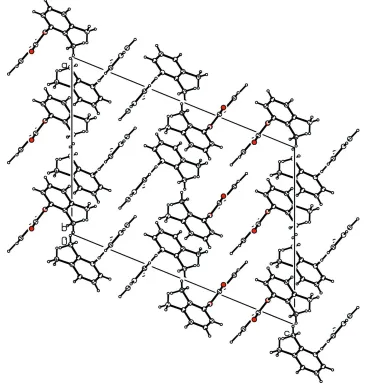
The structure of the title compound (23DMPBA), C15H14O2, resembles those of phenyl benzoate (PBA), 3-methylphenyl benzoate (3MePBA), 2,6-dichlorophenyl benzoate (26DC-PBA) and other aryl benzoates, with similar bond parameters. The dihedral angle between the benzene and benzoyl rings in 23DMPBA is 87.36 (6), compared with values of 55.7 in PBA, 79.61 (6)in 3MePBA and 75.75 (10)in 26DCPBA. The molecules in 23DMPBA are packed into a chain-like structure in the direction of theaaxis.
Related literature
For related literature, see: Adams & Morsi (1976); Gowdaet al.(2007a,b); Nayak & Gowda (2008).
Crystal data
C15H14O2
Mr= 226.26 Monoclinic,C2=c a= 15.190 (2) A˚
b= 8.417 (1) A˚
c= 20.604 (2) A˚
= 112.20 (1)
V= 2439.0 (5) A˚3
Z= 8
CuKradiation
= 0.65 mm 1
T= 299 (2) K 0.500.440.36 mm
Data collection
Enraf–Nonius CAD-4 diffractometer
Absorption correction: none 2328 measured reflections 2173 independent reflections
1886 reflections withI> 2(I)
Rint= 0.083 3 standard reflections
frequency: 120 min intensity decay: none
Refinement
R[F2> 2(F2)] = 0.048
wR(F2) = 0.157
S= 1.07 2173 reflections 181 parameters
H atoms treated by a mixture of independent and constrained refinement
max= 0.17 e A˚ 3
min= 0.17 e A˚ 3
Data collection:CAD-4-PC(Enraf–Nonius, 1996); cell refinement:
CAD-4-PC; data reduction:REDU4(Stoe & Cie, 1987); program(s) used to solve structure: SHELXS97(Sheldrick, 2008); program(s) used to refine structure: SHELXL97 (Sheldrick, 2008); molecular graphics:PLATON(Spek, 2003); software used to prepare material for publication:SHELXL97.
BTG thanks the Alexander von Humboldt Foundation, Bonn, Germany, for extensions of his research fellowship.
Supplementary data and figures for this paper are available from the IUCr electronic archives (Reference: OM2224).
References
Adams, J. M. & Morsi, S. E. (1976).Acta Cryst.B32, 1345–1347.
Enraf–Nonius (1996). CAD-4-PC. Version 1.2. Enraf–Nonius, Delft, The Netherlands.
Gowda, B. T., Foro, S., Babitha, K. S. & Fuess, H. (2007a).Acta Cryst.E63, o3756.
Gowda, B. T., Foro, S., Babitha, K. S. & Fuess, H. (2007b).Acta Cryst.E63, o4286.
Nayak, R. & Gowda, B. T. (2008).Z. Naturforsch. Teil A,63. In the press. Sheldrick, G. M. (2008).Acta Cryst.A64, 112–122.
Spek, A. L. (2003).J. Appl. Cryst.36, 7–13.
Stoe & Cie (1987).REDU4. Version 6.2c. Stoe & Cie, Darmstadt, Germany. Structure Reports
Online
supporting information
Acta Cryst. (2008). E64, o844 [doi:10.1107/S160053680800963X]
2,3-Dimethylphenyl benzoate
B. Thimme Gowda, Sabine Foro, K. S. Babitha and Hartmut Fuess
S1. Comment
In the present work, as part of a study of the substituent effects on the structures of aryl benzoates (Gowda et al.,
2007a,b), the structure of 2,3-dimethylphenyl benzoate (23DMPBA) has been determined. The structure of 23DMPBA
(Fig. 1) is similar to those of phenyl benzoate (PBA) (Adams & Morsi, 1976); 3-methylphenyl benzoate (3MePBA)
(Gowda et al., 2007a), 2,3-dichlorophenyl benzoate (23DCPBA), 2,6-dichlorophenyl benzoate (26DCPBA) and other
aryl benzoates (Gowda et al., 2007b). The bond parameters in 23DMPBA are similar to those in PBA, 3MePBA,
23DCPBA, 26DCPBA and other aryl benzoates. The dihedral angle between the benzene and benzoyl rings in 23DMPBA
is 87.36 (6)°, compared to the values of 55.7° in PBA, 79.61 (6)° in 3MePBA and 75.75 (10)° in 26DCPBA. The
molecules in the title compound are packed with the 2,3-dimethylphenyl and the benzoyl rings nearly orthogonal to each
other, in the direction of the a axis (Fig. 2).
S2. Experimental
The title compound was prepared according to a literature method (Nayak & Gowda, 2008). The purity of the compound
was checked by determining its melting point. It was characterized by recording its infrared and NMR spectra (Nayak &
Gowda, 2008). Single crystals of the title compound were obtained by slow evaporation of an ethanolic solution.
S3. Refinement
The H atoms of the methyl groups were positioned with idealized geometry using a riding model with C—H = 0.96 Å
The other H atoms were located in difference map, and their positional parameters were refined freely (C—H = 0.91 (2)–
1.04 (2) Å). All H atoms were refined with isotropic displacement parameters (set to 1.2 times of the Ueq of the parent
Figure 1
Molecular structure of the title compound, showing the atom labeling. Displacement ellipsoids are drawn at the 50%
probability level.
Figure 2
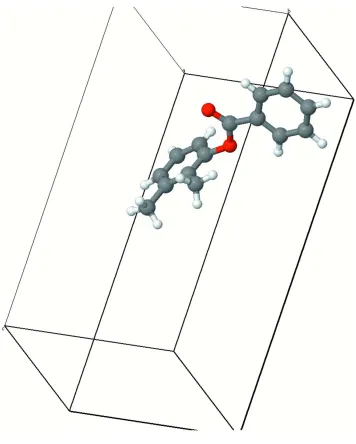
[image:3.610.122.492.280.667.2]Figure 3
View of the molecule in the unit cell.
2,3-Dimethylphenyl benzoate
Crystal data
C15H14O2 Mr = 226.26 Monoclinic, C2/c
Hall symbol: -C 2yc
a = 15.190 (2) Å
b = 8.417 (1) Å
c = 20.604 (2) Å
β = 112.20 (1)°
V = 2439.0 (5) Å3
Z = 8
F(000) = 960
Dx = 1.232 Mg m−3
Cu Kα radiation, λ = 1.54180 Å Cell parameters from 25 reflections
θ = 6.1–21.6°
Enraf–Nonius CAD-4 diffractometer
Radiation source: fine-focus sealed tube Graphite monochromator
ω/2θ scans
2328 measured reflections 2173 independent reflections 1886 reflections with I > 2σ(I)
Rint = 0.083
θmax = 66.9°, θmin = 4.6°
h = −18→1
k = −10→0
l = −23→24
3 standard reflections every 120 min intensity decay: none
Refinement
Refinement on F2
Least-squares matrix: full
R[F2 > 2σ(F2)] = 0.048 wR(F2) = 0.157 S = 1.07 2173 reflections 181 parameters 0 restraints
Primary atom site location: structure-invariant direct methods
Secondary atom site location: difference Fourier map
Hydrogen site location: inferred from neighbouring sites
H atoms treated by a mixture of independent and constrained refinement
w = 1/[σ2(F
o2) + (0.0825P)2 + 1.2712P]
where P = (Fo2 + 2Fc2)/3
(Δ/σ)max = 0.037
Δρmax = 0.17 e Å−3
Δρmin = −0.17 e Å−3
Extinction correction: SHELXL97 (Sheldrick, 2008), Fc*=kFc[1+0.001xFc2λ3/sin(2θ)]-1/4
Extinction coefficient: 0.0061 (5)
Special details
Geometry. All e.s.d.'s (except the e.s.d. in the dihedral angle between two l.s. planes) are estimated using the full covariance matrix. The cell e.s.d.'s are taken into account individually in the estimation of e.s.d.'s in distances, angles and torsion angles; correlations between e.s.d.'s in cell parameters are only used when they are defined by crystal symmetry. An approximate (isotropic) treatment of cell e.s.d.'s is used for estimating e.s.d.'s involving l.s. planes.
Refinement. Refinement of F2 against ALL reflections. The weighted R-factor wR and goodness of fit S are based on F2,
conventional R-factors R are based on F, with F set to zero for negative F2. The threshold expression of F2 > σ(F2) is used
only for calculating R-factors(gt) etc. and is not relevant to the choice of reflections for refinement. R-factors based on F2
are statistically about twice as large as those based on F, and R-factors based on ALL data will be even larger.
Fractional atomic coordinates and isotropic or equivalent isotropic displacement parameters (Å2)
x y z Uiso*/Ueq
C11 −0.11960 (15) 1.3535 (3) 0.28000 (11) 0.0631 (5) H11 −0.1449 (17) 1.458 (3) 0.2661 (13) 0.076* C12 −0.17667 (14) 1.2230 (3) 0.25200 (11) 0.0645 (5) H12 −0.2430 (17) 1.236 (3) 0.2159 (13) 0.077* C13 −0.14166 (13) 1.0727 (3) 0.27052 (11) 0.0591 (5) H13 −0.1795 (16) 0.987 (3) 0.2533 (12) 0.071* C14 0.06335 (18) 0.7675 (4) 0.50556 (15) 0.0871 (8) H14A 0.0134 0.7002 0.5076 0.105* H14B 0.0362 0.8622 0.4798 0.105* H14C 0.1051 0.7954 0.5522 0.105* C15 0.1773 (2) 0.4813 (3) 0.56843 (13) 0.0935 (8) H15A 0.1143 0.4629 0.5670 0.112* H15B 0.2091 0.5568 0.6046 0.112* H15C 0.2121 0.3831 0.5780 0.112* O1 0.07702 (9) 0.88173 (15) 0.37981 (8) 0.0675 (4) O2 −0.06258 (11) 0.76695 (18) 0.31914 (10) 0.0883 (6)
Atomic displacement parameters (Å2)
U11 U22 U33 U12 U13 U23
C1 0.0502 (9) 0.0455 (9) 0.0609 (10) −0.0046 (7) 0.0065 (8) −0.0017 (8) C2 0.0535 (10) 0.0564 (11) 0.0610 (11) −0.0095 (8) 0.0129 (8) −0.0072 (8) C3 0.0677 (11) 0.0563 (11) 0.0564 (10) −0.0138 (9) 0.0095 (9) 0.0000 (8) C4 0.0738 (13) 0.0501 (11) 0.0703 (13) 0.0013 (10) 0.0079 (10) −0.0009 (9) C5 0.0752 (13) 0.0619 (12) 0.0719 (13) 0.0045 (10) 0.0217 (11) −0.0120 (10) C6 0.0691 (12) 0.0617 (12) 0.0573 (11) −0.0039 (9) 0.0164 (9) −0.0044 (9) C7 0.0490 (9) 0.0546 (11) 0.0584 (10) −0.0054 (8) 0.0112 (8) −0.0043 (8) C8 0.0471 (9) 0.0549 (10) 0.0493 (9) −0.0032 (7) 0.0182 (7) −0.0015 (7) C9 0.0490 (9) 0.0566 (11) 0.0596 (10) −0.0050 (8) 0.0158 (8) −0.0020 (8) C10 0.0629 (11) 0.0524 (11) 0.0707 (12) −0.0060 (9) 0.0244 (9) −0.0003 (9) C11 0.0648 (12) 0.0569 (11) 0.0691 (12) 0.0077 (9) 0.0271 (10) 0.0086 (9) C12 0.0511 (10) 0.0692 (12) 0.0668 (12) 0.0066 (9) 0.0148 (9) 0.0069 (9) C13 0.0471 (9) 0.0610 (11) 0.0645 (11) −0.0054 (8) 0.0157 (8) −0.0020 (9) C14 0.0745 (14) 0.0993 (19) 0.0908 (17) −0.0057 (13) 0.0348 (13) −0.0173 (14) C15 0.111 (2) 0.0891 (17) 0.0706 (14) −0.0173 (15) 0.0230 (13) 0.0152 (13) O1 0.0532 (7) 0.0483 (8) 0.0808 (9) −0.0021 (5) 0.0025 (6) 0.0035 (6) O2 0.0634 (9) 0.0556 (9) 0.1143 (13) −0.0099 (7) −0.0022 (8) −0.0049 (8)
Geometric parameters (Å, º)
C5—C6 1.370 (3) C13—H13 0.91 (2) C5—H5 0.94 (3) C14—H14A 0.9600 C6—H6 0.92 (2) C14—H14B 0.9600 C7—O2 1.203 (2) C14—H14C 0.9600 C7—O1 1.344 (2) C15—H15A 0.9600 C7—C8 1.475 (3) C15—H15B 0.9600 C8—C13 1.387 (3) C15—H15C 0.9600
C6—C1—C2 123.46 (19) C8—C9—H9 120.3 (14) C6—C1—O1 117.59 (18) C9—C10—C11 120.18 (19) C2—C1—O1 118.66 (18) C9—C10—H10 119.9 (13) C1—C2—C3 116.89 (19) C11—C10—H10 119.9 (13) C1—C2—C14 121.2 (2) C10—C11—C12 119.76 (19) C3—C2—C14 121.9 (2) C10—C11—H11 121.1 (15) C4—C3—C2 119.20 (19) C12—C11—H11 119.1 (15) C4—C3—C15 119.8 (2) C13—C12—C11 120.09 (18) C2—C3—C15 121.0 (2) C13—C12—H12 118.8 (14) C5—C4—C3 122.0 (2) C11—C12—H12 121.0 (14) C5—C4—H4 121.7 (14) C12—C13—C8 120.62 (19) C3—C4—H4 116.3 (14) C12—C13—H13 120.3 (14) C4—C5—C6 119.7 (2) C8—C13—H13 119.0 (15) C4—C5—H5 117.5 (16) C2—C14—H14A 109.5 C6—C5—H5 122.7 (16) C2—C14—H14B 109.5 C1—C6—C5 118.7 (2) H14A—C14—H14B 109.5 C1—C6—H6 120.0 (15) C2—C14—H14C 109.5 C5—C6—H6 121.3 (15) H14A—C14—H14C 109.5 O2—C7—O1 122.50 (17) H14B—C14—H14C 109.5 O2—C7—C8 125.80 (16) C3—C15—H15A 109.5 O1—C7—C8 111.70 (15) C3—C15—H15B 109.5 C13—C8—C9 118.88 (18) H15A—C15—H15B 109.5 C13—C8—C7 118.69 (16) C3—C15—H15C 109.5 C9—C8—C7 122.43 (16) H15A—C15—H15C 109.5 C10—C9—C8 120.46 (17) H15B—C15—H15C 109.5 C10—C9—H9 119.2 (14) C7—O1—C1 119.33 (14)