608
Topic Tensor Network for Implicit
Discourse Relation Recognition in Chinese
Sheng Xu, Peifeng Li, Fang Kong, Qiaoming ZhuandGuodong Zhou Institute of Artificial Intelligence, School of Computer Science
and Technology, Soochow University, China
[email protected];{pfli,kongfang,qmzhu,gdzhou}@suda.edu.cn
Abstract
In the literature, most of the previous studies on English implicit discourse relation recog-nition only use sentence-level representations, which cannot provide enough semantic infor-mation in Chinese due to its unique paratac-tic characterisparatac-tics. In this paper, we propose a topic tensor network to recognize Chinese im-plicit discourse relations with both sentence-level and topic-sentence-level representations. In par-ticular, besides encoding arguments (discourse units) using a gated convolutional network to obtain sentence-level representations, we train a simplified topic model to infer the latent topic-level representations. Moreover, we feed the two pairs of representations to two fac-tored tensor networks, respectively, to capture both the sentence-level interactions and topic-level relevance using multi-slice tensors. Ex-perimentation on CDTB, a Chinese discourse corpus, shows that our proposed model sig-nificantly outperforms several state-of-the-art baselines in both micro and macro F1-scores.
1 Introduction
As a critical component of discourse parsing, dis-course relation recognition focuses on determining how two adjacent discourse units (e.g., clauses, sentences, and sentence groups), called argu-ments, semantically connect to one another. Ob-viously, identifying discourse relations can help many downstream NLP applications, such as auto-matic summarization, information extraction and question answering.
In principle, the discourse connectives between two arguments are important for recognizing the relationship between them. For explicit dis-course relation recognition where the disdis-course connectives explicitly exist in the text, a simple frequency-based mapping table can achieve high performance due to the critical role of a connective in determining the discourse relations (Xue et al.,
2016). For implicit discourse relation recognition, it is much more challenging due to missing an ex-act connective and it normally depends on the un-derstanding of the whole text (Pitler et al.,2009).
This paper focuses on recognizing implicit dis-course relations in Chinese. In contrast to English, which is a hypotactic language (formal cohesion), Chinese is a paratactic language (semantic cohe-sion) that tends to pro-drop clause connectives. Our statistics indicate that the implicit relations in the Chinese CDTB corpus account for 75.2%, while the proportion in the English PDTB corpus declines to only 40%. Hence, recognizing implicit discourse relations in Chinese becomes more cru-cial than in English.
In the literature, most of previous studies fo-cused on English, with only a few on Chinese. Compared with traditional feature-based methods (Pitler et al.,2009;Lin et al., 2009; Wang et al.,
2017;Kong and Zhou,2017) that directly rely on feature engineering, recent neural network models (Liu et al.,2017;Qin et al.,2017;Guo et al.,2018;
Bai and Zhao,2018) can capture deeper semantic cues and learn better representations (Zhang et al.,
2015). In particular, most neural network-based methods encode arguments using variants of Bi-LSTM or CNN (Qin et al.,2016;Guo et al.,2018) and propose various models (e.g., the gated rel-evance network, the encoder-decoder model, and interactive attention) to measure the semantic rel-evance (Chen et al.,2016;Cianflone and Kosseim,
2018;Guo et al.,2018)
con-junctions. Therefore, Chinese discourse parsing relies heavily on the deep semantics of arguments, especially topic continuity (Lei et al., 2018). In many cases, considering only the sentence-level representation is not enough for Chinese implicit discourse relation recognition, and we need vari-ous semantic clues beyond the sentence-level, e.g., at the topic level. Take the following two argu-ments as examples:
[一 九 九 一年至一 九 九 五年,中国的对
外开放以高速向前推进 (From 1991 to 1995, China’s opening was moving forward at a high speed)]Arg1 [国民经济更加广泛地参与国际
分工与国际交换,中外经济技术合作与交流
已渗入到中国经济生活的各个领域 (the na-tional economy is more widely involved in the in-ternational division of labor and inin-ternational ex-change, and the economic and technological co-operation and exchanges between China and for-eign countries had penetrated into various fields of China’s economic life)]Arg2
Although there is an Elaboration relation be-tween the above two arguments, it is difficult to obtain sufficient information for identifying this potential association by directly matching the words inArg1 (e.g., “speed” and “moving”) and those in Arg2 (e.g., “economic” and “ex-changes”). To identify theirElaborationrelation, the most crucial clue may be the fact that they be-long to the same topic, i.e., China’s opening is an international economic event. Therefore, it is critical for implicit discourse relation recognition to capture such topic information as an important clue.
In this paper, we propose a Topic Tensor Net-work (TTN) to recognize implicit discourse re-lations in Chinese using both sentence-level and topic-level representations. First, we introduce a GCN-based (Gated Convolutional Network) en-coder to learn the sentence-level representations. Then, we train a Simplified Topic Model (STM) to infer the latent topic-level representations to provide additional semantic clues. Finally, we feed the two pairs of representations to two Fac-tored Tensor Networks (FTNs) to model both the sentence-level interactions and topic-level rele-vance using multi-slice tensors. We summarize the contributions of our work as follows:
• Compared with previous works that were fo-cused on sentence-level representations, we incorporate additional topic-level
representa-tions to capture the deep semantic interac-tions among arguments.
• We introduce the simplified topic model STM to infer the latent topic-level representations and employ such topic-level relevance to rec-ognize Chinese implicit discourse relations.
• We propose the factored tensor network FTN to model the complex semantic interactions, and it has the advantage of significantly re-ducing the complexity of the original model (Guo et al.,2018).
2 Related Work
Most previous studies evaluated their models on PDTB (Prasad et al., 2008) and RST-DT ( Carl-son et al.,2003), which are two English discourse corpora that were available up to now. PDTB is the largest English discourse corpus with 2312 an-notated documents from Wall Street Journal using the PTB-style predicate-argument structure. RST-DT is another popular English discourse corpus, which annotates 385 documents from Wall Street Journal using the RST tree scheme.
Basically, previous studies can be categorized into traditional models that focus on linguistically informed features (Pitler et al., 2009; Lin et al.,
2009;Feng and Hirst, 2014; Wang et al., 2017), and neural network methods (Liu and Li, 2016;
Chen et al.,2016;Guo et al.,2018;Bai and Zhao,
2018). Especially, Zhou et al., (2010) attempted to predict implicit connectives. Qin et al. (2017), Shi et al. (2017) and Xu et al. (2018) attempted to leverage explicit examples for data augmenta-tion. Other studies resorted to unlabeled data to perform multi-task or unsupervised learning (Liu et al.,2016;Lan et al.,2017).
FTN FTN Classifier
GCN
Mean Pooling Mean Pooling
�1 log�12 �2 log�22
�1 �2
�1
� 1
Simplified Topic Model
GCN
�1 �2
�1 �2
�1 �2
�(�,�)
ℎ, �, �
D
e
co
d
e
r
E
n
c
o
d
e
r
� 2
[image:3.595.126.469.62.263.2]�2
Figure 1: The overall framework of our Topic Tensor Network.
a multi-slice tensor. Among others, Qin et al. (2017) applied an adversarial method to transfer the discriminability of connectives to implicit fea-tures through competition, while Xu et al. (2018) expanded the training set by cooperating active learning with explicit-to-implicit relation transfor-mation.
In comparison, previous studies on Chinese im-plicit discourse relation recognition were mainly carried out on CDTB (Li et al.,2014) and CDTB-ZX (Zhou and Xue, 2015). CDTB includes 500 newswire documents annotated with a connective-driven dependency tree scheme, while CDTB-ZX only contains 164 documents from Xinhua Newswire annotated with PDTB-style discourse relations.
Basically, most of the previous studies followed the English studies. Kong and Zhou (2017) con-structed an end-to-end Chinese discourse parser, which used contextual features, lexical features and dependency tree features to recognize dis-course relations with a maximum entropy classi-fier. R¨onnqvist et al. (2017) proposed a Bi-LSTM model with attention mechanism to link two argu-ments by inserting special labels. Liu et al. (2017) provided a memory augmented attention model that used memory slots to store the interactions be-tween two input arguments.
3 Topic Tensor Network for Implicit Discourse Relation Recognition
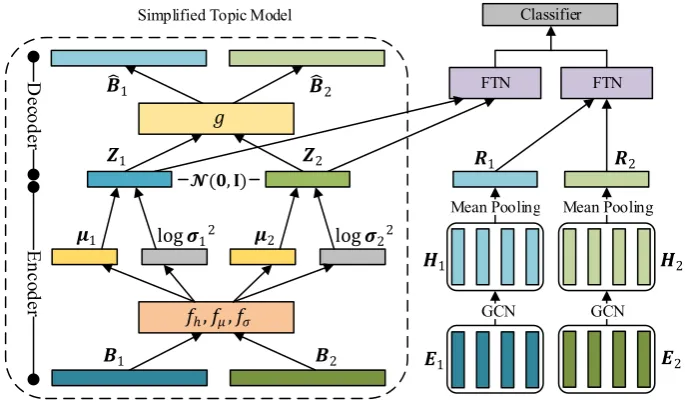
In this section, we describe our topic tensor net-work TTN with the overall architecture as shown
in Figure 1. TTN has four major components: (1) a simplified topic model (STM) to infer the la-tent topic distributions of arguments as topic-level representations; (2) a GCN-based encoder to gen-erate sentence-level representations; (3) two fac-tored tensor networks (FTNs) to jointly model the sentence-level interactions and the topic-level rel-evance; and (4) an MLP classifier, which produces the final discourse relation labels.
In particular, the GCN-based encoder extracts hierarchical features from the long text of argu-ments by stacking multiple gated convolution lay-ers, and fully represents the sentence-level seman-tic information. STM provides additional topic in-formation for the MLP classifier to recognize dis-course relations at a higher level. On this basis, the two pairs of representations are fed into two FTNs, respectively, which use multi-slice tensors to jointly model the sentence-level interactions and the topic-level relevance. Compared with the neural tensor network used in Guo et al. (2018), our FTN greatly reduces the computational com-plexity due to the tensor factorization. Hence, we can set more tensor slices to capture more complex interaction features.
Formally, the word sequence Ek =
{w1,w2, ...,wL} and the BoW (Bag-of-Words)
representation Bk ∈ RV of arguments are the
input of our model, where L is the sequence length and V is the vocabulary size. Each word wi in an argument is represented as the
sequences E1 and E2 of the two arguments are
fed into the GCN-based encoder to obtain the sentence-level representations, and the BoW representations B1 and B2 are sent to STM to
infer the latent topic-level representations. On this basis, two FTNs are applied to capture the interactive features between two arguments based on the above representations. Finally, the MLP classifier concatenates all of the features produced by FTNs to predict the discourse relation labely.
3.1 Simplified Topic Model on Topic-level Representation
Similar to the LDA-style topic models, we believe that there is an association between the word dis-tributionBkof an argument and its topic
distribu-tionZk. For eachBk, we can infer a latent topic
distribution Zk ∈ RK through our topic model,
whereK denotes the number of topics. Inspired by the Neural Topic Model (NTM) (Zeng et al.,
2018; Miao et al., 2016), we propose a simpli-fied topic model STM based on the Variational AutoEncoder (VAE) (Kingma and Welling,2013). Unlike NTM, our model does not attempt to re-construct the document during the decoding phase, and it only restores the word distributions. Al-though STM cannot learn the semantic word em-beddings, it significantly reduces the training pa-rameters to perform unsupervised training on the discourse corpus with a small sample size.
Similar to NTM, we can interpret our STM as a VAE: a neural network encoderp(Z|B)first com-presses the BoW representationBkinto a
contin-uous hidden vectorZk, and then an MLP decoder
g(Z)restoresZk toBk. Since STM is an
unsu-pervised model, we can only use the existing BoW representationBk to learn the latent topic
distri-bution Zk ∼ N(µ,σ2). The inference network
p(Z|B)is defined as follows:
µ=fµ(fh(B)) (1)
logσ2=fσ(fh(B)) (2)
wherefh(·)is a single layer neural network with
ReLU as the activation function, and fµ(·), fσ(·)
are simple linear transformations. For the BoW representationBk of the argument, the inference
network generates its own parametersµk,σ2kthat
parameterize the normal distribution N(µk,σk2),
and we can further sample the latent topic distri-bution Zk corresponding to the argument. To
re-duce the variance in the stochastic estimation, we
follow (Rezende et al.,2014) to sampleZ by the reparametric method and sample ∼ N(0,I) as follows:
Z =µ+·σ (3)
We hope that our STM can reconstruct the orig-inal inputB as much as possible using the topic distributionZ while adding Gaussian noise to the result generated by the encoder to increase the ro-bustness of the decoder. Therefore, the loss func-tion of STM is defined as follows:
LST M =EZ∼p(Z|B)[−logq(B|Z)]+KL(q(Z)kp(Z|B)) (4) where q(Z) is a standard normal distribution N(0,I). It is worth mentioning that reducing the reconstruction loss can make the decoder have the generative ability. We calculate the reconstruction loss by calculating the binary cross entropy be-tween the BoW representationBkandBbk recon-structed by the decoder. Since decreasing the KL (Kullback-Leibler) divergence makes allp(Z|B) approximate the standard normal distribution, the noise can be prevented from being zero with the result as follows.
KL(q(Z)kp(Z|B)) = 1 2(−logσ
2
+µ2+σ2−1) (5)
Given the BoW representation Bk, our STM
can infer its latent topic distributionZkto provide
topic-level representations.
3.2 GCN-based Encoder on Sentence-level Representation
Most previous studies used Bi-LSTM or 1D CNN to encode input sequences. However, CNN lacks visibility when capturing global information due to its limited view of the convolution kernel, while Bi-LSTM training is time-consuming due to its cyclic structure, especially for long texts, such as arguments. To address the above issues, Dauphin et al. (2017) proposed a Gated Convolutional Net-work (GCN) to extract hierarchical features from long texts by stacking multiple gated convolu-tional layers and mitigate the vanishing gradient problem by using gate units. In this paper, we choose GCN as our text encoder.
to its output so that the original input information can be passed to the back layers. Specifically, for the input sequence with N words E ∈ RN×D,
where D is the sum of the size of the word em-bedding and POS emem-bedding, each gated convolu-tional layerhlis computed as follows:
hl(X) = (X·W+b)⊗σ(X·V +c) +X (6)
where X ∈ RN×D is the input of layer h l
(ei-ther the input sequenceE or the outputs of pre-vious layers), W ∈ RC×D×D,b ∈
RD,V ∈
RC×D×D,c ∈ RD are model parameters, and C is the size of the convolution kernel. σ(·) is the sigmoid function and ⊗ is the element-wise product between matrices. After stackingL lay-ers on top of the input, we can obtain the seman-tic representation sequence of the argumentH = hL◦...◦h1(E)∈RN×D. Finally, the Mean
Pool-ing operation is performed to obtain the respec-tive argument representations on the sequences H1 = {h1L1, ..., hNL1} andH2 = {h1L2, ..., hNL2}
corresponding to the two arguments:
R1=
1 N
N
X
i=1
hiL1, R2 =
1 N
N
X
i=1
hiL2 (7)
As a result, in the GCN-based encoder, we stack multiple gated convolution layers with the resid-ual structure to learn the sentence-level represen-tations, which can take advantage of the paral-lel computing of convolutional networks, and also control the flow of information through the gate units similar to LSTM.
3.3 Factored Tensor Network on Joint Representations
Traditional methods for modeling the semantic relevance between two arguments capture the lin-ear and nonlinlin-ear interactions using various text matching models, such as Bilinear model ( Jenat-ton et al.,2012) and Single Layer Network ( Col-lobert and Weston,2008). Based on these meth-ods, Socher et al. (2013) proposed a Neural Ten-sor Network (NTN) to combine the advantages of these two models and showed the ability of the ten-sor to model complex informative interactions in knowledge graphs.
Following Guo et al. (2018), we use two NTNs to capture the interactive features between the se-mantic representations R1,R2, and between the
topic distributionsZ1,Z2as follows:
T(x,y) =fn
x>M[1:m]y+U
x y
+s
(8)
wherefn(·)is a standard nonlinear function,M ∈ Rd×d×mis a 3rd-order transformation tensor,U ∈ Rm×2d ands ∈ Rm are parameters. The tensor
productx>M[1:m]y results in a vectorc ∈ Rm,
where each entry is computed by sliceiof the ten-sorM asci = x>M[i]y, and it is equivalent to
includingm Bilinear models that simultaneously capture multiple linear interactions between vec-tors. However, it increases the parameters and the computational complexity of the model; therefore, we adopt tensor factorization (Pei et al., 2014), which uses two low rank matrices to approximate each tensor sliceM[i], as follows:
M[i]⇒J[i]K[i] (9)
whereJ[i]∈
Rd×r,K[i]∈Rr×dandr d.
We named our model FTN (Factored Tensor Network). Compared with the original NTN (Guo et al.,2018), our FTN greatly reduces the number of parameters. Hence, it can set more tensor slices and make the training process easier. In particu-lar, for semantic representations R1,R2 ∈ RD,
the parameterdin FTN is set toD, and for topic distributionZ1,Z2∈RK, it is set toK.
FTN can model not only the sentence-level in-teractions between argument representations but also the relevance between topic-level represen-tations, which can be regarded as topic-level in-teractions. Finally, we concatenate the sentence-level interactions T(R1,R2) and the topic-level
relevanceT(Z1,Z2)and send them to a two-layer
neural network classifier, which first applies a non-linear transformation and then computes the prob-abilities of each relation by a softmax layer.
3.4 Joint Learning
To simultaneously update the parameters in all components of TTN, we jointly tackle the topic modeling and the classification, and define the loss function of the overall model to combine the two effects as follows.
L=LST M +λLM LP (10)
where LST M represents the loss of STM and
LM LP is the cross entropy loss of the classifier. λ
between the topic model and the MLP classifier. To prevent overfitting, a dropout operation is per-formed on the parameter vector input to the soft-max layer.
4 Experimentation
4.1 Experiment Settings
Due to the small number of documents in CDTB-ZX, we evaluate our model on CDTB (Li et al.,
2014) with 500 annotated newswire articles from CTB (Xue et al.,2005). CDTB contains 7310 an-notated relations (implicit: 5496) which can be di-vided into 4 classes and 17 categories. To make full use of this corpus, we erase the existing con-nectives information and treat all samples as im-plicit discourse relation samples.
Following previous work (Kong and Zhou,
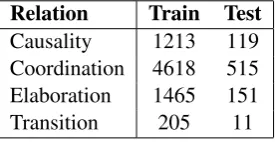
2017), we choose the same 450 documents as the training set and the remaining 50 documents as the testing set. We also evaluate TTN on the four top-level classes in CDTB, and transform all of the non-binary trees into left binary trees. Table 1 summarizes the statistics of the four CDTB rela-tions, i.e., Causality, Coordination, Elaboration, andTransition.
[image:6.595.113.251.422.493.2]Relation Train Test Causality 1213 119 Coordination 4618 515 Elaboration 1465 151 Transition 205 11
Table 1: Statistics of the discourse relations in CDTB.
We use HanLP1 as the NLP tool for word seg-mentation and POS tagging, and use the Keras2 library to implement our model. We selected 10% of the samples from the training set as the devel-opment set to fine-tune the hyper-parameters, and only give their final settings due to space limita-tion.
The 300-dimensional pre-trained word embed-dings are provided by Word2Vec (Mikolov et al.,
2013), and the dimension of the POS embeddings is set to 50. The trade-off parameter λ in Equ. (10) is set to 1.0. To alleviate the data sparseness of the input BoW representations, we limit the vo-cabulary to the top 5000 most frequent words, i.e., V = 5000.
1
https://github.com/hankcs/HanLP 2https://keras.io/
In STM, the number of topics is set to 256, and the number of neurons in the single-layer networks fh(·), fµ(·), fσ(·)are set to 512, 256 and 256,
re-spectively. In addition, the generatorg is imple-mented by a two-layer network with a hidden layer size of 512. In the GCN-based text encoder, the number of layersLis set to 3, and the convolution kernel size C is set to 3. In FTN, the number of tensor slicesm is set to 128, andr of the tensor factorization is set to 10. The size of the nonlinear transformation layer in the MLP classifier and the droupout rate are set to 64 and 0.5, respectively.
4.2 Experimental Results
To exhibit the effectiveness of our TTN model, we selectedBi-LSTM,CNNandGCN(Dauphin et al.,2017) as baselines in addition to three state-of-the-art models proposed in previous works: (1) Liu&Li(Liu and Li,2016): a multi-level attention model that simulates the repeated reading process by stacking multiple attention layers with external memory; (2)R¨onnqvist(R¨onnqvist et al.,2017): a Bi-LSTM model with attention mechanism that first links argument pairs by inserting special la-bels; and (3) Guo (Guo et al., 2018): a neural tensor network that encodes the arguments by Bi-LSTM and interactive attention. Among them, GCN uses the same settings as our model. Fol-lowing Liu and Li (2016), the hidden size for each direction of Bi-LSTM is set to 350, the same as the dimension of the word embeddings. Follow-ing Qin et al. (2016), the convolution kernel size and the number in CNN are set to 2 and 1024, re-spectively. The three state-of-the-art models are reproduced following their corresponding work.
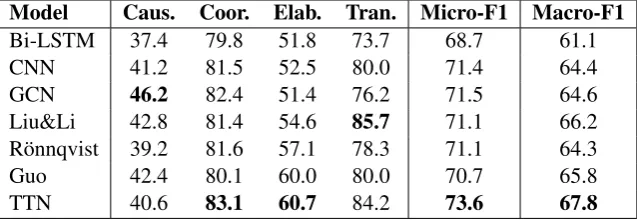
The experimental results on CDTB are illus-trated in Table 2. It shows that our TTN model outperforms the other baselines in both the micro and macro F1-scores. This indicated that topic-level information is a vital evidence to reveal the relationships among arguments and justify the ef-fectiveness of our TTN model.
state-of-Model Caus. Coor. Elab. Tran. Micro-F1 Macro-F1
Bi-LSTM 37.4 79.8 51.8 73.7 68.7 61.1
CNN 41.2 81.5 52.5 80.0 71.4 64.4
GCN 46.2 82.4 51.4 76.2 71.5 64.6
Liu&Li 42.8 81.4 54.6 85.7 71.1 66.2 R¨onnqvist 39.2 81.6 57.1 78.3 71.1 64.3
Guo 42.4 80.1 60.0 80.0 70.7 65.8
[image:7.595.140.459.63.173.2]TTN 40.6 83.1 60.7 84.2 73.6 67.8
Table 2: Performance of six baselines and TNN with F1-scores.
the-art models on English implicit discourse rela-tion recognirela-tion, and R¨onnqvist, a state-of-the-art model on Chinese, focus on extracting sentence-level features from arguments and achieve similar performance.
Our TTN model outperforms all of the base-lines with large gains from 2.1 to 4.9 in the micro F1-score and significant gains from 1.6 to 6.7 in the macro F1-score. Compared with the baselines, TTN not only captures the interactive features at sentence-level, but also considers the topic-level relevance among arguments. This result shows that TTN can recognize the discourse relations at a higher level to improve the performance of Chi-nese implicit discourse relation recognition. Dif-ferent from Liu&Li, TTN not only learns the ar-gument representations by stacking multiple lay-ers with residuals to simulate the repeated read-ing, but also models the deep semantic interactions through factored tensor networks. Different from Guo, TTN not only reduces the complexity of the tensor network using tensor factorization, but also models the sentence-level and topic-level interac-tions together.
5 Analysis and Discussion
5.1 Impact on Different Relations
Table 2 also compares the F1-scores on different relations. We can find that our TTN achieves the highest F1-scores in theElaborationand Coordi-nationrelations, and it achieves a comparable per-formance in the Transition relation. However, it reduces the F1-score in theCausality relation by 5.6, compared with GCN.
To explain the reasons behind this, we con-duct experiments on some variants of TTN with the results shown in Table 3. We choose the gated convolutional network (GCN) as the Base model with its parameters being set the same as
our model. To analyze the contribution of the topic-level representation and the factored tensor modeling method separately, we add our simpli-fied topic model (STM) and our factored tensor network (FTN) to the Base model, respectively.
The results shows that STM gives the latent topic distributions of arguments and there is a significant improvement (+8.6) in recognizing the
Elaborationrelation. The existence of an Elabo-rationrelation between two arguments means that the content of one argument is a further expla-nation of the other, and these arguments usually have similar topic distributions. Hence, STM es-sentially provides additional topic distribution fea-tures to TNN, which help in recognizing the Elab-orationrelation. Equally, STM can also improve the performance of recognizing theCoordination
relation because two arguments with the Coordi-nationrelation are equally important at the seman-tic level, and their contents describe different as-pects of one thing or different parts of a certain behavior; hence, they are also similar at the topic level in most cases. However, this does not apply to theCausalityrelation and there is a large drop (-9.8) with the lowest F1-score among all four re-lations. The reason behind this may be due to the fact that the recognition of the Causality re-lation relies more on the logical connection, and arguments with theCausalityrelation are not sim-ilar at the topic level in most cases. Hence, STM, which simply introduces topical information to the Base model, does not help and even may harm the recognition. Take the following two arguments as examples:
[出口快速增长 , (Exports have grown rapidly,)]Arg1 [成为推动经济增长的重要力
量。 (become an important force driving eco-nomic growth.)]Arg2
Model Caus. Coor. Elab. Tran. Micro-F1 Macro-F1
Base(GCN) 46.2 82.4 51.4 76.2 71.5 64.6
+STM 36.4 82.9 60.0 73.7 73.1 64.1
[image:8.595.135.466.62.120.2]+FTN 41.3 82.7 55.3 84.2 72.5 66.4
Table 3: Comparison of Base, STM and FTN on the F1-score.
Model Caus. Coor. Elab. Tran. Micro-F1 Macro-F1
TTN 40.6 83.1 60.7 84.2 73.6 67.8
NTN(Guo) 39.6 82.1 56.2 84.2 72.6 66.4
Table 4: Comparison of TTN and NTN(Guo) on the F1-score.
from the perspective of the topic, the words in the two arguments revolve around the same topic of “economic growth”. Therefore, our STM will di-rectly infers the similar topic distribution from the words of these two arguments and interfere with the recognition of theCausalityrelation.
Our neural factored tensor networks (FTNs) are capable of modeling complex semantic interac-tions between two arguments using multiple Bi-linear models and single layer neural network. Therefore, after the addition, a certain improve-ment has been achieved in recognizing most re-lations (except for Causality). Especially, it im-proves the F1-scores of theElaborationand Tran-sitionrelations by 3.9 and 8.0, respectively.
5.2 Impact of Tensor Factorization
To further verify the impact of tensor factoriza-tion, we compare it with Guo et al. (2018). Ta-ble 4 illustrates the results, whereNTN(Guo)is a modified version of our TTN, which uses the NTN model proposed by Guo et al. (2018) to replace our FTN.
Since NTN(Guo) does not use the tensor factor-ization operation, its parameter number and com-putational complexity increase greatly. The pa-rameters of factored tensor network in our model are reduced by approximately 20 times, compared with NTN(Guo). If it directly adopts our param-eter settings, the model will have serious over-fitting, and it will not even recognize the Transi-tion relation, which is only a small proportion of the training set. Therefore, following (Guo et al.,
2018), we set the tensor number to a very small value. It shows that NTN(Guo) has a performance degradation of 1.0 and 1.4 in micro and macro F1-scores, respectively, indicating that the tensor fac-torization operation in our model is very effective.
In addition, our neural tensor network can set more tensor slices to model the complex interactions be-tween two arguments.
[image:8.595.318.516.506.576.2]5.3 Error Analysis
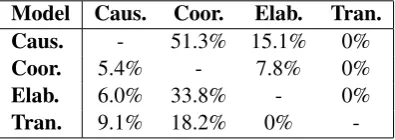
Table 5 illustrates the error statistics of our TTN model. It shows that 51.3% of the Causality
samples, 33.8% of the Elaboration samples, and 18.2% of the Transition samples are incorrectly identified asCoordination. This indicates that the error mainly occurs when judging whether a sam-ple isCoordination. This may be due to two rea-sons, which are that the number of Coordination
samples accounts for more than half of the train-ing set (61.6%) and that many argument pairs with
non-Coordinationrelations are similar at both the text level and the topic level. Take the following two arguments as examples:
Model Caus. Coor. Elab. Tran. Caus. - 51.3% 15.1% 0% Coor. 5.4% - 7.8% 0% Elab. 6.0% 33.8% - 0% Tran. 9.1% 18.2% 0%
-Table 5: Percentages of misclassified samples.
[甘肃省积极实施科技兴农战略,推广增产
措施 (Gansu Province promotes various agricul-tural applicable technologies and production in-crease measures)]Arg1 [农业获得较好收成,全 年粮食总产量达七十六点六亿公斤 ( Agricul-ture has achieved a good harvest, and the annual total grain output reached 7.66 billion kg)]Arg2
In above samples, since Arg1 is the reason forArg2, the discourse relation between them is
“agricultural” and “production”) and those in Arg2 (e.g., “harvests”, “gain”, and “output”). More-over, these two arguments are all about agricul-ture. Therefore, there is a strong similarity in the topic distribution, too.
6 Conclusion
In this paper, we propose a topic tensor network TTN to recognize implicit discourse relations in Chinese with both the sentence-level and topic-level representations. In addition to using a GCN-based encoder to obtain the sentence-level argu-ment representations, we train a STM to infer the latent topic distribution as the topic-level represen-tations. Moreover, we feed the two pairs of rep-resentations to two FTNs, respectively, to model the sentence-level interactions and topic-level rel-evance among arguments. Evaluation on CTDB shows that our proposed TTN model significantly outperforms several state-of-the-art baselines in both micro and macro F1-scores. In the fu-ture work, we will focus on how to mine differ-ent represdiffer-entations for differdiffer-ent discourse relation types and apply the topic information to other lan-guages.
Acknowledgments
The authors would like to thank four anonymous reviewers for their comments on this paper. This research was supported by the National Natural Science Foundation of China under Grant Nos. 61836007, 61772354 and 61773276.
References
Hongxiao Bai and Hai Zhao. 2018. Deep enhanced representation for implicit discourse relation recog-nition. In Proceedings of the 27th International Conference on Computational Linguistics (COL-ING), pages 571–583.
Lynn Carlson, Daniel Marcu, and Mary Ellen Okurowski. 2003. Building a discourse-tagged cor-pus in the framework of rhetorical structure theory. InCurrent and new directions in discourse and dia-logue, pages 85–112.
Jifan Chen, Qi Zhang, Pengfei Liu, Xipeng Qiu, and Xuanjing Huang. 2016. Implicit discourse relation detection via a deep architecture with gated rele-vance network. InProceedings of the 54th Annual Meeting of the Association for Computational Lin-guistics (ACL), pages 1726–1735.
National Institute of Child Health and Human De-velopment. 2000. Teaching children to read: An
evidence-based assessment of the scientific research literature on reading and its implications for reading instruction.
Andre Cianflone and Leila Kosseim. 2018. Attention for implicit discourse relation recognition. In Pro-ceedings of the 11th International Conference on Language Resources and Evaluation (LREC), pages 1946–1951.
Ronan Collobert and Jason Weston. 2008. A unified architecture for natural language processing: Deep neural networks with multitask learning. In Pro-ceedings of the 25th International Conference on Machine Learning (ICML), pages 160–167.
Yann N Dauphin, Angela Fan, Michael Auli, and David Grangier. 2017. Language modeling with gated convolutional networks. InProceedings of the 34th International Conference on Machine Learning (ICML), pages 933–941.
Vanessa Wei Feng and Graeme Hirst. 2014. A linear-time bottom-up discourse parser with constraints and post-editing. In Proceedings of the 52nd An-nual Meeting of the Association for Computational Linguistics (ACL), pages 511–521.
Fengyu Guo, Ruifang He, Di Jin, Jianwu Dang, Long-biao Wang, and Xiangang Li. 2018. Implicit dis-course relation recognition using neural tensor net-work with interactive attention and sparse learn-ing. InProceedings of the 27th International Con-ference on Computational Linguistics (COLING), pages 547–558.
Kaiming He, Xiangyu Zhang, Shaoqing Ren, and Jian Sun. 2016. Deep residual learning for image recog-nition. In Proceedings of the IEEE conference on computer vision and pattern recognition (CVPR), pages 770–778.
Rodolphe Jenatton, Nicolas L Roux, Antoine Bordes, and Guillaume R Obozinski. 2012. A latent factor model for highly multi-relational data. InAdvances in Neural Information Processing Systems (NIPS), pages 3167–3175.
Diederik P Kingma and Max Welling. 2013. Auto-encoding variational bayes. arXiv preprint arXiv:1312.6114.
Fang Kong and Guodong Zhou. 2017. A CDT-styled end-to-end Chinese discourse parser. ACM Trans-actions on Asian and Low-Resource Language In-formation Processing (TALLIP), 16(4):26.
Wenqiang Lei, Yuanxin Xiang, Yuwei Wang, Qian Zhong, Meichun Liu, and Min-Yen Kan. 2018. Lin-guistic properties matter for implicit discourse rela-tion recognirela-tion: Combining semantic interacrela-tion, topic continuity and attribution. In Proceedings of the 32nd AAAI Conference on Artificial Intelligence (AAAI), pages 4848–4855.
Yancui Li, Fang Kong, and Guodong Zhou. 2014. Building Chinese discourse corpus with connective-driven dependency tree structure. InProceedings of the 2014 Conference on Empirical Methods in Nat-ural Language Processing (EMNLP), pages 2105– 2114.
Ziheng Lin, Min-Yen Kan, and Hwee Tou Ng. 2009. Recognizing implicit discourse relations in the Penn Discourse Treebank. In Proceedings of the 2009 Conference on Empirical Methods in Natural Lan-guage Processing (EMNLP), pages 343–351.
Yang Liu and Sujian Li. 2016. Recognizing implicit discourse relations via repeated reading: Neural net-works with multi-level attention. InProceedings of the 2016 Conference on Empirical Methods in Nat-ural Language Processing (EMNLP), pages 1224– 1233.
Yang Liu, Sujian Li, Xiaodong Zhang, and Zhifang Sui. 2016. Implicit discourse relation classification via multi-task neural networks. In Proceedings of the 30th AAAI Conference on Artificial Intelligence (AAAI), pages 2750–2756.
Yang Liu, Jiajun Zhang, and Chengqing Zong. 2017. Memory augmented attention model for Chinese im-plicit discourse relation recognition. In Chinese Computational Linguistics and Natural Language Processing Based on Naturally Annotated Big Data (CCL), pages 411–423.
Yishu Miao, Lei Yu, and Phil Blunsom. 2016. Neu-ral variational inference for text processing. In Pro-ceedings of the 33rd International Conference on Machine Learning (ICML), pages 1727–1736.
Tomas Mikolov, Ilya Sutskever, Kai Chen, Greg S Cor-rado, and Jeff Dean. 2013. Distributed representa-tions of words and phrases and their compositional-ity. InAdvances in Neural Information Processing Systems (NIPS), pages 3111–3119.
Wenzhe Pei, Tao Ge, and Baobao Chang. 2014. Max-margin tensor neural network for Chinese word seg-mentation. InProceedings of the 52nd Annual Meet-ing of the Association for Computational LMeet-inguistics (ACL), pages 293–303.
Emily Pitler, Annie Louis, and Ani Nenkova. 2009. Automatic sense prediction for implicit discourse re-lations in text. InProceedings of the Joint Confer-ence of the 47th Annual Meeting of the ACL and the 4th International Joint Conference on Natural Language Processing of the AFNLP (ACL-IJCNLP), pages 683–691.
Rashmi Prasad, Nikhil Dinesh, Alan Lee, Eleni Milt-sakaki, Livio Robaldo, Aravind K Joshi, and Bon-nie L Webber. 2008. The Penn Discourse Tree-Bank 2.0. In The 6th international conference on Language Resources and Evaluation (LREC), pages 2961—-2968.
Lianhui Qin, Zhisong Zhang, and Hai Zhao. 2016. A stacking gated neural architecture for implicit dis-course relation classification. InProceedings of the 2016 Conference on Empirical Methods in Natural Language Processing (EMNLP), pages 2263–2270.
Lianhui Qin, Zhisong Zhang, Hai Zhao, Zhiting Hu, and Eric Xing. 2017. Adversarial connective-exploiting networks for implicit discourse relation classification. In Proceedings of the 55th Annual Meeting of the Association for Computational Lin-guistics (ACL), pages 1006–1017.
Danilo Jimenez Rezende, Shakir Mohamed, and Daan Wierstra. 2014. Stochastic backpropagation and ap-proximate inference in deep generative models. In
Proceedings of the 31st International Conference on Machine Learning (ICML), pages 1278–1286.
Samuel R¨onnqvist, Niko Schenk, and Christian Chiar-cos. 2017. A recurrent neural model with attention for the recognition of Chinese implicit discourse re-lations. In Proceedings of the 55th Annual Meet-ing of the Association for Computational LMeet-inguistics (ACL), pages 256–262.
Wei Shi, Frances Yung, Raphael Rubino, and Vera Demberg. 2017. Using explicit discourse connec-tives in translation for implicit discourse relation classification. In Proceedings of the 8th Interna-tional Joint Conference on Natural Language Pro-cessing (IJCNLP), pages 484–495.
Richard Socher, Danqi Chen, Christopher D Manning, and Andrew Ng. 2013. Reasoning with neural ten-sor networks for knowledge base completion. In
Advances in neural information processing systems (NIPS), pages 926–934.
Yizhong Wang, Sujian Li, and Houfeng Wang. 2017. A two-stage parsing method for text-level discourse analysis. InProceedings of the 55th Annual Meet-ing of the Association for Computational LMeet-inguistics (ACL), pages 184–188.
Yang Xu, Yu Hong, Huibin Ruan, Jianmin Yao, Min Zhang, and Guodong Zhou. 2018. Using active learning to expand training data for implicit dis-course relation recognition. InProceedings of the 2018 Conference on Empirical Methods in Natural Language Processing (EMNLP), pages 725–731.
Nianwen Xue, Hwee Tou Ng, Sameer Pradhan, Bon-nie Webber, Attapol Rutherford, Chuan Wang, and Hongmin Wang. 2016. The CoNLL-2016 shared task on shallow discourse parsing. InProceedings of the 20th Conference on Computational Natural Language Learning - Shared Task (CoNLL), pages 1–19.
Jichuan Zeng, Jing Li, Yan Song, Cuiyun Gao, Michael R Lyu, and Irwin King. 2018. Topic mem-ory networks for short text classification. In Pro-ceedings of the 2018 Conference on Empirical Meth-ods in Natural Language Processing (EMNLP), pages 3120–3131.
Biao Zhang, Jinsong Su, Deyi Xiong, Yaojie Lu, Hong Duan, and Junfeng Yao. 2015. Shallow convolu-tional neural network for implicit discourse relation recognition. InProceedings of the 2015 Conference on Empirical Methods in Natural Language Pro-cessing (EMNLP), pages 2230–2235.
Yuping Zhou and Nianwen Xue. 2015. The Chinese Discourse TreeBank: a Chinese corpus annotated with discourse relations. Language Resources and Evaluation, 49(2):397–431.