Non-distributional Word Vector Representations
Manaal Faruqui and Chris Dyer
Language Technologies Institute Carnegie Mellon University Pittsburgh, PA, 15213, USA
{mfaruqui, cdyer}@cs.cmu.edu
Abstract
Data-driven representation learning for words is a technique of central importance in NLP. While indisputably useful as a source of features in downstream tasks, such vectors tend to consist of uninter-pretable components whose relationship to the categories of traditional lexical seman-tic theories is tenuous at best. We present a method for constructing interpretable word vectors from hand-crafted linguis-tic resources like WordNet, FrameNet etc. These vectors are binary (i.e, contain only 0 and 1) and are 99.9% sparse. We analyze their performance on state-of-the-art eval-uation methods for distributional models of word vectors and find they are competi-tive to standard distributional approaches.
1 Introduction
Distributed representations of words have been shown to benefit a diverse set of NLP tasks in-cluding syntactic parsing (Lazaridou et al., 2013; Bansal et al., 2014), named entity recognition (Guo et al., 2014) and sentiment analysis (Socher et al., 2013). Additionally, because they can be induced directly from unannotated corpora, they are likewise available in domains and languages where traditional linguistic resources do not ex-haust. Intrinsic evaluations on various tasks are helping refine vector learning methods to discover representations that captures many facts about lex-ical semantics (Turney, 2001; Turney and Pantel, 2010).
Yet induced word vectors do not look anything like the representations described in most lexi-cal semantic theories, which focus on identifying classes of words (Levin, 1993; Baker et al., 1998; Schuler, 2005; Miller, 1995). Though expensive to construct, conceptualizing word meanings
sym-bolically is important for theoretical understand-ing and interpretability is desired in computational models.
Our contribution to this discussion is a new technique that constructs task-independent word vector representations using linguistic knowledge derived from pre-constructed linguistic resources like WordNet (Miller, 1995), FrameNet (Baker et al., 1998), Penn Treebank (Marcus et al., 1993) etc. In such word vectors every dimension is a lin-guistic feature and 1/0 indicates the presence or absence of that feature in a word, thus the vec-tor representations are binary while being highly sparse (≈99.9%). Since these vectors do not en-code any word cooccurrence information, they are non-distributional. An additional benefit of con-structing such vectors is that they are fully inter-pretable i.e, every dimension of these vectors maps to a linguistic feature unlike distributional word vectors where the vector dimensions have no in-terpretability.
Of course, engineering feature vectors from lin-guistic resources is established practice in many applications of discriminative learning; e.g., pars-ing (McDonald and Pereira, 2006; Nivre, 2008) or part of speech tagging (Ratnaparkhi, 1996; Collins, 2002). However, despite a certain com-mon inventories of features that re-appear across many tasks, feature engineering tends to be seen as a task-specific problem, and engineered feature vectors are not typically evaluated independently of the tasks they are designed for. We evaluate the quality of our linguistic vectors on a number of tasks that have been proposed for evaluating dis-tributional word vectors. We show that linguistic word vectors are comparable to current state-of-the-art distributional word vectors trained on bil-lions of words as evaluated on a battery of seman-tic and syntacseman-tic evaluation benchmarks.1
1Our vectors can be downloaded at: https://
github.com/mfaruqui/non-distributional
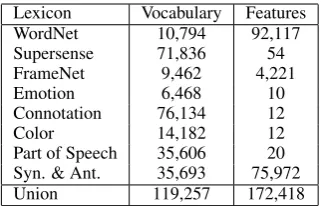
Lexicon Vocabulary Features
WordNet 10,794 92,117
Supersense 71,836 54
FrameNet 9,462 4,221
Emotion 6,468 10
Connotation 76,134 12
Color 14,182 12
Part of Speech 35,606 20 Syn. & Ant. 35,693 75,972
[image:2.595.101.263.61.164.2]Union 119,257 172,418
Table 1: Sizes of vocabualry and features induced from different linguistic resources.
2 Linguistic Word Vectors
We construct linguistic word vectors by extracting word level information from linguistic resources. Table 1 shows the size of vocabulary and number of features induced from every lexicon. We now describe various linguistic resources that we use for constructing linguistic word vectors.
WordNet. WordNet (Miller, 1995) is an En-glish lexical database that groups words into sets of synonyms called synsets and records a num-ber of relations among these synsets or their members. For a word we look up its synset for all possible part of speech (POS) tags that it can assume. For example, film will have SYNSET.FILM.V.01 and SYNSET.FILM.N.01 as
features as it can be both a verb and a noun. In ad-dition to synsets, we include the hyponym (for ex. HYPO.COLLAGEFILM.N.01), hypernym (for ex.
HYPER:SHEET.N.06) and holonym synset of the
word as features. We also collect antonyms and pertainyms of all the words in a synset and include those as features in the linguistic vector.
Supsersenses. WordNet partitions nouns and verbs into semantic field categories known as supsersenses (Ciaramita and Altun, 2006; Nas-tase, 2008). For example, lioness evokes the su-persense SS.NOUN.ANIMAL. These supersenses
were further extended to adjectives (Tsvetkov et al., 2014).2 We use these supsersense tags for nouns, verbs and adjectives as features in the lin-guistic word vectors.
FrameNet. FrameNet (Baker et al., 1998; Fill-more et al., 2003) is a rich linguistic resource that contains information about lexical and predicate-argument semantics in English. Frames can be realized on the surface by many different word
2http://www.cs.cmu.edu/˜ytsvetko/
adj-supersenses.tar.gz
types, which suggests that the word types evok-ing the same frame should be semantically related. For every word, we use the frame it evokes along with the roles of the evoked frame as its features. Since, information in FrameNet is part of speech (POS) disambiguated, we couple these feature with the corresponding POS tag of the word. For example, since appreciate is a verb, it will have the following features: VERB.FRAME.REGARD,
VERB.FRAME.ROLE.EVALUEEetc.
Emotion & Sentiment. Mohammad and Turney (2013) constructed two different lexicons that as-sociate words to sentiment polarity and to emo-tions resp. using crowdsourcing. The polar-ity is either positive or negative but there are eight different kinds of emotions like anger, an-ticipation, joy etc. Every word in the lexicon is associated with these properties. For example,
cannibal evokes POL.NEG, EMO.DISGUST and
EMO.FEAR. We use these properties as features
in linguistic vectors.
Connotation. Feng et al. (2013) construct a lex-icon that contains information about connotation of words that are seemingly objective but often allude nuanced sentiment. They assign positive, negative and neutral connotations to these words. This lexicon differs from Mohammad and Tur-ney (2013) in that it has a more subtle shade of sentiment and it extends to many more words. For example, delay has a negative connotation CON.NOUN.NEG, floral has a positive
connota-tion CON.ADJ.POSandoutlinehas a neutral
con-notation CON.VERB.NEUT.
Color. Most languages have expressions involv-ing color, for example green with envy andgrey with uncertainlyare phrases used in English. The word-color associtation lexicon produced by Mo-hammad (2011) using crowdsourcing lists the col-ors that a word evokes in English. We use every color in this lexicon as a feature in the vector. For example, COLOR.RED is a feature evoked by the
wordblood.
Word POL.POS COLOR.PINK SS.NOUN.FEELING PTB.VERB ANTO.FAIR · · · CON.NOUN.POS
love 1 1 1 1 0 1
hate 0 0 1 1 0 0
ugly 0 0 0 0 1 0
beauty 1 1 0 0 0 1
[image:3.595.73.528.61.125.2]refundable 0 0 0 0 0 1
Table 2: Some linguistic word vectors. 1 indicates presence and 0 indicates absence of a linguistic feature.
PTB.VERBas features.
Synonymy & Antonymy. We use Roget’s the-saurus (Roget, 1852) to collect sets of synony-mous words.3 For every word, its synonymous word is used as a feature in the linguistic vec-tor. For example, adoration and affair have a feature SYNO.LOVE, admissible has a
fea-ture SYNO.ACCEPTABLE. The synonym
lexi-con lexi-contains 25,338 words after removal of mul-tiword phrases. In a similar manner, we also use antonymy relations between words as fea-tures in the word vector. The antonymous words for a given word were collected from Ordway (1913).4 An example would be of
impartial-ity, which has features ANTO.FAVORITISM and
ANTO.INJUSTICE. The antonym lexicon has
10,355 words. These features are different from those induced from WordNet as the former code word-word relations whereas the latter en-code word-synset relations.
After collecting features from the various guistic resources described above we obtain lin-guistic word vectors of length 172,418 dimen-sions. These vectors are 99.9% sparse i.e, each vector on an average contains only 34 non-zero features out of 172,418 total features. On average a linguistic feature (vector dimension) is active for 15 word types. The linguistic word vectors con-tain 119,257 unique word types. Table 2 shows linguistic vectors for some of the words.
3 Experiments
We first briefly describe the evaluation tasks and then present results.
3.1 Evaluation Tasks
Word Similarity. We evaluate our word repre-sentations on three different benchmarks to mea-sure word similarity. The first one is the widely
3http://www.gutenberg.org/ebooks/10681 4https://archive.org/details/
synonymsantonyms00ordwiala
used WS-353 dataset (Finkelstein et al., 2001), which contains 353 pairs of English words that have been assigned similarity ratings by humans. The second is the RG-65 dataset (Rubenstein and Goodenough, 1965) of 65 words pairs. The third dataset is SimLex (Hill et al., 2014) which has been constructed to overcome the shortcomings of WS-353 and contains 999 pairs of adjectives, nouns and verbs. Word similarity is computed using cosine similarity between two words and Spearman’s rank correlation is reported between the rankings produced by vector model against the human rankings.
Sentiment Analysis. Socher et al. (2013) cre-ated a treebank containing sentences annotcre-ated with fine-grained sentiment labels on phrases and sentences from movie review excerpts. The coarse-grained treebank of positive and negative classes has been split into training, development, and test datasets containing 6,920, 872, and 1,821 sentences, respectively. We use average of the word vectors of a given sentence as features in an`2-regularized logistic regression for classifica-tion. The classifier is tuned on the dev set and ac-curacy is reported on the test set.
NP-Bracketing. Lazaridou et al. (2013) con-structed a dataset from the Penn TreeBank (Mar-cus et al., 1993) of noun phrases (NP) of length three words, where the first can be an adjective or a noun and the other two are nouns. The task is to predict the correct bracketing in the parse tree for a given noun phrase. For example, local (phone company) and (blood pressure) medicine exhibit
Vector Length (D) Params. Corpus Size WS-353 RG-65 SimLex Senti NP
Skip-Gram 300 D×N 300 billion 65.6 72.8 43.6 81.5 80.1
Glove 300 D×N 6 billion 60.5 76.6 36.9 77.7 77.9
LSA 300 D×N 1 billion 67.3 77.0 49.6 81.1 79.7
Ling Sparse 172,418 – – 44.6 77.8 56.6 79.4 83.3
Ling Dense 300 D×N – 45.4 67.0 57.8 75.4 76.2
[image:4.595.77.522.62.137.2]Skip-Gram⊕Ling Sparse 172,718 – – 67.1 80.5 55.5 82.4 82.8
Table 3: Performance of different type of word vectors on evaluation tasks reported by Spearman’s correlation (first 3 columns) and Accuracy (last 2 columns). Bold shows the best performance for a task.
3.2 Linguistic Vs. Distributional Vectors
In order to make our linguistic vectors comparable to publicly available distributional word vectors, we perform singular value decompostion (SVD) on the linguistic matrix to obtain word vectors of lower dimensionality. IfL∈ {0,1}N×Dis the
lin-guistic matrix withN word types andDlinguistic features, then we can obtainU∈RN×Kfrom the
SVD ofLas follows:L=UΣV>, withKbeing
the desired length of the lower dimensional space. We compare both sparse and dense linguistic vectors to three widely used distributional word vector models. The first two are the pre-trained Skip-Gram (Mikolov et al., 2013)5 and Glove (Pennington et al., 2014)6 word vectors each of length 300, trained on 300 billion and 6 billion words respectively. We used latent semantic anal-ysis (LSA) to obtain word vectors from the SVD decomposition of a word-word cooccurrence ma-trix (Turney and Pantel, 2010). These were trained on 1 billion words of Wikipedia with vector length 300 and context window of 5 words.
3.3 Results
Table 3 shows the performance of different word vector types on the evaluation tasks. It can be seen that although Skip-Gram, Glove & LSA perform better than linguistic vectors on WS-353, the lin-guistic vectors outperform them by a huge mar-gin on SimLex. Linguistic vectors also perform better at RG-65. On sentiment analysis, linguis-tic vectors are competitive with Skip-Gram vec-tors and on the NP-bracketing task they outper-form all distributional vectors with a statistically significant margin (p<0.05, McNemar’s test Di-etterich (1998)). We append the sparse linguis-tic vectors to Skip-Gram vectors and evaluate the resultant vectors as shown in the bottom row of Table 3. The combined vector outperforms
Skip-5https://code.google.com/p/word2vec 6http://www-nlp.stanford.edu/projects/
glove/
Gram on all tasks, showing that linguistic vectors contain useful information orthogonal to distribu-tional information.
It is evident from the results that linguistic vec-tors are either competitive or better to state-of-the-art distributional vector models. Sparse linguis-tic word vectors are high dimensional but they are also sparse, which makes them computationally easy to work with.
4 Discussion
Linguistic resources like WordNet have found tensive applications in lexical semantics, for ex-ample, for word sense disambiguation, word simi-larity etc. (Resnik, 1995; Agirre et al., 2009). Re-cently there has been interest in using linguistic resources to enrich word vector representations. In these approaches, relational information among words obtained from WordNet, Freebase etc. is used as a constraint to encourage words with sim-ilar properties in lexical ontologies to have simi-lar word vectors (Xu et al., 2014; Yu and Dredze, 2014; Bian et al., 2014; Fried and Duh, 2014; Faruqui et al., 2015a). Distributional represen-tations have also been shown to improve by us-ing experiential data in addition to distributional context (Andrews et al., 2009). We have shown that simple vector concatenation can likewise be used to improve representations (further confirm-ing the established findconfirm-ing that lexical resources and cooccurrence information provide somewhat orthogonal information), but it is certain that more careful combination strategies can be used.
word vectors have interpretable dimensions as ev-ery dimension is a linguistic property.
Linguistic word vectors require no training as there are no parameters to be optimized, meaning they are computationally economical. While good quality linguistic word vectors may only be ob-tained for languages with rich linguistic resources, such resources do exist in many languages and should not be disregarded.
5 Conclusion
We have presented a novel method of constructing word vector representations solely using linguistic knowledge from pre-existing linguistic resources. These non-distributional, linguistic word vectors are competitive to the current models of distribu-tional word vectors as evaluated on a battery of tasks. Linguistic vectors are fully interpretable as every dimension is a linguistic feature and are highly sparse, so they are computationally easy to work with.
Acknowledgement
We thank Nathan Schneider for giving comments on an earlier draft of this paper and the anonymous reviewers for their feedback.
References
Eneko Agirre, Enrique Alfonseca, Keith Hall, Jana Kravalova, Marius Pas¸ca, and Aitor Soroa. 2009. A study on similarity and relatedness using distri-butional and wordnet-based approaches. InProc. of NAACL.
Mark Andrews, Gabriella Vigliocco, and David Vin-son. 2009. Integrating experiential and distribu-tional data to learn semantic representations. Psy-chological review, 116(3):463.
Collin F. Baker, Charles J. Fillmore, and John B. Lowe. 1998. The berkeley framenet project. In Proc. of ACL.
Mohit Bansal, Kevin Gimpel, and Karen Livescu. 2014. Tailoring continuous word representations for dependency parsing. InProc. of ACL.
Jiang Bian, Bin Gao, and Tie-Yan Liu. 2014. Knowledge-powered deep learning for word embed-ding. InProc. of MLKDD.
Massimiliano Ciaramita and Yasemin Altun. 2006. Broad-coverage sense disambiguation and informa-tion extracinforma-tion with a supersense sequence tagger. In
Proc. of EMNLP.
Michael Collins. 2002. Discriminative training meth-ods for hidden markov models: Theory and ex-periments with perceptron algorithms. In Proc. of EMNLP.
Thomas G. Dietterich. 1998. Approximate statistical tests for comparing supervised classification learn-ing algorithms.Neural Computation.
Manaal Faruqui, Jesse Dodge, Sujay K. Jauhar, Chris Dyer, Eduard Hovy, and Noah A. Smith. 2015a. Retrofitting word vectors to semantic lexicons. In
Proc. of NAACL.
Manaal Faruqui, Yulia Tsvetkov, Dani Yogatama, Chris Dyer, and Noah A. Smith. 2015b. Sparse overcom-plete word vector representations. InProc. of ACL. Song Feng, Jun Seok Kang, Polina Kuznetsova, and
Yejin Choi. 2013. Connotation lexicon: A dash of sentiment beneath the surface meaning. InProc. of ACL.
Charles Fillmore, Christopher Johnson, and Miriam Petruck. 2003. Lexicographic relevance: select-ing information from corpus evidence.International Journal of Lexicography.
Lev Finkelstein, Evgeniy Gabrilovich, Yossi Matias, Ehud Rivlin, Zach Solan, Gadi Wolfman, and Ey-tan Ruppin. 2001. Placing search in context: the concept revisited. InProc. of WWW.
Daniel Fried and Kevin Duh. 2014. Incorporating both distributional and relational semantics in word rep-resentations. arXiv preprint arXiv:1412.4369. Alona Fyshe, Partha P. Talukdar, Brian Murphy, and
Tom M. Mitchell. 2014. Interpretable semantic vec-tors from a joint model of brain- and text- based meaning. InProc. of ACL.
Alona Fyshe, Leila Wehbe, Partha P. Talukdar, Brian Murphy, and Tom M. Mitchell. 2015. A composi-tional and interpretable semantic space. InProc. of NAACL.
Jiang Guo, Wanxiang Che, Haifeng Wang, and Ting Liu. 2014. Revisiting embedding features for sim-ple semi-supervised learning. InProc. of EMNLP. Felix Hill, Roi Reichart, and Anna Korhonen. 2014.
Simlex-999: Evaluating semantic models with (gen-uine) similarity estimation. CoRR, abs/1408.3456. Angeliki Lazaridou, Eva Maria Vecchi, and Marco
Baroni. 2013. Fish transporters and miracle homes: How compositional distributional semantics can help NP parsing. InProc. of EMNLP.
Beth Levin. 1993. English verb classes and alterna-tions : a preliminary investigation. University of Chicago Press.
Ryan T McDonald and Fernando CN Pereira. 2006. Online learning of approximate dependency parsing algorithms. InProc. of EACL.
Tomas Mikolov, Kai Chen, Greg Corrado, and Jef-frey Dean. 2013. Efficient estimation of word representations in vector space. arXiv preprint arXiv:1301.3781.
George A Miller. 1995. Wordnet: a lexical database for english. Communications of the ACM.
Saif M. Mohammad and Peter D. Turney. 2013. Crowdsourcing a word-emotion association lexicon.
Computational Intelligence, 29(3):436–465. Saif Mohammad. 2011. Colourful language:
Mea-suring word-colour associations. In Proc. of the Workshop on Cognitive Modeling and Computa-tional Linguistics.
Brian Murphy, Partha Talukdar, and Tom Mitchell. 2012. Learning effective and interpretable seman-tic models using non-negative sparse embedding. In
Proc. of COLING.
Vivi Nastase. 2008. Unsupervised all-words word sense disambiguation with grammatical dependen-cies. InProc. of IJCNLP.
Joakim Nivre. 2008. Algorithms for deterministic in-cremental dependency parsing. Computational Lin-guistics, 34(4):513–553.
Edith Bertha Ordway. 1913.Synonyms and Antonyms: An Alphabetical List of Words in Common Use, Grouped with Others of Similar and Opposite Mean-ing. Sully and Kleinteich.
Jeffrey Pennington, Richard Socher, and Christo-pher D. Manning. 2014. Glove: Global vectors for word representation. InProc. of EMNLP.
Adwait Ratnaparkhi. 1996. A maximum entropy model for part-of-speech tagging. In Proc. of EMNLP.
Philip Resnik. 1995. Using information content to evaluate semantic similarity in a taxonomy. InProc. of IJCAI.
P. M. Roget. 1852. Roget’s Thesaurus of English words and phrases. Available from Project Gutem-berg.
Herbert Rubenstein and John B. Goodenough. 1965. Contextual correlates of synonymy. Commun. ACM, 8(10).
Karin Kipper Schuler. 2005. Verbnet: A Broad-coverage, Comprehensive Verb Lexicon. Ph.D. the-sis, University of Pennsylvania.
Richard Socher, Alex Perelygin, Jean Wu, Jason Chuang, Christopher D. Manning, Andrew Y. Ng, and Christopher Potts. 2013. Recursive deep mod-els for semantic compositionality over a sentiment treebank. InProc. of EMNLP.
Yulia Tsvetkov, Nathan Schneider, Dirk Hovy, Archna Bhatia, Manaal Faruqui, and Chris Dyer. 2014. Augmenting english adjective senses with super-senses. InProc. of LREC.
Peter D. Turney and Patrick Pantel. 2010. From fre-quency to meaning : Vector space models of seman-tics. JAIR, pages 141–188.
Peter D. Turney. 2001. Mining the web for synonyms: Pmi-ir versus lsa on toefl. InProc. of ECML. Chang Xu, Yalong Bai, Jiang Bian, Bin Gao, Gang
Wang, Xiaoguang Liu, and Tie-Yan Liu. 2014. Rc-net: A general framework for incorporating knowl-edge into word representations. InProc. of CIKM. Mo Yu and Mark Dredze. 2014. Improving lexical