243
STRASS: A Light and Effective Method for Extractive Summarization
Based on Sentence Embeddings
L´eo Bouscarrat, Antoine Bonnefoy, Thomas Peel, C´ecile Pereira EURA NOVA
Marseille, France
{leo.bouscarrat,antoine.bonnefoy, thomas.peel,cecile.pereira}@euranova.eu
Abstract
This paper introduces STRASS: Summariza-tion by TRAnsformaSummariza-tion SelecSummariza-tion and Scor-ing. It is an extractive text summarization method which leverages the semantic infor-mation in existing sentence embedding spaces. Our method creates an extractive summary by selecting the sentences with the closest embed-dings to the document embedding. The model learns a transformation of the document em-bedding to minimize the similarity between the extractive summary and the ground truth summary. As the transformation is only com-posed of a dense layer, the training can be done on CPU, therefore, inexpensive. More-over, inference time is short and linear ac-cording to the number of sentences. As a second contribution, we introduce the French CASS dataset, composed of judgments from the French Court of cassation and their corsponding summaries. On this dataset, our re-sults show that our method performs similarly to the state of the art extractive methods with effective training and inferring time.
1 Introduction
Summarization remains a field of interest as numerous industries are faced with a growing amount of textual data that they need to process. Creating summary by hand is a costly and time-demanding task, thus automatic methods to gen-erate them are necessary. There are two ways of summarizing a document: abstractive and extrac-tive summarization.
In abstractive summarization, the goal is to cre-ate new textual elements to summarize the text. Summarization can be modeled as a sequence-to-sequence problem. For instance, Rush et al. (2015) tried to generate a headline from an article. However, when the system generates longer sum-maries, redundancy can be a problem. See et al.
(2017) introduce a pointer-generator model (PGN) that generates summaries by copying words from the text or generating new words. Moreover, they added a coverage loss as they noticed that other models made repetitions on long summaries. Even if it provides state of the art results, the PGN is slow to learn and generate. Paulus et al. (2017) added a layer of reinforcement learning on an encoder-decoder architecture but their results can present fluency issues.
In extractive summarization, the goal is to ex-tract part of the text to create a summary. There are two standard ways to do that: a sequence la-beling task, where the goal is to select the sen-tences labeled as being part of the summary, and a ranking task, where the most salient sentences are ranked first. It is hard to find datasets for these tasks as most summaries written by humans are abstractive.Nallapati et al. (2016a) introduce a way to train an extractive summarization model without labels by applying a Recurrent Neural Network (RNN) and using a greedy matching ap-proach based on ROUGE. Recently,Narayan et al. (2018b) combined reinforcement learning (to ex-tract sentences) and an encoder-decoder architec-ture (to select the sentences).
Some models combine extractive and abstrac-tive summarization, using an extractor to select sentences and then an abstractor to rewrite them (Chen and Bansal, 2018; Cao et al., 2018; Hsu et al.,2018). They are generally faster than models using only abstractors as they filter the input while maintaining or even improving the quality of the summaries.
Document
embedding embeddingsSentences
Neural network to learn a transformation
Real summary embedding
0.7
Selection of the sentences of the extracted summary
Selection Approximation Scoring
Transformation
Approximation of the embedding of our extracted summary
Scoring the quality of our
summary Trade-off Threshold
1 2 3 4
[image:2.595.97.503.69.230.2]Loss Update
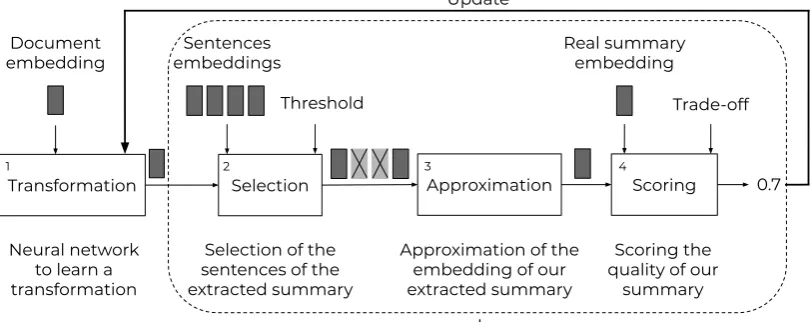
Figure 1: Training of the model. The blocks present steps of the analysis. All the elements above the blocks are inputs (document embedding, sentences embeddings, threshold, real summary embedding, trade-off).
proximity of the embeddings it is possible to rank the sentences. Secondly, we introduce the French CASS dataset (section4.1), composed of 129,445 judgments with their corresponding summaries.
2 Related Work
In our model, STRASS, it is possible to use an embedding function1trained with state of the art methods.
Word2vec is a classical method used to trans-form a word into a vector (Mikolov et al.,2013a). Methods like word2vec keep information about semantics (Mikolov et al., 2013b). Sent2vec (Pagliardini et al.,2017) create embedding of sen-tences. It has state-of-the-art results on datasets for unsupervised sentence similarity evaluation.
EmbedRank (Bennani-Smires et al., 2018) ap-plies sent2vec to extract keyphrases from a docu-ment in an unsupervised fashion. It hypothesizes that keyphrases that have an embedding close to the embedding of the entire document should rep-resent this document well.
We adapt this idea to select sentences for sum-maries (section 4.2). We suppose that sentences close to the document share some meaning with the document and are sentences that summarize well the text. We go further by proposing a su-pervised method where we learn a transformation of the document embedding to an embedding of the same dimension, but closer to sentences that summarize the text.
1In this paper, ‘embedding function’, ‘embedding space’
and ‘embedding’ will refer to the function that takes a textual element as input and outputs a vector, the vector space, and the vectors.
3 Model
The aim is to construct an extractive summary. Our approach, STRASS, uses embeddings to se-lect a subset of sentences from a document.
We apply sent2vec to the document, to the sen-tences of the document, and to the summary. We suppose that, if we have a document with an em-bedding2 d and a setS with all the embeddings of the sentences of the document, and a reference summary with an embeddingref sum, there is a subset of sentencesES⊂Sforming the reference summary. Our target is to find an affine function f(·):IRn −→IRn, such that:
(
sim(s, f(d))≥t ifs∈ES
sim(s, f(d))< t, otherwise
Where t is a threshold, and sim is a similarity function between two embeddings.
The training of the model is based on four main steps (shown in Figure1):
• (1) Transform the document embedding by applying an affine function learned by a neu-ral network (section3.1);
• (2) Extract a subset of sentences to form a summary (section3.2);
• (3) Approximate the embedding of the ex-tractive summary formed by the selected sen-tences (section3.3);
2Scalars are lowercased, vectors/embeddings are
• (4) Score the embedding of the resulting sum-mary approximation with respect to the em-bedding of the real summary (section3.4).
To generate the summary, only the first two steps are used. The selected sentences are the output. Approximation and scoring are only nec-essary during the training phase when computing loss function.
3.1 Transformation
To learn an affine function in the embedding space, the model uses a simple neural network. A single fully-connected feed-forward layer.f(·):IRn −→ IRn:
f(d) =W×d+b
withWthe weight matrix of the hidden layer and bthe bias vector. Optimization is only conducted on these two elements.
3.2 Sentence Extraction
Inspired by EmbedRank (Bennani-Smires et al., 2018) our proposed approach is based on embed-dings similarities. Instead of selecting the top n elements, our approach uses a threshold. All the sentences with a score above this threshold are se-lected. As in Pagliardini et al.(2017), our simi-larity score is the cosine simisimi-larity. Selection of sentences is the first element:
sel(s,d, S, t) =
sigmoid(ncos+(s, f(d), S)−t)
with sigmoidthe sigmoid function andncos+ a
normalized cosine similarity explained in section 3.5. A sigmoid function is used instead of a hard threshold as all the functions need to be differen-tiable to make the back-propagation. Sel outputs a number between 0 and 1. 1 indicates that a sen-tence should be selected and 0 that it should not. With this function, we select a subset of sentences from the text that forms our generated summary.
3.3 Approximation
As we want to compare the embedding of our gen-erated extractive summary and the embedding of the reference summary, the model approximates the embedding of the proposed summary. As the system uses sent2vec, the approximation is the av-erage of the sentences weighted by the number of words in each sentence. We have to apply this ap-proximation to the sentences extracted with sel,
which compose our generated summary. The ap-proximation is:
app(d, S, t) =X
s∈S
s×nb w(s)×sel(s,d, S, t)
where,nb w(s)is the number of words in the sen-tence corresponding to the embeddings.
3.4 Scoring
The quality of our generated summary is scored by comparing its embedding with the reference sum-mary embedding. Here, the compression ratio is added to the score in order to force the model to output shorter summaries. The compression ratio is the number of words in the summary divided by the number of words in the document.
loss=λ×nb w(gen sum)
nb w(d) +
(1−λ)×cos sim(gen sum,ref sum)
withλa trade-off between the similarity and the compression ratio,cos sim(x,y),x,y∈IRnthe cosine similarity and gen sum = app(d, S, t). The user should note thatλis also useful to change the trade-off between the proximity of the sum-maries and the length of the generated one. A higherλresults in a shorter summary.
3.5 Normalization
To use a single selection threshold on all our doc-uments, a normalization is applied on the similar-ities to have the same distribution for the similari-ties on all the documents. First, we transform the cosine similarity from (IRn,IRn) −→ [−1,1] to (IRn,IRn)−→[0,1]:
cos+(x,y) = cos sim(x,y) + 1
2
Then as inMori and Sasaki(2002) the function is reduced and centered in0.5:
rcos+(x,y, X) =
0.5 +
cos+(x,y)− µ
xk∈X
(cos+(xk,y))
σ xk∈X
(cos+(x k,y))
A threshold is applied to select the closest sen-tences on this normalized cosine similarity. In or-der to always select at least one sentence, we re-stricted our similarity measure in(−∞,1], where, for each document, the closest sentence has a sim-ilarity of 1:
ncos+(x,y, X) = rcos
+(x,y, X)
max
xk∈X
(rcos+(x
k,y, X))
4 Experiments
4.1 Datasets
To evaluate our approach, two datasets were used with different intrinsic document and summary structures which are presented in this section. More detailed information is available in the ap-pendices (table3, figure3and figure4).
We introduce a new dataset for text summa-rization, the CASS dataset3. This dataset is com-posed of 129,445 judgments given by the French Court of cassation between 1842 and 2016 and their summaries (one summary by original docu-ment). Those summaries are written by lawyers and explain in a short way the main points of the judgments. As multiple lawyers have writ-ten summaries, there are different types of sum-mary ranging from purely extractive to purely ab-stractive. This dataset is maintained up-to-date by the French Government and new data are regularly added. Our version of the dataset is composed of 129,445 judgements.
The CNN/DailyMail dataset (Hermann et al., 2015; Nallapati et al., 2016b) is composed of 312,084 couples containing a news article and its highlights. The highlights show the key points of an article. We use the split created by Nallapati et al.(2016b) and refined bySee et al.(2017).
4.2 Baseline
An unsupervised version of our approach is to use the document embedding as an approximation for the position in the embedding space used to select the sentences of the summary. It is the application of EmbedRank (Bennani-Smires et al., 2018) on the extractive summarization task. This approach is used as a baseline for our model
3The dataset is available here: https://github. com/euranova/CASS-dataset
4.3 Oracles
We introduce two oracles. Even if these models do not output the best possible results for extractive summarization, they show good results.
The first model, calledOracle, is the same as the baseline, but instead of taking the document embedding, the model takes the embedding of the summary and then extracts the closest sentences.
The second model, calledOraclesent, extracts the closest sentence to each sentence of the sum-mary. This is an adaptation of the idea that Nallap-ati et al.(2016a) andChen and Bansal(2018) used to create their reference extractive summaries.
4.4 Evaluation details
ROUGE (Lin,2004) is a widely used set of metrics to evaluate summaries. The three main metrics in this set are ROUGE-1 and ROUGE-2, which com-pare the 1-grams and 2-grams of the generated and reference summaries, and ROUGE-L, which mea-sures the longest sub-sequence between the two summaries. ROUGE is the standard measure for summarization, especially because more sophisti-cated ones like METEOR (Denkowski and Lavie, 2014) require resources not available for many languages.
Our results are compared with the unsupervised system TextRank (Mihalcea and Tarau,2004; Bar-rios et al.,2016) and with the supervised systems Pointer-Generator Network (See et al., 2017) and rnn−ext(Chen and Bansal,2018). The Pointer-Generator Network is an abstractive model and rnn−extis extractive.
For all datasets, a sent2vec embedding of di-mension 700 was trained on the training split. To choose the hyperparameters, a grid search was computed on the validation set. Then the set of hyperparameters with the highest ROUGE-L were used on the test set. The selected hyperparameters are available in appendixA.3.
5 Results
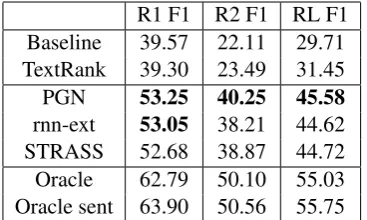
R1 F1 R2 F1 RL F1 Baseline 39.57 22.11 29.71 TextRank 39.30 23.49 31.45 PGN 53.25 40.25 45.58
[image:5.595.90.274.62.172.2]rnn-ext 53.05 38.21 44.62 STRASS 52.68 38.87 44.72 Oracle 62.79 50.10 55.03 Oracle sent 63.90 50.56 55.75
Table 1: Results of different models on the French CASS dataset using ROUGE with 95% confidence. The models of the first block are unsupervised, the models of the second block are supervised and the models of the last block are the oracles. F1 is the F-measure. R1, R2 and RL stand for ROUGE1, ROUGE2, and ROUGE-L.
R1 F1 R2 F1 RL F1 Baseline 34.02 12.48 28.27 TextRank 30.83 13.02 27.39 PGN* 39.53 17.28 36.38
rnn-ext* 40.17 18.11 36.41
STRASS 33.99 14.18 30.04 Oracle 43.55 22.43 38.47 Oracle sent 46.21 25.81 42.47 Lead3 40.00 17.56 36.33 Lead3 - PGN* 40.34 17.70 36.57
Table 2: Results of different models on the CNN/DailyMail. The Lead3 - PGN is the lead 3 score as reported in (See et al., 2017). The scores with * are taken from the corresponding publications. F1 is the F-measure. R1, R2 and RL stand for ROUGE1, ROUGE2, and ROUGE-L.
0 200 400 600 800 1000 Number of sentences
0.00 0.02 0.04 0.06 0.08 0.10 0.12 0.14
Tim
e t
o p
roc
ess
(s)
Figure 2: Processing time of the summarization func-tion (y-axis) by the number of lines of the text as input (x-axis). Results computed on an i7-8550U.
and the position of the sentences taken are avail-able in the appendicesA.4.2.
On the French CASS dataset, our method per-forms similarly to the rnn − ext. The PGN performs a bit better (+0.13 ROUGE-1, +0.38 ROUGE-2, + 0.81 ROUGE-L compared to the other models), which could be linked to the fact that it can select elements smaller than sentences.
On the CNN/DailyMail dataset, our supervised model performs poorly. We observe a significant difference (+2.66 ROUGE-1, +3.38 ROUGE-2, and +4.00 ROUGE-L) between the two oracles. It could be explained by the fact that the summaries are multi-topic and our models do not handle such case. Therefore, as our loss doesn’t look at the diversity, STRASS may miss some topics in the generated summary.
A second limitation of our approach is that our model doesn’t consider the position of the sen-tences in the summary, information which presents a high relevance in the CNN-Dailymail dataset.
STRASS has some advantages. First, it is train-able on CPU and thus light to train and run. In-deed, the neural network in our model is only com-posed of one dense layer. The most recent ad-vances in text summarization with neural networks are all based on deep neural networks requiring GPU to be learned efficiently. Second, the method is scalable. The processing time is linear with the number of lines of the documents (Figure2). The model is fast at inference time as sent2vec embed-dings are fast to generate. Our model generated the 13,095 summaries of the CASS dataset in less than 3 minutes on an i7-8550U CPU.
6 Conclusion and Perspectives
To conclude, we proposed here a simple, cost-effective and scalable extractive summarization method. STRASS creates an extractive summary by selecting the sentences with the closest em-beddings to the projected document embedding. The model learns a transformation of the docu-ment embedding to maximize the similarity be-tween the extractive summary and the ground truth summary. We showed that our approach obtains similar results than other extractive methods in an effective way.
[image:5.595.74.279.531.669.2]other embedding functions like doc2vec (Le and Mikolov,2014) or BERT (Devlin et al.,2019).
For now, we have only worked on sentences but this model can use any embeddings, so we could try to build summaries with smaller textual ele-ments than sentences such as key-phrases, noun phrases... Likewise, to apply our model on multi-topic texts, we could try to create clusters of sen-tences, where each cluster is a topic, and then ex-tract one sentence by cluster.
Moreover, currently, the loss of the system is only composed of the proximity and the compres-sion ratio. Other meaningful metrics for document summarization such as diversity and representa-tivity could be added into the loss. Especially, submodular functions could (1) allow to obtain near-optimal results and (2) allow to include ele-ments like diversity (Lin and Bilmes,2011). An-other information we could add is the position of the sentences in the documents likeNarayan et al. (2018a).
Finally, the approach could be extended to query-based summarization (V.V.MuraliKrishna et al.,2013). One could use the embedding func-tion on the query and take the sentences that are the closest to the embedding of the query.
Acknowledgement
We thank C´ecile Capponi, Carlos Ramisch, Guil-laume Stempfel, Jakey Blue and our anonymous reviewer for their helpful comments.
References
Federico Barrios, Federico L´opez, Luis Argerich, and Rosa Wachenchauzer. 2016. Variations of the simi-larity function of textrank for automated summariza-tion.CoRR, abs/1602.03606.
Kamil Bennani-Smires, Claudiu Musat, Andreea Hoss-mann, Michael Baeriswyl, and Martin Jaggi. 2018.
Simple unsupervised keyphrase extraction using sentence embeddings. In Proceedings of the 22nd Conference on Computational Natural Language Learning, pages 221–229. Association for Compu-tational Linguistics.
Ziqiang Cao, Wenjie Li, Sujian Li, and Furu Wei. 2018.
Retrieve, rerank and rewrite: Soft template based neural summarization. In Proceedings of the 56th Annual Meeting of the Association for Computa-tional Linguistics (Volume 1: Long Papers), pages 152–161. Association for Computational Linguis-tics.
Yen-Chun Chen and Mohit Bansal. 2018. Fast abstrac-tive summarization with reinforce-selected sentence rewriting. InProceedings of the 56th Annual Meet-ing of the Association for Computational LMeet-inguistics (Volume 1: Long Papers), pages 675–686. Associa-tion for ComputaAssocia-tional Linguistics.
Michael Denkowski and Alon Lavie. 2014. Meteor universal: Language specific translation evaluation for any target language. InProceedings of the Ninth Workshop on Statistical Machine Translation, pages 376–380. Association for Computational Linguis-tics.
Jacob Devlin, Ming-Wei Chang, Kenton Lee, and Kristina Toutanova. 2019. BERT: Pre-training of deep bidirectional transformers for language under-standing. InProceedings of the 2019 Conference of the North American Chapter of the Association for Computational Linguistics: Human Language Technologies, Volume 1 (Long and Short Papers), pages 4171–4186, Minneapolis, Minnesota. Associ-ation for ComputAssoci-ational Linguistics.
Karl Moritz Hermann, Tom´aˇs Koˇcisk´y, Edward Grefenstette, Lasse Espeholt, Will Kay, Mustafa Su-leyman, and Phil Blunsom. 2015. Teaching ma-chines to read and comprehend. InProceedings of the 28th International Conference on Neural Infor-mation Processing Systems - Volume 1, NIPS’15, pages 1693–1701, Cambridge, MA, USA. MIT Press.
Wan-Ting Hsu, Chieh-Kai Lin, Ming-Ying Lee, Kerui Min, Jing Tang, and Min Sun. 2018. A unified model for extractive and abstractive summarization using inconsistency loss. InProceedings of the 56th Annual Meeting of the Association for Computa-tional Linguistics (Volume 1: Long Papers), pages 132–141. Association for Computational Linguis-tics.
Quoc Le and Tomas Mikolov. 2014.Distributed repre-sentations of sentences and documents. In Proceed-ings of the 31st International Conference on Ma-chine Learning, volume 32 ofProceedings of Ma-chine Learning Research, pages 1188–1196, Bejing, China. PMLR.
Chin-Yew Lin. 2004. Rouge: A package for automatic evaluation of summaries. In Text Summarization Branches Out: Proceedings of the ACL-04 Work-shop, pages 74–81, Barcelona, Spain. Association for Computational Linguistics.
Hui Lin and Jeff Bilmes. 2011. A class of submodular functions for document summarization. In Proceed-ings of the 49th Annual Meeting of the Association for Computational Linguistics: Human Language Technologies - Volume 1, HLT ’11, pages 510–520, Stroudsburg, PA, USA. Association for Computa-tional Linguistics.
2004, pages 404–411, Barcelona, Spain. Associa-tion for ComputaAssocia-tional Linguistics.
Tomas Mikolov, Kai Chen, Greg Corrado, and Jeffrey Dean. 2013a. Efficient estimation of word represen-tations in vector space.CoRR, abs/1301.3781.
Tomas Mikolov, Wen-tau Yih, and Geoffrey Zweig. 2013b. Linguistic regularities in continuous space word representations. In Proceedings of the 2013 Conference of the North American Chapter of the Association for Computational Linguistics: Human Language Technologies, pages 746–751, Atlanta, Georgia. Association for Computational Linguistics.
Tatsunori Mori and Takuro Sasaki. 2002. Information gain ratio meets maximal marginal relevance -a method of summ-ariz-ation for multiple documents. InNTCIR.
Ramesh Nallapati, Feifei Zhai, and Bowen Zhou. 2016a. Summarunner: A recurrent neural network based sequence model for extractive summarization of documents.CoRR, abs/1611.04230.
Ramesh Nallapati, Bowen Zhou, Cicero dos San-tos, Caglar Gulcehre, and Bing Xiang. 2016b.
Abstractive text summarization using sequence-to-sequence rnns and beyond. InProceedings of The 20th SIGNLL Conference on Computational Natural Language Learning, pages 280–290, Berlin, Ger-many. Association for Computational Linguistics.
Shashi Narayan, Shay B. Cohen, and Mirella Lapata. 2018a. Don’t give me the details, just the summary! topic-aware convolutional neural networks for ex-treme summarization. InProceedings of the 2018 Conference on Empirical Methods in Natural Lan-guage Processing, pages 1797–1807, Brussels, Bel-gium. Association for Computational Linguistics.
Shashi Narayan, Shay B. Cohen, and Mirella Lapata. 2018b. Ranking sentences for extractive summa-rization with reinforcement learning. In Proceed-ings of the 2018 Conference of the North American Chapter of the Association for Computational Lin-guistics: Human Language Technologies, Volume 1 (Long Papers), pages 1747–1759. Association for Computational Linguistics.
Matteo Pagliardini, Prakhar Gupta, and Martin Jaggi. 2017. Unsupervised learning of sentence embed-dings using compositional n-gram features. CoRR, abs/1703.02507.
Romain Paulus, Caiming Xiong, and Richard Socher. 2017. A deep reinforced model for abstractive sum-marization.CoRR, abs/1705.04304.
Alexander M. Rush, Sumit Chopra, and Jason Weston. 2015. A neural attention model for abstractive sen-tence summarization. In Proceedings of the 2015 Conference on Empirical Methods in Natural Lan-guage Processing, pages 379–389. Association for Computational Linguistics.
Abigail See, Peter J. Liu, and Christopher D. Manning. 2017.Get to the point: Summarization with pointer-generator networks. InProceedings of the 55th An-nual Meeting of the Association for Computational Linguistics (Volume 1: Long Papers), pages 1073– 1083. Association for Computational Linguistics.
R V.V.MuraliKrishna, S Y. Pavan Kumar, and Ch Reddy. 2013. A hybrid method for query based automatic summarization system. Interna-tional Journal of Computer Applications, 68:39–43.
A Appendices
A.1 Datasets
The composition of the datasets and the splits are available in table3.
A.2 Preprocessing
On the French CASS dataset, we have deleted all the accents of the texts and we have lower-cased all the texts as some of them where entirely upper-cased without any accent. To create the sum-maries, all the ANA parts of the XML files pro-vided in the original dataset where taken and con-catenate to form a single summary for each doc-ument. These summaries explain different key points of the judgment. On the CNN/DailyMail, the preprocessing ofSee et al.(2017) was used. As an extra cleaning step, we deleted the documents that had an empty story.
A.3 Hyperparameters
To obtain the embeddings functions for both datasets we trained a sent2vec model of dimension 700 with unigrams on the train splits.
For the CASS dataset, the baseline model has a threshold at0.8, the oracle at 0.8 and STRASS has a threshold at 0.8 and a λ at0.3. TextRank was used with a ratio of 0.2. The PGN For the CNN/DailyMail dataset, the baseline model has a threshold at1.0, the oracle at0.9and STRASS has a threshold at 0.8and a λat0.4. TextRank was used with a ratio of0.15.
A.4 Results
A.4.1 ROUGE Score
Dataset sd ss td ts train val test CASS 19.4 1.6 894 114 103,434 12,916 13,095 CNN/DailyMail 28.9 3.8 786 53 287,112 13,367 11,489
Table 3: Size information for the datasets, sd andss are respectively the average number of sentences in the
document and in the summary,tdandttare respectively the number of tokens in the document and in the summary.
train, val and test are respectively the number of documents in the train, validation and test sets.
R1 P R1 R R1 F1 R2 P R2 R R2 F1 RL P RL R RL F1 Baseline 32.27 65.81 39.55 17.98 36.88 22.09 24.13 50.11 29.69 TextRank 32.62 68.58 39.30 19.47 41.95 23.49 25.98 56.16 31.45 PGN 69.70 49.01 53.25 53.46 36.67 40.25 60.31 41.65 45.58 rnn-ext 49.54 69.62 53.12 35.94 50.00 38.30 42.03 58.43 44.77 STRASS 56.23 62.55 52.68 41.97 45.71 38.87 48.05 52.93 44.72 Oracle 66.40 68.41 62.79 53.80 53.40 50.10 58.73 59.20 55.03 Oracle sent 69.50 64.82 63.90 55.36 50.91 50.56 60.77 56.34 55.75
Table 4: Full results of different models on the French CASS dataset using ROUGE with 95% confidence. The models in the first part are unsupervised models, then supervised models and the last part is the oracle. P is precision, R is recall and F1 is the F-measure. R1, R2 and RL stand for ROUGE1, ROUGE2, and ROUGE-L.
R1 P R1 R R1 F1 R2 P R2 R R2 F1 RL P RL R RL F1 Baseline 32.67 40.09 34.02 12.07 14.65 12.48 27.29 33.14 28.27 TextRank 23.44 59.29 30.83 9.95 25.02 13.02 20.77 53.02 27.39
PGN* 39.53 17.28 36.38
rnn-ext* 40.17 18.11 36.41
STRASS 28.56 53.53 33.99 11.89 22.62 14.18 25.21 47.46 30.04 Oracle 44.92 50.93 43.55 24.14 25.47 22.43 39.98 44.75 38.47 Oracle sent 35.17 74.30 46.21 19.84 40.83 25.81 32.37 68.12 42.47 Lead3 33.89 53.35 40.00 14.84 23.59 17.56 30.80 48.43 36.33
[image:8.595.136.467.62.105.2]Lead - PGN* 40.34 17.70 36.57
Model s w w/s Reference 1.6 117 73.1 STRASS 2.0 151 75.5 Oracle 1.7 138 81.2 Oracle sent 1.5 112 74.7
(a) Size information for the generated summary on the test split of the CASS dataset,s,w,w/sare respectively the average number of sentences, the average number of words and the average number of words per sentences.
1 2 3 4 5 6 7 8 9 10 11 12 13 14 15 16 17 18 19 20Pos sentence
0.000 0.025 0.050 0.075 0.100 0.125 0.150
Pe
rce
nta
ge
ta
ke
n i
n su
mm
ari
es STRASS
oracle oracle sent
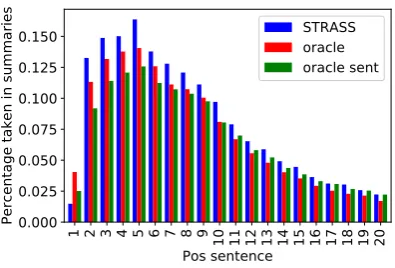
(b) Percentage of times that a sentence is taken in a gen-erated summary in function of their position in the docu-ment on the CASS dataset.
0.0 2.5 5.0 7.5 10.0 12.5 15.0 Nb sentences
0.0 0.1 0.2 0.3 0.4 0.5
Pe
rce
nta
ge
in
th
e r
esu
lts
Density of the number of sentences
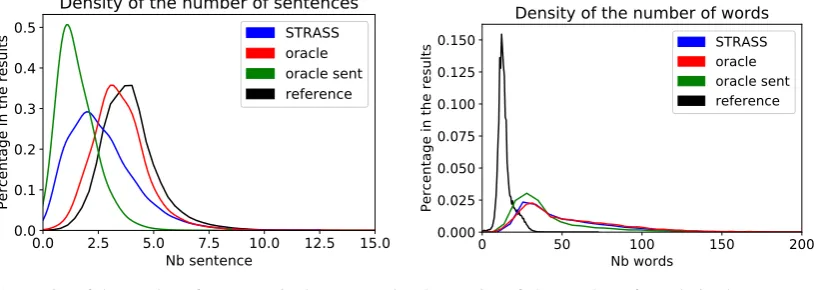
STRASS oracle oracle sent reference(c) Density of the number of sentences in the generated summaries for several models and the reference on the CASS dataset.
0 100 200 300 400
Nb words 0.0000
0.0025 0.0050 0.0075 0.0100 0.0125
Pe
rce
nta
ge
in
th
e r
esu
lts
Density of the number of words
STRASS oracle oracle sent reference
[image:9.595.306.504.63.197.2](d) Density of the number of words in the generated sum-maries for several models and the reference on the CASS dataset.
Figure 3: Information about the length of the generated summaries for the CASS dataset.
A.4.2 Words and sentences
On the French CASS dataset the summaries gen-erated by the models are generally close in terms of length (number of words, number of sentences and number of words per sentences (figure3a,3c, 3d)). All the tested extractive methods tend to se-lect sentences at the beginning of the documents. The first sentence make an exception to that rule (figure3b). We observe that this sentence can have the list of the lawyers and judges that were present at the case. STRASS tends to generate longer summaries with more sentences. The discrepancy in the average number of sentences between the reference andOraclesentis due to sentences that are extracted multiple times.
On the CNN/DailyMail dataset, STRASS tends to extract less sentences but longer ones compar-ing to the Oraclesent (figure 4a, 4c, 4d). On the figure 4b we can see that the three models tend to extract different sentences. Oraclesent which is the best performing model tends to ex-tract the 4 first sentences,Oracleextracts more
Model s w w/s Reference 3.9 55 14.1 STRASS 2.7 135 50
Oracle 1.5 84 56 Oracle sent 3.5 137 39.1
(a) Size information for the generated summary on the test split of the CNN/DM dataset,s,w,w/sare respec-tively the average number of sentences, the average num-ber of words and the average numnum-ber of words per sen-tences.
1 2 3 4 5 6 7 8 9 10 11 12 13 14 15 16 17 18 19 20Pos sentence
0.0 0.1 0.2 0.3 0.4 0.5
Pe
rce
nta
ge
ta
ke
n i
n su
mm
ari
es STRASS
oracle oracle sent
(b) Percentage of times that a sentence is taken in a gen-erated summary in function of their position in the docu-ment on the CNN/DM dataset.
0.0 2.5 5.0 7.5 10.0 12.5 15.0 Nb sentence
0.0 0.1 0.2 0.3 0.4 0.5
Pe
rce
nta
ge
in
th
e r
esu
lts
Density of the number of sentences
STRASS oracle oracle sent reference(c) Density of the number of sentences in the generated summaries for several models and the reference on the CNN/DM dataset.
0 50 100 150 200
Nb words 0.000
0.025 0.050 0.075 0.100 0.125 0.150
Pe
rce
nta
ge
in
th
e r
esu
lts
Density of the number of words
STRASS oracle oracle sent reference
[image:10.595.96.505.407.552.2](d) Density of the number of words in the generated summaries for several models and the reference on the CNN/DM dataset.