64
Hierarchical Document Encoder for Parallel Corpus Mining
Mandy Guo, Yinfei Yang, Keith Stevens, Daniel Cer, Heming Ge, Yun-Hsuan Sung, Brian Strope, Ray Kurzweil
Google AI
1600 Amphitheatre Parkway Mountain View, CA, USA
{xyguo, yinfeiy, kstevens, cer, hemingge, yhsung, raykurzweil}@google.com
Abstract
We explore using multilingual document em-beddings for nearest neighbor mining of par-allel data. Three document-level representa-tions are investigated: (i) document embed-dings generated by simply averaging multilin-gual sentence embeddings; (ii) a neural bag-of-words (BoW) document encoding model; (iii) a hierarchical multilingual document en-coder (HiDE) that builds on our sentence-level model. The results show document embed-dings derived from sentence-level averaging are surprisingly effective for clean datasets, but suggest models trained hierarchically at the document-level are more effective on noisy data. Analysis experiments demonstrate our hierarchical models are very robust to vari-ations in the underlying sentence embedding quality. Using document embeddings trained with HiDE achieves state-of-the-art perfor-mance on United Nations (UN) parallel doc-ument mining, 94.9% P@11 for en-fr and
97.3% P@1 for en-es.
1 Introduction
Obtaining a high-quality parallel training corpus is one of the most critical issues in machine trans-lation. Previous work on parallel document min-ing usmin-ing large distributed systems has proven effective (Uszkoreit et al., 2010; Antonova and Misyurev,2011), but these systems are often heav-ily engineered and computationally intensive. Re-cent work on parallel data mining has focused on sentence-level embeddings (Guo et al., 2018;
Artetxe and Schwenk, 2018; Yang et al., 2019).
However, these sentence embedding methods have had limited success when applied to document-level mining tasks (Guo et al., 2018). A re-cent study from Yang et al. (2019) shows that
1We use evaluation metrics precision at N, here P@1
means precision at 1
document embeddings obtained from averaging sentence embeddings can achieve state-of-the-art performance in document retrieval on the United Nation (UN) corpus. This simple averaging ap-proach, however, heavily relies on high quality sentence embeddings and the cleanliness of doc-uments in the application domain.
In our work, we explore using three variants of document-level embeddings for parallel document mining: (i) simple averaging of embeddings from a multilingual sentence embedding model (Yang et al., 2019); (ii) trained document-level embed-dings based on document unigrams; (iii) a simple hierarchical document encoder (HiDE) trained on documents pairs using the output of our sentence-level model.
The results show document embeddings are able to achieve strong performance on parallel document mining. On a test set mined from the web, all models achieve strong retrieval perfor-mance, the best being 91.4% P@1 for en-fr and 81.8% for en-es from the hierarchical document models. On the United Nations (UN) document mining task (Ziemski et al.,2016), our best model achieves 96.7% P@1 for en-fr and 97.3% P@1 for en-es, a 3%+ absolute improvement over the prior state-of-the-art (Guo et al.,2018;Uszkoreit et al., 2010). We also evaluate on a noisier ver-sion of the UN task where we do not have the ground truth sentence alignments from the orig-inal corpus. An off-the-shelf sentence splitter is used to split the document into sentences.2 The results shows that the HiDE model is robust to the noisy sentence segmentations, while the aver-aging of sentence embeddings approach is more sensitive. We further perform analysis on the ro-bustness of our models based on different qual-ity sentence-level embeddings, and show that the
2To introduce noise in sentence alignment, which is often
HiDE model performs well even when the under-lying sentence-level model is relatively weak.
We summarize our contributions as follows:
• We introduce and explore different ap-proaches for using document embeddings in parallel document mining.
• We adapt the previous work on hierarchical networks to introduce a simple hierarchical document encoder trained on document pairs for this task.
• Empirical results show our best document embedding model leads to state-of-the-art re-sults on the document-level bitext retrieval task on two different datasets. The proposed hierarchical models are very robust to varia-tions in sentence splitting and the underlying sentence embedding quality.
2 Related Work
Parallel document mining has been extensively studied. One standard approach is to identify bitexts using metadata, such as document titles (Yang and Li,2002), publication dates (Munteanu
and Marcu, 2005, 2006), or document structure
(Chen and Nie, 2000; Resnik and Smith, 2003;
Shi et al., 2006). However, the metadata
re-lated to the documents can often be sparse or unreliable (Uszkoreit et al., 2010). More re-cent research has focused on embedding-based ap-proaches, where texts are mapped to an embed-ding space to calculate their similarity distance and determine whether they are parallel (Gr´egoire and Langlais,2017;Hassan et al.,2018;Schwenk,
2018). Guo et al. (2018) has studied
document-level mining from sentence embeddings using a hyperparameter tuned similarity function, but had limited success compared to the heavily engi-neered system proposed byUszkoreit et al.(2010). An extensive amount of work has also been done on learning document embeddings. Le and Mikolov(2014);Li et al.(2015);Dai et al.(2015) explored Paragraph Vector with various lengths (sentence, paragraph, document) trained on next word/n-gram prediction given context sampled from the paragraph. The work from Roy et al.
(2016); Chen (2017); Wu et al. (2018) obtained document embeddings from word-level embed-dings. More recent work has been focused on learning document embeddings through hierarchi-cal training. The work from Yang et al.(2016);
[x0, ..., xn] [y0, ..., ym]
Encoder Encoder
[image:2.595.336.495.62.153.2]Dot Product
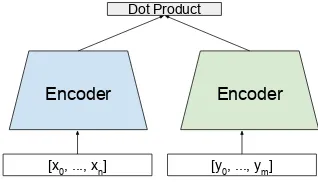
Figure 1: Dual encoder for parallel corpus mining, where(x, y)represents translation pairs.
Miculicich et al. (2018) approached Document
Classification and Neural Machine Translation us-ing Hierarchical Attention Networks, and Wang et al.(2017) proposed using a hierarchy of Recur-rent Neural Networks (RNNs) to summarize the cross-sentence context. However, the amount of work applying document embeddings to the trans-lation pair mining task has been limited.
Yang et al.(2019) recently showed strong paral-lel document retrieval results using document em-beddings obtained by averaging sentence embed-dings. Our paper extends this work to explore dif-ferent variants of document-level embeddings for parallel document mining, including using an end-to-end hierarchical encoder model.
3 Model
This section introduces our document embedding models and training procedure.
3.1 Translation Candidate Ranking Task using a Dual Encoder
All models use the dual encoder architecture in Figure 1, allowing candidate translation pairs to be scored using an efficient dot-product opera-tion. The embeddings that feed the dot-product are trained by modeling parallel corpus mining as a translation ranking task (Guo et al.,2018). Given translation pair(x, y), we learn to rank true trans-lation y over other candidates, Y. We use batch negatives, with sentence yi of the pair (xi, yi) serving as a random negative for all sourcexjin a training batch such thatj 6=i. FollowingArtetxe
and Schwenk (2018), a shared multilingual
Document Encoder
Pooling Dot Product
Sent Enc Pooling
Sent Enc Pooling
Sent Enc Pooling
DNN DNN DNN
Sentence Encoder Pooling Pooling
Dot Product
Sentence Encoder
Document Encoder
Pooling
[image:3.595.85.515.64.156.2]Sentence Level Task Document Level Task
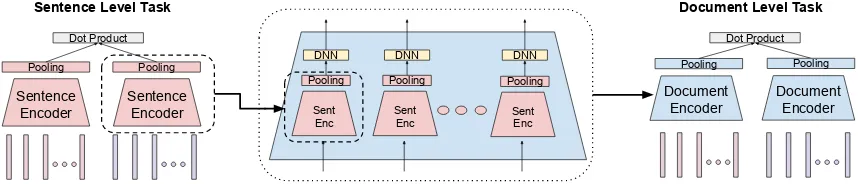
Figure 2: Illustration of the DNN→pooling version of the Hierarchical Document Encoder (HiDE). Each sentence is processed by our Transformer based encoding model with the final sentence-level embedding being produced by pooling across the last layer’s positional heads. Document-level embeddings are composed by pooling across the sentence-level embeddings after each sentence embedding has been adapted by additional feed-forward layers.
and marginm, the log-likelihood loss function is given by Eq.1.
J =−1
K K
X
i=1
log e
x0i·y0>i −m
ex0i·yi0>−m+PK
k=1e
x0k,k6=i·yk0>
(1) Models are trained with a bidirectional rank-ing objective (Yang et al., 2019). Given source and target pair (x, y), forward translation rank-ing, Jf orward, maximizes p(y|x), while back-ward translation ranking, Jbackward, maximizes
p(x|y). Bidirectional loss J sums the two direc-tional losses:
J =Jf orward+Jbackward (2)
3.1.1 Sentence-Level Embeddings
Sentence embeddings are produced by a Trans-former model (Vaswani et al., 2017) with pool-ing over the last block.3 Semantically similar hard negatives are included to augment batch negatives (Guo et al.,2018;Chidambaram et al.,2018;Yang
et al., 2019). We denote document embeddings
derived from averaged sentence embeddings as
Sentence-Avg.
3.1.2 Bag-of-words Document Embeddings
Our bag-of-words (BoW) document embeddings,
Document BoW, are constructed by feeding doc-ument unigrams into a deep averaging network (DAN) (Iyyer et al.,2015) trained on the parallel document ranking task.4
3
For pooling, we concatenate the combination of min, max and attentional pooling.
4The model uses feed-forward hidden layers of size 320,
320, 500, and 500.
3.2 Hierarchical Document Encoder (HiDE)
As illustrated in Figure2, our hierarchical model is also trained on the parallel document ranking task, but taking as input embeddings from our sentence-level model. ForHiDEDNN→pooling, sen-tence embeddings are adapted to the document-level task by applying a feed-forward DNN to each sentence embedding. Average pooling ag-gregates the adapted sentence representations into the final fixed-length document embedding. We contrast performance with a variant of the model,
HiDEpooling→DNN, that performs average pooling first followed by a feed-forward DNN to adapt the representation to document-level mining.
4 Experiments
This section describes our training data, model configurations, and retrieval results for our em-bedding models: Sentence-Avg, Document BoW, HiDEDNN→pooling, and HiDEpooling→DNN.
4.1 Data
We focus on two language pairs: English-French (en-fr) and English-Spanish (en-es). Two corpora are used for training and evaluation.
The first corpus is obtained from web (WebData) using a parallel document min-ing system and automatic sentence alignments, both following an approach similar to Uszkoreit
et al.(2010). Parallel documents number 13M for
en-fr and 6M for en-es, with 400M sentence pairs for each language pair. We split this corpus into training (80%), development (10%), and test set (10%).
sub-Corpus Document Pairs
English - French
WebData
(s1) Specs Toshiba Coverside FL not categorized (4407839940), (s2) Search by brand, (s3) Icecat: syndi-cator of product information via global Open catalog with more than 4578703 data-sheets & 19844 brands – Register (free)
(s1) Fiche produit Toshiba Coverside FL non class´e (4407839940), (s2) Partenaires en ligne, (s3) Edit my products
Clean UN
(s1) 1 July 2011, (s2) Original: English, (s3) Tenth meeting, (s4) Cartagena, Colombia, 17 - 21 October 2011, (s5) Item 4 of the provisional agenda
(s1) 1er juillet 2011, (s2) Original : anglais, (s3) Dixi`eme r´eunion, (s4) Cartagena (Colombie), 17-21 octobre 2011, (s5) Point 4 de l’ordre du jour provisoire*
Noisy UN
(s1) 6–7 May 1999 Non-governmental organizations New York, 14 to 18 December 1998 Corrigendum 1., (s2) Paragraph 1, draft decision I, under “Special consultative status” 2., (s3) Paragraph 48 Add Japan to the list of States Members of the United Nations represented by observers.
(s1) 6 et 7 mai 1999 Organisations non gouvernementales New York, 14-18 d´ecembre 1998 Rectificatif Paragraphe 1, projet de d´ecision I, sous la rubrique “Statut consultatif sp´ecial” Paragraphe 48 Ajouter le Japon `a la liste des ´Etats Membres de l’Organisation des Nations Unies repr´esent´es par des observateurs.
English - Spanish
WebData
(s1) Alcudia travel Guide & Map - android apps on Google play, (s2) Travel & Local, (s3) Alcudia travel Guide & Map, (s4) Maps, GPS Navigation Travel & Local, (s5) Offers in-app purchases”
(s1) Beirut Travel Guide & map - aplicaciones Android en Google play, (s2) Todav´ıa m´as ”, (s3) Seleccin de los editores, (s4) Libros de texto, (s5) Comprar tarjeta de regalo
Clean UN
(s1) [Original: English], (s2) Monthly report to the United Nations on the operations of the Kosovo Force, (s3) 1. Over the reporting period (1-28 February 2003) there were just over 26,600 troops of the Kosovo Force (KFOR) in theatre.
(s1) [Original: ingl´es], (s2) Informe mensual de las Naciones Unidas sobre las operaciones de la Fuerza Internacional de Seguridad en Kosovo, (s3) En el per´ıodo sobre el que se informa (1 a 28 de febrero 2003) hab´ıa en el teatro de operaciones algo m´as de 26.600 efectivos de la Fuerza Internacional de Seguridad en Kosovo (KFOR).
Noisy UN
(s1) (Original: English) Monthly report to the United Nations on the operations of the Kosovo Force 1., (s2) Over the reporting period (1-28 February 2003) there were just over 26,600 troops of the Kosovo Force (KFOR) in theatre.
[image:4.595.75.525.61.486.2](s1) (Original: ingl´es) Informe mensual de las Naciones Unidas sobre las operaciones de la Fuerza Inter-nacional de Seguridad en Kosovo En el per´ıodo sobre el que se informa (1 a 28 de febrero 2003) hab´ıa en el teatro de operaciones algo m´as de 26.600 efectivos de la Fuerza Internacional de Seguridad en Kosovo (KFOR).
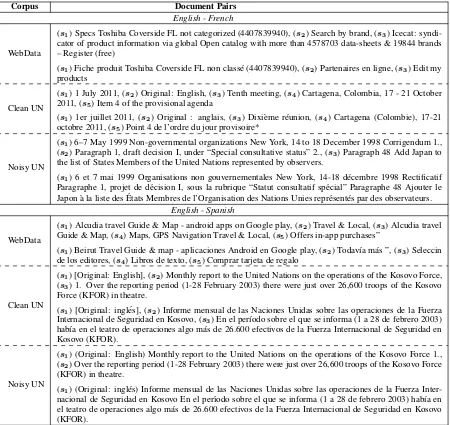
Table 1: Example document snippets from the WebData, original UN corpus, UN corpus with noisy sentence segmentation. We only show the starting sentences for each document, the original documents can go very long. Symbol (sn) means sentencenin the document to show sentence segmentation.
corpus of∼86k document pairs for the six official UN languages.5 As this corpus is small, it is only used for evaluation.
The sentence segmentation in the fully aligned subcorpus is particularly good due to the process used to construct the dataset. While automatic sentence splitting is performed using the Eserix spltter, documents are only included in the fully aligned subcorpus if sentences are consistently aligned across all six languages. This implicitly filters documents with noisy sentence segmenta-tions. Exceptions are errors in the sentence seg-mentation that are systematically replicated across the documents in all six languages.
5Arabic, Chinese, English, French, Russian, and Spanish.
We create a noisier version of the UN dataset that makes use of an robust off-the-shelf sentence splitter, but which necessarily introduces noise compare to sentences that were split by consen-sus across all six languages within the original UN dataset. Models are evaluated on this noisy UN corpus, as any real application of our models will almost certainly need to contend with noisy auto-matic sentence splits.
is translated sentence by sentence by human anno-tators, so it is perfectly aligned at the sentence-level with ground truth translations. The noisy UN, however, could have incorrect sentence-level mappings, but these could still be correct transla-tions on the document-level. The sentence split-ter used to generate the noisy UN dataset could also perform differently in different languages for the parallel content, resulting in mismatches at the sentence-level. As seen in the Noisy UN exam-ples shown in Table 1, the English text is split into 3 sentences, while the corresponding French or Spanish texts are only split into 1 sentence.
4.2 Configuration
Our sentence-level encoder follows a similar setup
as Yang et al. (2019). The sentence encoder
has a shared 200k token multilingual vocabulary with 10K OOV buckets. Vocabulary items and OOV buckets map to 320 dim. word embeddings. For each token, we also extract character n-grams (n= [3,6]) hashed to 200k buckets mapped to320 dim. character embeddings. Word and character n-gram representations are summed together to pro-duce the final input token representation. Updates to the word and character embeddings are scaled by a gradient multiplier of 25 (Chidambaram et al.,
2018). The encoder uses 3 transformer blocks with hidden size of 512, filter size of2048, and 8 attention heads. Additive margin softmax uses
m = 0.3. We train for 40M steps for both lan-guage pairs using an SGD optimizer with batch size K=100 and learning rate0.003.
During document-level training, sentence em-beddings are fixed due to the computational cost of dynamically encoding all of the sentences in a document. Sentence embeddings are adapted us-ing a four-layer DNN model with residual connec-tions and hidden sizes 320, 320, 500, and 500. The first three layers use ReLU activations with the final layer using Tanh. Document embed-dings are trained with an SGD optimizer, batch sizeK = 200, learning rate0.0001, and additive margin softmaxm = 0.5for en-fr, andm = 0.6 for en-es. We train for 5M steps for en-fr and 2M steps for en-es. Light hyperparameter tuning uses our development set from WebData.
4.3 Mining Translations and Evaluation
Translation candidates are mined with approxi-mate nearest neighbor (ANN) (Vanderkam et al.,
2013) search over our multilingual
embed-dings (Guo et al., 2018; Artetxe and Schwenk,
2018).6 The evaluation metric is precision at N (P@N), which evaluates if the true translation is in the top N candidates returned by the model.
4.3.1 Results on WebData Test Set
Table 2 presents document embedding P@N re-trieval performance using our WebData test set, for N =1, 3, 10. The evaluation uses 1M candi-date documents for en-fr and 0.6M for en-es. We obtain the best performance from our hierarchical models, HiDE∗. Adapting the sentence embed-dings prior to pooling, HiDEDNN→poolingperforms
better than attempting to adapt the representation after pooling, HiDEpooling→DNN. Document BoW
embeddings outperform Sentence-Avg, showing training a simple model for document-level repre-sentations (DAN) outperforms pooling of sentence embeddings from a complex model (Transformer).
4.3.2 Results on UN Corpus
Table 3 shows document matching P@1 for our models on both the original UN dataset sentence segmentation and on the noisier sentence segmen-tation. P@1 is evaluated using all of the UN doc-uments in a target language as translation can-didates. The prior state-of-the-art is Uszkoreit et al.(2010).7 Using both the official and noisy sentence segmentations, HiDEDNN→pooling
outper-formsUszkoreit et al.(2010), a heavily engineered system that incorporates both MT and monolin-gual duplicated document detection.
Guo et al. (2018) uses sentence-to-sentence
alignments to heuristically identify document pairs. Alignments were computed using sentence embeddings generated over the UN corpus an-notated sentence splits. With corpus annotated splits, Sentence-Avg performs better than Guo
et al. (2018). Furthermore, even with noisy
sen-tence splits HiDE∗ outperformsGuo et al.(2018). The performance of all our document embed-dings methods that build on sentence-level repre-sentations is remarkably strong when we use the sentence boundaries annotated in the UN corpus. Surprisingly, Sentence-Avg performed poorly on the WebData test data but is very competitive with both variants of HiDE when using the original UN corpus sentence splits.8 However, on the UN
6
Prior work only used ANN over sentence embeddings.
7
Uszkoreit et al.(2010) was applied to the UN dataset by Guo et al.(2018).
Document Embedding en-fr (1M) en-es (0.6M)
P@1 P@3 P@10 P@1 P@3 P@10
HiDEDNN→pooling 91.40 94.13 95.67 81.83 87.85 91.45
HiDEpooling→DNN 90.63 93.50 95.11 78.84 85.04 88.88
Document BoW 83.83 90.47 94.18 78.09 85.04 91.03
[image:6.595.131.468.61.146.2]Sentence-Avg 78.07 83.53 87.06 67.49 74.22 79.01
Table 2: Precision at N (P@N) of target document retrieval on the WebData test set. Models attempt to select the true translation target for a source document from the entire corpus (1 million parallel documents for en-fr, and 0.6 million for en-es).
Model en-fr en-es
UN Corpus Sentence Segmentation
HiDEDNN→pooling 96.6 97.3
HiDEpooling→DNN 96.5 96.1
Sentence-Avg 96.7 97.3
Noisy Sentence Segmentation
HiDEDNN→pooling 94.9 96.0
HiDEpooling→DNN 91.0 94.4
Sentence-Avg 86.8 95.7
No sentence splitting
Document BoW 74.3 71.9
Prior work
Uszkoreit et al.(2010) 93.4 94.4
Guo et al.(2018) 89.0 90.4
Table 3: Document matching on the UN corpus eval-uated using P@1. For methods that require sentence splitting, we report results using both the UN sentence annotations and an off-the-shelf sentence splitter.
data with noisy sentence splits, HiDE∗once again significantly outperforms Sentence-Avg. Averag-ing sentence embeddAverag-ings appears to be a strong baseline for clean datasets, but the hierarchical model helps when composing document embed-dings from noisier input representations.9 Simi-lar to the WebData test set, on the noisy UN data, HiDEDNN→pooling outperforms HiDEpooling→DNN.
We note that while Document BoW performed well on the in-domain test set, it performs poorly on the UN data. Preliminary analysis suggests this is due in part to differences in length between the WebData and UN documents.
We also observe that the performance of Sentence-Avg model dropped significantly in en-fr when transitioning en-from the Clean UN to the Noisy UN, but in en-es, the performance drop is
et al. (2019), we are able to obtain matching results on the original UN corpus
9We note that in practice parallel document mining will
[image:6.595.86.275.209.407.2]tend to operate over noisy datasets.
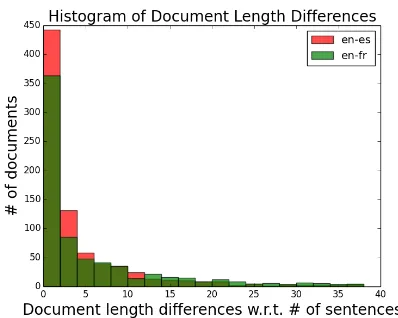
Figure 3: Histogram of document length differences w.r.t. # of sentences in each parallel document pair.
much less. We compute the histogram of the doc-ument length differences in each docdoc-ument pair w.r.t. the # of sentences in each document on the noisy UN corpus. As shown in figure 3, the en-es dataset indeed has better agreement on the sentence split comparing with en-fr, which indi-cates the Sentence-Avg model is sensitive to the sentence segmentation quality of the parallel doc-ument pairs.
5 Analysis
In this section, we first analyze the errors produced by the document embedding models. We then ex-plore how the performance of sentence-level els affect the performance of document-level mod-els that incorporate sentence-embeddings.
5.1 Errors
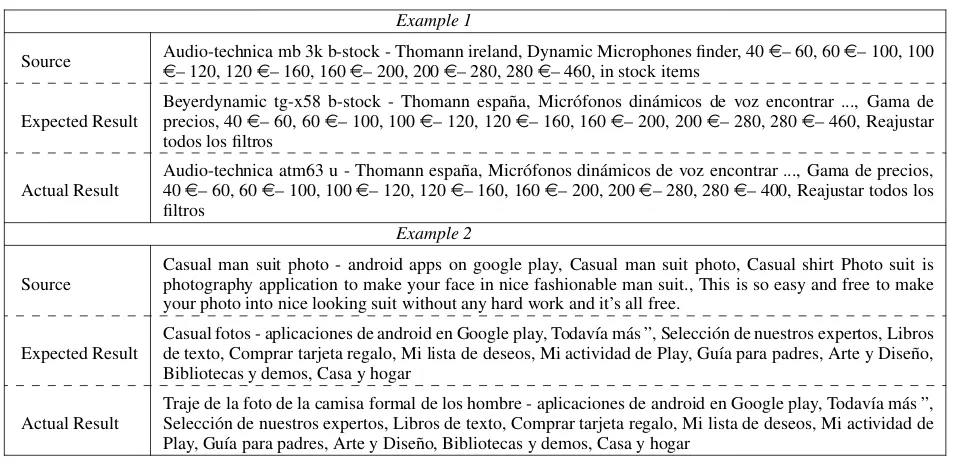
We first look at the false positive examples re-trieved by HiDEDNN→poolingmodel on en-es
Web-Doc development set. We observe that the actual error results often have similar sentence structure and meaning comparing to the expected result.
[image:6.595.313.512.215.374.2]Example 1
Source Audio-technica mb 3k b-stock - Thomann ireland, Dynamic Microphones finder, 40e e– 60, 60e– 100, 100 – 120, 120e– 160, 160e– 200, 200e– 280, 280e– 460, in stock items
Expected Result
Beyerdynamic tg-x58 b-stock - Thomann espa˜na, Micr´ofonos din´amicos de voz encontrar ..., Gama de precios, 40e– 60, 60e– 100, 100e– 120, 120e– 160, 160e– 200, 200e– 280, 280e– 460, Reajustar todos los filtros
Actual Result
Audio-technica atm63 u - Thomann espa˜na, Micr´ofonos din´amicos de voz encontrar ..., Gama de precios, 40e– 60, 60e– 100, 100e– 120, 120e– 160, 160e– 200, 200e– 280, 280e– 400, Reajustar todos los filtros
Example 2
Source
Casual man suit photo - android apps on google play, Casual man suit photo, Casual shirt Photo suit is photography application to make your face in nice fashionable man suit., This is so easy and free to make your photo into nice looking suit without any hard work and it’s all free.
Expected Result
Casual fotos - aplicaciones de android en Google play, Todav´ıa m´as ”, Selecci´on de nuestros expertos, Libros de texto, Comprar tarjeta regalo, Mi lista de deseos, Mi actividad de Play, Gu´ıa para padres, Arte y Dise˜no, Bibliotecas y demos, Casa y hogar
Actual Result
[image:7.595.70.547.58.295.2]Traje de la foto de la camisa formal de los hombre - aplicaciones de android en Google play, Todav´ıa m´as ”, Selecci´on de nuestros expertos, Libros de texto, Comprar tarjeta regalo, Mi lista de deseos, Mi actividad de Play, Gu´ıa para padres, Arte y Dise˜no, Bibliotecas y demos, Casa y hogar
Table 4: Example document snippets of source, expected result, and actual result retrieved by HiDEDNN→pooling model on the en-es development sets.
HiDEDNN→pooling. In the first example, our model
matches the translation of ”Audio-technica” to ”Audio-technica” instead of ”Beyerdynamic”. We observe that in multiple cases, HiDE model is able to retrieve a more accurate translation pair than the labeled expected result. As shown in Table1, the WebData automatically mined from the web is noisy and may contains non-translation pairs. This results indicates the proposed model is robust to the training data noise. The second example shows another typical error where the documents are template-like. The actual results retrieved by HiDEDNN→poolingstill largely match the expected
text.
We also look at the actual results retrieved from Sentence-Avg model. The Sentence-Avg model also suffers from the template-like docu-ments (e.g. Example 2 in Table4) similar to the HiDEDNN→poolingmodel. Other than that, though
some correctly translated words can be found, the retrieved error documents differ much more in sentence structure and meaning from the expected results. For example, the expected and actual re-sults can both be documents about the same sub-ject, but from entirely different perspectives. We also found that some of the WebData target docu-ments are in English instead of Spanish. In these cases, the Sentence-Avg model is more likely to retrieve a document in the same language as the source document instead of retrieving a translated document.
5.2 HiDE performance on Coarse Sentence-level Models
We further explore how the performance of sentence-level models affect the performance of document-level models that incorporate sentence-embeddings. We use different encoder configura-tions to produce sentence embeddings of varying quality as expressed by P@1 results for sentence-level retrieval on the UN dataset.10 Table5shows the P@1 of target document retrieval on both the WebData test set and the noisy UN corpus for HiDEDNN→pooling and Sentence-Avg. While
sen-tence encoding quality does impact document-level performance, the HiDE model is surprisingly robust once the sentence encoder reaches around 66% P@1, whereas the Sentence-Avg model re-quires much higher quality sentence-level embed-dings (around 85% for en-fr, and 80% for en-es). The robustness of HiDE model provides a means for obtaining high-quality document embeddings without high-quality sentence embeddings, and thus provides the option to trade-off sentence-level embedding quality for speed and memory perfor-mance.
6 Conclusion
In this paper, we explore parallel document min-ing usmin-ing several document embeddmin-ing methods.
10Model sentence-level model performance was varied by
Languages P@1 at Sentence Level P@1 on WebDoc test P@1 on Noisy UN HiDEDNN→pooling Sentence-Avg HiDEDNN→pooling Sentence-Avg
en-fr
48.9 66.6 0.6 70.3 4.4
66.9 89.2 54.3 92.6 63.9
81.3 90.5 72.9 92.1 76.9
86.1 91.3 78.1 94.9 86.9
en-es
54.9 59.0 1.2 81.3 4.7
67.0 79.1 54.2 93.2 82.9
80.6 79.8 60.1 91.2 88.9
89.0 81.9 67.4 96.0 95.7
Table 5: P@1 of target document retrieval on WebData test set and noisy UN corpus for HiDEDNN→pooling and Sentence-Avg models with different sentence-level P@1 performance . The sentence-level peroformance is mea-sured on the sentence-level UN retrieval task from the entire corpus (11.3 million sentence candidates).
Mining using document embeddings achieves a new state-of-the-art perfomance on the UN par-allel document mining task (en-fr, en-es). Docu-ment embeddings computed by simply averaging sentence embeddings provide a very strong base-line for clean datasets, while hierarchical embed-ding models perform best on noisier data. Finally, we show document embeddings based on aggrega-tions of sentence embeddings are surprisingly ro-bust to variations in sentence embedding quality, particularly for our hierarchical models.
Acknowledgements
We are grateful to the anonymous reviewers and our teammates in Deacartes and Google Translate for their valuable discussions, especially Chris Tar, Gustavo Adolfo Hernandez Abrego, and Wolf-gang Macherey.
References
Alexandra Antonova and Alexey Misyurev. 2011. Building a web-based parallel corpus and filtering out machine-translated text. InProceedings of the 4th Workshop on Building and Using Comparable Corpora: Comparable Corpora and the Web, pages 136–144. Association for Computational Linguis-tics.
Mikel Artetxe and Holger Schwenk. 2018. Margin-based parallel corpus mining with multilingual sen-tence embeddings.CoRR, abs/1811.01136.
Jiang Chen and Jian-Yun Nie. 2000. Parallel web text mining for cross-language ir. In Content-Based Multimedia Information Access-Volume 1, pages 62–77. Centre de Hautes Etudes Interna-tionale D’Informatique Documentaire.
Minmin Chen. 2017. Efficient vector representation for documents through corruption. 5th International Conference on Learning Representations.
Muthuraman Chidambaram, Yinfei Yang, Daniel Cer, Steve Yuan, Yun-Hsuan Sung, Brian Strope, and Ray Kurzweil. 2018. Learning cross-lingual sentence representations via a multi-task dual-encoder model. CoRR, abs/1810.12836.
Andrew M. Dai, Christopher Olah, and Quoc V. Le. 2015. Document embedding with paragraph vec-tors.CoRR, abs/1507.07998.
Francis Gr´egoire and Philippe Langlais. 2017. A deep neural network approach to parallel sentence extrac-tion. arXiv preprint arXiv:1709.09783.
Mandy Guo, Qinlan Shen, Yinfei Yang, Heming Ge, Daniel Cer, Gustavo Hernandez Abrego, Keith Stevens, Noah Constant, Yun-hsuan Sung, Brian Strope, and Ray Kurzweil. 2018. Effective parallel corpus mining using bilingual sentence embeddings. InProceedings of the Third Conference on Machine Translation: Research Papers, pages 165–176. As-sociation for Computational Linguistics.
Hany Hassan, Anthony Aue, Chang Chen, Vishal Chowdhary, Jonathan Clark, Christian Feder-mann, Xuedong Huang, Marcin Junczys-Dowmunt, William Lewis, Mu Li, et al. 2018. Achieving hu-man parity on automatic chinese to english news translation.arXiv preprint arXiv:1803.05567.
Mohit Iyyer, Varun Manjunatha, Jordan Boyd-Graber, and Hal Daum´e III. 2015. Deep unordered compo-sition rivals syntactic methods for text classification. In Proceedings of the 53rd Annual Meeting of the Association for Computational Linguistics and the 7th International Joint Conference on Natural Lan-guage Processing (Volume 1: Long Papers), pages 1681–1691, Beijing, China. Association for Com-putational Linguistics.
Quoc Le and Tomas Mikolov. 2014.Distributed repre-sentations of sentences and documents. In Proceed-ings of the 31st International Conference on Inter-national Conference on Machine Learning - Volume 32, ICML’14, pages II–1188–II–1196. JMLR.org.
by predicting n-grams for sentiment classification of long movie reviews.CoRR, abs/1512.08183.
Lesly Miculicich, Dhananjay Ram, Nikolaos Pappas, and James Henderson. 2018. Document-level neural machine translation with hierarchical attention net-works. InProceedings of the 2018 Conference on Empirical Methods in Natural Language Process-ing, pages 2947–2954, Brussels, Belgium. Associ-ation for ComputAssoci-ational Linguistics.
Dragos Stefan Munteanu and Daniel Marcu. 2005. Im-proving machine translation performance by exploit-ing non-parallel corpora. Computational Linguis-tics, 31(4):477–504.
Dragos Stefan Munteanu and Daniel Marcu. 2006. Ex-tracting parallel sub-sentential fragments from non-parallel corpora. InProceedings of the 21st Interna-tional Conference on ComputaInterna-tional Linguistics and the 44th Annual Meeting of the Association for Com-putational Linguistics, pages 81–88. Association for Computational Linguistics.
Philip Resnik and Noah A. Smith. 2003. The web as a parallel corpus.Comput. Linguist., 29(3):349–380.
Dwaipayan Roy, Debasis Ganguly, Mandar Mitra, and Gareth J. F. Jones. 2016. Representing documents and queries as sets of word embedded vectors for information retrieval.CoRR, abs/1606.07869.
Holger Schwenk. 2018. Filtering and mining paral-lel data in a joint multilingual space. In Proceed-ings of the 56th Annual Meeting of the Association for Computational Linguistics (Volume 2: Short Pa-pers), pages 228–234, Melbourne, Australia. Asso-ciation for Computational Linguistics.
Lei Shi, Cheng Niu, Ming Zhou, and Jianfeng Gao. 2006. A dom tree alignment model for mining paral-lel data from the web. InProceedings of the 21st In-ternational Conference on Computational Linguis-tics and the 44th Annual Meeting of the Association for Computational Linguistics, pages 489–496. As-sociation for Computational Linguistics.
Jakob Uszkoreit, Jay M. Ponte, Ashok C. Popat, and Moshe Dubiner. 2010. Large scale parallel docu-ment mining for machine translation. In Proceed-ings of the 23rd International Conference on Com-putational Linguistics, COLING ’10, pages 1101– 1109, Stroudsburg, PA, USA. Association for Com-putational Linguistics.
Dan Vanderkam, Rob Schonberger, Henry Rowley, and Sanjiv Kumar. 2013. Nearest neighbor search in google correlate. Technical report, Google.
Ashish Vaswani, Noam Shazeer, Niki Parmar, Jakob Uszkoreit, Llion Jones, Aidan N Gomez, Ł ukasz Kaiser, and Illia Polosukhin. 2017. Attention is all you need. In I. Guyon, U. V. Luxburg, S. Bengio, H. Wallach, R. Fergus, S. Vishwanathan, and R. Gar-nett, editors, Advances in Neural Information Pro-cessing Systems 30, pages 5998–6008. Curran As-sociates, Inc.
Longyue Wang, Zhaopeng Tu, Andy Way, and Qun Liu. 2017. Exploiting cross-sentence context for neural machine translation. InProceedings of the 2017 Conference on Empirical Methods in Natu-ral Language Processing, pages 2826–2831, Copen-hagen, Denmark. Association for Computational Linguistics.
Lingfei Wu, Ian En-Hsu Yen, Kun Xu, Fangli Xu, Avinash Balakrishnan, Pin-Yu Chen, Pradeep Ravikumar, and Michael J. Witbrock. 2018. Word mover’s embedding: From word2vec to document embedding. InProceedings of the 2018 Conference on Empirical Methods in Natural Language Pro-cessing, pages 4524–4534. Association for Compu-tational Linguistics.
Christopher C Yang and Kar Wing Li. 2002. Mining english/chinese parallel documents from the world wide web. InProceedings of the 11th International World Wide Web Conference, Honolulu, USA.
Yinfei Yang, Gustavo Hern´andez ´Abrego, Steve Yuan, Mandy Guo, Qinlan Shen, Daniel Cer, Yun-Hsuan Sung, Brian Strope, and Ray Kurzweil. 2019. Im-proving multilingual sentence embedding using bi-directional dual encoder with additive margin soft-max.CoRR, abs/1902.08564.
Zichao Yang, Diyi Yang, Chris Dyer, Xiaodong He, Alex Smola, and Eduard Hovy. 2016. Hierarchi-cal attention networks for document classification. InProceedings of the 2016 Conference of the North American Chapter of the Association for Computa-tional Linguistics: Human Language Technologies, pages 1480–1489, San Diego, California. Associa-tion for ComputaAssocia-tional Linguistics.