Munich Personal RePEc Archive
Game-theoretic model of tax evasion:
analysis of agents’ interaction and
optimization of tax burden
Sokolovskyi, Dmytro
30 April 2018
Online at https://mpra.ub.uni-muenchen.de/86415/
Game-theoretic model of tax evasion: analysis of
agents’
interaction
and optimization of tax burden
Abstract
The article analyzes a tax evasion problem using game-theoretic tools. The model develops a well-known Alligham–Sandmo classic model by introducing parameters of “transparency” of detected violations, of cost of control, of tax evasion and of conscientious tax payment.
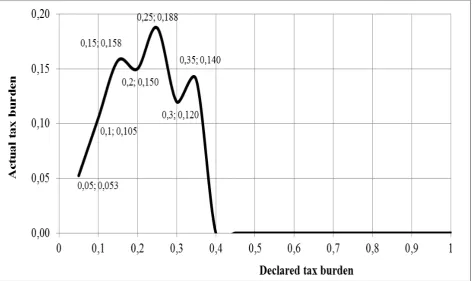
For that model we calculated Nash-equilibrium conditions in pure strategies. Based on this we investigated the problem of optimization of real tax burden. It is shown that curve describing the dependence between actual tax burden from declared one has not 1 (like the Laffer curve), but 3 local maxima.
Those findings may contribute to better calculation of tax burden in the real economy.
Keywords: tax evasion, game-theoretic model, Nash-equilibrium, tax burden, pure strategies, Laffer curve
Introduction
The proposed study involves the development of a game-theoretic model of interaction between the taxpayer and the tax inspector. In economic theory, one of the main factors of non-fulfillment of the revenue part of the budget is the problem, known as the “tax evasion problem”. In this article is examined the existing studies of the problem of “tax evasion” by game-theoretic modeling of typical of it processes.
article by Slemrod & Yitzhaki (2000) that consider basic aspects of tax planning, tax evasion and taxation.
In addition consideration each of general and some local issues related to the tax evasion problem, can be found in Levaggi & Menoncin (2012), Yaniv (1988), Koskela (1983), Yitzhaki (1974), Davidson et al. (2005), Bordignon (1993), Elffers et al. (1992), Weigel et al. (1987), Wallschutzky (1984), Landskroner et al. (1991).
Note both Alingham and Sandmo, and their direct followers did not use game theory in explicit form for their models. Its application in tasks of tax evasion can be found in works Gottlieb D. (1985), Elffers et al. (1987).
At once based on an analysis of tax evasion research can be concluded there is by actual still not solved problem is the problem is the problem of optimizing tax burden (Bayer R.-C. (2006), Cremer H. & F. Gahvari (1993)), based on an analysis of the dependence of the economic behavior of agents on the change in tax burden and must necessary take into account the possibility of their opportunistic actions. Its solution will increase the efficiency of the implementation of the revenue part of the budgets.
Thus, there get the problem of calculation the optimal aggregate tax burden on the subjects of economic activity, i.e. of such nominal burden, with the increase of which the actual burden (actual taxes and fees) is decreased.
Analyzing of the basis of the Alingham – Sandmo model
The classic Alingham – Sandmo’s model (Alingham & Sandmo, 1972) describes the relationship between the taxpayer and the tax controller (1) is very simplistic:
1
checked declarations) and of the tax inspector qualification (fixing the probability of finding the violation when checking declarations with violations). I.e. the game-theoretic issue turn to one-dimensional optimization issue with enough elementary an objective function.
Second, the simple of basic model and the objective function is , in our opinion, a consequence of neglect a number of important factors are quite realistic for the actual relationship of this (and not only) type. In particular it is about follows.
Even when verifying a knowingly false declaration, the inspector detect the violation not guaranteed. However for the abstract model this nuance is not very fundamental: the probability to detect the violation is the function of the frequency of inspections and the quality ones, so we can set the quality equal to 1, reducing the frequency.
At once, the inspector can “find” the violation where it really is not – while checking the correct and complete declaration of income by the payer: due to its own mistake or conscious opportunistic decision, e.g. using the unclearness of regulation, the fuzzy designing of the declaration etc.
the cost of inspections is fundamentally important for an adequate description of the model of the relationship between taxpayer and tax inspector.
Considering the basic Alingham – Sandmo model uses the probability of detection of tax evasion, tax evasion, that in usually is less than 1, it may assume, the cost of inspections don’t equal to 0 and this parameter is taken into account in the model implicitly – precisely because of the limited probability of detecting tax evasion. Since such approach complicates the possibility to regulate the inspector's activities, explicit consideration of the cost of inspections in the model is more appropriate.
At once the Alingham – Sandmo model does not uses at all a parameter “the cost of taxpayer’s activity”, despite the fact that the principle of taking into account this parameter is the same as for the cost of inspections: the disregard of the cost of design of the payer, at least the camouflage of evasion, makes the logic of the relationship between the taxpayer and the tax unnatural: attracting unlimited powerful resource of accountants, lawyers, etc., the payer can uniquely confuse any inspector with a limited resource of inspections.
Above simplifications of the basic model: the absence of inspector’s utility function; guaranteed the detection of a violation when checking the declarations, in which it is present; guaranteed the non-detection of a violation when checking of declarations, in which it is absent; the absence of the cost of inspections and the design of payer: the camouflage of tax evasion or the presentation of conscientious behavior and the full tax payment – naturally leads to a fairly simple analytical decision, about which arises the question of adequacy to its realities.
It can be written the basic model more strictly – as a game of 2 agents: of the taxpayer and tax inspector:
, , , ; ; 0; 1 ,1 ; ;
1 1 1
SP SA G H SP SA
R R R G H R R R R
where R– the expected payer’s income, R>0;
τ– the aggregate tax burden, τ>0;
γ– the penalty coefficient for the evasion of taxpaying.
It is easily seen, the game (2) has a unified equilibrium in poor strategies
(g11; h11), that is: the payer conscientious pays the required amount of taxes, in return, the inspector total controls to the payer. The solution looks trivial and simultaneously inadequate in practice: as already noted, total control in a sufficiently large and complex system is impossible, at once if all payers always chose the strategy “conscientious pay taxes”, there would be no tax evasion problem. The slight complication of the model, as indicated above – the implicit set of the cost of inspections by fixing the probability of finding violations 0<p<1:
, , , ; ; 0; 1 ,1 ; ;
1
1 1
SP SA G H SP SA
R
R R
G H
p R R
R p R
, (3)
reduces the triviality of the decision a little bit. The taxpayer really has an alternative: similarly to the previous case to pay tax in full, if
11 1 1
1
p R R p
or to evade taxes, if
1 1
p
(if
1 1 p
the payer does not care how many taxes to pay: completely, partially or not pay anything). Simultaneously, impossible in practice total control of taxpayers is an optimal tax strategy of the tax controller also in this case.
The last model adds such problems. In terms of the issue of finding the optimal solution is nullified, because it is obvious. By itself, it is not negative, but the presence of such result “hints” on the final solution to the tax evasion problem, that is disproved by practical experience and the presence of further researches in taxation. Moreover, such conclusions are not supported by practical experience in taxation.
nonlinear functions of expected utility. Srinivasan (1973), McCaleb (1976), Singh (1973), Christiansen (1980), Baldry (1984), Borck (2004) researched an issue of the optimization of the relationship between the probability of detecting violations and the size of penalties, and use of these instruments for tax evasion prevention. In general, similar theoretical studies are focused at establishing the possibility of using various tax instruments (tax rates and fines, the probability of a tax check, etc.) of opposition to tax evasion.
Also there are quite well-known attempts to describe economic behavior of contractors (first of all of the taxpayer) using paradigms alternative of classical expected utility theory: the nonexpected utility analysis (Konrad & Skaperdas, 1993), prospect theory (Elffers & Hessing, 1997), Dhami & al-Nowaihi, 2007, 2010) etc.
However these studies all one do not deprive the model of interaction between the payer and the inspector of all its unnaturalities.
From the logic of the model a paradoxical conclusion has following about the independence of the optimal behavior of the taxpayer from the tax rate: whatever the tax burden (even if 100%), the taxpayer's economic behavior does not change (it is a dream of any government, but such payer's behavior looks rather unlikely).
On the basis, it is proposed to improvement the basis Alingham – Sandmo’s model taken into account above nuances.
Consider an agreement between the principal and an agent, in which the agent undertakes to perform a definite work, income from which parties share in a pre-agreed proportion: τ– the part of the principal: τ– the part of the principal, 1–τ – the part of the agent. In addition the principal has the right to control the agent’s activity, spending on it some resource (π). The agent also may spend a resource either on the presentation of him conscientious activity (known as design, μ), or on the camouflage of evasion compliance with the agreement (opportunism, ν).
It should also be noted the interaction between the principal and the agent implies the incompleteness of the information of the parties, and hence the opacity of the "agent" activity evaluation, that causes the eventual opportunism of both the agent and the principal. It is naturally believed the level of persuasiveness of the agent (as with opportunistic, and with conscientious activity), as well as the level of the principal's competence depends on the resources spent by the parties on the solution of these issues.
Under these conditions the relationship between the principal and the agent is described by the game (4):
, , , ; ; 0; 1 ,1 , 1 ;
, 1 ;
1 , 1 1 1 , 1
SP SA G H SP SA
R
R R
G H
q R
p v R
p v R q R
, (4)
where p, q are, in accordance, frequencies of detection the actual and fictitious evasion of the agent from complying with the agreement;
π, ν, μ are values of resources, in accordance, to control the activities of the agent, to camouflage the agent's evasion and to support the transparency of agent's activities.
in the base model, from the outset, there is used an equilibrium in mixed
strategies, in return, this model proposes a full set of the relationship;
this model taken into account the eventual opportunism of principal on the
conscientious behaviour of agent;
also it takes into account the cost of inspections by the principal and the agent’s
design (both of the presentation of the conscientious compliance with the agreement and camouflage evasion of the compliance);
Consider advances, provides the implementation of above costs.
Assume ν and μ are identically 0. Then the conditions for the Nash equilibrium in pure strategies are as follows:
00 : 01 E R p ;
01 : min 0;1 E R q ;
10 : max ; 0
1 E R p ;
11 0 :1 1 1
E R
q p q
or
00 : 1 E R p ; (5)
01 : 0
E R ; (6)
10 : 1 E R p ; (7)
11 : 1 E R q . (8)
00 :1
E R
p
; (9)
10 :1
E R
p
. (10)
As can be seen, the inequalities (9) and (10) completely cover the admitted range of product τR, that is, there is no other cases are possible. It means that of the whole theoretical spectrum of equilibriums (4 pure and 1 mixed) under condition
ν=0, μ=0 there are possible only 2: E00 and E10. In other words, the tax inspector decides to control the taxpayer or not on the basis of the productivity of payer and tax burden: all other conditions being equal it will control more productive payers. At the same time, regardless of the degree of positive tax burden, the payer will always evade pays taxes. Such situation looks paradoxical and is bad corresponded of results of observation of the real behavior of economic agents. This leads to the conclusion of the fundamental importance of taking into account the value of resources, that payer spends on the design him activity: either on the presentation of conscientious compliance with the agreement with principal (μ), or on the camouflage of evasion of the compliance with this agreement (ν) – depending on his choice, i.e. all parameters in the model (4) are value.
The relationship model described in this way is to analyze the level of efficiency of Nash equilibriums, to which may lead contractors’ relationship.
Instability of equilibrium in mixed strategies
The stability of the mutual strategy of 2 players, we understand as a sufficiently small deviation of the optimal strategy of one player, provided a sufficiently small deviation of the strategy of the second player and vice versa.
For game 2х2
Pr,Ag G,
Pr,Ag H
, Pr,Ag
, 01
Pr pr
pr
, Ag
ag0; ag1
with an arbitrary payoff matrix
G H,
g hij, ij
, when using by players the mixedstrategy (x, y),
where x – the probability of selection the 1st player the strategy pr1 (in accordance the strategy pr0 is applied by him with the probability of 1–x);
y – the probability of selection of the 1st player the strategy ag1 (in accordance the strategy ag0 is applied by him with the probability of 1–y);
payoffs of each player are, in accordance:
00 00 10 00 01 00 01 10 11
( , )
g x y g x g g y g g xy g g g g ;
00 00 10 00 01 00 01 10 11
( , )
h x y h x h h y h h xy h h h h
. Nash equilibrium means for this case that
, : : 0;1 : ( , ) ; : 0;1 : ( , )
x y y y h x y const x x g x y const
,
i.e.
00 01
00 01 10 11
( , ) 0
y
h x y h h x h h h h ,
00 10
00 01 10 11
( , ) 0
x
g x y g g y g g g g ;
00 01
00 01 10 11
h h
x
h h h h
;
00 10
00 01 10 11
g g
y
g g g g
.
Because functions gx( , )x y and h x yy( , ) are linear, they reach its maximum
(except direct indifference xx; yy) at boundaries of the definition area x and y
equilibrium strategy xx or of the 2st player from the equilibrium strategy y y
leads to the maximum deviation of the optimal strategy for his vis-a-vis: to one or another pure strategy. Own this is evidence the equilibrium in mixed strategies is unstable.
Unavailability of equilibrium in mixed strategies
Adhere to a mixed (i.e. probabilistic, frequency) strategy is not only difficult, but impossible. if weight numbers for pure strategies are even rational (the assertion, it is practically impossible to implement a mixed strategy with irrational weight numbers for pure strategies, is obvious), the optimal value can only be achieved through the number of steps that equal to the least integer common multiple of coefficients; the next time – also through the same number of steps etc. In the next steps, the player's behavior will not be optimal, even on average. If to consider each local game separately, the player with all desire will never be able to apply the optimal strategy.
Considering that the equilibrium in mixed strategies E:
, 1 ,
1
1x
R
p v q
;
, 1 ,
1
y
p v q
in the game is unstable and practically approachless, depending on the specific values of the parameters of the model, the evolution of the contractors' relations tend to one of the four possible Nash equilibrium in pure strategies, namely:
E00 = {do not control; evade},
E01 = {do not control; do not evade}, E10 = {to control; evade},
E11 = {to control; do not evade}.
00 : , 1 E R p v ; (11)
01 : min ;
, 1 E R q
; (12)
10 : max ;
, 1 1 , , 1
E R
p v p v q
; (13)
11:, 1 1 , , 1
E R
q p v q
. (14)
The value τR characterizes both the power of tax burden of principal and the agent’s productivity.
The optimal tax burden
The model (4) can help in research of problem of optimization of actually tax burden. The beginning of these studies is counted from development by Arthur Betz Laffer of his hypothesis the function of the actual tax burden from the declared has the following properties:
the function is convex;
values of the function on the whole segment [0; 1] are less than its argument; at points 0 and 1 its values are equal to 0;
maximum of the function is between points 0 and 1 (Wanniski, 1978).
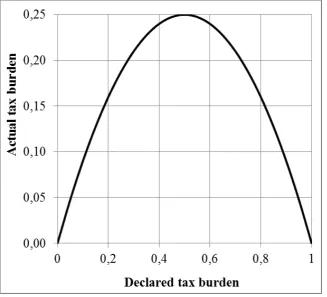
. Then the actual tax burden may be described by function:
1
2n
. 1 2 ; 0 0,5;. 2 0. Thus at
0,5
[image:14.595.57.385.212.509.2] we get maximum of θ:
0,5 0,25 (Fig. 1).Figure 1. The dependence of actual tax burden from declared based on the simple Laffer function
It is clear the function n may also be more complicated.
In our opinion, Arthur Laffer and his followers simplify the situation in this way. In Laffer’s model of behaviour the taxpayer either the payer agrees to pay the tax and pays it or refuses to pay the tax and does not pay it. In addition the reasons that motivate payers to compliance their responsibilities, maybe against their desire are not considered, also does not taken into account the possibility of punishing those who evade from paying, with the additional payment of post-factum.
a set of parameters of relationship’s environment. Such an improvement of the model shows that the function the actual tax burden from the declared has potentially three local maxima, not one (and in accordance, 2 local minima, if not to count end-points
[image:15.595.58.531.220.501.2]0 and 1) (Fig. 2).
Figure 2. The dependence of actual tax burden from declared, calculated on the basis of the game model
Conclusion
1.The classic Alingham – Sandmo’s model, was very innovative for its time, has a number of shortcomings, first of all, regarding to not taking into account several important determinants of the behavior of economic agents - taxpayer and tax inspector, namely:
the model fixes a tax inspector’s behaviour in general terms, given only single
parameter – the probability of checking of the declaration;
is ignored the fact tax inspections, the tax evasion's camouflage and the
presentation of the conscientious behavior by the payer are not free and need resource spend.
2.Such model constraints lead to distortion of economic behaviour of contractors: Nash equilibriums that provide for the total government’s control, at once, the total conscientiousness or, conversely, the total payer’s evasion; the independence of optimal agent’s behaviour of tax burden.
3.The model of the relationship of the taxpayer and the inspector, takes into account above factors, releases the contractor's behaviour of these imperfections. Apart from the fact that this is useful for obtaining additional information on the behavioral obligations of the payer and the controller, the above fact indicates the common ways of complicating the model: limit on the number of inspections; the implementation of non-elementary functions of expected utility; the application of non-mainstream behavioral theories (non-expected utility, prospect theory, etc.) are not fundamental decisions, therefore them can be completely ignored.
Reference
Allingham, М. G. & Sandmo, A., 1972. Income Tax Evasion: a Theoretical Analysis. J. Public Economic, 1(3/4), pp. 323-338.
Baldry, J. C., 1984. The Enforcement in Income Tax Laws: Efficiency Implications. Economic Rec., Juno, pp. 156-159.
Bayer, R.-C., 2006. A contest with the taxman – the impact of tax rates on tax evasion and wastefully invested resources. European Economic Review, 50(5), pp. 1071-1104.
Borck, R., 2004. Stricter enforcement may increase tax evasion. European Journal of Political Economy, 20(3), pp. 725-737.
Bordignon, M., 1993.A fairness approach to income tax evasion. Journal of Public Economics, 52(3), pp. 345-362.
Christiansen, V., 1980. Two Comments on Tax Evasion. J. Public Economic. – 1980, 13(3), pp. 389-393.
Cremer, H. & Gahvari, F., 1993. Tax evasion and optimal commodity taxation. Journal of Public Economics, 50(2), pp. 261-275.
Davidson, C., Martin, L. W. & Wilson, J. D., 2005. Tax evasion as an optimal tax device. Economics Letters, 86(2), pp. 285-289.
Dhami, S. & al-Nowaihi, A., 2007. Why do people pay taxes? Prospect theory versus expected utility theory. Journal of Economic Behavior & Organization, 64(1), pp. 171-192.
Dhami, S. & al-Nowaihi, A., 2010. Optimal taxation in the presence of tax evasion: Expected utility versus prospect theory. Journal of Economic Behavior & Organization, 75(2), pp. 313-337.
Elffers, H. & Hessing, D. J., 1997. Influencing the prospects of tax evasion. Journal of Economic Psychology, 18(2-3), pp. 289-304.
Elffers, H., Weigel, R. H. & Hessing, D. J., 1987. The consequences of different strategies for measuring tax evasion behavior. Journal of Economic Psychology, 8(3), pp. 311-337.
Gottlieb, D., 1985. Tax evasion and the prisoner’s dilemma. Mathematical Social Sciences, 10(1), pp. 81-89.
Konrad, K. & Skaperdas, S., 1993. Self-insurance and self-protection: a nonexpected utility analysis. Geneva Papers on Risk and Insurance Theory, 18, pp. 131-146.
Koskela, E., 1983. A note on progression, penalty schemes and tax evasion. Journal of Public Economics, 22(1), pp. 127-133.
Landskroner, Y., Muller, E. & Swary, I., 1991. Tax evasion and financial equilibrium. Journal of Economics and Business, 43(1), pp. 25-35.
Levaggi, R. & Menoncin, F., 2012. Tax audits, fines and optimal tax evasion in a dynamic context. Economics Letters, 117(1), pp. 318-321.
McCaleb, T. S., 1976. Tax Evasion and the Differential Taxation of Labor and Capital Income. Public Finance, XXXI(2), pp. 287-294.
Sandmo, A., 2004. The theory of tax evasion: A retrospective view. Norwegian School of Economics and Business Administration, 31-04, 31 p.
Singh, В., 1973. Making Honesty as the Best Policy. J. Public Economic, 2(3), pp. 257-263.
Slemrod, J. & Yitzhaki, S., 2000. Tax Avoidance, Evasion and Administration. NBER, WP #7473, 79 p.
Srinivasan, Т. N., 1973. Tax Evasion: a Model / Т. N. Srinivasan // J. Public Economic, 2(4), pp. 339-346.
Wallschutzky, I. G., 1984. Possible causes of tax evasion. Journal of Economic Psychology, 5(4), pp. 371-384.
Yaniv, G., 1988. Withholding and non-withheld tax evasion. Journal of Public Economics, 35(2), pp. 183-204.