364
CUED@WMT19:EWC&LMs
Felix Stahlberg† and Danielle Saunders† and Adri`a de Gispert‡ and Bill Byrne‡† †Department of Engineering, University of Cambridge, UK
‡SDL Research, Cambridge, UK
{fs439, ds636, wjb31}@cam.ac.uk,{agispert, bbyrne}@sdl.com
Abstract
Two techniques provide the fabric of the Cam-bridge University Engineering Department’s (CUED) entry to theWMT19evaluation cam-paign: elastic weight consolidation (EWC) and different forms of language modelling (LMs). We report substantial gains by fine-tuning very strong baselines on former WMT test sets using a combination of checkpoint averaging and EWC. A sentence-level Trans-former LM and a document-level LM based on a modified Transformer architecture yield fur-ther gains. As in previous years, we also ex-tractn-gram probabilities from SMT lattices which can be seen as a source-conditionedn -gram LM.
1 Introduction
Both fine-tuning and language modelling are tech-niques widely used for NMT. Fine-tuning is of-ten used to adapt a model to a new domain ( Lu-ong and Manning, 2015), while ensembling neu-ral machine translation (NMT) with neuneu-ral lan-guage models (LMs) is an effective way to lever-age monolingual data (Gulcehre et al.,2015,2017; Stahlberg et al., 2018a). Our submission to the WMT19 news shared task relies on ideas from these two lines of research, but applies and com-bines them in novel ways. Our contributions are:
• Elastic weight consolidation (Kirkpatrick et al., 2017, EWC) is a domain adaptation technique that aims to avoid degradation in performance on the original domain. We re-port large gains from fine-tuning our mod-els on former English-German WMT test sets with EWC. We find that combining fine-tuning with checkpoint averaging ( Junczys-Dowmunt et al., 2016b,a) yields further sig-nificant gains. Fine-tuning is less effective for German-English.
• Inspired by the shallow fusion technique byGulcehre et al.(2015,2017) we ensemble our neural translation models with neural lan-guage models. While this technique is effec-tive for single models, the gains are diminish-ing under NMT ensembles trained with large amounts of back-translated sentences.
• To incorporate document-level context in a light-weight fashion, we propose a modifi-cation to the Transformer (Vaswani et al., 2017) that has separate attention layers for inter- and intra-sentential context. We re-port large perplexity reductions compared to sentence-level LMs under the new architec-ture. Our document-level LM yields small BLEU gains on top of strong NMT ensem-bles, and we hope to benefit even more from it in document-level human evaluation.
• Even though the performance gap between NMT and traditional statistical machine translation (SMT) is growing rapidly on the task at hand, SMT can still improve very strong NMT ensembles. To combine NMT and SMT we followStahlberg et al.(2017a, 2018b) and build a specialized n-gram LM for each sentence that computes the risk of hypotheses relative to SMT lattices.
• While data filtering was central in last year’s evaluation (Koehn et al., 2018b; Junczys-Dowmunt, 2018b), in our experiments this year we found that a very simple filter-ing approach based on a small number of crude heuristics can perform as well as dual conditional cross-entropy filtering ( Junczys-Dowmunt,2018a,b).
2 Document-level Language Modelling
MT systems usually translate sentences in isola-tion. However, there is evidence that humans also take context into account, and judge trans-lations from humans with access to the full doc-ument higher than the output of a state-of-the-art sentence-level machine translation system (L¨aubli et al., 2018). Common examples of ambiguity which can be resolved with cross-sentence con-text are pronoun agreement or consistency in lex-ical choice. This year’s WMT competition en-couraged submissions of translation systems that are sensitive to cross-sentence context. We ex-plored the use of document-level language models to enhance a sentence-level translation system. We argue that this is a particularly light-weight way of incorporating document-level context. First, the LM can be trained independently on mono-lingual target language documents, i.e. no parallel or source language documents are needed. Sec-ond, since our document-level decoder operates on the n-best lists from a sentence-level trans-lation system, existing transtrans-lation infrastructure does not have to be changed – we just add an-other (document-level) decoding pass. On a prac-tical note, this means that, by skipping the second decoding pass, our system would work well even for the translation of isolated sentences when no document context is available.
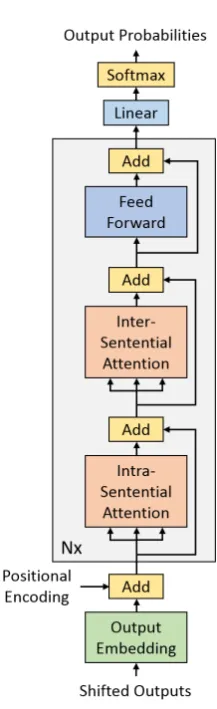
[image:2.595.364.473.54.410.2]Our document-level LMs are trained on the concatenations of all sentences in target language documents, separated by special sentence bound-ary tokens. Training a standard Transformer LM (Vaswani et al., 2017) on this data already yields significant reductions in perplexity com-pared to sentence-level LMs. However, the at-tention layers have to capture two kinds of de-pendencies – the long-range cross-sentence con-text and the short-range concon-text within the sen-tence. Our modified Intra-Inter Transformer ar-chitecture (Fig. 1) splits these two responsibili-ties into two separate layers using masking. The “Intra-Sentential Attention” layer only allows to attend to the previous tokens in the current sen-tence, i.e. the intra-sentential attention mask acti-vates the tokens between the most recent sentence boundary marker and the current symbol. The “Inter-Sentential Attention” layer is restricted to the tokens in all previouscompletesentences, i.e. the mask enables all tokens from the document beginning to the most recent sentence boundary
Figure 1: Our modified Intra-Inter Transformer archi-tecture with two separate attention layers.
marker. As usual (Vaswani et al., 2017), during training the attention masks are also designed to prevent attending to future tokens. Fig. 2 shows an example of the different masks. Note that as illustrated in Fig.1, both attention layers are part of the same layer stack which allows a tight inte-gration of both types of context. An implication of this design is that they also use the same posi-tional embedding – the posiposi-tional encoding for the first unmasked item for intra-sentential attention may not be zero. For example, ‘Lonely’ has the position 10 in Fig.2although it is the first word in the current sentence.
Vinyl destination : who is actually buying records ? < /s >Lonely , middle-aged men love ‘???’
Position 0 1 2 3 4 5 6 7 8 9 10 11 12 13 14 15
Intra-sentential 0 0 0 0 0 0 0 0 0 0 1 1 1 1 1
-Inter-sentential 1 1 1 1 1 1 1 1 1 1 0 0 0 0 0
-Figure 2: Intra-sentential and inter-sentential attention masks for an English example fromnews-test2017. Document-level context helps to predict the next word (‘vinyl’).
We stop when the translation score difference to the first-best translation exceeds a threshold.1
3 Experimental Setup
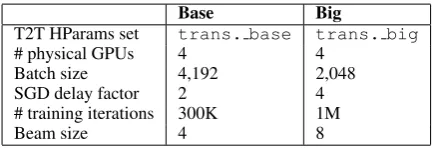
Our experimental setup is essentially the same as last year (Stahlberg et al., 2018b): Our pre-processing includes Moses tokenization, punctu-ation normalizpunctu-ation, truecasing, and joint sub-word segmentation using byte pair encoding ( Sen-nrich et al., 2016c) with 32K merge opera-tions. We compute cased BLEU scores with mteval-v13a.pl that are directly compara-ble with the official WMT scores.2 Our mod-els are trained with the TensorFlow (Abadi et al., 2016) based Tensor2Tensor (Vaswani et al.,2018) library and decoded with our SGNMT frame-work (Stahlberg et al., 2017b, 2018c). We delay SGD updates (Saunders et al., 2018) to use larger training batch sizes than our tech-nical infrastructure3 would normally allow with vanilla SGD by using the MultistepAdam optimizer in Tensor2Tensor. We use Trans-former (Vaswani et al.,2017) models in two con-figurations (Tab. 1). Preliminary experiments are carried out with the ‘Base’ configuration while we use the ‘Big’ models for our final system. We usenews-test2017as development set to tune model weights and select checkpoints and news-test2018as test set.
3.1 ParaCrawl Corpus Filtering
Junczys-Dowmunt(2018a,b) reported large gains from filtering the ParaCrawl corpus. This year, the WMT organizers made version 3 of the ParaCrawl corpus available. We compared two different filtering approaches on the new data set. First, we implemented dual cross-entropy filtering (Junczys-Dowmunt, 2018a,b), a sophis-ticated data selection criterion based on neural
1
Tensor2Tensor implementation: https://github. com/fstahlberg/ucam-scripts/blob/master/ t2t/t2t_refine_with_glue_lm.py
2
http://matrix.statmt.org/
3The Cambridge HPC service (http://www.hpc. cam.ac.uk/) allows parallel training on up to four phys-ical P100 GPUs.
Base Big
T2T HParams set trans. base trans. big
# physical GPUs 4 4 Batch size 4,192 2,048 SGD delay factor 2 4 # training iterations 300K 1M
[image:3.595.66.530.62.104.2]Beam size 4 8
Table 1: Transformer setups.
language model and neural machine translation model scores in both translation directions. In ad-dition, we used the “naive” filtering heuristics pro-posed byStahlberg et al.(2018b):
• Language detection (Nakatani,2010) in both source and target language.
• No words contain more than 40 characters.
• Sentences must not contain HTML tags.
• The minimum sentence length is 4 words.
• The character ratio between source and target must not exceed 1:3 or 3:1.
• Source and target sentences must be equal af-ter stripping out non-numerical characaf-ters.
• Sentences must end with punctuation marks.
Tab. 2 indicates that our systems benefit from ParaCrawl even without filtering (rows 1 vs. 2). Our best ‘Base’ model uses both dual and naive fil-tering. However, the difference between filtering techniques diminishes under stronger ‘Big’ mod-els with back-translation (rows 6 and 7).
4 Results
4.1 Back-translation
[image:3.595.308.526.155.229.2]Model ParaCrawl Naive BLEU
filtering test15 test16 test17 test18
1 Base No 29.3 34.1 27.8 41.9
2 Base Full 30.0 35.3 28.2 43.1
3 Base Full X 30.3 35.6 28.6 43.5
[image:4.595.112.493.62.151.2]4 Base Dual x-ent filtering 30.2 35.5 28.7 43.6 5 Base Dual x-ent filtering X 30.6 35.7 28.8 43.8 6 Big (with back-translation) Full X 32.4 38.5 31.2 46.6 7 Big (with back-translation) Dual x-ent filtering X 32.7 38.1 31.1 46.6
Table 2: Comparison of ParaCrawl filtering techniques. The rest of the training data is over-sampled to roughly match the size of the filtered ParaCrawl corpus. In the ‘Dual x-ent filtering’ experiments we selected the 15M best sentences according the dual cross-entropy filtering criterion ofJunczys-Dowmunt(2018a).
news-2016 news-2017 news-2018 Noise BLEU
(35M sentences) (20M sentences) (37M sentences) test15 test16 test17 test18
1 30.2 35.7 28.7 43.8
2 X 30.8 36.2 29.8 44.3
3 X 30.4 35.8 29.4 43.2
4 X X 30.3 35.9 29.5 43.1
5 X X 31.0 36.6 29.7 44.8
6 X X 30.7 36.6 29.5 44.7
7 X X X 30.6 36.6 29.5 44.4
8 X X X 31.3 37.4 30.0 45.2
[image:4.595.100.506.209.321.2]9 X X X X 31.3 37.3 30.3 45.2
Table 3: Using different corpora for back-translation. We back-translated with a ‘base’ model fornews-2017
and the big single Transformer model ofStahlberg et al.(2018b) fornews-2016andnews-2018.
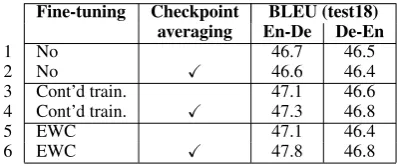
Fine-tuning Checkpoint BLEU (test18) averaging En-De De-En
1 No 46.7 46.5
2 No X 46.6 46.4
3 Cont’d train. 47.1 46.6 4 Cont’d train. X 47.3 46.8
5 EWC 47.1 46.4
6 EWC X 47.8 46.8
Table 4: Fine-tuning our models on former WMT test sets using continued training and EWC.
has to be balanced with the amount of real par-allel data (Sennrich et al.,2016b,a;Poncelas et al., 2018). Edunov et al. (2018) had overcome this limitation by adding random noise to the synthetic source sentences. Tab. 3 shows that using noise improves the BLEU score by between 0.5 and 1.5 points on thenews-test2018test set (rows 2-4 vs. 5-7).4 Our final model uses a very large num-ber (92M) of (noisy) synthetic sentences (row 9), although the same performance could already be reached with fewer sentences (row 8).
4.2 Fine-tuning with EWC and Checkpoint Averaging
Fine-tuning (Luong and Manning, 2015) is a do-main adaptation technique that first trains a model
4We use Sergey Edunov’s addnoise.py script available at https://gist.github.com/edunov/ d67d09a38e75409b8408ed86489645dd
until it converges on a training corpus A, and then continues training on a usually much smaller cor-pus B which is close to the target domain. Sim-ilarly to Schamper et al. (2018); Koehn et al. (2018a), we fine-tune our models on former WMT test sets (2008-2016) to adapt them to the target domain of high-quality news translations. Due to the very small size of corpus B, much care has to be taken to avoid over-fitting. We exper-imented with different techniques that keep the model parameters in the fine-tuning phase close to the original ones. First, we fine-tuned our mod-els for about 1K-2K iterations (depending on the performance on the news-test2017 dev set) and dumped checkpoints every 500 steps. Av-eraging all fine-tuning checkpoints together with the last unadapted checkpoint yields minor gains over fine-tuning without averaging (rows 3 vs. 4 in Tab. 4). However, we obtain the best results by combining checkpoint averaging with another regularizer – elastic weight consolidation ( Kirk-patrick et al., 2017, EWC) – that explicitly pe-nalizes the distance of the model parametersθ to the optimized but unadapted model parametersθ∗A. The regularized training objective according EWC is:
L(θ) =LB(θ) +λ X
i
[image:4.595.84.283.372.455.2]Perplexity (per subword)
Model Context German English
test15 test16 test17 test18 test15 test16 test17 test18
[image:5.595.89.511.61.124.2]Standard (Big) Sentence-level 36.23 35.69 36.17 34.77 39.94 37.19 35.34 42.38 Standard(Big) Document-level 26.63 27.85 25.43 28.36 43.37 34.55 31.27 39.74 Intra-Inter (Big) Document-level 23.54 22.39 22.05 22.56 34.25 31.16 29.31 34.47
Table 5: Language model perplexities of different neural language models. ‘Intra-Inter’ denotes our modified Transformer architecture from Sec.2. The standard model has 448M parameters, Intra-Inter has 549M parameters.
English-German German-English
Base Big (with EWC) Base Big (with EWC) Single Single 4-Ensemble Single Single 4-Ensemble
1 Using back-translation? No Yes Yes No Yes Yes
2 NMT 43.8 47.8 48.8 40.7 47.4 48.3
3 + Sentence-level LM 44.7 47.8 48.8 41.4 47.6 48.3 4 + PBSMT (MBR-based) 45.1 48.0 49.1 42.1 47.6 48.5 5 + Document-level Intra-Inter LM 45.7 47.6 49.3 42.1 47.3 48.6
Table 6: Using different kinds of language models for translation onnews-test2018. The PBSMT baseline gets 26.7 BLEU on English-German and 27.5 BLEU on German-English.
where LB(θ) is the normal cross-entropy train-ing loss on task B and Fi = E∇2LA(θi)
is an estimate of task A Fisher information, which represents the importance of parameter θi to A. On English-German, fine-tuning with EWC and checkpoint averaging yields an 1.1 BLEU im-provement (rows 1 vs. 6 in Tab.4). Gains are gen-erally smaller on German-English.
4.3 Language modelling
We introduced our new Intra-Inter Transformer architecture for document-level language mod-elling in Sec. 2. Tab. 5 shows that our architec-ture achieves much better perplexity than both a sentence-level language model and a document-level vanilla Transformer model. Tab. 6 summa-rizes our translation results with various kinds of language models. Adding a Transformer sentence-level LM to NMT helps for the single Base model without back-translation, but is less effective on top of (ensembles of) Big models with back-translation (row 2 vs. 3). Extractingn-gram prob-abilities from traditional PBSMT lattices as de-scribed byStahlberg et al.(2017a) and using them as source-conditioned n-gram LMs yields gains even on top of our ensembles (row 4). Our document-level Intra-Inter language models im-prove the ensembles and the single En-De Base model, but hurt performance slightly for the single Big models (row 5).
5 Related Work
Regularized fine-tuning Our approach to fine-tuning is a combination of EWC (Kirkpatrick
et al., 2017) and checkpoint averaging ( Junczys-Dowmunt et al., 2016b,a). In our context, both methods aim to avoid catastrophic forget-ting5 (Goodfellow et al.,2013;French,1999) and over-fitting by keeping the adapted model close to the original, and can thus be seen as regularized fine-tuning techniques. Khayrallah et al.(2018); Dakwale and Monz(2017) regularized the output distributions during fine-tuning using techniques inspired by knowledge distillation (Bucilu et al., 2006;Hinton et al., 2014;Kim and Rush,2016). Barone et al.(2017) applied standard L2 regular-ization and a variant of dropout to domain adap-tation. EWC as generalization of L2 regulariza-tion has been used for NMT domain adaptaregulariza-tion byThompson et al.(2019);Saunders et al.(2019). In particular, Saunders et al. (2019) showed that EWC is not only more effective than L2 in reduc-ing catastrophic forgettreduc-ing but even yields gains on the general domain when used for fine-tuning on a related domain.
Document-level MT Various techniques have been proposed to provide the translation system with inter-sentential context, for example by ini-tializing encoder or decoder states (Wang et al., 2017a), using multi-source encoders (Bawden et al., 2018;Jean et al., 2017), as additional de-coder input (Wang et al., 2017a), with memory-augmented neural networks (Tu et al.,2018;Maruf and Haffari, 2018; Kuang et al., 2017),
[image:5.595.92.514.167.248.2]chical attention (Miculicich et al., 2018; Maruf et al.,2019), deliberation networks (Xiong et al., 2018), or by simply concatenating multiple source and/or target sentences (Tiedemann and Scherrer, 2017;Bawden et al.,2018). Context-aware exten-sions to Transformer encoders have been proposed byVoita et al.(2018);Zhang et al.(2018). Tech-niques also differ in whether they use source con-text only (Jean et al., 2017; Wang et al., 2017a; Voita et al.,2018;Zhang et al.,2018), target con-text only (Tu et al., 2018; Kuang et al., 2017), or both (Bawden et al., 2018; Maruf and Haf-fari,2018;Miculicich et al.,2018;Tiedemann and Scherrer,2017;Maruf et al.,2019). Several stud-ies on document-level NMT indicate that auto-matic and human sentence-level evaluation met-rics often do not correlate well with improvements in discourse level phenomena (Bawden et al., 2018; L¨aubli et al., 2018; M¨uller et al., 2018). Our document-level LM approach is similar to the work ofXiong et al.(2018) in that cross-sentence context is only used in a second pass to improve translations from a sentence-level MT system. Our method is light-weight as, similarly toTiedemann and Scherrer(2017), we do not modify the archi-tecture of the core NMT system.
NMT-SMT hybrid systems Popular examples of combining a fully trained SMT system with independently trained NMT are rescoring and reranking methods (Neubig et al.,2015;Stahlberg et al., 2016b; Khayrallah et al., 2017; Grund-kiewicz and Junczys-Dowmunt, 2018;Avramidis et al., 2016; Marie and Fujita, 2018; Zhang et al., 2017), although these models may be too constraining if the neural system is much stronger than the SMT system. Loose combina-tion schemes include the edit-distance-based sys-tem of Stahlberg et al. (2016a) or the minimum Bayes-risk approach ofStahlberg et al.(2017a) we adopted in this work. NMT and SMT can also be combined in a cascade, with SMT providing the input to a post-processing NMT system (Niehues et al.,2016;Zhou et al.,2017) or vice versa (Du and Way, 2017). Wang et al. (2017b, 2018) in-terpolated NMT posteriors with word recommen-dations from SMT and jointly trained NMT to-gether with a gating function which assigns the weight between SMT and NMT scores dynami-cally. The AMU-UEDIN submission to WMT16 let SMT take the lead and used NMT as a fea-ture in phrase-based MT (Junczys-Dowmunt et al.,
English-German
Team BLEU
MSRA 44.9
Microsoft 43.9
NEU 43.5
UCAM 43.0
Facebook FAIR 42.7
JHU 42.5
eTranslation 41.9 8 more...
German-English
Team BLEU
MSRA 42.8
Facebook FAIR 40.8
NEU 40.5
UCAM 39.7
RWTH 39.6
MLLP-UPV 39.3
DFKI 38.8
[image:6.595.306.527.62.163.2]4 more...
Table 7: English-German and German-English primary submissions to the WMT19 shared task.
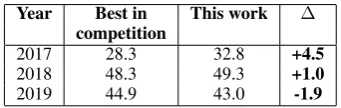
Year Best in This work ∆ competition
2017 28.3 32.8 +4.5
2018 48.3 49.3 +1.0
2019 44.9 43.0 -1.9
Table 8: Comparison of our English-German system with the winning submissions over the past two years.
2016b). In contrast,Long et al.(2016) translated most of the sentence with an NMT system, and just used SMT to translate technical terms in a post-processing step.Dahlmann et al.(2017) pro-posed a hybrid search algorithm in which the neu-ral decoder expands hypotheses with phrases from an SMT system.
6 Conclusion
Our WMT19 submission focused on regular-ized fine-tuning and language modelling. With our novel Intra-Inter Transformer architecture for document-level LMs we achieved significant re-ductions in perplexity and minor improvements in BLEU over very strong baselines. A combination of checkpoint averaging and EWC proved to be an effective way to regularize fine-tuning. Our sys-tems are competitive on both English-German and German-English (Tab. 7), especially considering the immense speed with which our field has been advancing in recent years (Tab.8).
Acknowledgments
This work was supported by the U.K. Engineering and Physical Sciences Research Council (EPSRC) grant EP/L027623/1 and has been performed us-ing resources provided by the Cambridge Tier-2 system operated by the University of Cambridge Research Computing Service6 funded by EPSRC Tier-2 capital grant EP/P020259/1.
[image:6.595.331.502.208.262.2]References
Mart´ın Abadi, Paul Barham, Jianmin Chen, Zhifeng Chen, Andy Davis, Jeffrey Dean, Matthieu Devin, Sanjay Ghemawat, Geoffrey Irving, Michael Isard, et al. 2016. TensorFlow: A system for large-scale machine learning. InProceedings of the 12th USENIX conference on Operating Systems Design and Implementation, pages 265–283. USENIX As-sociation.
Eleftherios Avramidis, Vivien Macketanz, Aljoscha Burchardt, Jindrich Helcl, and Hans Uszkoreit. 2016. Deeper machine translation and evaluation
for German. In Proceedings of the 2nd Deep
Ma-chine Translation Workshop, pages 29–38. ´UFAL MFF UK.
Antonio Valerio Miceli Barone, Barry Haddow, Ulrich Germann, and Rico Sennrich. 2017. Regularization techniques for fine-tuning in neural machine
trans-lation. In Proceedings of the 2017 Conference on
Empirical Methods in Natural Language Process-ing, pages 1489–1494, Copenhagen, Denmark. As-sociation for Computational Linguistics.
Rachel Bawden, Rico Sennrich, Alexandra Birch, and Barry Haddow. 2018. Evaluating discourse
phe-nomena in neural machine translation. In
Proceed-ings of the 2018 Conference of the North American Chapter of the Association for Computational Lin-guistics: Human Language Technologies, Volume 1 (Long Papers), pages 1304–1313, New Orleans, Louisiana. Association for Computational Linguis-tics.
Cristian Bucilu, Rich Caruana, and Alexandru Niculescu-Mizil. 2006. Model compression. In Proceedings of the 12th ACM SIGKDD interna-tional conference on Knowledge discovery and data mining, pages 535–541. ACM.
Leonard Dahlmann, Evgeny Matusov, Pavel Petrushkov, and Shahram Khadivi. 2017. Neu-ral machine translation leveraging phrase-based
models in a hybrid search. In Proceedings of the
2017 Conference on Empirical Methods in Natural Language Processing, pages 1411–1420, Copen-hagen, Denmark. Association for Computational Linguistics.
Praveen Dakwale and Christof Monz. 2017. Fine-tuning for neural machine translation with limited degradation across in-and out-of-domain data. Pro-ceedings of the XVI Machine Translation Summit, page 117.
Jinhua Du and Andy Way. 2017. Neural pre-translation for hybrid machine translation. In Proceedings of MT Summit XVI, 1:27–40.
Sergey Edunov, Myle Ott, Michael Auli, and David Grangier. 2018. Understanding back-translation at scale. In Proceedings of the 2018 Conference on Empirical Methods in Natural Language Process-ing, pages 489–500.
Robert M French. 1999. Catastrophic forgetting in connectionist networks. Trends in cognitive sci-ences, 3(4):128–135.
Ian J Goodfellow, Mehdi Mirza, Da Xiao, Aaron Courville, and Yoshua Bengio. 2013. An em-pirical investigation of catastrophic forgetting in gradient-based neural networks. arXiv preprint arXiv:1312.6211.
Roman Grundkiewicz and Marcin Junczys-Dowmunt. 2018. Near human-level performance in grammati-cal error correction with hybrid machine translation. InProceedings of the 2018 Conference of the North American Chapter of the Association for Compu-tational Linguistics: Human Language Technolo-gies, Volume 2 (Short Papers), pages 284–290, New Orleans, Louisiana. Association for Computational Linguistics.
Caglar Gulcehre, Orhan Firat, Kelvin Xu, Kyunghyun Cho, Loic Barrault, Huei-Chi Lin, Fethi Bougares, Holger Schwenk, and Yoshua Bengio. 2015. On us-ing monolus-ingual corpora in neural machine transla-tion. arXiv preprint arXiv:1503.03535.
Caglar Gulcehre, Orhan Firat, Kelvin Xu, Kyunghyun Cho, and Yoshua Bengio. 2017. On integrating
a language model into neural machine translation.
Computer Speech & Language, 45:137 – 148.
Geoffrey Hinton, Oriol Vinyals, and Jeff Dean. 2014. Distilling the knowledge in a neural network. In NIPS Deep Learning Workshop.
Sebastien Jean, Stanislas Lauly, Orhan Firat, and Kyunghyun Cho. 2017. Does neural machine trans-lation benefit from larger context? arXiv preprint arXiv:1704.05135.
Marcin Junczys-Dowmunt. 2018a. Dual conditional cross-entropy filtering of noisy parallel corpora. In Proceedings of the Third Conference on Machine Translation: Shared Task Papers, pages 888–895, Belgium, Brussels. Association for Computational Linguistics.
Marcin Junczys-Dowmunt. 2018b. Microsoft’s sub-mission to the WMT2018 news translation task:
How I learned to stop worrying and love the data.
InProceedings of the Third Conference on Machine Translation: Shared Task Papers, pages 425–430. Association for Computational Linguistics.
Marcin Junczys-Dowmunt, Tomasz Dwojak, and Hieu Hoang. 2016a. Is neural machine translation ready for deployment? A case study on 30 translation di-rections. InInternational Workshop on Spoken Lan-guage Translation IWSLT.
Huda Khayrallah, Gaurav Kumar, Kevin Duh, Matt Post, and Philipp Koehn. 2017. Neural lattice search
for domain adaptation in machine translation. In
Proceedings of the Eighth International Joint Con-ference on Natural Language Processing (Volume 2: Short Papers), pages 20–25, Taipei, Taiwan. Asian Federation of Natural Language Processing.
Huda Khayrallah, Brian Thompson, Kevin Duh, and Philipp Koehn. 2018. Regularized training objective for continued training for domain adaptation in neu-ral machine translation. InProceedings of the 2nd Workshop on Neural Machine Translation and Gen-eration, pages 36–44, Melbourne, Australia. Asso-ciation for Computational Linguistics.
Yoon Kim and Alexander M. Rush. 2016. Sequence-level knowledge distillation. InProceedings of the 2016 Conference on Empirical Methods in Natu-ral Language Processing, pages 1317–1327, Austin, Texas. Association for Computational Linguistics.
James Kirkpatrick, Razvan Pascanu, Neil Rabinowitz, Joel Veness, Guillaume Desjardins, Andrei A Rusu, Kieran Milan, John Quan, Tiago Ramalho, Ag-nieszka Grabska-Barwinska, et al. 2017. Over-coming catastrophic forgetting in neural networks. Proceedings of the national academy of sciences, 114(13):3521–3526.
Philipp Koehn, Kevin Duh, and Brian Thompson. 2018a. The JHU machine translation systems for
WMT 2018. In Proceedings of the Third
Confer-ence on Machine Translation: Shared Task Papers, pages 438–444, Belgium, Brussels. Association for Computational Linguistics.
Philipp Koehn, Huda Khayrallah, Kenneth Heafield, and Mikel L. Forcada. 2018b. Findings of the WMT 2018 shared task on parallel corpus filtering. In Pro-ceedings of the Third Conference on Machine Trans-lation: Shared Task Papers, pages 726–739, Bel-gium, Brussels. Association for Computational Lin-guistics.
Shaohui Kuang, Deyi Xiong, Weihua Luo, and Guodong Zhou. 2017. Cache-based document-level neural machine translation. arXiv preprint arXiv:1711.11221.
Samuel L¨aubli, Rico Sennrich, and Martin Volk. 2018. Has machine translation achieved human parity? A case for document-level evaluation. InProceedings of the 2018 Conference on Empirical Methods in Natural Language Processing, pages 4791–4796.
Zi Long, Takehito Utsuro, Tomoharu Mitsuhashi, and Mikio Yamamoto. 2016. Translation of patent sen-tences with a large vocabulary of technical terms
us-ing neural machine translation. In Proceedings of
the 3rd Workshop on Asian Translation (WAT2016), pages 47–57. The COLING 2016 Organizing Com-mittee.
Minh-Thang Luong and Christopher D Manning. 2015. Stanford neural machine translation systems for spo-ken language domains. In Proceedings of the In-ternational Workshop on Spoken Language Transla-tion, pages 76–79.
Benjamin Marie and Atsushi Fujita. 2018. A smorgas-bord of features to combine phrase -based and neural machine translation. InProceedings of AMTA Work-shop on MT Research and the Translation Industry, Boston, US.
Sameen Maruf and Gholamreza Haffari. 2018. Docu-ment context neural machine translation with
mem-ory networks. In Proceedings of the 56th Annual
Meeting of the Association for Computational Lin-guistics (Volume 1: Long Papers), pages 1275– 1284, Melbourne, Australia. Association for Com-putational Linguistics.
Sameen Maruf, Andr´e F. T. Martins, and Gholamreza Haffari. 2019. Selective attention for context-aware
neural machine translation. InProceedings of the
2019 Conference of the North American Chapter of the Association for Computational Linguistics: Hu-man Language Technologies, Volume 1 (Long and Short Papers), pages 3092–3102, Minneapolis, Min-nesota. Association for Computational Linguistics.
Lesly Miculicich, Dhananjay Ram, Nikolaos Pappas, and James Henderson. 2018. Document-level neural machine translation with hierarchical attention
net-works. InProceedings of the 2018 Conference on
Empirical Methods in Natural Language Process-ing, pages 2947–2954, Brussels, Belgium. Associ-ation for ComputAssoci-ational Linguistics.
Mathias M¨uller, Annette Rios, Elena Voita, and Rico Sennrich. 2018. A large-scale test set for the eval-uation of context-aware pronoun translation in neu-ral machine translation. InProceedings of the Third Conference on Machine Translation: Research Pa-pers, pages 61–72, Belgium, Brussels. Association for Computational Linguistics.
Shuyo Nakatani. 2010. Language detection library for Java.
Graham Neubig, Makoto Morishita, and Satoshi Naka-mura. 2015. Neural reranking improves subjective
quality of machine translation: NAIST at WAT2015.
In Proceedings of the 2nd Workshop on Asian Translation (WAT2015), pages 35–41, Kyoto, Japan. Workshop on Asian Translation.
Jan Niehues, Eunah Cho, Thanh-Le Ha, and Alex Waibel. 2016. Pre-translation for neural machine
translation. In Proceedings of COLING 2016, the
26th International Conference on Computational Linguistics: Technical Papers, pages 1828–1836. The COLING 2016 Organizing Committee.
Danielle Saunders, Felix Stahlberg, Adri`a de Gispert, and Bill Byrne. 2018. Multi-representation en-sembles and delayed SGD updates improve
syntax-based NMT. In Proceedings of the 56th Annual
Meeting of the Association for Computational Lin-guistics (Volume 2: Short Papers), pages 319–325. Association for Computational Linguistics.
Danielle Saunders, Felix Stahlberg, Adri`a de Gispert, and Bill Byrne. 2019. Domain adaptive inference for neural machine translation. In Proceedings of the 57th Annual Meeting of the Association for Com-putational Linguistics (Volume 2: Short Papers). As-sociation for Computational Linguistics.
Julian Schamper, Jan Rosendahl, Parnia Bahar, Yunsu Kim, Arne Nix, and Hermann Ney. 2018. The RWTH Aachen university supervised machine trans-lation systems for WMT 2018. InProceedings of the Third Conference on Machine Translation: Shared Task Papers, pages 496–503, Belgium, Brussels. As-sociation for Computational Linguistics.
Rico Sennrich, Barry Haddow, and Alexandra Birch. 2016a. Edinburgh neural machine translation
sys-tems for WMT 16. In Proceedings of the First
Conference on Machine Translation, pages 371– 376, Berlin, Germany. Association for Computa-tional Linguistics.
Rico Sennrich, Barry Haddow, and Alexandra Birch. 2016b. Improving neural machine translation
mod-els with monolingual data. In Proceedings of the
54th Annual Meeting of the Association for Compu-tational Linguistics (Volume 1: Long Papers), pages 86–96. Association for Computational Linguistics.
Rico Sennrich, Barry Haddow, and Alexandra Birch. 2016c. Neural machine translation of rare words with subword units. InProceedings of the 54th An-nual Meeting of the Association for Computational Linguistics (Volume 1: Long Papers), pages 1715– 1725, Berlin, Germany. Association for Computa-tional Linguistics.
Felix Stahlberg, James Cross, and Veselin Stoyanov. 2018a. Simple fusion: Return of the language
model. InProceedings of the Third Conference on
Machine Translation: Research Papers, pages 204– 211. Association for Computational Linguistics.
Felix Stahlberg, Adri`a de Gispert, and Bill Byrne. 2018b. The University of Cambridge’s machine
translation systems for WMT18. In Proceedings
of the Third Conference on Machine Translation: Shared Task Papers, pages 504–512. Association for Computational Linguistics.
Felix Stahlberg, Adri`a de Gispert, Eva Hasler, and Bill Byrne. 2017a. Neural machine translation by minimising the Bayes-risk with respect to syntactic translation lattices. InProceedings of the 15th Con-ference of the European Chapter of the Association for Computational Linguistics: Volume 2, Short Pa-pers, pages 362–368. Association for Computational Linguistics.
Felix Stahlberg, Eva Hasler, and Bill Byrne. 2016a.
The edit distance transducer in action: The Uni-versity of Cambridge English-German system at
WMT16. In Proceedings of the First Conference
on Machine Translation: Volume 2, Shared Task Pa-pers, pages 377–384. Association for Computational Linguistics.
Felix Stahlberg, Eva Hasler, Danielle Saunders, and Bill Byrne. 2017b. SGNMT – A flexible NMT de-coding platform for quick prototyping of new mod-els and search strategies. InProceedings of the 2017 Conference on Empirical Methods in Natural Lan-guage Processing: System Demonstrations, pages 25–30. Association for Computational Linguistics.
Felix Stahlberg, Eva Hasler, Aurelien Waite, and Bill Byrne. 2016b. Syntactically guided neural machine translation. InProceedings of the 54th Annual Meet-ing of the Association for Computational LMeet-inguistics (Volume 2: Short Papers), pages 299–305. Associa-tion for ComputaAssocia-tional Linguistics.
Felix Stahlberg, Danielle Saunders, Gonzalo Iglesias, and Bill Byrne. 2018c. Why not be versatile? Ap-plications of the SGNMT decoder for machine trans-lation. InProceedings of the 13th Conference of the Association for Machine Translation in the Ameri-cas (Volume 1: Research Papers), pages 208–216. Association for Machine Translation in the Ameri-cas.
Brian Thompson, Jeremy Gwinnup, Huda Khayrallah, Kevin Duh, and Philipp Koehn. 2019. Overcoming catastrophic forgetting during domain adaptation of
neural machine translation. InProceedings of the
2019 Conference of the North American Chapter of the Association for Computational Linguistics: Hu-man Language Technologies, Volume 1 (Long and Short Papers), pages 2062–2068, Minneapolis, Min-nesota. Association for Computational Linguistics.
J¨org Tiedemann and Yves Scherrer. 2017. Neural ma-chine translation with extended context. In Proceed-ings of the Third Workshop on Discourse in Machine Translation, pages 82–92, Copenhagen, Denmark. Association for Computational Linguistics.
Zhaopeng Tu, Yang Liu, Shuming Shi, and Tong Zhang. 2018. Learning to remember translation
his-tory with a continuous cache. Transactions of the
Association for Computational Linguistics, 6:407– 420.
Ashish Vaswani, Samy Bengio, Eugene Brevdo, Fran-cois Chollet, Aidan N. Gomez, Stephan Gouws, Llion Jones, Łukasz Kaiser, Nal Kalchbrenner, Niki Parmar, Ryan Sepassi, Noam Shazeer, and Jakob Uszkoreit. 2018. Tensor2tensor for neural machine translation.CoRR, abs/1803.07416.
Elena Voita, Pavel Serdyukov, Rico Sennrich, and Ivan Titov. 2018. Context-aware neural machine trans-lation learns anaphora resolution. InProceedings of the 56th Annual Meeting of the Association for Com-putational Linguistics (Volume 1: Long Papers), pages 1264–1274, Melbourne, Australia. Associa-tion for ComputaAssocia-tional Linguistics.
Longyue Wang, Zhaopeng Tu, Andy Way, and Qun Liu. 2017a. Exploiting cross-sentence context for
neural machine translation. InProceedings of the
2017 Conference on Empirical Methods in Natu-ral Language Processing, pages 2826–2831, Copen-hagen, Denmark. Association for Computational Linguistics.
Xing Wang, Zhengdong Lu, Zhaopeng Tu, Hang Li, Deyi Xiong, and Min Zhang. 2017b. Neural machine translation advised by statistical machine translation. InAAAI, pages 3330–3336.
Xing Wang, Zhaopeng Tu, and Min Zhang. 2018. Incorporating statistical machine translation word knowledge into neural machine translation. IEEE/ACM Transactions on Audio, Speech, and Language Processing, 26(12):2255–2266.
Hao Xiong, Zhongjun He, Hua Wu, and Haifeng Wang. 2018. Modeling coherence for discourse neural ma-chine translation. arXiv preprint arXiv:1811.05683.
Jiacheng Zhang, Huanbo Luan, Maosong Sun, Feifei Zhai, Jingfang Xu, Min Zhang, and Yang Liu. 2018.
Improving the Transformer translation model with document-level context. InProceedings of the 2018 Conference on Empirical Methods in Natural Lan-guage Processing, pages 533–542, Brussels, Bel-gium. Association for Computational Linguistics.
Jingyi Zhang, Masao Utiyama, Eiichro Sumita, Gra-ham Neubig, and Satoshi Nakamura. 2017. Improv-ing neural machine translation through phrase-based
forced decoding. In Proceedings of the Eighth
In-ternational Joint Conference on Natural Language Processing (Volume 1: Long Papers), pages 152– 162, Taipei, Taiwan. Asian Federation of Natural Language Processing.