1
Transcoding compositionally: using attention to find more generalizable
solutions
Kris Korrel
University of Amsterdam
Dieuwke Hupkes
University of Amsterdam
Verna Dankers
University of Amsterdam
Elia Bruni
Universitat Pompeu Fabra
Abstract
While sequence-to-sequence models have shown remarkable generalization power across several natural language tasks, their construct of solutions are argued to be less composi-tional than human-like generalization. In this paper, we present seq2attn, a new architecture that is specifically designed to exploit atten-tion to find composiatten-tional patterns in the input. In seq2attn, the two standard components of an encoder-decoder model are connected via atranscoder, that modulates the information flow between them. We show that seq2attn can successfully generalize, without requiring any additional supervision, on two tasks which are specifically constructed to challenge the com-positional skills of neural networks. The so-lutions found by the model are highly inter-pretable, allowing easy analysis of both the types of solutions that are found and potential causes for mistakes. We exploit this opportu-nity to introduce a new paradigm to test com-positionality that studies the extent to which a modelovergeneralizeswhen confronted with exceptions. We show that seq2attn exhibits such overgeneralization to a larger degree than a standard sequence-to-sequence model.
1 Introduction
In recent years, deep artificial neural networks have been at the root of many successes in a wide variety of AI tasks, including sequential tasks, for which encoder-decoder models are the de facto standard (Cho et al.,2014;Sutskever et al.,2014). These successes have also caused a renewed inter-est in the types of solutions that they learn (Linzen et al.,2018) and, in particular, have prompted the question: to what extent can their high accuracy be taken as evidence that they in fact understood the task they are modeling. A number of recent studies argues that it cannot, when ‘understand-ing the task’ is explained as understand‘understand-ing the
im-plicit rules by which it is governed (e.g., Johnson et al.,2017;Lake and Baroni, 2018;Liˇska et al., 2018; Feng et al., 2018; Ravfogel et al., 2018). More specifically, they argue that rather than un-derstanding those implicit rules and being able to compositionally apply them, RNN models exploit biases in the data that are unrelated to the under-lying system. While the latter strategy is remark-ably effective when large amounts of training data are available, the lack of understanding of the ac-tual task leads to sample inefficiency, inability to transfer knowledge between tasks and difficulty to generalize to sequences that are drawn from the same rule space, but differ distributionally from the training data. Furthermore, the use of such strategies, which deviate largely from human ap-proaches, that are typically compositional (Lake et al.,2015), makes it difficult to understand what a model does and when it may make a mistake.
2 Related Work
2.1 Compositional datasets
The ability to learn and compositionally apply symbolic rules is considered to be an important prerequisite for understanding and modeling nat-ural language. While (gated) recurrent nenat-ural net-works are in principle capable of modeling com-positional systems (e.g., Gers and Schmidhuber, 2001;Rodriguez, 2001), whether they in fact do so when trained on large amounts of data to per-form natural language processing tasks remains an open question. Some positive results in this di-rection have been presented (e.g., Hupkes et al., 2018b), but a number of recent papers have ar-gued that, rather than understanding the underly-ing compositional structure of a problem, RNNs rely on heuristics and exploit biases in the data. Particularly relevant to the current work are the studies ofLake and Baroni(2018) andLiˇska et al. (2018), who both present data sets specifically de-signed to reflect compositionality in their task ac-curacy. Using their compositional tests, they show that vanilla seq2seq models do not readily gener-alize to solutions that exhibit an understanding of the underlying rule system of the tasks.
2.2 Models
Some recent approaches attack the lack of com-positional behaviour of RNNs by designing mod-els that have compositionality explicitly built in, for instance by equiping architectures with a se-ries of specialized modules and a controller that composes them (e.g.,Andreas et al.,2016; John-son et al.,2017). In this work, instead, we focus on inducing compositional solutions in RNN mod-els, that are less rigid and generally require fewer supervision.
Our method draws inspiration from the work on compositional learning ofHupkes et al. (2018a). The authors introduce the concept of Attentive Guidance, a training signal given to the attention mechanism of a seq2seq model to induce more compositional solutions. While they convincingly show that seq2seq models with attention can in fact implement such solutions (see Baan et al. (2019) for an in-depth analysis), their model re-quires attention annotation of the training data, which may not always be available. In this work, we address this problem by designing a model that still aims to be compositional through the atten-tion mechanism, but instead learns these patterns
fully automatically, obtaining similar or even im-proved performance without the need of extra su-pervision.
Another line of work which exploits attention as a regularization technique is proposed by Hud-son and Manning(2018), who introduce the Mem-ory, Attention and Composition (MAC) cell. The MAC cell consists of three components, whose communication within one cell is restricted to us-ing attention. An important limitation of the MAC cell is that the number of reasoning steps needs to be specified in advance. Our model, as vanilla seq2seq models, doesn’t suffer from this limita-tion.
3 Model
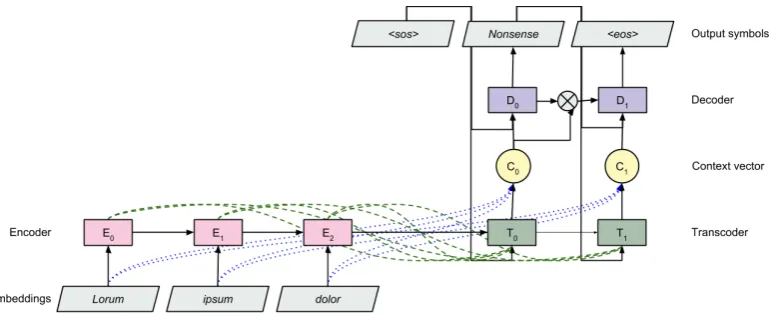
We propose seq2attn, a novel attention-centric module that connects the encoder and decoder of a seq2seq model.1 The core component of seq2attn is the transcoder: a recurrent module that mod-ulates the information flow between encoder and decoder by generatingsparseattention vectors us-ing separatekeysandvalues. Below, we demon-strate and test how seq2attn can be used in combi-nation with a vanilla encoder-decoder architecture.
3.1 Encoder
In our tests, we assume a standard recurrent en-coder, that, given an input sequence{x1, . . . , xN} and an embedding layer Eenc, generates a se-quence of outputs and hidden states:
xenct =Eenc(xt) (1) ytenc,henct =Senc(xenct ,henct−1) (2)
S is a recurrent state transition model, such as a vanilla RNN, LSTM or GRU.
3.2 Transcoder
The transcoder is initialized withhtrans0 = hencN and uses the hidden states of the encoder to com-pute context vectorsctthat will be passed to the decoder.
The input to the transcoder is the embedded out-put of te decoder (Eq.11):
xtranst =Etrans(ˆyt−1) (3) ytranst ,htranst =Strans(xtranst ,htranst−1 ) (4)
Figure 1: Schematic of the seq2attn architecture. The input sequence is processed by the encoder (E), after which the transcoder (T) generates context vectors, which are weighted means over the input embeddings.
The transcoder state is then used to query the hidden states of the encoder. The resulting scores are normalized using the Softmax function:
αt(s) =v>a ·ReLU(Wa·[henct ;htranst−1 ]) (5)
πt(s) =
expαt(s) PN
i=1expαt(i)
(6)
Using the Softmax distribution often results in distributed vectors that attend to many input sym-bols at the same time, while an ideal composi-tional attention vector only focuses on the rele-vant parts of the input. To force the transcoder to be more selective in the information it se-lects, we use Gumbel-Softmax, which allows us to draw from the categorical distribution com-puted in Eq. 6, with continuous relaxation (Jang et al.,2017;Maddison et al.,2016). The Straight-Through estimator is then used as a biased gradi-ent estimator of thearg maxoperator:
˜
at(s) =
explogπtτ(s)+gs
PN i=1exp
logπt(i)+gi τ
(7)
at= ˜at−aˆt+one hot(arg max(˜at)) (8)
The temperatureτ can be interpreted as a measure of uncertainty. ˆat is a copy of a˜t which we do not backpropagate through. At inference time the stochasticity of Gumbel-Softmax is not needed, andarg maxis used as activation function.
The resulting attention weights are used to com-pute the context vectors that will be passed to the decoder:
ct= N X
i=1
at(i)·xenci (9)
Crucially, the context vector represents a weighted average of the input embeddings of the encoder, while the weightsat(i)are depending on the hid-den statesof the encoder, thus introducing a sep-aration between attentionkeysandvalues(similar to, e.g.,Mino et al.,2017;Vaswani et al.,2017).
3.3 Decoder
The decoder of a seq2seq model is commonly ini-tialized with the final hidden state of the encoder. However, as this state vector encodes the entire in-put sequence, this type of initialization does not urge compositional behavior of the decoder. When seq2attn is used, the decoder should be initialized with a fixed,learnedinitialization vector. In com-bination with using input embeddings as attention values (Eq. 9), this restricts the decoder to work only with disentangled representations of the input sequence, which encourages it to learn and process the individual meaning of all input symbols.
To model outputs, the decoder uses the context vector ct, its own embedded output (identical to Eq.3) and a vectorhdect−1that integrates the current decoder hidden state with the context vector:
ytdec,h˜dect =Sdec([ct;Etrans(ˆyt−1)],hdect−1) (10)
ˆ
yt= arg max(Softmax(ydect )) (11)
Wherehdect−1is computed using an element-wise multiplication of the context vector with the previ-ous hidden state of the decoder:
hdect−1= ˜hdect−1ct (12)
held-out inputs
held-out compositions
[image:4.595.74.291.63.110.2]held-out tables Baseline 38.25±0.04 43.28±0.09 7.86±0.02 Seq2attn 100±0.00 100±0.00 100±0.00
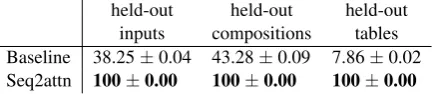
Table 1: Average sequence accuracies and standard deviations of the baseline and seq2attn models on all lookup tables test sets.
4 Test Case 1: Lookup tables
Our first test-case is the lookup table task intro-duced byLiˇska et al.(2018).
4.1 Task
The core of thelookup table compositiondomain consists in sequentially applying simple lookup ta-ble functions. The functions to be applied are bi-jective mappings from the set of alln-bit bitstrings onto itself. FollowingLiˇska et al.(2018), we focus on 3-bit strings, resulting in23 = 8 possible in-puts and outin-puts. We create 8 random table lookup functions, to which we refer with the names t1,
t2, . . . ,t8. Given the simplicity of the functions,
the main challenge of the task resides in inferring that the input sequences should be treated compo-sitionally, rather than considered as a whole.
We borrow the setup presented inHupkes et al. (2018a), which differs slightly from the setup as it was originally presented. In this setup, a typical input output example could be001 t1 t2→001 010 111. Computing the output for this example requires the sequential application oft1to001, and thent2to the intermediate result. Since two tables are to be applied in succession, we refer to such an examples as abinary composition, as op-posed to aunary composition in which only one function has to be applied on the input. The input bitstring and all intermediate outputs are included in the target output sequence.
Liˇska et al.(2018) train models on all 8 inputs for unary compositions and on 6 out of 8 input bit-strings of all binary compositions. The remain-ing 2 held-out inputs are used to test for gener-alization. Following Hupkes et al. (2018a), we do not include all 64 binary compositions in the training set, but leave out some for testing. In par-ticular, we create one test set that contains all bi-nary compositions containingt7ort8, which are thus only seen in the training set as unary com-positions. We call this conditionheld-out tables. Of the remaining binary compositions, that con-tain only functions in{t1,. . .,t6}, 8 randomly
held-out inputs
held-out compositions
held-out tables Baseline+G 34.17±8.25 38.54±12.39 8.16 ±3.57 Baseline+E 82.50±12.42 85.42±12.39 31.08±7.85 Baseline+F 85.83±16.50 91.67±11.79 30.03±16.12 Baseline+T 43.33±12.30 47.40±15.33 3.99 ±2.70 Baseline+GE 82.50±12.42 83.85±7.48 30.21±3.32 Baseline+GF 69.17±21.25 76.04±13.28 4.69 ±1.47 Baseline+GT 32.50±8.90 45.31±10.13 1.56 ±1.53 Baseline+EF 85.00±9.35 82.29±18.46 24.13±2.99 Baseline+ET 100.00±0.00 100.00±0.00 41.49±3.30 Baseline+FT 68.33±21.44 71.88±23.00 19.44±19.06 Baseline+GEF 74.17±36.53 72.40±37.94 37.33±22.10 Baseline+GET 97.50±3.54 98.44±1.28 24.31±17.87 Baseline+GFT 90.83±3.12 91.15±3.21 28.30±7.23 Baseline+EFT 66.67±47.14 66.67±47.14 66.67±47.14 Seq2attn 100.00±0.00 100.00±0.00 100.00±0.00
Table 2: Mean sequence accuracies and standard deviation on the lookup tables task of a baseline seq2seq model with additional components of seq2attn.
G=Gumbel-Softmax,E=embeddings as attention val-ues,F=full focus,T=transcoder.
selected compositions are held out from the train set for all inputs, which form theheld-out compo-sitionstest set. Lastly, we remove 2 of the 8 in-puts for each binary composition independently to form theheld-out inputstest set, which is similar to the generalization condition presented byLiˇska et al.(2018).
4.2 Results
We first compare the seq2attn architecture to a standard seq2seq model with an attention mech-anism on generalization to new test examples. We establish the optimal parameters for both models using a grid search over a separate validation set. Our search includes the type of RNN cell ({GRU, LSTM}), the embedding and RNN sizes ({32, 64, 128, 256, 512, 1024}) and the dropout rate ({0, 0.2, 0.5}). The results are summarized in Table3. The mini-batch size (1) and optimizer (Adam with default parameters (Kingma and Ba, 2014)) are fixed. We train 10 models with the optimal pa-rameters and report mean sequence accuracy. For simplicity we will henceforth simply refer to this as the accuracy.
4.3 Ablation Study
The difference between a traditional seq2seq and the seq2attn model can be summarized as the use of (i) a transcoder, (ii) the Gumbel-Softmax ac-tivation for the attention vector, (iii) using input embeddings as attention values and (iv) using full focus. To assess the contributions of these com-ponents, we take the seq2attn model with optimal hyper-parameters as a base model, and increas-ingly ablate components. The results of this study (Table2) indicate that, while some of the compo-nents of seq2attn cause an increase in accuracy on their own, no subset of them can match the perfor-mance of the full seq2attn model.
4.4 Attention patterns
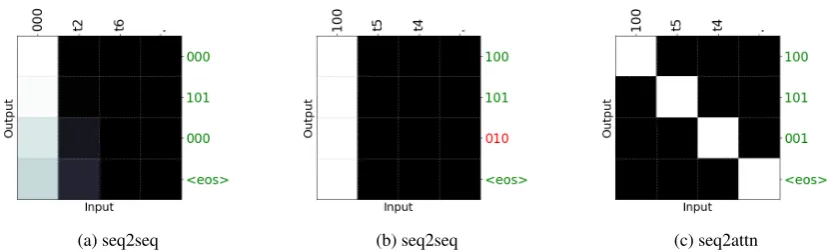
As the modeled output of the decoder is highly dictated by the context vectors that it receives, we can gain insights into the types of solutions the models are forming by studying their attention vectors. As illustrated in Figure2, seq2attn learns to generate a “correct” attention trace, attending to the right input at the right time. Contrastingly, the baseline fails to capture a systematic pattern and produces a diffused attention instead or attends to irrelevant inputs, indicating that it does not utilize the attention mechanism to its full advantage.
4.5 Overgeneralization
The results for the lookup tables task indicate that seq2attn performs much better than the baseline on data containing held-out inputs, tables and compo-sitions. The model is thus better able to infer the compositional rules underlying the data. To fur-ther explore seq2attn’s bias towards composition-ality, we test its behaviour when confronted with
uncompositional examples, that do not adhere to the previously mentioned rules. Where a model unaware of the underlying task structure would have little problems learning such exceptions – or in fact, would not realise that they are exceptions – a model with a strong compositional bias may sometimes wrongly assume the exceptions also adhere to the underlying system, and overgeneral-izean inferred rule. The extent to which a model overgeneralizes can thus be seen as a proxy for the strength of its compositional bias. Whether over-generalization is actually preferentiable behavior is depend on the task to be solved.
In the proposed setup, a small number of train-ing instances are assigned adapted output targets.
We call these instancesexceptions. The target out-put sequences of the exceptions are changed such that they can only be learned through memoriza-tion. For the lookup table task, we adapt the train-ing set such that one composition, t1 t2, is an exception to the general rules for three out of the eight existing input bitstrings. In the target output, the third bitstring is replaced with a randomly se-lected bitstring, thus changing the application of table t2in this context. Both the three adapted samples and the other five unadapted samples for
t1 t2are included in the training set.
While training a model, we monitor the output sequences generated for these exceptions. The ac-curacy on the original targets is reported to iden-tify whether the model is processing the excep-tions compositionally despite being exposed to the adapted targets in the training set, i.e., whether the model is overgeneralizing.
Figure 3displays the accuracy on the original
targets of all eight inputs in compositiont1 t2 over the first 30 training epochs. While both the baseline and seq2attn learn to memorize the three exceptions, only seq2attn shows a strong bias to treat the inputs compositionally before memoriz-ing the adapted targets. The performance goes as high up as8/8between the fifth and fifteenth epoch for differently initialized models, before dropping to5/8. This indicates that the rules are learned be-fore the adapted instances are memorized as ex-ceptions to these rules.
5 Test Case 2: SCAN
While the lookup table task provides an excellent test case to evaluate the compositional abilities of a neural network model, its simplicity limits the conclusions that can be drawn about the usability of seq2attn in more challenging domains. In this section, we evaluate seq2attn onSCAN(Lake and Baroni, 2018), a task involving mapping naviga-tional commands to sequences of output actions.
5.1 Task
learn-(a) seq2seq (b) seq2seq (c) seq2attn
Figure 2: Examples of modeled attention patterns on held-out input examples of the lookup tables domain.
Baseline Seq2attn
[image:6.595.76.298.321.460.2]Lookup tables 128, 512, 1, GRU, 0.5 256, 256, 1, GRU, 0.5 SCAN 200, 200, 2, LSTM, 0.5 512, 512, 1, GRU, 0.5
Table 3: Hyperparameters (embedding dimensions, RNN dimensions, RNN layers, RNN type, dropout rate) used for both the seq2seq baseline and seq2attn model for both tasks.
overgen.
0 5 10 15 20 25 30 0/8
1/8 2/8 3/8 4/8 5/8 6/8 7/8 8/8
epochs
sequence
accurac
y
(a) seq2seq
overgen.
0 5 10 15 20 25 30
0/8 1/8 2/8 3/8 4/8 5/8 6/8 7/8 8/8
epochs
sequence
accurac
y
(b) seq2attn
Figure 3: Average accuracies on original targets for the eight inputs in compositiont1 t2. As three of these compositions are exceptions, we refer to accu-racy higher than5/8 as overgeneralization. The 95% confidence interval is indicated.
ing agent has to mentally perform these actions in a 2-dimensional grid and output the sequence of actions it takes: “I TURN LEFT I WALK I TURN LEFT I WALK I JUMP”. For full de-tails of the data set and experiments, we refer to Lake and Baroni(2018).
Lake and Baroni use three different train-test distributions of the total of 20.910 examples. They show that vanilla seq2seq models are able to al-most perfectly generalize when the data is ran-domly split in a training and testing set, but that they are unfit for generalizing to longer test se-quences and for one-shot learning to commands seen only in their atomic form. Later,Loula et al. (2018) proposed a new set of experiments based on the same task, which they argue are better
suited for assessing systematic compositionality. We focus on experiments 2 and 3 of their paper.
Experiment 2 contains four different train-test distributions as there are four primitive commands involved. For all four conditions, the test set is the same. This test set consists of all examples that contain “jump around right” in their input sequences. The first condition, which is called
0 fillers, contains no subsequences of the form “primitivearound right” in the training set, where
primitive is either of the four primitives “jump”, “look”, “run” or “walk”. This condition should thus test whether a model can induce a compo-sitional understanding of “jump around right” by showing those symbols (“jump”, “around” and “right”) only in different contexts. The next three conditions,1 filler,2 fillersand3 fillers, are con-sidered increasingly easier. They retain the same test set, but increasingly add more examples to the train set of the template “primitive around right”.
1 filleradds all examples of this template where
primitive is “look”. 2 fillers and 3 fillers add “walk” and “run” respectively.
As Loula et al.(2018) observed a great differ-ence in performance between the 0 fillers and 1 filler conditions, they zoom in on these condi-tions in experiment 3. The0 fillerscondition con-tains 0 examples with the subsequence “primitive
to the1 fillerconditions. They accomplish this by taking the training set of the0 fillerscondition and adding respectively 1, 2, 4, 8, 16, 32, 64, 128, 256, 512 and 1024 extra examples containing the sub-sequence “look around right”, resulting in 11 new training sets. The test set is again the same as in experiment 2.
5.2 Results
We compare a baseline seq2seq to the seq2attn ar-chitecture on these two tasks. First, we perform a grid search using a random split of the data to find the optimal parameters for seq2attn. The re-sults of this are summarized in Table3. As a base-line, we used the model which Lake and Baroni (2018) found to be overall best performing, which is a seq2seq model with 2-layer LSTMs, 200 hid-den units per layer and a dropout rate of 0.5. For comparison to the seq2attn model, we also added an attention mechanism, which was missing in the original model. For all reported results we ran these models 10 times with random weight initial-ization. Since experiments 2 and 3 byLoula et al. (2018) do not have validation sets for early stop-ping, we ran all models for 50 epochs.
Firstly, we confirm the findings ofLake and Ba-roni (2018) and Loula et al. (2018) (see Fig. 4, left). A vanilla seq2seq with attention is able to perform analogical generalization (95.19% accu-racy): it requires examples of1 filleronly to gen-eralize to other fillers of the same template. On the other hand, it is not able to apply “right” and “around” to a primitive verb in a productive way, when they were never seen together (0.26% ac-curacy, 0 fillers condition). When we look at seq2attn, we notice how not only it is able to per-form analogical generalization (94.32% accuracy,
1 filler) but, to a certain extent, it is also able to generalize productively in the 0 fillers condition (36.23% accuracy).
In Figure 4(right) we report the results for ex-periment 3 of Loula et al.(2018) where we con-sider the 0 fillerscondition of Experiment 2 and progressively add extra training examples from
1 filler. As Loula et al. (2018) observed, per-formance of a seq2seq model ramps up as more samples are injected in the training set. Yet, the fact that performance increases gradually and takes long to peak (at 512 examples) suggests that rather than systematically understanding the rule, the model is piling up evidence for a very
spe-cific pattern. The situation is quite different for the seq2attn model, whose performance spikes much earlier, reaching a plateau at 16 examples already. Interestingly, the performance peak is also at 512, but with an improvement of just over 5 percentage points over 16 examples vs. approximately 50 per-centage points improvement in the case of base-line. Seq2attn seems then to show evidence for an opposite interpretation, namely for a network that, to a certain extent, is able to induce the compo-sitional rules. A property that is often linked to sample efficiency (Lake and Baroni,2018).
5.3 Analysis
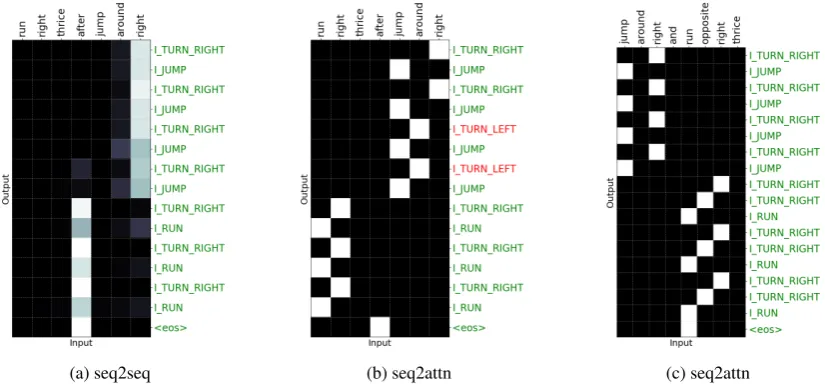
In Figure 5, we now look at some attention pat-terns for the 0 fillers condition. While base-line models emit sparser and more informative attentional patterns here than in the lookup ta-ble task, they still are locally diffused and, more importantly, do not maintain a systematic input-output alignment, which suggests that the mod-els are not understanding the rules of the task, but use a pattern matching strategy instead. On the contrary, seq2attn shows always fully sparse, one-hot attention patterns. Figure5c shows how the model usually aligns outputs to their respec-tive primirespec-tive commands or directions in the input sequence, e.g., “I JUMP” aligns to “jump”, and “I TURN RIGHT” aligns to “right”. A modifier like “opposite” is used as an indicator to repeat the last modeled directional action.
Seq2attn reaches an accuracy of 36.23% on the
under-0 1 2 3
0 50 100
Number of primitive fillers used for training
sequence
accurac
y
seq2attn baseline
1 2 4 8 16 32 64 1282565121024
0 50 100
Number of examples used for training
sequence
accurac
[image:8.595.127.507.64.218.2]y
Figure 4: Mean sequence accuracies on experiment 2 (left) and 3 (right) ofLoula et al.(2018). The bootstrapped 95% confidence intervals are indicated with error bars.
(a) seq2seq (b) seq2attn (c) seq2attn
Figure 5: Examples of attention patterns on the0 fillerscondition. Seq2attn models the output incorrectly when the attention pattern is incorrect.
standing of the root of this.
5.4 Overgeneralization
To assess seq2attn’s overgeneralization abilities for the SCAN task, we repeated experiment 3. In addition to gradually adding samples indicat-ing the correct interpretation of “primitivearound right”, we also added a single exception for “jump around right” to the training set. The target for this sequence, originally consisting of four repetitions of “I TURN RIGHT I JUMP”, was modified to consist of only two repetitions.
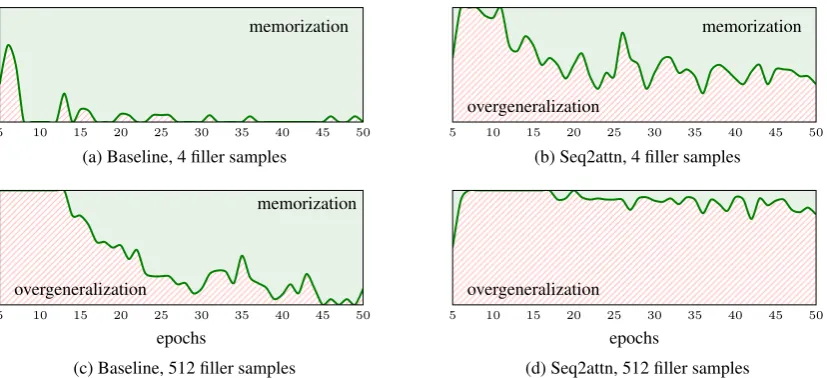
For all conditions of experiment 3, we added the exception to the training set, trained multiple ran-domly initialized models, and monitored the out-put sequences generated for this exception over the course of training. In Figure 6, we visualize the distribution over the adapted and original
tar-gets for the conditions with 4 and 512 filler sam-ples respectively. Note that the models have im-plicit and exim-plicit evidence for the correct appli-cation of the rules for “primitive around right”: explicit evidence through training examples con-taining “look around right“ subsequences, and im-plicit evidence through training samples including “around” or “right” seen in different contexts.
[image:8.595.94.507.269.461.2]memorization
5 10 15 20 25 30 35 40 45 50 (a) Baseline, 4 filler samples
overgeneralization
memorization
5 10 15 20 25 30 35 40 45 50 (b) Seq2attn, 4 filler samples
overgeneralization
memorization
5 10 15 20 25 30 35 40 45 50 epochs
(c) Baseline, 512 filler samples
overgeneralization
5 10 15 20 25 30 35 40 45 50 epochs
[image:9.595.93.507.62.251.2](d) Seq2attn, 512 filler samples
Figure 6: Mean sequence accuracy on theoriginal targetof “jump around right” of multiple models as training progresses. The distribution was normalized for cases in which the output emitted was neither the original or the adapted target.
For this condition, seq2attn and the baseline yield similar sequence accuracies in the original setup of experiment 3 (see Figure6), but seq2attn overgen-eralizes more frequently, indicating that seq2attn has a stronger compositional bias.
6 Discussion
In search for a neural network architecture that ex-hibits a bias towards systematic generalization, we introducedseq2attn, a recurrent attention-centric module that controls the information flow from encoder to decoder. We installed this module in a standard recurrent encoder-decoder architecture. To quantify its capabilities in terms of system-atic compositionality, we tested the model on the lookup table and SCAN tasks.
On both tasks, we see significant improvements compared to a standard recurrent seq2seq model, providing evidence for a compositional bias in the system. Furthermore, because the architecture re-lies heavily on its attention mechanism, its solu-tions can more easily be interpreted by looking at the generated attention patterns. This provides opportunities for analyzing what the model has learned as well as for detecting potential biases in the training set.
Although on the considered tasks, which are specifically designed to evaluate compositionality, seq2attn leads to clear improvements, its contri-bution could not have been observed when con-sidering a task for which the test accuracy is not directly linked to compositionality, such as
nat-ural language modeling and translation. We ar-gue that, for those cases, additional assessment methods are needed to compare the compositional skills of different models. We propose one such method, which involves monitoring to what extent a modelovergeneralizes. We show how a model with seq2attn, for both tasks, has a greater ten-dency to overgeneralize than the baseline.
A possible limitation of the design of seq2attn is that the flow of information from transcoder to decoder is very rigid. Possible solutions could be found in the use of less skewed activations than the Gumbel-Softmax such as Sparsemax (Martins and Astudillo,2016), or allowing the transcoder to communicate multiple embeddings using adaptive computation time (Graves,2016).
Importantly, seq2attn is not tied to a particular type of seq2seq architecture. In future work, we plan to install it into other popular seq2seq archi-tectures such as convolutional seq2seq (Gehring et al., 2017) and Transformer models (Vaswani et al.,2017).
Acknowledgements
References
Jacob Andreas, Dan Klein, and Sergey Levine. 2016. Modular multitask reinforcement learning with pol-icy sketches. arXiv preprint arXiv:1611.01796.
Joris Baan, Jana Leible, Nikolaus Mitja, Rau David, Ulmer Dennis, Tim Baumgrtner, Dieuwke Hupkes, and Elia Bruni. 2019. On the realization of compo-sitionality in neural networks. BlackboxNLP 2019, ACL.
Kyunghyun Cho, Bart van Merri¨enboer, Caglar Gul-cehre, Fethi Bougares Holger Schwenk, and Yoshua Bengio. 2014. Learning phrase representations us-ing RNN encoder–decoder for statistical machine translation. InProceedings of the 2014 Conference on Empirical Methods in Natural Language Pro-cessing (EMNLP), page 17241734. Association for Computational Linguistics.
Shi Feng, Eric Wallace, Alvin Grissom II, Mohit Iyyer, Pedro Rodriguez, and Jordan Boyd-Graber. 2018.
Pathologies of neural models make interpretations
difficult. In Proceedings of the 2018 Conference
on Empirical Methods in Natural Language Pro-cessing, pages 3719–3728. Association for Compu-tational Linguistics.
Jonas Gehring, Michael Auli, David Grangier, De-nis Yarats, and Yann N Dauphin. 2017. Convolu-tional sequence to sequence learning. arXiv preprint arXiv:1705.03122.
Felix A Gers and J¨urgen Schmidhuber. 2001. LSTM recurrent networks learn simple context-free and context-sensitive languages. Neural Networks, IEEE Transactions on, 12(6):1333–1340.
Alex Graves. 2016. Adaptive computation time for recurrent neural networks. arXiv preprint arXiv:1603.08983.
Drew A Hudson and Christopher D Manning. 2018. Compositional attention networks for machine rea-soning.arXiv preprint arXiv:1803.03067.
Dieuwke Hupkes, Anand Singh, Kris Korrel, Ger-man Kruszewski, and Elia Bruni. 2018a. Learning compositionally through attentive guidance. arXiv preprint arXiv:1805.09657.
Dieuwke Hupkes, Sara Veldhoen, and Willem Zuidema. 2018b. Visualisation and ’diagnostic clas-sifiers’ reveal how recurrent and recursive neural networks process hierarchical structure. Journal of Artificial Intelligence Research, 61:907–926.
Eric Jang, Shixiang Gu, and Ben Poole. 2017. Cat-egorical reparameterization with gumbel-softmax. In Proceedings of the International Conference on Learning Representations (ICLR2017).
Justin Johnson, Bharath Hariharan, Laurens van der Maaten, Li Fei-Fei, C Lawrence Zitnick, and Ross Girshick. 2017. Clevr: A diagnostic dataset for
compositional language and elementary visual rea-soning. InComputer Vision and Pattern Recognition (CVPR), 2017 IEEE Conference on, pages 1988– 1997. IEEE.
Diederik P Kingma and Jimmy Ba. 2014. Adam: A method for stochastic optimization. arXiv preprint arXiv:1412.6980.
Brenden Lake and Marco Baroni. 2018. Generalization without systematicity: On the compositional skills of sequence-to-sequence recurrent networks. In In-ternational Conference on Machine Learning, pages 2879–2888.
Brenden M Lake, Ruslan Salakhutdinov, and Joshua B Tenenbaum. 2015. Human-level concept learning through probabilistic program induction. Science, 350(6266):1332–1338.
Tal Linzen, Grzegorz Chrupała, and Afra Alishahi, editors. 2018. Proceedings of the 2018 EMNLP Workshop BlackboxNLP: Analyzing and Interpret-ing Neural Networks for NLP. Association for Com-putational Linguistics.
Adam Liˇska, Germ´an Kruszewski, and Marco Baroni. 2018. Memorize or generalize? searching for a compositional rnn in a haystack. arXiv preprint arXiv:1802.06467.
Jo˜ao Loula, Marco Baroni, and Brenden M Lake. 2018. Rearranging the familiar: Testing composi-tional generalization in recurrent networks. arXiv preprint arXiv:1807.07545.
Chris J Maddison, Andriy Mnih, and Yee Whye Teh. 2016. The concrete distribution: A continuous re-laxation of discrete random variables. In Proceed-ings of the International Conference on Learning Representations (ICLR2017).
Andre Martins and Ramon Astudillo. 2016. From soft-max to sparsesoft-max: A sparse model of attention and multi-label classification. In International Confer-ence on Machine Learning, pages 1614–1623.
Hideya Mino, Masao Utiyama, Eiichiro Sumita, and Takenobu Tokunaga. 2017. Key-value attention mechanism for neural machine translation. In Pro-ceedings of the Eighth International Joint Confer-ence on Natural Language Processing (Volume 2: Short Papers), volume 2, pages 290–295.
Shauli Ravfogel, Yoav Goldberg, and Francis Tyers. 2018. Can lstm learn to capture agreement? the case of basque. InProceedings of the 2018 EMNLP Workshop BlackboxNLP: Analyzing and Interpret-ing Neural Networks for NLP, pages 98–107.
Ilya Sutskever, Oriol Vinyals, and Quoc V Le. 2014. Sequence to sequence learning with neural net-works. InAdvances in neural information process-ing systems, pages 3104–3112.