Munich Personal RePEc Archive
Energy Efficiency Indicators: Estimation
Methods
Pillai N., Vijayamohanan and AM, Narayanan
Centre for Development Studies, Trivandrum, Kerala, India, Energy
Management Centre, Trivandrum, Kerala, India
November 2019
Online at
https://mpra.ub.uni-muenchen.de/97744/
Energy Efficiency Indicators:
Estimation Methods
Vijayamohanan Pillai N.
Centre for Development Studies, Trivandrum,
Kerala, India.
AM Narayanan
Energy Management CentreTrivandrum. Kerala, india
November 2019
---We express our deep debt of gratitude to the guidance and
support
of
Sri
K.
M.
Dharesan
Unnithan
Energy Efficiency Indicators:
Estimation Methods
Abstract
Energy Efficiency Indicators:
Estimation Methods
1. Energy Efficiency Indicators
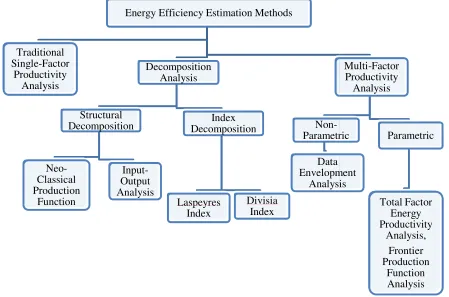
Figure 1: Energy Efficiency
Source: Adapted from Ou (201
En Traditional Single-Factor Productivity Analysis Structural Decomposition Neo-Classical Production Function Inp Ou Ana
ncy Indicators: Estimation Methods
2014)
Energy Efficiency Estimation Methods
Table 1: Energy Efficiency Indicators: Estimation Methods
Indicator Estimation method Problems and applicability
Energy productivity (reciprocal of energy intensity)
Ratio between useful output and energy input
Easy for data acquisition and calculation Productivity does not equate to efficiency
Calculation commonly using GDP and energy use, and unable to remove other impacts on GDP
Unable to reflect individual elements of efficiency Unable to reflect the differences between resource allocation efficiency and technical efficiency
Energy productivity after factor
decomposition
Laspeyres Index
Divisia Index Driven by energy productivity changes analysis, therelation between energy consumption and economy being purified
Limited by decomposition method, and difficulty to get empirical support
Comprehensive energy efficiency index Technical efficiency Allocative efficiency Economic efficiency (Commonly used estimation methods include: stochastic frontier analysis, DEA)
Can be used to compare efficiency differences between manufacturers, can also estimate efficiency changes trend over time
Can be applied to the comparisons in the levels of manufacturer, industry, region, and nation
Unable to evaluate the efficiency of individual elements, (Hu and Wang (2006) further proposed TFEE method for the relative analyses)
Source: Adapted from Yang(2012); Ou(2014).
2. Traditional Energy Productivity Indicator
First we have thermodynamic indicators, the ‘most natural and obvious way to measure energy efficiency’ as thermodynamics is the ‘science of energy and energy processes’ (Ibid.). Traditionally, it measures the heat content, or work potential. The thermodynamic indicators are a measure of the thermal, or enthalpic, efficiency, the sum of the ratio of useful energy output of a process to input into a process. As a thermodynamic indicator, Patterson uses the example of a light bulb: it has an enthalpic efficiency of around six percent. This means that six percent of the input of energy (electricity) is converted to the desired output (light energy) and 94 percent is converted to ‘waste’ heat (Patterson, 1996, 378). One flaw with this straightforward measurement of energy is that it does not differentiate between energy quality. This means that thermodynamic indicators are unsatisfactory indicators in general in a policy context as they are related to a process and do not allow for a comparison across different processes with different energy input and output. They are thus less suited for macro-level use (Patterson, 1996, 386).
Second, physical-thermodynamic indicators: Unlike in thermodynamic efficiency ratios, numerator in this indicator is not heat content or work potential, but output measured in physical units rather than in thermodynamic units. Physical units specifically reflect the end use service that consumers require. For instance, in relation to transport, the output is given as distance. That is, the energy efficiency is the sum of the ratio between output in a physical unit (kilometers) and the change in energy input.
“indicators such as energy-GDP ratio are more useful for macro-level policy analysis” that however, “encounter problems with separating the structural effects from the underlying technical energy efficiency trends.” (Patterson, 1996: 387; Wilson et al. 1994). There are many other factors such as changes in the sectoral mix in the economy, energy for labour substitution, and changes in the energy input mix that can influence changes in energy-GDP ratio, though they have nothing to do with technical energy efficiency (Patterson 1996). Note that the other measure, energy productivity ratio, is the reciprocal of energy-GDP ratio, suffering from the same problems.
Last, we have economic indicators, in which output is measured in terms of economic value (Rs) and energy input is still measured in thermodynamic terms. Some critics argue that both the input and output measurements be in terms of economic value (Rs), using monetary values of input and output. The most widely advocated pure economic indicator of energy efficiency (intensity) is the ratio of national energy input (Rs) to national output (GDP in Rs), or its reciprocal, productivity measure. The greatest advantage of this measure is its ease of applicability regarding data acquisition and calculation, using GDP and energy use. However, it also suffers from a number of problems: productivity in general cannot be equated to efficiency, as it is highly unable to remove the other impacts on GDP, and thus to reflect individual elements of efficiency; it is again difficult to reflect the differences between resource allocation efficiency and technical efficiency
3. Factor Decomposition Analysis
Structural Decomposition Analysis (SDA)
SDA has both inputs and outputs as its theoretical foundation, and is hence also known as equilibrium analysis. There are two approaches here: input-output method and neo-classical production function method.
Input–output model is a quantitative representation of the interdependence among various sectors of a national economy. It was Wassily Leontief (1906–1999; a Russian-American economist) who developed this method, for which he earned the Nobel Prize in Economics in 1973. The model development was highly influenced by the work of the classical economist Karl Marx (1818–1883; German), who had represented an economy as consisting of two interdependent departments. Even before Marx, a cruder version of this model of sectoral interdependence of an economy had been provided by Francois Quesnay (1694–1774; a French economist and physician of the Physiocratic school) in terms of Tableau économique. The general equilibrium
theory of Léon Walras (1834–1910; a French mathematical economist) in his Elements of Pure
Economicsalso was a forerunner and a generalization of Leontief's seminal model.
Input-output model functions under three assumptions: (1) fixed coefficient; (2) fixed proportion; and (3) single product (Miller and Blair, 2009). The first assumption stipulates that the technical relation between input and output be constant; this is possible when the production function of each industry exhibits constant returns to scale; that is, when all the inputs simultaneously increase n times, its output also increases n times. The second assumption requires that each industry uses the same fixed input proportion to the product, implying an irreplaceable nature among the inputs of production. And the third assumption is that each industry produces only one kind of product.
neoclassical economics, allocative efficiency in the use of inputs in production is very significant in the resulting process of distribution of income to those factor inputs, based on their marginal products.
The Cobb–Douglas production function is the first specific functional form
,
widely used inempirical studies on the technological relationship between two or more inputs (physical capital, labor and energy, for example) and the corresponding output. This function was developed and empirically tested with data by Charles Cobb ((1875–1949; an American mathematician and economist) and Paul Douglas (189 –1976; an American politician and economist) during 1927– 1947. A few other more flexible production functions, such as the constant elasticity of substitution (CES and its variant versions) and transcendental logarithmic (translog) production functions, have also appeared in a large number of empirical studies. However, the Cobb– Douglas production function is generally preferred to these more complex forms as the use of the latter has in general yielded nothing better in many cases and the former has got a lot of empirical justification for its use in the light of the fact that the factor shares are roughly constant (Felipe and McCombie 2013, pp. 1-2).
However, the wider popularity of the Cobb–Douglas production function does not mean that it is free from errors, especially when its aggregate form is used at the national economy level. “Most notably, there are the problems posed by both the Cambridge capital theory controversies and what may be generically termed the ‘aggregation problems.’” (Felipe and McCombie 2013, p. 3).
4. Index Decomposition Analysis (IDA)
As already mentioned, the 1973 oil crisis opened the eyes of the world countries to the prime need for energy consumption reduction through energy use efficiency improvements; this in turn essentially required complete evaluation of energy consumption patterns and identifying the driving factors of changes in energy consumption.
warming also created a demand for effective tools to decompose aggregate indicators. As the ultimate objective of the Kyoto protocol is to achieve stabilization of GHG in the atmosphere (UNFCCC 1992), emission level targets are given to every committed country. Since energy consumption is the main cause of GHG emissions, there is a need to understand the patterns of energy use and how they affect GHG emissions. Information on the factors contributing to emission growth becomes therefore more and more important.
This need led to the development of the Index Decomposition Methodology in the late 1970s in the United States (Myers and Nakamura 1978) and in the United Kingdom (Bossanyi 1979). These pioneering studies then spurred a number of different decomposition methods, most of which were derived from the index number theory, initially developed in economics to study the respective contributions of price and quantity effects to final aggregate consumption. A variant of factor decomposition analysis, IDA takes energy as a single factor of production, and explores various effects on energy intensity changes, by decomposing these changes into pure intensity changes effect and industrial structure changes effect. The first component (pure intensity changes effect) implies that when the industrial structure remains unchanged, the energy intensity change may be taken as the result of energy use efficiency changes in some sector, and the second implies that given the fixed energy efficiencies of various industries and their different energy intensity levels, the total energy intensity changes effect may be taken as the result of the dynamic changes of the yield of each industry.
IDA, as applied to time series data of a specific period, involves results which are very sensitive to the choice of the base period during the study period. In terms of the selection of base period, the approach usually considers Laspeyres Index of fixed weights and Divisia Index of variable weights.
Laspeyres Index
quantities of theith good in the base year and current year respectively, then the Laspeyres price
index is given by
=∑
∑ .
Here the numerator is the total expenditures on all the goods in the current period (t) using base
(0) quantities, and the denominator is the total expenditures on all the goods in the base period using base quantities. A Laspeyres index of unity (when the numerator = the denominator) means that a consumer is able to afford the same basket of goods in the current period as he was in the base period. The quantities remaining the same, it is only the price that varies; and this simple method helps determine inflation rate. This situation gives rise to the economic concept of compensating variation: by how much do we need to raise a consumer’s income in order to meet a price rise (inflation)?
Divisia Index of variable weights
Divisia Index was proposed by Francois Divisia (1889–1964), a French economist, in 1925 for continuous-time data on prices and quantities of goods consumed. The biggest advantage of this index is that it can almost fully explain the changes effect of energy intensity in terms of those of its components, as the residual effect involved is much less compared with other indices; moreover, the Divisia Index gives the weights of each effect as functions of time (varying with time). An important property of this index is that a Divisia price (quantity) index has a rate of growth equal to a weighted average of rates of growth of its component prices (quantities).
Divisia factor decomposition analysis of Energy Efficiency
by a number of studies, some attempts directed towards modifying the index. Since then, a large number of studies have followed, some in the direction of modification of the index; these efforts have finally fulfilled in LMDI, proposed by Ang and Choi (1997), using logarithmic mean function as weights for aggregation that leaves no residual in the decomposition results. Ang et
al. (1998) introduced the term “LMDI” for the first time to denote this model. There are two
LMDI measures: LMDI-I and LMDI-II. Ang (2004) presents a number of desirable properties LMDI (I and II) measures possess that elevate LMDI as a popular method, and Ang (2005) reports a practical guide to it. In this study, we use LMDI-I, which we denote simply by LMDI.
For both the measures, decomposition can be done either additively or multiplicatively. In additive decomposition method, we decompose the aggregate indicator (total energy consumption) in terms of its arithmetic change (or difference), with both the aggregate and decomposed changes given in physical unit. In multiplicative model, the aggregate indicator is decomposed in terms of its ratio change, with both the aggregate and decomposed changes given in indexes. The present study employs the multiplicative model.
5. Decomposition of Energy Consumption Change
The changes in energy consumption over time (E) may be attributed to three different effects:
(i) an activity effect that refers to the overall level of activity (Q) in an economy; in general different units are used for different sectors of the economy to measure activity (for example, for the residential (or commercial) sector, we use either square footage of floor space or number of households (or commercial units), for the industrial sector, we use the money value of output produced, for the transport sector, we have passenger-miles, and so on);
(ii) a structural effect which refers to changes in the structure of activities in terms of their inter-sectoral or intra-inter-sectoral shares (Si); this reflects the impact on energy use emanating from the
(iii) an intensity effect that represents the effect of changing energy intensity for sectors or sub-sectors (Ii).
Thus the decomposition identity may be written as
=∑ =∑ =∑
where E is the total energy consumption,Q(=∑ ) is the activity level,Si (=Qi/Q) is theith sector’s activity share andIi(=Ei/Qi) is that sector’s energy intensity.
Assuming from period 0 to T, the aggregate (E) changes from E0 toET, our objective is to find
out the contributions of the components to the change in the aggregate. Thus, the change in energy use in multiplicative decomposition model is given by
= / =
This equation simply indicates that change in total energy consumption is due to changes in activity level, Q (activity effect), sectoral shares, Si (structural effect) and sectoral energy intensities,Ii(energy intensity effect).
These effects evaluated for the multiplicative model of the LMDI‐I are:
= exp ln
= exp ln
= exp ln
where = ( )/( )
6. Frontier Production Function Analysis
A production function in microeconomic theory is defined in terms of maximum output producible from a given combination of inputs in the framework of the given technology. It was the seminal paper of Farrell (1957) that characterized the maximum output, represented by the production function, as the frontier output, representing economic efficiency, and thus the production function itself as the frontier function.
Farrell's concept of the production function (or frontier) can be explained with reference to the following figure, involving one input and one output.
In empirical exercises, there are two types of frontiers: deterministic and stochastic frontier functions.
Deterministic frontier
The deterministic frontier model is defined by:
Yi= f(xi;)exp( -ui), i = 1,2, ... ,N (1)
where Yi= the possible production level for the ith sample firm;
f(xi;) = a suitable function (e.g., Cobb-Douglas or Translog) of the input vector, Xi, for the
ith firm and a column vector,, of unknown parameters;
ui= a non-negative random variable associated with firm-specific factors which contribute to
the ith firm not attaining maximum efficiency of production; and
N = the number of firms involved in a cross-sectional survey of the industry.
The technical efficiency of a given firm is defined to be the factor by which the level of production for the firm is less than its frontier output. Given the deterministic frontier model, the frontier output for the ith firm is
Yi* = f(xi;)
and so the technical efficiency for the ith firm,
TEi= Yi/Yi*
= f(xi;) exp(-Ui)/f(xi;)
= exp(-Ui)
TEi= Yi/ f(xi; b),
where b = either the ML estimator or the corrected ordinary least-squares (COLS) estimator for.
This model was estimated by Aigner and Chu (1968) using programming technique. Richmond (1974) improved upon the COLS estimates to make them unbiased and consistent. In order to give statistical content to the programming estimators proposed by Aigner and Chu (1968), Schmidt (1976) estimated the model by the maximum likelihood (ML) method assuming exponential and half-normal distribution.
Although the deterministic frontier approach of Aigner and Chu (1968) and Schmidt (1976) estimates the frontier function respecting its frontier property, an obvious limitation of this approach is that one cannot isolate the effect of inefficiency from that of the random noise as both are lumped together in the disturbance term of the model. Also, it violates one of the regularity conditions required for application of ML method viz. the support of the distribution ofymust be independent of the parameter vector.
Stochastic frontier
The stochastic frontier approach of efficiency analysis aimed to rectify the above mentioned limitation of the deterministic frontier approach, introduced by Aigner, Lovell and Schmidt (1977), Meeusen and van den Broeck (1977) almost simultaneously. Kumbhakar and Lovell (2000) provide a survey of this literature. The novelty of the stochastic frontier approach lies in decomposing the disturbance term into two random components representing the "random noise" and the "inefficiency".
Panel Data Stochastic Frontier
Suppose that a producer has a production function f(xit; ). In a world without error or inefficiency, in time t, the ith firm would produce
the disturbance term in a stochastic frontier model is assumed to have two components. One component is assumed to have a strictly nonnegative distribution, and the other is assumed to have a symmetric distribution. In the econometrics literature, the nonnegative component is often referred to as the inefficiency term, and the component with the symmetric distribution as the idiosyncratic error.
A fundamental element of stochastic frontier analysis is that each firm potentially produces less than it might because of a degree of inefficiency. Specifically,
yit = f(xit;)it
whereit is the level of efficiency for firm i at time t; i must be in the interval (0;1 ]. Ifit = 1, the firm is achieving the optimal output with the technology embodied in the production function f(xit;). Whenit < 1, the firm is not making the most of the inputs xit given the
technology embodied in the production function f(xit; ). Because the output is assumed to be strictly positive, (that is, qit > 0), the degree of technical efficiency is assumed to be strictly positive (that is,it > 0).
Note that output is also assumed to be subject to random shocks so that
yit = f(xit;)it exp(vit)
Taking the natural log of both sides yields
ln(yit) = ln f(xit;) +ln(it) + vit.
If we define uit =ln(it) we have
ln(yit) = ln f(xit;) + vituit.
There are two models:
1. Time-invariant inefficiency model, where the inefficiency term is assumed to have a truncated-normal distribution, and
2. Time-varying decay model, where the inefficiency term is modeled as a truncated-normal random variable multiplied by a function of time.
The time-invariant inefficiency model is the simplest specification; the inefficiency term uit
is a time-invariant truncated normal random variable N+(;2), truncated at zero with mean
and variance2. In the time-invariant model, uit = ui, and
uiiid N+(;u2), vitiid N(0;v2),
and ui and vit are distributed independently of each other and the covariates in the model.
In the time-varying decay specification,
uit = exp{(tTi)}ui
where Ti is the last period in the ith panel, δ is the decay parameter,
where uiiid N+(;u2), vitiid N(0;v2), and ui and vit are distributed independently of
each other and the covariates in the model.
Note that when> 0, the degree of inefficiency decreases over time; and when < 0, the degree of inefficiency increases over time. Because t = Ti in the last period, the last period for
firm i contains the base level of inefficiency for that firm. When = 0, the time-varying decay model reduces to the time-invariant model.
7. Data Envelopment Analysis (DEA)
As already pointed out, Farrell (1957), based on Pareto optimality, proposed the concept of production frontier, and thereby established the theoretical basis for measuring the overall efficiency. He divided the productivity of a decision making unit into two parts: technical efficiency and price efficiency, which had non-parametric advantages as well as no limitation by functional forms. Farrel (1957) proposed a technical measuring method based on single-input-and-single-output applied to the production efficiency analysis of multiple production factors.
Charnes, Cooper and Rhodes (1978) extended Ferrell’s model into the field of multiple inputs and outputs in terms of what they called data envelopment analysis (DEA). Under the assumption of constant returns to scale (CRS), they calculated the optimum piecewise linear efficiency frontier using the mathematical linear programming, wherein the relative efficiencies of all DMUs may be further compared. The DEA was a fast success, and has since been widely used in large number of researches related to efficiencies of not only various industries, including banking, manufacturing, and health care, but also the performance of universities, cities, regions, and countries.
As the original model is based on CRS principle, it cannot measure the inefficiencies caused by inappropriate setting of the scale of production. Therefore, Banker, Charnes and Cooper (1984) amended this model to propose variable returns to scale (VRS) model. DEA’s CRS and VRS models are the two most influential models recognized by scholars, which not only can be used to assess an organization's performance, but also can be applied in many fields (Seiford and Zhu 1998; Wu and Ho 2009; Chang and Hsieh 2009, Charnes et al., 1995, Ray 2004, and Huang et al., 2009)
basic concepts of DEA. Literatures using multi-stage DEA model are: Coelli et al. (2005), Copper et al. (2006).
For each DMU we would like to obtain a measure of the ratio of all outputs over all inputs, such as u' yi/v' xi, where u is an Mx1 vector of output weights and v is a Kx1 vector of input
weights.
To select optimal weights we specify the mathematical programming problem:
maxu,v(u'yi/v'xi),
st u'yj/v'xj1, j = 1, 2,..., N,
u, v 0.
This involves finding values for u and v, such that the efficiency measure of the ith DMU is maximised, subject to the constraint that all efficiency measures must be less than or equal to one. One problem with this particular ratio formulation is that it has an infinite number of solutions. To avoid the problem of having infinite number of solutions one can impose the constraint
'xi= 1,
which provides:
Max,(’yi),
st 'xi= 1,
’yj–'xj 0, j = 1, 2,..., N,
, 0, (1)
This form is known as themultiplierform of the linear programming problem.
Using the duality in linear programming, one can derive an equivalent envelopmentform of
this problem:
min,,
st -yi+ Y 0, xi- x o,
0, (2)
whereis a scalar andis a Nx1 vector of constants.
This envelopment form involves fewer constraints than the multiplier form (K+M < N+1), and hence is generally the preferred form to solve. The value of obtained will be the
REFERENCES
Afriat, S.N. (1972), "Efficiency Estimation of Production Functions", International Economic Review,13, 568-598.
Ali, A. I. and L. M. Seiford (1993), ‘The Mathematical Programming Approach to Efficiency Analysis’, in Fried, H.O., C.A.K. Lovell and S.S. Schmidt (eds),The Measurement of Productive Efficiency,Oxford University Press, New York, 120-159.
Ang, B.W., (2004). ‘Decomposition analysis for policymaking in energy: which is the preferred method?’,Energy Policy, 32, pp. 1131–1139.
Ang, B.W. (2006). ‘Monitoring changes in economy-wide energy efficiency: From energy–GDP ratio to composite efficiency index’, Energy Policy (2006), Volume: 34, Issue: 5, Pages:
574-582.
Banker, R.D., A. Chames and W.W. Cooper (1984), "Some Models for Estimating Technical and Scale Inefficiencies in Data Envelopment Analysis",Management Science,30, 1078-1092.
Bauer, P. W. (1990), ‘Recent Developments in the Econometric Estimation of Frontiers’,
Journal of Econometrics46, 39-56.
Baumgärtner, S. 2004. Thermodynamic models. In Modelling in Ecological Economics.
P.Safonov and J. Proops, Eds.: 102-129. Edward Elgar. Cheltenham.
Boles, J.N. (1966), "Efficiency Squared - Efficient Computation of EfficiencyProceedings of the 39th Annual Meeting of the Western Farm Economic Association,pp 137-142.
Boulding K. 1966. The economics of the coming spaceship Earth. InEnvironmental Quality in a Growing Economy. H. Jarett, Ed. Johns Hopkins University Press. Baltimore, MD.
Boyd, Gale; McDonald, John; Ross, M. and Hansont, D. A. (1987) “Separating the Changing Composition of U.S. Manufacturing Production from Energy Efficiency Improvements: A Divisia Index Approach”.The Energy Journal, Volume 8, issue Number 2, 77-96
Brown, M. (1980), ‘The Measurement of Capital Aggregates: A Postreswitching Problem’, in D. Usher (ed.),The Measurement of Capital, Chicago, IL: University of Chicago Press.
Coelli, T.J., Rao D.S.P., O’Donnell C.J. and Battese G.E. (2005). An introduction to efficiency and productivity analysis. Springer
Cooper, W.W., Seiford L.M. and Tone K. (2006). Introduction to Data Envelopment Analysis and its uses. Springer.
Charnes, A., W.W. Cooper and E. Rhodes (1978), "Measuring the Efficiency of Decision Making Units",European Journal of Operational Research, 2,429-444.
Cohen, A. and Harcourt, G.C. (2003), ‘Retrospectives: Whatever Happened to the Cambridge Capital Theory Controversies?’,Journal of Economic Perspectives, vol. 17(1), pp. 199–214.
Cohen, A. and Harcourt, G.C. (2005), ‘Introduction, Capital Theory Controversy: Scarcity, Production, Equilibrium and Time’, in C. Bliss, A. Cohen and G.C. Harcourt (eds), Capital Theory, 3 volumes, Cheltenham, UK and Northampton, MA, USA: Edward Elgar.
Daly, H.E. and A.F. Umana (eds.). 1981.Energy, Economics, and the Environment: Conflictillg Views of all Essential Interrelationship, American Association for the Advancement of Science,
Divisia, F. 1925. "L'indice monétaire et la théorie de la monnaie." Revue d'écon. polit.,
XXXIX, Nos. 4, 5, 6: 842-61, 980-1008, 1121-51.
Divisia, F. 1926. "L'indice monétaire et la théorie de la monnaie."Revue d'écon. polit., LX,No.
1: 49-81.
Farrell, M.J. (1957), "The Measurement of Productive Efficiency", Journal of the Royal Statistical Society, Series A,CXX, Part 3, 253-290.
Forsund, F. R., Lovell, C. A. K. and Schmidt P. (1 980), ‘A Survey of Frontier Production
Functions and of their Relationship to Efficiency Measurement’,Journal of Econometrics 13,
5-25.
Friend, A., and Rapport, D. (1979). Towards a comprehensive framework for environment statistics: a stress-response approach. Ottawa: Statistics Canada.
Gales, B., A. Kander, P. Malanima, and M. Rubio. 2007. North versus South: Energy transition and energy intensity in Europe over 200 years. European Review of Economic History11:
219-253.
Greene, W. H. (1993), ‘The Econometric Approach to Efficiency Analysis’, in H. O. Fried, C.A.
K. Lovell and S.S. Schmidt (eds),The MeasurementofProductive Efficiency,Oxford University
Press, New York, 68-1 19.
Hoover, K.D. (2012),Intermediate Applied Macroeconomics, Cambridge: Cambridge University
Press.
Kerry Du, 2017. "LMDI: Stata module to compute Logarithmic Mean Divisia Index (LMDI) Decomposition," Statistical Software Components S458435, Boston College Department of Economics, revised 01 Jan 2018.
Kumbhakar, S. C., and Lovell. C. A. K. (2000). Stochastic Frontier Analysis. Cambridge:
Cambridge University Press.
Lermit, J. and Jollands, N. (2001)Monitoring Energy Efficiency Performance in New Zealand: A Conceptual and Methodological Framework, National Energy Efficiency and Conservation
Authority, Wellington.
Lermit, Jonathan and Jollands, Nigel (2001) Monitoring Energy efficiency Performance in New Zealand: A Conceptual and Methodological Framework, Energy Efficiency and Conservation
Authority, New Zealand.
Lovell, C. A. K. (1993), ‘Production Frontiers and Productive Efficiency’, in H. 0. Fried, C. A. K. Lovell and S. S. Schmidt (eds),The Measurement of Productive Efficiency,Oxford University
Press, New York, 3-67.
Mankiw, N.G (2010),Macroeconomics(7th edition), New York: Worth.
Myers, J. and Nakamura L. (1978). Saving energy in manufacturing. Cambridge, MA: Ballinger, 1978.
Miller, R.E. and Blair P.D. (2009). Input-output analysis: Foundations and extensions, 2nd edition, Cambridge University Press, New York
Niessen, L.W., Rotmans, J., de Vries, H.J.M. and Weterings, R. (1995). Scanning the Global Environment: A framework and methodology for integrated environmental reporting and assessment. Environmental Assessment Sub-Programme, UNEP, Nairob
NRCAN, (1996). Energy Efficiency Trends in Canada. Office of Energy Efficiency, Natural
Resources Canada, Ottawa.
Patterson M. G., (1993). ‘An accounting framework for decomposing the energy-to-GDP ratio into its structural components of change’,Energy, Volume 18, Issue 7, July, Pages 741-761.
Pillai, N. Vijayamohanan (1992): Seasonal Time of Day Pricing of Electricity Under Uncertainty: A Marginalist Approach to Kerala Power System. PhD Thesis submitted to the
University of Madras, Chennai.
Rosenquist, G., McNeil, M., Lyer, M., Meyers, S., and McMahon, J. 2004. Energy Efficiency Standards for Residential and Commercial Equipment: Additional Opportunities, Lawrence Berkeley National Laboratory.
Schipper, Lee; Unander, Fridtjof; Murtishaw, Scott and Ting, Mike (2001) Annual Review of Energy and the Environment Vol. 26:49-81 (Volume publication date November
https://doi.org/10.1146/annurev.energy.26.1.49
Schipper, L.J., Meyers, S., Howarth, R., and Steiner, R. , 1992, Energy Efficiency and Human Activity: Past Trends, Future Prospects,Cambridge Studies in Energy and the Environment, ed.
C. Hope and J. Skea. Cambridge University Press, Cambridge, UK (1992).
Schurr, S. and B. Netschert. 1960. Energy and the American Economy, 1850-1975. Johns
Hopkins University Press, Baltimore.
Sheinbaum-Pardo, C., Mora-Pérez S. and Robles-Morales, G. (2012). Decomposition of energy consumption and CO2 emissions in Mexican manufacturing industries: Trends between 1990 and 2008.Energy for Sustainable Development, 16(1), 57-67.
Schmidt, P. (1986), ‘Frontier Production Functions’,Econometric Reviews4,289-328.
Schmidt, P. and Sickles, R. C. (1984), ‘Production Frontier and Panel Data’,JournalofBusiness and Economic Statistics2.367-374.
Tryon, F. G. (1927). “An index of consumption of fuels and water power”.Journal of American Statistical Association. Vol. 22:271–282.
Wang, W.W., Liu X., Zhang M. and Song X.F. (2014). Using a new generalized LMDI (logarithmic mean Divisia index) method to analyze China’s energy consumption. Energy, 67,