First Observation of Acceleration of Electrons by
a Laser in a Vacuum
David Cline1, Lei Shao1, Xiaoping Ding1*, Yukun Ho2, Qing Kong2, Pingxiao Wang2
1University of California at Los Angeles, Los Angeles, USA 2Fudan University, Shanghai, China
Email: *[email protected]
Received September 20, 2012; revised October 23, 2012; accepted October 31, 2012
ABSTRACT
Using the BNL Accelerator Test Facility we have shown that a tightly focused laser on a vacuum can accelerate an electron beam in free space. The electron beam had energy of 20 MeV and the CO2 laser had energy of about 3 Joule. In
the readout of the experiment we detect a clear effect for the laser beam off and on. The size of the effect is about 20% and is reproducible over many laser and beam shots. This is a proof of principle and the data are fully consistent with the CAS theory. The results of this experiment may have an impact on the LASER fusion method.
Keywords: Vacuum Laser Acceleration; Laser Phase Velocity; VLA
1. Introduction
The acceleration of a free electron by a laser is a long- time goal of acceleration science. In free space a plane wave laser is unable to accelerate an electron according to the 1979 Lawson-Woodword theorem [1-3]. In order to accelerate electron a process that goes the 2 (QED)
must be used [4,5]. With today’s powerful lasers it is possible to observe these 2 effects. One concept is the
Capture Acceleration Scenario (CAS) [6-9] proposed by Prof. Ho from Fudan University. This method uses a tightly focused laser beam in a special place where the field phase velocity is relatively low. In fact a channel for the electron is created that may be useful for other sci-ence such as guiding an electron beam into a special re-gion.
This project has been proposed to Brookhaven Na-tional Laboratory—Accelerator Test Facility and ap-proved. This is a collaboration between UCLA high en-ergy group (PI: Prof. David Cline) and BNL-ATF. BNL-ATF is one of the few facilities that can provide both high quality electron beam and high intensity laser beam. Simulation research work and hardware design have been done in accordance to BNL-ATF’s real ex-perimental condition [10,11]. The simulation results pre-dict that vacuum laser acceleration phenomena can be observed with ATF’s diagnostic system.
In this letter we will show a demonstration of the ac-celeration of an electron by a laser. The experiment was carried out at the Accelerator Test Facility at Brookhaven
National Laboratory. A high quality laser photo cathode initiated beam of low emittance is accelerated to 20 MeV and a CO2 laser is focused and brought into contact with
the electron beam. The resulting electron beam passes through a magnet spectrometer and the results are re-corded with a fast camera.
2. Underlying Physics
We use Gaussian-Hermit (0,0) mode to describe the laser field [6-9]. The phase function will be:
x y z t, , ,
g x y z
, ,
t
(1)
where
2 2
, ,
2 k x y g x y z kz z
R z
is the phase
front. The phase velocity along a certain trajectory J must satisfy the equation:
J 0J
V
t
(2)
J
Jwhere and V are the phase gradient and
the phase velocity respectively along the electron trajec-tory. Therefore we derive the phase velocity formula as:
0
V g l (3)
l
where 0 is the unit vector along the certain direction.
Then we have Vz g z for the phase velocity
along the laser propagation direction-axis z; and
m
V g for the phase velocity along the gradient direction on electron trajectory during interaction.
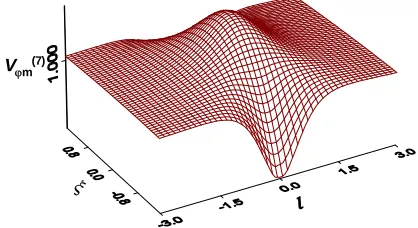
ously Vm provides the lowest phase velocity. Figure 1
represent the minimum velocity Vm distribution on y =
0 plane. In the Figure 1 we can see that on the z-axis along propagation (x = 0) direction the phase velocity is no less than c, especially in the central focus spot (z = 0) the phase velocity is much higher than c. In this area, electrons will experience high phase slippage with the laser field and gain no energy.
Also in Figure 1, however, there appear to be regions where the phase velocity is quite low, lower than c. These regions are located at both sides of the laser profile line
w(z) and centered at focus spot (x = z = 0) and extend a few w0-length in transverse direction and a few Rayleigh
Lengths in longitudinal direction. This feature exists in a focused laser beam because, unlike a plane wave, differ-ent wave fronts have differdiffer-ent radii of curvature. In the gradient direction of phase front, the phase velocity of the laser beam reaches minimum. In Equation (1), it comes from the phase factor k x
2y2
2R z
—thediffraction effect. Therefore if the electron is injected in a proper position, the transverse force can keep it moving along the trajectory close to the laser profile. Thus the electron will experience the low phase velocity and the phase slippage would be slow enough so that the electron can be captured in the acceleration phase and continue being violently accelerated.
3. VLA Prediction with ATF Current
Experimental Conditions
The current ATF’s CO2 laser system delivers peak energy
at 5 J; pulse length 5 ps, 1 ps, 500 fs; focus spot around 50 μm to beam lines in experimental hall. Therefore the laser intensity could be 0 .
ATF’s electron beam system provides a high quality electron beam with low emittance and it routinely oper-ates at energy above 40 MeV to avoid strong space- charge effects. ATF has two SLAC-type S-band linac sections. Basically there are two solutions to obtain a lower-energy beam: one is to adjust the first linac section
0.9 - 2 a
Vm(7)
[image:2.595.67.276.575.689.2]l
Figure 1. The minimum phase velocity distribution on y = 0 plane, spot waist w030μm, ξx w0, lz ZR
0
w
, where is the laser waist size and ZR is the Rayleigh length.
phasing in acceleration with a larger accelerating gra- dient but phasing the second linac section in deceleration to obtain a lower energy; and the other is to adjust both linac sections phasing in acceleration but with a lower accelerating gradient. PARMELA code was used first to simulate beam energy spectrums for 20 MeV. And it was successfully tuned to the end of the beam line at 20 MeV beam energy.
The VLA effect at the ATF conditions is non linear— therefore a detailed computer simulation is required [6-9]. This simulation was initially set up in collaboration with the Fudan Group [12].
Laser intensity is another key factor to perform this VLA mechanism. Due to the limited subluminous phase velocity distribution, high laser intensity is required to accelerate electrons in a short distance to catch up the matching phase velocity.
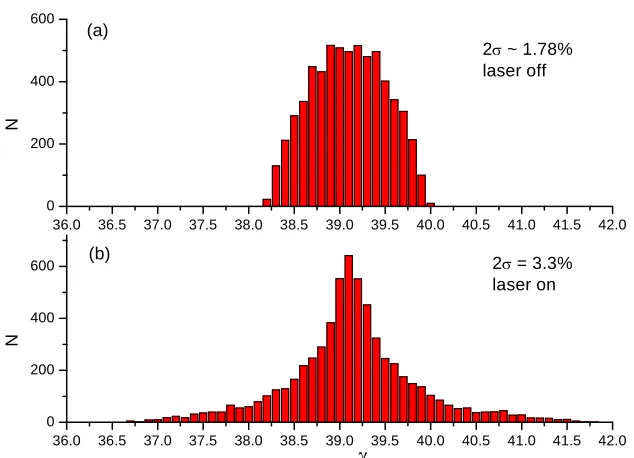
In simulation the electron beam enters along the same direction as the laser beam on the z-axis and encounters the laser beam at the laser focus spot. The simulation results are shown in Figure 2(a). We only show the si- mulation of e-beam 168 microns. Figure 2(b) represents the final electron beam energy spread after interacting with laser. Figure 2(a) is the case of laser off; the elec- tron beam doesn’t experience any field.
We use Gaussian regression to analyze the energy dis- tribution. Figure 2 illustrates the simulation results based on the given parameters of BNL-ATF real experimental condition. By comparing Figures 2(a) and (b), we can observe that the electron beam energy spread increases. Here σ is the standard deviation of Gaussian distribution, e.g. ±σ covers 68% events and ±2σ covers 95% events of the distribution. We define energy spread ratio as ΔE/E0,
where ΔE is the width of energy spread of ±2σ, and E0 is
the energy expectation value in Gaussian distribution (the center energy value). On Figure 2 it shows that the en-ergy spread ratio expands to 3.3% from the initial 1.78% after interacting with laser beam. ATF’s current spec-trometer and diagnostic system can distinguish 0.1% accuracy and tell 0.05% accuracy. The changes of energy spread between “laser on” and “laser off” can be meas-ured by the spectrometer on the beam line. The original e-beam is at 20 MeV and ~1.78% energy spread. And the final e-beam energy spread is still centered around 20 MeV. However the energy spread increases to around ~3.3%, which gives about ~550 keV. The maximum en-ergy loss and gain could be up to ~±1.0 MeV. When the laser intensity increases, there will be more significant effect, studied in our previous simulation [10,11]. At higher laser power we expect rapid acceleration of the electron beam. At larger values of the laser intensity the acceleration rapidly increases with intensity. These ef-fects can be seen in Reference [11].
36.0 36.5 37.0 37.5 38.0 38.5 39.0 39.5 40.0 40.5 41.0 41.5 0
200 400 600
42.0
2 = 3.3% laser on
N
(b)
36.0 36.5 37.0 37.5 38.0 38.5 39.0 39.5 40.0 40.5 41.0 41.5 0
200 400 600
42.0
N
[image:3.595.128.445.81.310.2]2 ~ 1.78% laser off (a)
[image:3.595.59.286.379.467.2]Figure 2. Electron beam particles distribution versus energy spread. (a) shows the result of laser off, (b) shows the result of laser on case. The parameters see Table 1.
Table 1. Actual BNL-ATF experiment condition parameters for simulation.
Laser: e-beam:
Spot Size w0 50 μm Initial Energy E0 20 MeV
Wave Length 10.6 μm Initial Emittance ~1.0 mm·mrad
Intensity a0 0.6 ∆Ei/Ei ~×1.8–2
Pulse length 5 ps beam size (at focus spot) 168 μm
energy spread with the laser on in Figure 2(b). We have put all the current parameter of the experiment into our simulation. Other differences can also be seen in the laser off/laser on events.
This is consistent with our theory and proves the signal of net energy exchange coming from laser acceleration mechanism. This proof-of-principle experiment is the first stage of the project and it is assigned on beam line #1 at BNL-ATF. Note that the accelerated beam width is asymmetrical as we would expect.
4. The Experimental Set-Up at the ATF
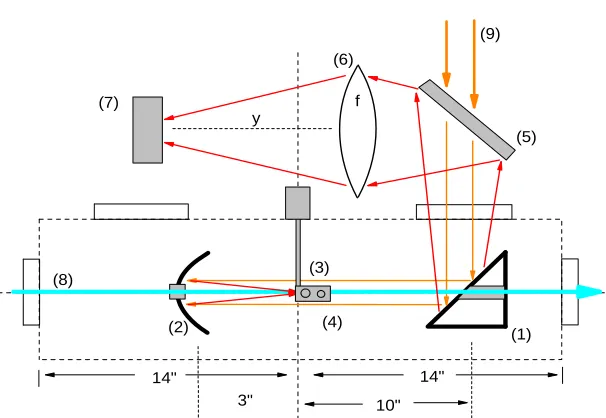
In Figure 3 the layout of the experiment design is shown. Target parts (3) and (4) are the pinhole and Germanium plate respectively. The pinhole is used for electron-beam and laser beam alignment. On beam line #1 at ATF, one He-Ne laser is used to simulate electron beam transport-ing and another He-Ne laser is used simulate the CO2.
With the iris at the downstream position we use a pin-hole and the two local He-Ne lasers to achieve alignment. The Germanium plate is used for synchronization. An
electron-beam going through the Germanium plate will generate plasma, which blocks the CO2 laser beam. By
measuring the signal on the detector (7) we can achieve synchronization to ps. After alignment and synchroniza-tion are achieved the optics setup outside vacuum cham-ber will be disabled for interaction measurement. The yellow parallel lines denote the initial incoming CO2
laser beam.
The CO2 laser enters from the downstream window
and then goes backward along the beam line by being reflected by the downstream flat mirror (1) in the cham-ber. And parabolic mirror (2) will focus the incoming CO2 laser at the interaction spot and reflect the CO2 laser
again to propagate forward the same direction as electron beam. After interacting, the e-beam is directed out of the interaction vacuum chamber downstream on beam line #1. There is a dipole positioned right after the chamber downstream can bend the e-beam by 90 degrees to guide the output electron-beam to the spectrometer which then can measure the energy spread of the output e-beam. The major interaction area is only about several centimeters (a few Rayleigh lengths).
Figure 4 shows the experiment devices, set up on beam line #1. The upper-left in Figure 4(a) is the vac-uum chamber for interaction. The lower-left in (a) is the parabolic mirror with a 2 mm hole, used for reflecting and focusing laser. The parabolic mirror sits in the vac-uum chamber as we can see in the upper-left in Figure 4(a). The right side of Figure 4(a) is the target of pinhole and Germanium plate mounted on the flange which will be installed in vacuum chamber in the upper-left in
Fig-re 4(a). The flange can adjust the target (the pin-hole
(5) (7)
(4) (6)
(3)
(2)
3" 10"
14" 14"
(1) f
y
(8)
[image:4.595.147.450.77.286.2](9)
Figure 3. Experiment design and diagnostic system. It will be on Beamline #1, (1) Flat mirror #1 with small hole, reflecting CO2 laser; (2) Focus parabolic mirror #2 with small hole, short focus length f = 3”; (3) and (4) The pinhole and Germanium plate for alignment and synchronization; (5) 45˚ Beam splitter for alignment and diagnostic; (6) and (7) outside vacuum chamber detector setup for beam synchronization; (8) electron beam; (9) CO2 beam.
(a) (b)
Figure 4. Experiment devices and setups. Upper-left in (a) is the vacuum chamber for interaction; the lower-left in (a) is the parabolic mirror with 5 mm hole for electron-beam transporting, with focus length 3, sitting in the chamber (upper-left in (a)); the right side in (a) is the target of pinhole and Germanium plate mounted on the flange, which will be installed in the vacuum chamber; (b) is the outlook of beam line #1 and optics setup table.
and Germanium) in three directions. The pinhole will be used for alignment and Germanium will be used for syn-chronization. The 3-D adjustment of the flange will be used to control the shifting. And the whole target will be completely retracted during experiment, after alignment and synchronization. The parabolic mirror is mounted on an adjustable stage, facing the direction of downstream. As we described in Figure 3, the incoming CO2 laser
will be placed opposite the beam line transporting direc-tion. The parabolic mirror will reflect CO2 back to guide
it to the same direction of beam line transporting and focus CO2 in 3”, the position of the target. The 2 mm
hole in the parabolic mirror will be set to the same height
as the e-beam in order to let the e-beam go through the mirror. Figure 4(b) shows the outlook of the beam line #1 setup and optics setup for guiding CO2 laser outside
the chamber.
5. Experimental Data
During March 2012 the experiment was carried out at the ATF. The CO2 laser pulse was delivered around 30 shots.
The peak power of CO2 laser pulse was relatively weak
[image:4.595.95.510.349.519.2]laser-off and laser-on. Both laser beam and e-beam have pulse duration of 5 ps and the synchronization resolution is close to 1 ps. Through the entire experiment process, we scan laser-pulse and e-beam pulse offset by 1 ps at every shot in order to optimize the overlap of laser-beam and electron beam during interacting. Transversely both laser beam and electron beam are focused and aligned via a 200 micron pinhole. The laser beam size is 40 microns and electron beam size is about 100 microns. As for each snapshot pair, the first frame was taken for laser on ac-cording to synchronization setup; the second frame was taken 2 - 3 seconds later without changing electron beam configuration. As shown in Figure 5, each row of two frames represents one snapshot-pair of laser on (on the right side) and laser off (on the left side) with unchanged configuration. Here we only demonstrate four pairs of snapshots. The same effect is seen in most of the 20 high intensity shots.
The energy spread of the beam was increased as ex-pected in the Figure 2 simulation result. From Figure 5, a significant energy spread increase can be obviously observed and it is consistent with the simulation of the experiment. All 30 snapshot-pairs present two important homogenous features:
1) Electron beam profile shape remains stable/un- changed for two snapshots in one set with 2 seconds la-tency.
2) Energy spread always increases with cases of laser on. There is no one exception through the whole experi-ment where it decreases.
From these two important homogeneous features, we can conclude that the interaction between electron beam and laser beam in vacuum is only reason increases en-ergy spread distribution, and causes acceleration and de-celeration on both energy spread ends simultaneously. This conclusion is consistent with our simulation results. Though the results’ optimization varies because of both synchronization setup and alignment defects, it doesn’t impact the underlying physics principle—electrons/charged particle can have net exchanged with intense focused laser beam.
In our previous work [6-9] we pointed out that vacuum laser acceleration scheme is linear after the threshold of laser intensity around a0 ≈ 5 (CAS model); and is non-
linear under the case that laser intensity less than this threshold. The CAS method implies that there is a chan-nel that the electrons are captured into and it yields high acceleration gradient. However the non-linear interaction model presents symmetric property of the acceleration and deceleration. In this scheme, the electron bunch meets the entire laser pulse, 2, therefore, half gets accel-erated and half gets decelaccel-erated.
This paper is for proof-of-principle discovery on vac-uum-laser-driven-electron-acceleration. This could possibly
Spectr_after_018 Spectr_laser_018
Spectr_after_019 Spectr_laser_019
Spectr_after_027 Spectr_laser_027
Spectr_after_030 Spectr_laser_030
[image:5.595.309.537.77.462.2]Laser off Laser on
Figure 5. Pictures of the beam momentum spread after the spectrometer taken with the laser off (left column) and the laser on (right column). The length of the beam image veals the energy spread of the beam. The experiment re-corded 30 shots. 20 shots were high intensity and showed effects of the laser on/laser off difference. We show 4 shot examples here. Pictures are taken from spectrometer on Beam Line #1 at BNL-ATF.
be useful for LASER fusion applications. The electron beam could be accelerated and guided into a pellet to provide ionization in the pellet that may damp instabili-ties. We have been in contact with the National Ignition Facility (NIF) group at LLNL and may propose an ex-periment there to test this concept.
6. Conclusion
We have carried out an experiment at the BNL Accelera-tor Test Facility to demonstrate that a tightly focused laser on a vacuum can accelerate an electron beam in free space. The electron beam had energy of 20 MeV and the CO2 laser had energy of about 3 Joule. In the readout of
off and on. The size of the effect is about 20% and is reproducible over many laser and beam shots. This is a proof of principle and the data are fully consistent with the CAS theory.
7. Acknowledgements
This work was supported by the US Department of En-ergy under award number DE-FG02-92ER40695 (UCLA). Thanks to the collaboration and support from Fudan University, Shanghai, China and Brookhaven National Laboratory Accelerator Test Facility, Upton, New York. We wish to thank Igor Pogorelsky, Karl Kusche, Mikhail Fedurin, and Yusuke Sakai for their help. We thank Ro- bert Palmer for his support of this experiment and dis-cussions and Caludio Pellegrini for disdis-cussions.
REFERENCES
[1] P. M. Woodward, “A Method of Calculating the Field over a Plane Aperture Required to Produce a Given Polar Diagram,” Journal of the Institution of Electrical Engi-neers, Vol. 93, No. 10, 1947, pp. 1554-1558.
[2] J. D. Lawson, “Lasers and Accelerators,” IEEE Transac-tions on Nuclear Science, Vol. 26, No. 3, 1979, pp. 4217-4219. doi:10.1109/TNS.1979.4330749
[3] R. B. Palmer, “A Laser-Driven Grating Linac,” Part Ac-cel, Vol. 11, 1980, pp. 81-90.
[4] M. Baig, “Phase Transitions in Lattice QED,” Nuclear Physics B—Proceedings Supplements, Vol. 42, No. 1-3,
1995, p. 654. doi:10.1016/0920-5632(95)00340-F
[5] C. Bula, et al., “Observation of Nonlinear Effects in Compton Scattering,” Physical Review Letters, Vol. 76, 1996, pp. 3116-3119. doi:10.1103/PhysRevLett.76.3116 [6] J. Pang, Y. K. Ho, et al., “Subluminous Phase Velocity of
a Focused Laser Beam and Vacuum Laser Acceleration,” Physical Review E, Vol. 66, No. 6, 2002, Article ID: 066501. doi:10.1103/PhysRevE.66.066501
[7] J. X. Wang, et al., “Electron Capture and Violent Accel-eration by an Extra-Intense Laser Beam,” Physical Re-view E, Vol. 58, No. 5, 1998, pp. 6575-6577.
doi:10.1103/PhysRevE.58.6575
[8] L. J. Zhu, et al., “Violent Acceleration of Electrons by an Ultra-Intense Pulsed Laser Beam,” Physics Letters A, Vol. 248, No. 6, 1998, pp. 319-324.
doi:10.1016/S0375-9601(98)00685-9
[9] Q. Kong, et al., “Conditions for Electron Capture by an Ultraintense Stationary Laser Beam,” Physical Review E, Vol. 61, No. 2, 2000, pp. 1981-1984.
[10] L. Shao, D. Cline, X. P. Ding, et al., “Simulation Predic-tion and Experiment Setup of Vacuum Laser AcceleraPredic-tion at Brookhaven National Lab-Accelerator Test Facility,” Nuclear Instruments and Methods in Physics Research Section A, Vol. 701, 2013, pp. 25-99.
[11] L. Shao, D. Cline, X. P. Ding, et al., “Vacuum Laser Ac-celeration at BNL-ATF,” Proceedings of PAC09, Van-couver, 4-8 May 2009, pp. 3022-3024.